Stellar: A Programming Model for Developing
Protocol-Compliant Agents
Akın G¨unay and Amit K. Chopra
Lancaster University Lancaster, LA1 4WA, UK
{a.gunay, amit.chopra}@lancaster.ac.uk
Abstract. An interaction protocol captures the rules of encounter in a multiagent system. Development of agents that comply with protocols is a central challenge of multiagent systems. Our contribution in this chapter is a programming model, Stellar, that simplifies development of agents compliant with information protocols specified in BSPL. A sig-nificant distinction of Stellar from similar approaches is that it does not rely upon extracting control flow structures from protocol specifications to ensure compliance. Instead, Stellar provides a set of fundamental op-erations to programmers for producing viable messages according to the correct flow of information between agents as specified by a protocol, en-abling flexible design and implementation of protocol-compliant agents. Our main contributions are: (1) identification of a set of programming errors that commonly occur when developing agents for protocol-based multiagent system, (2) definition of Stellar’s operations and a simple yet effective pattern to develop protocol-compliant agents that avoid the identified errors, and (3) demonstration of Stellar’s effectiveness by pre-senting concrete agents in e-commerce and insurance policy domains.
1
Introduction
Interaction protocols capture the rules of encounter in multiagent systems by defining operational constraints on the occurrence and ordering of messages be-tween agents. Effective interaction of agents in a multiagent system depends on their compliance with the system’s protocol. However, development of protocol-compliant agents is challenging in practical settings where communication is asynchronous.
which is a critical limitation particularly in open multiagent systems, where inde-pendent parties implement their own agents according to their private business requirements and logic. Another technical drawback of this approach is the need for synchronization between agents to ensure correct ordering of messages, which is hard to achieve in asynchronous decentralized environments.
Several information-based protocol languages [11,13,3] have been proposed in the recent years to overcome limitations of the procedural protocol specification approaches. These languages specify protocols in a declarative way with respect to the correct flow of information between the agents, rather than specifying rigid messages sequences. Hence, information-based languages do not impose a control flow for implementing protocol-compliant agents. As a result, indepen-dent parties can design their own agents as they see fit according to their own requirements, as long as their agents emit messages complying with the pro-tocol’s flow of information. Consequently, information-based languages do not rely on synchronization and inherently support asynchronous and decentralized communication.
In this chapter we focus particularly on BSPL [11] which constitutes the base for all later information-based languages. Although BSPL provides a rich protocol specification language, it does not define a systematic methodology for developing protocol-compliant agents. Our contribution, namely Stellar, ad-dresses this issue with a simple yet effective programming model. To this end, Stellar defines a set of fundamental operations and a software pattern over these operations that enables developers to build compliant agents. Hence, developers can focus on the business logic of their agents without worrying about compli-ance with protocols. Thanks to BSPL’s declarative approach, Stellar does not rely on control flow structures (e.g., no code skeleton is created), which enables maximum flexibility when designing and implementing agents. Our main contri-butions are as follows. One, we identify common pitfalls of protocol-compliant agent development in decentralized multiagent systems. Two, we develop Stel-lar’s programming model, describe its programming pattern, and define its op-erations. Three, we demonstrate Stellar’s effectiveness by developing agents in e-commerce and insurance policy domains.
2
BSPL
In this section we provide an overview of BSPL to establish the necessary back-ground. BSPL [11] is an information-based protocol specification language. The main difference of BSPL from procedural protocol specification approaches is its way of characterizing operational constraints with respect to causality and flow of information between agents. We explain BSPL’s main features using an example purchase protocol that we present in Listing 1.
Listing 1: A BSPL protocol for purchase.
P u r c h a s e {
p a r a m e t e r s out pID key , out item , out price , out r e s u l t B 7→ S : rfq [ out pID , out i t e m ]
S 7→ B : q u o t e [ in pID , in item , out p r i c e ]
B 7→ S : a c c e p t [ in pID , in item , in price , out r e s u l t ] B 7→ S : r e j e c t [ in pID , in item , in price , out r e s u l t ] }
A BSPL protocol is composed of a name, a set of roles, a set of public pa-rameters, and a set of message schemas. BSPL is a declarative language and hence the ordering of message schemas in a protocol specification is irrelevant.
The name of the protocol in Listing 1 is Purchase. It includes two roles, B and
S corresponding to a buyer and a seller, respectively. Purchase has four public
parameters pID, item, price, and result, which describe the protocol’s interface,
intuitively corresponding to the identifier of the protocol, an item to purchase, price of the item, and the outcome of the interaction, respectively. A proto-col’s enactment is complete when all of its public parameters are bound. BSPL protocols can be composed using their interfaces to build complex interactions. However, we do not consider composite protocols in this chapter for brevity.
Each message schema in the form ofs7→r:m[P] has a sendersand a receiver
rrole, a message namem, and a set of parameters P.
For instance, the name of the first message schema in Listing 1 is rfq,
cor-responding to a request for a quote, in which the sender is B, the receiver isS,
and the parameters arepIDanditem. Instances of message schemas are relational
tuples that represent the bindings of message parameters. For instance, Table 1
shows three instance ofquote. In the rest of the chapter we use “message” to refer
[image:3.612.172.439.483.533.2]to both a message schema and message instance when there is no ambiguity.
Table 1: Instances of quotemessage.
pID item price
1 book 5
2 bike 10
3 phone 20
Anenactment of a protocol corresponds to the set of messages that are ex-changed between the agents with respect to a unique key. Each unique enactment of a protocol is identified by one or more key parameters. In our example the
only key parameter ispID. Hence, each distinct enactment ofPurchasemust have
a unique binding forpID. The uniqueness constraints of typical relational models
Agents can enact multiple instances of a protocol concurrently. To this end,
each agent keeps its own local history, which is the set of sent and received
messages by the agent in all enactments. Table 2 shows an example local history of an agent who enacts the buyer role. In Table 2, there are four enactments of
Purchase(i.e., one for each distinct binding ofpID). Note that only the enactments
in whichpIDis bound to 1 and 2 are complete. That is, all the public parameters
[image:4.612.147.470.289.427.2]of Purchase are bound in these two enactments. The local history of an agent is sufficient for the agent to carry out its interactions with other agents complying with a protocol. In other words, an agent does not need any information about the states of the other agents to interact with them. Hence, BSPL protocols can be enacted by agents in a fully decentralized way without referring to any global state.
Table 2: Local history of an agent enacting the buyer role.
(a)rfq
pID item
1 book
2 bike
3 phone
4 pen
(b)quote
pID item price
1 book 5
2 bike 10
3 phone 20
(c)accept
pID item price result
1 book 5 OK
(d)reject
pID item price result
2 bike 10 NOK
Given an agent’s local history, we say that a parameter’s binding is known
to the agent in an enactment of a protocol, if the agent’s local history includes a message with a binding of the parameter for that particular enactment.
Oth-erwise, we say that the parameter’s binding is unknown to the agent in that
particular enactment. For instance, according to the local history of the buyer
in Table 2, binding of price is known (as 5) to the buyer for the enactment of
PurchasewherepIDis bound to 1. This is due to thequotemessage that is received
by the buyer for this enactment. However, the binding of price is unknown to
the buyer for the enactment where pIDis bound to 4, since there is no message
in the buyer’s local history with a binding of pricefor that enactment.
As we have stated earlier, the key idea of BSPL is to specify operational constraints of a protocol in terms of correct flow of information among agents, instead of using procedural control structures. BSPL models the flow of infor-mation in a protocol by adorning parameters withpinq,poutq, orpnilq.
Parameters that are adornedpinq in a message correspond conceptually to
the inputs of the message, whose bindings must be known to the sender before
anditem before sending aquote. Parameters that are adornedpoutq correspond conceptually to the outputs of a message, whose bindings are produced by the sender when sending the message. For instance, the seller must produce the
bind-ing of pricewhen sending aquote. Agents cannot violate integrity of information
when sending messages. That is, a sender cannot change the known binding of a parameter when sending a message. As a consequence, if two or more message
share the same poutq adorned parameter, only one of these messages can be
sent in an enactment to ensure integrity, meaning that the messages that share
poutq adorned parameters are mutually exclusive (e.g.,accept and rejectdue to
poutq adorned parameter outcome). Lastly, if a parameter is adorned pnilq in a
message, the sender must not know the binding of the parameter and also must not produce a binding for the parameter when sending the message.
BSPL formalizes the correct flow of information in a protocol by defining
viability of messages in an enactment. A message is viable for a sender in an
enactment, if and only if (1) the sender knows the bindings of all thepinqadorned
parameters of the message, and (2) there is no earlier message in the sender’s
local history that already binds any ofpoutq orpnilqadorned parameters of the
message. Agents comply with a protocol, if they exchange only viable messages in an enactment of the protocol. For instance, considering the local history of the buyer in Table 2, the instance (3, phone,20,OK) ofacceptis viable for the buyer,
since the bindings of all itspinqadorned parameters are known (due to the earlier
rfqandquotemessages that are exchanged in the enactment) and the binding of
thepoutqadornedresultis unknown to the buyer for the enactment wherepIDis 3.
Hence, the buyer can send this message by producing the binding ofresult, which
is OK in our case. Similarly, the rejectmessage instance (3, phone,10,NOK) is
also viable.
On the other hand, there is no viableacceptmessage for the enactment where
pID is bound to 2, since the poutq adorned result is already bound to NOK in
this enactment as a result of the priorrejectmessage (i.e., the value of anpoutq
adorned parameter is known). Similarly, there is no viablerejectmessage for the
enactment where pID is bound to 1, since the poutq adorned result is already
bound to OK in this enactment because of the prior accept message. For the
enactment where pID is bound to 4, the buyer does not know the binding of
price, which is adorned pinq in accept and reject messages. Hence, there are no
viableacceptorrejectmessages for this enactment.
3
Pitfalls of Developing Protocol-Compliant Agents
Development of a protocol-compliant agent for an information-based protocol is a challenging task due to factors such as concurrent enactments of the pro-tocol and asynchronous communication between agents. Without a well-defined methodology, developers may easily fail to identify subtle details of a protocol and implement non-compliant agents. In this section we identify such potential
pitfalls of agent development for information-based protocols using ourPurchase
the issues that we discuss here are general and occur when developing agents for protocols that are specified in any language.
Let us start by examining some interactions between a protocol-compliant
buyer and seller for ourPurchaseprotocol. Figure 1 shows two such interactions.
In both cases, the buyer first sends an rfq in which pID and item are bound to
1 and book, respectively. Then, the seller replies with a quote that binds price
to 5. Finally, the buyer either sends an accept as in Figure 1(a) or a reject as
in Figure 1(b) in response to the received quote. Now we identify several issues that induce non-compliant implementation of agents.
B S
rfq[1, book]
quote[1, book,5]
accept[1, book, 5, OK]
(a) Accept Quote
B S
rfq[1, book]
quote[1, book,5]
reject[1, book, 5, NOK]
[image:6.612.168.446.259.353.2](b) Reject Quote
Fig. 1: Compliant interactions between the buyer (B) and seller (S).
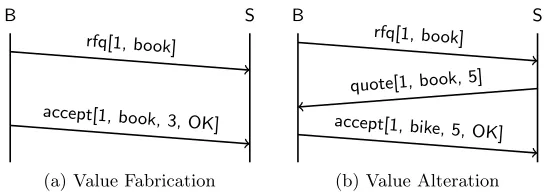
Information Integrity:Protocol-compliant agents must ensure integrity of the exchanged information when interacting according to an information-based pro-tocol. An agent may easily violate information integrity (maliciously or acciden-tally) by either creating information that does not exist or by altering known information. Figure 2(a) shows an interaction that corresponds to the former
case, where the buyer sends anacceptmessage to the seller without receiving a
quote message by creating the binding of priceas 3 even tough price is adorned
pinq foraccept. Figure 2(b) shows an interaction that corresponds to the latter
case, where the buyer alters the binding of the item to bike when sending the
accept message, which should actually be book as in the prior rfqmessage that she sent to the seller earlier.
In both cases, the integrity of the exchanged information is violated by the buyer leading to a non-compliant enactment of the protocol. These kind of mis-takes occur especially when an agent is implemented for concurrently enacting multiple instances of a protocols. For instance, consider a buyer that interacts concurrently with multiple sellers to purchase the cheapest copy of a book. This normally can be achieved by executing multiple instances of the buyer agent concurrently (e.g., in separate threads), each handling a separate enactment of
buyer agent must share the price information they receive from different buyers. A developer may make a mistake when developing the buyer agent, which may cause the price that is received in one enactment to be used in another enactment as we demonstrate in Figure 2.
B S
rfq[1, book]
accept[1, book, 3, OK]
(a) Value Fabrication
B S
rfq[1, book]
quote[1, book,5]
accept[1, bike, 5, OK]
[image:7.612.171.444.197.293.2](b) Value Alteration
Fig. 2: Violation of information integrity.
Mutual Exclusion:Realistic information-based protocols usually involve
mu-tually exclusive messages. For instance, when the buyer receives aquotemessage
from the seller, she must either send anaccept or rejectmessage, but not both.
Figure 3(a) shows violation of the mutual exclusion by the buyer, who sends first anacceptmessage and then arejectmessage after receiving aquotemessage. Note that, in this example mutual exclusion is local to the buyer. That is, emission
of theacceptandrejectmessages are local choices of the buyer. Hence, violation
of mutual exclusion can be avoided by ensuring the buyer’s compliance with the protocol.
However, mutual exclusion may also be non-local [7]. Suppose that in an extended version of our purchase protocol the seller may cancel its quote by
sending acancelmessage, which binds result, between the quote andaccept
mes-sages. Therefore, if there is a cancel message, there should not be an accept
message and vice versa. However, these message are emitted by different agents (i.e., mutual exclusion is non-local) and violation of mutual exclusion may occur as Figure 3(b) shows even though the agents are protocol-compliant. In general, non-local mutual exclusion cannot be satisfied unless behaviors of agents are synchronized, which is costly and hard to achieve (if not impossible) in
realis-tic systems. A protocol is calledsafe if it does have any enactments where two
agents may bind the same parameter, and in this chapter we only consider safe protocols.
B S rfq[1, book]
quote[1, book, 5]
accept[1, book, 5, OK] reject[1, book, 5, NOK]
(a) Mutual Exclusion (Local)
B S
rfq[1, book]
quote[1, book, 5]
accept[1,
book, 5, OK] cancel[1, book, 5,NOK]
[image:8.612.137.477.126.243.2](b) Mutual Exclusion (Non-local)
Fig. 3: Violation of mutual exclusion.
situations, in addition to the integrity issues that we have discussed, develop-ers should also deal with interleaved asynchronous emission and reception of messages in different enactments. To this end, developers normally use multi-threading mechanisms (i.e., each concurrent protocol instance is executed in a separate thread). However, this requires the use of complex synchronization mechanisms between the threads to properly handle interleaving messages from different enactments. For instance, the the seller must check if there are sufficient quantity of goods when making concurrent quotes. Achieving such synchroniza-tion is an error-prone task and if not done correctly may easily cause agents to act in a non-compliant manner or event stop operating due to deadlock issues.
4
Stellar
Stellar1is a programming model to develop protocol-compliant agents for BSPL
protocols. Stellar eliminates the pitfalls of protocol-compliant agent development that we have discussed in Section 3. To this end, Stellar provides a a set of well-defined operations around a software pattern for developing agents to enact roles in a protocol. If an agent’s interactions are implemented using the operations of Stellar following its software pattern, the developed agent is guaranteed to be protocol-compliant.
We implement Stellar as a Java framework. The implementation provides, (1) a code generation tool, which, given a BSPL protocol, automatically gener-ates a protocol-specific code library that includes classes to represent the roles, messages, and parameters of the given protocol, and (2) a static core library that provides the operations to apply Stellar’s software patterns.
The workflow for developing a protocol-compliant agent using Stellar is as follows. First, a BSPL protocol for which an agent is intended to be developed is specified. Second, the protocol is provided to Stellar’s code generation tool, which automatically generates a library of classes corresponding to the roles, messages,
1
and parameters of the given protocol. Third, programmers develop their agents using the static core library and the automatically generated protocol-specific library and by following Stellar’s software pattern.
Before explaining Stellar’s details, we first highlight its key features for devel-oping protocol-compliant agents using the following Java snippet, which shows
a possible implementation of the seller agent inPurchase protocol to handle the
reception of anrfqmessage and respond with the correspondingquotemessage.
Listing 2: Handling of a receivedrfqmessage by a seller.
1 p u b l i c v o i d h a n d l e R f q ( Rfq rfq ) 2 {
3 // c r e a t e a q u e r y to d e f i n e a c r i t e r i a for m e s s a g e r e t r i e v a l 4 Q u e r y q u e r y = new Q u e r y (" pID " , Q u e r y . EQ , rfq . get ( Rfq . pID ) ) ; 5
6 // use a d a p t e r to r e t r i e v e an e n a b l e d m e s s a g e a c c o r d i n g to the c r i t e r i a 7 Q u o t e q u o t e = a d a p t e r . r e t r i e v e E n a b l e d ( Q u o t e . class , q u e r y ) . g e t F i r s t () ; 8
9 // seller's b u s i n e s s l o g i c to d e t e r m i n e the r e q u e s t e d item's p r i c e 10 S t r i n g p r i c e = p r i c e M a p . get ( q u o t e . get ( Q u o t e . I T E M ) ) ;
11
12 // s e n d the e n a b l e d m e s s a g e by b i n d i n g n e c e s s a r y p a r a m e t e r s 13 q u o t e . s e n d ( p r i c e ) ;
14 }
Stellar follows BSPL’s declarative approach. Hence, it does not impose a control flow for developing protocol-compliant agents. Instead, Stellar uses an event-driven model, where viable messages are created and sent according to the local history of an agent when certain events happen. In this regard, the
above code snippet shows an event handler for the reception of anrfqmessage.
A key class of Stellar is a role adapter, which provides operations to retrieve and exchange viable messages during enactment of protocols. In our code snippet
the seller’s adapter is referred via the variable adapter, which is created during
the initialization of the seller agent as we will demonstrate later.
A fundamental feature of an adapter is to provide operations for retrieving
enabled messages from an agent’s local history. In an enabled message, all pinq
adorned parameters are bound according to the local history of the agent, and
allpoutq andpnilq parameters are unbound. Hence, the programmer can easily
create a viable message from an enabled message, which is retrieved from its lo-cal history using the role adapter, simply by producing bindings for all unbound
poutq parameters according to the business logic of the agent. In this way
Stel-lar ensures that agents send only viable messages and accordingly guarantees compliance of an agent’s implementation with a protocol.
To exemplify, in Line 7 of Listing 2, adapter object’s retrieveEnabled method
retrieves an enabled quote object of Quote class, which corresponds to a quote
message of Purchaseprotocol, to create a viable response to the receivedrfq
mes-sage. The retrieval operation takes a query to determine which particular enabled message(s) it should retrieve. In our example, a single object corresponding to
the enabled quote message is retrieved as a response to the received rfq, using
the identifier of the received message in the query that is provided to
rfqmessage), which is automatically set by theadapterwhen retrieving theQuote
object from the sender’s local history. Note that, in order to make the
corre-sponding message viable, thesend method takes aprice argument, whose value
is determined by the seller’s business logic.
agent’s business
logic
Stellar
determine message retrieval criteria
retrieve enabled messages
determinepoutq parameter bindings
send viable messages with bindings criteria
enabled messages
[image:10.612.139.475.191.304.2]viable messages with bindings
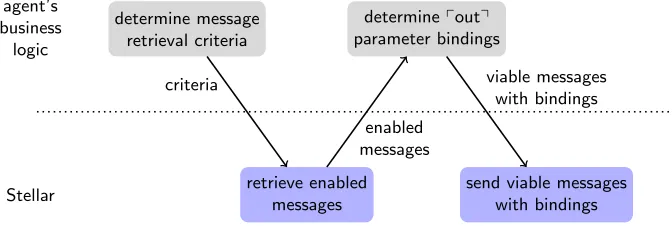
Fig. 4: Pattern to implement protocol-compliant agents using Stellar.
Figure 4 shows an abstract representation of Stellar’s software pattern that we use in the above code snippet in Listing 2 to ensure compliance of the seller agent. First, the agent’s business logic determines the criteria to retrieve a certain type of enabled message(s) from its local history. Then, the agent uses Stellar to retrieve the enabled message(s) that satisfy its criteria. Next, the agent’s business
logic determines the bindings of thepoutqadorned parameters of the retrieved
enabled message(s), and provide them to Stellar. Finally, Stellar compiles viable
messages using the enabled messages and the provided bindings for the poutq
adorned parameters, and sends them to their recipients.
4.1 Developing Agents using Stellar
In this section we present details of Stellar using an example in which we
imple-ment a buyer agent for thePurchaseprotocol in Listing 1.
Structure of an Agent:Listing 3 shows the overall structure of theBuyerclass,
which we use to implement the buyer agent. The objectadapterof classBAdapter
is the buyer’s role adapter which is generated by Stellar from the specification
of thePurchaseprotocol.Buyerclass implements QuoteHandlerinterface, which is
also generated by Stellar, with a single methodhandleQuote, which is called by
adapter when the buyer receives a Quotemessage. Note that QuoteHandler could
also be implemented by a separate class to enhance modularity.Buyerclass may
have other variables and methods as usual to represent the buyer’s business logic.
Also note that Buyer is a programmer defined class and it is not generated by
Listing 3: Structure of the buyer’s agent. 1 p u b l i c c l a s s B u y e r i m p l e m e n t s Q u o t e H a n d l e r
2 { 3
4 p r i v a t e B A d a p t e r a d a p t e r ; 5
6 // c l a s s v a r i a b l e s and m e t h o d s to r e p r e s e n t buyer's b u s i n e s s l o g i c
7 ...
8
9 // o b j e c t i n i t i a l i z a t i o n 10 ...
11
12 p u b l i c v o i d h a n d l e Q u o t e ( Q u o t e q u o t e )
13 {
14 ...
15 }
16 17 }
Initialization of Agent: Listing 4 shows the constructor of Buyer class. The
objectadapterof classBAdapteris initialized using the factory methodnewAdapter
according to aConfigurationobject, which includes information about the buyer’s
deployment such as its own and other agents network addresses. We discuss these
concepts in detail in Section 4.2. Next, the created Buyer object registers itself
as the handler for the receivedQuote messages.
Listing 4: Initialization of the buyer’s agent. 1 p u b l i c B u y e r ( C o n f i g u r a t i o n c o n f i g u r a t i o n )
2 {
3 a d a p t e r = B A d a p t e r . n e w A d a p t e r ( c o n f i g u r a t i o n ) ; 4 a d a p t e r . r e g i s t e r Q u o t e H a n d l e r ( t h i s ) ;
5
6 // i n i t i a l i z a t i o n of o t h e r c l a s s v a r i a b l e s
7 ...
8 }
Initialization of Interaction: Listing 5 shows how the buyer agent initiates
its interaction with a seller agent. The code first retrieves an enabled rfq
mes-sage object calling the methodretrieveEnabled of adapter. Remember that in the
Purchase protocol the rfq message does not have any pinq adorned parameters. Hence, this message corresponds to an entry point for a new enactment of the protocol. Therefore, the buyer can send this message at any time to initiate a
new enactment by setting its poutq adorned parameters. In other words, anrfq
message is always viable. WhenretrieveEnabled method is called for such a
mes-sage, Stellar automatically assigns values to the key parameter(s) of the message to create a unique key for initiating a new enactment ensuring information in-tegrity. Hence, the only thing the buyer should do is to determine the item, for
which it intends to request a quote, and call thesendmethod of the retrievedrfq
object.
Listing 5: Initialization of interaction by the buyer’s agent. 1 Rfq rfq = a d a p t e r . r e t r i e v e E n a b l e d ( Rfq . c l a s s ) ;
2 S t r i n g i t e m = ... // set by buyer's b u s i n e s s l o g i c 3 rfq . s e n d ( i t e m ) ;
list of items to buy, it can iterate over the list and execute the snippet for each
item in effect imitating a new (concurrent) enactment of the Purchaseprotocol.
Note that, although the buyer can enact multiple protocols concurrently, it is executed as a single thread, avoiding pitfalls of concurrency. Agents that are developed using Stellar process a single message at a time (similar to actors model). Hence, an agent is always implemented as a single thread even if it enacts multiple protocols concurrently.
Handling of Messages:The next two code snippets show handling of received quotes. Listing 6 shows the interface that is generated by Stellar from the
spec-ification of Purchaseand Listing 7 shows the implementation of the interface by
the buyer’s agent.
Listing 6: Specification of QuoteHandler interface.
1 p u b l i c i n t e r f a c e Q u o t e H a n d l e r 2 {
3 p u b l i c v o i d h a n d l e Q u o t e ( Q u o t e q u o t e ) ; 4 }
For simplicity, suppose that the business logic of the buyer is to accept quotes
below 50 and reject others. The code in Listing 7 first creates a Queryobject to
represent the buyer’s acceptance criteria for the received quotes. The first part
of the query calls thegetmethod to determine the identifier of the enactment for
which the quote is received (Line 3), and then defines the buyer’s criterion for
the acceptable value of the price (Line 4). Next, the code calls theretrieveEnabled
method to retrieve an enabled Accept message object that matches the given
query.
Listing 7: Implementation of QuoteHandlerinterface by buyer’s agent.
1 p u b l i c v o i d h a n d l e Q u o t e ( Q u o t e q u o t e ) 2 {
3 C o n d i t i o n c1 = new C o n d i t i o n (" pID " , Q u e r y . EQ , q u o t e . get ( Q u o t e . pID ) ) ; 4 C o n d i t i o n c2 = new C o n d i t i o n (" p r i c e " , Q u e r y . LT , 50) ) ;
5 Q u e r y a Q u e r y = new Q u e r y ( new A n d C o n d i t i o n ( c1 , c2 ) ) ; 6
7 A c c e p t a c c e p t = a d a p t e r . r e t r i e v e E n a b l e d ( A c c e p t . class , a Q u e r y ) . g e t F i r s t () ;
8
9 if ( a c c e p t != n u l l ) { 10 a c c e p t . s e n d (" OK ") ; 11 } e l s e {
12 Q u e r y r Q u e r y = new Q u e r y (" pID " , Q u e r y . EQ , q u o t e . get ( Q u o t e . pID ) ) ; 13 R e j e c t r e j e c t = a d a p t e r . r e t r i e v e E n a b l e d ( R e j e c t . class ,
r Q u e r y ) . g e t F i r s t () ; 14 r e j e c t . s e n d (" NOK ") ;
15 }
16 }
Note that there can only be one enabledacceptmessage for every enactment
with a particular binding of pID. However, retrieveEnabled returns a MessageSet
object, which implements theSetinterface with additional convenience methods.
In Line 7, getFirst is one of these convenience methods that retrieves a single
message if the set is a singleton andnullotherwise.
If there is an enabledacceptmessage that matches the query (i.e., the quoted
method, providing”OK”as the binding of resultparameter (Lines 9–10).
Other-wise (i.e., the quoted price is above 50 and henceacceptisnull), the code sends a
Rejectmessage, which is retrieved by calling theretrieveEnabled method with the corresponding query (Lines 11–14).
Remember that the buyer should either send an accept or a reject message
for a received quote to comply with Purchase (i.e., accept or rejectare mutually
exclusive). Let us explain how this is guaranteed by Stellar. Suppose that the programmer of buyer agent made a mistake an wrote the following code to handle
receivedquote messages instead of the code in Listing 7.
1 p u b l i c v o i d h a n d l e Q u o t e ( Q u o t e q u o t e ) 2 {
3 ...
4 A c c e p t a c c e p t = a d a p t e r . r e t r i e v e E n a b l e d ( A c c e p t . class , a Q u e r y ) . g e t F i r s t () ;
5 if ( a c c e p t != n u l l ) { 6 a c c e p t . s e n d (" OK ") ;
7 }
8 Q u e r y r Q u e r y = new Q u e r y (" pID " , Q u e r y . EQ , q u o t e . get ( Q u o t e . pID ) ) ; 9 R e j e c t r e j e c t = a d a p t e r . r e t r i e v e E n a b l e d ( R e j e c t . class ,
r Q u e r y ) . g e t F i r s t () ; 10 if ( r e j e c t != n u l l ) { 11 r e j e c t . s e n d (" NOK ") ;
12 }
13 ...
This piece of code tries to send first anacceptand then a rejectmessage for
the samepIDbinding. However, when anacceptmessage for apIDbinding is sent
(Line 6), the parameter result is bound for the pID binding, which makes the
rejectmessage for the samepIDbinding disabled, sinceresultis adornedpoutqin
reject. Accordingly,retrieveEnabledalways returns null when it is called to retrieve a Reject object for a binding of pID for which anaccept message is already sent
(Line 9). Hence, the agent still complies with thePurchaseprotocol, event though
its business logic is not correctly implemented.
4.2 Implementation of Stellar
Management of Local Histories: Stellar stores local history of an agent in a local relational database. Stellar hides the details of the particular database system from programmers. In fact, the programmer should not access the local
history of the agent directly. Instead, the programmer should use only the
re-trieveandsendmethods provided by Stellar. Our implementation currently uses MySQL to store local histories of agents, however any relational database system that supports fundamental relational operations can be easily adopted.
Emission and Reception of Viable Messages: Stellar uses asynchronous message passing for agent communication, which we implemented using UDP. The messages that are exchanged over the network are serialized into parameter-value pairs and represented in JSON format. Emission of messages is enabled
only via the sendmethods of the generated message classes. The aim of these
adapters of Stellar. Hence, Stellar does not provide any method to programmers for manual message reception. Instead, the programmers should implement han-dlers of the messages that they want to react, which are automatically called by the adapters of Stellar when a message is received. This simplifies programming of agents in asynchronous settings.
Retrieval of Enabled Messages:Here we provide Stellar’s algorithm for the
retrieval of enabled messages from an agent’s local history. Below, we use,Pfor
a BSPL protocol,p for individual parameters,P, Q, K for lists (or sets if their
ordering is not important) of parameters. We use calligraphic capital letters for relations in the local history of an agent, and apply standard relational algebra
operatorsΠ for projection,σfor selection,./ for natural join, ./ for full outer
join, and ./ for left outer join. We also use the utility methods allParams,
keyParams,inParams,nilParams, andoutParamswith a relation and protocol argument to access the set of all, key,pinq,pnilq, andpoutq adorned parameters of the relation, respectively.
Algorithm 1: retrieveEnabled(M, φ,P)
1 Pin←inParams(M,P) // pinq adorned parameters of M 2 Pnil←nilParams(M,P) // pnilq adorned parameters of M 3 Pout←outParams(M,P) // poutq adorned parameters of M 4 K←keyParams(M,P) // key parameters of M 5 WI← ∅
6 if Pinis∅then
7 return{()} 8 WI←SN ∈
PΠK(N) 9 foreachp∈Pindo
10 Q←K∪ {p}
11 Wp←createRelation(Q)
12 foreachN ∈Psuch thatp∈allParams(N,P)do
13 Wp←ΠQ(N)∪ Wp
14 WI← WI./KWp
15 WE←SN ∈PΠK(N) 16 foreachp∈Pout∪Pnil do
17 Q←K∪ {p}
18 Wp←createRelation(Q)
19 foreachN ∈Psuch thatp∈allParams(N,P)do
20 Wp←ΠQ(N)∪ Wp
21 WE← WE ./KWp
22 W ←σPout=null∧Pnil=null(WI ./KWE)
23 returnσφ(W)
Algorithm 1 defines retrieval of enabled messages, given the relationMthat
query φ, and the protocol specification P. Note that the algorithm returns a relation (not actual message objects in Java), where each tuple of the relation corresponds to the parameter bindings of an enabled instance of the message
schema M. A Stellar adapter uses this relation to create the corresponding
message objects and return them as the result of aretrieveEnabledmethod call as
we demonstrated in earlier examples.
Algorithm 1 can be divided into three phases. In the first phase (from lines 8
to 14), the algorithm builds the relationWI where allpinqadorned parameters
ofMare bound. In the second phase (from lines 15 to 21), the algorithm builds
another relation WE where one or more poutq or pnilq adorned parameters of
Mare bound. In the last phase (lines 22–23), the algorithm removes the tuples
from WI for which there is a matching tuple (i.e., identified by the same key)
in WE. Hence, each tuple of the resulting relation corresponds to an enabled
message (i.e., allpinq parameters are bound and allpoutq andpnilqparameters
are unbound). Note that this operation removes the tuples that would cause
violation of mutual exclusion. If a messageM0 that is mutually exclusive toM
is already emitted in an enactment, then there are tuples inWEwith bindings of
the parameters that are adornedpoutqin bothMandM0, and accordingly the
corresponding tuples inWI are removed. Hence, the messages that can cause to
violation of mutual exclusion are not enabled. The algorithm applies the given
queryφto the resulting relationW to filter the tuples.
4.3 Revisiting Pitfalls
Stellar’s retrieval and emission operations ensure causality and information
in-tegrity. Specifically, retrieval operations ensure integrity ofpinqadorned
param-eters by binding them permanently to the corresponding values according to the
agent’s local history. Hence, a programmer cannot fabricate or alterpinqadorned
parameters of a message. The send operations ensure integrity ofpoutqandpnilq
adorned parameters by enforcing the programmer to assign values to onlypoutq
adorned parameters when needed. Hence, the programmer cannot omit assign-ment of mandatory parameters and thus break integrity. Further, Stellar handles creation of bindings for key parameters ensuring their uniqueness, which prevents key related integrity issues.
Stellar’s retrieval operations prevent emission of mutually exclusive messages. That is, if two (or more) messages are mutually exclusive in a protocol and an agent has already sent one of these messages in an enactment of the protocol, the retrieval operation does not consider the other mutually exclusive message(s) as enabled in the same enactment. Hence, the agent cannot retrieve and send mutually exclusive messages. Stellar does not directly handle non-local mutual exclusion. However, safety of a BSPL protocol, which means that the protocol is free from non-local mutual exclusion, can be verified automatically [12] at design time to avoid non-local mutual exclusion issues.
Further, Stellar’s programming model handles one incoming message at a time. Hence, developers can implement their agents without any thread synchroniza-tion that deals with interleaving recepsynchroniza-tion of multiple messages in different en-actments. This feature of Stellar substantially simplifies design of an agent, as our case study in Section 5 demonstrates. Note that UDP, which is used in our implementation, is an unreliable protocol (i.e., it does not guarantee delivery of emitted messages), which may compromise liveness of an interaction. This issue can be avoided using a reliable alternative, such as RUDP, TCP, or message queues. However, these alternatives provide features (e.g., ordered message de-livery), which are not needed by Stellar. We chose UDP for our implementation to show that lack of such features do not affect protocol-compliance of agents. We will address liveness of interactions in our future work.
5
Case Study
To demonstrate the use of Stellar in a more comprehensive case, where an agent should consider multiple messages for decision making, we use a claim handling scenario from insurance domain. We list the protocol that represents this sce-nario in Listing 8. In this scesce-nario there is a policy subscriber and an insurer. The
subscriber can make multiple claims (claimmessage) by sending an incident’s
de-tails and the claimed amount to the insurer. The insurer either approves (approve
message) or rejects a claim (rejectmessage). In case of approval, the insurer pays
the claimed amount to the subscriber. The insurer can pay its balance
immedi-ately for each claim or as lump sum for several claims (paymessage). For brevity,
we omit some policy aspects such as premium payments.
Listing 8: An insurance policy claim protocol. I n s u r a n c e {
r o l e s I , S // insurer , s u b s c r i b e r
p a r a m e t e r s out sID key , out cID key , out pID key , out s u b s c r i b e r , out period ,
out type , out date , out i n c i d e n t , out cAmount , out outcome , out p A m o u n t
S 7→ I : s u b s c r i b e [ out sID , out s u b s c r i b e r , out period , out t y p e ] I 7→ S : r e g i s t e r [ in sID , in s u b s c r i b e r , in period , in type , out d a t e ] S 7→ I : c l a i m [ in sID , out cID , out i n c i d e n t , out c A m o u n t ]
I 7→ S : a p p r o v e [ in sID , in cID , in i n c i d e n t , in cAmount , out o u t c o m e ] I 7→ S : r e j e c t [ in sID , in cID , in i n c i d e n t , in cAmount , out o u t c o m e ] I 7→ S : pay [ in sID , out pID , out p A m o u n t ]
}
Listing 9 shows the implementation of ClaimHandlerinterface by the insurer
agent to handleclaimmessages when enactingInsurance. As we explained earlier,
ClaimHandler interface is generated by Stellar from the specification of Insurance
and consists of a single methodhandleClaim, which is used to define the insurer’s
The methodprocessClaim(Lines 8–21) captures the first step. The method first
decides whether the received claim is valid by callingisValidClaim(Line 12), which
returns true for valid and false for invalid claims. We do not present the details of
isValidClaimsince they are not relevant to our demonstration. Depending on the
validity of the claim,processClaimretrieves and sends either the enabledApprove
(Lines 13–15) orReject(Lines 17–19) message. Finally,processClaimreturns true
or false depending on the validity of the claim.
If the claim is approved (Line 3),handleClaimcallspayBalance(Line 4), which
captures the second step (Lines 23–30). The method payBalance first computes
the insurer’s total balance for the policy using approvedClaimAmount and
paid-ClaimAmount methods (Line 24). We describe these methods later in Listing 10.
If the insurer’s balance is more that the minimum payable amount,processClaim
retrieves and sends the enabledPay message to pay the insurer’s balance (Lines
25–29).
Listing 9: Implementation of ClaimHandlerinterface by the insurance agent.
1 p u b l i c v o i d h a n d l e C l a i m ( C l a i m c l a i m ) 2 {
3 b o o l e a n i s A p p r o v e d = p r o c e s s C l a i m ( c l a i m ) ; 4 if ( i s A p p r o v e d ) {
5 p a y B a l a n c e ( c l a i m . get ( C l a i m . sID ) ) ;
6 }
7 } 8
9 p r i v a t e v o i d p r o c e s s C l a i m ( C l a i m c l a i m ) 10 {
11 C o n d i t i o n c1 = new C o n d i t i o n (" sID " , Q u e r y . EQ , c l a i m . get ( C l a i m . sID ) ) ; 12 C o n d i t i o n c2 = new C o n d i t i o n (" cID " , Q u e r y . EQ , q u o t e . get ( C l a i m . sID ) ) ; 13 Q u e r y q u e r y = new Q u e r y ( new A n d C o n d i t i o n ( c1 , c2 ) ) ;
14
15 if ( i s V a l i d C l a i m ( c l a i m ) ) {
16 A p p r o v e msg = a d a p t e r . r e t r i e v e E n a b l e d ( A c c e p t . class , q u e r y ) . g e t F i r s t () ; 17 msg . s e n d (" A P P R O V E D ") ;
18 r e t u r n t r u e ; 19 } e l s e {
20 R e j e c t msg = a d a p t e r . r e t r i e v e E n a b l e d ( R e j e c t . class , q u e r y ) . g e t F i r s t () ; 21 msg . s e n d (" R E J E C T E D ") ;
22 r e t u r n f a l s e ;
23 }
24 } 25
26 p r i v a t e v o i d p a y B a l a n c e ( S t r i n g sId ) 27 {
28 int b a l a n c e = p a y a b l e C l a i m e d A m o u n t ( sId ) - t o t a l P a i d A m o u n t ( sId ) ; 29
30 if ( M I N _ P A Y A B L E _ A M O U N T <= b a l a n c e ) {
31 Q u e r y q u e r y = new Q u e r y (" sID " , Q u e r y . EQ , sId ) ; 32 Pay msg = a d a p t e r . r e t r i e v e E n a b l e d ( Pay . class , q u e r y ) ; 33 msg . s e n d ( b a l a n c e ) ;
34 }
35 }
Computation of the insurer’s balance for a policy requires consideration of multiple messages. That is, we should first compute the total payable claimed amount for the policy according to the approved claims. Then we should com-pute the total paid amount for the policy according to the previous payments,
and subtract it from the total payable claimed amount. The method
amount. It first retrieves all the sent Approve messages for the policy, which
is identified by sId, from the insurer’s message history calling retrieveMessage
method (Line 3). Note that this is a different method thanretrieveEnabled. Next,
the total payable amount is computed by iterating over all the retrievedApprove
messages and summing up the claimed amount of each message. The method
totalPaidAmount (Lines 11–19) repeats the same process to compute the total
paid amount for the policy using Pay messages (instead of Approve messages)
and corresponding paid amounts in those messages.
Listing 10: Computation of total claimed and paid amounts. 1 p r i v a t e int p a y a b l e C l a i m e d A m o u n t ( S t r i n g sId )
2 {
3 Q u e r y q u e r y = new Q u e r y (" sID " , Q u e r y . EQ , sId ) ;
4 M e s s a g e S e t < Approve > m s g s = a d a p t e r . r e t r i e v e M e s s a g e ( A p p r o v e . class , q u e r y ) ;
5
6 int sum = 0;
7 for ( A p p r o v e msg : m s g s ) {
8 sum += ( int ) msg . get ( A p p r o v e . c A m o u n t ) ;
9 }
10 r e t u r n sum ; 11 }
12
13 p r i v a t e int t o t a l P a i d A m o u n t ( S t r i n g sId ) 14 {
15 Q u e r y q u e r y = new Q u e r y (" sID " , Q u e r y . EQ , sId ) ;
16 M e s s a g e S e t < Pay > m s g s = a d a p t e r . r e t r i e v e M e s s a g e ( Pay . class , q u e r y ) ; 17
18 int sum = 0;
19 for ( Pay msg : m s g s ) {
20 sum += ( int ) msg . get ( Pay . p A m o u n t ) ;
21 }
22 r e t u r n sum ; 23 }
6
Discussion
We summarize our contributions, relate them to the literature, and discuss di-rections for future work.
6.1 Summary
(i.e., code skeletons), and more distantly related to distributed programming models without interaction protocols.
6.2 Related Work
Scribble [15] enforces design-time adherence to protocols that specify typed mes-sage signatures and messaging constraints with explicit control flow. Scribble [5] extracts state machines from protocol specifications to generate APIs for end-points. Sending or receiving a message returns a protocol state object and each protocol state object provides message sending and receiving operations that comply with correct subsequent state transitions. Stellar provides more flexibil-ity to developers, since it does not impose a control flow for ensuring compliance when implementing agents. Developers are free to design their agents as they see fit, without being distracted about the state of their interactions. Stellar’s retrieve and send pattern ensures exchange of only viable messages and accord-ingly ensures compliance of agent, which is independent from a control flow.
Business-oriented approaches for web services propose the use of high-level processes according to which correct interactions are enforced in code. Business Process Modeling Notation (BPMN) has been used to specify processes that are then translated into the Business Process Execution Language [10] (BPEL), an executable language for externally invoking web services and their inter-actions based on event occurrences. The BPMN-BPEL approach is inherently process-oriented and depends on the correct realization of workflows. Stellar is information-oriented and uses a declarative approach without imposing any workflow. Business artifacts [9] are high-level representations of both processes, interaction, and the relational data that they operate on. Artifact interoperation hubs [6] enforce correct messaging with business processes by acting as central communication points between web services. Stellar only uses local information and does not rely on any centralized communication artifacts to ensure compli-ance.
Programming models for distributed systems generally do not consider tocols, e.g., functional reactive programming [2], the Sunny Event-driven pro-gramming model [8], and the Actor propro-gramming model [4] implemented in Akka [1]. These programming models support interaction derived from internal sys-tem or actor code, without a protocol specification against which correct imple-mentations must comply. In Stellar, we focus on supporting independent agent development against protocol specifications, where programmers are protected from violating protocol compliance and integrity of information.
6.3 Future Work
commitments) may be used alongside Stellar, especially since norms represent the meaning of information communicated via protocols.
Acknowledgments. Munindar P. Singh and Thomas C. King gave valuable
suggestions that helped improve this chapter. Akın G¨unay and Amit Chopra
were supported by the EPSRC grant EP/N027965/1 (Turtles).
References
1. Akka: 2.5.6 (2017),http://akka.io
2. Bainomugisha, E., Carreton, A.L., van Cutsem, T., Mostinckx, S., de Meuter, W.: A survey on reactive programming. ACM Computing Surveys 45(4), 52:1–52:34 (2013)
3. Chopra, A.K., Christie V., S.H., Singh, M.P.: Splee: A declarative information-based language for multiagent interaction protocols. In: Proceedings of the 16th Conference on Autonomous Agents and MultiAgent Systems. pp. 1054–1063 (2017) 4. Hewitt, C., Bishop, P., Steiger, R.: A universal modular actor formalism for ar-tificial intelligence. In: Proceedings of the 3rd International Joint Conference on Artificial Intelligence. pp. 235–245. IJCAI’73, Morgan Kaufmann Publishers Inc., San Francisco, CA, USA (1973)
5. Hu, R., Yoshida, N.: Hybrid session verification through endpoint api generation. In: Proceedings of the 19th International Conference on Fundamental Approaches to Software Engineering - Volume 9633. pp. 401–418. Springer-Verlag, New York, NY, USA (2016)
6. Hull, R., Narendra, N.C., Nigam, A.: Facilitating workflow interoperation using artifact-centric hubs. In: Proceedings of the 7th International Joint Conference on Service-Oriented Computing. pp. 1–18. ICSOC-ServiceWave ’09, Springer-Verlag, Berlin, Heidelberg (2009)
7. Ladkin, P.B., Leue, S.: Interpreting message flow graphs. Formal Aspects of Com-puting7(5), 473–509 (1995)
8. Milicevic, A., Jackson, D., Gligoric, M., Marinov, D.: Model-based, event-driven programming paradigm for interactive web applications. In: Proceedings of the 2013 ACM International Symposium on New Ideas, New Paradigms, and Reflec-tions on Programming & Software. pp. 17–36. Onward! 2013, ACM, New York, NY, USA (2013)
9. Nigam, A., Caswell, N.S.: Business artifacts: An approach to operational specifi-cation. IBM Systems Journal42(3), 428–445 (2003)
10. Ouyang, C., Dumas, M., van der Aalst, W.M.P., Hofstede, t.A.H.M., Mendling, J.: From business process models to process-oriented software systems. ACM Trans-actions on Software Engineering and Methodology 19(1), 2:1–2:37 (2009)
11. Singh, M.P.: Information-driven interaction-oriented programming: BSPL, the Blindingly Simple Protocol Language. In: Proceedings of the 10th International Conference on Autonomous Agents and MultiAgent Systems. pp. 491–498 (2011) 12. Singh, M.P.: Semantics and verification of information-based protocols. In:
Pro-ceedings of the 11th International Conference on Autonomous Agents and Multi-agent Systems. pp. 1149–1156 (2012)
13. Singh, M.P.: Bliss: Specifying declarative service protocols. In: Proceedings of the 2014 IEEE International Conference on Services Computing. pp. 235–242 (2014) 14. Winikoff, M., Yadav, N., Padgham, L.: A new hierarchical agent protocol notation.