Iran J Public Health, Vol. 46, No.12, Dec 2017, pp.1679-1689
Original Article
A Robust and Accurate Non-rigid Medical Image Registration
Algorithm Based on Multi-level Deformable Model
Yanli WAN
1, *Hongpu HU
1, Yanli XU
2, Quan CHEN
1, Yan WANG
1, Dongping GAO
1 1. Institute of Medical Information, Chinese Academy of Medical Sciences, Beijing, China2. Medical College of Hebei Engineering University, Handan, Hebei, China *Corresponding Author: Email: [email protected]
(Received 22 Dec 2016; accepted 26 Apr 2017)
Introduction
Medical image registration is one of the most im-portant and challenging research in the modern medical image analysis field. It aims to align two images which are captured from different de-vice/time into the same coordinate system. “It has many potential and important applications in clinical diagnosis, such as fusion of computer tomography (CT) and magnetic resonance imag-ing (MRI) data to obtain more complete infor-mation about the patient, monitoring tumor growth, treatment verification, and comparison of the patient’s data with anatomical atlases” (1). From the view of the image transformation, med-ical image registration can be classified into rigid
registration and non-rigid registration. In the past few years, a number of excellent rigid image reg-istration methods were proposed and widely ap-plied, such as the cross-correlation method (2), maximization of mutual information method (3) and normalized mutual information method (4). These methods are extended or integrated, and gradually applied to solve the non-rigid image registration problem (5-7). Compared to the rigid image registration task, the non-rigid image regis-tration task faces much more challenges due to its high degree of freedom and inherent require-ment of smoothness in the deformation field. The accuracy, robustness and speed of these
al-Abstract
Background: Compared to the rigid image registration task, the non-rigid image registration task faces much more challenges due to its high degree of freedom and inherent requirement of smoothness in the deformation field. The purpose was to propose an efficient coarse-to-fine non-rigid medical image registration algorithm based on a multi-level deformable model.
Methods: In this paper, a robust and efficient coarse-to-fine non-rigid medical image registration algorithm is pro-posed. It contains three level deformation models, i.e., the global homography model, the local mesh-level homogra-phy model, and the local B-spline FFD (Free-Form Deformation) model. The coarse registration is achieved by the first two level models. In the global homography model, a robust algorithm for simultaneous outliers (error matched feature points) removal and model estimation is applied. In the local mesh-level homography model, a new similarity measure is proposed to improve the robustness and accuracy of local mesh based registration. In the fine registration, a local B-spline FFD model with normalized mutual information gradient is employed.
Results:We verified the effectiveness of each stage of the proposed registration algorithm with many non-rigid trans-formation image pairs, and quantitatively compared our proposed registration algorithm with the HBFFD method which is based on the control points of multi-resolution. The experimental results show that our algorithm is more accurate than the hierarchical local B-spline FFD method.
Conclusion:Our algorithm can achieve high precision registration by coarse-to-fine process based on multi-level de-formable model, which ourperforms the state-of-the-art methods.
gorithms are required to be further improved for clinical applications (8-9).
The non-rigid medical image registration algo-rithm naturally depends on the geometric defor-mation model and the similarity measure criteri-on. The geometric deformation models can be classified into two main categories: i) physics-based models such as the elastic body models (10-11), the optical flow models (12) and the dif-fusion models (13); and ii) interpolation-based models such as free-form deformations (14-15). Christensen et al. (10) proposed an approach to tackle large deformations with multiple linear elastic models which represent a series of small deformations. Guyader et al. (11) proposed an approach that combines segmentation and regis-tration that is based on nonlinear elasticity. Lu et al. (12) proposed a registration method based on the optical flow model for non-rigid heart imag-es. This algorithm includes two steps, i.e., coarse registration and precise registration, to improve both of the registration accuracy and the conver-gence speed. Thirion (13) regarded the image reg-istration as a diffusion process. This algorithm is actually an iterative process between estimation of the pixel displacements and the update of the transformation. In each iteration, the movement of any pixel is decided by a matching process based on the Sum of Squared Differences (SSD) criterion. For the above registration algorithms based on the physical models, it is difficult to construct a reasonable physical model that can simulate the complex tissue deformations be-tween the two input images. Rueckert et al. (14) proposed a local deformation model for non-rigid registration on breast MR images. This model was described by the so called Free-Form Deformation (FFD) based on B-splines, and it employed the normalized mutual information (NMI) as the similarity function. Since the degree of freedom of the local deformation model is de-termined by the number of control points, it is important to decide whether a sparse or dense set of control points should be used. However, both sparse and dense sets have limitations. If a sparse set of control points is used, the movements of the control points will not well represent
compli-cated deformations. If a dense set of control points is used, the optimization can be computa-tionally inefficient. In order to tackle these short-comings, some researchers proposed some com-promise methods. For example, Shi et al. (15) proposed a multi-level B-spline model in which only a sparse subset of the control points is active to balance speed and accuracy.
In addition to the geometric deformation model itself, extraction of the robust and precise feature correspondences is also very important. It is an essential step to estimate the geometric defor-mation model in many registration methods. However, it is often affected by image noise, fea-ture outliers and local deformations. In the past decade, a number of methods were proposed to solve the robust feature matching problem. Among them, one kind of fuzzy correspondence methods, such as softassign methods (16) and relaxation labeling methods (17) have been de-veloped, in which the binary constrains of the correspondences are relaxed to become a fuzzy correspondence during the optimization process. Some researchers combined the iconic feature and the geometric feature for correspondence searching and outlier discarding (18-19). Howev-er, most of these approaches have limited capa-bility in handling outliers caused by feature ex-traction errors or large deformations.
This paper proposes an efficient coarse-to-fine non-rigid medical image registration algorithm based on a multi-level deformable model.
Materials and Methods
The study was carried out according to the Hel-sinki Declaration and approved by the ethical committee of Chinese Academy of Medical Sci-ences. The need for informed consent was waived, because the data sets used in this study downloaded from some open web sites.
Algorithm Overview
and the bottom one is called the float image (which will be transformed by the registration process). The right part of (a) shows the differ-ence of the two input images. (e) shows the dif-ference between the fixed redif-ference image and the registered float image after the proposed coarse-to-fine registration algorithm. Comparing
(e) and the right part of (a), it can be seen that most pixels of the two input images are already aligned accurately. (b), (c) and (d) are the inter-mediate results corresponding to the three steps of the proposed coarse-to-fine registration algo-rithm, and will be described in detail in the fol-lowing text.
Fig. 1: The flow chart of our algorithm
[1] Feature correspondence detection based on global homography model. The robust and accu-rate feature correspondence detection between the reference image and float image plays an im-portant role in image registration (shown in Fig 1 (b)). In this paper, we used the SIFT (Scale-invariant feature transform) (20-21) algorithm to detect sparse feature correspondences in the two images. Although SIFT can be invariant to uni-form scaling, orientation, and partially invariant to affine distortion and illumination changes, it inevitably produces outliers due to feature extrac-tion errors or large deformaextrac-tions. To tackle this issue, an improved robust RANSAC algorithm for simultaneous removal of outliers and estima-tion of the global level transformaestima-tion model is applied. [2] Coarse registration based on local-mesh level homography model
Since the global transformation model cannot precisely simulate the local deformations of non-rigid tissue, a number of local deformable models corresponding to a series of uniform grid mesh are robustly estimated. In this step, the local de-formation model is estimated by a local homog-raphy with shape-preserving constraints. The lo-cal deformation mesh is shown in Fig 1 (c). Then, the coarse registration based on the local mesh-level homography model is performed. It can greatly improve the convergence speed and
preci-sion of the following fine registration step.[3] Fi-ne registration based on B-spliFi-ne FFD model. Although the above local homography transfor-mation model can effectively simulate the defor-mations to some extent, its ability is limited for the images with very complex deformations be-cause the model reduces degree of freedom by introducing a shape-preserving constraint. To tackle the complex deformations, a fine registra-tion step is further applied. In this step, a B-spline FFD model is constructed by integrating the normalized mutual information (NMI) gradi-ent to acquire more accurate registration results in this step (shown in Fig. 1 (d)).
Estimation of the Global Level Homography Model
The global level transformation model is de-scribed by a homography , a matrix. Suppose is the i-th matched SIFT feature correspondence between the reference image R and the float image F, can be estimated by four pairs of correspondences:
[1] where is a homogeneous coordinate, i.e.,
In order to enhance the robustness and accuracy of the feature correspondences, the robust ORSA (Optimized Random Sample Consensus, i.e., Op-timized RANSAC) algorithm (23) is applied to estimate the parameters of the global homogra-phy model and eliminate the outliers simul-taneously. The average residual error of the correspondences is used to distinguish the inliers and outliers in the process of the estimation (Fig 2).
Fig. 2: Residual error terms for global homography estimation
[2]
where is the Euclidean distance be-tween the locations of point and transformed
point .
After performing the ORSA algorithm, a global transformation model and an inlier set (with a relatively large error threshold ) are obtained. In order to further eliminate outliers, the ORSA algorithm is further applied on the sub-images of the reference image R with a relatively small error threshold . The estimated global homography matrix and the inliers will be used in the following local mesh-level defor-mation step.
Coarse Registration based on Local Mesh-level Deformable Model
Estimation of the Local Mesh-level Deform-able Model
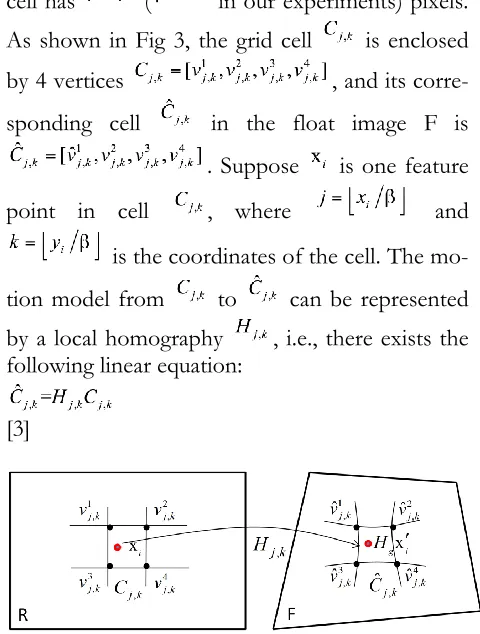
The reference image R is divided into a number of regular square cells (called meshes). Each grid
cell has ( in our experiments) pixels. As shown in Fig 3, the grid cell is enclosed
by 4 vertices , and its
corre-sponding cell in the float image F is . Suppose is one feature
point in cell , where and
is the coordinates of the cell. The mo-tion model from to can be represented by a local homography , i.e., there exists the following linear equation:
[3]
Fig. 3: Local deformable model in the corresponding grid cell of the reference image R and the float image
F
Since the local model can be linearly solved with the 4 vertices of the grid cell, so the estima-tion of the local homography model becomes the estimation of the 4 vertices .
repre-sented by a 2D bilinear interpolation of the cell , i.e., , where is the interpolation
weight, and there is .
It is supposed that the corresponding point has the same weight in the cell where it is located. Then the data term used to estimate all cell’s vertices in the float image is defined as:
[4] Although this flexible motion model can well de-scribe the transformation between the local cor-responding cells, it is difficult to estimate it be-cause there are no sufficient feature correspond-ences in each cell. In order to address this chal-lenge, a similarity constraint term is introduced to limit the degrees of freedom of the motion mod-el:
[5] where are three vertices of one grid in the
float image, is a scale ratio
computed from the corresponding three vertices in the reference image, and is a rotation ma-trix used to guarantee the right angle of vector
and . This constraint term requires the triangle formed by three neighboring vertices
to follow a similarity transformation. The data term and constraint term are linearly combined to obtain the final energy function:
[6] where is a weight to control the contribution of the two terms. Since the energy function is quadratic, all cell’s vertices can be solved by a sparse linear solver. Then the local model will be estimated by Eq.(3). Note that the final local homography in each cell is determined
by .
The data term in the above mentioned energy function mainly considers the position
infor-mation of the feature correspondences. In order to further improve the robustness of the local homography estimation algorithm, a new similari-ty measure with stronger constraints by employ-ing direction and distance information (See Sec.4.2) is proposed for adaptively determining the weight of the constraint term in Eq.(6). The weight is equally discretized into 10 values between 0.3 and 3. Taking the center point of each grid as the center of the support window in the reference image, the corresponding support window in the float image can be determined by the estimated local homographies. Then the similar-ity is calculated between the corresponding win-dows, and the optimal local homographies are se-lected as those with maximum similarity measure. Once the optimal local homographies are determined, they are used for coarse registration by transforming and interpolating the float image to obtain the coarsely registered image . It is worth noting that after the transformation, the pixel coordinates are mapped to the non-integer coordinates, so the pixel interpolation is the key step in the registration. In this paper, we use the partial volume interpolation method (PVI) (24). PVI is one kind of interpolation method that is based on the joint histogram, and can obtain a more smooth objective function curve.
A New Similarity Measure based on NCC
The new similarity measure is a weighted normal-ized cross correlation (Weighted NCC) aiming to select the optimal local homographies. As we know, NCC is a simple but effective similarity measure. However, it only uses the gray pixel values to measure the similarity of the corre-sponding local windows. In fact, direction of the pixel gradient is also valuable and powerful in-formation for similarity measurement. In this pa-per, a new similarity measure is proposed by as-signing a weight for each pixel except the center point in a support window. It is defined as:
where and are the gray values at point and in the image R and F respectively. and are the mean gray pixel values in the given windows centered at and
. In Eq.(7), the weights and are re-spectively determined by the product of two components of direction and distance, i.e.
and . The
fol-lowing section takes weight as an exam-ple to introduce the meaning of the two compo-nents.
The direction component is computed as:
[8] where and are the main direction at
point and . is the angle
between the two main directions. is a scale factor. The main direction, such as , is de-termined by the histogram of oriented gradient (HOG) formed by the gradient orientations of all pixels within a window region centered at . The orientation histogram is equally dis-cretized into 36 bins covering 360 degree range of orientations. The gradient orientations of each pixel in the corresponding bin of histogram are added by its gradient magnitude :
[9]
where the Gaussian window ( in
our experiments) aims to give emphasis on gradi-ents close to the center of the region. The peak value of the orientation histogram is considered as the main direction. Then the angle of two main directions can be calculated by the number of bins of histogram.
Similarly, the distance component is computed as:
[10] where is the Euclidean distance be-tween the locations of pixel and . is a scale factor and it is set as the half of the support window, i.e., . The pixel with smaller dis-tance to the center of the region will be assigned a higher weight in Eq.(10).
In a word, the new similarity measure presents stronger constraints by combing direction and distance information to weight each pixel in the support window. It can obtain the best score when each pixel has similar direction and dis-tance simultaneously.
Fine Registration based on B-spline FFD Model
In order to better adapt to the local complex de-formation of organ tissue, an additional trans-formation is required. We chose an FFD model, based on B-splines, which affects the transfor-mation only in the local neighborhood of the control point. Suppose image is divided into a number of mesh cells and let denote a
mesh of control points with uniform spacing ( in our experiments). The FFD can be defined as:
[11] where is a point in the image .
, and represents the lth basis function of the B-spline:
[13] where ( in our experiments) is a weight to balance the two terms of the cost func-tion. is used to guarantee the
smooth-ness of the spline-based FFD transformation,
and measures the similarity by the
normalized mutual information. Because is only affected by its neighboring control points, i.e. the position of the control point is only depends its neighborhood grid. So NMI is not calculated on the full image, and it is only calculated between the neighborhood of the corresponding control point (i.e.,N1 and ) before and after transformation. This will greatly improve the computational efficiency. The two terms of the energy function defined in Eq.(13) are given as follows:
[14]
where is the area of the image domain, and w and h are its width and height. and
denote the marginal entropy at and , and denotes their joint en-tropy.
The key of the fine registration algorithm is to find the optimal transformation parameters by minimizing the cost . We employ an iterative gradient descent optimization method which steps in the direction of the gradient vector with a certain step size . The procedure of the algo-rithm is summarized in Algoalgo-rithm 1.
Algorithm 1. The fine registration algorithm. Step 1: Partition the coarse registration image to initialize the control point set .
Step 2: Calculate the gradient of the cost function
in Eq.(13), i.e. .
Step 3: If ( in our experiments),
update the control point set , and turn to step 2.
Step 4: Compute by Eq.(11), Obtain the fine registration image by the interpolation method (PVI).
Results
Algorithm Validation
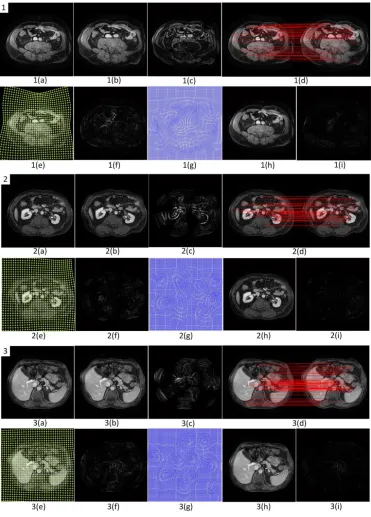
We first verify the effectiveness of each stage of the proposed registration algorithm with many non-rigid transformation image pairs. Fig. 4 shows the results of three brain data sets after performing the registration algorithm, where (a) is the reference image (image download from (25), ARRA project) and (b) is the float image. The difference of (a) and (b) is shown in (c). From the difference we can see that there are large local deformations between the two input images. (d) shows the correspondences after out-liers discarding by robustly estimating the global homography transformation model. (e) shows the estimated warpped meshes from all inliers. The warped meshes are represented by a series of lo-cal homographies which are used to perform the coarse registration. The difference between the float image and the coarsely registered image is shown in (f). It demonstrates that the defor-mation becomes smaller after performing the coarse registration. (g) is the transformation mesh which is determined based on B-spline FFD model.
Fig. 4: Three sets of experimental results produced by our coarse-to-fine registration algorithm
At the same time, our method can achieve fast convergence in the fine registration stage because a coarse registration step is applied first to com-pensate the large displacements.
Fig (5) shows another set of testing results to demonstrate the effectiveness of the proposed
difference of the reference and the float images registered by the hierarchical local B-spline FFD method (called HBFFD method). Obviously, our algorithm has better robustness to noises and transformations than HBFFD method.
Quantitative Comparison and Evaluation
We also quantitatively evaluate and measure the proposed registration algorithm and compare it with the HBFFD method which is based on the control points of multi-resolution. The similarity measurements used to evaluate the accuracy of our algorithm are sum of squared differences (SSD), sum of absolute difference (SAD), malized correlation coefficient (NCC), and nor-malized mutual information (NMI). Table 1 lists the experimental results of the three data sets shown Fig. 4 and five data sets shown Fig. 5. From the results we can see that our method can obtain better similarity scores between the regis-tered float images and the reference images than
HBFFD method on each data set. Fig. 5:our coarse-to-fine registration algorithm Five sets of experimental results produced by
Table 1: Comparison of HBFFD and our algorithm with different similarity measurements
Data sets Registration
method SSD SAD Similarity CC NMI
Fig (4)-1 HBFFD 0.000139 0.007298 0.997311 1.362331
Our method 0.000094 0.004915 0.999132 1.427246
Fig. (4)-2 HBFFD 0.000068 0.005895 0.999017 1.440683
Our method 0.000041 0.003386 0.999611 1.501243
Fig. (4)-3 HBFFD 0.000174 0.007753 0.999326 1.496891
Our method 0.000132 0.005291 0.999753 1.564322
Fig. (5)-1 HBFFD 0.001145 0.025060 0.990610 1.240709
Our method 0.001002 0.020108 0.993157 1.252207
Fig. (5)-2 HBFFD 0.003002 0.028780 0.985250 1.242566
Our method 0.001091 0.018340 0.991436 1.254210
Fig. (5)-3 HBFFD 0.001557 0.027649 0.986869 1.223756
Our method 0.001241 0.025660 0.989843 1.233242
Fig. (5)-4 HBFFD 0.001321 0.027423 0.991089 1.240364
Our method 0.000927 0.021150 0.995822 1.251860
Fig. (5)-5 HBFFD 0.001051 0.023837 0.991260 1.242578
Our method 0.000828 0.020012 0.996651 1.253413
Discussion
In addition to the geometric deformation model itself, extraction of the robust and precise feature correspondences is also very important. It is an
solve the robust feature matching problem. Among them, one kind of fuzzy correspondence methods, such as softassign methods (16) and relaxation label-ing methods (17) have been de-veloped, in which the binary constrains of the correspondences are relaxed to become a fuzzy correspondence during the op-timization process. Some researchers combined the iconic feature and the ge-ometric feature for correspondence searching and outlier discarding (18-19). Howev-er, most of these approaches have limited capa-bility in handling outliers caused by feature ex-traction errors or large deformations.
This paper proposes an efficient coarse-to-fine non-rigid medical image regis-tration algorithm based on a multi-level deformable model. Com-pared to the existing non-rigid medical image reg-istration methods, our algorithm has the follow-ing characteristics:
1) The multi-level deformable model consists of global homography mod-el, local mesh-level homography model and local B-spline based FFD model. The coarse registration process which is based on the first two level models can effectively improve the convergence speed. It also helps improve the pre-cision of the fine reg-istration process which employs an iterative op-timization model. More reliable registration re-sults can be obtained compared to the hier-archical local B-spline FFD method which is based on the control points of multi-resolution. 2) In order to improve the robustness of the reg-istration algorithm, on the one hand, a robust algorithm for simultaneous outliers removal and model es-timation is applied in the estimation of the global level homography model; on the other hand, a new similarity measure with strong con-straints is proposed and applied in the local mesh-level homography model. It combines di-rection and distance information to weight each pixel in a support window, so as to achieve more accurate comparison of corresponding pixels.
Conclusion
This paper proposes an efficient coarse-to-fine non-rigid medical image registration algorithm
based on a multi-level deformable model. The multi-level deformable model consists of global homography model, local mesh-level homogra-phy model and local B-spline based FFD model. In the estimation of the global level transfor-mation model, a robust algorithm for simultane-ous outliers removal and model estimation is ap-plied. A new similarity measure with strong con-straints is proposed to robustly estimate the local mesh-level deformable model. It combines the direction and distance information to weight each pixel in the support window. The coarse registra-tion of the first two level models can greatly im-prove the convergence speed and help imim-prove the precision of the fine registration stage. The experimental results show that our algorithm is more accurate than the hierarchical local B-spline FFD method which is based on the control points of multi-resolution.
Ethical considerations
Ethical issues (Including plagiarism, informed consent, misconduct, data fabrication and/or fal-sification, double publication and/or submission, redundancy, etc.) have been completely observed by the authors.
Acknowledgments
This work was supported by PUMC Youth Fund (3332016128), the Fundamental Research Funds for the Central Universities (2016ZX330013), and the National Natural Science Foundation of China (No. 71273280).
Conflict of interest
The authors declare that they have no conflict of interest.
References
Pro-cessing Pattern Recognition, 2: 11-27.
2. Kanekoa S, Yutaka S, Satoru I (2003). Using se-lective correlation coefficient for robust image registration. Pattern Recognition, 19: 1165-73. 3. Maes F, Collignon A, Vandermeulen D, Marchal
G, Suetens P (1997). Multimodality image registration by maximization of mutual in-formation. IEEE Trans Med Imaging, 16: 187– 98.
4. Bardera A, Feixas M, Boada I, Sbert M (2006). High-dimensional normalized mutual infor-mation for image registration using random lines. In: International Workshop on Biomed-ical Image Registration, 4057: 264-71.
5. Andronache A, Von-Siebenthal MG, Cattin P (2008). Non-rigid registration of multi-modal images using both mutual information and cross-correlation. Med Image Anal, 12: 3-15. 6. Pluim J, Maintz JA, Viergever M (2003). Mutual
information based registration of medical im-ages: a survey. IEEE Trans Med Imaging, 22: 986–1004.
7. Zhang J, Wang J, Wang X, Feng D (2015). Mul-timodal image registration with joint structure tensor and local entropy. Int J Comput Assist Radiol Surg, 10:1765-75.
8. Holden M (2008). A review of geometric trans-formations for nonrigid body registration.
IEEE Trans Med Imaging, 27: 111-28.
9. Sotiras A, Davatzikos C, Paragios N (2013). De-formable medical image registration: a survey. IEEE Trans Med Imaging, 32:1153-90.
10. He J, Christensen GE (2003). Large deformation inverse consistent elastic image registration. In: International Conference on Information Processing in Medical Imaging, 18: 438-49. 11. Le Guyader C, Vese LA (2011). A combined
segmentation and registration framework with a nonlinear elasticity smoother. Computer Vision and Image Understanding, 115: 1689-709. 12. Lu X, Zhao Y, Zhang B, Wu JS, Li N, Jia WT
(2013). A non-rigid cardiac image registration method based on an optical flow model. Int J Light Electron Optics, 124: 4266-73.
13. Thirion JP (1998). Image matching as a diffusion process: an analogy with Maxwell's demons.
Med Image Anal, 2: 243-60.
14. Rueckert D, Sonoda LI, Hayes C, Hill D, Leach M, Hawkes D (1999). Non-rigid registration
using free-form deformations: application to breast MR images. IEEE Trans Med Imaging, 18: 712–21.
15. Rohde GK, Aldroubi A, Dawant BM (2003). The adaptive bases algorithm for intensity-based nonrigid image registration. IEEE Trans Med Imaging, 22:1470-9.
16. Chui H, Rangarajan A (2003). A new point matching algorithm for non-rigid registration.
Computer Vision Image Understand, 89: 114–41. 17. Datteri RD, Liu Y, D'Haese PF, Dawant BM
(2015). Validation of a nonrigid registration error detection algorithm using clinical MRI brain data. IEEE Trans Med Imaging, 34:86-96. 18. Hellier P, Barillot C (2003). Coupling dense and landmark-based approaches for non-rigid reg-istration. IEEE Trans Med Imaging, 22:217–27. 19. Wu G, Yap PT, Kim M, Shen D (2010). TPS-HAMMER: improving HAMMER registra-tion algorithm by soft correspondence match-ing and thin-plate splines based deformation interpolation. NeuroImage, 49: 2225–33. 20. Lowe DG (2004). Distinctive Image Features
from Scale-Invariant Keypoints. Int J Computer Vision, 60: 91-110.
21. Mikolajczyk K, Schmid C (2005). Performance evaluation of local descriptors. IEEE Trans Pattern Anal Mach Intell, 27: 1615-30.
22. Liu S, Yuan L, Tan P, Sun J (2013). Bundled camera paths for video stabilization. Acm Transactions on Graphic, 32:1-10.
23. Moisan L, Moulon P, Monasse P (2012). Auto-matic Homographic Registration of a Pair of Images, with A Contrario Elimination of Outliers. Image Processing on Line, 2: 56-73. 24. Yushkevich PA, Wang HZ, Pluta J, Das SR,
Craige C, Avants BB, Weiner MW, Mueller S (2010). Nearly automatic segmentation of hippocampal subfields in in vivo focal T2-weighted MRI. Neuroimage, 53: 1208-24. 25. Suh JW, Scheinost D, Dione DP, Dobrucki LW,
Sinusas AJ, Papademetris X (2011). A non-rigid registration method for serial lower ex-tremity hybrid SPECT/CT imaging. Med Im-age Anal, 15:96-111.