© 2019, IRJET | Impact Factor value: 7.211 | ISO 9001:2008 Certified Journal | Page 2129
Automatic Weighing and Packaging Machine
Prajakta Hambir
1, Nimish Joshi
2, Pranav Karande3, Amol Kolhe
41,2,3
TYBTECH Student, School of Mechanical and Civil Engineering, MIT Academy of Engineering, Alandi (D),
Pune, M.S. India.
4
Assistant Professor, School of Mechanical and Civil Engineering, MIT Academy Of Engineering, Alandi (D),
Pune, M.S. India
---***---Abstract -
Many small scale food production businessowners and small and medium scale Grocery Store owners do the process of weighing and packaging their product manually. Small and Medium scale food production business owners who particularly produce items like ‘Chiwda’, etc has to do the weighing, filling and packaging process manually. The sealing process is carried out with the help of candles. This process is very time and effort consuming and thus it limits their production as well as their business.
It is observed that the cheapest machine which would automate this process of weighing and packaging costs around Rs.1.25 lakhs [21] and it is manufactured by ‘All pack Engineers’. Automatic Weighing and Packaging which is priced at the rate mentioned is not affordable for small scale and medium scale businesses.
This project aims to develop such a machine which automatically weighs and packs the food with the help of microcontroller and sensors. The idea is to manually place the bag, then automatic weighing, filling and packaging is done. The purpose of doing this project is to reduce human efforts and time consumption. Decreasing machine cost is the major advantage of project. The machine design is based on simple mechanisms and it can be installed easily. The speed of packaging is increased thus resulting in more production and business. It will eradicate the traditional packing and sealing method. This process will reduce the number of paid workers.
Key Words: Automatic weighing, automatic filling, automatic packaging, Arduino Uno board, stepper motor.
1. INTRODUCTION
Nowadays, automation in the industry becomes the global trend in manufacturing The Automatic Weighing and packaging machines are fully automatic multi-head weighing and packaging machine. The machine is used for packing, seeds, vegetables, dry fruit packaging, pharmaceutical and coffee industry. It can wrap the product in 10 grams to 100’s of kilogram of pouches and sachets and bags. It fills the product in the bags and den seal the product centrally. It is based on draw bar mechanism or belt draw down mechanism.
Automation is certainly the necessity as today’s manufacturers face razor-thin profit margins. Companies
must automate in order to deliver what today’s customer is demanding when he wants it and at the price he wants to pay. The increase in manufacturing is led by the automation as well as low wages, customization, mass production, flexibility and information.
The entire weighing and packaging process is done with the help of electro pneumatics and motors. The control for the hardware is to be process by the programmable logic controller via the computer. The whole system executes the following processes:
I. Automation using the microcontroller II. Filling of material into the bag III. Packaging
IV. Sealing
The automatic weighing and packaging machines provide a wide array of applications for different industries. The greatest asset of the packaging and weighing machines that are manufactured in the market is that they are advanced and they provide effective coordination with the other processes of production in the best possible manner. It is important for the food industry to stick to the market standards in a position that will make sure their brand value and also attach to the industry quality standards in the best possible manner. It is necessary to note that the customized solutions provided by packing machines for food products in India are modified today to meet a particular set of items in the process.
1.1 Working of an automatic weighing and packaging machine
© 2019, IRJET | Impact Factor value: 7.211 | ISO 9001:2008 Certified Journal | Page 2130
The door is controlled by using stepper motors. Thestepper motors are used because they provide stable speed control even with the fluctuating load and offer constant torque over a wide range of speed.
The content dispensed from the hopper is filled into the ‘Paper Bags’. These bags are manually held under the machine and when it is filled it can be folded and stapled.
2. OBJECTIVE AND SCOPE
2.1 Objective
Many small and medium scale food production business owners have to do the process of weighing and packaging manually. This process is time consuming and it limits their business and production. The cheapest machine available in India costs around Rs. 1.25 lakhs which is not affordable to small and medium scale businesses.
The greatest asset of the packaging and weighing machines that are manufactured in the market is that they are advanced and they provide effective coordination with the other processes of production in the best possible manner. It is important for the food industry to stick to the market standards in a position that will make sure their brand value and also attach to the industry quality standards in the best possible Manner. Since the machine is cheap, it will be affordable to small and medium scale Businesses. This will result in increase in production and business. The accuracy and time consumption will be decreased.
The literature survey carried at during course of work reveals that the weighing and packaging process needs to be simplified. It must not require a special skill-set to operate the machine.
The major objectives of the project are:
I. To design a machine which provides clean bag filling II. To design a machine which is space saving
III. To design a machine which is easy to handle and which runs on simple mechanical operations. IV. To create a mechanism this would deliver the
packed product
V. To create a machine which would be stable while operations
2.2 Scope
This machine can be used in many industries some of them are written below, but scope of using this machine is not limited to this only.
I. Small scale food production industries
II. Automatic Weighing and packaging machine manufacturing industries
III. Pharmaceutical industries
IV. Farmers can use it directly for packaging their agricultural products
V. Can be used in medium scale soap manufacturing industries
3. LITERATURE REVIEW
Tawanda Mushiri and Charles Mbohwa Johannesburg, South Africa [1], filed September 10-11, 2015 titled as ‘Design of a small scale cereal packaging machine suitable for developing countries’. More particularly, this invention concerns creating a small scale cereal packaging machine which has capability of sealing 1 kg of any cereal per minute. The invention has particular application to automatic weighing and packaging and sealing using cheaper and more efficient alternative of food packaging machinery. The objectives of this invention were to:
I. To design a machine that operates on simple mechanical principles for ease of operation and maintenance.
II. Design a machine that cost approximately US $300. III. To design a durable machine by proper material selection that can last more than 5 years.
The concept consists of a hopper from which the contents to be packaged are poured through. The amount of contents into the film is controlled by the rotation of the rotating weight meter just below the hopper. The weight meter weighs the amount of contents at the same time its rotation provides the path of the contents into the plastic film. A pair of rollers below the weight meter forms longitudinal seals between the two meshes of thermoplastic films. The other pair of rollers divides by cutting the completed package from the meshes. The package then falls by gravity sliding through the outlet. The roller width determines the seal thickness.
The conclusion was the design operates on simple mechanical principles. The cost from the objectives is justifiable as depicted by the bill of quantities. The machine has a capability of packing 1packet which weighs 1kg per every minute. I would recommend the improvement of the machine so that it can pack a range of weights and the plastic should move automatically from the spring plastic holder. Shashank Lingappa, Vijayavithal Bongale, Sreerajendra, Hasan, Karnataka [2], title as ‘PLC Controlled Low Cost Automatic Packing Machine’. This invention contemplates is the introduction of simple pneumatic, hydraulic, mechanical and electrical devices into the existing production machinery, with a view to improving their productivity.
© 2019, IRJET | Impact Factor value: 7.211 | ISO 9001:2008 Certified Journal | Page 2131
set to certain delay) starts. After certain delay, cylinderextends and seals the film. The extended cylinder rod is detected by SENSOR 2 and the counter is reset to ‘0’. This process is repeated for the required duration.
This process is done using the following component and sensors:
I. Inductive sensors:
Inductive sensors use currents induced by magnetic fields to detect nearby metal objects. The net effect is that it changes the inductance of the coil in the inductive sensor. By measuring the inductance the sensor can determine when a metal have been brought nearby. These sensors will detect any metals.
II. Capacitive Sensor:
Capacitive sensors can directly sense a variety of things such as motion, electric field and indirectly sense many other variables which can be converted into motion or dielectric constant, such as pressure, acceleration, fluid level, and fluid composition. They are built with conductive sensing electrodes in a dielectric, with excitation voltages on the order of five volts and detection circuits which turn a capacitance variation into a voltage, frequency, or pulse width variation. The range of application of capacitive sensors is extraordinary.
III. Photoelectric Sensors:
A photoelectric sensor is another type of position sensing device. Photoelectric sensors are similar to the ones with a modulated light beam that is either broken or reflected by the target The control consists of an emitter (light source), a receiver to detect the emitted light, and associated electronics that evaluate and amplify the detected signal causing the photoelectric output switch to change state. It can be concluded from the case study that the automatic packing of different sized products is based on PLC. Photoelectric sensor senses the leading and lagging end of the product, and based upon the calculation in the program; packing of different sized products takes place.
Melchizedek Alipio, Angelo A. Beltran Jr., De La Salle University, Manila, Philippines [3] titled as ‘Automation of Packaging and Material Handling Using Programmable Logic Controller’. This paper presents an automation of packaging and material handling using a programmable logic controller. The idea is to automate the process of placing the materials inside a box, detecting good and bad items in terms of weight, and sealing using a packaging tape. The purpose of the study is to replace the manual system being used in the Industry, compare the time, and manpower requirement for both the existing system with the proposed automated system. The Mitsubishi FX series programmable logic controller is used to mechanize the system. Sensors such as proximity and load sensor are used to provide the input to the system. The motors, pneumatics, and also the solenoids serve as the output. The researchers used a ladder diagram as a software that will control then the whole system between its input and output components. The working methodology of the invention is as follows:
Box Feeding Station (Conveyor or Roller) <Filling Station (Product or item to the box) <Checking Station (Accept or Reject item) <Lid folding station (Folding) <Sealing Station (Conveyor or Roller) <Finished Package or item. The conclusion of the research paper:
The system works during normal operation and greatly improves the automation processes with the use of the PLC ladder diagram. The wiring and installation procedure are also improved because the PLC input and output devices are assigned with specific addresses, and thus; further simplifies troubleshooting. Cost reduction mainly on the man-power or personnel cost is achieved in this paper. Hence, only one or two personnel are needed for the operation and maintenance with the automated system. After a thorough investigation, the researchers highly recommends extending the other automation processes such as adding input, adding output devices, and also the expansion of the ladder program. The utilization also of the other PLC brands and models may be suggested depending on the need and specifications of different processes.
Mr. Abhishek Shigwan, Mr. Pankaj Shirke, Ms. Snehal Ukarde, Ms. Priyanka Salaskar, Mr. Guru Bhurshe, Mumbai [4] titled as ‘Automatic Packing Control Machine’. The idea is to automate the process of placing the material on the paper sheet, detecting items and folding simple mechanism. The purpose of doing this project is to reduce human effort. Decreasing machine cost is also advantages of our design. This machine design is based on simple mechanism and can easily install. It is found out that the system decreases time and manpower requirements for every station as compared with traditional manual system. About 90% of full automation without humanism specified also in the system. The Working methodology is as followed:
Soap will pass from conveyor belt1. As soon as soap passes through conveyor belt1. Where creased box sheet already placed there at initial belt position from these points folding operation will be started. As box sheet goes further both side flap will be pulled up. Next step will be top left flap will flap will cover top portion on this portion glue will be spread with the help of small pin holed pipe. The same procedure will be follow for top right flap. The next stage is this soap will be fall on conveyor belt 2 Then soap will be pushed on inclined surface where remaining side flap folding operation will be done. The mechanism used for these operations is
same as first folding operation. The single most likely mode of failure for all stages of our
© 2019, IRJET | Impact Factor value: 7.211 | ISO 9001:2008 Certified Journal | Page 2132
M. R. Saraf, V. V. Ruiwale, V. V. Kulkarni and S. M. Kulkarnititled as ‘Design and Development of Cost Effective Automatic Machine for Powder Packaging’[5] In the design shown above, a separate weighing mechanism is added. Load cell arrangement allows for accurate measurement of the material to be filled in the pouch. Load cell arrangement allows for accurate measurement of the material to be filled in the pouch. When the bowl is filled with the specific amount of material, it rotates and the material falls in the forming tube. A pneumatic cylinder and disc arrangement rotates the bowl. The forming collar is a uniquely designed structure by which the flat plastic film is turned into a vertical round film. Heat sealers are mounted vertically and horizontally to make vertical and horizontal seals. Two horizontal sealers are placed to make the bottom and top seals of the pouch. These heat sealers are actuated by pneumatic cylinders. A set of draw rollers are mounted vertically on the forming tube which pull the formed plastic downwards. These rollers are rotated with the help of a motor. A cutter is placed between the horizontal seals to separate two consecutive bags from each other. Using currently available information and data on flexible automation techniques and mechatronics systems the automation of the machine has been developed. Due to a simple design and the use of low cost reliable components, the machine is developed in lesser cost as compared to other conventional machines. Hence, the Low cost automated Pouch Packing Machine is successfully developed which can benefit small Industries or enterprises. Safety of the workers is achieved as the machine requires very less human intervention.
Alhade A. Algitta, Mustafa S., Ibrahim F., Abdalruof N. and Yousef M., titled as ‘Automated Packaging Machine Using PLC’ [6], this paper presents final year project prototype with the use of programmable logic controller in automation industry for packaging process. The main idea of the project is to design and fabricate a small and simple conveyor belt system, and automate the process for packaging small cubic pieces (2 × 1.4 × 1) cm3 of wood into small paper box (3 × 2 × 3) cm3. Inductive sensor and photoelectric sensor were used to provide the information to the controller. Electrical DC motors used as output actuators for the system to move the conveyor belts after get the orders from the control system. Programmable logic controller Mitsubishi FX2n-32MT was used to control and automate the system by ladder logic diagram software. The experimental result of the prototype was able to fully automate the packaging system. This result shows that the machine was done to package 21 boxes in one minute. In addition, the results obtained show that the system able to decreases product time, and increase product rate as compared with traditional manual system.
Said Elshahat Abdallah and Wael Mohamed Elmessery, titled as ‘an innovative low-cost automatic prototype for fruits and vegetables weight basis packaging’ [7], Nowadays most packaging machines manufacturers implement highly
© 2019, IRJET | Impact Factor value: 7.211 | ISO 9001:2008 Certified Journal | Page 2133
Yousef Moh. Abueejela and Abdulhameed K. Belkasem,‘Inspection, Packaging and Packing Machine Development Based PLC’ [8] this paper presents an automated controlling system based programmable logic controller (PLC) that consists of two different transporting conveyors; vertical and horizontal. The samples were placed on the horizontal conveyor for transportation from loaded point to packaging point. After the DC motor that drives the horizontal conveyor is energized, the samples move along the conveyor before they reach an inspection sensor that separates the two types of products and drop the chosen sample inside a filling box. When the box is filled with the right amount of samples, the vertical conveyor picks and places these boxes inside vertical shelves. This process is controlled using a Programmable Logic Controllers (PLC) Mitsubishi FX2n-32MT. The experimental results of the prototype were able to fully automate the system and improve the time of inspection and packing. The results show that the machine was done to inspect, package and pack24 boxes (96 samples) in one hour. In addition, the results obtained show that the system able to decreases product time, and increase product rate as compared with traditional manual system.
Rafael Couto Rodrigues de Oliveira, Claudio Garcia, titled ‘Simulator for a packing and weighing system of granulated powders’ [9], the development of a simulator for a packing and weighing system (PWS) of granulated powder is described. It employed system identification to obtain the deterministic part of the model and stochastic processes to reproduce disturbances. It reproduces the fluctuations in carton weight observed in real packing systems. Its final use is to evaluate proposed improvements in the PWS, aiming at reducing overweight and underweight. Its performance is satisfactory, as the oscillations observed in the carton weights, due to powder density variability, are close to reality as well as the monetary losses due to overweight and underweight and the power spectral density graphs of the real and simulated weights.
Alberto Regattieria, Francesco Pianaa, Mauro Gamberia, Francesco Gabriele Galiziab, Andrea Castoa, titled as ‘Reliability assessment of a packaging automatic machine by accelerated life testing approach’ [10] Industrial competitiveness in innovation, the time of the market introduction of new machines and the level of reliability requested implies that the strategies for the development of products must be more and more efficient. In particular, researchers and practitioners are looking for methods to evaluate the reliability, as cheap as possible, knowing that systems are more and more reliable. This paper presents a reliability assessment procedure applied to a mechanical component of an automatic machine for packaging using the accelerated test approach. The general log-linear (GLL) model is combined based on a relationship between a number strains, in particular mechanical and time based. The complete Accelerated Life Testing - ALT approach is presented by using We bull distribution and Maximum Likelihood verifying method. A test plan is proposed to
estimate the unknown parameters of accelerated life models. Using the proposed ALT model, the reliability function of the component is evaluated and then compared with data from the field collected by customers referring to 8 years of real work on a fleet of automatic packaging machines.
The results confirm that the assessment method through ALT is effective for lifetime prediction with shorter test times, and for the same reason it can improve the design process of automatic packaging machines.
A. Mhalla, S. Collart Dutilleul and M. Benrejeb, titled as ‘Monitoring of Packaging Machine Using Synchronized Fuzzy Petri Nets’ [11], according to authors The aim of this paper is the study and the design of a monitoring module based on P-time Petri nets (P-TPN) for manufacturing job-shops with time constraints. In such systems, operation times are included between a minimum and a maximum value. The monitoring consists in a set of two collaborative PNs. The first is used for modeling of normal behavior of the system by temporal spectrum of the marking. The second model, Synchronized Fuzzy Petri Nets (SinFPN), corresponds to monitoring activities. This paper proposes failures modeling and process monitoring for a flexible manufacturing system with time constrains, using a P-TPNs and SincFPN. A monitoring approach based on fuzzy model able to integrate alarm signals and the moment of appearance of the external events in the supervised system is presented. The aim of this original approach is to show how the detection of the occurrence/persistence of the monitored external events could make the supervision more efficient by performing an early diagnosis. It is illustrated step by step on an example of a packaging machine.
© 2019, IRJET | Impact Factor value: 7.211 | ISO 9001:2008 Certified Journal | Page 2134
is proposed to analyze existing products in view of theirfunctional and physical architecture.
Birgit Geueke*, Ksenia Groh, Jane Muncke, ‘Food packaging in the circular economy: Overview of chemical safety aspects for commonly used materials’ [13]; the authors said that Food packaging facilitates storage, handling, transport, and preservation of food and is essential for preventing food waste. Besides these beneficial properties, food packaging causes rising concern for the environment due to its high production volume, often short usage time, and problems related to waste management and littering. Reduction, reuse, and recycling, but also redesign support the aims of the circular economy. These tools also have the potential to decrease the environmental impact of food packaging.
In this article, we focus on chemical safety aspects of recycled food packaging, as recycling is currently seen as an important measure to manage packaging waste. However, recycling may increase the levels of potentially hazardous chemicals in the packaging and -after migration- in the food. Since exposure to certain chemicals migrating from food packaging has been associated with chronic diseases, it is of high importance to assess the safety of recycled packaging. Therefore, we describe recycling processes of commonly used food packaging materials, including plastics, paper and board, aluminum, steel, and multimaterial multilayers (e.g., beverage cartons). Further, we give an overview of typical migrants from all types of recycled food packaging materials, and summarize approaches to reduce chemical contamination. We discuss the role of food packaging in the circular economy, where recycling is only one of many complementary tools for providing environmentally-friendly and safe food packaging.
Agnes L. Karmausa, Ron Osbornb, Mansi Krishanc, ‘scientific advances and challenges in safety evaluation of food packaging materials: Workshop proceedings’ [14], authors said that Packaging is an indispensable component of the food manufacturing and food supply process. This scientific workshop was convened to bring together scientists from government, academia, and industry to discuss the state of the science regarding the safety of food packaging, prompted by rapidly advancing research to improve food packaging that continues to impact packaging technology, toxicology, exposure, risk assessment, and sustainability. The opening session focused on scientific challenges in the safety assessment of food packaging materials. Experts discussed migration of contaminant residues from food packaging, presented emerging analytical methods for safety evaluation, and highlighted the use of improved exposure assessment models and new packaging technologies. The workshop then focused on recycled packaging and sustainability. Experts also discussed application of recycled materials in food packaging, recycling processes, identification of contaminant residues from recycled packaging, and challenges in safety assessment of recycled materials. The workshop concluded with panel discussions that highlighted the challenges and
research gaps in food packaging. Overall, there is a need to better understand and define “contaminants in food packaging” for developing appropriate testing methods needed to establish the significance of the migration levels of these contaminants and conduct appropriate safety assessments in this rapidly evolving field.
4. Methodology
I. Making rough sketch of the model II. Making of CAD Model
III. Collecting the required components after making the list.
IV. Programming on Arduino Uno V. STAGE 1
a) Making of the uppermost hopper which will be used for storage.
b) Opening closing mechanism for the hopper. VI. STAGE 2
a) A weighing utensil to hold the stuff to be measured is attached to the load cell.
b) Another mechanism that will put the measured stuff into the funnel.
VII. Attaching the funnel below the weighing utensil so that material directly falls in it.
3.1 Components used for making a low cost automatic weighing and packaging machine
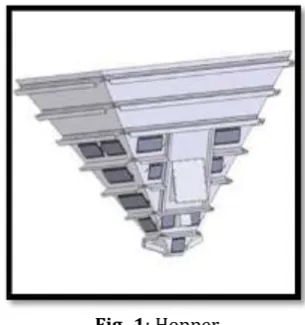
I. Hopper
‘Hopper’ is defined as a container which generally tapers downward and is able to discharge the material stored in it at the bottom. It is used for storing the material which is to be dispensed. The reason for using hopper in these types of machines is, due to it tapering shape at the bottom, the amount of material falling from the container can be controlled, making the process more uniform. Hopper increases the collection quantity. Hopper walls are coated and protect the materials inside it from contamination.
[image:6.595.355.508.564.727.2]© 2019, IRJET | Impact Factor value: 7.211 | ISO 9001:2008 Certified Journal | Page 2135
II. Load cell sensorA load cell is a sensor that converts a load or force or weight acting on it into an electronic signal. This electronic signal can be a current change, voltage change or Frequency change depending on the type of load cell and circuit used. Principle of piezo-resistivity is used in load sensors. When a load or force or stress is applied to the sensor, the resistance is changed. Resistance change causes change in output voltage when an input voltage is applied. Strain gauge load cells are most commonly in weighing and packaging industry. These load cells are particularly inflexible, have very good echo values, and have longer life cycles in application. Strain gauge load cells work on the principle that the strain gauge (a planar resistor) deforms when the material of the load cells deforms appropriately. Electrical resistance is changed by the deformation of strain gauge, by an amount that is proportional to the strain. The change in resistance of the strain gauge provides an electrical value change that is enumerated to the load placed on the load cell. Calibration process is conducted incrementally, starting working in ascending or descending order.
Fig -1: Load Cell Sensor
III. Arduino Uno Board(Microcontroller)
A micro-controller (noun) is a small computer on a single integrated circuit containing a processor core, memory, and programmable input/output peripherals. The Arduino Uno is a microcontroller board based on the ATmega328. It has 14 digital input/output pins (of which 6 can be used as PWM outputs), 6 analog inputs, a 16 MHz crystal oscillator, a USB connection, a power jack, an ICSP header, and a reset button. Arduino uses its own IDE (Integrated Development Environment) uses as amplified version of C++, making it easier to learn to program.
Fig -3: Arduino Uno Board
IV.
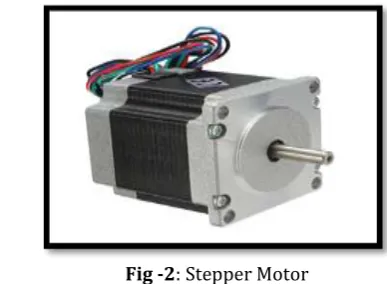
Stepper MotorA stepper motor or step motor or stepping motor is brushless DC electric motor that divides a full rotation into a number of equal steps. The motor's position can then be commanded to move and hold at one of these steps without any position sensor for feedback (an open-loop controller), as long as the motor is carefully sized to the application in respect to torque and speed. Stepper motors are DC motors that move in discrete steps. They have multiple coils that are organized in groups called "phases". With a computer controlled stepping you can achieve very precise positioning and/or speed control. For this reason, stepper motors are the motor of choice for many precision motion control
applications.
Fig -2: Stepper Motor
V.
Stepper Motor Driver [image:7.595.332.533.92.248.2] [image:7.595.85.238.361.500.2] [image:7.595.325.519.460.602.2]© 2019, IRJET | Impact Factor value: 7.211 | ISO 9001:2008 Certified Journal | Page 2136
Fig -4: Stepper Motor DriversVI. Keypad Kit and LCD
This kit is used for giving input values of the desired weight. The LCD displays the input values. This kit is used because,
Offers the most keys
Multi-tap access to all characters (upper and lower cases), numbers, and symbols
Escape key brings up panel settings menu to adjust settings
Fig -5: Keypad kit and LCD Display
5. Experimental Validation
5.1 Processes involved in testing of automatic weighing and packaging machine:
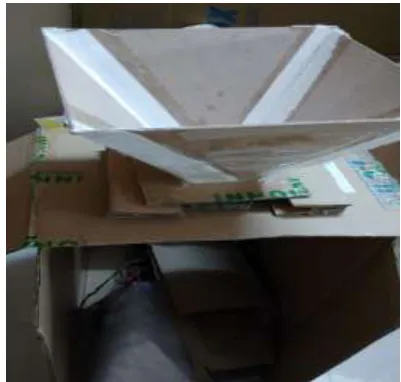
For testing of machine, rice is used for automatic filling, weighing and packing. Figure 7 shows the setup of automatic weighing and packaging machine.
a) Filling the hopper with the material to be dispensed in bags
b) Placing of bags
c) Giving input of amount of weight required d) Collecting the filled bag
5.2 Objective of testing
Main objective of the testing is to check whether the new machine does the work properly like automatic weighing, filling and packaging of the food. To get value of how much
time it require for automatic weighing, filling and packaging of the food. The figures
5.3 Observations
Some of the observations are noted down as Material used: Rice
Type of bag used: Paper Bag Amount of input given: 500 Grams
Time required for filling the bag: 40 Seconds
The experimentation is done and the rate of time required for measuring and dispensing process is measured. It is observed out that the system decreases time, efforts and manpower requirements as compared to traditional manual process. A reduction of 60% to 80% was observed in terms of time allotment for filling, weighing, and sealing. About 90% of full automation without human can be specified from the system.
This project provides the information about developed machine which automatically weighs and packs the food with the help of microcontroller and sensors. The idea is to manually place the bag, then automatic weighing, filling and packaging is done. The purpose of doing this project is to reduce human efforts and time consumption. Decreasing machine cost is the major advantage of our design. The machine design is based on simple mechanisms and it can be installed easily. The speed of packaging is increased thus resulting in more production and business. It will eradicate the traditional packing and sealing method. This process will reduce the number of paid workers.
Main comparative parameters between the older and newer machines are that, it reduces the time required for filling, packing and sealing. It is observed out that the system decreases time, efforts and manpower requirements as compared to older machines. Also the cost of newer machine is very less as compared to older one.
[image:8.595.74.246.100.203.2] [image:8.595.51.269.359.494.2] [image:8.595.332.533.549.740.2]© 2019, IRJET | Impact Factor value: 7.211 | ISO 9001:2008 Certified Journal | Page 2137
Fig -7: Door opening and closing mechanismFig -8: Filled bag with 500 grams of rice
6. Conclusions and future scope
6.1 Conclusion
Low cost automatic weighing and packaging machine which can perform operations of weighing, bag filling and dispensing the bag with maximum efficiency is manufactured. The operating of this machine is simple and chances of error in weight calculation are almost negligible. The time consumption and efforts required for the manual weighing and packaging are minimized. The process is completed in 3 steps. In first step, input value is given; the amount of material of the given input value is dispensed from the hopper to the funnel. In this step, a rotating disc will act as a door and it will get on/off as per the value of input. Weight calculation is done using load cell sensor. Second step consist of a miniature vacuum pump which will broaden the opening of the bag, so that the filling operation will be eased. In third step, by using conveyor belt, the bag will be moved outside the machine. The only task which the operator has to perform is to give the input value and collect the bag after the process is done.
6.2 Future scope
The machine has a wide application in industries. Since the machine is automating the process of weighing, packing and sealing at a very cheap cost, further research will lead to
sophistication of the machine. This automatic weighing and packaging machine can be used widely in packaging industries, food industries, pharmaceutical, dairy products industries Further research will lead to minimization of automation cost for large scale industries also. Integration of artificial intelligence is recommended which could be used for more complex operations. By using File Transfer Protocol (FTP), the packaging and material handling will be a fully automated process without any human intervention. By use of ladder program, the processes such as adding input, adding output devices can also be automated. This project can be useful for the related researches in future in conducting advance researches on Automatic Packaging machines using microcontrollers. This can be helpful in other industries too, resulting in safe operating system, efficient packaging, fast response time and less number of workers.
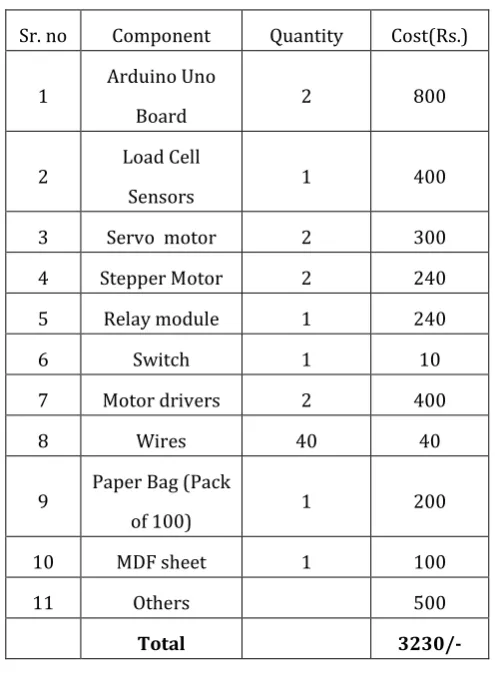
[image:9.595.38.282.60.228.2]7. COST ESTIMATION
Table -1: Cost Estimation
Sr. no Component Quantity Cost(Rs.)
1 Arduino Uno
Board 2 800
2 Load Cell
Sensors 1 400
3 Servo motor 2 300
4 Stepper Motor 2 240
5 Relay module 1 240
6 Switch 1 10
7 Motor drivers 2 400
8 Wires 40 40
9 Paper Bag (Pack
of 100) 1 200
10 MDF sheet 1 100
11 Others 500
Total 3230/-
REFERENCES
[1] Tawanda Mushiri, Charles Mbohwa, International
Conference on Operations Excellence and Service Engineering Orlando, Florida, USA, September 10-11, 2015.
[2] Shashank Lingappa M., Vijayavithal Bongale,
[image:9.595.45.281.260.404.2] [image:9.595.310.558.336.676.2]© 2019, IRJET | Impact Factor value: 7.211 | ISO 9001:2008 Certified Journal | Page 2138
Mechanical Engineering.ISSN 2250-3234 Volume 4,Number 7 (2014), pp. 803-811
[3] Melchizedek Alipio, Angelo A. Beltran Jr., International
Journal of Scientific Engineering and Technology (ISSN: 2277 – 1581), Volume No. 3, Issue No. 6, pp: 767 – 770. 1 June 2014
[4] Mr. Abhishek Shigwan, Mr. Pankaj Shirke, Ms. Snehal
Ukarde, Ms. Priyanka Salaskar, Mr. Guru Bhurshe, IJSRD - International Journal for Scientific Research & Development| Vol. 4, Issue 02, 2016 | ISSN (online): 2321-0613
[5] M. R. Saraf, V. V. Ruiwale, V. V. Kulkarni and S. M.
Kulkarni, International Journal of Current Engineering and Technology (E-ISSN 2277 – 4106, P-ISSN 2347 – 5161), Special Issue-4 (March 2016)
[6] Alhade A. Algitta, Mustafa S., Ibrahim F., Abdalruof N.
and Yousef M., titled as ‘Automated Packaging Machine Using PLC’ IJISET - International Journal of Innovative Science, Engineering & Technology, (ISSN 2348 – 7968) Vol. 2 Issue 5, May 2015
[7] Said Elshahat Abdallah and Wael Mohamed Elmessery,
titled as ‘an innovative low-cost automatic prototype for fruits and vegetables weight basis packaging’, Misr J. Ag. Eng., 35 (1): 169 – 198, January 2018
[8] Yousef Moh. Abueejela and Abdulhameed K. Belkasem,
‘Inspection, Packaging and Packing Machine Development Based PLC’, Libyan International Conference on Electrical Engineering and Technologies (LICEET2018) 3 – 7 March 2018, Tripoli –Libya.
[9] Rafael Couto Rodrigues de Oliveira, Claudio Garcia, ISA
Transactions 52 (2013) 672–683 0019-0578/$ - see front matter & 2013 ISA. Published by Elsevier Ltd. All
rights reserved.
http://dx.doi.org/10.1016/j.isatra.2013.05.006
[10] Alberto Regattieria, Francesco Pianaa, Mauro Gamberia,
Francesco Gabriele Galiziab, Andrea Castoa, ‘Reliability assessment of a packaging automatic machine by accelerated life testing approach’, 27th International Conference on Flexible Automation and Intelligent Manufacturing, FAIM2017, 27-30 June 2017, Modena, Italy, 2351-9789 © 2017 The Authors. Published by Elsevier
[11] A. Mhalla, S. Collart Dutilleul and M. Benrejeb,
Monitoring of Packaging Machine Using Synchronized Fuzzy Petri Nets, 6th IFAC Conference on Management and Control of Production and Logistics The International Federation of Automatic Control September 11-13, 2013. Fortaleza, Brazil
[12] Dirk Schaefer and Wai M. Cheung, ‘Smart Packaging:
Opportunities and Challenges’, 51st CIRP Conference on Manufacturing Systems, Procedia CIRP 72 (2018) 1022– 1027, 2212-8271 © 2017, Published by Elsevier B.V.
[13] Birgit Geueke*, Ksenia Groh, Jane Muncke, ‘Food
packaging in the circular economy: Overview of chemical safety aspects for commonly used materials’, https://doi.org/10.1016/j.jclepro.2018.05.005 0959-6526/© 2018, Published by Elsevier Ltd. This is an open access article under the CC BY-NC-ND license (http://creativecommons.org/licenses/by-nc-nd/4.0/).
[14] Agnes L. Karmausa,∗, Ron Osbornb, Mansi Krishanc,
‘Scientific advances and challenges in safety evaluation of food packaging materials: Workshop proceedings’, 0273-2300/ © 2018 The Authors. Published by Elsevier
Inc. This is an open access article under the CC BY-NC-ND license.
Web references
[15] https://www.tdipacksys.com/packaging-
[16] https://www.uniquepackagingmachines.com/automatic
-weighing-filling-packaging- machines.html
[17]
https://www.technopac.net/weighing-packing-machine.html
[18] https://www.tdipacksys.com/packaging-
[19]
https://uspackagingandwrapping.com/blog/how-does-a-heat-sealer-work.html