Direction Finding Using Cumulant in Multipath
Environment with an Arbitrary Array
Maryam Johnny1, Vahid Tabataba Vakili2, Mansour Sheikhan1
1Electrical Engineering Department, Islamic Azad University-South Tehran Branch, Tehran, Iran; 2Electrical Engineering Depart-
ment, Iran University of Science and Technology, Tehran, Iran. Email: [email protected]
Received January 3rd,2012; revised February 8th, 2012; accepted March 13th, 2012
ABSTRACT
In this paper, the problem of estimating the direction of arrival of signals of which some may be perfectly correlated is considered. This method can be applied in the situation that the non-Gaussian independent and coherent signals coexist with unknown Gaussian noise. In this method at first via mappings, the virtual uniform linear array (ULA) and also the shifted versions of this virtual ULA by assuming that all the DOAs are located in one section are constructed. In order to avoid coloring the noise because of these mappings we use a cumulant matrix instead of a covariance ones. In this method since we construct all the subarrays virtually for detection of coherent signals we do not need the array with regular configuration. The advantages of this method are: increasing the array aperture, having the ability to find the DOAs with fewer sensors and also avoiding the coupling between sensors as much as possible in contrast to conven- tional spatial smoothing.
Keywords: Array Interpolation; Direction of Arrival; MUSIC; Cumulant; Uniform Linear Array
1. Introduction
Direction finding techniques based on the eigendecom- position of the covariance matrix of the vector of the sig- nals received by an array of sensors, have received con- siderable attention in years. The main drawback of these techniques like MUSIC [1] is their inability to handle perfectly correlated (or highly correlated) signals which arise quite often in practice due to multipath propagation. This fact has motivated various researchers to look for variations of the MUSIC algorithm which do not suffer from this problem. Under the certain conditions, spatial smoothing technique introduced in [2,3] makes it possible to use a MUSIC type algorithm in the presence of arbi- trary signal correlation. The most restrictive aspect of the spatial smoothing technique as presented in [2] and dis- cussed further in [3,4], is that it requires a linear uni- formly spaced array and also has a significant loss of array aperture. Other techniques, such as the one pre- sented in [5], appear to have similar restrictions. Also these methods all assume that the additive noise is a white Gaussian process or the noise covariance matrix is known in advanced. On the contrary, in many practical situations, the additive noise is colored Gaussian process and a priori estimate of the noise covariance matrix is not available therefore these methods will suffer severe per- formance degradation. Owing to the attractive property
of Gauassian processes that all cumulant spectra of order greater than two are identical to zero, many effective algorithms based on cumulants [6,7] have been proposed. An attempt to generalize the spatial smoothing technique based on cumulant to arbitrary array geometries (Sparse Array) by using the idea of interpolated array [8] is the main topic here. In this method we need no extra sensors and subarrays so array aperture significantly increased means that we need only K + 1 sensors for detection of K
coherent signals in contrast to conventional spatial smoo- thing that needs 2K sensors or FBSS that use 3
2K sen-
sors [9]. This paper is organized as follows. A definition of cumulant and some properties of that is introduced in Section 2. Narrowband signal model and also the pro- posed method of DOA estimation are then considered and analyzed in detail in Sections 3 and 4, respectively. The simulation results to validate the effectiveness of our method are shown in Section 5 and some concluding remarks are given in Section 6.
2. Cumulant for Array Processing
ments, as in the Gaussian case; however, in real applica- tions, practical far field sources often emit non-Gaussian signals, e.g., as in a communication scenario. Whenever second-order statistics can not completely characterize all of the statistical properties of underlying signals, it is beneficial to consider information embedded in higher than second-order moments. Higher order prove to be re- warding alternative to second order statistics, and there are many signal processing problems that are not solv- able without access to HOS [10]. Particular cases of higher order statistics (Cumulant) are the third and fourth order statistics. In most of the application that deal with cumulant we use fourth order statistic, a logical question to ask is “why do we need fourth order cumulant?” If a random process is symmetrically distributed like Laplace, Uniform, Gaussian, etc. then its third order cumulant equals zero. Additionally, some processes have extremely small third order cumulants and much larger fourth order so for such a process we must use fourth order cumulant. We list properties of cumulants that are useful to us in the sequel [10]:
[CP1]—If i1 are constants and are ran- dom variables, then
n i
n1i i x
1 1 2 2
1 2 1, , , n n n i , , , n
i
cum x x x cum x x x
n [CP2]—Cumulants are additive in their arguments
1 1 2
1 2 1 2
, , ,
, , , , , ,
n
n
cum x y x x
cum x x x cum y x x
n
[CP3]—If the random variable
xi i are independent of the random variables
yi in, then, y ,
, y
1 1 2 2
1, , ,2 1, , ,2
n n
n
cum x y x x
cum x x x cum y y y
n
[CP4]—Cumulant suppress Gaussian noise of arbitrary covariance, i.e., if
zi in1 are Gaussian random variables independent of
xi in1 and we have,x z ,
2,
n
1 1 2 2 , nzn
1, , ,2 ncum x z x cum x x x
n
[CP5]—If a subset of random variables
xi i1 are independent of the rest, then
1, , ,2 n
0cum x x x
[CP6]—The permutation of the random variables does not change the value of the cumulant.
In this paper we use Fourth order Cumulant defined as follows:
, , ,
, , ,
i j k l
i j k l i j k l
i k j l i l j k
Cum r r r r
E r r r r E r r E r r
E r r E r r E r r E r r
3. Problem Formulation
Consider an arbitrary array composed of M sensors. Let q
narrowband and non-Gaussian plane waves with zero mean, centered at frequency 0, impinge on the array
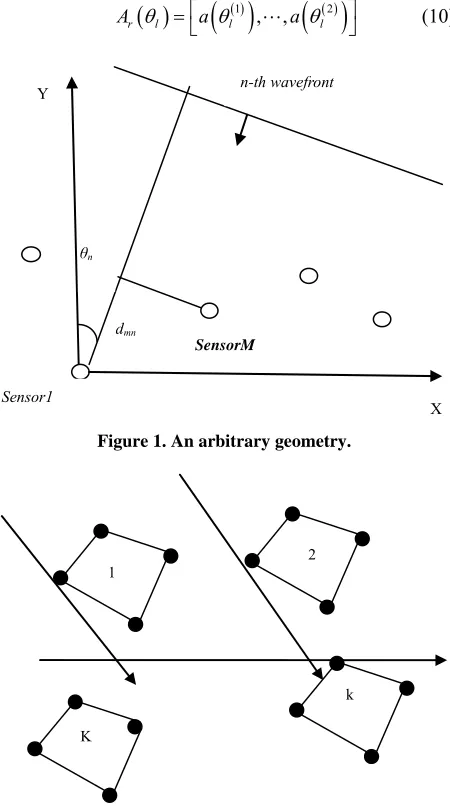
with M sensors like Figure 1 from directions
w
1, ,q
.Using complex signal representation, the received signals at the mth sensor can be expressed as
π sin cos
1
m n m n
q
j x y
n n m
n
r t a s t e n t
(1)where s tn
ais the signal associated with the nth wave- front, n is the complex response of the sensor to the
nth wavefront,
x ym, m
are the coordinates of the mth sensor measured in half wave-length unites and n tm
is an additive noise at the mth sensor. In addition, the unknown noise is assumed to be Gaussianwith variance2
, uncorrelated with the signals and uncorrelated from sensor to sensor. Rewriting (1) in a vector notation, as- suming for simplicity that the sensors are ominidirec- tional with unit gain, i.e., an1, we obtain:
q
n 1 n n
a s t
r t n t (2)
where r t
,n t are the M1 vector
1
, ,
T M
t r t r t
r (3a)
1
, ,
T M
t n t n t
n (3b)
And a
n is the steering vector of the array in the direction n:
j xπ1sinn y1cosn, , j xπMsin n yMcosn Tn e e
a (4)
To further simplify the notation, we rewrite (2) as
A
S t r t n t (5)
where S(t) is the q1 vector as:
1
, ,
T q
s t s t
S t (6)
and A
is the M q matrix
a
1 , , a
q A (7)
also the fourth order cumulant of can be computed
as (8).
r t
, , ,
, , ,
i j k l
i j k l i j k l
i k j l i l j k
Cum r r r r
E r r r r E r r E r r
E r r E r r E r r E r r
(8)
For 1i j k l M, , , .
coloring we use cumulant counterpart instead of a co- variance. In fact we replace every member of covariance matrix with its cumulant counterpart which is computed in the sufficient snapshots by (9).
2
1 1
2 4, 1
1 1
1
1 1
1 1
1 1
1 1
1 1
1 1
, , ,
1
( )
1 1
1 1
1 1
p
p p
p p
p p
k l
s
k l
s N
k l
t p
N N
k l
t t
p p
N N
k l
t t
p p
N N
l
t t
p p
E r t r t
cum r t r t r t r t a
r t r t r t r t N
r t r t r t r t
N N
r t r t r t r t
N N
r t r t r t r
N N
k
t
(9).
4. Proposed DOA Estimation
4.1. Spatial SmoothingCommunication systems operating in a mobile commu- nication environment may encounter multipath propaga- tion caused by various reflected surfaces (e.g., buildings, hills, cars, etc.). When a signal wavefront reflects off of a surface, the original wavefront and the reflected wave- front will both impinge on the receiving array of sensors, although from different directions. Since the original signal and reflected signal come from the same radiating source, if the delay difference between the two paths is sufficiently small, then the signals are coherent (i.e., fully correlated) and their covariance matrix or cumulant ma- trix is singular. As was pointed out in the previous sec- tion, the nonsingularity of the signal covariance matrix or cumulant matrix is the key to successful application of eigenstructure techniques. Many effective decorrelated methods are then proposed to overcome this problem. Among these methods, the spatial smoothing techniques are relatively more effective, which are first introduced in [2] and extensively studied by Shan et al. [3] and Pillai and Kwon [9]. Their solutions are based on a preproc- essing scheme that divides the original array into number of subarrays. Then the average of the subarray covari- ance matrices is computed and in conjunction with the high-resolution methods to resolve the signals. Examina- tion of the smoothing technique described in [13,14] reveals that it is not limited to uniform linear arrays. The forward and also forward-backward spatial smoothing can be performed on any array which can be subdivided into subarrays which all have the same configuration, but are shifted with respect to each other like Figure 2. But
when it is urgent to use Sparse array or any array that has not a suitable construction for using spatial smoothing like Figure 1 what should we do for the detection of the
K coherent signals?
4.2. Array Interpolation
1) The first step in designing an interpolated array is to divide the field of view of the real arbitrary array into sectors.
2) For each sector we define a set of angles like
1, 1 , 1 2 , , 2
l l l l l
where
2 1
l l
n
. These angles are used only in the design of the interpolation matrix.
3) Compute the steering vectors associated with the set l for the given real array and arrange them in a matrix as follows:
1
, ,
r l l l
A a a 2 (10)
θn
n-th wavefront
Y
Sensor1
SensorM
dmn
[image:3.595.95.287.137.326.2]X
Figure 1. An arbitrary geometry.
1
2
K
k
[image:3.595.311.536.316.719.2]Next we decide where we want to place the virtual elements of the interpolated array, having decided on their locations we can compute the array manifold of the interpolated array. We denote by Al the section of this array manifold computed for the angles l also as fol- lows:
1
, ,
l l l
[image:4.595.65.278.599.724.2]A a a 2 (11) In other words Ar
l , A
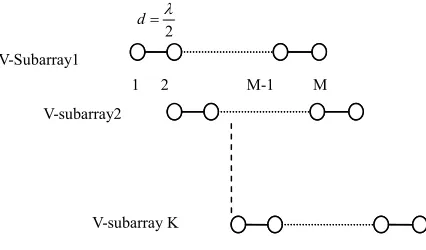
l are the responses of the real and virtual arrays to the signals arriving from the set l respectively. In this paper we try to create virtual subarrays having a suitable geometry for the application of the spatial smoothing technique. The idea in this paper is to select the uniform linear arrays as the virtual subar- rays all having the same number of sensors as the origin- nal real array but are shifted versions of each other likeFigure 3. The displacement vector of these virtual su-
barrays and also between their sensors is equal to
2
. 4) The basic assumption is that the array manifold of the virtual array can be obtained by linear interpolation of the array manifold of the real array, within each sec- tor. In other words, we assume that there exist a constant
M M matrix Bl such that
( )
lAr l A l
B (12a)
Of course, the interpolation is not exact and therefore the equality above does not really hold. The “best” in- terpolation matrix Bl is the one which will give the
best fit between the interpolated response BlA
l and the desired response A
l .In this paper we assume that all the coherent DOAs are located in one section like
1, 2
, this section is di- vided with the calibration angles.
1 1 1 2
2 1
, , , ,
where , 1, ,
i
i n
n
where n is the division index, Avk
,Ar are the manifold matrixes for the kth desired virtual subarray and real array respectively constructed from these calibrationV-Subarray1
V-subarray2
V-subarray K
1 2 M-1 M
2
d
Figure 3. Virtual subarrays.
angles . Because every virtual subarray is the shifted version of the first virtual subarray. So:
1
1
k
vk Av D Bk r
A A (12b)
where denotes the kth power of the diagnal matrix D as follows:
k
D n n
0 0 0
1 1
sin sin sin sin sin
diag , , , ,
jw d jw d jw d
c c c
e e e 2
D
0
f
0 2π
w (13) In (13) parameter c is the speed of light and d is the distance between adjacent sensors of virtual ULA that for avoiding grating lobe it must be equal to half a wave- length
2
d
. By the idea of interpolation as de-
scribed in 4.2 we can relate every virtual subarray to the real ones by solving a following linear equation:
vk Bk r
A A
(14)In following we use the cumulant’s properties in the direction finding. Since the Cumulant or Fourth order moment is blind to additive Gaussian noise (color or white) as shown in (CP4) the Fourth order Cumulant ma- trix counterpart of the real array is obtained as follows:
Hr c r
C A S A (15a) where Sc is the q q Cumulant matrix of signals that impinge on the real array. After obtaining interpolation matrix Bk for every virtual subarray now we can com- pute the cumulant of these subarrays as follows:
H
k k k
C BCB (15b) Now the spatially smoothed cumulant matrix is de- fined as the sample means of the virtual subarrays cumu- lants:
1
1 K
k k C
K
C (16)where K is the number of virtual subarrays that for non- singularity of Cit should be larger than the number of coherent signals. If mapping matrices
best se-lected then
kB
C becomes:
1
1
†
1 1
1
1 K
Hk k
V c
k
C A E S E A
K
v (17)And EK is the kth power of E.
0 0 0
1 2
sin sin sin
0 0
diag , , ,
2π
where π
2
q
jw d jw d jw d
c c c
E e e e
w d f
c c
† 1 1 1 1 1 1 1 1 1 1 1 K k k c c k c k k cS E S E
K
I S
K E
I E E
S E K
(18)Which can be further simplified to: H c
S GG (19) where G is the q Kq block matrix:
k 1C E C E C
G (20)
In which C denoting the Hermitian square root of 1
c
S
K . It is clear that the rank of C is equal to the rank
of Sc. Thus our task is to prove that G has rank q even when this q signals are coherent. Recalling that the rank of a matrix is unchanged by a permutation of its columns, it can be easily verified that G can be written in the form
of (21).
11 1 12 1 1 1
1 2
q
q q q q qq q
c b c b c b
c b c b c b
G q (21)
where is the ijth element of the matrix C and
is the column vector: ij c 1, , i
i b K1
0sin 2 0sin 0sin 1 jw i jw i Kjw i T
i e e e
b (22)
To show that the matrix is of rank q, it suffices to show that each row of the matrix S has at least one non-
zero element and that all the vectors i are linearly in- dependent. The first fact follows by contradiction. As- sume that a row of , say the kth, is composed of all zeros this implies that the kth signal has zero cumulant, in contradiction to the definition of as the cumulant matrix of nonvanishing non-Gaussian signals. The linear independence of the vectors bi follows by observing that these vectors can be embedded in a vandermonde matrix. Since rank of
G
b
C C
c
S is equal to the rank of and rank of is so the rank of
G
G q C is . At the end
we apply one of the subspace methods to
q C.
5. Simulation and Experimental Results
In this section, we illustrate the performance of our me- thod through simulations. We select conventional spatial smoothing in the presence of white noise with variance2
n
as a comparative method. In the first simulation, we consider three non-Gaussian coherent signals received by two arrays, ULA for the Conventional Spatial Smoothing
and the known arbitrary one for our Cumlant Spatial Smoothing each with 7 sensors. The amplitudes and phases of the complex fading coefficient of coherent sig- nals are [1, 0.7, 0.6] and 7 ,12 , 22
2
n
respectively. The unknown colored Gaussian additive noises are generated by passing the complex white Gaussian random proc- esses with zero mean and variance through a spatial moving average (MA) filter of order 2 with coefficients
a a0, ,1 a2
, where
a a0, ,1 a2
are selected to be
1, 0.8, 0.6
in the simulations. The input SNR is defined
as
2
s
10 2 2 0 1 g
a a a
2 2 2 n 10lo
. Note that the noise co- variance matrices for colored and white noises have the same trace, i.e. total noise power introduced to these me- thods have the same power. 200 Monte Carlo trials were performed for each experiment, and the root mean square error (RMSE) of the DOA estimates is used as the per- formance index:
200
1 1 2 0
ˆ 0 q
n k Ns
n
2k k
RMSE
where ˆk
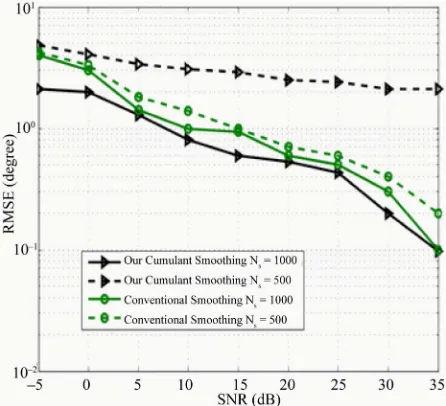
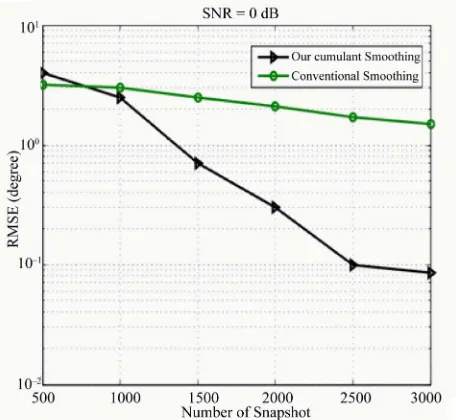
n is an estimate of k for the nth Monte Carlo trial, and is the number of all the independent or coherent signals. In Figure 4 the RMSE of the DOA [image:5.595.56.289.85.268.2]estimates against input SNR is shown with the Ns = 500 and 1000 snapshots for the two methods. Also the RMSE of the DOA estimate of two methods versus the number of snapshots with input SNR equaling to zero is shown in
Figure 5. In these two simulations we assume that the
division index is n = 50 for our method. As it is clearly seen, the performance of our method (Cumulant Spatial Smoothing) is better than Conventional spatial smoothing
q
[image:5.595.312.535.505.708.2]Figure 5. RMSE of the DOA estimates against number of snapshot.
specially in low SNR but against the increasing of snap- shots. In the third simulation we show the performance of our method versus division index n in the presence of three predefined coherent signals. As it is obvious in
Figures 6(a)-(c), by choosing n as large as possible we
can get a better resolution (targets are distinguished clearly). To investigate the performance of our cumulant based method, we performed additional experiments by changing both the SNR and the data length. Each mean and standard deviation pair in each table are obtained from 100 independent realizations. Table 1(a) reports the
results of Spatial Smoothing for 200 snapshots with dif- ferent SNRs in which the conventional spatial smoothing based on sample covariance means is selected as a direc- tion finder method. Table 1(b) also shows the perform-
ance of conventional spatial smoothing versus two dif- ferent snapshots with SNR equaling to zero.
From Tables 1(a), (b) it is obvious that the conven-
tional spatial smoothing is more dependent on SNR than snapshot and can estimate DOAs with fewer snapshots by increasing the SNR accurately. Also we repeat the experiment again for our method based on the sample cumulant means with division index n = 50, as it is seen in Table 2(a) we can obtain better estimations in the low
SNR by increasing the number of snapshots or data lengths. Table 2(b) also shows the performance of our
method versus two different SNRs with a number of snapshots equaling to 200.
As shown in Table 2(b) our cumulant spatial smooth-
ing fails in general in a few snapshots, it means that the effect of snapshots in our method is more than the SNR in contrast to conventional spatial smoothing. In the latter
[image:6.595.58.286.87.297.2]Table 1. (a) (b), DOA estimation with conventional spatial smoothing with 7 sensor versus SNR and snapshot.
(a)
DOA 7˚ 13˚ 22˚
SNR = –5 dB Snapshot = 200
Mean = 10.8546 Std = 2.2275
Mean = 16.3767 Std = 2.3773
Mean = 25.0914 Std = 2.2781 SNR = 0 dB
Snapshot = 200
Mean = 8.3541 Std = 1.1636
Mean = 14.3715 Std = 1.0297
Mean = 23.6741 Std = 1.1233 SNR = 5 dB
Snapshot = 200
Mean = 7.2890 Std = 0.2917
Mean = 13.5066 Std = 0.2954
Mean = 22.44 Std = 0.2840 SNR = 10 dB
Snapshot = 200 Mean = 7.0053 Std = 0.1669 Mean = 13.1017 Std = 0.2909 Mean = 22.1270Std = 0.2812
(b)
SNR = 0, Snapshot = 500
Mean = 8.3133 Std = 1.1587
Mean = 14.1541 Std = 1.0133
Mean = 23.2541 Std = 1.1011 SNR = 0
[image:7.595.308.538.85.286.2]Snapshot = 1000 Mean = 8.2522 Std = 1.0539 Mean = 14.1071 Std = 1.0117 Mean = 23.0990Std = 1.0036
Table 2. (a) (b), DOA estimation with our cumulant method with 7 sensors versus SNR and snapshots.
(a)
DOA 7˚ 13˚ 22˚
SNR = 0 dB
Snapshot = 200 MeanStd = 1.7519 = 9.9831 Mean = 14.5400 Std = 1.6910 Mean = 24.6120Std = 1.7063 SNR = 0 dB
Snapshot = 1000
Mean = 8.1503 Std = 1.1636
Mean = 14.1648 Std = 1.1600
Mean = 23.6741 Std = 1.1215 SNR = 0 dB
Snapshot = 1500
Mean = 7.6748 Std = 0.3010
Mean = 13.7687 Std = 0.3943
Mean = 22.9125 Std = 0.4016 SNR = 0 dB
Snapshot = 2000
Mean = 7.2568 Std = 0.2961
Mean = 13.4101 Std = 0.2655
Mean = 22.1988 Std = 0.2531
(b)
SNR = 0, Snapshot = 500
Mean = 8.4111 Std = 1.2683
Mean = 14.6851 Std = 1.1725
Mean = 23.5630 Std = 1.2031 SNR = 5,
Snapshot = 500
Mean = 8.0961 Std = 1.1700
Mean = 13.9589 Std = 1.0027
Mean = 23.1065 Std = 1.0260
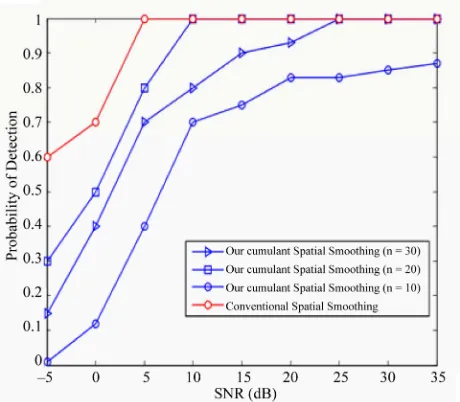
methods (Cumulant and conventional spatial smoothing). This detection is computed over 250 independent trails by detecting the source(s) at within an in- terval of around this actual DOA. Figure 7 shows
this detection probability for our cumulant spatial smooth- ing with three different ns and also conventional spatial smoothing versus SNR. As it is clearly seen by increas- ing the n we can get better detection probability. As the explanation of Figure 7 we must say that the detection
probability of our method is more depend on mapping matrix k
DOA 22
0.1
B obtained from solving Equation (14). We see
that by selecting n as large as possible we can obtain the best mapping matrix as in [15-17] has been said.
6. Conclusion
In this paper, DOA estimation method in multipath envi- ronment with fewer sensors has been presented. We have taken the effects of cumulant and interpolated array into
Figure 7. Probability of detection versus SNR and n.
account in spatial smoothing. In this paper, by the use of mapping and interpolation techniques in an arbitrary ar- ray geometry we tried to approach to the ULA and also shifted versions of this ULA so that the spatial smoothing can be performed on it, therefore the need for extra real subarrays has been removed. Because this mapping can color the white noise and also in practical situation we don’t have any knowledge of Gaussian noise, we use cumulant instead of the covariance of data. The simula- tion results presented illustration of the performance of our method against n, SNR and the number of snapshots. We see by increasing these parameter the resolution and the probability of detection of our method will be better.
REFERENCES
[1] A. J. Barabell, “Improving the Resolution Performance of Eigenstructure Based Direction Finding Algorithms,” Proceedings of the International Conference on Acoustics, Speech, and Signal Processing,Boston, Vol. 8, 1983, pp. 336-339.
[2] T. J. Shan and T. Kailath, “Adaptive Beamforming for Coherent Signals and Interference,” IEEE Transactions on Acoustic Speech and Signal Processing, Vol. 33, No. 3, 1985, pp. 527-536.doi:10.1109/TASSP.1985.1164583 [3] T. J. Shan, M. Wax and T. Kailath, “On Spatial Smooth-
ing of Estimation of Coherent Signals,” IEEE Transac- tions on Acoustics, Speech and Signal Processing, Vol. 33, No. 3, 1985, pp. 806-811.
doi:10.1109/TASSP.1985.1164649
[image:7.595.56.288.324.498.2]rection of Arrival Estimation: A Signal Subspace Ap- proach,” IEEE Transactions on Aerospace and Electronic Systems,Vol. 25, No. 1, 1989, pp. 31-47.
doi:10.1109/7.18659
[6] M. C. Dogan and J. M. Mendel, “Application of Cumu- lants to Array Processing—Part I: Aperture Extension and Array Calibration,” IEEE Transactions on Signal Proc- essing,Vol. 43, No. 5, 1995, pp. 1200-1216.
doi:10.1109/78.382404
[7] S. Lie, A. R. Leyman and Y. H. Chew, “Fourth-Order and Weighted Mixed Order Direction-of-Arrival Estimators,” IEEE Signal Processing Letters, Vol. 13, No. 11, 2006, pp. 691-694.doi:10.1109/LSP.2006.879456
[8] M. Johnny, M. Johnny and V. T. Vakili, “Wideband Di- rection Finding Using Cumulant in Arbitrary Array,” IEEE International Conference on Acoustic, Speech, and Signal Processing,Victoria, October 2011, pp. 135-139. [9] S. U. Pillai and B. H. Kwon, “Forward/Backward Spatial
Smoothing Techniques for Coherent Signal Identifica- tion,” IEEE Transactions on Acoustics, Speech, and Sig- nal Processing,Vol. 37, No. 1, 1989, pp. 8-15.
doi:10.1109/29.17496
[10] M. C. Dogan and J. M. Mendel, “Applications of Cumu- lants to Array Processing—Part I: Aperture Extension and Array Calibration,” IEEE Transaction on Signal Proc- essing,Vol. 43, No. 5, 1995, pp. 1200-1216.
[11] P. Chevalier, A. Ferreol and L. Albera, “ High Resolution Direction Finding from Higher Order Statistics: The 2q-
MUSIC Algorithm,” IEEE Transactions on Signal Proc- essing, Vol. 55, No. 11, 2008, pp. 5337-5350.
doi:10.1109/TSP.2007.899367
[12] R. O. Schmid, “Multiple Emitter Location and Signal Pa- rameter Estimation,” IEEE Transactions on Antennas and Propagation, Vol. 34, No. 3, 1989, pp. 276-380.
doi:10.1109/TAP.1986.1143830
[13] M. J. D. Rendas and J. M. F. Moura, “Resolving Nar- rowband Coherent Paths with Nonuniform Arrays,” Proc- essing of the International Conference on Acoustics, Speech, and Signal Processing,Glasgow,1989, pp. 2625-2628. [14] H. Y. Wang and K. J. R. Liu, “2-D Spatial Smoothing for
Multipath Coherent Signal Separation,” IEEE Transac- tions on Aerospace and Electronic Systems, Vol. 34, No. 2, 1999, pp. 391-405.doi:10.1109/7.670322
[15] P. Hyberg, J. Magnus and B. Ottersten, “Array Interpola- tion and DOA MSE Reduction,” IEEE Transactions on Signal Processing, Vol. 53, No. 12, 2005, pp. 4464-4471. doi:10.1109/TSP.2005.859341
[16] G. H. Glob and C. F. Van Loan, “Matrix Computation,” Johnn Hapkins University Press,Baltimore,2007, pp. 425- 426.