Risks in Critical Infrastructure
Awais Rashid[0000−0002−0109−1341]†, Joseph Gardiner[0000−0003−4748−4228]†, Benjamin Green[0000−0002−1013−9933]‡, and Barnaby
Craggs[0000−0002−6706−9745]†
†Bristol Cyber Security Group, University of Bristol, Bristol, UK;‡Security Lancaster Institute, Lancaster University, UK⋆⋆
†{awais.rashid,barney.craggs,joe.gardiner}@bristol.ac.uk; ‡[email protected]
http://www.bristol.ac.uk/engineering/research/cyber-security/
Abstract. Industrial Control Systems (ICS) play an important role in the monitoring, control and automation of critical infrastructure such as water, gas, oil and electricity. Recent years have seen a number of high profile cyber attacks on such infrastructure exemplified by Stuxnet and the Ukrainian Power Grid attacks. This naturally begs the question: how should we manage cyber security risks in such infrastructure on which the day-to-day functioning of societies rely? What are the complexities of managing security in a landscape shaped by the often competing de-mands of a variety of stakeholders, e.g., managers, control engineers, enterprise IT personnel and field site operators? What are the challenges posed by the convergence of Internet of Things (IoT) and critical infras-tructure through the so-called Industrial Internet of Things (IIoT)? In this paper, we discuss insights from a multi-year programme of research investigating these issues and the challenges to addressing them.
Keywords: Cyber security·Industrial control systems·Critical infras-tructure·Industrial IoT·Cyber risk decisions.
1
Introduction
Critical infrastructure systems, e.g., water, power, etc. are increasingly being connected to other enterprise systems for a variety of reasons. These range from the need to remotely update and maintain systems, reducing the effort, time and cost of visiting remote, hard to access facilities through to the desire to gain real-time business intelligence in order to optimise processes and improve efficiencies. Consequently, the past assumption that such systems are air-gapped from wider networks, and the Internet, is increasingly being proven to no longer be valid. Unintentional connections are also an increasing issue, with poorly configured controls allowing outside connections to individual control devices. For instance,
⋆⋆ Current affiliation. The author conducted the work while employed by the Bristol
a browse though the Shodan search engine of Internet connected devices shows a large number of programmable logic controllers (PLCs) from various manu-facturers. As we note above, increasingly, these connections to external systems, and the Internet, are being introduced intentionally for remote connectivity and configuration capabilities or other business needs. This results in a number of risks to critical infrastructures as a consequence of an increased cyber-attack surface.
As we build more and more complex large, connected environments, the scale of connectivity and complexity of such enrivonments will only increase further—resulting in increased scale of attacks and impact. The problem is com-pounded by the fact that often critical infrastructures have multiple organi-sations that collectively contribute to the environment, e.g., power producers and power distribution networks are often owned by different organisations not to mention the large number of organisations that form the supply chain. The infrastructures remain in operation over a long lifespan and their make-up (de-vices, software, communication protocols) changes over time, often resulting in a large number of legacy and non-legacy systems working in conjunction to deliver critical services to citizens.
For instance, we are seeing the emergence of multiple products and services on the market that allow for data from industrial environments to be sent to the cloud for processing, allowing remote monitoring of processes, under the banner of Industrial Internet of Things (IIoT) and Industry 4.0. The latest push is to move onto SCADA-in-the-cloud, where more and more control functions are moved into the remote cloud environment. This transition results in ICS equipment becoming Internet-of-Things devices, with indirect connections to IT networks and the wider Internet—providing a route for attackers to gain access to these devices through compromise of the cloud environment.
Cyber security risks, therefore, need to be managed in the face of these new attack vectors and increased attack sophistication whereby highly resourced ad-versaries may disrupt critical services to large parts of the population. Managing such risks is, however, non-trivial for three reasons:
– Risk is a socio-technical construct—requiring not only an understanding of the technical threat landscape but also organisational and human dimensions of risk and risk decision-making.
– Risks arising from both legacy and non-legacy systems need to be understood especially those that emerge from the convergence of the two.
– Such understanding needs to be developed through direct engagement with the stakeholders and experimentation on realistic infrastructures. The former is often challenging due to the sensitive nature and confidentiality cultures within critical infrastructure organisations. The latter cannot be achieved through experimentation on production environments (as this can lead to disruption to the infrastructure), hence requiring realistic testbeds that en-able modelling and experimentation of non-trival attack scenarios.
infrastructures. We first summarise (Section 2) insights from our prior work [4, 5] to discuss the human and organisational dimensions of cyber risks. We then move onto the technical aspects of the problem and particularly the risks arising from convergence of IIoT and ICS environments. We describe the Bristol Cyber Security Group (BCSG) testbed (Section 3) followed by detailed discussion of an attack (Section 4) against an ICS environment (set up using our testbed) which utilises a cloud provider. We exploit the connection from the operational network to the cloud to provide a tunnel through which we can gain access to the control equipment. Through this access we force the physical process, a wa-ter treatment plant, to enwa-ter an unsafe state by disabling a pressure alarm and increasing he speed of the primary pump.
2
Human and Organisational Dimensions of Cyber Risk
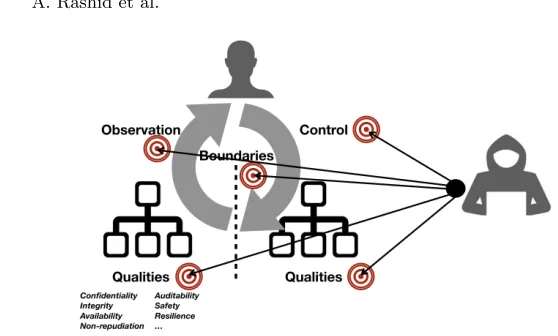
In prior work [5], we analysed a number of high profile attacks against industrial control systems (including those impacting critical infrastructures) and high-lighted that perception errors play a key part in attack success. These perception errors relate to four dimensions (Figure 1):
System qualities Operators may have incorrect perceptions of particular qual-ities of the system, e.g., confidentiality, integrity, availability, resilience, etc. This may lead them to think that the system can withstand particular faults or recover gracefully when this may not be the case in reality.
System boundaries Operators may have incorrect perceptions a system’s iso-lation (physical or virtual) from other systems. This, in turn, may lead the operators to assume that lateral movement across systems or from less criti-cal to mission criticriti-cal systems is not possible when this may not be the case in reality.
Observability Operators may assume that, at a particular point in time, their observation of system behaviour is accurate and complete.
Controllability Operators may assume that, even under attack conditions, they maintain control of the system especially safety-critical components.
However, these perception errors often arise due tolatent design conditions[9] – improper specification of system qualities, borders, observability and control-lability – during conception, design, implementation or evolution. These latent design conditions are further exacerbated when the attacker actively tampers
with the observation and control link between the operators and the system. A number of stakeholder decisions shape security within such a system, and by consequence, may lead to latent design conditions. Previously, we designed a game, Decisions & Disruptions1 and analysed the decision-making processes of three different stakeholder groups: managers, computer science/IT experts and security experts [4]. The game (see Figure 2) charges a team of players to defend a hydro-electric power producer (represented by a LegoR
board) against
1
Fig. 1.Dimensions of cyber risk perception
cyber attacks. Players invest in various defences over four game rounds. Attacks occur during each round and their success depends on the defences in which the players have invested. However, the players have a limited budget in each round (unspent budget carries over to the next round) so they must prioritise and choose amongst the different types of defences. These range from basic defences such as firewalls, anti-virus and security training to more advanced network monitoring solutions. Players can also seek to gain intelligence by paying for a threat assessment and an asset audit. The game is available under a CC-BY-NC license and all the cards, a Bricklink model the LegoR
and the rule book are all available on the website.
[image:4.612.198.420.466.635.2]Our analysis of twelve teams representing the three stakeholder groups: man-agers, computer scientists/IT personnel and security experts from academia and industry has highlighted a number of interesting patterns. We briefly summarise these below. Readers are referred to [4] for a detailed discussion:
– Security experts favoured advanced cyber security protection measures, e.g., the advanced network monitoring product (effectively a very expensive intru-sion detection system) and often deprioritised basic protections (e.g., fire-walls, anti-virus and patching) and intelligence gathering (e.g., threat as-sessment or asset audits). Their discussions werescenario-driven(e.g., what if . . . ) and they had high confidence in their decisions – even when these decisions led them to catastrophic outcomes.
– Computer scientists, by contrast, focused more substantially on intelligence gathering and human factors (e.g., security training) and deprioritised ad-vanced cyber security protection measures. However, they also deprioritised data protection – a fundamental requirement for information security. They useddiverse strategies during decision-making but expressedlow confidence
in their decisions even those that subsequently successfully deflected attacks. – Managers, on the other hand, did prioritise data protection along side ba-sic cyber security protection whilst also favouring advanced cyber security technologies. However, they paid less attention to human factors. Their de-cisions were very muchintuition-driven (e.g., I like the firewall) and they too exhibitedlow confidence in their choices.
The analysis also showed that security experts did not necessarily always perform the best. There were also a number of good, bad and ugly decision-making patterns that stakeholders should look out for when decision-making decisions about cyber seurity in an organisation. These are detailed in [4].
Having summarised human and organisational aspects of cyber security in critical infrastructure settings from prior work, in the rest of the paper, we discuss a concrete scenario emerging from the convergence of tranditional control systems (so-called operational technology (OT)) and Industrial IoT platforms and devices and demonstrate how this leads to an increased attack surfance and successful attacks.
3
Testbed
3.1 Physical process
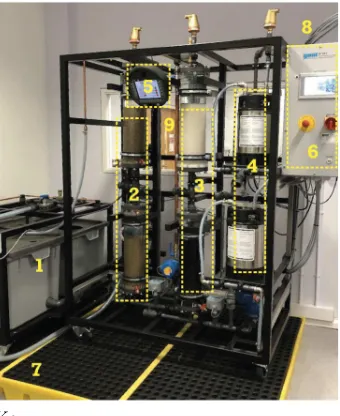
The primary physical process of the BCSG testbed, and the target of the de-scribed attack, is the Gunt CE581 water treatment plant2, as seen in Figure 3. The CE581 system, designed for the training of water treatment engineers, con-sists of a three-stage filtration, absorption and ion-exchange process. The CE581 physical aspect is largely off–the-shelf, however we had the unit customised with safety valves to release system pressure when under attack, and added a remov-able copper pipe between the filtration and absorption stages to allow for the easy installation and removal of additional sensors.
The CE581 initially utilised a small Eaton PLC for control. By using swap-pable terminal blocks, we replaced the control equipment with our own control architecture. This allows us to utilise equipment that more closely represents real-world scenarios. This architecture is discussed in Section 3.2. The original control equipment can be made operational with minimal effort if required for maintenance.
The system has five controllable elements: the pump and 4 electronically operated valves to control the flow of water though the three stages. The system also has a number of sensors, including a pressure alarm, differential pressure across the filtration tanks and temperature sensors.
Normal operation Under normal operation, the system operates with the pump set at 80% speed utilising all three stages of the treatment process. Under these conditions, the system runs with around 1.55 bar of internal pressure. If the pump speed is increased past 90%, the system pressure increases above 1.6 bar. If this occurs, the pressure sensor sends an alarm signal to the PLC, and the logic deactivates the pump. After a few seconds, the pressure will drop below 1.3 bar and the alarm will terminate, allowing the pump to restart. If the pump speed is not reduced, the system will repeatedly exceed the pressure limit, shut down and then restart,
3.2 Control Equipment
We now describe the different pieces of control equipment that control the water treatment process. The control equipment is connected via ethernet to a West-ermo industrial switch, which provides communication between devices and to other services.
Programmable logic controllers (PLCs) The primary PLC for the water treatment plant is a modern Siemens S7-1500. This unit controls the electronic valves and pump speed, as well as receiving inputs from the various sensors on the plant. A second, much older PLC, a Siemens ET200S, is used to control the
2
Key:
1 Input (dirty) & output (clean) water tanks 2 Filtration tanks
3 Absorption tanks 4 De-ionisation tanks 5 Wireless HMI
6 Original control panel, replaced by field site board 7 Safety bunds
8 IO cabling to field site board
[image:7.612.205.375.116.324.2]9 Removable copper pipe for sensor installation
Fig. 3.Water treatment process
pump on-off state. This mix of older (more vulnerable) and newer devices allows us to examine the convergence of old and new devices.
Human machine interfaces (HMIs) The operator HMI is a wireless Siemens panel (MobilePanel 277 IWlAN V2). This is connected to the field site network over WiFi using a Mikrotik access point. The screen can be seen in Figure 5a.
Remote telemetry unit (RTU) Telemetry is provided through a SCADA-pack32 from Schneider, which communicates with the ClearSCADA software.
3.3 Networks
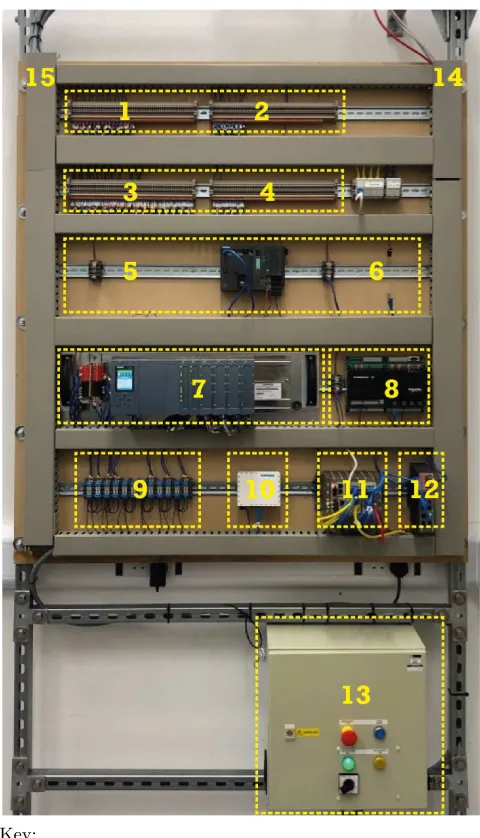
Key:
1 & 2 Digital Inputs\Outputs (32 each) 3 & 4 Analogue Inputs\Outputs (16 each) 5 & 6 Secondary PLC\RTU Housing
7 Primary Programmable Logic Controller (PLC) 8 Primary Remote Terminal/Telemetry Unit 9 24VDC Distribution
10 WiFi Access Point
11 L3 Managed Ethernet Switch 12 Firewall
13 240VAC to 24V DC Power Supplies
[image:8.612.187.427.113.532.2]14 Ethernet Back-haul to Core Network Infrastructure 15 IO Cabling to Physical Process
(a) HMI (b) ClearSCADA
Fig. 5.HMI and ClearSCADA screens
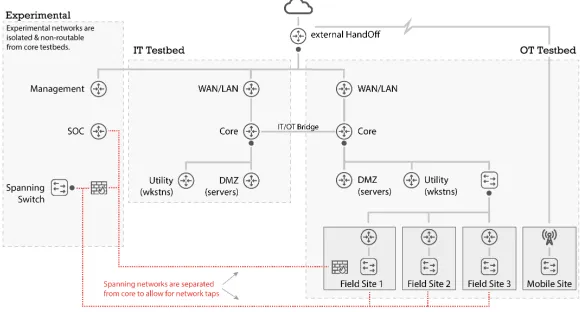
Fig. 6.Testbed network diagram
into multiple subnets, with each assigned its own /24 address space. Along-side the IT and OT networks there exists an experimental network which has a primary function of allowing researchers access to the testbed for experimen-tation and maintenance. For example, all virtual machines have a connection to the management network to allow for easy RDP access. Subnets are mapped to VLANs for allowing access by virtual machines. Each individual field site (physical process and associated control equipment) is assigned its own field site network.
The network is configured with multiple spanning networks to allow for net-work captures across any of the individual subnets within the netnet-work.
3.4 Software
[image:9.612.162.452.281.437.2]machine, which is, in turn, attached to an appropriate set of VLANs to insert the machine into the network architecture.
ClearSCADA from Schneider3is used to display telemetry data to the oper-ations centre. ClearSCADA communicates with the Scadapack32 RTU over the Modbus and DNP3 industrial protocols and sits within the OT-Utility network. A basic example display can be seen in Figure 5b.
KEPServerEX from Kepware4 (henceforth referred to as Kepware) is a data historian which sits inside individual field site networks with direct access to the control hardware. It can read and write data to these devices, and send it on to higher level services, including public cloud services. Kepware is installed within a Windows 7 virtual machine with an installation deployed within each field site network.
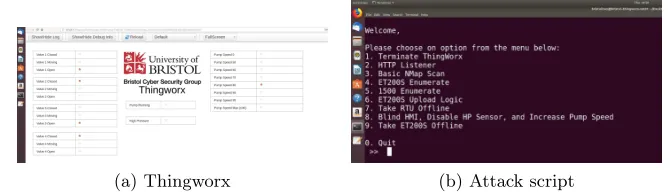
The primary cloud service that we use is Thingworx5 from PTC (who now also own Kepware), a cloud-based IIoT platform. Through a connection to Kep-ware, apps can be developed to run on the Thingworx platform with data from the control devices. Thingworx is deployed within an Ubuntu virtual machine running Tomcat 8.5, as configured by the supplier. An example Thingworx ap-plication for the water process can be seen in Figure 8a.
4
Attack Overview
The physical process under attack is the water treatment plant as seen in Fig-ure 3, with the control equipment mounted onto an specially designed board, as seen in Figure 4. The goal of the attack is to cause the water treatment process to enter into an unsafe state.
The overall conceptual architecture for the attack demonstration can be seen in Figure 7. Data aggregation from the testbed is performed by the Kepware data aggregation platform. In the deployment for the attack scenario, Kepware resides within a Microsoft Windows 7 VM, located within the OT DMZ network on the field site for the water treatment process, communicating directly with the devices on its related control board.
The IIoT cloud platform for the demonstrator is Thingworx, which supports the development of web-based applications utilising IIoT data. The manufactur-ers of Thingworx (PTC) acquired Kepware in 2016, and since have marketed Kepware and Thingworx as an IIoT solution, with Kepware providing data in-puts to the Thingworx platform.
Thingworx is deployed on top of an Ubuntu virtual machine (supplied pre-built by PTC) and uses Apache Tomcat 8.5 as its underlying platform. Our deployment operates Thingworx within a virtual cloud (i.e. inside our closed testbed environment). A trusted communication link between Kepware and Thing-worx is achieved by way of a default, pre-configured, HTTP connection.
3
https://www.se.com/uk/en/product-range-presentation/61264-clearscada/
4
https://www.kepware.com/en-us/
5
Fig. 7.Testbed environment for SecCNIoT demonstrator
(a) Thingworx (b) Attack script
Fig. 8.Thingworx and attack script
4.1 Anatomy of the attack on the OT-IIoT environment
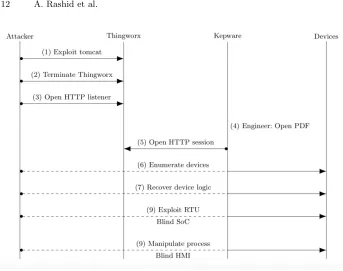
We now discuss the anatomy of the attack we have implemented on this con-verged OT-IIoT environment as modelled within our testbed. It is an evolution of our previous work on attacks in ICS environments [7]. The flow of the attack can be seen in Figure 9.
[image:11.612.138.473.358.454.2]Fig. 9.Attack process. indicates communication over the proxy
onto the host. The attack script, as seen in Figure 8b, is a simple python script utilising command line tools such as nmap and the Step7 python libraries.
(2) Terminate Thingworx On gaining access to the machine, the attacker first takes Thingworx offline by terminating the Tomcat process. This will mean Kepware can no longer communicate with the Thingworx server and will display an error.
(3) Setup HTTP listener The attacker now starts an HTTP listener on the Thingworx host, ready for receiving a connection from within the OT network in the next step.
workstation, are many and varied including USB drives, internet download, an injection into the supply chain (akin to the 2019 malware attack on Asus6) or a direct hack of the workstation itself.
In trying to fix the communication error, the engineer opens the malicious PDF file which, whilst appearing to open as normal for the engineer, executes the attacker’s payload.
(5) Open reverse HTTP connection and set up proxy On opening the malicious PDF, the payload opens a reverse HTTP connection back to the Thing-worx host, connecting to the listener started in step (3). As Kepware already communicated with the Thingworx host over HTTP, this connection is trusted and allowed through any firewalls. The attacker then. sets up a proxy connection through this HTTP link, and pipes all actions from their attack through this proxy, allowing them access to the control devices accessible from the Kepware host.
(6) Enumerate devices Once access has been gained to the ICS devices, the first stage is to enumerate these devices. In the first instance nmap can be used to perform a port scan across the field site network. This should give the attacker a list of devices, and open ports. From the open ports the attacker can gain some insight into the manufacturers of each device. For example, devices with port 102 open indicate Step7, which is the primary protocol in use by Siemens devices.
Specific tools can then be used to gain precise information about device hardware and software. As en example, PLCScan7 can be used to gain details on older Step7 and modbus devices. For newer devices, there are nmap scripts as well as vulnerability scanners, e.g., [1, 2], available for collecting the same information. Returned information includes the hardware and firmware versions, and device name (as set by the operator). Knowing the hardware and firmware version allows the attacker to find publicly known vulnerabilities in the devices. At this stage the attacker could use a known exploit to carry out, for example, a denial-of-service attack. In this scenario we go further to show how an attacker could have a controlled impact on the physical process.
(7) Recover device logic In order to craft attacks which can manipulate the process in a specific way, the attacker first needs to gain a copy of the logic running on the PLCs. This will allow them to know which memory addresses need to be attacked. For the Siemens ET200S, this is a simple case of directly reading a function block from the device using the Step7 protocol. This block will then need to be reverse engineered to recover the logic. For newer Siemens devices, such as the S7-1500, this no longer works. However, if the attacker has
6
https://www.symantec.com/blogs/threat-intelligence/ asus-supply-chain-attack
7
network access to the device and knows the exact hardware variant, the logic can be recovered from the device using the Siemens TIAPortal software.
Whilst reverse engineering the logic may prove difficult, especially if the attacker has no knowledge of the underlying physical process, it is possible to craft attacks using the recovered logic [8].
(8) Exploit RTU to blind control room To exploit the RTU, we developed a zero-day exploit and followed standard disclosure practices for vendor notifi-cation. Details can be found in a Schneider report [3]. Through this exploit, we load a new configuration to the device in order to change the devices IP address. This causes ClearSCADA to lose its connection to the device, meaning that the control room no longer has a view of the system.
(9) Manipulate process and blind HMI The final step is to directly interact with the PLC to interfere with the physical process, and cause the HMI to display incorrect information. This is achieved by repeatedly writing to specific memory addresses within the PLC logic, which overwrites variables used by the logic and specific tags on the PLC. The targeted elements are the state of the pressure alarm, and the pump speed. The pump speed is increased to 95% (above the standard operation of 80%). We also overwrite the variable that is read by the HMI to display the pump speed. Writing is achieved using the S7 protocol, with packets sent repeatedly at a high rate, faster than the PLCs cycle time.
This has the effect that the pump speed increases to 90% which causes the system pressure to exceed the usual safety limit, however the pressure alarm does not trigger the safety cutoff and the pump continues to run. Meanwhile, the HMI displays no pressure alarm and continues to indicate a pump speed of 80%.
5
Conclusion
highly connected to external systems and newer devices and platforms such as IIoT. This leads an increased attack surface that can be exploited by attackers to compromise security and hence safety as well as impact critical services to large swathes of the population. Studying such issues – from a socio-technical perspective – is a key part of our on-going and future work.
Acknowledgements.
This work is funded by EPSRC Grant “Mumba: Multi-faceted Metrics for ICS Business Risk Analysis” (EP/M002780/1), part of the Research Institute on Trustworthy, Interconnected, Cyber-Physical Systems (RITICS) and Lloyds Reg-ister Foundation grant “Securing IoT in Critical National Infrastructure”, part of the UK Research Hub on Cyber Security of IoT (PETRAS). The work is also supported by Rashid’s Fellowship from the Alan Turing Institute.
References
1. Rob Antrobus, Sylvain Frey, Awais Rashid, and Benjamin Green. Simaticscan: Towards A specialised vulnerability scanner for industrial control systems. In 4th International Symposium for ICS & SCADA Cyber Security Research 2016, ICS-CSR 2016, 23 - 25 August 2016, Queen’s Belfast University, UK, 2016.
2. Rob Antrobus, Benjamin Green, Sylvain Frey, and Awais Rashid. The forgotten i in iiot: a vulnerability scanner for industrial internet of things. InIET Conference on Living in the Internet of Things. IET, 2019.
3. Schceider Electric. Security Notification - Modicon Controllers and SCADA-Pack (V3.0). https://www.schneider-electric.com/en/download/document/ SEVD-2017-065-01/, 2019.
4. Sylvain Frey, Awais Rashid, Pauline Anthonysamy, Maria Pinto-Albuquerque, and Syed Asad Naqvi. The good, the bad and the ugly: A study of security decisions in a cyber-physical systems game. IEEE Trans. Software Eng., 45(5):521–536, 2019. 5. Sylvain Frey, Awais Rashid, Alberto Zanutto, Jerry S. Busby, and Karolina
Fol-lis. On the role of latent design conditions in cyber-physical systems security. In
Proceedings of the 2nd International Workshop on Software Engineering for Smart Cyber-Physical Systems, SEsCPS@ICSE 2016, Austin, Texas, USA, May 14-22, 2016, pages 43–46, 2016.
6. Joe Gardiner, Barnaby Craggs, Benjamin Green, and Awais Rashid. Oops I did it again: Further adventures in the land of ICS security testbeds. InACM Workshop on Cyber-Physical Systems Security and Privacy (CPS-SPC). ACM Press, 2019. 7. Benjamin Green, Marina Krotofil, and Ali Abbasi. On the significance of
pro-cess comprehension for conducting targeted ICS attacks. In Proceedings of the 2017 Workshop on Cyber-Physical Systems Security and PrivaCy, Dallas, TX, USA, November 3, 2017, pages 57–67, 2017.
8. Stephen McLaughlin and Patrick McDaniel. Sabot: Specification-based payload generation for programmable logic controllers. In Proceedings of the 2012 ACM Conference on Computer and Communications Security, CCS ’12, pages 439–449, New York, NY, USA, 2012. ACM.