Survey Study of Virtual Machine Migration Techniques in
Cloud Computing
Akram S. A.
Alhammadi
PhD Research Scholar
Computer Science
Department,
Rathinam College of Arts
and Science
,
Bharathiar University,
Coimbatore, India
Sulaiman Ghaleb
PhD Research Scholar
Computer Science
Department,
Rathinam College of Arts
and Science
Bharathiar University,
Coimbatore, India
Salem Ba Hamaid
PhD Research Scholar
Computer Science
Department
Rathinam College of Arts
and Science
Bharathiar University,
Coimbatore, India
V. Vasanthi,
PhD
Research Supervisor
Computer Science
Department
Rathinam College of Arts
and Science
Bharathiar University,
Coimbatore, India
ABSTRACT
Migration of virtual machine is one of the most important features in virtual machine technology .It involves moving a VM from a physical host to another, facilitating balancing load, utilization of resource and reducing energy consumption. The goal of this paper is to present a survey of the main types of virtual machine live migration, their classifications and a comparative study of these techniques in a particular class. It also discusses the algorithms used in virtual machine migration.
General Terms
Algorithms, classifications, techniques
Keywords
Hypervisors, Virtual Machines, Live Migration, Pre-Copy, Post-Copy, virtual machine migration
1.
INTRODUCTION
Cloud Computing is a network based facility that provides shared resources on demand. It offers online data storage, infrastructure, and application, without the need for any infrastructure at the user’s location, except for the input device, the output device, and internet connection. Established as a pay-as-you-use business model. It offers three levels of services namely, Infrastructure as a Service (IaaS), Platform as a Service (PaaS), and Software as a Service (SaaS). Virtualization allows better use of a server by storing multiple operating systems and applications on a single shared computer, which can be used over the network just with the help of a simple web browser and a faster internet connection. Virtualization technology has been widely applied in cloud computing due to its inherent benefits such as elasticity, scalability, flexibility, and on-demand resource provision.[1] Virtual Machine is a complete computer system that is simulated in software. It has complete hardware system functions, and runs in an isolated environment. Large computers or servers might run various different VMs providing different services.
Live virtual machine (VM) migration is a technology, which enables VMs to be moved from one physical host to another while continuing to execute without any loss of connection to the user, even after migration. It demands to move all the state information of the VM being migrated (memory state, network state, and storage stat) from one physical server to
another within the same data center or across remote data centers. [3]
Virtual Machine live migration is usually made in the data centers of the Cloud for the following purposes: load balance, Power management, hardware maintenance and system upgradation. The aims are to distribute load across the physical servers to improve scalability, reliability and availability of virtual machine. The need for migration techniques saves the energy of servers both by using a limited number of servers and also by switching off unused servers in order to reduce power consumption.[4] Supervisors can transfer virtual machines to shut down hosts either for maintenance or for upgradation purposes. This paper is organized as follows: Section 2 discusses the types of virtual machine migration, section 3 presents the algorithms and technician of live migration, Section 4 consolidates the various challenges in live virtual machine migration technique and section 5 presents the conclusions and future work.
2.
TYPES OF VIRTUAL MACHINE
MIGRATION
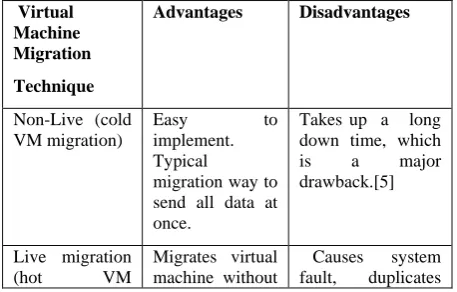
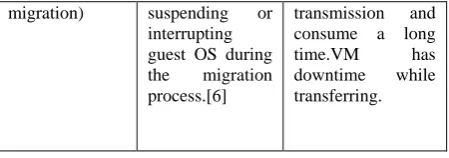
[image:1.595.309.538.617.763.2]There are two main types of virtual machine migration non-live migration and non-live migration. Non-Live migration or Cold migration is the process of migrating the guest OS and its applications after shutting down the OS and then resuming the working of a virtual machine at the target host. The prime advantage of Live migration or Hot migration technique is that it helps in migrating the virtual machine without any shutting down, suspending or interrupting the guest OS.
Table 1 Comparative analysis of various VM migration techniques.
Virtual Machine Migration
Technique
Advantages Disadvantages
Non-Live (cold VM migration)
Easy to implement. Typical
migration way to send all data at once.
Takes up a long down time, which is a major drawback.[5]
Live migration (hot VM
Migrates virtual machine without
migration) suspending or interrupting guest OS during the migration process.[6]
transmission and consume a long time.VM has downtime while transferring.
2.1 Live Migration
There are three types of live virtual machine migration pre-copy ,post-pre-copy and Hybrid. The performance of any live VM migration strategy could be measured by the following metrics.
Down Time which starts when the VM stops working during migration until it becomes available again at the destination host.
Total Migration that starts when the migration of VM memory and the CPU status start until the entire migration process is complete.
Application Degradation which refer to The degree at which the VM’s operation or application slows down due to the live migration process.
Total Transferred Bytes which refer to the total number of bytes of VM memory and the CPU status that are transferred over the network from the source host to the destination host.
2.1.1 Post-copy Approach
The Post-copy approach has been proposed by Michael et al, where the VM is immediately paused, a minimal processor state copied, and the VM resumed at the destination, following which any memory page needed by the running applications is pulled from the source. [7]
2.1.2 Pre-copy Approach
C. Clark et al proposed a live VM migration mechanism named pre-copy migration, which first transfers the memory state and then the CPU state.[8] There are two phases in Pre-copy approach [9][10] namely the Warm-up phase and Stop-and-Copy phase. In the Warm-up phase, the hypervisor copies all the memory pages from source to destination, while the VM is still running on the source. If some memory pages are altered through the memory copy process dirty pages will be created, and it will be recopied. In the Stop-and-Copy phase, the VM will be stopped at source, the remaining dirty pages will be copied to the destination, and VM resumed in the destination. Live migration in an iterative pre-copy technique that is used in Xen and VMware and involves six phases [11] described as follows
1. Initialization: this process starts with selecting the VM to migrate to the destination.
2. Reservation: The source machine sends a request to the target machine for reserving resources and the target machine answers with an acknowledgment after reserving the required resources for the migration.
3. Iterative pre-copy: The entire RAM is sent in the first iteration, following which the pages modified during the previous iteration are transferred to the destination.
4. Stop-and-Copy: When the stop conditions are met, the VM is halted on the source for a final transfer round.
The migrated VM's CPU state is transferred to the destination at the same round of stop- and-copy while transferring the final dirty pages.
5. Commitment: The destination host checks if it has successfully received a consistent copy of the migrated VM. The target machine then sends a message confirming the source that it has successfully synchronized the migrated VM states.
6. Activation: Once the target host informs source host that it has synchronized virtual machine states, the source VM can be discarded. The migrated VM running on the target host serves as the primary host now and takes over the services offered by the source VM.
2.1.3 Hybrid
The hybrid algorithm is an admirable algorithm that merge the pre-copy algorithm with the post-copy algorithm to neutralize the defects of the pre-copy and post-copy algorithms. Lei Exiong and Zhou Sun proposed a novel hybrid-copy algorithm [12]. The main target is to improve the performance of the hybrid-copy algorithm by reducing the number of page faults, while maintaining the time of migration at the same level.
2.2 Different between post-copy and
pre-copy
[image:2.595.50.275.76.155.2]The primary difference between the post-copy and pre-copy migration is that Pre-copy migration first transfers the memory and then transfers the execution, while the post-copy migration first transfers the execution and followed by memory.[13]
Table 2 A Comparative analysis of live virtual machine migration techniques
Virtual Machine Migration
Technique
Advantage disadvantage
Pre-copy Pre-copy is the most typical live-migration technique used for migrating VM memory state .[8]
The duplicate transmission overhead of a memory page further extends the migration process. The Stop and copy phase causes short VM downtime while transferring the dirty page of the memory and CPU state.
Post copy Post-copy could reduce the total migration time, as each memory page is transferred only once, thus reducing the
short downtime (millisecond) during the migration of CPU and device state.
Hybrid Decreases the transfer time or minimizing the page faults
pre-copy and post-copy may perform well in certain scenarios [15]
3.
ALGORITHMS AND TECHNIQUES
FOR LIVE MIGRATION AND THEIR
KEY OBJECTIVES
Honeybee behavior inspired load balancing (HBB-LB) [16] algorithm aims to achieve well-balanced load across virtual machines for maximizing the throughput. The proposed algorithm also balances the priorities of tasks on the Virtual Machines in such a way that the amount of waiting time of the tasks in the queue is minimal.
Self-aggregation algorithms [17] enables to dynamically create and maintain groups of similar nodes that would know their neighbors and execute the needed load balancing algorithms.
Multiple Regression Host Overload Detection (MRHOD)[1] significantly reduces energy consumption while ensuring a high level of loyalty to Service Level Agreements (SLA) . It gives a real indication of host utilization based on the utilization of three parameters namely CPU, Memory, and Bandwidth utilization instead of considering only the CPU. Lazy-copy migration [18] reduces the amount of page faults. A comparison of lazy-copy and post-copy from their simulation model reveals that lazy-copy decreases the total migration time and the total number of page faults.
CPU scheduling [19], In the pre-copy phase,, if there are a lot
of memory pages
either the migration process tends to get extended or live migration would fail. parvin ahmadi doval amiri
concluded that
live migration based on CPU scheduling is the most optimized and useful method because most applications have high writing rate on memory.
Dynamic migration of VMs (DM-VM),[20] takes energy consumption, communication between VMs, and migration cost into account under the situation that the platform works normally. The DM-VM problem is divided into two parts: forming VMs into groups, and determining the best way to place the groups into certain physical nodes.
Compare_and_balance [21] ,proposed a distributed load balancing mechanism supported by VM live migration. The VM with the highest combination of CPU and I/O usages was selected for migration. However, the memory use was not taken into consideration.
Unified ant colony system (UACS) [22] Find a placement solution that uses the fewest servers to host the VMs. Two resources name the CPU and RAM have considered in this algorithm.
VMware [23] VMs hosting services being part of the same workflow exchange data among themselves thus benefiting from being hosted in the same host. Also certain virtual machines are always placed on different physical hosts.
Red Hat Enterprise Virtualization suite [24], Load balancing is controlled by a central entity that determines which of the VMs are to be migrated and to what destination hosts. Priority is given to these hosts with the lowest utilization of CPU.
HMDC algorithm [25], achieves both efficiency and transparency in memory migration. Not only does it evidently shorten migration time, but also increases migration throughput and decreases total data transmitted, thus protecting the performance of VM .
Novel memory-compression based VM migration approach (MECOM)[26] introduces memory compression technique into live VM migration. Based on memory page characteristics, they designed a particular memory compression algorithm for live migration of VMs. Concurrent migration and sequential migration methods based on greedy algorithm [27], the priority is for the virtual machines resulting in reduction of the total migration time. In the sequential migration method, the virtual machines are placed in a queue and sent consecutively. The Concurrent Migration method is a cluster of virtual machines, which are concurrently sent from a source to a destination. This method is used when the size of the virtual machines within a cluster is small.
Efficient VDC migration algorithm (VDC-M)[28], it use parallel migration strategy and focus on the efficient online live migration of multiple correlated VMs in VDC requests, for optimizing migration performance.
Memory Exploration and Encoding (ME2)[11], first identifies useful pages and then utilizes Run Length Encode algorithm to quickly encode memory, to efficiently decrease the total transferred data, total migration time and downtime for further reducing transferred data, RLE algorithm is utilized which can quickly it is compared with Xen’s pre-copy algorithm. Pre-filter-copy (PFC) algorithm [12], the main target is to reduce migration time and bandwidth resource consumption of the pre-copy algorithm, while keeping the downtime at the same level.
There are a lot of elements that can be considered while migrating a virtual machine from one host to other such as:- 1) Decrease the migration process as possible as much as it can save resource consumption such as network bandwidth. 2) Rules to determine when to migrate VMs under some conditions such as an energy saving or heavy load on some host and we need to make the urgent decision.
3) Decision must be taken to select which VMs are to be migrated.
4) Heuristics a set of host for defining where to migrate the VMs.
5) Policies for determining when to turn off/on hosts to save power
4.
CHALLENGES IN LIVE VIRTUAL
MACHINE MIGRATION
TECHNIQUE
• Stop and copy phase causes VM downtime while transferring the dirty page of memory in pre-copy migration.
• In post copy when the virtual machine tries to fetch the pages that are not sent it will create page faults. The fault must be resolved over the network by the source host. • Incompatibility between hosts that has different
operating system.
• The Data centers consume a lot of power.
5.
CONCLUSION AND FUTURE WORK
An analysis of the various technique and algorithms under live virtual migration reveals that there exist many challenges with respect to the techniques which are used to minimize the down time and total migration time in order to provide better performance in limited bandwidth. The total migration time can be reduced by reducing the total number of pages transferred from the source to the destination. Consequently, the downtime will also be reduced.
In future, we are going to implement algorithm or technique that choose VM for migrate and to exploring a group of host to identify the place where possibly VM can be stored that will improve the overall performance of migration.
5. REFERENCES
1. Abdelsamea, Amany El-Moursy, Ali A. Hemayed, Elsayed E. Eldeeb, Hesham , 2016 “Virtual Machine Consolidation Enhancement Using Hybrid Regression Algorithms” ,Egyptian Informatics Journal, Production and hosting by Elsevier.
2. Sun, Gang Liao, Dan Anand, Vishal Zhao, Dongcheng Yu, Hongfang Yu, 2016, “A New Technique For Efficient Live Migration Of Multiple Virtual Machines”, Future Generation Computer Systems , Production and hosting by Elsevier.
3. Martin Duggan ,Jim Duggan , Enda Howley , Enda Barrett, 2017 “A Network Aware Approach For The Scheduling Of Virtual Machine Migration During Peak Loads”, Springer Science+Business Media New York . 4. Leelipushpam.P.G.J , Shermila.J, December 2013,”Live
Migration Techniques in Cloud Environment: Survey”,IEEE Conference on Information and Communication Technology,2016.
5. Gulshan Soni, Mala Kalra. “Comparative Study of Live Virtual Machine Migration Techniques in Cloud”, IJCA, EBSCO, Google Scholar, vol 84, no. 14.
6. Liyanage, S., 2015 ,“Virtual Machine Migration Strategy in Cloud Computing”, IEEE 14th International Symposium on Distributed Computing and Applications for Business Engineering and Science.
7. R. H. Michael, D. Umesh, and G. Kartik 2009. Post-copy live migration of virtual machines. ACM Special Interest Group on Operating Systems, 14-26.
8. C. Clark, K. Fraser, S. Hand, J. Hansen, E. Jul, C. Limpach, I. Pratt, and A. Warfield,2005, “Live Migration of Virtual Machines,” in USENIX NSDI, 2005, pp. 273– 286.
9. Kapil, Divya;Pilli, Emmanuel S.;Joshi, Ramesh C. , 2013 ,Live virtual machine migration techniques: Survey and
10. Sandeep Kaur, Prof. Vaibhav Pandey, 2015, “A Survey of Virtual Machine Migration Techniques in Cloud Computing”, ISSN 2222-1719 (Paper) ISSN 2222-2863 (Online), Computer Engineering and Intelligent Systems, Vol.6, No.7, 2015.
11. Elsaid, Mohamed Esam Meinel, Christoph, 2016, “Multiple Virtual Machines Live Migration Performance Modelling Vmware Vmotion Based Study” IEEE International Conference on Cloud Engineering.
12. Lei, Zhou Sun, Exiong,2017, A Novel Hybrid-Copy Algorithm for Live Migration of Virtual Machine, Future Internet, Scopus
13. Rinal M.Chawda,Ompriya Kale, 2013 “Virtual_Machine_Migration_Techniques_In Cloud Environment_ A Survey”, IJSRD, Open-Access peer reviewed International Journal .
14. Aidan Shribman and Benoit Hudzia, 2012,”Pre-Copy and Post-Copy VM Live Migration for Memory Intensive Applications” ,Caragiannis I. et al. (eds) Euro-Par 2012: Parallel Processing Workshops. Euro-Par 2012. Lecture Notes in Computer Science, vol 7640. Springer, Berlin, Heidelberg.
15. Nakrani, S.Tovey, Craig , 2004 “On Honey Bees and Dynamic Server Allocation in Internet Hosting Centers “,Adaptive Behavior , SCI index.
16. Sahni, S.; Varma, V. 11–12 October 2012,A Hybrid Approach to Live Migration of Virtual Machines. In Proceedings of the IEEE International Conference on Cloud Computing in Emerging Markets, Bangalore, India; IEEE: Piscataway, NJ, USA, 2012; pp. 1–5 17. Nitto, Elisabetta Di Dubois, Daniel J Milano, Politecnico
,Saffre, Fabrice ,Tateson, Richard ,Park, Adastral Ip, Ipswitch, 2008.” Applying Self-Aggregation to Load Balancing : Experimental Results “ ,Exchange Organizational Behavior Teaching Journal.
18. Xiaoming Sun BaishanLv Shan Tao, 2014 .“A simulation of live virtual machine migration” COEN283, Spring 2014 .
19. parvin ahmadi doval amiri,shayan zamani rad,faramarz safi isfahani , October 2016 “Providing A Solution To Improve Pre-Copy Method For Migrating Virtual Machines In cloud infrastructure” jatit , Elsevier SCOPUS .
20. Tao, Fei,Li, Chen,Liao, T. Warren,Laili, Yuanjun, 2015,” BGM-BLA: A new algorithm for dynamic migration of virtual machines in cloud computing” , IEEE Transactions on Services Computing
21. Y. Zhao and W. Huang, 2009 “Adaptive distributed load balancing algorithm based on live migration of virtual machines in cloud”, Proc. of the 5th IEEE International Joint Conference on Net- worked Computing, pp. 170-175.
22. Liu, Xiao-Fang Zhan, Zhi-Hui Deng, Jeremiah D. Li, Yun Gu, Tianlong Zhang, Jun ,2017, An Energy Efficient Ant Colony System for Virtual Machine Placement in Cloud Computing , IEEE Transactions on Evolutionary Computation .
22 24. Dover, Zac Gordon, Steve Hildred, 2013 “Red Hat
Enterprise Virtualization”, The Technical Architecture of Red Hat Enterprise Virtualization Environments Edition. 25. Hu, Liang;Zhao, Jia;Xu, GaochaoDing, Yan;Chu,
Jianfeng,2013, HMDC: Live virtual machine migration based on hybrid memory copy and delta compression, Applied Mathematics and Information Sciences