BARRIERS TO EFFECTIVE PERFORMANCE MANAGEMENT
Department of Business Management, Dr.H.S. Gour University, Sagar, India
ARTICLE INFO ABSTRACT
Performance has always been a decisive element to construe an employee’s worth in an organization. Researchers have given varied stand points as to how to extract the be
individual employees up keeping the organizational objectives. However, most of the researchers focused on the organizations appraisal system in order to affect efficient performance. The responsibility to generate desired performan
set of excuses of dependency on organizational resources and management find itself entangled in the cob-web of organizational complexities. An extensive study was done surfing through various research
procedure is put forth on trial whenever an organization experiences a mismatch of desired and actual performance. In this research article, the middle level manager is
responsibility for generating appropriate performance keeping in mind the available organizational resources, skills, knowledge and organizational objectives. Secondly, an Operative model “Manager Accelerator Model” is devised by me
making right decision and thus ensuring efficient performance. Further the article gives an overview as to why and how the performance of the individual employees is affected.
Copyright © 2014 Miss. Suneet Walia. This is an open access article distributed under the Creative Commons Attribution License, which permits unrestricted use, distribution, and reproduction in any medium, provided the original work is properly cited.
INTRODUCTION
“One of the most important tasks of a manager is to eliminate his people’s excuses for failures” (Robert
Performance management has become an ever increasing tool to success for business (Robin Throckmolton, M.A., SPHR). Performance Management is a continuous process to observe, evaluate and develop each employee’s performance and to link individual goals to business goals. Thus performance management is a process by which managers and employees work together to plan, monitor and review an employees work objectives and overall contribution to the organization. The fundamental goal of performance management
and improve employee effectiveness. The basic question arises, whether the employee who claims to possess the required qualification and is selected by an expert jury should be held responsible for his performance or not? Or the organization being the haven of resources, policies and strategies should be fingered for it’s under performance. Managers are called upon to deliver in demanding and changing times to prevent work orders from piling up, getting swamped by outstanding demands.
administer on stereotype norms and expect their subordinates to perform in a certain way, despite the fact that
*Corresponding author:Miss. Suneet Walia,
Department of Business Management, Dr.H.S. Gour University, Sagar, India.
ISSN: 0975-833X
Article History:
Received 14th August, 2014
Received in revised form
22nd September, 2014
Accepted 14th October, 2014
Published online 18th November,2014
Key words: Desired-actual Performance, Managerial performance, Work Complexities, Management.
RESEARCH ARTICLE
BARRIERS TO EFFECTIVE PERFORMANCE MANAGEMENT
*
Miss. Suneet Walia
f Business Management, Dr.H.S. Gour University, Sagar, India
ABSTRACT
Performance has always been a decisive element to construe an employee’s worth in an organization. Researchers have given varied stand points as to how to extract the be
individual employees up keeping the organizational objectives. However, most of the researchers focused on the organizations appraisal system in order to affect efficient performance. The responsibility to generate desired performance is shouldered by none. As employees have their own set of excuses of dependency on organizational resources and management find itself entangled in the web of organizational complexities. An extensive study was done surfing through various research articles, which revealed that either the leader of the organization or the recruitment procedure is put forth on trial whenever an organization experiences a mismatch of desired and actual performance. In this research article, the middle level manager is
responsibility for generating appropriate performance keeping in mind the available organizational resources, skills, knowledge and organizational objectives. Secondly, an Operative model “Manager Accelerator Model” is devised by me enabling the manager to set the right flow of the work process, making right decision and thus ensuring efficient performance. Further the article gives an overview as to why and how the performance of the individual employees is affected.
is an open access article distributed under the Creative Commons Attribution License, which permits unrestricted use, distribution, and reproduction in any medium, provided the original work is properly cited.
“One of the most important tasks of a manager is to eliminate (Robert Townsend). Performance management has become an ever increasing tool to success for business (Robin Throckmolton, M.A., SPHR). Performance Management is a continuous process to observe, evaluate and develop each employee’s performance and to to business goals. Thus performance management is a process by which managers and employees work together to plan, monitor and review an employees work objectives and overall contribution to the organization. The fundamental goal of performance management is to promote The basic question arises, whether the employee who claims to possess the is selected by an expert jury should be held responsible for his performance or not? Or the being the haven of resources, policies and strategies should be fingered for it’s under performance. Managers are called upon to deliver in demanding and changing times to prevent work orders from piling up, escape demands. Even managers administer on stereotype norms and expect their subordinates
the fact that they are
Department of Business Management, Dr.H.S. Gour University,
human beings with different aspirations, having varied perspective for their work. Most managers have, in reality, to make do with average, ordinary people, and with these ordinary people, they must deliver extraordinary performances. Hence the question a
extraordinary performance from ordinary people? The actual work system is structured by the top management but is executed by the middle level employees. The gap arises when the objectives set by the management remains underachieved by its employees.
It is thus important to understand the dynamic aspirations of individual employees and the control and supervision that are showered upon them. Employees can walk astray, getting diverted or distracted snubbing their own ambitions including organizational objectives. However there are various dimensions to performance management. An effective performance can be managed where a manager acts as a coach, and as a coach he makes a proper observation of the working processes and provides feedback f
Secondly, through the methodology of performance appraisal, he evaluates the effectiveness of the individual performances and thus points out the differentials in the actual performance from the expected performance. Another dimension to effective performance management is to set some performance standards. The researches made suggest the change in organizational system such as appraisal, recruitment etc, but this research article focuses on to setting an effective work system for effective work performance.
International Journal of Current Research
Vol. 6, Issue, 11, pp.9896-9902, November,2014
INTERNATIONAL
BARRIERS TO EFFECTIVE PERFORMANCE MANAGEMENT
f Business Management, Dr.H.S. Gour University, Sagar, India
Performance has always been a decisive element to construe an employee’s worth in an organization. Researchers have given varied stand points as to how to extract the best performance from the individual employees up keeping the organizational objectives. However, most of the researchers focused on the organizations appraisal system in order to affect efficient performance. The ce is shouldered by none. As employees have their own set of excuses of dependency on organizational resources and management find itself entangled in the web of organizational complexities. An extensive study was done surfing through various articles, which revealed that either the leader of the organization or the recruitment procedure is put forth on trial whenever an organization experiences a mismatch of desired and actual performance. In this research article, the middle level manager is viewed to shoulder the responsibility for generating appropriate performance keeping in mind the available organizational resources, skills, knowledge and organizational objectives. Secondly, an Operative model “Manager enabling the manager to set the right flow of the work process, making right decision and thus ensuring efficient performance. Further the article gives an overview as to why and how the performance of the individual employees is affected.
is an open access article distributed under the Creative Commons Attribution License, which permits unrestricted
human beings with different aspirations, having varied perspective for their work. Most managers have, in reality, to make do with average, ordinary people, and with these ordinary people, they must deliver extraordinary performances. Hence the question arises ‘how to get extraordinary performance from ordinary people? The actual work system is structured by the top management but is executed by the middle level employees. The gap arises when the objectives set by the management remains underachieved
It is thus important to understand the dynamic aspirations of individual employees and the control and supervision that are showered upon them. Employees can walk astray, getting diverted or distracted snubbing their own ambitions including rganizational objectives. However there are various dimensions to performance management. An effective performance can be managed where a manager acts as a coach, and as a coach he makes a proper observation of the provides feedback from time to time. Secondly, through the methodology of performance appraisal, he evaluates the effectiveness of the individual performances and thus points out the differentials in the actual performance from the expected performance. Another dimension to effective performance management is to set some The researches made suggest the change in organizational system such as appraisal, recruitment etc, but this research article focuses on to setting an effective
e work performance.
MATERIALS AND METHODS
This research article is based on purposeful extreme or deviant case sampling, (Patton, M. 1990), Qualitative
evaluation and research methods, (pp.169-186), focusing on
what has already happened in varied cases in lieu of the subject performance management. The main objective was to know how the performance of an individual employee is dealt with. Various research articles were studied which revealed varied view points of the researchers, such as (1) Focus on Appraisal System, were doing fairly well until it got marred with ‘halo effect’ on the appraiser. (2) David Green suggested the ‘removal of bad apple’, a timely correction of a mistake but a misjudgment of talent and potential. (3) Dessler pointed to have a strategic focus and assign measurable goals; however productivity gets affected badly when entangled in organizational complexities. The various research articles were studied for understanding of the loopholes a performance management system in an organization can have---and to make an endeavor to provide a method or a work process system that ensures an efficient performance management system
Review of Literature
Performance management is viewed objectively as the performance of the individual employee is quantified in terms of productivity and profitability. Denisi in his paper has mentioned about the ‘contextual performance’---the term was first used by Borman and Motowidlo (1993), and refers to something closely related to the concept of Organizational Citizenship Behavior (OCB, Organ 1988). Contextual performance refers to behavior that is not specified; but is not required by anyone in a formal way. However to go an extra mile, an additional workload or thinking for the betterment of the organization is the unspoken expectation of every organization.
The, approaches to performance management are changing, and senior managers must be attentive to the performance management systems in their organizations. Further various angle of view were revealed as different scholars fashioned varied approaches towards managing the performance in an organization, such as; Many managers resort to performance appraisal as a tool for checking or controlling performances. Appraisals typically occur once or twice a year, but are affected by prejudices, Halo effect, and controlled evaluation system. Appraisals are usually done with a motive to judge an employee for a raise in the salary or position. On the other hand performance management is an ongoing process of intervention. A 1997, study by DDI proves that successful organizations realize that performance management is a critical business tool in translating strategy into results. Recruitment is one area that is said to provide employees who would dedicatedly work for the organization choosing them. Most often management gets the suggestion to improve its recruitment process so that only the most efficient gets hired. Referring to ‘Bad Apple’ (six short stories, by David Green); it says no matter how good your hiring processes are, mistakes do happen. One story tells about a new hire in a new functional area, who had encountered a lot of problems
working with women--- and this was the business where the majority of employees were women; then the decision was taken to let go of that person. Hence the importance of performance management revealed as it gets people to pay attention and act in a timely way---by detecting the ‘Bad Apple’ early, the system saved the company a lot of grief. Another fact that was brought forward by David Green was that the firm in the story “overseen with loving grace”, really believed in talent, “It’s all we’ve got”, they would say. Thus when the recruitments are done on a similar qualification grounds, still managers find something missing among few of the employees.
Dessler views performance management as an approach that should be able to achieve total quality, redefine Appraisal Methodology and have a strategic focus towards work, which he achieves through assigning specific and measurable goals. The various research articles and books studied had only one contextual approach in dealing with the performance of the employees. They focused on the organizational system, be it appraisal, recruitment, or removal of an inappropriately skilled employee. But performance management is a key process in any organization and should assist the management and staff to focus on the key issues and business objectives to ensure sustainability---performance management is therefore much more than merely telling a person what to do or “policing” them until it is done----rather, it is an integral part of the manager and the employees job. In generic terms performance management is the process of defining clear objectives and targets for individuals and teams, and the regular review of actual achievement and eventual rewarding for target achievement. The process should ensure that individual and team effort support the organizational objectives and that key stake holder expectations are key value drivers.
Complexity in Performance
Global organizations face a complex set of challenges characterized by diversity both inside and outside the organization--- across every aspect of the business itself and its strategy drivers. As employees come from different educational and family background, values and beliefs, their aspirations are also variedly displayed in their attitude and perception. This variations at times stand in contradiction to the prevailing organizational culture. Moreover, the business world today is characterized by too much information with less and less clarity on how to interpret and apply insights. Diversity in supervision methodology, random change in organizational policy and technology up-gradation creates chaotic uncertainties in the self abilities of the individual employees. The employees find their working in disarray and thus endeavor for an escape route or search an easy way out to complete their allotted task. Hence, this results in the mis-match of the actual performance from the desired performance. Another complication faced by the organizations is, that though employees have same qualifications, thereby fulfilling the eligibility criteria’s, however, individual talents and skills differ from one person to another. Example: two sales executive, having a management degree join a sales organization. The difference
is found in their approach, perception, behavior, knowledge, enthusiasm, team coping abilities and establishing customer relationships. A manager does not get all members having equal talents. Thus the performance orientation of every individual team member shall vary and it becomes a cause of worry as the manager is not able to measure each of his team mates on a similar scale.
Research Opportunities
Work Environment Complexity
Organizational work environment plays a crucial role in generating appropriate performance from its employees. Hence setting the right environment for the employees to work is a herculean task. Work environment usually comprises of work supervision, workload, and pace of work, work time, job content, work postures and working movements. It further includes light arrangements, noise, scope of action, tools and equipment, cooperation philosophy and opportunities and other influences etc. The actual state of personnel is often detectable in day-to-day work. Dissatisfaction with own performance, interpersonal relationship problem, loosing zeal for achievement, all amount to warning signals of hazards in the workplace. The environment has long been recognized as a source of influence on the individual’s behavior. Because work environment is an interdependent environment, so the common question arises among the employees, that:
How can I focus on my area, when everything else is connected?
Secondly, how can I be held accountable when everything is interdependent?
Variety of influences affect the decision making, as the information so communicated often lacks clarity and is ambiguous. Interdependence of work processes, the flow of work in changing directions, hence everything is in “Fast Flux”. Thus interdependence diversity and ambiguity—all in flux--- are the building blocks of Managerial Complexity and explain why a manager faces challenges in generating appropriate performance from individual employees. Thus it is important for every manager to understand that work environment complexities generate complications in individual performances. The differences in nature, perception, personalities at times become a barricade with the organizational objectives. Most of the time employee develops an ambiguity in understanding the intentions of the work process system and achievement of the organizational objectives.
Culture Orientation
Aldrich and Marsden (1988); Hofstede (1991), Tayeb(1994) and Zakaria (1997), have argued that organizations do not exist in vacuum, but in a specific culture or socio-cultural environment. Culture is conceptualized as an aggregation of attitudes, values, norms, style, consumption and general world view of life, its perception, expression and utility by a people that identify and distinguish them from other people. Hofstede (1991) defined culture as “the collective programming of the mind and distinguishes the member of one group or category
from another”. Blunt and Jones(1992), George and Jones (1996) and Zakaria (19997) argued that all organizations everywhere function within a specific culture, and it is becoming more widely recognized in contemporary discussions of organizational performance that managers and other organizational practioners have to develop an understanding of their cultural settings if their organizations are to perform effectively.
Many studies have proved that organizational culture has a direct influence on the employee performance. Culture generally defined as values, beliefs, and norms usually brings individuals on the dialectic threshold. However, multinational organizations operating in different cultural contexts have become increasingly sensitive, to the potential impact of culture of a host country on organizational performance (Brown, 1973, and Hofstede 1991). Individuals join an organization with a preconceived values and beliefs and set his behavior, attitude and perceptions accordingly. Point of clashes arises when organizational values are perceived to be in contradiction to individual values. It is often suggested that culture operates as unitary “main effect” on all people. It is said, that the work culture is subject to conscious manipulation by management, who are to be capable of directing culture to their desired end (Deal and Kennedy, 1982; Pascale and Athos, 1981; Peters and Waterman, 1982). Pattanyak (1998) has developed the notion of work culture as the human environment within which organizations employees perform their jobs. Thus it is the manager, who has to understand whether the culture is having a positive effect or negative impact upon the performance of employees. A manager is then required to seek the factors negatively influencing the employees, such as culture placing constraints on the individual’s freedom of choice and providing a source of reward and punishment.
Ashkansy et al. (2000), emphasized in their study that managers speak of developing the “right kind of culture”, a “culture of quality”, or a culture of “customer service”, suggesting that culture has to do with certain values that managers are trying to inculcate in their organizations.
Barriers to effective performance
“To Err is human”, is the common slogan but seldom accepted. Organizations are striving for minimum or no error work processes and even a slightest mistake by an employee at times result into serious repercussions. Every organizations sets up a work environment conducive enough for them to dwell and perform. It is often observed that there are many factors encircling the working arena that either boosts up performance or hand locks the most proficient, commonly termed as organizational climate. The major issues that create a distressing climate and thereby affect an employee’s performance negatively are as follows:
Compensation Package
needs but also his desire to achieve social ambitions. But due to organizations restrictive pay package policies, employees feel dissatisfied with their current packages with no scope of a raise to nurture his/her expectations. Then reluctance is observed in the behavior when it comes to additional task or a challenging task.
Reward system
Rewards can be great incentives for employees to work, even go an extra mile. Economist usually focuses on linking performance and incentives. In the Agency theory, reward system uses available information to most accurately (cost-effectively) measure performance and tie pay and other rewards to the outcome of the measurement process. Different employees doing the same job would earn different rewards, depending on performance. Generally managers will distinguish between employees through performance measures or merit ratings, give them feedback on good and bad performance, and differentiate compensation and rewards on this basis, (Gibbs J. Michael). It is further concluded that if pay is increased with the increase in performance, performances are only elevated.
Work life balance
Along with the professional aspirations, employee’s main happiness resides in the well being of his family members. In recent years the term “work life balance” has replaced what used to be known as “work-family balance” (Hudson Resourcing, 2005). However it is important to understand that work life balance does not mean to devote an equal amount of time to paid works and non paid roles; and stress emerges when an individual either keeps his professional obligation or his personal obligations pending. According to Jim Bird, CEO of work life balance.com, work life balance is meaningful achievement and enjoyment in everyday life”. Quoting Hye Kyoung Kim’s paper on “work life balance and Employees performance: the mediating role of effective commitment”, several empirical studies have showed that the experience of work life balance is positively related to employee’s performance and organizational performance as well (Harrington and Lodge, 2009; Parkes and Langford, 2008). More specifically, work life balance has been shown to have positive outcomes, such as low turnover intention, improvement of performance and Job satisfaction. (Cegarra-levia et al., 2012; Nelson et al., 1090; Scandura and Lankan, 1997).
Training and Development
The singular function of training is to produce Change---change for progress. Training is simply, the upgrading of a person’s skill or the addition of a new skill, which in turn can bring out the desired change, an organization is seeking. Employee training and development activities are intended to improve performance. In the research article by Hassan Raza, on “Training and development impact on organizational performance: Empirical Evidence from oil and gas sector of Pakistan”, the training and development of the employees has direct contributions in the high achievements of the
organizations which shows better performance. Training increases the organizational performance as predicted by many researches (Peteraf, 1993; Niazi, 2011).
Creative Work Environment
All innovations begin with creative ideas. In the research paper by Jhon. Politis, “the impact of self management leadership on organizational creativity”, employee creativity was considered to be the production of ideas, products or procedures that are (a) Novel or original and (b) potentially useful to the organization (Amabil,1996). It is further suggested that there are factors (i.e. internal political problems, conservatism and rigid formal structures) that could impede creativity amongst individuals (Amabile and Gryskiewicz, 1987).
DISCUSSION
Manager---The Catalyst
The basic question arises, “What do Managers do?” Some have attempted to define that a Manager’s job include the use of such words as leader, motivator, coordinator, professional, or organizer, and some simply say “they manage”. However, there are many different types of managers in the organization with varying tasks and responsibilities. First, the Executive Manager termed “top management”. This small group of individuals makes up the highest level of management. Managers who hold these positions are responsible for interacting with representatives of the external environment, (e.g. financial institutions, governmental and political figures, suppliers and customers).
The middle-level managers---- the responsibilities of these managers include translating executive orders into operations, implementing plans and directly supervising lower level managers. Thirdly, the first-line managers are responsible for directing first-line non supervisory employees. Additional duties include evaluations of day-to-day performance indicators such as volume produced, quality control, inventory etc. A second way of describing types of managers is to distinguish between line and staff responsibilities. A staff manager’s responsibilities and duties is to support the activities of Line managers. The approach to management suggests that the manager’s job can be studied from at least three perspectives, i.e. in terms of technical skills, human skills and conceptual skills. Managers in all types of organization are continually faced with the fact that vast differences exists in the performances of individual employees. Some employees always perform at high levels, need little or no direction and appear to enjoy what they are doing. Other employees perform only at marginal levels, require constant attention and direction. The reasons for these differences in performances are varied and complex, involving the nature of the job, the behavior of the manager, and the characteristics of the employee. Moreover the organizational complexity creates big problems by making it hard to get things done; few executives have a realistic understanding of how complexity actually affects their own companies, ones the manager recognizes where the employee
is getting affected at his work. Employees, as coming from different family background, having different perceptions, and attitudes, do at times experience discomfort with the set institutional processes and system, caused by factors such as a lack of role clarity or poor processes. A manager can boost up performance effectiveness through a combination of two things: first, removing the complexities that don’t add value and second, channelizing what’s left to employees who can either handle it naturally or be trained to cope with it.
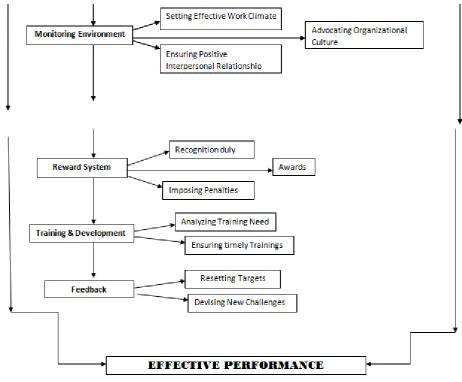
Manager Accelerator Model: (Figure 1)
An operational model is devised where a manager is bound to play the role of a Catalyst and thus is able to synchronize the actual performance of individuals with the desired performance of the organization. The objective of the model is to enable the manager to ensure that all the environmental complexities are sorted and the individual inhibitions are cleared, thereby enabling each employee to act and perform, generating the right performance. The organization establishes themselves in the prevailing market environment with a particular purpose and vision in addition to its profit objective. It thus devises its strategies, sets its policies, organizes their resources keeping in mind the technology to be used, thereby creating a work culture so that its employees are able to achieve the expected targets and fulfill organizational objectives.
On the other hand an employee, with an ambition joins an organization to fulfill his personal and professional dreams in regards to money, achievement and social position, proclaiming himself to be most skillful, knowledgeable and prove himself to be an in valuable asset. However their interaction with the organizational policies and strategies is affected by their own attitude, skills and perception, which sometimes become a barricade in achieving organizational objectives. Moreover when employees own expectations do not get accomplished, their performance tends to get diminished. On the other hand, possession of effective knowledge and skill makes an individual not only confident but also enhances his need for recognition and success.
Organizations live on their own terms and employees survive protecting their own interest. Hence, the onus descends on the shoulders of the manager, who is then required to enact as a catalyst channelizing the endeavors and ambitions of both the organization as well as the employee. As a catalyst, he emerges synthesizing the requirement of the organization along with the expectations of individual employees, removing the barriers and blockades to effective performance. In the above model, the manager is being vigilante at every phase of working. While defining and delegating tasks and responsibilities to his subordinates, he contemplates on individual skills and interest, and henceforth he administers the domain of obligations.
Up-keeping the organizational culture, the manager endeavors to set such a work climate that is conducive for an employee’s growth, provides him a support to work rightly, and creating a cordial interpersonal relationship, for proper coordination, communication and control. Moreover a manager understands the human emotions and expectations. He sets strong targets but ensures acknowledgement of even small endeavors of each employees. However devising appropriate reward system, he also generates some punitive measures to uphold the slow or low performers. No employee is perfect in skill or knowledge. Thus arrangement of timely training and development sessions is vital for every organization. The catalyst manager analyses the training need and ensures an up gradation of his employees. Eventually he provides the appropriate feedback, where he resets the challenges for his employees duly recognizing their potential, skills and knowledge, serving their ambitions and achieving organizational objectives. Implementing the above model, will not only achieve effective performance from its employees, but also attain organizational excellence.
Conclusion
An organization’s success is not just dependent upon having the right strategy and resources. It is also reliant upon the
ability of its management to harness, direct and support teams and individuals to engage in delivering the organization’s mission and objectives. Managers play a critical role in delivering performance. Managers need to be able to consistently deliver performance and results and get the best possible performance from the teams and individuals they manage. Most employees want to be successful contributors to an organization. They want to know what is expected of them and how they can most effectively achieve those expectations. The Accelerator model provides full scope for the employees to dwell in the organizational environment and work with complete effectiveness. As Thomas J. Watson puts “A Manager is an assistant to his men”. Conventionally a manager acts as a coach or a supervisor to his subordinates, guides or marks their performances. The performances so made are then categorized as bad work, good work and great work.
[image:6.595.70.533.69.451.2]The main responsibility of the Manager, however, is to sort reasons as to the productivity of his subordinates and endeavor to convert the bad work into good and good work into great work, as rightly said by Peter Drucker, “The productivity of work is not the responsibility of the worker but of the Manager”. However this research article provides Fig. 1. Manager Accelerator Model
an extensive view towards the work process in an organization so encircled by the complexities of internal and external environment. I have made an attempt with the Manager Accelerator model to organize the work process keeping in mind the organizational growth and individual employee aspirations. Researchers can further dwell upon material factors that influence an employee’s zeal to work harder or deject working hard, and to resolve the organization complexities.
REFERENCES
Armstrong Michael, 2005. Human Resource Management
practice, Handbook, (9th ed.) South Asian Edition; ISBN
0-7494-4215-8.
Aluko M. A. O., Awolowo Obafemi University, 2003.
Nigeria. The impact of culture on organizational
performance in selected textile firms in Nigeria.
Birkinshaw Julian and Heywood Suzanne. Putting organizational complexity in its place.
Chaddha Prem, 2005. Performance Management---Its about performing –not just Appraising, Macmillan business books, ISBN: 0333937961.
Callaghan Andrè O., February 2005. Performance management: SDFs in the Fasset Sector,
Creelman David,2012. Six stories of successful performance management, www.hr.com | 1-877-472- 6648, IHR.
Denisi Angelo S., 2011, Tulane University, New Orleans,
Louisiana, USA. Managing performance to change
behavior, Journal of Organizational Behavior
Management, 31:262–276, 2011
Dessler Gary, 2008. Human resource management, Prentice Hall publication, ISBN: 978-81-317-1303-7.
Gibbs Michael J. 1991. Harvard Business School. An economic approach to process in pay and performance appraisals.
Kim Hye Kyoung, 2014. Work-Life Balance and Employees’ Performance: The mediating role of affective commitment. Global Business and Management
Research: An International Journal, Vol. 6, No. 1 2014.
Lazar Ioan, Osoian Codruta Senior, Ratiu Patricia, 2010. The role of work-life balance practices in order to improve organizational performance, European Research Studies,
Volume XIII, Issue (1), 2010.
Marsden David, 2009. The paradoxof performance related pay’ systems: ‘why do we keep adopting them in the face of evidence that they fail to motivate? http:// eprints. lse. ac.uk/23639/.
Maznevski Martha, 2014. Managing complexity in global organizations, IMD No. 141, www.imd.ch, Perspective for Managers.
Patton, M. 1990. Qualitative evaluation and research methods, (pp. 169-186). Beverly Hills, CA: Sage.
Politis John D. The impact of self-management leadership on organizational creativity. Higher Colleges of Technology, Dubai, United Arab Emirates, [email protected] Raza Hassan, 2014. Training and development impact on
organizational performance: Empirical evidence from oil and gas sector of Pakistan; IOSR Journal of Business and
Management, (IOSR-JBM), e-ISSN: 2278-487X, p-ISSN:
2319-7668. Volume 16, Issue 1. Ver. II (Jan. 2014), PP 67-72, www.iosrjournals.org.
Samra J., Gilbert M., Shain M. and Bilsker D., 2012. Psychosocial Factors, Centre for Applied Research in Mental Health and Addiction (CARMHA).
Sumlin Roger,Senior Consultant, Performance Management Practice. Performance Management: Impacts and Trends, whitepaper, Development dimensions international. (year not mentioned).
Swedish Work Environment Authority, 2006. Systematic work environment management, http://www.av.se/ teman/ sam/
Sinha Smrita, Singh Ajay Kr., Gupta Nisha, Dutt Rajul, 6/2010. Impact of work culture on motivation and performance level of employees in private sector companies. Acta Oeconomica Pragensia.
Szilagyi Andrew D., Jr., Scott, Foresman and Company., Management and performance, ISBN 0-673-16101-3. Throckmorton Robin, M.A., SPHR, Performance
management: The individual strategic plan, (retrieved from) http://www.e-hresources.com/Articles/May1.htm.
Websites
http://www.mckinsey.com/insights/organization/putting_orga nizational_complexity_in_its_place.
http://catalystone.com/performance- management/, 9th September 2014
http://humanresources.about.com/od/glossaryp/g/perform_mgmt. htm, 9th September 2014.
http://ucsfhr.ucsf.edu/index.php/pubs/hrguidearticle/chapter-7-performance-management/ 9th September 2014.
http://hrcouncil.ca/hr-toolkit/keeping-people-performance-management.cfm, 9th September 2014.
http://www.catalystpld.com/manager-as -coach/, 9th September 2014.
http://www.exponentialtraining.com/Downloads/Resources/E xample%20Module%20-%20Level%205/page_03.htm.