Proceedings of ACL 2018, Student Research Workshop, pages 74–83 74
Unsupervised Semantic Abstractive Summarization
Shibhansh Dohare CSE Department
IIT Kanpur sdohare’
Vivek Gupta Microsoft Research
Bangalore t-vigu"
Harish Karnick CSE Department
IIT Kanpur hk’
Abstract
Automatic abstractive summary genera-tion remains a significant open problem for natural language processing. In this work, we develop a novel pipeline for Se-mantic Abstractive Summarization (SAS). SAS, as introduced by Liu et al. (2015) first generates an AMR graph of an input story, through which it extracts a summary graph and finally, creates summary sen-tences from this summary graph. Com-pared to earlier approaches, we develop a more comprehensive method to gener-ate the story AMR graph using stgener-ate-of- state-of-the-art co-reference resolution and Meta Nodes. Which we then use in a novel unsupervised algorithm based on how hu-mans summarize a piece of text to ex-tract the summary sub-graph. Our algo-rithm outperforms the state of the art SAS method by 1.7% F1 score in node predic-tion.
1 Introduction
Summarization of large texts is still an open prob-lem in natural language processing. Automatic summarization is often used in summarizing large texts like stories, journal papers, news articles and even larger texts like books and court judgments.
Existing methods for summarization can be broadly categorized into two categories Extrac-tive and Abstractive. Most of the work done on summarization in the past has been Extractive Dang and Owczarzak (2008). Extractive meth-ods directly pick up words and sentences from the text to generate a summary. Vanderwende et al. (2004) transformed the input to nodes, then used
’@cse.iitk.ac.in, ”@microsoft.com, Shibhansh is the corresponding author
the Pagerank algorithm to score nodes, and finally grow the nodes from high-value to low-value us-ing some heuristics. Some of the approaches com-bine this with sentence compression so that more sentences can be packed in the summary. McDon-ald(2007), Martins and Smith (2009), Almeida and Martins(2013), and Gillick and Favre(2009) among others used ILPs and approximations for encoding compression and extraction. However, human level summary generation require rephras-ing sentences and combinrephras-ing information from different parts of the text. Thus, these methods are inherently limited in the sense that they can never generate human level summaries for large and complicated documents.
On the other hand, most Abstractive methods take advantages of the recent developments in deep learning. Specifically, the recent success of the sequence to sequenceSutskever et al. (2014) learning models, where recurrent networks read the text; encodes it and then generate target text produce promising results. Rush et al. (2015), Chopra et al. (2016), Nallapati et al. (2016), See et al. (2017) used standard encoder-decoder models along with their variants to generate sum-maries. Takase et al. (2016) incorporated the AMR information in the standard encoder-decoder models to improve results. These approaches have produced promising results and have been recently shown to be competitive with the extractive meth-ods, but they are still far from reaching human level quality in summary generation. One of the significant problems with these methods is that there is no guarantee that they can handle sub-tleties of language like the presence of a word that negates the meaning of the full text, hard to cap-ture co-references, etc.
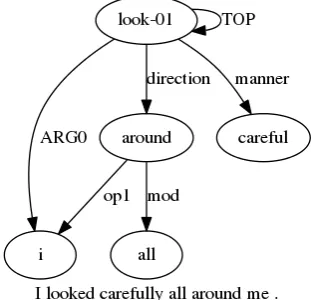
cap-ture“who is doing what to whom“in a sentence. An AMR represents the meaning of a sentence us-ing rooted, acyclic, labeled, directed graphs. Fig-ure 2 shows the AMR graph of the sentence “I looked carefully all around me“generated by the JAMR parser Flanigan et al. (2014). The nodes in the AMR are labeled withconcepts, in Figure2
‘around’represents one such concept. Edges con-tain the information regarding thesemantic rela-tion between the concepts. In Figure2 direction
is the relation between the concepts look-01 and
around. AMR relies on Propbank for semantic re-lations (edge labels). Concepts can also be of the formrun-01where the index01represents the first sense of the word run. Further details about the AMR can be found in the AMR guidelines Ba-narescu et al. (2015). Liu et al. (2015) started the work on summarization using AMR, which we call Semantic Abstractive Summarization (SAS).
Liu et al. (2015) introduced the fundamental idea behind SAS. In SAS the final summary is pro-duced by extracting a summary subgraph from the story graph and generating the summary from this extracted graph (See Figure1). But the work was limited to obtaining the summary graph due to the absence of AMR to text generators at that time. They used various graphical features like distance from the root, the number of outgoing edges, etc. and sentence number as features for nodes. The procedure then learned weights over these features with the constraint that the nodes must form a con-nected graph.
In this work, we propose an alternative method to use AMRs for abstractive summarization. Our approach is inspired by the way humans summa-rize any piece of text. User studies Chin et al. (2009); Kang et al. (2011) have shown that hu-mans summarize by first writing down the key phrases and then try to figure out the relationships among them and then organize the data accord-ingly. Falke and Gurevych (2017) used similar ideas to propose the task of concept map based summarization. We design our algorithm along the same lines. The first step is to find the most important entities/events in the text. The second step is to identify the key relations among the most important entities/events, and finally, in the last step, we capture information around the selected relation. AMRs provide a natural way to achieve this process, as all the events/entities can be rep-resented by a node Rao et al. (2017) or a group
of nodes, while any relation can be captured by a path in the AMR graph. We also develop a more comprehensive method to generate the story AMR from the sentence AMRs based on event/entity co-reference resolution and Meta Nodes. Our al-gorithm outperforms the previous state of the art methods for SAS by 1.7% F1 score on Node pre-diction.
Our major contributions in this work are :
• We propose a novel unsupervised algorithm for the key step of summary graph extraction, which provides a stronger baseline for future work on SAS.
• We propose a novel method to generate the story AMR based on a more comprehensive co-reference resolution andMeta Nodes.
The rest of the paper is organized as follows. Section2and3contain description of the datasets and the algorithm used for summary generation re-spectively. Section4contains the results of exper-iments using our approach.
2 Datasets
We use the proxy report section of the AMR Bank Knight et al.(2014), as it is the only section that is relevant for the task because it contains the gold-standard (human-generated) AMR graphs for news articles and their summaries. In the training set, the stories and summaries contain 17.5 sen-tences and 1.5 sensen-tences on average respectively. The training and test sets include 298 and 33 sum-mary document pairs respectively.
3 Pipeline for Summary Generation
The pipeline consists of three major steps. The first step is to convert the document into an AMR (step-1). The next step is to extract a summary AMR from the document AMR constructed in the previous step (step-2). The final step generates text from the extracted sub-graph (step-3). In the following subsections, we expand on each step.
3.1 Step 1: Story to AMR: Document graph generation
Document AMR refers to the AMR representing the meaning of the whole document. The AMR
Figure 1: The pipeline proposed by (Liu et al.,2015) had the following step - AMR Parsing, Naive node merging, Subgraph selection and Text generation
Figure 2: The graphical representation of the AMR graph of the sentence : ”I looked care-fully all around me”using AMRICA Saphra and Lopez(2015)
formalism guarantees that no two nodes refer to the same event/entity.Liu et al.(2015) extends this principle to multiple sentences by merging nodes referring to the same named entity (or date) across sentences. However, they adopted a naive ap-proach to for co-reference resolution using a sim-ple name and date matching3.1. The co-reference resolution can be greatly improved if we take ad-vantage of the huge literature on text co-reference resolution. We solve node co-reference resolu-tionusingtext co-reference resolutionfollowed by mapping the text to a node usingAlignments.
Node Co-reference Resolutionis a crucial step, as a wrongly generated document AMR can pro-duce a factually wrong summary. To mitigate wrong mergers, we implement multiple sanity checks to avoid wrong mergers. Text co-reference resolution techniques can be broadly categorized into three major categories - neural, statistical and rule-based. We used the state-of-the-art end-to-end neural co-reference resolution system Lee et al.(2017). Future work can use an ensemble of co-reference resolvers to improve robustness. A list of major sanity checks that we employed
• Don’t merge nodes which have an outgo-ing edge with label :name if the value of
:name argument is different, and neither of the names is the initials of the other
• Don’t merge if, cycle emerges in the graph after the merger
• Don’t merge if, the nodes to be merged have common outgoing edge labels, and the nodes that are connected with these edges are dif-ferent
For mapping text to the node, we use align-ments.Alignmentsprovide a mapping from a word in the text to the corresponding node in the AMR. Most co-reference systems provide co-references between noun phrases instead of individual words. But for node co-reference resolution we are re-quired to merge individual nodes rather than a group of nodes. However, Lee et al.(2017) sys-tem also outputs attention weight for every word of a noun phrase which signifies the importance of each word in the noun phrase. We merge the nodes corresponding to the word that has the max-imum attention weight among the words in the noun phrase.
[image:3.595.101.257.167.317.2]nodes. In table1we present two examples where words reinforce the importance of each other without referring to the exact same thing.
These examples inspire us to introduce a new set of nodes which we call Meta nodes. In this work, we use Meta nodes to increase the impor-tance of only common nouns. Common nouns like drugs, opium, etc. can occur a lot of times in the text which suggests that they are relevant for the text, but they are not identified by co-reference systems as their different occurrences do not refer to exactly the same thing. To capture the impor-tantcommon nounswhich are otherwise not cap-tured in the co-reference resolution, we add a new
Meta nodein the graph for each such set of com-mon nouns. In Example 2 of Fig.1, we introduce a
Meta Nodefor the common nounOpium, which is present twice in the story. EachMeta nodeis con-nected to all the occurrences of the correspond-ing common noun. The nodes connected with a meta node signifies that the nodes at some level might refer to the same thing.Meta nodesare used as representative for the group during ranking but they are not extracted in the final summary graph, and hence they are not used during the final step of summary generation.
The cases that we examined in Table1are cases where the words don’t have a perfect identity but rather a near identity. This points out that co-reference resolution is not a simple yes/no ques-tion but rather a complicated one. This problem of the complexity of co-reference resolution has been explored theoretically in the literature Recasens et al. (2011); Versley (2008) and our work will benefit directly from more work on the complex-ity of co-reference resolution. In our current work, we don’t implement any procedure to detect rein-forcements of the sort given in Example 2 of Table 1. Future works may include event co-reference resolution and word similarity using word embed-dings to identify such reinforcements.
3.2 Step 2: Summary Graph Extraction
[image:4.595.310.521.63.148.2]Summary graph extraction is a key step in SAS. In this step, we extract the summary sentence AMR graphs from the document AMR produced in Step-1. We take our cue from the way humans summa-rize a text by first identifying the most important entities/events in the text then finding the most im-portant relationships among these events/entities and finally include information surrounding the
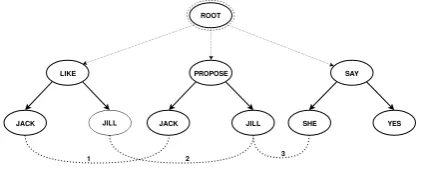
Figure 3: An example of node merging in a very basic AMR, The mergers1and2were also present in the methods proposed byLiu et al. (2015) but not the merger3. Here, dash line represent node to be merged.
selected relationship(s).
Step-A: Finding Important Nodes - For finding important events/entities, we use
term frequency-inverse document frequency
(Tf−IDF) to determine the importance of any node. We first find the top nnodes in the graph using term frequency. This n depends upon the size of the summary required. Similar to earlier approaches we use Alignmentsto find text corre-sponding to the nodes. Finally, we use Tf-IDF values of the text corresponding to the nodes to rank the selected n nodes. The proxy report section of the AMR Bank is quite small with only 298 training stories. We use the CNN-Dailymail Hermann et al. (2015) corpus containing around 300,000 news articles to evaluate the Document Frequencies (DF). We calculateTf−Idf as
-Tf−Idf = Tf×log10(300,000/(DF + 1))
As explained in section 3.1, Meta Nodes are used as a representative for a set of nodes during importance evaluation. Hence, during importance evaluation we do not consider nodes that are con-nected with anyMeta Node. To evaluate the im-portance of aMeta Node, we take the number of nodes connected with aMeta Nodeas theterm fre-quencyfor theMeta Node.
Table 1: In Example 1, the words illegalandban reinforce each others importance but they are not captured by co-reference resolution. We add aMeta Nodeconnected to the nodes corresponding to the wordsillegalandban. During importance evaluation, the occurrences of thisMeta Nodewill be these occurrences ofillegalandbanandterm frequencyfor thisMeta Nodewill be 2. Similarly, in the second example both the occurrences of the wordopiumare connected to a newMeta Node
1. On 011006 The Citizen newspaper stated that it isillegalfor South Africans to be involved in mercenary activity or to render foreign military assistance inside or outside of South Africa. The Citizen newspaper stated that the South African Foreign Ministry announced on 011005 that the South African government imposed the mercenary activitybanfollowing reports that 1000 Muslims with military training have enlisted to leave South Africa for Afghanistan to fight for the Taliban against the United States.
2. Head of the U.N. drug office Antonio Maria Costa said that Afghanistan has produced so much
[image:5.595.80.525.359.445.2]opiumin recent years that the Taliban are cutting back poppy cultivation and stockpiling raw opium in an effort to support prices and preserve a major source of financing for the insurgency. Costa said this to reporters last week as the U.N. Drug Office Office prepared to release its latest survey of Afghanistan’sopiumcrop.
Table 2: Results on the Proxy report section of the AMR bank. First-half contains the Recall, Precision, and F-1 for the nodes in the generated summary AMR. The second half contains the scores for the final summary generated using state-of-the-art text generator evaluated using the ROUGE metric
Subgraph extraction Full pipeline
Method Recall Precision F1 R-1 R-2 R-L
Liu et al.(2015) 63.5 54.7 58.7 - -
-Unsupervised SAS (Naive co-reference) 67.9 57.2 60.3 - -
-Unsupervised SAS (Lee et al.(2017) co-reference) 67.0 58.0 60.4 39.5 16.5 29.0
Unsupervised SAS (Human co-reference) 67.7 60.4 62.4 40.9 16.7 29.5
Thus, in the selected sentence we find a path be-tween the two nodes closest to the root. If one of the selected nodes happens to be aMeta Node, the occurrences of theMeta Nodeinclude all the occurrences of all the nodes that the Meta Node
represents (Fig.1).
StepC: Capture Surrounding Information
-The final step in subgraph extraction is to expand around the selected path to capture the surround-ing information. We use OpenIEBanko(2009) at this step. The output of the OpenIE system are tuples of the form(arg;relation;arg). The rele-vant tuples for us are the set of tuples that contain the selected path. As, these tuples contain all the auxiliary information about the relationship that they are describing, selecting a tuple will solve the problem of graph expansion. To capture the max-imum amount of auxiliary information we choose the largest tuple among the set of relevant tuples. This ends the process of summary graph extrac-tion. Algorithm1provides an overview of the en-tire algorithm.
3.3 Step 3: Summary Generation
To generate sentences from the extracted AMR graphs we use state of the art AMR to text gen-eratorKonstas et al.(2017).
4 Experiments
In table 2we report results on the test set of the proxy report section of the AMR bank. The table contains results using the human annotated AMRs. We outperform the state-of-the-art in SAS by 1.7% F1 scores in node prediction. Similar to previous methods we use the target summary size to control the length of the output summary.
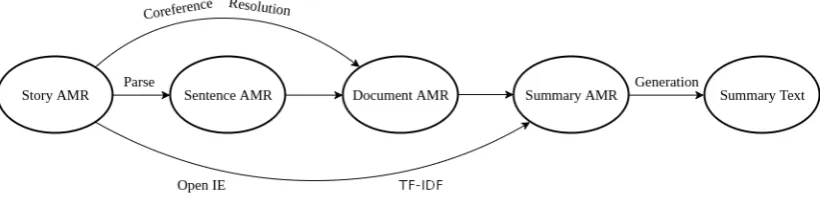
Figure 4: The updated pipeline proposed by us has the following step - AMR Parsing, Co-reference resolution, Open Information Extraction,TF-IDF calculation, Subgraph selection and Text generation
Algorithm 1Overview of Algorithm
Input. Input original text data
Node co-reference resolution and Meta node formation
Node ranking using Tf-idf Rank nodes
Rank node pairs, using node weights
forSorted node pairsdo
Select the first co-occurrence sentence
ifno such sentencethen
Continue
end if
Find the path closest to root in the sentence Find relevant tuples using OpenIE
Choose the largest tuple containing the path
ifno such tuplethen
Output the selected sentence AMR
end if
ifsummary size>required sizethen
Break
end if end for
AMR to text conversion
As clear from table 2 there is not much dif-ference between the scores when we use naive node resolution and date merging and when we use state-of-art co-reference resolution. To check the impact of co-reference resolution, we also did manual co-reference resolution on the test set which resulted in a further 2% increase in the scores to 62.4%. We suspect that a significant rea-son for lower performance with state of the art co-reference resolution might be the inability of the system to handle cataphoric references. These references are particularly crucial in news articles where the first occurrence of an entity/event is generally essential.
5 Conclusion and Future Work
In this work, we present a new method to do Se-mantic Abstractive Summarization (Figure4). We outperform the previous state-of-the-art methods for SAS by 1.7% and by 3.7% using human co-reference resolution. In the process, we complete the SAS pipeline for the first time showing that SAS can be used to construct high-quality sum-maries. We also extend the method to construct a document AMR graph from the sentence AMRs using Meta nodes which can further be used in some future formalism for Document Meaning Representation.
The work will benefit directly from improve-ments in each step of the pipeline. Specifically, the advances in co-reference resolution for the near-identity cases might significantly improve the summary quality. We are currently experiment-ing with bigger text summarization datasets like DUC 2004 and DUC 2006. The hypothesis we used to find the key relations is the main hurdle in extending the work to multi-document summa-rization as all other steps can be directly applied in multi-document summarization. Using differ-ent methods that might be based on supervision to find the key relation is an interest direction for fu-ture work.
Acknowledgments
References
Miguel Almeida and Andre Martins. 2013. Fast and ro-bust compressive summarization with dual decom-position and multi-task learning. InProceedings of the 51st Annual Meeting of the Association for Com-putational Linguistics (Volume 1: Long Papers), pages 196–206. Association for Computational Lin-guistics.
Laura Banarescu, Claire Bonial, Shu Cai, Madalina Georgescu, Kira Griffitt, Ulf Hermjakob, Kevin Knight, Philipp Koehn, Martha Palmer, and Nathan Schneider. 2015. Amr-guidelines.
Laura Banarescu, Claire Bonial, Shu Cai, Madalina Georgescu, Kira Griffitt, Ulf Hermjakob, Kevin Knight, Martha Palmer, Philipp Koehn, and Nathan Schneider. 2013. Abstract meaning representation for sembanking. Proceedings of Linguistic Annota-tion Workshop.
Michele Banko. 2009. Open Information Extraction for the Web. Ph.D. thesis, Seattle, WA, USA. AAI3370456.
George Chin, Olga A. Kuchar, and Katherine E. Wolf. 2009. Exploring the analytical processes of intel-ligence analysts. In InProceedings of the SIGCHI Conference on Human Factors in Computing Sys-tems, page 1120. Association for Computational Linguistics.
Sumit Chopra, Michael Auli, and Alexander M. Rush. 2016. Abstractive sentence summarization with at-tentive recurrent neural networks. InProceedings of the 2016 Conference of the North American Chap-ter of the Association for Computational Linguistics: Human Language Technologies, pages 93–98, San Diego, California. Association for Computational Linguistics.
Hoa Trang Dang and Karolina Owczarzak. 2008. Overview of the tac 2008 update summarization task. In Proceedings of Text Analysis Conference (TAC).
Tobias Falke and Iryna Gurevych. 2017. Bringing structure into summaries: Crowdsourcing a bench-mark corpus of concept maps. In Proceedings of the 2017 Conference on Empirical Methods in Nat-ural Language Processing, pages 2951–2961. Asso-ciation for Computational Linguistics.
Jeffrey Flanigan, Sam Thomson, Jaime Carbonell, Chris Dyer, and Noah A. Smith. 2014. A discrim-inative graph-based parser for the abstract mean-ing representation. InProceedings of the 52nd An-nual Meeting of the Association for Computational Linguistics (Volume 1: Long Papers), pages 1426– 1436. Association for Computational Linguistics.
Dan Gillick and Benoit Favre. 2009.A scalable global model for summarization. In Proceedings of the NAACL Workshop on Integer Linear Programming for Natural Langauge Processing.
Karl Moritz Hermann, Tomas Kocisky, Edward Grefenstette, Lasse Espeholt, Will Kay, Mustafa Su-leyman, and Phil Blunsom. 2015. Teaching ma-chines to read and comprehend.
Youn-ah Kang, Carsten Gorg, and John Stasko. 2011.
How can visual analytics assist investigative analy-sis? design implications from an evaluation. IEEE Transactions on Visualization and Computer Graph-ics, 17(5):570–583.
Kevin Knight, Laura Baranescu, Claire Bonial, Madalina Georgescu, Kira Griffitt, Ulf Hermjakob, Daniel Marcu, Martha Palmer, and Nathan Schnei-der. 2014. Deft phase 2 amr annotation r1 ldc2015e86. philadelphia: Linguistic data consor-tium. Abstract meaning representation (AMR) an-notation release 1.0 LDC2014T12. Web Download. Philadelphia: Linguistic Data Consortium.
Ioannis Konstas, Srinivasan Iyer, Mark Yatskar, Yejin Choi, and Luke Zettlemoyer. 2017. Neural amr: Sequence-to-sequence models for parsing and gen-eration. In Proceedings of the 52nd Annual Meet-ing of the Association for Computational LMeet-inguis- Linguis-tics. Association for Computational LinguisLinguis-tics.
Kenton Lee, Luheng He, Mike Lewis, and Luke Zettle-moyer. 2017. End-to-end neural coreference resolu-tion.CoRR, abs/1707.07045.
C. Lin. 2004. Rouge: A package for automatic evalua-tion of summaries. Text Summarizaevalua-tion Branches Out, Post-Conference Workshop of ACL 2004. Barcelona, Spain.
Fei Liu, Flanigan Jeffrey, Thomson Sam, Sadeh Nor-man, and Smith Noah A. 2015. Toward abstractive summarization using semantic representations. In Proceedings of the 2015 Conference of the North American Chapter of the Association for Compu-tational Linguistics. Association for CompuCompu-tational Linguistics, Denver, Colorado, pages 10771086.
Andre F. T. Martins and Noah A. Smith. 2009. Sum-marization with a joint model for sentence extrac-tion and compression. In Proceedings of the ACL Workshop on Integer Linear Programming for Natu-ral Language Processing.
Ryan McDonald. 2007. A study of global inference algorithms in multi-document summarization. In
Proceedings of the 29th European Conference on IR Research, ECIR’07, pages 557–564, Berlin, Heidel-berg. Springer-Verlag.
Sudha Rao, Daniel Marcu, Kevin Knight, and Hal Daum´e III. 2017. Biomedical event extraction us-ing abstract meanus-ing representation. In BioNLP 2017, pages 126–135, Vancouver, Canada,. Associ-ation for ComputAssoci-ational Linguistics.
Marta Recasens, Eduard Hovy, and M. Antnia Mart. 2011. Identity, non-identity, and near-identity: Ad-dressing the complexity of coreference. Lingua, 121(6):1138 – 1152.
Alexander M. Rush, Sumit Chopra, and Jason Weston. 2015. A neural attention model for sentence sum-marization.
Naomi Saphra and Adam Lopez. 2015. Amrica: an amr inspector for cross-language alignments. In
Proceedings of the 2015 Conference of the North American Chapter of the Association for Compu-tational Linguistics: Demonstrations, pages 36–40, Denver, Colorado. Association for Computational Linguistics.
Abigail See, Peter J. Liu, and Christopher D. Manning. 2017.Get to the point: Summarization with pointer-generator networks.
Ilya Sutskever, Oriol Vinyals, and Quoc V Le. 2014.
Sequence to sequence learning with neural net-works. In Advances in Neural Information Pro-cessing Systems 27, pages 3104–3112. Curran As-sociates, Inc.
Sho Takase, Jun Suzuki, Naoaki Okazaki, Tsutomu Hirao, and Masaaki Nagata. 2016. Neural head-line generation on abstract meaning representation. In Proceedings of the 2016 Conference on Empiri-cal Methods in Natural Language Processing, pages 1054–1059, Austin, Texas. Association for Compu-tational Linguistics.
Lucy Vanderwende, Michele Banko, and Arul Menezes. 2004. Event-centric summary generation. In Proceedings of DUC.
Yannick Versley. 2008. Vagueness and referential am-biguity in a large-scale annotated corpus. Research on Language and Computation, 6(3):333–353.
A Example to generate document AMR from sentence AMR
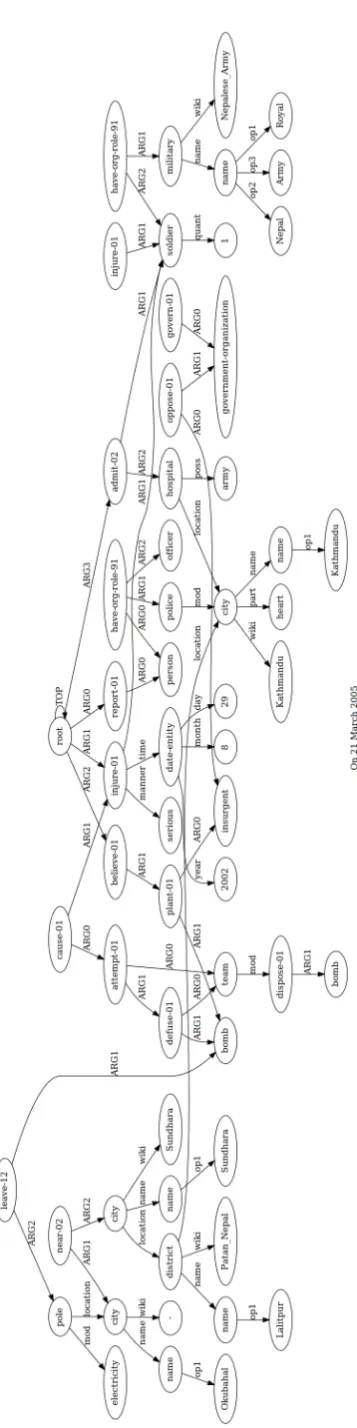
In this appendix, we give an example showing how to generate Document AMR from the sentence AMRs. Consider a short multisentence story
-A Kathmandu police officer reports –. 1 soldier of the Royal Nepal Army was seriously injured on 29 August 2002 when a bomb disposal team at-tempted to defuse the bomb left at an electricity pole in okubahal near Sundhara in Lalitpur dis-trict in Kathmandu. Anti-government insurgents are believed to have planted the bomb. The injured
soldier has been admitted to the army hospital in Kathmandu.
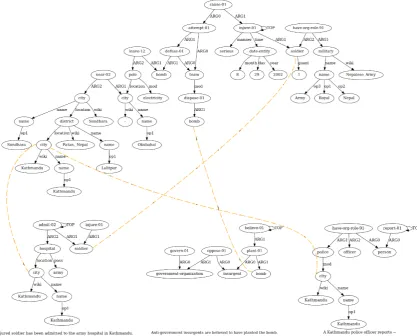
Figure5shows the sentence AMRs of the four sentences of the short story. The nodes that re-fer to the similar entity have to be merged; the dashed lines connect the nodes to be merged. Fig-ure6shows, the generated document AMR from the merger. Fig6also shows how large the AMRs of even short stories can become after merging.
If the summarization process were to follow, we would’ve started by finding the key nodes in the document graph based on TF−IDF. The Term frequency is the number of incoming edges in the AMR. It is clear from the document AMR that the important nodes based on Term frequency areSoldier, Bomb,andKathmandu. Then we use
TF−IDFto rank among these key nodes, it turns out that the key nodes that the final ranking in de-creasing order of importance is Kathmandu, Sol-dier and Bomb. The next step is to find the key relation, which according to our hypothesis lies in the sentence where they first co-occur, i.e., the second sentence. The exact relation is the highest path. As clear from Figure5the path will include the nodes corresponding to the wordsKathmandu,