Modeling the Interpretation of Discourse Connectives
by Bayesian Pragmatics
Frances Yung
Nara Institute of Science and Technology 8916-5 Takayama, Ikoma,
Nara, 630-0101, Japan
Kevin Duh John Hopkins University
810 Wyman Park Drive, Baltimore, MD 21211-2840, USA
Taku Komura University of Edinburgh
10 Crichton Street,
Edinburgh, EH8 9AB, United Kingdom [email protected]
Yuji Matsumoto
Nara Institute of Science and Technology 8916-5 Takayama, Ikoma,
Nara, 630-0101, Japan [email protected]
Abstract
We propose a framework to model hu-man comprehension of discourse connec-tives. Following the Bayesian pragmatic paradigm, we advocate that discourse con-nectives are interpreted based on a sim-ulation of the production process by the speaker, who, in turn, considers the ease of interpretation for the listener when choos-ing connectives. Evaluation against the sense annotation of the Penn Discourse Treebank confirms the superiority of the model over literal comprehension. A fur-ther experiment demonstrates that the pro-posed model also improves automatic dis-course parsing.
1 Introduction
A growing body of evidence shows that human interpretation and production of natural language are inter-related (Clark, 1996; Pickering and Gar-rod, 2007; Zeevat, 2011; Zeevat, 2015). In par-ticular, evidence shows that during interpretation, listeners simulate how the utterance is produced; and during language production, speakers simu-late how the utterance will be perceived. One explanation is that the human brain reasons by Bayesian inference (Doya, 2007; Kilner et al., 2007), which is, at the same time, a popular for-mulation used in language technology.
In this work, we model how humans interpret the sense of a discourse relation based on the Bayesian pragmatic framework. Discourse rela-tions are relarela-tions between units of texts that make a document coherent. These relations are either
marked by discourse connectives (DCs), such as ‘but’, ‘as a result’, or implied implicitly, as in the following examples:
1. He came late.In fact, he came at noon. 2. It is late. I will go to bed.
The explicit DC ‘in fact’ in Example (1) marks a Specificationrelation. On the other hand, aResult relation can be inferred between the two sentences in Example (2) although there are not any explicit markers. We say the two sentences (called argu-ments) are connected by an implicit DC.
Discourse relations have a mixture of semantic and pragmatic properties (Van Dijk, 1980; Lewis, 2006). For example, the sense of a discourse rela-tion is encoded in the semantics of a DC (Exam-ple (1)), yet the interpretation of polysemic DCs (such as ‘since’, ‘as’) and implicit DCs relies on the pragmatic context (Example (2)).
This work seeks to find out if Bayesian prag-matic approaches are applicable to human com-prehension of discourse relations. Our contribu-tion includes: (i) an adaptacontribu-tion of the Bayesian Rational Speech Acts model to DC interpretation using a discourse-annotated corpus, the Penn Dis-course Treebank; (ii) integration of the proposed model with a state-of-the-art automatic discourse parser to improve discourse sense classification. 2 Related work
There is increasing literature arguing that the hu-man motor control and sensory systems make es-timations based on a Bayesian perspective (Doya, 2007; Oaksford and Chater, 2009). For example, it is proposed that the brain’s mirror neuron system
recognizes a perceptual input by Bayesian infer-ence (Kilner et al., 2007). Similarly, behavioural, physiological and neurocognitive evidences sup-port that the human brain reasons about the uncer-tainty in natural languages comprehension by em-ulating the language production processes (Galan-tucci et al., 2006; Pickering and Garrod, 2013).
Analogous to this principle of Bayesian lan-guage perception, a series of studies have devel-oped the Grice’s Maxims (Grice, 1975) based on game-theoretic approaches (J¨ager, 2012; Frank and Goodman, 2012; Goodman and Stuhlm¨uller, 2013; Goodman and Lassiter, 2014; Benz et al., 2016). These proposals argue that the speaker and the listener cooperate in a conversation by recur-sively inferring the reasoning of each other in a Bayesian manner. The proposed framework suc-cessfully explains existing psycholinguistic theo-ries and predict experimental results at various lin-guistic levels, such as the perception of scalar im-plicatures (e.g. ‘some’ meaning ‘not all’ in prag-matic usage) and the production of referring ex-pressions (Lassiter and Goodman, 2013; Bergen et al., 2014; Kao et al., 2014; Potts et al., 2015; Lassiter and Goodman, 2015). Recent efforts also acquire and evaluate the models using corpus data (Orita et al., 2015; Monroe and Potts, 2015).
Production and interpretation of discourse re-lations is also a kind of cooperative communica-tion between speakers and listeners (or authors and readers). We hypothesize that the game-theoretic account of Bayesian pragmatics also applies to human comprehension of the meaning of a DC, which can be ambiguous or even dropped.
3 Method
This section explains how we model the interpre-tation of discourse relations by Bayesian pragmat-ics. The model is based on the formal framework known asRational Speech Actsmodel (Frank and Goodman, 2012; Lassiter and Goodman, 2015). Section 3.1 explains the key elements of the RSA model, and Section 3.2 illustrates how it is adapted for discourse interpretation.
3.1 The Rational Speech Acts model
The Rational Speech Acts (RSA) model describes the speaker and listener as rational agents who cooperate towards efficient communication. It is composed of a speaker model and a listener model. In the speaker model, theutilityfunctionU
de-fines the effectiveness for the speaker to use utter-ancedto express the meaningsin contextC.
U(d;s, C) = lnPL(s|d, C)−cost(u) (1)
PL(s|d, C) is the probability that the listener
can interpret speaker’s intended meaning s. The speaker selects an utterance which, s/he thinks, is informative to the listener. The utility of dis thus defined by its informativeness towards the in-tended interpretation, which is quantified by nega-tive surprisal(lnPL(s|d, C)), according to
Infor-mation Theory (Shannon, 1948). The utility is modified by production cost (cost(d)), which is related to articulation and retrieval difficulties, etc.
PS(d|s, C)is the probability for thespeakerto
use utterancedfor meanings. It is proportional to the soft-max of theutilityofd.
PS(d|s, C)∝exp(α·U(d;s, C)) (2)
whereα, the decision noise parameter, is set to1. On the other hand, the probability for the lis-tener to infer meaning s from utterance dis de-fined by Bayes’ rule.
PL(s|d, C)∝PS(d|s, C)PL(s) (3)
The listener infers the speaker’s intended mean-ing by considermean-ing how likely, s/he thinks, the speaker uses that utterance (PS(d|s, C)). The
in-ference is also related to thesalienceof the mean-ing (PL(s)), a private preference of the listener.
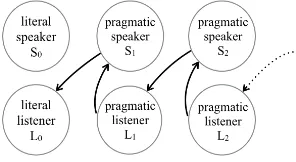
[image:2.595.344.492.606.687.2]To summarize, the speaker and listener emulate the language processing of each other. However, instead of unlimitted iterations (i.e. the speaker thinks the listener thinks the speaker thinks..), the inference is grounded on literal interpretation of the utterance. Figure 1 illustrates the direction of pragmatic inference between the speaker and lis-tenerin their minds.
Figure 1: Pragmatic listeners/speakers reason for 1 or more levels, but not the literal listener/speaker.
reasons for one level (L1), and the pragmatic lis-tener who reasons for two levels (L2). Previ-ous works demonstrate that one level of reason-ing is robust in modelreason-ing human’s interpretation of scalar implicatures (Lassiter and Goodman, 2013; Goodman and Stuhlm¨uller, 2013).
3.2 Applying the RSA model on discourse relation interpretation
We use the listener model of RSA to model how listeners interpret the sense a DC. Given the DC
d and context C in a text, the listener’s inter-preted relation sensesiis the sense that maximizes
PL(s|d, C). siis specifically defined as
si= arg max
s∈S PL(s|d, C) (4)
where S is the set of defined relation senses. The literal listener,L0, interprets a DC directly by its most likely sense in the context. The proba-bility is estimated by counting the co-occurrences in corpus data, the Penn Discourse Treebank, in which explicit and implicit DCs are labelled with discourse relation senses.
PL0(s|d, C) =
count(s, d, C)
count(d, C) (5)
More details about the annotation of PDTB will be explained in Section 4.1.
As shown in Figure 1, the pragmatic speakerS1 estimates the utility of a DC by emulating the com-prehension of the literal listenerL0(Eq. 1, 2). The probability for the pragmatic speakerSnto use DC
dto express meaningsis estimated as:
PSn(d|s, C)
= Pexp(lnPLn−1(s|d, C)−cost(d))
d0∈Dexp(lnPLn−1(s|d
0, C)−cost(d0)) (6)
wheren ≥ 1. Dis the set of annotated DCs, in-cluding ‘null’, which stands for an implicit DC.
The cost function in Equation 6, cost(d), mea-sures the production effort of the DC. As DCs are mostly short words, we simply define the cost of producing any explicit DCby a constant positive value, which is tuned manually in the experiments. On the other hand, the production cost for an im-plicit DC is0, since no word is produced .
In turn, the pragmatic listener L1 emulates the DC production of the pragmatic speaker S1 (Eq.
3). The probability for the pragmatic listenerLn
to assign meaningsto DCdis estimated as:
PLn(s|d, C) =
PSn(d|s, C)PL(s) P
s0∈SPSn(d|s
0, C)PL(s0) (7)
wheren≥1and S is the set of defined sense. The salience of a relation sense in Equation 7,PL(s), is
defined by the frequency of the sense in the corpus.
PL(s) = Pcount(s) s0∈Scount(s
0) (8)
Lastly, we propose to define the context vari-ableCby the the immediately previous discourse relation to resemble incremental processing. We hypothesize that certain patterns of relation tran-sitions are more expected and predictable. Dis-course context in terms of relation sense, relation form (explicit DC or not), and the sense-form pair are compared in the experiments.
4 Experiment
This section describes experiments that evaluate the model against discourse-annotated corpus. We seek to answer the following questions: (1) Can the proposed model explain the sense interpreta-tion (annotainterpreta-tion) of the DCs in the corpus? (2) Is the DC interpretation refined by the context in terms of previous discourse structure? (3) Does the proposed model help automatic discourse pars-ing? We first briefly introduce the corpus resource we use, the Penn Discourse Treebank.
4.1 Penn Discourse Treebank
The Penn Discourse Treebank (PDTB) (Prasad et al., 2008) is the largest available discourse-annotated resource in English. The raw text are collected from news articles of the Wall Street Journals. On the PDTB, all explicit DCs are an-notated with discourse senses, while implicit dis-course senses are annotated between two adja-cent sentences. Other forms of discourse relations, such as ‘entity relations’, are also labeled. In total, there are 5 form labels and 42 distinct sense labels, some of which only occur very sparsely.
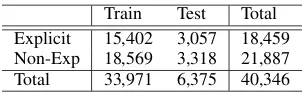
training set and the rest of the corpus, Sections 0, 1, 23 and 24, are combined as the test set. Sizes of the data sets are summarized in Table 1.
[image:4.595.105.256.110.157.2]Train Test Total Explicit 15,402 3,057 18,459 Non-Exp 18,569 3,318 21,887 Total 33,971 6,375 40,346 Table 1: Sample count per data set
4.2 Does RSA explain DC interpretation? The RSA model argues that a rational listener does not just stick to the literal meaning of an utter-ance. S/he should reason about how likely the speaker will use that utterance, in the current con-text, based on the informativeness and production effort of the utterance. If the RSA model explains DC interpretation as well, discourse sense predic-tions made by the pragmatic listeners should out-perform predictions by the literal listener.
In this experiment, we compare the DC inter-pretation by the literal listenerL0, and pragmatic listenersL1 and L2. Given a DC d and the dis-course context C for each test instance, the rela-tion sense is deduced by maximizing the proba-bility estimatePL(s|d, C). PL0(s|d, C)is simply
based on co-occurrences in the training data (Eq. 5).PL1(s|d, C)andPL2(s|d, C)are calculated by
Eq. 6 and 7, in which the salience of each sense is also extracted from the training data (Eq. 8).
contextC Explicit Non-Explicit
L0 constant (BL) .8767 .2616 prev. form .8754 .2616 prev. sense .8727 .2507 form-sense .8684 .2692
L1 constant .8853* .2616 prev. form .8830 .2616 prev. sense .8671 .2698* form-sense .8621 .2671
L2 constant .8853* .2616 prev. form .8830 .2616 prev. sense .8671 .2616 form-sense .8621 .2616
Table 2: Accuracy of prediction by L0, L1 and
L2. Improvements above the baseline are bolded. * means significant atp <0.02by McNemar Test.
Table 2 shows the accuracy of discourse sense prediction by listenersL0,L1 andL2, when pro-vided with various discourse contexts. Predictions
by L1, when they are differ from the predictions byL0under ‘constant’ context, are more accurate than expected by chance. This provides support that the RSA framework models DC interpreta-tion. Overall, predictions of non-implicit senses hardly differ among different models, since an im-plicit DC is much less informative than an exim-plicit DC. Moreover, previous relation senses or forms do not improve the accuracy, suggesting that a more generalized formulation of contextual infor-mation is required to refine discourse understand-ing. It is also observed that predictions byL2are mostly the same asL1. This implies that the lis-tener is unlikely to emulate speaker’s production iteratively at deeper levels.
4.3 Insights on automatic discourse parsing Next, we investigate if the proposed method helps automatic discourse sense classification. A full discourse parser typically consists of a pipeline of classifiers: explicit and implicit DCs are first clas-sified and then processed separately by 2 classi-fiers (Xue et al., 2015). On the contrary, the prag-matic listener of the RSA model considers if the speaker would prefer a particular DC, explicit or implicit, when expressing the intended sense.
In this experiment, we integrate the output of an automatic discourse parser with the probabil-ity prediction by the pragmatic listener L1. We employ the winning parser of the CONLL shared task (Wang and Lan, 2015). The parser is also trained on Sections 2-22 of PDTB, and thus does not overlap with our test set. The sense classi-fication of the parser is based on a pool of lex-icosyntactic features drawn from gold standard arguments, DCs and automatic parsed trees pro-duced by CoreNLP (Manning et al., 2014).
For each test sample, the parser outputs a prob-ability estimate for each sense. We use these esti-mates to replace thesaliencemeasure (PL(s)) (in
Eq. 8) and deduce P0
L1(s|d, C), whereC is the
previous relation form.
PL01(s|d, C) = PPS1(d|s, C)Pparser(s)
s0∈SPS1(d|s
0, C)Pparser(s0) (9)
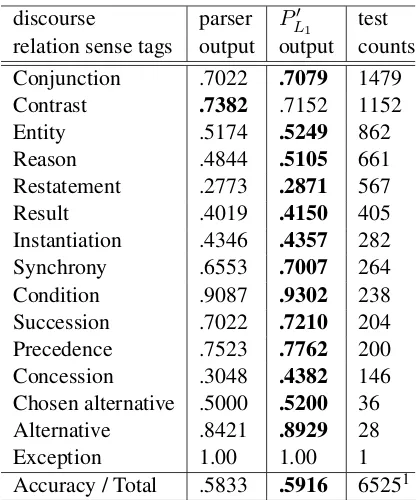
Table 3 compares the performance of the origi-nal parser output and the prediction based onP0
L1.
discourse parser P0
L1 test
relation sense tags output output counts Conjunction .7022 .7079 1479
Contrast .7382 .7152 1152
Entity .5174 .5249 862
Reason .4844 .5105 661
Restatement .2773 .2871 567
Result .4019 .4150 405
Instantiation .4346 .4357 282
Synchrony .6553 .7007 264
Condition .9087 .9302 238
Succession .7022 .7210 204
Precedence .7523 .7762 200
Concession .3048 .4382 146
Chosen alternative .5000 .5200 36
Alternative .8421 .8929 28
Exception 1.00 1.00 1
[image:5.595.77.287.60.310.2]Accuracy / Total .5833 .5916 65251
Table 3: F1 scores of original parser output vs parser output modified with P0
L1. Higher scores
are bolded. The improvement in accuracy is sig-nificant atp <0.05by McNemar Test.
Significant improvement in classification accuracy is achieved and the F1 scores for most senses are improved. This confirms the applicational poten-tial of our model on automatic discourse parsing.
5 Conclusion
We propose a new framework to model the inter-pretation of discourse relations based on Bayesian pragmatics. Experimental results support the ap-plicability of the model on human DC comprehen-sion and automatic discourse parsing. As future work, we plan to deduce a more general abstrac-tion of the context governing DC interpretaabstrac-tion. A larger picture is to design a full, incremental dis-course parsing algorithm that is motivated by the psycholinguistic reality of human discourse pro-cessing.
References
Anton Benz, Gerhard J¨ager, Robert Van Rooij, and Robert Van Rooij. 2016. Game theory and prag-matics. Springer.
Leon Bergen, Roger Levy, and Noah D. Goodman. 2014. Pragmatic reasoning through semantic infer-ence.
Herbert H Clark. 1996. Using language. Cambridge university press.
Kenji Doya. 2007. Bayesian brain: Probabilistic ap-proaches to neural coding. MIT press.
Michael C. Frank and Noah D. Goodman. 2012. Pre-dicting pragmatic reasoning in lanugage games. Sci-ence, 336(6084):998.
Bruno Galantucci, Carol A Fowler, and Michael T Turvey. 2006. The motor theory of speech per-ception reviewed. Psychonomic bulletin & review, 13(3):361–377.
Noah D Goodman and Daniel Lassiter. 2014. Prob-abilistic semantics and pragmatics: Uncertainty in language and thought. Handbook of Contemporary Semantic Theory. Wiley-Blackwell.
Noah D Goodman and Andreas Stuhlm¨uller. 2013. Knowledge and implicature: modeling language un-derstanding as social cognition. Topics in cognitive science, 5(1):173–184.
HP Grice. 1975. Logic and conversation in p. cole and j. morgan (eds.) syntax and semantics volume 3: Speech acts.
Gerhard J¨ager. 2012. Game theory in semantics and pragmatics. In Claudia Maienborn, Klaus von Heusinger, and Paul Portner, editors, Semantics: An International Handbook of Natural Language Meaning, volume 3, pages 2487–2425. Mouton de Gruyter.
Justine T Kao, Jean Y Wu, Leon Bergen, and Noah D Goodman. 2014. Nonliteral understanding of num-ber words. Proceedings of the National Academy of Sciences, 111(33):12002–12007.
James M Kilner, Karl J Friston, and Chris D Frith. 2007. Predictive coding: an account of the mir-ror neuron system. Cognitive processing, 8(3):159– 166.
Daniel Lassiter and Noah D Goodman. 2013. Context, scale structure, and statistics in the interpretation of positive-form adjectives. InSemantics and Linguis-tic Theory, volume 23, pages 587–610.
Daniel Lassiter and Noah D Goodman. 2015. Adjecti-val vagueness in a bayesian model of interpretation. Synthese, pages 1–36.
Diana Lewis. 2006. Discourse markers in english: a discourse-pragmatic view. Approaches to discourse particles, pages 43–59.
Will Monroe and Christopher Potts. 2015. Learning in the rational speech acts model. arXiv preprint arXiv:1510.06807.
Mike Oaksford and Nick Chater. 2009. Prcis of bayesian rationality: The probabilistic approach to human reasoning. Behavioral and Brain Sciences, 32:69–84, 2.
Naho Orita, Eliana Vornov, Naomi H. Feldman, and Hal Daum´e III. 2015. Why discourse affects speak-ers’ choice of refering expressions. Proceedings of the Annual Meeting of the Association for Computa-tional Linguistics.
Martin J Pickering and Simon Garrod. 2007. Do people use language production to make predictions during comprehension? Trends in cognitive sci-ences, 11(3):105–110.
Martin J Pickering and Simon Garrod. 2013. An integrated theory of language production and comprehension. Behavioral and Brain Sciences, 36(04):329–347.
Christopher Potts, Daniel Lassiter, Roger Levy, and Michael C. Frank. 2015. Embedded implicatures as pragmatic inferences under compositional lexical uncertainty. Manuscript.
Rashmi Prasad, Nikhit Dinesh, Alan Lee, Eleni Milt-sakaki, Livio Robaldo, Aravind Joshi, and Bonnie Webber. 2008. The penn discourse treebank 2.0. Proceedings of the Language Resource and Evalua-tion Conference.
C.E. Shannon. 1948. A mathematical theory of com-munication. The Bell System Technical Journal, 27(379-423; 623-656).
Teun A Van Dijk. 1980. The semantics and pragmat-ics of functional coherence in discourse. Speech act theory: Ten years later, pages 49–66.
Jianxiang Wang and Man Lan. 2015. A refined end-to-end discourse parser. CoNLL 2015, page 17. Nianwen Xue, Hwee Tou Ng, Sameer Pradhan, Rashmi
PrasadO Christopher Bryant, and Attapol T Ruther-ford. 2015. The conll-2015 shared task on shallow discourse parsing. CoNLL 2015, page 1.
Henk Zeevat. 2011. Bayesian interpretation and opti-mality theory. Bidirectional Optimality Theory. Pal-grave Macmillan, Amsterdam, pages 191–220. Henk Zeevat. 2015. Perspectives on bayesian