Proceedings of the 55th Annual Meeting of the Association for Computational Linguistics, pages 2016–2027 Vancouver, Canada, July 30 - August 4, 2017. c2017 Association for Computational Linguistics Proceedings of the 55th Annual Meeting of the Association for Computational Linguistics, pages 2016–2027
Vancouver, Canada, July 30 - August 4, 2017. c2017 Association for Computational Linguistics
From Characters to Words to in Between: Do We Capture Morphology?
Clara Vania and Adam Lopez
Institute for Language, Cognition and Computation School of Informatics
University of Edinburgh
[email protected], [email protected]
Abstract
Words can be represented by composing the representations of subword units such as word segments, characters, and/or char-acter n-grams. While such representations are effective and may capture the mor-phological regularities of words, they have not been systematically compared, and it is not understood how they interact with different morphological typologies. On a language modeling task, we present ex-periments that systematically vary (1) the basic unit of representation, (2) the com-position of these representations, and (3) the morphological typology of the lan-guage modeled. Our results extend previ-ous findings that character representations are effective across typologies, and we find that a previously unstudied combination of character trigram representations com-posed with bi-LSTMs outperforms most others. But we also find room for improve-ment: none of the character-level models match the predictive accuracy of a model with access to true morphological analy-ses, even when learned from an order of magnitude more data.
1 Introduction
Continuous representations of words learned by neural networks are central to many NLP tasks (Cho et al.,2014;Chen and Manning,2014;Dyer et al., 2015). However, directly mapping a fi-nite set of word types to a continuous representa-tion has well-known limitarepresenta-tions. First, it makes a closed vocabulary assumption, enabling only generic out-of-vocabulary handling. Second, it cannot exploit systematic functional relationships in learning. For example,catandcatsstand in the
same relationship asdoganddogs. While this re-lationship might be discovered for these specific frequent words, it does not help us learn that the same relationship also holds for the much rarer wordsslothandsloths.
These functional relationships reflect the fact that words are composed from smaller units of meaning, or morphemes. For instance,cats con-sists of two morphemes,catand-s, with the latter shared by the wordsdogsandtarsiers. Modeling this effect is crucial for languages with rich mor-phology, where vocabulary sizes are larger, many more words are rare, and many more such func-tional relationships exist. Hence, some models produce word representations as a function of sub-word units obtained from morphological segmen-tation or analysis (Luong et al.,2013;Botha and Blunsom, 2014;Cotterell and Sch¨utze,2015). A downside of these models is that they depend on morphological segmenters or analyzers.
Morphemes typically have similar orthographic representations across words. For example, the morpheme -s is realized as -es infinches. Since this variation is limited, the general relationship between morphology and orthography can be ex-ploited by composing the representations of char-acters (Ling et al.,2015;Kim et al.,2016), char-acter n-grams (Sperr et al., 2013;Wieting et al.,
2016;Bojanowski et al., 2016; Botha and Blun-som, 2014), bytes (Plank et al., 2016; Gillick et al.,2016), or combinations thereof (Santos and Zadrozny, 2014; Qiu et al., 2014). These mod-els are compact, can represent rare and unknown words, and do not require morphological analyz-ers. They raise a provocative question: Does NLP benefit from models of morphology, or can they be replaced entirely by models of characters?
The relative merits of word, subword. and character-level models are not fully understood because each new model has been compared on
different tasks and datasets, and often compared against word-level models. A number of questions remain open:
1. How do representations based on morphemes compare with those based on characters? 2. What is the best way to compose subword
representations?
3. Do character-level models capture morphol-ogy in terms of predictive utility?
4. How do different representations interact with languages of different morphological ty-pologies?
The last question is raised by Bender (2013): languages are typologically diverse, and the behavior of a model on one language may not generalize to others. Character-level mod-els implicitly assume concatenative morphology, but many widely-spoken languages feature non-concatenative morphology, and it is unclear how such models will behave on these languages.
To answer these questions, we performed a sys-tematic comparison across different models for the simple and ubiquitous task of language model-ing. We present experiments that vary (1) the type of subword unit; (2) the composition function; and (3) morphological typology. To understand the extent to which character-level models capture true morphological regularities, we present ora-cle experiments using human morphological an-notations instead of automatic morphological seg-ments. Our results show that:
1. For most languages, character-level represen-tations outperform the standard word repre-sentations. Most interestingly, a previously unstudied combination of character trigrams composed with bi-LSTMs performs best on the majority of languages.
2. Bi-LSTMs and CNNs are more effective composition functions than addition.
3. Character-level models learn functional re-lationships between orthographically similar words, but don’t (yet) match the predictive accuracy of models with access to true mor-phological analyses.
4. Character-level models are effective across a range of morphological typologies, but or-thography influences their effectiveness.
word tries
morphemes try+s
morphs tri+es
morph. analysis try+VB+3rd+SG+Pres
Table 1: The morphemes, morphs, and morpho-logical analysis oftries.
2 Morphological Typology
A morpheme is the smallest unit of meaning in a word. Some morphemes express core meaning (roots), while others express one or more depen-dent features of the core meaning, such as per-son, gender, or aspect. Amorphological analysis identifies the lemma and features of a word. A morph is the surface realization of a morpheme (Morley, 2000), which may vary from word to word. These distinctions are shown in Table1.
Morphological typology classifies languages based on the processes by which morphemes are composed to form words. While most languages will exhibit a variety of such processes, for any given language, some processes are much more frequent than others, and we will broadly identify our experimental languages with these processes.
When morphemes are combined sequentially, the morphology is concatenative. However, morphemes can also be composed by non-concatenative processes. We consider four broad categories of both concatenative and non-concatenative processes in our experiments.
Fusional languages realize multiple features in a single concatenated morpheme. For exam-ple, English verbs can express number, person, and tense in a single morpheme:
wanted(English)
want+ed
want+VB+1st+SG+Past
Agglutinative languages assign one feature per morpheme. Morphemes are concatenated to form a word and the morpheme boundaries are clear. For example (Haspelmath,2010):
okursam(Turkish)
oku+r+sa+m
“read”+AOR+COND+1SG
Root and Pattern Morphology forms words by inserting consonants and vowels of dependent morphemes into a consonantal root based on a given pattern. For example, the Arabic root ktb
takaatab“wrote to each other” (Arabic) Reduplication is a process where a word form is produced by repeating part or all of the root to express new features. For example:
anak“child” (Indonesian)
anak-anak“children” (Indonesian)
buah“fruit” (Indonesian)
buah-buahan“various fruits” (Indonesian)
3 Representation Models
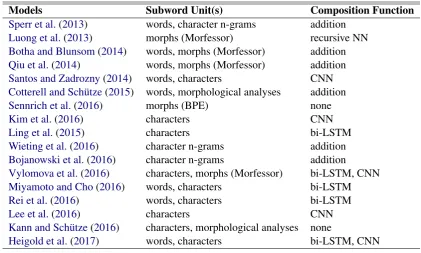
We compare ten different models, varying sub-word units and composition functions that have commonly been used in recent work, but evalu-ated on various different tasks (Table 2). Given wordw, we compute its representationwas:
w=f(Ws, σ(w)) (1)
whereσ is a deterministic function that returns a
sequence of subword units;Wsis a parameter
ma-trix of representations for the vocabulary of sub-word units; andf is a composition function which
takesσ(w)andWsas input and returnsw. All of
the representations that we consider take this form, varying only inf andσ.
3.1 Subword Units
We consider four variants of σ in Equation 1,
each returning a different type of subword unit: character, character trigram, or one of two types of morph. Morphs are obtained from Morfes-sor (Smit et al., 2014) or a word segmentation based on Byte Pair Encoding (BPE;Gage(1994)), which has been shown to be effective for handling rare words in neural machine translation (Sennrich et al., 2016). BPE works by iteratively replac-ing frequent pairs of characters with a sreplac-ingle un-used character. For Morfessor, we use default parameters while for BPE we set the number of merge operations to 10,000.1 When we segment into character trigrams, we consider all trigrams in the word, including those covering notional begin-ning and end of word characters, as inSperr et al.
(2013). Example output ofσis shown in Table3. 3.2 Composition Functions
We use three variants off in Eq. 1. The first
con-structs the representationwof wordwby adding
1BPE takes a single parameter: the number of merge
op-erations. We tried different parameter values (1k, 10k, 100k) and manually examined the resulting segmentation on the En-glish dataset. Qualitatively, 10k gave the most plausible seg-mentation and we used this setting across all languages.
the representations of its subwords s1, . . . , sn = σ(w), where the representation ofsiis vectorsi.
w=
n X
i=1
si (2)
The only subword unit that we don’t compose by addition is characters, since this will produce the same representation for many different words.
Our second composition function is a bidi-rectional long-short-term memory (bi-LSTM), which we adapt based on its use in the character-level model of Ling et al. (2015) and its widespread use in NLP generally. Given si and
the previous LSTM hidden statehi−1, an LSTM (Hochreiter and Schmidhuber,1997) computes the following outputs for the subword at positioni:
hi =LST M(si,hi−1) (3)
ˆ
si+1=g(VT ·hi) (4)
wheresˆi+1is the predicted target subword,gis the softmax function andVis a weight matrix.
A bi-LSTM (Graves et al.,2005) combines the final state of an LSTM over the input sequence with one over the reversed input sequence. Given the hidden state produced from the final input of the forward LSTM,hf w
n and the hidden state
pro-duced from the final input of the backward LSTM hbw
0 , we compute the word representation as:
wt=Wf ·hf wn +Wb·hbw0 +b (5)
whereWf,Wb, andbare parameter matrices and
hf w
n and hbw0 are forward and backward LSTM states, respectively.
The third composition function is a convolu-tional neural network (CNN) with highway lay-ers, as inKim et al.(2016). Letc1, . . . , ckbe the
sequence of characters of wordw. The character
embedding matrix is C ∈ Rd×k, where thei-th
column corresponds to the embeddings ofci. We
first apply a narrow convolution betweenCand a
filterF∈Rd×nof widthnto obtain a feature map f ∈Rk−n+1. In particular, the computation of the j-th element off is defined as
f[j] =tanh(hC[∗, j:j+n−1],Fi+b) (6)
where hA, Bi = Tr(ABT) is the Frobenius
in-ner product andbis a bias. The CNN model
Models Subword Unit(s) Composition Function
Sperr et al.(2013) words, character n-grams addition
Luong et al.(2013) morphs (Morfessor) recursive NN
Botha and Blunsom(2014) words, morphs (Morfessor) addition
Qiu et al.(2014) words, morphs (Morfessor) addition
Santos and Zadrozny(2014) words, characters CNN
Cotterell and Sch¨utze(2015) words, morphological analyses addition
Sennrich et al.(2016) morphs (BPE) none
Kim et al.(2016) characters CNN
Ling et al.(2015) characters bi-LSTM
Wieting et al.(2016) character n-grams addition
Bojanowski et al.(2016) character n-grams addition
Vylomova et al.(2016) characters, morphs (Morfessor) bi-LSTM, CNN
Miyamoto and Cho(2016) words, characters bi-LSTM
Rei et al.(2016) words, characters bi-LSTM
Lee et al.(2016) characters CNN
Kann and Sch¨utze(2016) characters, morphological analyses none
[image:4.595.87.509.61.314.2]Heigold et al.(2017) words, characters bi-LSTM, CNN
Table 2: Summary of previous work on representing words through compositions of subword units.
Unit Output ofσ(wants)
Morfessor ˆwant, s$
BPE ˆw, ants$
char-trigram ˆwa, wan, ant, nts ts$ character ˆ, w, a, n, t, s, $
analysis want+VB, +3rd, +SG, +Pres
Table 3: Input representations forwants.
of character n-grams. We then calculate the max-over-time of each feature map.
yj = max
j f[j] (7)
and concatenate them to derive the word represen-tationwt = [y1, . . . , ym], wheremis the number
of filters applied. Highway layers allow some di-mensions ofwtto be carried or transformed. Since
it can learn character n-grams directly, we only use the CNN with character input.
3.3 Language Model
We use language models (LM) because they are simple and fundamental to many NLP applica-tions. Given a sequence of text s= w1, . . . , wT,
our LM computes the probability ofsas:
P(w1, . . . , wT) = T Y
t=1
[image:4.595.94.507.64.312.2]P(yt|w1, . . . , wt−1) (8)
Figure 1: Our LSTM-LM architecture.
where yt = wt if wt is in the output vocabulary
andyt=UNKotherwise.
Our language model is an LSTM variant of recurrent neural network language (RNN) LM (Mikolov et al.,2010). At time stept, it receives inputwt and predicts yt+1. Using Eq. 1, it first
computes representationwtofwt. Given this
rep-resentation and previous stateht−1, it produces a
new statehtand predictsyt+1:
ht=LST M(wt,ht−1) (9)
ˆ
yt+1=g(VT ·ht) (10)
wheregis a softmax function over the vocabulary
[image:4.595.311.517.361.498.2]Typology Languages #tokens #types
Fusional CzechEnglish 1.2M 125.4K1.2M 81.1K
Russian 0.8M 103.5K
Agglutinative
Finnish 1.2M 188.4K
Japanese 1.2M 59.2K
Turkish 0.6M 126.2K
Root&Pattern ArabicHebrew 1.4M 137.5K1.1M 104.9K
Reduplication Indonesian 1.2M 76.5K
[image:5.595.73.292.61.214.2]Malaysian 1.2M 77.7K
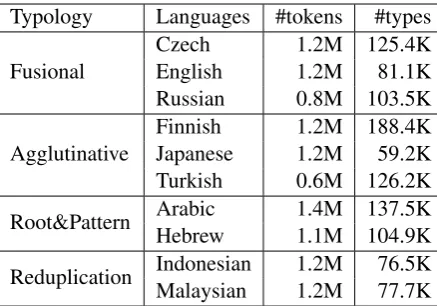
Table 4: Statistics of our datasets.
from a finite output vocabulary, so our models dif-fer only in their representation of context words. This design makes it possible to compare language models using perplexity, since they have the same event space, though open vocabulary word predic-tion is an interesting direcpredic-tion for future work.
The complete architecture of our system is shown in Figure1, showing segmentation function
σand composition functionf from Equation1.
4 Experiments
We perform experiments on ten languages (Ta-ble 4). We use datasets from Ling et al. (2015) for English and Turkish. For Czech and Russian we use Universal Dependencies (UD) v1.3 (Nivre et al.,2015). For other languages, we use prepro-cessed Wikipedia data (Al-Rfou et al.,2013).2 For each dataset, we use approximately 1.2M tokens to train, and approximately 150K tokens each for development and testing. Preprocessing involves lowercasing (except for character models) and re-moving hyperlinks.
To ensure that we compared models and not im-plementations, we reimplemented all models in a single framework using Tensorflow (Abadi et al.,
2015).3 We use a common setup for all experi-ments based on that of Ling et al. (2015), Kim et al. (2016), andMiyamoto and Cho (2016). In preliminary experiments, we confirmed that our models produced similar patterns of perplexities for the reimplemented word and character LSTM
2The Arabic and Hebrew dataset are unvocalized.
Japanese mixes Kanji, Katakana, Hiragana, and Latin charac-ters (for foreign words). Hence, a Japanese character can cor-respond to a character, syllable, or word. The preprocessed dataset is already word-segmented.
3Our implementation of these models can be found at
https://github.com/claravania/subword-lstm-lm
models ofLing et al.(2015). Even following de-tailed discussion with Ling (p.c.), we were unable to reproduce their perplexities exactly—our En-glish reimplementation gives lower perplexities; our Turkish higher—but we do reproduce their general result that character bi-LSTMs outperform word models. We suspect that different prepro-cessing and the stochastic learning explains dif-ferences in perplexities. Our final model with bi-LSTMs composition follows Miyamoto and Cho
(2016) as it gives us the same perplexity results for our preliminary experiments on the Penn Tree-bank dataset (Marcus et al., 1993), preprocessed byMikolov et al.(2010).
4.1 Training and Evaluation
Our LSTM-LM uses two hidden layers with 200 hidden units and representation vectors for words, characters, and morphs all have dimension 200. All parameters are initialized uniformly at random from -0.1 to 0.1, trained by stochastic gradient de-scent with mini-batch size of 32, time steps of 20, for 50 epochs. To avoid overfitting, we ap-ply dropout with probability 0.5 on the input-to-hidden layer and all of the LSTM cells (includ-ing those in the bi-LSTM, if used). For all models which do not use bi-LSTM composition, we start with a learning rate of 1.0 and decrease it by half if the validation perplexity does not decrease by 0.1 after 3 epochs. For models with bi-LSTMs com-position, we use a constant learning rate of 0.2 and stop training when validation perplexity does not improve after 3 epochs. For the character CNN model, we use the same settings as thesmall model
ofKim et al.(2016).
To make our results comparable to Ling et al.
(2015), for each language we limit the output vo-cabulary to the most frequent 5,000 training words plus an unknown word token. To learn to predict unknown words, we followLing et al.(2015): in training, words that occur only once are stochasti-cally replaced with the unknown token with prob-ability 0.5. To evaluate the models, we compute perplexity on the test data.
5 Results and Analysis
Language word character char trigrams BPE Morfessor %imp bi-lstm CNN add bi-lstm add bi-lstm add bi-lstm
Czech 41.46 34.25 36.60 42.73 33.59 49.96 33.74 47.74 36.87 18.98
English 46.40 43.53 44.67 45.41 42.97 47.51 43.30 49.72 49.72 7.39
Russian 34.93 28.44 29.47 35.15 27.72 40.10 28.52 39.60 31.31 20.64
Finnish 24.21 20.05 20.29 24.89 18.62 26.77 19.08 27.79 22.45 23.09
Japanese 98.14 98.14 91.63 101.99 101.09 126.53 96.80 111.97 99.23 6.63
Turkish 66.97 54.46 55.07 50.07 54.23 59.49 57.32 62.20 62.70 25.24
Arabic 48.20 42.02 43.17 50.85 39.87 50.85 42.79 52.88 45.46 17.28
Hebrew 38.23 31.63 33.19 39.67 30.40 44.15 32.91 44.94 34.28 20.48
Indonesian 46.07 45.47 46.60 58.51 45.96 59.17 43.37 59.33 44.86 5.86
[image:6.595.73.524.61.228.2]Malay 54.67 53.01 50.56 68.51 50.74 68.99 51.21 68.20 52.50 7.52
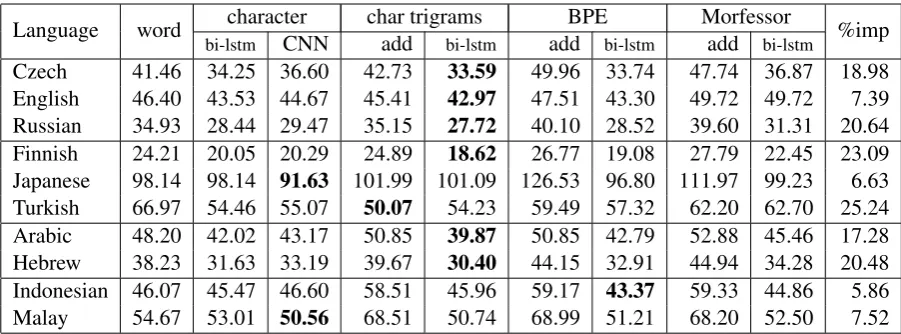
Table 5: Language model perplexities on test. The best model for each language is highlighted inbold and the improvement of this model over the word-level model is shown in the final column.
to (but more general than) the model of Sperr et al. (2013). We can see that the performance of character, character trigrams, and BPE are very competitive. Composition by bi-LSTMs or CNN is more effective than addition, except for Turk-ish. We also observe that BPE always outperforms Morfessor, even for the agglutinative languages. We now turn to a more detailed analysis by mor-phological typology.
Fusional languages. For these languages, character trigrams composed with bi-LSTMs outperformed all other models, particularly for Czech and Russian (up to 20%), which is unsur-prising since both are morphologically richer than English.
Agglutinative languages. We observe differ-ent results for each language. For Finnish, char-acter trigrams composed with bi-LSTMs achieves the best perplexity. Surprisingly, for Turkish char-acter trigrams composed via addition is best and addition also performs quite well for other rep-resentations, potentially useful since the addition function is simpler and faster than bi-LSTMs. We suspect that this is due to the fact that Turk-ish morphemes are reasonably short, hence well-approximated by character trigrams. For Japanese, we improvements from character models are more modest than in other languages.
Root and Pattern. For these languages, char-acter trigrams composed with bi-LSTMs also achieve the best perplexity. We had won-dered whether CNNs would be more effective for root-and-pattern morphology, but since these data are unvocalized, it is more likely that non-concatenative effects are minimized, though we do
still find morphological variants with consonan-tal inflections that behave more like concatenation. For example,maktab(root:ktb) is written asmktb. We suspect this makes character trigrams quite ef-fective since they match the tri-consonantal root patterns among words which share the same root.
Reduplication. For Indonesian, BPE morphs composed with bi-LSTMs model obtain the best perplexity. For Malay, the character CNN out-performs other models. However, these improve-ments are small compared to other languages. This likely reflects that Indonesian and Malay are only moderately inflected, where inflection in-volves both concatenative and non-concatenative processes.
5.1 Effects of Morphological Analysis
In the experiments above, we used unsupervised morphological segmentation as a proxy for mor-phological analysis (Table 3). However, as dis-cussed in Section2, this is quite approximate, so it is natural to wonder what would happen if we had the true morphological analysis. If character-level models are powerful enough to capture the effects of morphology, then they should have the predictive accuracy of a model with access to this analysis. To find out, we conducted an oracle experiment using the human-annotated morpho-logical analyses provided in the UD datasets for Czech and Russian, the only languages in our set for which these analyses were available. In these experiments we treat the lemma and each morpho-logical feature as a subword unit.
Languages Addition bi-LSTM
Czech 51.8 30.07
[image:7.595.324.509.61.172.2]Russian 41.82 26.44
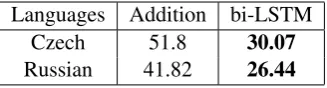
Table 6: Perplexity results using hand-annotated morphological analyses (cf. Table5).
other models for both languages. These results demonstrate that neither character representations nor unsupervised segmentation is a perfect re-placement for manual morphological analysis, at least in terms of predictive accuracy. In light of character-level results, they imply that current un-supervised morphological analyzers are poor sub-stitutes for real morphological analysis.
However, we can obtain much more unanno-tated than announanno-tated data, and we might guess that the character-level models would outperform those based on morphological analyses if trained on larger data. To test this, we ran experiments that varied the training data size on three represen-tation models: word, character-trigram bi-LSTM, and character CNN. Since we want to see how much training data is needed to reach perplexity obtained using annotated data, we use the same output vocabulary derived from the original train-ing. While this makes it possible to compare per-plexities across models, it is unfavorable to the models trained on larger data, which may focus on other words. This is a limitation of our experimen-tal setup, but does allow us to draw some tentative conclusions. As shown in Table 7, a character-level model trained on an order of magnitude more data still does not match the predictive accuracy of a model with access to morphological analysis.
5.2 Automatic Morphological Analysis The oracle experiments show promising results if we have annotated data. But these annotations are expensive, so we also investigated the use of auto-matic morphological analysis. We obtained analy-ses for Arabic with the MADAMIRA (Pasha et al.,
2014).4 As in the experiment using annotations, we treated each morphological feature as a sub-word unit. The resulting perplexities of71.94and 42.85for addition and bi-LSTMs, respectively, are worse than those obtained with character trigrams (39.87), though it approaches the best perplexities. 4We only experimented with Arabic since MADAMIRA
disambiguates words in contexts; most other analyzers we found did not do this, and would require additional work to add disambiguation.
#tokens word char trigrambi-LSTM CNNchar
1M 39.69 32.34 35.15
2M 37.59 36.44 35.58
3M 36.71 35.60 35.75
4M 35.89 32.68 35.93
5M 35.20 34.80 37.02
[image:7.595.100.264.62.106.2]10M 35.60 35.82 39.09
Table 7: Perplexity results on the Czech develop-ment data, varying training data size. Perplexity using ~1M tokens annotated data is28.83.
5.3 Targeted Perplexity Results
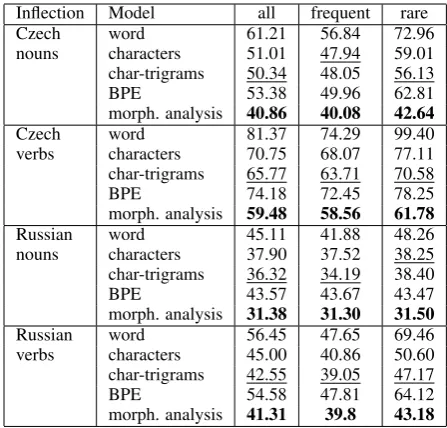
A difficulty in interpreting the results of Table 5
with respect to specific morphological processes is that perplexity is measured for all words. But these processes do not apply to all words, so it may be that the effects of specific morphological processes are washed out. To get a clearer picture, we measured perplexity for only specific subsets of words in our test data: specifically, given tar-get wordwi, we measure perplexity of wordwi+1.
In other words, we analyze the perplexitieswhen the inflected words of interest are in the most re-cent history, exploiting the recency bias of our LSTM-LM. This is the perplexity most likely to be strongly affected by different representations, since we do not vary representations of the pre-dicted word itself.
We look at several cases: nouns and verbs in Czech and Russian, where word classes can be identified from annotations, and reduplication in Indonesian, which we can identify mostly auto-matically. For each analysis, we also distinguish betweenfrequent cases, where the inflected word occurs more than ten times in the training data, and
rare cases, where it occurs fewer than ten times. We compare only bi-LSTM models.
Inflection Model all frequent rare
Czech word 61.21 56.84 72.96
nouns characters 51.01 47.94 59.01 char-trigrams 50.34 48.05 56.13
BPE 53.38 49.96 62.81
morph. analysis 40.86 40.08 42.64
Czech word 81.37 74.29 99.40
verbs characters 70.75 68.07 77.11 char-trigrams 65.77 63.71 70.58
BPE 74.18 72.45 78.25
morph. analysis 59.48 58.56 61.78
Russian word 45.11 41.88 48.26
nouns characters 37.90 37.52 38.25 char-trigrams 36.32 34.19 38.40
BPE 43.57 43.67 43.47
morph. analysis 31.38 31.30 31.50
Russian word 56.45 47.65 69.46
verbs characters 45.00 40.86 50.60 char-trigrams 42.55 39.05 47.17
BPE 54.58 47.81 64.12
morph. analysis 41.31 39.8 43.18 Table 8: Average perplexities of words that occur after nouns and verbs. Frequent words occur more than ten times in the training data; rare words oc-cur fewer times than this. The best perplexity is in boldwhile the second best is underlined.
For Indonesian, we exploit the fact that the hy-phen symbol ‘-’ typically separates the first and second occurrence of a reduplicated morpheme, as in the examples of Section2. We use the presence of word tokens containing hyphens to estimate the percentage of those exhibiting reduplication. As shown in Table9, the numbers are quite low.
Table 10 shows results for reduplication. In contrast with the overall results, the BPE bi-LSTM model has the worst perplexities, while character bi-LSTM has the best, suggesting that these mod-els are more effective for reduplication.
Looking more closely at BPE segmentation of reduplicated words, we found that only 6 of 252 reduplicated words have a correct word segmenta-tion, with the reduplicated morpheme often com-bining differently with the notional start-of-word or hyphen character. One the other hand BPE cor-rectly learns 8 out of 9 Indonesian prefixes and 4 out of 7 Indonesian suffixes.5 This analysis sup-ports our intuition that the improvement from BPE might come from its modeling of concatenative morphology.
5.4 Qualitative Analysis
Table 11 presents nearest neighbors under co-sine similarity for in-vocabulary, rare, and
out-of-5We use Indonesian affixes listed inLarasati et al.(2011)
Language type-level (%) token-level (%)
Indonesian 1.10 2.60
[image:8.595.70.294.61.275.2]Malay 1.29 2.89
Table 9: Percentage of full reduplication on the type and token level.
Model all frequent rare
word 101.71 91.71 156.98
characters 99.21 91.35 137.42
BPE 117.2 108.86 156.81
Table 10: Average perplexities of words that occur after reduplicated words in the test set.
vocabulary (OOV) words.6 For frequent words, standard word embeddings are clearly superior for lexical meaning. Character and morph representa-tions tend to find words that are orthographically similar, suggesting that they are better at model-ing dependent than root morphemes. The same pattern holds for rare and OOV words. We sus-pect that the subword models outperform words on language modeling because they exploit affixes to signal word class. We also noticed similar pat-terns in Japanese.
We analyze reduplication by querying redupli-cated words to find their nearest neighbors using the BPE bi-LSTM model. If the model were sensi-tive to reduplication, we would expect to see mor-phological variants of the query word among its nearest neighbors. However, from Table12, this is not so. With the partially reduplicated query
berlembah-lembah, we do not find the lemma lem-bah.
6 Conclusion
We presented a systematic comparison of word representation models with different levels of mor-phological awareness, across languages with dif-ferent morphological typologies. Our results con-firm previous findings that character-level models are effective for many languages, but these mod-els do not match the predictive accuracy of model with explicit knowledge of morphology, even af-ter we increase the training data size by ten times. Moreover, our qualitative analysis suggests that they learn orthographic similarity of affixes, and lose the meaning of root morphemes.
[image:8.595.307.523.62.106.2] [image:8.595.321.514.151.207.2]Model man Frequent Wordsincluding relatively unconditionalRare Wordshydroplane uploadingOOV wordsfoodism word
person like extremely nazi molybdenum -
-anyone featuring making fairly your -
-children include very joints imperial -
-men includes quite supreme intervene -
-BPE ii called newly unintentional emphasize upbeat vigilantism
LSTM texthill involvelike essentiallynever ungenerousunanimous hybridizedheartbeat handlinguprising pyrethrumpausanias netherlands creating least unpalatable unplatable hand-colored footway char- mak include resolutely unconstitutional selenocysteine drifted tuaregs trigrams vill includes regeneratively constitutional guerrillas affected quft LSTM cow undermining reproductively unimolecular scrofula conflicted subjectivism
maga under commonly medicinal seleucia convicted tune-up
[image:9.595.72.527.59.290.2]char- mayr inclusion relates undamaged hydrolyzed musagte formulas LSTM manymary insularityincludes relativityreplicate unconditionallyunmyelinated hysterotomyhydraulics mutualismmutualists formallyfecal may include gravestones uncoordinated hydraulic meursault foreland char- mtn include legislatively unconventional hydroxyproline unloading fordism CNN mannjan excludingincludes creativelylovely unconstitutionalunintentional hydrangeahydrate upgradingloading dadaismpopism nun included negatively untraditional hyena upholding endemism Table 11: Nearest neighbours of semantically and syntactically similar words.
Query Top nearest neighbours
kota-kota wilayah-wilayah (areas), pulau-pulau (islands), negara-negara (countries), (cities) bahasa-bahasa (languages), koloni-koloni (colonies)
berlembah-lembah berargumentasi (argue), bercakap-cakap (converse), berkemauan (will), (have many valleys) berimplikasi (imply), berketebalan (have a thickness)
Table 12: Nearest neighbours of Indonesian reduplicated words in the BPE bi-LSTM model.
in limited quantities, our results suggest that there might be utility in semi-supervised learning from partially annotated data. Across languages with different typologies, our experiments show that the subword unit models are most effective on agglu-tinative languages. However, these results do not generalize to all languages, since factors such as morphology and orthography affect the utility of these representations. We plan to explore these ef-fects in future work.
Acknowledgments
Clara Vania is supported by the Indonesian En-dowment Fund for Education (LPDP), the Cen-tre for Doctoral Training in Data Science, funded by the UK EPSRC (grant EP/L016427/1), and the University of Edinburgh. We thank Sameer Bansal, Toms Bergmanis, Marco Damonte, Fed-erico Fancellu, Sorcha Gilroy, Sharon Gold-water, Frank Keller, Mirella Lapata, Felicia Liu, Jonathan Mallinson, Joana Ribeiro, Naomi Saphra, Ida Szubert, and the anonymous reviewers for helpful discussion of this work and comments on previous drafts of the paper.
References
Mart´ın Abadi, Ashish Agarwal, Paul Barham, Eugene Brevdo, Zhifeng Chen, Craig Citro, Greg S. Cor-rado, Andy Davis, Jeffrey Dean, Matthieu Devin, Sanjay Ghemawat, Ian Goodfellow, Andrew Harp, Geoffrey Irving, Michael Isard, Yangqing Jia, Rafal Jozefowicz, Lukasz Kaiser, Manjunath Kudlur, Josh Levenberg, Dan Man´e, Rajat Monga, Sherry Moore, Derek Murray, Chris Olah, Mike Schuster, Jonathon Shlens, Benoit Steiner, Ilya Sutskever, Kunal Tal-war, Paul Tucker, Vincent Vanhoucke, Vijay Va-sudevan, Fernanda Vi´egas, Oriol Vinyals, Pete Warden, Martin Wattenberg, Martin Wicke, Yuan Yu, and Xiaoqiang Zheng. 2015. TensorFlow: Large-scale machine learning on heterogeneous sys-tems. Software available from tensorflow.org. http://tensorflow.org/.
Rami Al-Rfou, Bryan Perozzi, and Steven Skiena. 2013. Polyglot: Distributed word representa-tions for multilingual nlp. In Proceedings of the Seventeenth Conference on Computational Natu-ral Language Learning. Association for Computa-tional Linguistics, Sofia, Bulgaria, pages 183–192. http://www.aclweb.org/anthology/W13-3520.
Piotr Bojanowski, Edouard Grave, Armand Joulin, and Tomas Mikolov. 2016. Enriching word vectors with subword information. CoRRabs/1607.04606. http://arxiv.org/abs/1607.04606.
Jan A. Botha and Phil Blunsom. 2014. Com-positional Morphology for Word Representa-tions and Language Modeling. In Proceed-ings of the 31st International Conference on Machine Learning (ICML). Beijing, China. http://jmlr.org/proceedings/papers/v32/botha14.pdf.
Danqi Chen and Christopher Manning. 2014. A fast and accurate dependency parser using neural networks. In Proceedings of the 2014 Confer-ence on Empirical Methods in Natural Language Processing (EMNLP). Association for Computa-tional Linguistics, Doha, Qatar, pages 740–750. http://www.aclweb.org/anthology/D14-1082.
Kyunghyun Cho, Bart van Merrienboer, Caglar Gul-cehre, Dzmitry Bahdanau, Fethi Bougares, Holger Schwenk, and Yoshua Bengio. 2014. Learning phrase representations using rnn encoder–decoder for statistical machine translation. InProceedings of the 2014 Conference on Empirical Methods in Nat-ural Language Processing (EMNLP). Association for Computational Linguistics, Doha, Qatar, pages 1724–1734. http://www.aclweb.org/anthology/D14-1179.
Ryan Cotterell and Hinrich Sch¨utze. 2015. Morpho-logical word-embeddings. In Proceedings of the 2015 Conference of the North American Chapter of the Association for Computational Linguistics: Hu-man Language Technologies. Association for Com-putational Linguistics, Denver, Colorado, pages 1287–1292. http://www.aclweb.org/anthology/N15-1140.
Chris Dyer, Miguel Ballesteros, Wang Ling, Austin Matthews, and Noah A. Smith. 2015. Transition-based dependency parsing with stack long short-term memory. In Proceedings of the 53rd An-nual Meeting of the Association for Computa-tional Linguistics and the 7th InternaComputa-tional Joint Conference on Natural Language Processing (Vol-ume 1: Long Papers). Association for Computa-tional Linguistics, Beijing, China, pages 334–343. http://www.aclweb.org/anthology/P15-1033.
Philip Gage. 1994. A new algorithm for data compression. C Users J. 12(2):23–38. http://dl.acm.org/citation.cfm?id=177910.177914.
Dan Gillick, Cliff Brunk, Oriol Vinyals, and Amarnag Subramanya. 2016. Multilingual language process-ing from bytes. InProceedings of the 2016 Confer-ence of the North American Chapter of the Associ-ation for ComputAssoci-ational Linguistics: Human Lan-guage Technologies. Association for Computational Linguistics, San Diego, California, pages 1296– 1306.http://www.aclweb.org/anthology/N16-1155.
Alex Graves, Santiago Fern´andez, and J¨urgen Schmidhuber. 2005. Bidirectional lstm net-works for improved phoneme classification and recognition. In Proceedings of the 15th International Conference on Artificial Neu-ral Networks: Formal Models and Their Ap-plications - Volume Part II. Springer-Verlag, Berlin, Heidelberg, ICANN’05, pages 799–804. http://dl.acm.org/citation.cfm?id=1986079.1986220. Martin Haspelmath. 2010. Understanding
Morphol-ogy. Understanding Language Series. Arnold, Lon-don, second edition.
Georg Heigold, Guenter Neumann, and Josef van Gen-abith. 2017. An extensive empirical evaluation of character-based morphological tagging for 14 lan-guages. InProceedings of the 15th Conference of the European Chapter of the Association for Com-putational Linguistics: Volume 1, Long Papers. As-sociation for Computational Linguistics, pages 505– 513. http://aclweb.org/anthology/E17-1048. Sepp Hochreiter and J¨urgen Schmidhuber. 1997. Long
short-term memory. Neural Comput. 9(8):1735– 1780.https://doi.org/10.1162/neco.1997.9.8.1735. Katharina Kann and Hinrich Sch¨utze. 2016.
Pro-ceedings of the 14th SIGMORPHON Workshop on Computational Research in Phonetics, Phonol-ogy, and Morphology, Association for Compu-tational Linguistics, chapter MED: The LMU System for the SIGMORPHON 2016 Shared Task on Morphological Reinflection, pages 62–70. https://doi.org/10.18653/v1/W16-2010.
Yoon Kim, Yacine Jernite, David Sontag, and Alexan-der Rush. 2016. Character-aware neural language models. InProceedings of the 2016 Conference on Artificial Intelligence (AAAI).
Septina Dian Larasati, Vladislav Kuboˇn, and Daniel Zeman. 2011. Indonesian Morphology Tool (Mor-phInd): Towards an Indonesian Corpus, Springer Berlin Heidelberg, Berlin, Heidelberg, pages 119– 129. https://doi.org/10.1007/978-3-642-23138-4 8. Jason Lee, Kyunghyun Cho, and Thomas
Hof-mann. 2016. Fully character-level neural machine translation without explicit segmentation. CoRR
abs/1610.03017.http://arxiv.org/abs/1610.03017. Wang Ling, Chris Dyer, Alan W Black, Isabel
Tran-coso, Ramon Fermandez, Silvio Amir, Luis Marujo, and Tiago Luis. 2015. Finding function in form: Compositional character models for open vocabu-lary word representation. In Proceedings of the 2015 Conference on Empirical Methods in Natu-ral Language Processing. Association for Compu-tational Linguistics, Lisbon, Portugal, pages 1520– 1530.http://aclweb.org/anthology/D15-1176. Thang Luong, Richard Socher, and Christopher
Computational Linguistics, Sofia, Bulgaria, pages 104–113. http://www.aclweb.org/anthology/W13-3512.
Mitchell P. Marcus, Mary Ann Marcinkiewicz, and Beatrice Santorini. 1993. Building a large annotated corpus of english: The penn treebank. Comput. Linguist. 19(2):313–330. http://dl.acm.org/citation.cfm?id=972470.972475.
Tom´aˇs Mikolov, Martin Karafi´at, Luk´aˇs Burget, Jan ˇCernock´y, and Sanjeev Khudanpur. 2010. Recurrent neural network based language model. In Proceedings of the 11th Annual Conference of the International Speech Communication
Association (INTERSPEECH 2010).
Inter-national Speech Communication Association, volume 2010, pages 1045–1048. http://www.isca-speech.org/archive/interspeech 2010/i10 1045.html.
Yasumasa Miyamoto and Kyunghyun Cho. 2016. Gated word-character recurrent language model.
In Proceedings of the 2016 Conference on
Empirical Methods in Natural Language Pro-cessing. Association for Computational Lin-guistics, Austin, Texas, pages 1992–1997. https://aclweb.org/anthology/D16-1209.
G. David Morley. 2000. Syntax in Functional Gram-mar: An Introduction to Lexicogrammar in Systemic Linguistics. Continuum.
Joakim Nivre, ˇZeljko Agi´c, Maria Jesus Aranzabe, Masayuki Asahara, Aitziber Atutxa, Miguel Balles-teros, John Bauer, Kepa Bengoetxea, Riyaz Ah-mad Bhat, Cristina Bosco, Sam Bowman, Giuseppe G. A. Celano, Miriam Connor, Marie-Catherine de Marneffe, Arantza Diaz de Ilarraza, Kaja Do-brovoljc, Timothy Dozat, Tomaˇz Erjavec, Rich´ard Farkas, Jennifer Foster, Daniel Galbraith, Filip Gin-ter, Iakes Goenaga, Koldo Gojenola, Yoav Gold-berg, Berta Gonzales, Bruno Guillaume, Jan Hajiˇc, Dag Haug, Radu Ion, Elena Irimia, Anders Jo-hannsen, Hiroshi Kanayama, Jenna Kanerva, Simon Krek, Veronika Laippala, Alessandro Lenci, Nikola Ljubeˇsi´c, Teresa Lynn, Christopher Manning, Ctlina Mrnduc, David Mareˇcek, H´ector Mart´ınez Alonso, Jan Maˇsek, Yuji Matsumoto, Ryan McDonald, Anna Missil¨a, Verginica Mititelu, Yusuke Miyao, Simonetta Montemagni, Shunsuke Mori, Hanna Nurmi, Petya Osenova, Lilja Øvrelid, Elena Pascual, Marco Passarotti, Cenel-Augusto Perez, Slav Petrov, Jussi Piitulainen, Barbara Plank, Martin Popel, Prokopis Prokopidis, Sampo Pyysalo, Loganathan Ramasamy, Rudolf Rosa, Shadi Saleh, Sebastian Schuster, Wolfgang Seeker, Mojgan Seraji, Natalia Silveira, Maria Simi, Radu Simionescu, Katalin Simk´o, Kiril Simov, Aaron Smith, Jan ˇStˇep´anek, Alane Suhr, Zsolt Sz´ant´o, Takaaki Tanaka, Reut Tsarfaty, Sumire Uematsu, Larraitz Uria, Viktor Varga, Veronika Vincze, Zdenˇek ˇZabokrtsk´y, Daniel Zeman, and Hanzhi Zhu. 2015. Universal depen-dencies 1.2LINDAT/CLARIN digital library at In-stitute of Formal and Applied Linguistics, Charles
University in Prague. http://hdl.handle.net/11234/1-1548.
Arfath Pasha, Mohamed Al-Badrashiny, Mona Diab, Ahmed El Kholy, Ramy Eskander, Nizar Habash, Manoj Pooleery, Owen Rambow, and Ryan Roth. 2014. Madamira: A fast, comprehensive tool for morphological analysis and disambiguation of ara-bic. In Nicoletta Calzolari, Khalid Choukri, Thierry Declerck, Hrafn Loftsson, Bente Maegaard, Joseph Mariani, Asuncion Moreno, Jan Odijk, and Ste-lios Piperidis, editors, Proceedings of the Ninth International Conference on Language Resources and Evaluation (LREC’14). European Language Re-sources Association (ELRA), Reykjavik, Iceland, pages 1094–1101. ACL Anthology Identifier: L14-1479.
Barbara Plank, Anders Søgaard, and Yoav Goldberg. 2016. Multilingual part-of-speech tagging with bidirectional long short-term memory models and auxiliary loss. In Proceedings of the 54th Annual Meeting of the Association for Computational Lin-guistics (Volume 2: Short Papers). Association for Computational Linguistics, Berlin, Germany, pages 412–418. http://anthology.aclweb.org/P16-2067.
Siyu Qiu, Qing Cui, Jiang Bian, Bin Gao, and Tie-Yan Liu. 2014. Co-learning of word representations and morpheme representations. In Proceedings of COLING 2014, the 25th International Conference on Computational Linguistics: Technical Papers. Dublin City University and Association for Com-putational Linguistics, Dublin, Ireland, pages 141– 150. http://www.aclweb.org/anthology/C14-1015.
Marek Rei, Gamal Crichton, and Sampo Pyysalo. 2016. Attending to characters in neural sequence label-ing models. In Proceedings of COLING 2016, the 26th International Conference on Computational Linguistics: Technical Papers. The COLING 2016 Organizing Committee, Osaka, Japan, pages 309– 318. http://aclweb.org/anthology/C16-1030.
Brian Roark and Richard Sproat. 2007. Computational Approach to Morphology and Syntax. Oxford Uni-versity Press.
Cicero Dos Santos and Bianca Zadrozny. 2014. Learning character-level representations for part-of-speech tagging. In Eric P. Xing and Tony Jebara, editors, Proceedings of the 31st Interna-tional Conference on Machine Learning. PMLR, Bejing, China, volume 32 of Proceedings of Machine Learning Research, pages 1818–1826. http://proceedings.mlr.press/v32/santos14.html.
Peter Smit, Sami Virpioja, Stig-Arne Gr¨onroos, and Mikko Kurimo. 2014. Morfessor 2.0: Toolkit for statistical morphological segmentation. In Proceed-ings of the Demonstrations at the 14th Conference of the European Chapter of the Association for Com-putational Linguistics. Association for Computa-tional Linguistics, Gothenburg, Sweden, pages 21– 24.http://www.aclweb.org/anthology/E14-2006.
Henning Sperr, Jan Niehues, and Alex Waibel. 2013. Letter n-gram-based input encoding for continu-ous space language models. In Proceedings of the Workshop on Continuous Vector Space Models and their Compositionality. Association for Compu-tational Linguistics, Sofia, Bulgaria, pages 30–39. http://www.aclweb.org/anthology/W13-3204.
Ekaterina Vylomova, Trevor Cohn, Xuanli He, and Gholamreza Haffari. 2016. Word representation models for morphologically rich languages in neu-ral machine translation. CoRR abs/1606.04217. http://arxiv.org/abs/1606.04217.