107
Learning Compressed Sentence Representations
for On-Device Text Processing
Dinghan Shen1∗, Pengyu Cheng1∗, Dhanasekar Sundararaman1
Xinyuan Zhang1, Qian Yang1, Meng Tang3, Asli Celikyilmaz2, Lawrence Carin1
1 Duke University 2 Microsoft Research 3Stanford University
Abstract
Vector representations of sentences, trained on massive text corpora, are widely used as generic sentence embeddings across a variety of NLP problems. The learned representa-tions are generally assumed to becontinuous
andreal-valued, giving rise to a large memory footprint and slow retrieval speed, which hin-ders their applicability to low-resource (mem-ory and computation) platforms, such as mo-bile devices. In this paper, we propose four different strategies to transform continuous
and generic sentence embeddings into a bi-narizedform, while preserving their rich se-mantic information. The introduced methods are evaluated across a wide range of down-stream tasks, where the binarized sentence em-beddings are demonstrated to degrade perfor-mance by only about2%relative to their con-tinuous counterparts, while reducing the stor-age requirement by over98%. Moreover, with the learned binary representations, the seman-tic relatedness of two sentences can be evalu-ated by simply calculating their Hamming dis-tance, which is more computational efficient compared with the inner product operation be-tween continuous embeddings. Detailed anal-ysis and case study further validate the effec-tiveness of proposed methods.
1 Introduction
Learning general-purpose sentence representa-tions from large training corpora has received widespread attention in recent years. The learned sentence embeddings can encapsulate rich prior knowledge of natural language, which has been demonstrated to facilitate a variety of downstream tasks (without fine-tuning the encoder weights). The generic sentence embeddings can be trained either in an unsupervised manner (Kiros et al., 2015;Hill et al., 2016; Jernite et al., 2017; Gan
∗
Equal contribution.
et al., 2017;Logeswaran and Lee,2018; Pagliar-dini et al., 2018), or with supervised tasks such as paraphrase identification (Wieting et al.,2016), natural language inference (Conneau et al.,2017), discourse relation classification (Nie et al.,2017), machine translation (Wieting and Gimpel,2018),
etc.
Significant effort has been devoted to design-ing better traindesign-ing objectives for learndesign-ing sentence embeddings. However, prior methods typically as-sume that the general-purpose sentence represen-tations arecontinuousandreal-valued. However, this assumption is sub-optimal from the following perspectives: i) the sentence embeddings require large storage or memory footprint; ii) it is com-putationally expensive to retrieve semantically-similar sentences, since every sentence represen-tation in the database needs to be compared, and the inner product operation is computationally in-volved. These two disadvantages hinder the appli-cability of generic sentence representations to mo-bile devices, where a relatively tiny memory foot-print and low computational capacity are typically available (Ravi and Kozareva,2018).
In this paper, we aim to mitigate the above is-sues by binarizing the continuous sentence em-beddings. Consequently, the embeddings require much smaller footprint, and similar sentences can be obtained by simply selecting those with clos-est binary codes in the Hamming space (Kiros and Chan, 2018). One simple idea is to naively bi-narize the continuous vectors by setting a hard threshold. However, we find that this strategy leads to significant performance drop in the em-pirical results. Besides, the dimension of the bi-nary sentence embeddings cannot be flexibly cho-sen with this strategy, further limiting the practice use of the direct binarization method.
pre-trained generic continuous embeddings to their binary forms. Our exploration spans from
simple operations, such as a random projection,
to deep neural network models, such as a
regu-larized autoencoder. Particularly, we introduce
a semantic-preserving objective, which is aug-mented with the standard autoenoder architec-ture to encourage abstracting informative binary codes. InferSent (Conneau et al., 2017) is em-ployed as the testbed sentence embeddings in our experiments, but the binarization schemes pro-posed here can easily be extended to other pre-trained general-purpose sentence embeddings. We evaluate the quality of the learned general-purpose binary representations using the SentEval toolkit (Conneau et al.,2017). It is observed that the in-ferred binary codes successfully maintain the se-mantic features contained in the continuous em-beddings, and only lead to around 2% perfor-mance drop on a set of downstream NLP tasks, while requiring merely1.5%memory footprint of their continuous counterparts.
Moreover, on several sentence matching bench-marks, we demonstrate that the relatedness be-tween a sentence pair can be evaluated by sim-ply calculating the Hamming distance between their binary codes, which perform on par with or even superior than measuring the cosine sim-ilarity between continuous embeddings (see Ta-ble1). Note that computing the Hamming distance is much more computationally efficient than the inner product operation in a continuous space. We further perform aK-nearest neighbor sentence re-trieval experiment on the SNLI dataset (Bowman et al., 2015), and show that those semantically-similar sentences can indeed be efficiently re-trieved with off-the-shelf binary sentence repre-sentations. Summarizing, our contributions in this paper are as follows:
i) to the best of our knowledge, we con-duct the first systematic exploration on learn-ing general-purposebinarized(memory-efficient) sentence representations, and four different strate-gies are proposed;
ii) an autoencoder architecture with a carefully-designedsemantic-preserving lossexhibits strong empirical results on a set of downstream NLP tasks;
iii) more importantly, we demonstrate, on sev-eral sentence-matching datasets, that simply eval-uating the Hamming distance over binary
repre-sentations performs on par or even better than cal-culating thecosine similaritybetween their contin-uous counterparts (which is less computationally-efficient).
2 Related Work
Sentence representations pre-trained from a large amount of data have been shown to be effective when transferred to a wide range of downstream tasks. Prior work along this line can be roughly divided into two categories: i) pre-trained models that require fine-tuning on the specific transferring task (Dai and Le,2015;Ruder and Howard,2018; Radford et al.,2018;Devlin et al.,2018;Cer et al., 2018); ii) methods that extract general-purpose sentence embeddings, which can be effectively applied to downstream NLP tasks without fine-tuning the encoder parameters (Kiros et al.,2015; Hill et al., 2016; Jernite et al., 2017; Gan et al., 2017;Adi et al.,2017;Logeswaran and Lee,2018; Pagliardini et al., 2018; Tang and de Sa, 2018). Our proposed methods belong to the second cat-egory and provide a generic and easy-to-use en-coder to extract highly informative sentence rep-resentations. However, our work is unique since the embeddings inferred from our models are bi-narized and compact, and thus possess the advan-tages of small memory footprint and much faster sentence retrieval.
Learning memory-efficient embeddings with deep neural networks has attracted substantial at-tention recently. One general strategy towards this goal is to extract discrete or binary data repre-sentations (Jang et al.,2016;Shu and Nakayama, 2017; Dai et al., 2017; Chen et al., 2018; Shen et al., 2018; Tissier et al., 2019). Binarized em-beddings are especially attractive because they are more memory-efficient (relative to discrete em-beddings), and they also enjoy the advantages of fast retrieval based upon a Hamming distance cal-culation. Previous work along this line in NLP has mainly focused on learning compact representa-tions at the word-level (Shu and Nakayama,2017; Chen et al.,2018;Tissier et al.,2019), while much less effort has been devoted to extracting binarized embeddings at the sentence-level. Our work aims to bridge this gap, and serves as an initial attempt to facilitate the deployment of state-of-the-art sen-tence embeddings on on-device mobile applica-tions.
text embeddings specifically for the information retrieval task (Salakhutdinov and Hinton, 2009; Zhang et al., 2010;Wang et al., 2014;Xu et al., 2015;Shen et al.,2018). However, these methods are typically trained and evaluated on documents that belong to a specific domain, and thus cannot serve as generic binary sentence representation ap-plicable to a wide variety of NLP taks. In contrast, our model is trained on large corpora and seeks to provide general-purpose binary representations that can be leveraged for various application sce-narios.
3 Proposed Approach
We aim to produce compact and binarized repre-sentations from continuous sentence embeddings, and preserve the associated semantic information. Letxandf denote, respectively, an input sentence and the function defined by a pre-trained general-purpose sentence encoder. Thus,f(x)represents the continuous embeddings extracted by the en-coder. The goal of our model is to learn a universal transformation g that can convert f(x) to highly informative binary sentence representations, i.e., g(f(x)), which can be used as generic features for a collection of downstream tasks. We explore four strategies to parametrize the transformationg.
3.1 Hard Threshold
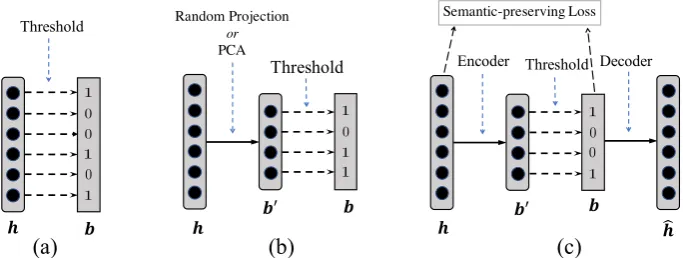
We useh andbto denote the continuous and bi-nary sentence embeddings, respectively, andL de-notes the dimension ofh. The first method to bi-narize the continuous representations is to simply convert each dimension to either 0or1 based on a hard threshold. This strategy requires no train-ing and directly operates on pre-trained continu-ous embeddings. Supposesis the hard threshold, we have, fori= 1,2, ..., L:
b(i)=1h(i)>s=
sign(h(i)−s) + 1
2 , (1)
One potential issue of this direct binarization method is that the information contained in the continuous representations may be largely lost, since there is no training objective encouraging the preservation of semantic information in the pro-duced binary codes (Shen et al., 2018). Another disadvantage is that the length of the resulting bi-nary code must be the same as the original contin-uous representation, and can not be flexibly cho-sen. In practice, however, we may want to learn
shorter binary embeddings to save more memory footprint or computation.
3.2 Random Projection
To tackle the limitation of the above direct bina-rization method, we consider an alternative strat-egy that requires no training either: simply apply-ing a random projection over the pre-trained con-tinuous representations.Wieting and Kiela(2018) has shown that random sentence encoders can ef-fectively construct universal sentence embeddings from word vectors, while possessing the flexibility of adaptively altering the embedding dimensions. Here, we are interested in exploring whether a ran-dom projection would also work well while trans-forming continuous sentence representations into their binary counterparts.
We randomly initialize a matrix W ∈ RD×L,
whereDdenotes the dimension of the resulting bi-nary representations. Inspired by the standard ini-tialization heuristic employed in (Glorot and Ben-gio, 2010; Wieting and Kiela, 2018), the values of the matrix are initialized as sampled uniformly. Fori= 1,2, . . . , Dandj= 1,2, . . . , L, we have:
Wi,j ∼Uniform(−
1
√
D, 1
√
D), (2) After converting the continuous sentence embed-dings to the desired dimension D with the ma-trix randomly initialized above, we further apply the operation in (1) to binarize it into the dis-crete/compact form. The dimensionDcan be set arbitrarily with this approach, which is easily ap-plicable to any pre-trained sentence embeddings (since no training is needed). This strategy is re-lated to the Locality-Sensitive Hashing (LSH) for inferring binary embeddings (Van Durme and Lall, 2010).
3.3 Principal Component Analysis
We also consider an alternative strategy to adap-tively choose the dimension of the resulting bi-nary representations. Specifically, Principal Com-ponent Analysis (PCA) is utilized to reduce the dimensionality of pre-trained continuous embed-dings.
Given a set of sentences{xi}Ni=1and their
corre-sponding continuous embeddings{hi}Ni=1 ⊂ RL,
0
<latexit sha1_base64="JxFURWUH6R+vJirwMs9sg7WrHjU=">AAAB+HicbVBNSwMxEJ2tX7V+VT16CRbBU8mKoMeiF49V7Ae0S8mm2TY0yS5JVqhL/4FXPXsTr/4bj/4T03YPtvXBwOO9GWbmhYngxmL87RXW1jc2t4rbpZ3dvf2D8uFR08SppqxBYxHrdkgME1yxhuVWsHaiGZGhYK1wdDv1W09MGx6rRztOWCDJQPGIU2Kd9IBLvXIFV/EMaJX4OalAjnqv/NPtxzSVTFkqiDEdHyc2yIi2nAo2KXVTwxJCR2TAOo4qIpkJstmlE3TmlD6KYu1KWTRT/05kRBozlqHrlMQOzbI3Ff/zOqmNroOMqyS1TNH5oigVyMZo+jbqc82oFWNHCNXc3YrokGhCrQtnYUsoJy4TfzmBVdK8qPq46t9fVmo3eTpFOIFTOAcfrqAGd1CHBlCI4AVe4c179t69D+9z3lrw8pljWID39QtO0pNe</latexit><latexit sha1_base64="JxFURWUH6R+vJirwMs9sg7WrHjU=">AAAB+HicbVBNSwMxEJ2tX7V+VT16CRbBU8mKoMeiF49V7Ae0S8mm2TY0yS5JVqhL/4FXPXsTr/4bj/4T03YPtvXBwOO9GWbmhYngxmL87RXW1jc2t4rbpZ3dvf2D8uFR08SppqxBYxHrdkgME1yxhuVWsHaiGZGhYK1wdDv1W09MGx6rRztOWCDJQPGIU2Kd9IBLvXIFV/EMaJX4OalAjnqv/NPtxzSVTFkqiDEdHyc2yIi2nAo2KXVTwxJCR2TAOo4qIpkJstmlE3TmlD6KYu1KWTRT/05kRBozlqHrlMQOzbI3Ff/zOqmNroOMqyS1TNH5oigVyMZo+jbqc82oFWNHCNXc3YrokGhCrQtnYUsoJy4TfzmBVdK8qPq46t9fVmo3eTpFOIFTOAcfrqAGd1CHBlCI4AVe4c179t69D+9z3lrw8pljWID39QtO0pNe</latexit>
<latexit sha1_base64="JxFURWUH6R+vJirwMs9sg7WrHjU=">AAAB+HicbVBNSwMxEJ2tX7V+VT16CRbBU8mKoMeiF49V7Ae0S8mm2TY0yS5JVqhL/4FXPXsTr/4bj/4T03YPtvXBwOO9GWbmhYngxmL87RXW1jc2t4rbpZ3dvf2D8uFR08SppqxBYxHrdkgME1yxhuVWsHaiGZGhYK1wdDv1W09MGx6rRztOWCDJQPGIU2Kd9IBLvXIFV/EMaJX4OalAjnqv/NPtxzSVTFkqiDEdHyc2yIi2nAo2KXVTwxJCR2TAOo4qIpkJstmlE3TmlD6KYu1KWTRT/05kRBozlqHrlMQOzbI3Ff/zOqmNroOMqyS1TNH5oigVyMZo+jbqc82oFWNHCNXc3YrokGhCrQtnYUsoJy4TfzmBVdK8qPq46t9fVmo3eTpFOIFTOAcfrqAGd1CHBlCI4AVe4c179t69D+9z3lrw8pljWID39QtO0pNe</latexit>
<latexit sha1_base64="JxFURWUH6R+vJirwMs9sg7WrHjU=">AAAB+HicbVBNSwMxEJ2tX7V+VT16CRbBU8mKoMeiF49V7Ae0S8mm2TY0yS5JVqhL/4FXPXsTr/4bj/4T03YPtvXBwOO9GWbmhYngxmL87RXW1jc2t4rbpZ3dvf2D8uFR08SppqxBYxHrdkgME1yxhuVWsHaiGZGhYK1wdDv1W09MGx6rRztOWCDJQPGIU2Kd9IBLvXIFV/EMaJX4OalAjnqv/NPtxzSVTFkqiDEdHyc2yIi2nAo2KXVTwxJCR2TAOo4qIpkJstmlE3TmlD6KYu1KWTRT/05kRBozlqHrlMQOzbI3Ff/zOqmNroOMqyS1TNH5oigVyMZo+jbqc82oFWNHCNXc3YrokGhCrQtnYUsoJy4TfzmBVdK8qPq46t9fVmo3eTpFOIFTOAcfrqAGd1CHBlCI4AVe4c179t69D+9z3lrw8pljWID39QtO0pNe</latexit>
1<latexit sha1_base64="TLhiafyz+7kVW7hdyQ94ij177M0=">AAAB+XicbVBNSwMxEJ2tX3X9qnr0EiyCp7IRQY9FLx4r2lpol5JNs21okl2SrFCW/gSvevYmXv01Hv0npu0ebOuDgcd7M8zMi1LBjQ2Cb6+0tr6xuVXe9nd29/YPKodHLZNkmrImTUSi2xExTHDFmpZbwdqpZkRGgj1Fo9up//TMtOGJerTjlIWSDBSPOSXWSQ/Y93uValALZkCrBBekCgUavcpPt5/QTDJlqSDGdHCQ2jAn2nIq2MTvZoalhI7IgHUcVUQyE+azUyfozCl9FCfalbJopv6dyIk0Ziwj1ymJHZplbyr+53UyG1+HOVdpZpmi80VxJpBN0PRv1OeaUSvGjhCqubsV0SHRhFqXzsKWSE5cJng5gVXSuqjhoIbvL6v1myKdMpzAKZwDhiuowx00oAkUBvACr/Dm5d679+F9zltLXjFzDAvwvn4BhVSTcw==</latexit><latexit sha1_base64="TLhiafyz+7kVW7hdyQ94ij177M0=">AAAB+XicbVBNSwMxEJ2tX3X9qnr0EiyCp7IRQY9FLx4r2lpol5JNs21okl2SrFCW/gSvevYmXv01Hv0npu0ebOuDgcd7M8zMi1LBjQ2Cb6+0tr6xuVXe9nd29/YPKodHLZNkmrImTUSi2xExTHDFmpZbwdqpZkRGgj1Fo9up//TMtOGJerTjlIWSDBSPOSXWSQ/Y93uValALZkCrBBekCgUavcpPt5/QTDJlqSDGdHCQ2jAn2nIq2MTvZoalhI7IgHUcVUQyE+azUyfozCl9FCfalbJopv6dyIk0Ziwj1ymJHZplbyr+53UyG1+HOVdpZpmi80VxJpBN0PRv1OeaUSvGjhCqubsV0SHRhFqXzsKWSE5cJng5gVXSuqjhoIbvL6v1myKdMpzAKZwDhiuowx00oAkUBvACr/Dm5d679+F9zltLXjFzDAvwvn4BhVSTcw==</latexit><latexit sha1_base64="TLhiafyz+7kVW7hdyQ94ij177M0=">AAAB+XicbVBNSwMxEJ2tX3X9qnr0EiyCp7IRQY9FLx4r2lpol5JNs21okl2SrFCW/gSvevYmXv01Hv0npu0ebOuDgcd7M8zMi1LBjQ2Cb6+0tr6xuVXe9nd29/YPKodHLZNkmrImTUSi2xExTHDFmpZbwdqpZkRGgj1Fo9up//TMtOGJerTjlIWSDBSPOSXWSQ/Y93uValALZkCrBBekCgUavcpPt5/QTDJlqSDGdHCQ2jAn2nIq2MTvZoalhI7IgHUcVUQyE+azUyfozCl9FCfalbJopv6dyIk0Ziwj1ymJHZplbyr+53UyG1+HOVdpZpmi80VxJpBN0PRv1OeaUSvGjhCqubsV0SHRhFqXzsKWSE5cJng5gVXSuqjhoIbvL6v1myKdMpzAKZwDhiuowx00oAkUBvACr/Dm5d679+F9zltLXjFzDAvwvn4BhVSTcw==</latexit><latexit sha1_base64="TLhiafyz+7kVW7hdyQ94ij177M0=">AAAB+XicbVBNSwMxEJ2tX3X9qnr0EiyCp7IRQY9FLx4r2lpol5JNs21okl2SrFCW/gSvevYmXv01Hv0npu0ebOuDgcd7M8zMi1LBjQ2Cb6+0tr6xuVXe9nd29/YPKodHLZNkmrImTUSi2xExTHDFmpZbwdqpZkRGgj1Fo9up//TMtOGJerTjlIWSDBSPOSXWSQ/Y93uValALZkCrBBekCgUavcpPt5/QTDJlqSDGdHCQ2jAn2nIq2MTvZoalhI7IgHUcVUQyE+azUyfozCl9FCfalbJopv6dyIk0Ziwj1ymJHZplbyr+53UyG1+HOVdpZpmi80VxJpBN0PRv1OeaUSvGjhCqubsV0SHRhFqXzsKWSE5cJng5gVXSuqjhoIbvL6v1myKdMpzAKZwDhiuowx00oAkUBvACr/Dm5d679+F9zltLXjFzDAvwvn4BhVSTcw==</latexit>
0
<latexit sha1_base64="JxFURWUH6R+vJirwMs9sg7WrHjU=">AAAB+HicbVBNSwMxEJ2tX7V+VT16CRbBU8mKoMeiF49V7Ae0S8mm2TY0yS5JVqhL/4FXPXsTr/4bj/4T03YPtvXBwOO9GWbmhYngxmL87RXW1jc2t4rbpZ3dvf2D8uFR08SppqxBYxHrdkgME1yxhuVWsHaiGZGhYK1wdDv1W09MGx6rRztOWCDJQPGIU2Kd9IBLvXIFV/EMaJX4OalAjnqv/NPtxzSVTFkqiDEdHyc2yIi2nAo2KXVTwxJCR2TAOo4qIpkJstmlE3TmlD6KYu1KWTRT/05kRBozlqHrlMQOzbI3Ff/zOqmNroOMqyS1TNH5oigVyMZo+jbqc82oFWNHCNXc3YrokGhCrQtnYUsoJy4TfzmBVdK8qPq46t9fVmo3eTpFOIFTOAcfrqAGd1CHBlCI4AVe4c179t69D+9z3lrw8pljWID39QtO0pNe</latexit><latexit sha1_base64="JxFURWUH6R+vJirwMs9sg7WrHjU=">AAAB+HicbVBNSwMxEJ2tX7V+VT16CRbBU8mKoMeiF49V7Ae0S8mm2TY0yS5JVqhL/4FXPXsTr/4bj/4T03YPtvXBwOO9GWbmhYngxmL87RXW1jc2t4rbpZ3dvf2D8uFR08SppqxBYxHrdkgME1yxhuVWsHaiGZGhYK1wdDv1W09MGx6rRztOWCDJQPGIU2Kd9IBLvXIFV/EMaJX4OalAjnqv/NPtxzSVTFkqiDEdHyc2yIi2nAo2KXVTwxJCR2TAOo4qIpkJstmlE3TmlD6KYu1KWTRT/05kRBozlqHrlMQOzbI3Ff/zOqmNroOMqyS1TNH5oigVyMZo+jbqc82oFWNHCNXc3YrokGhCrQtnYUsoJy4TfzmBVdK8qPq46t9fVmo3eTpFOIFTOAcfrqAGd1CHBlCI4AVe4c179t69D+9z3lrw8pljWID39QtO0pNe</latexit>
<latexit sha1_base64="JxFURWUH6R+vJirwMs9sg7WrHjU=">AAAB+HicbVBNSwMxEJ2tX7V+VT16CRbBU8mKoMeiF49V7Ae0S8mm2TY0yS5JVqhL/4FXPXsTr/4bj/4T03YPtvXBwOO9GWbmhYngxmL87RXW1jc2t4rbpZ3dvf2D8uFR08SppqxBYxHrdkgME1yxhuVWsHaiGZGhYK1wdDv1W09MGx6rRztOWCDJQPGIU2Kd9IBLvXIFV/EMaJX4OalAjnqv/NPtxzSVTFkqiDEdHyc2yIi2nAo2KXVTwxJCR2TAOo4qIpkJstmlE3TmlD6KYu1KWTRT/05kRBozlqHrlMQOzbI3Ff/zOqmNroOMqyS1TNH5oigVyMZo+jbqc82oFWNHCNXc3YrokGhCrQtnYUsoJy4TfzmBVdK8qPq46t9fVmo3eTpFOIFTOAcfrqAGd1CHBlCI4AVe4c179t69D+9z3lrw8pljWID39QtO0pNe</latexit>
<latexit sha1_base64="JxFURWUH6R+vJirwMs9sg7WrHjU=">AAAB+HicbVBNSwMxEJ2tX7V+VT16CRbBU8mKoMeiF49V7Ae0S8mm2TY0yS5JVqhL/4FXPXsTr/4bj/4T03YPtvXBwOO9GWbmhYngxmL87RXW1jc2t4rbpZ3dvf2D8uFR08SppqxBYxHrdkgME1yxhuVWsHaiGZGhYK1wdDv1W09MGx6rRztOWCDJQPGIU2Kd9IBLvXIFV/EMaJX4OalAjnqv/NPtxzSVTFkqiDEdHyc2yIi2nAo2KXVTwxJCR2TAOo4qIpkJstmlE3TmlD6KYu1KWTRT/05kRBozlqHrlMQOzbI3Ff/zOqmNroOMqyS1TNH5oigVyMZo+jbqc82oFWNHCNXc3YrokGhCrQtnYUsoJy4TfzmBVdK8qPq46t9fVmo3eTpFOIFTOAcfrqAGd1CHBlCI4AVe4c179t69D+9z3lrw8pljWID39QtO0pNe</latexit>
0<latexit sha1_base64="JxFURWUH6R+vJirwMs9sg7WrHjU=">AAAB+HicbVBNSwMxEJ2tX7V+VT16CRbBU8mKoMeiF49V7Ae0S8mm2TY0yS5JVqhL/4FXPXsTr/4bj/4T03YPtvXBwOO9GWbmhYngxmL87RXW1jc2t4rbpZ3dvf2D8uFR08SppqxBYxHrdkgME1yxhuVWsHaiGZGhYK1wdDv1W09MGx6rRztOWCDJQPGIU2Kd9IBLvXIFV/EMaJX4OalAjnqv/NPtxzSVTFkqiDEdHyc2yIi2nAo2KXVTwxJCR2TAOo4qIpkJstmlE3TmlD6KYu1KWTRT/05kRBozlqHrlMQOzbI3Ff/zOqmNroOMqyS1TNH5oigVyMZo+jbqc82oFWNHCNXc3YrokGhCrQtnYUsoJy4TfzmBVdK8qPq46t9fVmo3eTpFOIFTOAcfrqAGd1CHBlCI4AVe4c179t69D+9z3lrw8pljWID39QtO0pNe</latexit><latexit sha1_base64="JxFURWUH6R+vJirwMs9sg7WrHjU=">AAAB+HicbVBNSwMxEJ2tX7V+VT16CRbBU8mKoMeiF49V7Ae0S8mm2TY0yS5JVqhL/4FXPXsTr/4bj/4T03YPtvXBwOO9GWbmhYngxmL87RXW1jc2t4rbpZ3dvf2D8uFR08SppqxBYxHrdkgME1yxhuVWsHaiGZGhYK1wdDv1W09MGx6rRztOWCDJQPGIU2Kd9IBLvXIFV/EMaJX4OalAjnqv/NPtxzSVTFkqiDEdHyc2yIi2nAo2KXVTwxJCR2TAOo4qIpkJstmlE3TmlD6KYu1KWTRT/05kRBozlqHrlMQOzbI3Ff/zOqmNroOMqyS1TNH5oigVyMZo+jbqc82oFWNHCNXc3YrokGhCrQtnYUsoJy4TfzmBVdK8qPq46t9fVmo3eTpFOIFTOAcfrqAGd1CHBlCI4AVe4c179t69D+9z3lrw8pljWID39QtO0pNe</latexit><latexit sha1_base64="JxFURWUH6R+vJirwMs9sg7WrHjU=">AAAB+HicbVBNSwMxEJ2tX7V+VT16CRbBU8mKoMeiF49V7Ae0S8mm2TY0yS5JVqhL/4FXPXsTr/4bj/4T03YPtvXBwOO9GWbmhYngxmL87RXW1jc2t4rbpZ3dvf2D8uFR08SppqxBYxHrdkgME1yxhuVWsHaiGZGhYK1wdDv1W09MGx6rRztOWCDJQPGIU2Kd9IBLvXIFV/EMaJX4OalAjnqv/NPtxzSVTFkqiDEdHyc2yIi2nAo2KXVTwxJCR2TAOo4qIpkJstmlE3TmlD6KYu1KWTRT/05kRBozlqHrlMQOzbI3Ff/zOqmNroOMqyS1TNH5oigVyMZo+jbqc82oFWNHCNXc3YrokGhCrQtnYUsoJy4TfzmBVdK8qPq46t9fVmo3eTpFOIFTOAcfrqAGd1CHBlCI4AVe4c179t69D+9z3lrw8pljWID39QtO0pNe</latexit><latexit sha1_base64="JxFURWUH6R+vJirwMs9sg7WrHjU=">AAAB+HicbVBNSwMxEJ2tX7V+VT16CRbBU8mKoMeiF49V7Ae0S8mm2TY0yS5JVqhL/4FXPXsTr/4bj/4T03YPtvXBwOO9GWbmhYngxmL87RXW1jc2t4rbpZ3dvf2D8uFR08SppqxBYxHrdkgME1yxhuVWsHaiGZGhYK1wdDv1W09MGx6rRztOWCDJQPGIU2Kd9IBLvXIFV/EMaJX4OalAjnqv/NPtxzSVTFkqiDEdHyc2yIi2nAo2KXVTwxJCR2TAOo4qIpkJstmlE3TmlD6KYu1KWTRT/05kRBozlqHrlMQOzbI3Ff/zOqmNroOMqyS1TNH5oigVyMZo+jbqc82oFWNHCNXc3YrokGhCrQtnYUsoJy4TfzmBVdK8qPq46t9fVmo3eTpFOIFTOAcfrqAGd1CHBlCI4AVe4c179t69D+9z3lrw8pljWID39QtO0pNe</latexit> 1<latexit sha1_base64="TLhiafyz+7kVW7hdyQ94ij177M0=">AAAB+XicbVBNSwMxEJ2tX3X9qnr0EiyCp7IRQY9FLx4r2lpol5JNs21okl2SrFCW/gSvevYmXv01Hv0npu0ebOuDgcd7M8zMi1LBjQ2Cb6+0tr6xuVXe9nd29/YPKodHLZNkmrImTUSi2xExTHDFmpZbwdqpZkRGgj1Fo9up//TMtOGJerTjlIWSDBSPOSXWSQ/Y93uValALZkCrBBekCgUavcpPt5/QTDJlqSDGdHCQ2jAn2nIq2MTvZoalhI7IgHUcVUQyE+azUyfozCl9FCfalbJopv6dyIk0Ziwj1ymJHZplbyr+53UyG1+HOVdpZpmi80VxJpBN0PRv1OeaUSvGjhCqubsV0SHRhFqXzsKWSE5cJng5gVXSuqjhoIbvL6v1myKdMpzAKZwDhiuowx00oAkUBvACr/Dm5d679+F9zltLXjFzDAvwvn4BhVSTcw==</latexit><latexit sha1_base64="TLhiafyz+7kVW7hdyQ94ij177M0=">AAAB+XicbVBNSwMxEJ2tX3X9qnr0EiyCp7IRQY9FLx4r2lpol5JNs21okl2SrFCW/gSvevYmXv01Hv0npu0ebOuDgcd7M8zMi1LBjQ2Cb6+0tr6xuVXe9nd29/YPKodHLZNkmrImTUSi2xExTHDFmpZbwdqpZkRGgj1Fo9up//TMtOGJerTjlIWSDBSPOSXWSQ/Y93uValALZkCrBBekCgUavcpPt5/QTDJlqSDGdHCQ2jAn2nIq2MTvZoalhI7IgHUcVUQyE+azUyfozCl9FCfalbJopv6dyIk0Ziwj1ymJHZplbyr+53UyG1+HOVdpZpmi80VxJpBN0PRv1OeaUSvGjhCqubsV0SHRhFqXzsKWSE5cJng5gVXSuqjhoIbvL6v1myKdMpzAKZwDhiuowx00oAkUBvACr/Dm5d679+F9zltLXjFzDAvwvn4BhVSTcw==</latexit><latexit sha1_base64="TLhiafyz+7kVW7hdyQ94ij177M0=">AAAB+XicbVBNSwMxEJ2tX3X9qnr0EiyCp7IRQY9FLx4r2lpol5JNs21okl2SrFCW/gSvevYmXv01Hv0npu0ebOuDgcd7M8zMi1LBjQ2Cb6+0tr6xuVXe9nd29/YPKodHLZNkmrImTUSi2xExTHDFmpZbwdqpZkRGgj1Fo9up//TMtOGJerTjlIWSDBSPOSXWSQ/Y93uValALZkCrBBekCgUavcpPt5/QTDJlqSDGdHCQ2jAn2nIq2MTvZoalhI7IgHUcVUQyE+azUyfozCl9FCfalbJopv6dyIk0Ziwj1ymJHZplbyr+53UyG1+HOVdpZpmi80VxJpBN0PRv1OeaUSvGjhCqubsV0SHRhFqXzsKWSE5cJng5gVXSuqjhoIbvL6v1myKdMpzAKZwDhiuowx00oAkUBvACr/Dm5d679+F9zltLXjFzDAvwvn4BhVSTcw==</latexit><latexit sha1_base64="TLhiafyz+7kVW7hdyQ94ij177M0=">AAAB+XicbVBNSwMxEJ2tX3X9qnr0EiyCp7IRQY9FLx4r2lpol5JNs21okl2SrFCW/gSvevYmXv01Hv0npu0ebOuDgcd7M8zMi1LBjQ2Cb6+0tr6xuVXe9nd29/YPKodHLZNkmrImTUSi2xExTHDFmpZbwdqpZkRGgj1Fo9up//TMtOGJerTjlIWSDBSPOSXWSQ/Y93uValALZkCrBBekCgUavcpPt5/QTDJlqSDGdHCQ2jAn2nIq2MTvZoalhI7IgHUcVUQyE+azUyfozCl9FCfalbJopv6dyIk0Ziwj1ymJHZplbyr+53UyG1+HOVdpZpmi80VxJpBN0PRv1OeaUSvGjhCqubsV0SHRhFqXzsKWSE5cJng5gVXSuqjhoIbvL6v1myKdMpzAKZwDhiuowx00oAkUBvACr/Dm5d679+F9zltLXjFzDAvwvn4BhVSTcw==</latexit>
1<latexit sha1_base64="TLhiafyz+7kVW7hdyQ94ij177M0=">AAAB+XicbVBNSwMxEJ2tX3X9qnr0EiyCp7IRQY9FLx4r2lpol5JNs21okl2SrFCW/gSvevYmXv01Hv0npu0ebOuDgcd7M8zMi1LBjQ2Cb6+0tr6xuVXe9nd29/YPKodHLZNkmrImTUSi2xExTHDFmpZbwdqpZkRGgj1Fo9up//TMtOGJerTjlIWSDBSPOSXWSQ/Y93uValALZkCrBBekCgUavcpPt5/QTDJlqSDGdHCQ2jAn2nIq2MTvZoalhI7IgHUcVUQyE+azUyfozCl9FCfalbJopv6dyIk0Ziwj1ymJHZplbyr+53UyG1+HOVdpZpmi80VxJpBN0PRv1OeaUSvGjhCqubsV0SHRhFqXzsKWSE5cJng5gVXSuqjhoIbvL6v1myKdMpzAKZwDhiuowx00oAkUBvACr/Dm5d679+F9zltLXjFzDAvwvn4BhVSTcw==</latexit><latexit sha1_base64="TLhiafyz+7kVW7hdyQ94ij177M0=">AAAB+XicbVBNSwMxEJ2tX3X9qnr0EiyCp7IRQY9FLx4r2lpol5JNs21okl2SrFCW/gSvevYmXv01Hv0npu0ebOuDgcd7M8zMi1LBjQ2Cb6+0tr6xuVXe9nd29/YPKodHLZNkmrImTUSi2xExTHDFmpZbwdqpZkRGgj1Fo9up//TMtOGJerTjlIWSDBSPOSXWSQ/Y93uValALZkCrBBekCgUavcpPt5/QTDJlqSDGdHCQ2jAn2nIq2MTvZoalhI7IgHUcVUQyE+azUyfozCl9FCfalbJopv6dyIk0Ziwj1ymJHZplbyr+53UyG1+HOVdpZpmi80VxJpBN0PRv1OeaUSvGjhCqubsV0SHRhFqXzsKWSE5cJng5gVXSuqjhoIbvL6v1myKdMpzAKZwDhiuowx00oAkUBvACr/Dm5d679+F9zltLXjFzDAvwvn4BhVSTcw==</latexit><latexit sha1_base64="TLhiafyz+7kVW7hdyQ94ij177M0=">AAAB+XicbVBNSwMxEJ2tX3X9qnr0EiyCp7IRQY9FLx4r2lpol5JNs21okl2SrFCW/gSvevYmXv01Hv0npu0ebOuDgcd7M8zMi1LBjQ2Cb6+0tr6xuVXe9nd29/YPKodHLZNkmrImTUSi2xExTHDFmpZbwdqpZkRGgj1Fo9up//TMtOGJerTjlIWSDBSPOSXWSQ/Y93uValALZkCrBBekCgUavcpPt5/QTDJlqSDGdHCQ2jAn2nIq2MTvZoalhI7IgHUcVUQyE+azUyfozCl9FCfalbJopv6dyIk0Ziwj1ymJHZplbyr+53UyG1+HOVdpZpmi80VxJpBN0PRv1OeaUSvGjhCqubsV0SHRhFqXzsKWSE5cJng5gVXSuqjhoIbvL6v1myKdMpzAKZwDhiuowx00oAkUBvACr/Dm5d679+F9zltLXjFzDAvwvn4BhVSTcw==</latexit><latexit sha1_base64="TLhiafyz+7kVW7hdyQ94ij177M0=">AAAB+XicbVBNSwMxEJ2tX3X9qnr0EiyCp7IRQY9FLx4r2lpol5JNs21okl2SrFCW/gSvevYmXv01Hv0npu0ebOuDgcd7M8zMi1LBjQ2Cb6+0tr6xuVXe9nd29/YPKodHLZNkmrImTUSi2xExTHDFmpZbwdqpZkRGgj1Fo9up//TMtOGJerTjlIWSDBSPOSXWSQ/Y93uValALZkCrBBekCgUavcpPt5/QTDJlqSDGdHCQ2jAn2nIq2MTvZoalhI7IgHUcVUQyE+azUyfozCl9FCfalbJopv6dyIk0Ziwj1ymJHZplbyr+53UyG1+HOVdpZpmi80VxJpBN0PRv1OeaUSvGjhCqubsV0SHRhFqXzsKWSE5cJng5gVXSuqjhoIbvL6v1myKdMpzAKZwDhiuowx00oAkUBvACr/Dm5d679+F9zltLXjFzDAvwvn4BhVSTcw==</latexit>
1<latexit sha1_base64="TLhiafyz+7kVW7hdyQ94ij177M0=">AAAB+XicbVBNSwMxEJ2tX3X9qnr0EiyCp7IRQY9FLx4r2lpol5JNs21okl2SrFCW/gSvevYmXv01Hv0npu0ebOuDgcd7M8zMi1LBjQ2Cb6+0tr6xuVXe9nd29/YPKodHLZNkmrImTUSi2xExTHDFmpZbwdqpZkRGgj1Fo9up//TMtOGJerTjlIWSDBSPOSXWSQ/Y93uValALZkCrBBekCgUavcpPt5/QTDJlqSDGdHCQ2jAn2nIq2MTvZoalhI7IgHUcVUQyE+azUyfozCl9FCfalbJopv6dyIk0Ziwj1ymJHZplbyr+53UyG1+HOVdpZpmi80VxJpBN0PRv1OeaUSvGjhCqubsV0SHRhFqXzsKWSE5cJng5gVXSuqjhoIbvL6v1myKdMpzAKZwDhiuowx00oAkUBvACr/Dm5d679+F9zltLXjFzDAvwvn4BhVSTcw==</latexit><latexit sha1_base64="TLhiafyz+7kVW7hdyQ94ij177M0=">AAAB+XicbVBNSwMxEJ2tX3X9qnr0EiyCp7IRQY9FLx4r2lpol5JNs21okl2SrFCW/gSvevYmXv01Hv0npu0ebOuDgcd7M8zMi1LBjQ2Cb6+0tr6xuVXe9nd29/YPKodHLZNkmrImTUSi2xExTHDFmpZbwdqpZkRGgj1Fo9up//TMtOGJerTjlIWSDBSPOSXWSQ/Y93uValALZkCrBBekCgUavcpPt5/QTDJlqSDGdHCQ2jAn2nIq2MTvZoalhI7IgHUcVUQyE+azUyfozCl9FCfalbJopv6dyIk0Ziwj1ymJHZplbyr+53UyG1+HOVdpZpmi80VxJpBN0PRv1OeaUSvGjhCqubsV0SHRhFqXzsKWSE5cJng5gVXSuqjhoIbvL6v1myKdMpzAKZwDhiuowx00oAkUBvACr/Dm5d679+F9zltLXjFzDAvwvn4BhVSTcw==</latexit><latexit sha1_base64="TLhiafyz+7kVW7hdyQ94ij177M0=">AAAB+XicbVBNSwMxEJ2tX3X9qnr0EiyCp7IRQY9FLx4r2lpol5JNs21okl2SrFCW/gSvevYmXv01Hv0npu0ebOuDgcd7M8zMi1LBjQ2Cb6+0tr6xuVXe9nd29/YPKodHLZNkmrImTUSi2xExTHDFmpZbwdqpZkRGgj1Fo9up//TMtOGJerTjlIWSDBSPOSXWSQ/Y93uValALZkCrBBekCgUavcpPt5/QTDJlqSDGdHCQ2jAn2nIq2MTvZoalhI7IgHUcVUQyE+azUyfozCl9FCfalbJopv6dyIk0Ziwj1ymJHZplbyr+53UyG1+HOVdpZpmi80VxJpBN0PRv1OeaUSvGjhCqubsV0SHRhFqXzsKWSE5cJng5gVXSuqjhoIbvL6v1myKdMpzAKZwDhiuowx00oAkUBvACr/Dm5d679+F9zltLXjFzDAvwvn4BhVSTcw==</latexit><latexit sha1_base64="TLhiafyz+7kVW7hdyQ94ij177M0=">AAAB+XicbVBNSwMxEJ2tX3X9qnr0EiyCp7IRQY9FLx4r2lpol5JNs21okl2SrFCW/gSvevYmXv01Hv0npu0ebOuDgcd7M8zMi1LBjQ2Cb6+0tr6xuVXe9nd29/YPKodHLZNkmrImTUSi2xExTHDFmpZbwdqpZkRGgj1Fo9up//TMtOGJerTjlIWSDBSPOSXWSQ/Y93uValALZkCrBBekCgUavcpPt5/QTDJlqSDGdHCQ2jAn2nIq2MTvZoalhI7IgHUcVUQyE+azUyfozCl9FCfalbJopv6dyIk0Ziwj1ymJHZplbyr+53UyG1+HOVdpZpmi80VxJpBN0PRv1OeaUSvGjhCqubsV0SHRhFqXzsKWSE5cJng5gVXSuqjhoIbvL6v1myKdMpzAKZwDhiuowx00oAkUBvACr/Dm5d679+F9zltLXjFzDAvwvn4BhVSTcw==</latexit>
0
<latexit sha1_base64="JxFURWUH6R+vJirwMs9sg7WrHjU=">AAAB+HicbVBNSwMxEJ2tX7V+VT16CRbBU8mKoMeiF49V7Ae0S8mm2TY0yS5JVqhL/4FXPXsTr/4bj/4T03YPtvXBwOO9GWbmhYngxmL87RXW1jc2t4rbpZ3dvf2D8uFR08SppqxBYxHrdkgME1yxhuVWsHaiGZGhYK1wdDv1W09MGx6rRztOWCDJQPGIU2Kd9IBLvXIFV/EMaJX4OalAjnqv/NPtxzSVTFkqiDEdHyc2yIi2nAo2KXVTwxJCR2TAOo4qIpkJstmlE3TmlD6KYu1KWTRT/05kRBozlqHrlMQOzbI3Ff/zOqmNroOMqyS1TNH5oigVyMZo+jbqc82oFWNHCNXc3YrokGhCrQtnYUsoJy4TfzmBVdK8qPq46t9fVmo3eTpFOIFTOAcfrqAGd1CHBlCI4AVe4c179t69D+9z3lrw8pljWID39QtO0pNe</latexit><latexit sha1_base64="JxFURWUH6R+vJirwMs9sg7WrHjU=">AAAB+HicbVBNSwMxEJ2tX7V+VT16CRbBU8mKoMeiF49V7Ae0S8mm2TY0yS5JVqhL/4FXPXsTr/4bj/4T03YPtvXBwOO9GWbmhYngxmL87RXW1jc2t4rbpZ3dvf2D8uFR08SppqxBYxHrdkgME1yxhuVWsHaiGZGhYK1wdDv1W09MGx6rRztOWCDJQPGIU2Kd9IBLvXIFV/EMaJX4OalAjnqv/NPtxzSVTFkqiDEdHyc2yIi2nAo2KXVTwxJCR2TAOo4qIpkJstmlE3TmlD6KYu1KWTRT/05kRBozlqHrlMQOzbI3Ff/zOqmNroOMqyS1TNH5oigVyMZo+jbqc82oFWNHCNXc3YrokGhCrQtnYUsoJy4TfzmBVdK8qPq46t9fVmo3eTpFOIFTOAcfrqAGd1CHBlCI4AVe4c179t69D+9z3lrw8pljWID39QtO0pNe</latexit>
<latexit sha1_base64="JxFURWUH6R+vJirwMs9sg7WrHjU=">AAAB+HicbVBNSwMxEJ2tX7V+VT16CRbBU8mKoMeiF49V7Ae0S8mm2TY0yS5JVqhL/4FXPXsTr/4bj/4T03YPtvXBwOO9GWbmhYngxmL87RXW1jc2t4rbpZ3dvf2D8uFR08SppqxBYxHrdkgME1yxhuVWsHaiGZGhYK1wdDv1W09MGx6rRztOWCDJQPGIU2Kd9IBLvXIFV/EMaJX4OalAjnqv/NPtxzSVTFkqiDEdHyc2yIi2nAo2KXVTwxJCR2TAOo4qIpkJstmlE3TmlD6KYu1KWTRT/05kRBozlqHrlMQOzbI3Ff/zOqmNroOMqyS1TNH5oigVyMZo+jbqc82oFWNHCNXc3YrokGhCrQtnYUsoJy4TfzmBVdK8qPq46t9fVmo3eTpFOIFTOAcfrqAGd1CHBlCI4AVe4c179t69D+9z3lrw8pljWID39QtO0pNe</latexit>
<latexit sha1_base64="JxFURWUH6R+vJirwMs9sg7WrHjU=">AAAB+HicbVBNSwMxEJ2tX7V+VT16CRbBU8mKoMeiF49V7Ae0S8mm2TY0yS5JVqhL/4FXPXsTr/4bj/4T03YPtvXBwOO9GWbmhYngxmL87RXW1jc2t4rbpZ3dvf2D8uFR08SppqxBYxHrdkgME1yxhuVWsHaiGZGhYK1wdDv1W09MGx6rRztOWCDJQPGIU2Kd9IBLvXIFV/EMaJX4OalAjnqv/NPtxzSVTFkqiDEdHyc2yIi2nAo2KXVTwxJCR2TAOo4qIpkJstmlE3TmlD6KYu1KWTRT/05kRBozlqHrlMQOzbI3Ff/zOqmNroOMqyS1TNH5oigVyMZo+jbqc82oFWNHCNXc3YrokGhCrQtnYUsoJy4TfzmBVdK8qPq46t9fVmo3eTpFOIFTOAcfrqAGd1CHBlCI4AVe4c179t69D+9z3lrw8pljWID39QtO0pNe</latexit>
1<latexit sha1_base64="TLhiafyz+7kVW7hdyQ94ij177M0=">AAAB+XicbVBNSwMxEJ2tX3X9qnr0EiyCp7IRQY9FLx4r2lpol5JNs21okl2SrFCW/gSvevYmXv01Hv0npu0ebOuDgcd7M8zMi1LBjQ2Cb6+0tr6xuVXe9nd29/YPKodHLZNkmrImTUSi2xExTHDFmpZbwdqpZkRGgj1Fo9up//TMtOGJerTjlIWSDBSPOSXWSQ/Y93uValALZkCrBBekCgUavcpPt5/QTDJlqSDGdHCQ2jAn2nIq2MTvZoalhI7IgHUcVUQyE+azUyfozCl9FCfalbJopv6dyIk0Ziwj1ymJHZplbyr+53UyG1+HOVdpZpmi80VxJpBN0PRv1OeaUSvGjhCqubsV0SHRhFqXzsKWSE5cJng5gVXSuqjhoIbvL6v1myKdMpzAKZwDhiuowx00oAkUBvACr/Dm5d679+F9zltLXjFzDAvwvn4BhVSTcw==</latexit><latexit sha1_base64="TLhiafyz+7kVW7hdyQ94ij177M0=">AAAB+XicbVBNSwMxEJ2tX3X9qnr0EiyCp7IRQY9FLx4r2lpol5JNs21okl2SrFCW/gSvevYmXv01Hv0npu0ebOuDgcd7M8zMi1LBjQ2Cb6+0tr6xuVXe9nd29/YPKodHLZNkmrImTUSi2xExTHDFmpZbwdqpZkRGgj1Fo9up//TMtOGJerTjlIWSDBSPOSXWSQ/Y93uValALZkCrBBekCgUavcpPt5/QTDJlqSDGdHCQ2jAn2nIq2MTvZoalhI7IgHUcVUQyE+azUyfozCl9FCfalbJopv6dyIk0Ziwj1ymJHZplbyr+53UyG1+HOVdpZpmi80VxJpBN0PRv1OeaUSvGjhCqubsV0SHRhFqXzsKWSE5cJng5gVXSuqjhoIbvL6v1myKdMpzAKZwDhiuowx00oAkUBvACr/Dm5d679+F9zltLXjFzDAvwvn4BhVSTcw==</latexit><latexit sha1_base64="TLhiafyz+7kVW7hdyQ94ij177M0=">AAAB+XicbVBNSwMxEJ2tX3X9qnr0EiyCp7IRQY9FLx4r2lpol5JNs21okl2SrFCW/gSvevYmXv01Hv0npu0ebOuDgcd7M8zMi1LBjQ2Cb6+0tr6xuVXe9nd29/YPKodHLZNkmrImTUSi2xExTHDFmpZbwdqpZkRGgj1Fo9up//TMtOGJerTjlIWSDBSPOSXWSQ/Y93uValALZkCrBBekCgUavcpPt5/QTDJlqSDGdHCQ2jAn2nIq2MTvZoalhI7IgHUcVUQyE+azUyfozCl9FCfalbJopv6dyIk0Ziwj1ymJHZplbyr+53UyG1+HOVdpZpmi80VxJpBN0PRv1OeaUSvGjhCqubsV0SHRhFqXzsKWSE5cJng5gVXSuqjhoIbvL6v1myKdMpzAKZwDhiuowx00oAkUBvACr/Dm5d679+F9zltLXjFzDAvwvn4BhVSTcw==</latexit><latexit sha1_base64="TLhiafyz+7kVW7hdyQ94ij177M0=">AAAB+XicbVBNSwMxEJ2tX3X9qnr0EiyCp7IRQY9FLx4r2lpol5JNs21okl2SrFCW/gSvevYmXv01Hv0npu0ebOuDgcd7M8zMi1LBjQ2Cb6+0tr6xuVXe9nd29/YPKodHLZNkmrImTUSi2xExTHDFmpZbwdqpZkRGgj1Fo9up//TMtOGJerTjlIWSDBSPOSXWSQ/Y93uValALZkCrBBekCgUavcpPt5/QTDJlqSDGdHCQ2jAn2nIq2MTvZoalhI7IgHUcVUQyE+azUyfozCl9FCfalbJopv6dyIk0Ziwj1ymJHZplbyr+53UyG1+HOVdpZpmi80VxJpBN0PRv1OeaUSvGjhCqubsV0SHRhFqXzsKWSE5cJng5gVXSuqjhoIbvL6v1myKdMpzAKZwDhiuowx00oAkUBvACr/Dm5d679+F9zltLXjFzDAvwvn4BhVSTcw==</latexit>
1<latexit sha1_base64="TLhiafyz+7kVW7hdyQ94ij177M0=">AAAB+XicbVBNSwMxEJ2tX3X9qnr0EiyCp7IRQY9FLx4r2lpol5JNs21okl2SrFCW/gSvevYmXv01Hv0npu0ebOuDgcd7M8zMi1LBjQ2Cb6+0tr6xuVXe9nd29/YPKodHLZNkmrImTUSi2xExTHDFmpZbwdqpZkRGgj1Fo9up//TMtOGJerTjlIWSDBSPOSXWSQ/Y93uValALZkCrBBekCgUavcpPt5/QTDJlqSDGdHCQ2jAn2nIq2MTvZoalhI7IgHUcVUQyE+azUyfozCl9FCfalbJopv6dyIk0Ziwj1ymJHZplbyr+53UyG1+HOVdpZpmi80VxJpBN0PRv1OeaUSvGjhCqubsV0SHRhFqXzsKWSE5cJng5gVXSuqjhoIbvL6v1myKdMpzAKZwDhiuowx00oAkUBvACr/Dm5d679+F9zltLXjFzDAvwvn4BhVSTcw==</latexit><latexit sha1_base64="TLhiafyz+7kVW7hdyQ94ij177M0=">AAAB+XicbVBNSwMxEJ2tX3X9qnr0EiyCp7IRQY9FLx4r2lpol5JNs21okl2SrFCW/gSvevYmXv01Hv0npu0ebOuDgcd7M8zMi1LBjQ2Cb6+0tr6xuVXe9nd29/YPKodHLZNkmrImTUSi2xExTHDFmpZbwdqpZkRGgj1Fo9up//TMtOGJerTjlIWSDBSPOSXWSQ/Y93uValALZkCrBBekCgUavcpPt5/QTDJlqSDGdHCQ2jAn2nIq2MTvZoalhI7IgHUcVUQyE+azUyfozCl9FCfalbJopv6dyIk0Ziwj1ymJHZplbyr+53UyG1+HOVdpZpmi80VxJpBN0PRv1OeaUSvGjhCqubsV0SHRhFqXzsKWSE5cJng5gVXSuqjhoIbvL6v1myKdMpzAKZwDhiuowx00oAkUBvACr/Dm5d679+F9zltLXjFzDAvwvn4BhVSTcw==</latexit><latexit sha1_base64="TLhiafyz+7kVW7hdyQ94ij177M0=">AAAB+XicbVBNSwMxEJ2tX3X9qnr0EiyCp7IRQY9FLx4r2lpol5JNs21okl2SrFCW/gSvevYmXv01Hv0npu0ebOuDgcd7M8zMi1LBjQ2Cb6+0tr6xuVXe9nd29/YPKodHLZNkmrImTUSi2xExTHDFmpZbwdqpZkRGgj1Fo9up//TMtOGJerTjlIWSDBSPOSXWSQ/Y93uValALZkCrBBekCgUavcpPt5/QTDJlqSDGdHCQ2jAn2nIq2MTvZoalhI7IgHUcVUQyE+azUyfozCl9FCfalbJopv6dyIk0Ziwj1ymJHZplbyr+53UyG1+HOVdpZpmi80VxJpBN0PRv1OeaUSvGjhCqubsV0SHRhFqXzsKWSE5cJng5gVXSuqjhoIbvL6v1myKdMpzAKZwDhiuowx00oAkUBvACr/Dm5d679+F9zltLXjFzDAvwvn4BhVSTcw==</latexit><latexit sha1_base64="TLhiafyz+7kVW7hdyQ94ij177M0=">AAAB+XicbVBNSwMxEJ2tX3X9qnr0EiyCp7IRQY9FLx4r2lpol5JNs21okl2SrFCW/gSvevYmXv01Hv0npu0ebOuDgcd7M8zMi1LBjQ2Cb6+0tr6xuVXe9nd29/YPKodHLZNkmrImTUSi2xExTHDFmpZbwdqpZkRGgj1Fo9up//TMtOGJerTjlIWSDBSPOSXWSQ/Y93uValALZkCrBBekCgUavcpPt5/QTDJlqSDGdHCQ2jAn2nIq2MTvZoalhI7IgHUcVUQyE+azUyfozCl9FCfalbJopv6dyIk0Ziwj1ymJHZplbyr+53UyG1+HOVdpZpmi80VxJpBN0PRv1OeaUSvGjhCqubsV0SHRhFqXzsKWSE5cJng5gVXSuqjhoIbvL6v1myKdMpzAKZwDhiuowx00oAkUBvACr/Dm5d679+F9zltLXjFzDAvwvn4BhVSTcw==</latexit>
0
<latexit sha1_base64="JxFURWUH6R+vJirwMs9sg7WrHjU=">AAAB+HicbVBNSwMxEJ2tX7V+VT16CRbBU8mKoMeiF49V7Ae0S8mm2TY0yS5JVqhL/4FXPXsTr/4bj/4T03YPtvXBwOO9GWbmhYngxmL87RXW1jc2t4rbpZ3dvf2D8uFR08SppqxBYxHrdkgME1yxhuVWsHaiGZGhYK1wdDv1W09MGx6rRztOWCDJQPGIU2Kd9IBLvXIFV/EMaJX4OalAjnqv/NPtxzSVTFkqiDEdHyc2yIi2nAo2KXVTwxJCR2TAOo4qIpkJstmlE3TmlD6KYu1KWTRT/05kRBozlqHrlMQOzbI3Ff/zOqmNroOMqyS1TNH5oigVyMZo+jbqc82oFWNHCNXc3YrokGhCrQtnYUsoJy4TfzmBVdK8qPq46t9fVmo3eTpFOIFTOAcfrqAGd1CHBlCI4AVe4c179t69D+9z3lrw8pljWID39QtO0pNe</latexit><latexit sha1_base64="JxFURWUH6R+vJirwMs9sg7WrHjU=">AAAB+HicbVBNSwMxEJ2tX7V+VT16CRbBU8mKoMeiF49V7Ae0S8mm2TY0yS5JVqhL/4FXPXsTr/4bj/4T03YPtvXBwOO9GWbmhYngxmL87RXW1jc2t4rbpZ3dvf2D8uFR08SppqxBYxHrdkgME1yxhuVWsHaiGZGhYK1wdDv1W09MGx6rRztOWCDJQPGIU2Kd9IBLvXIFV/EMaJX4OalAjnqv/NPtxzSVTFkqiDEdHyc2yIi2nAo2KXVTwxJCR2TAOo4qIpkJstmlE3TmlD6KYu1KWTRT/05kRBozlqHrlMQOzbI3Ff/zOqmNroOMqyS1TNH5oigVyMZo+jbqc82oFWNHCNXc3YrokGhCrQtnYUsoJy4TfzmBVdK8qPq46t9fVmo3eTpFOIFTOAcfrqAGd1CHBlCI4AVe4c179t69D+9z3lrw8pljWID39QtO0pNe</latexit>
<latexit sha1_base64="JxFURWUH6R+vJirwMs9sg7WrHjU=">AAAB+HicbVBNSwMxEJ2tX7V+VT16CRbBU8mKoMeiF49V7Ae0S8mm2TY0yS5JVqhL/4FXPXsTr/4bj/4T03YPtvXBwOO9GWbmhYngxmL87RXW1jc2t4rbpZ3dvf2D8uFR08SppqxBYxHrdkgME1yxhuVWsHaiGZGhYK1wdDv1W09MGx6rRztOWCDJQPGIU2Kd9IBLvXIFV/EMaJX4OalAjnqv/NPtxzSVTFkqiDEdHyc2yIi2nAo2KXVTwxJCR2TAOo4qIpkJstmlE3TmlD6KYu1KWTRT/05kRBozlqHrlMQOzbI3Ff/zOqmNroOMqyS1TNH5oigVyMZo+jbqc82oFWNHCNXc3YrokGhCrQtnYUsoJy4TfzmBVdK8qPq46t9fVmo3eTpFOIFTOAcfrqAGd1CHBlCI4AVe4c179t69D+9z3lrw8pljWID39QtO0pNe</latexit>
<latexit sha1_base64="JxFURWUH6R+vJirwMs9sg7WrHjU=">AAAB+HicbVBNSwMxEJ2tX7V+VT16CRbBU8mKoMeiF49V7Ae0S8mm2TY0yS5JVqhL/4FXPXsTr/4bj/4T03YPtvXBwOO9GWbmhYngxmL87RXW1jc2t4rbpZ3dvf2D8uFR08SppqxBYxHrdkgME1yxhuVWsHaiGZGhYK1wdDv1W09MGx6rRztOWCDJQPGIU2Kd9IBLvXIFV/EMaJX4OalAjnqv/NPtxzSVTFkqiDEdHyc2yIi2nAo2KXVTwxJCR2TAOo4qIpkJstmlE3TmlD6KYu1KWTRT/05kRBozlqHrlMQOzbI3Ff/zOqmNroOMqyS1TNH5oigVyMZo+jbqc82oFWNHCNXc3YrokGhCrQtnYUsoJy4TfzmBVdK8qPq46t9fVmo3eTpFOIFTOAcfrqAGd1CHBlCI4AVe4c179t69D+9z3lrw8pljWID39QtO0pNe</latexit>
1<latexit sha1_base64="TLhiafyz+7kVW7hdyQ94ij177M0=">AAAB+XicbVBNSwMxEJ2tX3X9qnr0EiyCp7IRQY9FLx4r2lpol5JNs21okl2SrFCW/gSvevYmXv01Hv0npu0ebOuDgcd7M8zMi1LBjQ2Cb6+0tr6xuVXe9nd29/YPKodHLZNkmrImTUSi2xExTHDFmpZbwdqpZkRGgj1Fo9up//TMtOGJerTjlIWSDBSPOSXWSQ/Y93uValALZkCrBBekCgUavcpPt5/QTDJlqSDGdHCQ2jAn2nIq2MTvZoalhI7IgHUcVUQyE+azUyfozCl9FCfalbJopv6dyIk0Ziwj1ymJHZplbyr+53UyG1+HOVdpZpmi80VxJpBN0PRv1OeaUSvGjhCqubsV0SHRhFqXzsKWSE5cJng5gVXSuqjhoIbvL6v1myKdMpzAKZwDhiuowx00oAkUBvACr/Dm5d679+F9zltLXjFzDAvwvn4BhVSTcw==</latexit><latexit sha1_base64="TLhiafyz+7kVW7hdyQ94ij177M0=">AAAB+XicbVBNSwMxEJ2tX3X9qnr0EiyCp7IRQY9FLx4r2lpol5JNs21okl2SrFCW/gSvevYmXv01Hv0npu0ebOuDgcd7M8zMi1LBjQ2Cb6+0tr6xuVXe9nd29/YPKodHLZNkmrImTUSi2xExTHDFmpZbwdqpZkRGgj1Fo9up//TMtOGJerTjlIWSDBSPOSXWSQ/Y93uValALZkCrBBekCgUavcpPt5/QTDJlqSDGdHCQ2jAn2nIq2MTvZoalhI7IgHUcVUQyE+azUyfozCl9FCfalbJopv6dyIk0Ziwj1ymJHZplbyr+53UyG1+HOVdpZpmi80VxJpBN0PRv1OeaUSvGjhCqubsV0SHRhFqXzsKWSE5cJng5gVXSuqjhoIbvL6v1myKdMpzAKZwDhiuowx00oAkUBvACr/Dm5d679+F9zltLXjFzDAvwvn4BhVSTcw==</latexit><latexit sha1_base64="TLhiafyz+7kVW7hdyQ94ij177M0=">AAAB+XicbVBNSwMxEJ2tX3X9qnr0EiyCp7IRQY9FLx4r2lpol5JNs21okl2SrFCW/gSvevYmXv01Hv0npu0ebOuDgcd7M8zMi1LBjQ2Cb6+0tr6xuVXe9nd29/YPKodHLZNkmrImTUSi2xExTHDFmpZbwdqpZkRGgj1Fo9up//TMtOGJerTjlIWSDBSPOSXWSQ/Y93uValALZkCrBBekCgUavcpPt5/QTDJlqSDGdHCQ2jAn2nIq2MTvZoalhI7IgHUcVUQyE+azUyfozCl9FCfalbJopv6dyIk0Ziwj1ymJHZplbyr+53UyG1+HOVdpZpmi80VxJpBN0PRv1OeaUSvGjhCqubsV0SHRhFqXzsKWSE5cJng5gVXSuqjhoIbvL6v1myKdMpzAKZwDhiuowx00oAkUBvACr/Dm5d679+F9zltLXjFzDAvwvn4BhVSTcw==</latexit><latexit sha1_base64="TLhiafyz+7kVW7hdyQ94ij177M0=">AAAB+XicbVBNSwMxEJ2tX3X9qnr0EiyCp7IRQY9FLx4r2lpol5JNs21okl2SrFCW/gSvevYmXv01Hv0npu0ebOuDgcd7M8zMi1LBjQ2Cb6+0tr6xuVXe9nd29/YPKodHLZNkmrImTUSi2xExTHDFmpZbwdqpZkRGgj1Fo9up//TMtOGJerTjlIWSDBSPOSXWSQ/Y93uValALZkCrBBekCgUavcpPt5/QTDJlqSDGdHCQ2jAn2nIq2MTvZoalhI7IgHUcVUQyE+azUyfozCl9FCfalbJopv6dyIk0Ziwj1ymJHZplbyr+53UyG1+HOVdpZpmi80VxJpBN0PRv1OeaUSvGjhCqubsV0SHRhFqXzsKWSE5cJng5gVXSuqjhoIbvL6v1myKdMpzAKZwDhiuowx00oAkUBvACr/Dm5d679+F9zltLXjFzDAvwvn4BhVSTcw==</latexit>
0
<latexit sha1_base64="JxFURWUH6R+vJirwMs9sg7WrHjU=">AAAB+HicbVBNSwMxEJ2tX7V+VT16CRbBU8mKoMeiF49V7Ae0S8mm2TY0yS5JVqhL/4FXPXsTr/4bj/4T03YPtvXBwOO9GWbmhYngxmL87RXW1jc2t4rbpZ3dvf2D8uFR08SppqxBYxHrdkgME1yxhuVWsHaiGZGhYK1wdDv1W09MGx6rRztOWCDJQPGIU2Kd9IBLvXIFV/EMaJX4OalAjnqv/NPtxzSVTFkqiDEdHyc2yIi2nAo2KXVTwxJCR2TAOo4qIpkJstmlE3TmlD6KYu1KWTRT/05kRBozlqHrlMQOzbI3Ff/zOqmNroOMqyS1TNH5oigVyMZo+jbqc82oFWNHCNXc3YrokGhCrQtnYUsoJy4TfzmBVdK8qPq46t9fVmo3eTpFOIFTOAcfrqAGd1CHBlCI4AVe4c179t69D+9z3lrw8pljWID39QtO0pNe</latexit><latexit sha1_base64="JxFURWUH6R+vJirwMs9sg7WrHjU=">AAAB+HicbVBNSwMxEJ2tX7V+VT16CRbBU8mKoMeiF49V7Ae0S8mm2TY0yS5JVqhL/4FXPXsTr/4bj/4T03YPtvXBwOO9GWbmhYngxmL87RXW1jc2t4rbpZ3dvf2D8uFR08SppqxBYxHrdkgME1yxhuVWsHaiGZGhYK1wdDv1W09MGx6rRztOWCDJQPGIU2Kd9IBLvXIFV/EMaJX4OalAjnqv/NPtxzSVTFkqiDEdHyc2yIi2nAo2KXVTwxJCR2TAOo4qIpkJstmlE3TmlD6KYu1KWTRT/05kRBozlqHrlMQOzbI3Ff/zOqmNroOMqyS1TNH5oigVyMZo+jbqc82oFWNHCNXc3YrokGhCrQtnYUsoJy4TfzmBVdK8qPq46t9fVmo3eTpFOIFTOAcfrqAGd1CHBlCI4AVe4c179t69D+9z3lrw8pljWID39QtO0pNe</latexit>
<latexit sha1_base64="JxFURWUH6R+vJirwMs9sg7WrHjU=">AAAB+HicbVBNSwMxEJ2tX7V+VT16CRbBU8mKoMeiF49V7Ae0S8mm2TY0yS5JVqhL/4FXPXsTr/4bj/4T03YPtvXBwOO9GWbmhYngxmL87RXW1jc2t4rbpZ3dvf2D8uFR08SppqxBYxHrdkgME1yxhuVWsHaiGZGhYK1wdDv1W09MGx6rRztOWCDJQPGIU2Kd9IBLvXIFV/EMaJX4OalAjnqv/NPtxzSVTFkqiDEdHyc2yIi2nAo2KXVTwxJCR2TAOo4qIpkJstmlE3TmlD6KYu1KWTRT/05kRBozlqHrlMQOzbI3Ff/zOqmNroOMqyS1TNH5oigVyMZo+jbqc82oFWNHCNXc3YrokGhCrQtnYUsoJy4TfzmBVdK8qPq46t9fVmo3eTpFOIFTOAcfrqAGd1CHBlCI4AVe4c179t69D+9z3lrw8pljWID39QtO0pNe</latexit>
<latexit sha1_base64="JxFURWUH6R+vJirwMs9sg7WrHjU=">AAAB+HicbVBNSwMxEJ2tX7V+VT16CRbBU8mKoMeiF49V7Ae0S8mm2TY0yS5JVqhL/4FXPXsTr/4bj/4T03YPtvXBwOO9GWbmhYngxmL87RXW1jc2t4rbpZ3dvf2D8uFR08SppqxBYxHrdkgME1yxhuVWsHaiGZGhYK1wdDv1W09MGx6rRztOWCDJQPGIU2Kd9IBLvXIFV/EMaJX4OalAjnqv/NPtxzSVTFkqiDEdHyc2yIi2nAo2KXVTwxJCR2TAOo4qIpkJstmlE3TmlD6KYu1KWTRT/05kRBozlqHrlMQOzbI3Ff/zOqmNroOMqyS1TNH5oigVyMZo+jbqc82oFWNHCNXc3YrokGhCrQtnYUsoJy4TfzmBVdK8qPq46t9fVmo3eTpFOIFTOAcfrqAGd1CHBlCI4AVe4c179t69D+9z3lrw8pljWID39QtO0pNe</latexit>
1<latexit sha1_base64="TLhiafyz+7kVW7hdyQ94ij177M0=">AAAB+XicbVBNSwMxEJ2tX3X9qnr0EiyCp7IRQY9FLx4r2lpol5JNs21okl2SrFCW/gSvevYmXv01Hv0npu0ebOuDgcd7M8zMi1LBjQ2Cb6+0tr6xuVXe9nd29/YPKodHLZNkmrImTUSi2xExTHDFmpZbwdqpZkRGgj1Fo9up//TMtOGJerTjlIWSDBSPOSXWSQ/Y93uValALZkCrBBekCgUavcpPt5/QTDJlqSDGdHCQ2jAn2nIq2MTvZoalhI7IgHUcVUQyE+azUyfozCl9FCfalbJopv6dyIk0Ziwj1ymJHZplbyr+53UyG1+HOVdpZpmi80VxJpBN0PRv1OeaUSvGjhCqubsV0SHRhFqXzsKWSE5cJng5gVXSuqjhoIbvL6v1myKdMpzAKZwDhiuowx00oAkUBvACr/Dm5d679+F9zltLXjFzDAvwvn4BhVSTcw==</latexit><latexit sha1_base64="TLhiafyz+7kVW7hdyQ94ij177M0=">AAAB+XicbVBNSwMxEJ2tX3X9qnr0EiyCp7IRQY9FLx4r2lpol5JNs21okl2SrFCW/gSvevYmXv01Hv0npu0ebOuDgcd7M8zMi1LBjQ2Cb6+0tr6xuVXe9nd29/YPKodHLZNkmrImTUSi2xExTHDFmpZbwdqpZkRGgj1Fo9up//TMtOGJerTjlIWSDBSPOSXWSQ/Y93uValALZkCrBBekCgUavcpPt5/QTDJlqSDGdHCQ2jAn2nIq2MTvZoalhI7IgHUcVUQyE+azUyfozCl9FCfalbJopv6dyIk0Ziwj1ymJHZplbyr+53UyG1+HOVdpZpmi80VxJpBN0PRv1OeaUSvGjhCqubsV0SHRhFqXzsKWSE5cJng5gVXSuqjhoIbvL6v1myKdMpzAKZwDhiuowx00oAkUBvACr/Dm5d679+F9zltLXjFzDAvwvn4BhVSTcw==</latexit><latexit sha1_base64="TLhiafyz+7kVW7hdyQ94ij177M0=">AAAB+XicbVBNSwMxEJ2tX3X9qnr0EiyCp7IRQY9FLx4r2lpol5JNs21okl2SrFCW/gSvevYmXv01Hv0npu0ebOuDgcd7M8zMi1LBjQ2Cb6+0tr6xuVXe9nd29/YPKodHLZNkmrImTUSi2xExTHDFmpZbwdqpZkRGgj1Fo9up//TMtOGJerTjlIWSDBSPOSXWSQ/Y93uValALZkCrBBekCgUavcpPt5/QTDJlqSDGdHCQ2jAn2nIq2MTvZoalhI7IgHUcVUQyE+azUyfozCl9FCfalbJopv6dyIk0Ziwj1ymJHZplbyr+53UyG1+HOVdpZpmi80VxJpBN0PRv1OeaUSvGjhCqubsV0SHRhFqXzsKWSE5cJng5gVXSuqjhoIbvL6v1myKdMpzAKZwDhiuowx00oAkUBvACr/Dm5d679+F9zltLXjFzDAvwvn4BhVSTcw==</latexit><latexit sha1_base64="TLhiafyz+7kVW7hdyQ94ij177M0=">AAAB+XicbVBNSwMxEJ2tX3X9qnr0EiyCp7IRQY9FLx4r2lpol5JNs21okl2SrFCW/gSvevYmXv01Hv0npu0ebOuDgcd7M8zMi1LBjQ2Cb6+0tr6xuVXe9nd29/YPKodHLZNkmrImTUSi2xExTHDFmpZbwdqpZkRGgj1Fo9up//TMtOGJerTjlIWSDBSPOSXWSQ/Y93uValALZkCrBBekCgUavcpPt5/QTDJlqSDGdHCQ2jAn2nIq2MTvZoalhI7IgHUcVUQyE+azUyfozCl9FCfalbJopv6dyIk0Ziwj1ymJHZplbyr+53UyG1+HOVdpZpmi80VxJpBN0PRv1OeaUSvGjhCqubsV0SHRhFqXzsKWSE5cJng5gVXSuqjhoIbvL6v1myKdMpzAKZwDhiuowx00oAkUBvACr/Dm5d679+F9zltLXjFzDAvwvn4BhVSTcw==</latexit>
𝒉 𝒃
Threshold
𝒉 𝒃
Threshold
𝒃#
Random Projection
or
PCA
Encoder Decoder
𝒉
𝒃 𝒃#
𝒉$
Threshold
(a) (b) (c)
[image:4.595.125.467.64.193.2]Semantic-preserving Loss
Figure 1: Proposed model architectures: (a) direct binarization with a hard thresholds; (b) reducing the dimension-ality with either a random projection or PCA, followed by a binarization step; (c) an encoding-decoding framework with an additional semantic-preserving loss.
a matrix H = (h1, h2, . . . , hN), has the singular
value decomposition (SVD):
H =UΛVT,
whereΛis anL×N matrix with descending sin-gular values ofX on its diagonal, with U andV orthogonal matrices. Then the correlation matrix can be written as:HHT =UΛ2UT. Assume that
the diagonal matrix Λ2 = diag(λ
1, λ2, . . . , λL)
has descending elementsλ1 ≥λ2 ≥ · · · ≥λL ≥
0. We select firstD rows of U as our projection matrix W = U1:D, then the correlation matrix
ofW H isW HHTWT = diag(λ1, λ2, . . . , λD),
which indicates that the embeddings are projected toDindependent and most distinctive axes.
After projecting continuous embeddings to a representative lower dimensional space, we apply the hard threshold function at the position0to ob-tain the binary representations (since the embed-dings are zero-centered).
3.4 Autoencoder Architecture
The methods proposed above suffer from the com-mon issue that the model objective does not ex-plicitly encourage the learned binary codes to re-tain the semantic information of the original con-tinuous embeddings, and a separate binarization step is employed after training. To address this shortcoming, we further consider an autoencoder architecture, that leverages the reconstruction loss to hopefully endow the learned binary representa-tions with more information. Specifically, an en-coder network is utilized to transform the contin-uous into a binary latent vector, which is then re-constructed back with a decoder network.
For the encoder network, we use a matrix op-eration, followed by a binarization step, to extract useful features (similar to the random projection
setup). Thus, fori= 1,2, . . . , D, we have:
b(i) =1σ(W
i·h+k(i))>s(i)
= sign(σ(Wi·h+k
(i))−s(i)) + 1
2 , (3)
wherekis the bias term andk(i)corresponds to the i-th element ofk. s(i)denotes the threshold deter-mining whether thei-th bit is0or1. During train-ing, we may use eitherdeterministicorstochastic
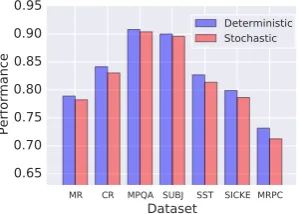
binarization upon the latent variable. For the de-terministic case,s(i) = 0.5for all dimensions; in the stochastic case, s(i) is uniformly sampled as: s(i) ∼ Uniform(0,1). We conduct an empirical comparison between these two binarization strate-gies in Section4.
Prior work have shown that linear decoders are favorable for learning binary codes under the encoder-decoder framework (Carreira-Perpin´an and Raziperchikolaei,2015;Dai et al.,2017;Shen et al.,2018). Inspired by these results, we employ a linear transformation to reconstruct the original continuous embeddings from the binary codes:
ˆ
h(i) =Wi0·b+k0(i), (4)
whereW0andk0are weight and bias term respec-tively, which are learned. The mean square error betweenhandˆhis employed as the reconstruction loss:
Lrec= 1 D
D
X
i=1
(h(i)−ˆh(i))2, (5)
model is optimized by minimizing the reconstruc-tion loss for all sentences. After training, the en-coder network is leveraged as the transformation to convert the pre-trained continuous embeddings into the binary form.
3.4.1 Semantic-preserving Regularizer
Although the reconstruction objective can help the binary variable to endow with richer semantics, there is no loss that explicitly encourages the bi-nary vectors to preserve the similarity information contained in the original continuous embeddings. Consequently, the model may lead to small recon-struction error but yield sub-optimal binary repre-sentations (Tissier et al., 2019). To improve the semantic-preserving property of the inferred bi-nary embeddings, we introduce an additional ob-jective term.
Consider a triple group of sentences (xα, xβ, xγ), whose continuous embeddings
are (hα, hβ, hγ), respectively. Suppose that the
cosine similarity between hα and hβ is larger
than that between hβ andhγ, then it is desirable
that the Hamming distance between bα and bβ
should be smaller than that between bβ and bγ
(notably, both large cosine similarity and small Hamming distance indicate that two sentences are semantically-similar).
Let dc(·,·) anddh(·,·) denote the cosine
sim-ilarity and Hamming distance (in the continuous and binary embedding space), respectively. De-finelα,β,γ as an indicator such that, lα,β,γ = 1if
dc(hα, hβ) ≥dc(hβ, hγ), andlα,β,γ = −1
other-wise. The semantic-preserving regularizer is then defined as:
Lsp= X
α,β,γ
max{0, lα,β,γ[dh(bα, bβ)−dh(bβ, bγ)]},
(6)
By penalizing Lsp, the learned transformation
functiongis explicitly encouraged to retain the se-mantic similarity information of the original con-tinuous embeddings. Thus, the entire objective function to be optimized is:
L=Lrec+λspLsp, (7)
whereλspcontrols the relative weight between the
reconstruction loss (Lrec) and semantic-preserving loss (Lsp).
3.5 Discussion
Another possible strategy is to directly train the general-purpose binary embeddings from scratch,
i.e., jointly optimizing the continuous embed-dings training objective and continuous-to-binary parameterization. However, our initial attempts demonstrate that this strategy leads to inferior em-pirical results. This observation is consistent with the results reported in (Kiros and Chan, 2018). Specifically, a binarization layer is directly ap-pended over the InferSent architecture (Conneau et al., 2017) during training, which gives rise to much larger drop in terms of the embeddings’ quality (we have conducted empirical compar-isons with (Kiros and Chan, 2018) in Table 1). Therefore, here we focus on learning universal bi-nary embeddings based on pretained continuous sentence representations.
4 Experimental setup
4.1 Pre-trained Continuous Embeddings
Our proposed model aims to produce highly in-formative binary sentence embeddings based upon pre-trained continuous representations. In this pa-per, we utilize InferSent (Conneau et al., 2017) as the continuous embeddings (given its effective-ness and widespread use). Note that all four pro-posed strategies can be easily extended to other pre-trained general-purpose sentence embeddings as well.
Specifically, a bidirectional LSTM architecture along with a max-pooling operation over the hid-den units is employed as the sentence encoder, and the model parameters are optimized on the natu-ral language inference tasks, i.e., Standford Nat-ural Language Inference (SNLI) (Bowman et al., 2015) and Multi-Genre Natural Language Infer-ence (MultiNLI) datasets (Williams et al.,2017).
4.2 Training Details
Our model is trained using Adam (Kingma and Ba, 2014), with a value1×10−5 as the learning rate
Model Dim MR CR SUBJ MPQA SST STS14 STSB SICK-R MRPC Continuous(dense) sentence embeddings
fastText-BoV 300 78.2 80.2 91.8 88.0 82.3 .65/.63 58.1/59.0 0.698 67.9/74.3 SkipThought 4800 76.5 80.1 93.6 87.1 82.0 .29/.35 41.0/41.7 0.595 57.9/66.6 SkipThought-LN 4800 79.4 83.1 93.7 89.3 82.9 .44/.45 - -
-InferSent-FF 4096 79.7 84.2 92.7 89.4 84.3 .68/.66 55.6/56.2 0.612 67.9/73.8
InferSent-G 4096 81.1 86.3 92.4 90.2 84.6 .68/.65 70.0/68.0 0.719 67.4/73.2
Binary(compact) sentence embeddings
InferLite-short 256 73.7 81.2 83.2 86.2 78.4 0.61/- 63.4/63.3 0.597 61.7/70.1 InferLite-medium 1024 76.3 83.2 87.8 88.4 81.3 0.67/- 64.9/64.9 0.642 64.1/72.0 InferLite-long 4096 77.7 83.7 89.6 89.1 82.3 0.68/- 67.9/67.6 0.663 65.4/72.9
[image:6.595.100.499.53.245.2]HT-binary 4096 76.6 79.9 91.0 88.4 80.6 .62/.60 55.8/53.6 0.652 65.6/70.4 Rand-binary 2048 78.7 82.7 90.4 88.9 81.3 .66/.63 65.1/62.3 0.704 65.7/70.8 PCA-binary 2048 78.4 84.5 90.7 89.4 81.0 .66/.65 63.7/62.8 0.518 65.0/ 69.7 AE-binary 2048 78.7 84.9 90.6 89.6 82.1 .68/.66 71.7/69.7 0.673 65.8/70.8 AE-binary-SP 2048 79.1 84.6 90.8 90.0 82.7 .69/.67 73.2/70.6 0.705 67.2/72.0
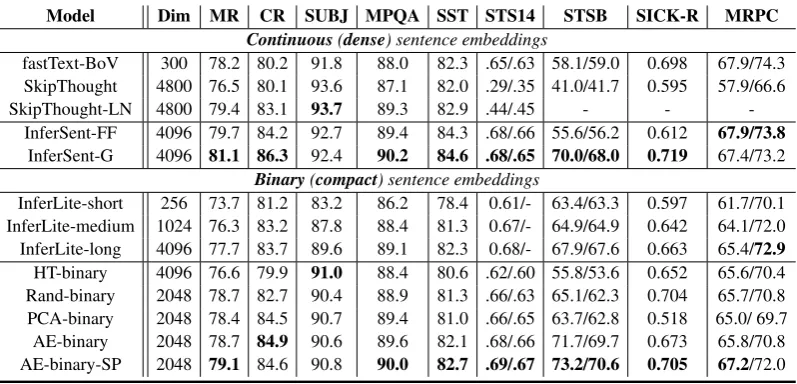
Table 1: Performance on the test set for10downstream tasks. The STS14, STSB and MRPC are evaluated with Pearson and Spearman correlations, and SICK-R is measured with Pearson correlation. All other datasets are evaluated with test accuracy. InferSent-G uses Glove (G) as the word embeddings, while InferSent-FF employs FastText (F) embeddings with Fixed (F) padding. The empirical results of InferLite with different lengths of binary embeddings,i.e., 256, 1024 and 4096, are considered.
The training with the autoencoder setup takes only about1hour to converge, and thus can be readily applicable to even larger datasets.
4.3 Evaluation
To facilitate comparisons with other baseline methods, we use SentEval toolkit1 (Conneau and Kiela, 2018) to evaluate the learned binary (compact) sentence embeddings. Concretely, the learned representations are tested on a series of downstream tasks to assess their transferability (with the encoder weights fixed), which can be cat-egorized as follows:
• Sentence classification, including sentiment analysis (MR, SST), product reviews (CR), subjectivity classification (SUBJ), opinion polarity detection (MPQA) and question type classification (TREC). A linear classifier is trained with the generic sentence embeddings as the input features. The default SentEval settings is used for all the datasets.
• Sentence matching, which comprises se-mantic relatedness (SICK-R, STS14, STSB) and paraphrase detection (MRPC). Particu-larly, each pair of sentences in STS14 dataset is associated with a similarity score from 0 to5(as the corresponding label). Hamming distance between the binary representations is directly leveraged as the prediction score (withoutany classifier parameters).
1https://github.com/facebookresearch/SentEval
For the sentence matching benchmarks, to allow fair comparison with the continuous embeddings, we do not use the same classifier architecture in SentEval. Instead, we obtain the predicted relat-edness by directly computing thecosine similar-ity between the continuous embeddings. Conse-quently, there are no classifier parameters for both the binary and continuous representations. The same valuation metrics in SentEval(Conneau and Kiela, 2018) are utilized for all the tasks. For MRPC, the predictions are made by simply judg-ing whether a sentence pair’s score is larger or smaller than the averaged Hamming distance (or cosine similarity).
4.4 Baselines
We consider several strong baselines to compare with the proposed methods, which include both
continuous (dense) and binary(compact) repre-sentations. For the continuous generic sentence embeddings, we make comparisons with fastText-BoV (Joulin et al., 2016), Skip-Thought Vectors (Kiros et al.,2015) and InferSent (Conneau et al., 2017). As to the binary embeddings, we consider the binarized version of InferLite (Kiros and Chan, 2018), which, as far as we are concerned, is the only general-purpose binary representations base-line reported.
5 Experimental Results
We experimented with five model variants to learn general-purpose binary embeddings:
{0,0.01,0.1}on the validation set), Rand-binary
(random projection), PCA-binary (reduce the di-mensionality with principal component analysis),
AE-binary (autoencoder with the reconstruction
objective) and AE-binary-SP (autoencoder with both the reconstruction objective and Semantic-Preserving loss). Our code will be released to en-courage future research.
5.1 Task transfer evaluation
We evalaute the binary sentence representations produced by different methods with a set of trans-ferring tasks. The results are shown in Table 1. The proposed autoencoder architecture generally demonstrates the best results. Especially while combined with the semantic-preserving loss de-fined in (7), AE-binary-SP exhibits higher perfor-mance compared with a standard autoencoder. It is worth noting that the Rand-binary and PCA-binary model variants also show competitive per-formance despite their simplicity. These strategies are also quite promising given that no training is required given the pre-trained continuous sentence representations.
Another important result is that, the AE-binary-SP achieves competitive results relative to the In-ferSent, leading to only about 2% loss on most datasets and even performing at par with InferSent on several datasets, such as the MPQA and STS14 datasets. On the sentence matching tasks, the yielded binary codes are evaluated by merely uti-lizing the hamming distance features (as men-tioned above). To allow fair comparison, we com-pare the predicted scores with the cosine similarity scores based upon the continuous representations (there are no additional parameters for the classi-fier). The binary codes brings out promising em-pirical results relative to their continuous counter-parts, and even slightly outperform InferSent on the STS14 dataset.
We also found that our AE-binary-SP model variant consistently demonstrate superior results than the InferLite baselines, which optimize the NLI objective directly over the binary representa-tions. This may be attributed to the difficulty of backpropagating gradients through discrete/binary variables, and would be an interesting direction for future research.
5.2 Nearest Neighbor Retrieval
Case Study One major advantage of binary sen-tence representations is that the similarity of two
sentences can be evaluated by merely calculating the hamming distance between their binary codes. To gain more intuition regarding the semantic in-formation encoded in the binary embeddings, we convert all the sentences in the SNLI dataset into continuous and binary vectors (with InferSent-G and AE-binary-SP, respectively). The top-3closet sentences are retrieved based upon the correspond-ing metrics, and the resultcorrespond-ing samples are shown in Table2. It can be observed that the sentences selected based upon the Hamming distance indeed convey very similar semantic meanings. In some cases, the results with binary codes are even more reasonable compared with the continuous embed-dings. For example, for the first query, all three sentences in the left column relate to “watching a movie”, while one of the sentences in the right column is about “sleeping”.
Retrieval Speed The bitwise comparison is much faster than the element-wise multiplication operation (between real-valued vectors) (Tissier et al., 2019). To verify the speed improvement, we sample 10000 sentence pairs from SNLI and extract their continuous and binary embeddings (with the same dimension of 4096), respectively. We record the time to compute the cosine sim-ilarity and hamming distance between the corre-sponding representations. With our Python imple-mentation, it takes3.67µs and288ns respectively, indicating that calculating the Hamming distance is over 12 times faster. Our implementation is not optimized, and the running time of computing Hamming distance can be further improved (to be proportional to the number of different bits, rather than the input length2).
5.3 Ablation Study
5.3.1 The effect of semantic-preserving loss
To investigate the importance of incorporating the locality-sensitive regularizer, we select different values of λsp (ranging from 0.0 to 1.0) and ex-plore how the transfer results would change ac-cordingly. Theλspcontrols the relative weight of the semantic-preserving loss term. As shown in Table3, augmenting the semantic-preserving loss consistently improves the quality of learned binary embeddings, while the best test accuracy on the MR dataset is obtained withλsp= 0.8.
2https://en.wikipedia.org/wiki/
Hamming Distance (binary embeddings) Cosine Similarity (continuous embeddings) Query:Severalpeople are sitting in amovie theater.
A group ofpeople watching amovieat atheater. A group ofpeople watching a movie at a theater .
A crowd of peopleare watching amovieindoors . A man is watching amoviein atheater.
A man is watching amoviein atheater. Somepeople are sleeping on a sofa in front of the television .
Query: Awomancrossing abusydowntown street .
Aladyis walking down abusystreet . Awomanwalking on the street downtown .
Awomanis on acrowdedstreet . Aladyis walking down abusystreet .
Awomanwalking on the street downtown . A man and woman walking down abusystreet .
Query: A well dressed man standing in front ofpiece of artwork.
A well dressed man standing in front ofan abstract fence painting. A man wearing headphones is standing in front of aposter. A man wearing headphones is standing in front of aposter. A man standing in front of a chalkboard points at adrawing. A man in a blue shirt standing in front of a garage-like structure
painted withgeometric designs.
A man in a blue shirt standing in front of a garage-like structure painted withgeometric designs.
Query: A woman is sitting at a bareating a hamburger.
A woman sittingeating a sandwich. A woman is sitting in a cafeeating lunch. A woman is sitting in a cafeeating lunch. A woman iseating at a diner.
The woman iseating a hotdogin the middle of her bedroom . A woman iseating her mealat a resturant .
Query:Group ofmen trying tocatch fishwith a fishing net .
Twomen are on a boat trying tofish for foodduring a sunset . There arethreemen on a fishing boat trying tocatch bass. There arethreemen on a fishing boat trying tocatch bass. Twomen are trying tofish.
[image:8.595.101.498.53.259.2]Twomenpull a fishing net upinto their red boat . Twomen are on a boat trying tofish for foodduring a sunset .
Table 2: Nearest neighbor retrieval results on the SNLI dataset. Given a a query sentence, the left column shows the top-3retrieved samples based upon the hamming distance with all sentences’ binary representations, while the right column exhibits the samples according to the cosine similarity of their continuous embeddings.
[image:8.595.86.278.313.340.2]λsp 0.0 0.2 0.5 0.8 1.0 Accuracy 78.2 78.5 78.5 79.1 78.4
Table 3: Ablation study for the AE-binary-SP model with different choices ofλsp(evaluated with test
accu-racy on the MR dataset).
5.3.2 Sampling strategy
As discussed in Section3.4, the binary latent vec-tor b can be obtained with either a deterministic or stochastically sampled threshold. We compare these two sampling strategies on several down-stream tasks. As illustrated in Figure 2, setting a fixed threshold demonstrates better empirical per-formance on all the datasets. Therefore, determin-istic threshold is employed for all the autoencoder model variants in our experiments.
MR CR MPQA SUBJ SST SICKE MRPC
Dataset 0.65
0.70 0.75 0.80 0.85 0.90 0.95
Performance
Deterministic Stochastic
Figure 2: The comparison betweendeterministic and
stochasticsampling for the autoencoder strategy.
5.3.3 The effect of embedding dimension
Except for the hard threshold method, other three proposed strategies all possess the flexibility of adaptively choosing the dimension of learned bi-nary representations. To explore the sensitivity of
512 1024 2048 4096 Number of Bits
71 72 73 7475 7677 78 79 80
Accuracy (%)
[image:8.595.339.489.318.420.2]Random PCA AE AE-SP
Figure 3: The test accuracy of different model on the MR dataset across512,1024,2048,4096bits for the learned binary representations.
extracted binary embeddings to their dimensions, we run four model variants (Rand-binary, PCA-binary, AE-PCA-binary, AE-binary-SP) with different number of bits (i.e.,512,1024, 2048, 4096), and their corresponding results on the MR dataset are shown in Figure3.
For the AE-binary and AE-binary-SP models, longer binary codes consistently deliver better re-sults. While for the Rand-binary and PCA-binary variants, the quality of inferred representations is much less sensitive to the embedding dimension. Notably, these two strategies exhibit competitive performance even with only512bits. Therefore, in the case where less memory footprint or little training is preferred, Rand-binary and PCA-binary could be more judicious choices.
6 Conclusion
[image:8.595.106.256.544.651.2]ex-plore four distinct strategies to convert pre-trained continuous sentence embeddings into a binarized form. Notably, a regularized autoencoder aug-mented with semantic-preserving loss exhibits the best empirical results, degrading performance by only around 2%while saving over98% memory footprint. Besides, two other model variants with a random projection or PCA transformation re-quire no training and demonstrate competitive em-bedding quality even with relatively small dimen-sions. Experiments on nearest-neighbor sentence retrieval further validate the effectiveness of pro-posed framework.
References
Yossi Adi, Einat Kermany, Yonatan Belinkov, Ofer Lavi, and Yoav Goldberg. 2017. Fine-grained anal-ysis of sentence embeddings using auxiliary predic-tion tasks.CoRR, abs/1608.04207.
Samuel R. Bowman, Gabor Angeli, Christopher Potts, and Christopher D. Manning. 2015. A large anno-tated corpus for learning natural language inference.
InEMNLP.
Miguel A Carreira-Perpin´an and Ramin Raziperchiko-laei. 2015. Hashing with binary autoencoders. In
Proceedings of the IEEE conference on computer vi-sion and pattern recognition, pages 557–566.
Daniel Cer, Yinfei Yang, Sheng yi Kong, Nan Hua, Nicole Limtiaco, Rhomni St. John, Noah Con-stant, Mario Guajardo-Cespedes, Steve Yuan, Chris Tar, Yun-Hsuan Sung, Brian Strope, and Ray Kurzweil. 2018. Universal sentence encoder. CoRR, abs/1803.11175.
Ting Chen, Martin Renqiang Min, and Yizhou Sun. 2018. Learning k-way d-dimensional discrete codes for compact embedding representations. arXiv preprint arXiv:1806.09464.
Alexis Conneau and Douwe Kiela. 2018. Senteval: An evaluation toolkit for universal sentence representa-tions. arXiv preprint arXiv:1803.05449.
Alexis Conneau, Douwe Kiela, Holger Schwenk, Lo¨ıc Barrault, and Antoine Bordes. 2017. Supervised learning of universal sentence representations from natural language inference data. InEMNLP.
Andrew M Dai and Quoc V Le. 2015. Semi-supervised sequence learning. InAdvances in neural informa-tion processing systems, pages 3079–3087.
Bo Dai, Ruiqi Guo, Sanjiv Kumar, Niao He, and Le Song. 2017. Stochastic generative hashing. In
Proceedings of the 34th International Conference
on Machine Learning-Volume 70, pages 913–922.
JMLR. org.
Jacob Devlin, Ming-Wei Chang, Kenton Lee, and Kristina Toutanova. 2018. Bert: Pre-training of deep bidirectional transformers for language understand-ing.arXiv preprint arXiv:1810.04805.
Zhe Gan, Yunchen Pu, Ricardo Henao, Chunyuan Li, Xiaodong He, and Lawrence Carin. 2017. Learning generic sentence representations using convolutional neural networks. InEMNLP.
Xavier Glorot and Yoshua Bengio. 2010. Understand-ing the difficulty of trainUnderstand-ing deep feedforward neu-ral networks. In Proceedings of the thirteenth in-ternational conference on artificial intelligence and statistics, pages 249–256.
Felix Hill, Kyunghyun Cho, and Anna Korhonen. 2016. Learning distributed representations of sentences from unlabelled data. InHLT-NAACL.
G Hinton. 2012. Neural networks for machine learn-ing. coursera,[video lectures].
Eric Jang, Shixiang Gu, and Ben Poole. 2016. Categor-ical reparameterization with gumbel-softmax. arXiv preprint arXiv:1611.01144.
Yacine Jernite, Samuel R. Bowman, and David A Son-tag. 2017. Discourse-based objectives for fast un-supervised sentence representation learning. CoRR, abs/1705.00557.
Armand Joulin, Edouard Grave, Piotr Bojanowski, and Tomas Mikolov. 2016. Bag of tricks for efficient text classification.arXiv preprint arXiv:1607.01759.
Diederik P Kingma and Jimmy Ba. 2014. Adam: A method for stochastic optimization. arXiv preprint arXiv:1412.6980.
Jamie Kiros and William Chan. 2018. Inferlite: Sim-ple universal sentence representations from natural language inference data. InProceedings of the 2018 Conference on Empirical Methods in Natural Lan-guage Processing, pages 4868–4874.
Ryan Kiros, Yukun Zhu, Ruslan Salakhutdinov, Richard S. Zemel, Antonio Torralba, Raquel Urta-sun, and Sanja Fidler. 2015. Skip-thought vectors. InNIPS.
Lajanugen Logeswaran and Honglak Lee. 2018. An efficient framework for learning sentence represen-tations.ICLR.
Allen Nie, Erin D. Bennett, and Noah D. Good-man. 2017. Dissent: Sentence representation learning from explicit discourse relations. CoRR, abs/1710.04334.
Matteo Pagliardini, Prakhar Gupta, and Martin Jaggi. 2018. Unsupervised learning of sentence embed-dings using compositional n-gram features. In
Alec Radford, Karthik Narasimhan, Tim Salimans, and Ilya Sutskever. 2018. Improving language under-standing by generative pre-training. URL https://s3-us-west-2. amazonaws.
com/openai-assets/research-covers/languageunsupervised/language
under-standing paper. pdf.
Sujith Ravi and Zornitsa Kozareva. 2018. Self-governing neural networks for on-device short text classification. InProceedings of the 2018 Confer-ence on Empirical Methods in Natural Language Processing, pages 804–810.
Sebastian Ruder and Jeremy Howard. 2018. Universal language model fine-tuning for text classification. In
ACL.
Ruslan Salakhutdinov and Geoffrey Hinton. 2009. Se-mantic hashing. International Journal of Approxi-mate Reasoning, 50(7):969–978.
Dinghan Shen, Qinliang Su, Paidamoyo Chapfuwa, Wenlin Wang, Guoyin Wang, Lawrence Carin, and Ricardo Henao. 2018. Nash: Toward end-to-end neural architecture for generative semantic hashing. InACL.
Raphael Shu and Hideki Nakayama. 2017. Compress-ing word embeddCompress-ings via deep compositional code learning.arXiv preprint arXiv:1711.01068.
Shuai Tang and Virginia R de Sa. 2018. Improving sen-tence representations with multi-view frameworks.
arXiv preprint arXiv:1810.01064.
Julien Tissier, Amaury Habrard, and Christophe Gravier. 2019. Near-lossless binarization of word embeddings. AAAI.
Benjamin Van Durme and Ashwin Lall. 2010. Online generation of locality sensitive hash signatures. In
Proceedings of the ACL 2010 Conference Short Pa-pers, pages 231–235. Association for Computational Linguistics.
Jingdong Wang, Heng Tao Shen, Jingkuan Song, and Jianqiu Ji. 2014. Hashing for similarity search: A survey. arXiv preprint arXiv:1408.2927.
John Wieting, Mohit Bansal, Kevin Gimpel, and Karen Livescu. 2016. Towards universal paraphrastic sen-tence embeddings. CoRR, abs/1511.08198.
John Wieting and Kevin Gimpel. 2018. Paranmt-50m: Pushing the limits of paraphrastic sentence embed-dings with millions of machine translations. InACL.
John Wieting and Douwe Kiela. 2018. No training required: Exploring random encoders for sentence classification. CoRR, abs/1901.10444.
Adina Williams, Nikita Nangia, and Samuel R Bow-man. 2017. A broad-coverage challenge corpus for sentence understanding through inference. arXiv preprint arXiv:1704.05426.
Jiaming Xu, Peng Wang, Guanhua Tian, Bo Xu, Jun Zhao, Fangyuan Wang, and Hongwei Hao. 2015. Convolutional neural networks for text hashing. In
Twenty-Fourth International Joint Conference on Artificial Intelligence.