219
LIUM-MIRACL Participation in the MADAR Arabic Dialect
Identification Shared Task
Sam´eh Kchaou University of Sfax, Tunisia
Fethi Bougares
University of Le Mans, France
Lamia Hadrich Belguith University of Sfax, Tunisia
Abstract
This paper describes the joint participation of the LIUM and MIRACL Laboratories at the Arabic dialect identification challenge of the MADAR Shared Task (Bouamor et al.,2019) conducted during the Fourth Arabic Natu-ral Language Processing Workshop (WANLP 2019). We participated to the Travel Domain Dialect Identification subtask. We built several systems and explored different techniques in-cluding conventional machine learning meth-ods and deep learning algorithms. Deep learn-ing approaches did not perform well on this task. We experimented several classification systems and we were able to identify the di-alect of an input sentence with an F1-score of 65.41%on the official test set using only the training data supplied by the shared task orga-nizers.
1 Introduction
Dialect can be defined as the language character-istics of a specific community (Etman and Beex,
2015). For all their daily communications, Arabic speakers use their local dialect. Dialects are commonly known as spoken or colloquial Arabic, acquired naturally as their mother tongue.
Being able to identify the dialect of a given sen-tence is a fundamental step for various applica-tions such as machine translation, speech recog-nition and multiple Natural Language Processing (NLP) related services. Therefore, the dialect identification task has been the subject of several earlier research and exploration activities. For in-stance, Arabic dialect identification in speech tran-scripts was introduced as a subtask of the Discrim-inating between Similar Languages (DSL) Shared Task of the Third, Fourth and the Fifth Workshop on NLP for Similar Languages, Varieties and Di-alects (VarDial) (Malmasi et al., 2016;Zampieri et al.,2017,2018).
In practice, the number of existing dialects are as many as there are cities in the Arab world. Go-ing to the city-level of granularity for dialect iden-tification is a complex and expensive task. It is for this reason that earlier work in dialect identifi-cation generally study the problem at a region or country level (Zaidan and Callison-Burch,2014). In this respect, dialects are generally classified into five main groups:Maghrebi,Egyptian,Levantine,
Gulf, andIraqi (El Haj et al.,2018;Elaraby and Abdul-Mageed,2018).
Quite recently, and in contrast with the overall previous work, (Bouamor et al., 2018) presented the MADAR corpus which is now the existing re-source with the greatest dialectal coverage. In-deed, the MADAR corpus includes 25 Arabic dif-ferent dialects from east to west. The MADAR shared task is organized to make the most efficient use of this corpus. Dialect Identification (DID) is already a hard task, even when taking into account only 5 groups. This task became more perplex-ing when takperplex-ing into consideration 25 groups of MADAR shared task. Indeed, taking into consid-eration additional dialects will reduce the overall classes dissimilarity and thus make the discrimi-nation process harder. In the following sections of this paper, we will describe our participation to the MADAR Shared task. We investigate dif-ferent classification techniques based on conven-tional machine learning algorithms with different kinds of features and various deep learning se-quence2sequence architectures.
2 MADAR Shared Task
Arabic Dialect processing is a challenging task since dialects are mainlyspokenand do not have an explicit written set of grammar rules. In this context, the MADAR corpus (Bouamor et al.,
2018) is a valuable resource to push forward the field Arabic Dialect processing. The MADAR Di-alect Identification shared task is partially based on this corpus. MADAR Shared task is the first DID shared task to target a large set of dialects. The challenge offered two subtasks: subtask 1 focuses on Travel Domain Dialect Identification, whereas subtask 2 is centred around Twitter User Dialect Identification. We will describe only the subtask 1 in which we have participated.
Subtask 1 Dataset: The provided data-sets are presented in table 1. The organizers provided a training and development sets from two sources created by translating the Basic Traveling Ex-pression Corpus (BTEC) (Takezawa, 2006): (i)
corpus-6, a large-scale additional sentences of the BTEC corpus of 5 regional representative dialects and MSA,(ii)corpus-26, a smaller-scale parallel corpus of 25 dialects in addition to MSA.
Corpus #lines #token
Corpus-26-train 41.6k 343.7k
Corpus-26-Dev 5.2k 43.7k
Corpus-6-train 54k 452.3k
Corpus-6-Dev 6k 49.6k
[image:2.595.100.265.433.524.2]Corpus-26-Test 5.2k 43.1k
Table 1: Statistics of MADAR Subtask 1 Data Sets.
The shared task allowed participants to exploit all the data presented in Table1 for the develop-ment of their DID systems1. Submission must
be constrained in the sense that external manu-ally annotated data sets are prohibited. Submis-sions are evaluated automatically on the test set
Corpus-26-Test, using F1 score. Both Corpus-26-dev and Corpus-26-Test consist of 5.2k dialectal sentences, uniformly distributed over the 26 ad-dressed dialects (200 sentences for each dialect). We note that we only usecorpus-26train and dev to develop our DID systems.
1Training data from MADAR-Shared-Task-Subtask-2 are
also allowed but not used for our submission.
3 LIU-MIR Submission
3.1 Data pre-processing
All Arabic dialects came from the same source, use the same character set, and share a large num-ber of common words seen throughout their sub-stantial vocabulary overlap. None of the existing Arabic dialects, at least until now, has an official status and none is regulated and taught in schools. As there is at present no dialect-specific compu-tationally motivated pre-processing methods, our pre-processing is limited to a few steps of cleaning up applied to all the data without distinction. This includes the normalization of few arabic charac-ters (
@
,@
,@
,ø
,ø
,ð
2), the deletion of short vowelsand tatweel3and the deletion of punctuation num-bers and non arabic words.
3.2 Dialect Identification systems
In this section we present our experiments for MADAR Travel Domain Dialect Identification task. All our systems are constrained as we only used the supplied data from table1.
3.3 Baseline systems
As a baseline for our DID system, we tried to re-produce the results presented in (Salameh et al.,
2018). Just like them, we trained a Multinomial Naive Bayes (MNB) classifier using Word and character n-gram features. We also used Term Frequency-Inverse Document Frequency (Tf-Idf) scores learned on extracted character n-grams ranging from 1-grams to 5-grams.
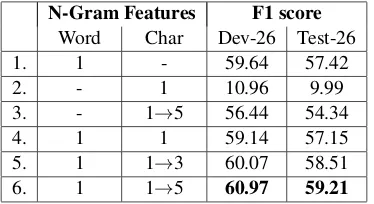
N-Gram Features F1 score Word Char Dev-26 Test-26
1. 1 - 59.64 57.42
2. - 1 10.96 9.99
3. - 1→5 56.44 54.34
4. 1 1 59.14 57.15
5. 1 1→3 60.07 58.51
6. 1 1→5 60.97 59.21
Table 2: MNB system using pre-processed training and evaluation data..
Table 2 reports the results of our baseline systems accuracy on the development set of CORPUS-26 (Dev-26). We performed several ex-periments using TF-IDF features of word and char
2
This corresponds to>,|,<, y, and & with Buckwalter transliteration.
[image:2.595.309.496.523.625.2]level n-grams. The best identification accuracy is obtained using uni-gram word level 1→5-gram character level.
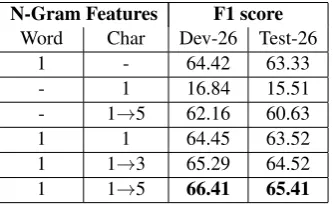
We have tested also to evaluate the above sys-tems without any pre-processing or normalization of the training data. The results are presented in the following table.
N-Gram Features F1 score Word Char Dev-26 Test-26
1 - 64.42 63.33 - 1 16.84 15.51 - 1→5 62.16 60.63 1 1 64.45 63.52 1 1→3 65.29 64.52 1 1→5 66.41 65.41
Table 3: MNB system using raw training and evalua-tion data.
As shown in the table above, the dialect iden-tification results are better when the systems are trained using the raw data. Knowing that data were created by translating sentences from English and French, we suspect that the translation was per-formed by one single person per dialect. If this is true, This could explain this result since the sys-tem learns as a side effect, to distinguish between the style of the translators (i.espelling, punctua-tion, lexical choices, with or without vowels ...).
3.4 LM-based Systems
In addition to the baseline system presented in the previous section, we evaluated the identification performance using only n-gram word and charac-ter level Language Models(LM) trained using only corpus 26 training data. This has been done by directly comparing LM perplexity for each input sentence: Given an input sentence S to classify into one of k dialects d1, d2, ..., dk we select the dialectd∗ of the model that gives the lowest per-plexity on this sentence (i.eequation 1).
d∗ = arg min k
P P(S) k
(1)
For this experiment, we considered forward and backward word (LMWF, LMWB) and character-level (LMCF, LMCB) LMs, trained using se-quences of words and characters in the reverse order. All LMs are 5-gram order, trained us-ing KenLM toolkit with default parameters and Kneser–Ney smoothing (Heafield,2011).
Table4presents the results of the DID systems with only LMs. While the character level LMs is
[image:3.595.315.517.62.114.2]Word LMs Char LMs LMWF LMWB LMCF LMCB dev-26 60.34 60.34 61.07 61.36 test-26 60.07 60.15 60.21 60.63
Table 4: F1-scores of DID system using LM Scores
lightly better than word-level LMs, both shows a lower accuracy compared to the MNB with word n-gram features (line 1 in table 3). The best LM based DID system is obtained using Backward character level LM with F1-score of60.63on the test-26 set.
3.5 LM Scores as Features
In this section we present our attempt to integrate LMs scores as extra feature to the MNB classifier. Each sentence is evaluated using the 26 trained LMs presented in section3.4 and their scores are used as input features to the MNB.
N-Gram Feat. LM Feat. F1 score Word Char Char Word Dev-26
[image:3.595.99.266.167.269.2]1 1→5 - - 66.41(65.41) 1 1→5 F - 65.97 (64.60) 1 1→5 B - 66.03 (64.58) 1 1→5 FB - 65.74 (63.73) 1 1→5 - F 45.19 (61.51) 1 1→5 - B 45.19 (61.78) 1 1→5 - FB 44.76 (61.49) 1 1→5 F F 46.09 (61.51)
Table 5: MNB system with N-Gram and LMs features.
As shown in table5, adding LMs scores as fea-tures to MNB results in a decrease of F1-score on both dev-26 and test-26 sets. We tried both word and character level LMs trained in either Forward or Backward fashion. However, none of them and not even their combination had a positive effect on the system’s accuracy.
3.6 Analysis and Discussion
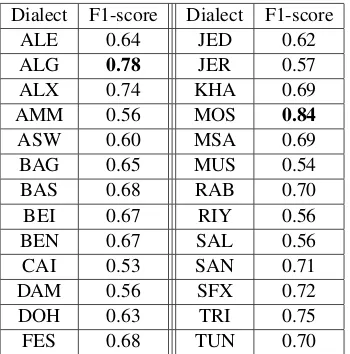
In this section, we present an analysis of the clas-sification results of our DID system. Table 6
[image:3.595.317.517.354.483.2]and MOS dialects have high pairwise token dis-similarity rate and they are also the easier to iden-tify compared to CAI and RIY for instance.
[image:4.595.95.270.114.291.2]Dialect F1-score Dialect F1-score ALE 0.64 JED 0.62 ALG 0.78 JER 0.57 ALX 0.74 KHA 0.69 AMM 0.56 MOS 0.84 ASW 0.60 MSA 0.69 BAG 0.65 MUS 0.54 BAS 0.68 RAB 0.70 BEI 0.67 RIY 0.56 BEN 0.67 SAL 0.56 CAI 0.53 SAN 0.71 DAM 0.56 SFX 0.72 DOH 0.63 TRI 0.75 FES 0.68 TUN 0.70
Table 6: F1-score per dialect of the best system on the test-26 set
After analyzing the full confusion matrix, we figured out that identification confusion tends to be bigger for geographical close cities. This is expected since sentences from close cities has a big vocabulary overlap and thus harder to discrim-inate. In order to investigate further this, we con-ducted a deeper analysis of two dialects belonging to the same geographical area. The primary objec-tive of this study is to measure the upper bound of the classification accuracy for these dialects (i.e. the best possible prediction accuracy).
We conducted this analysis for the Top-2 most confused dialects: TUN (TUNIS) and SFX (SFAX). These dialects belongs to the same coun-try, Tunisia, and present a high level of lexical similarity. In addition, there are the only ones for which we have native speakers. Table7, presents the TUNvs.SFX dialects confusion matrix.
Predicted SFX TUN
Actual
SFX 153 18
TUN 41 123
Table 7: TUN - SFX dialects Confusion matrix.
As shown in Table7, TUN and SFX dialects are source of confusion for the system. For instance, from among all the 200 SFX test sentences, 153 were well predicted and 18 predicted TUN. Sim-ilarly, 123 from the 200 TUN test sentences are well identified whereas 41 are predicted SFX.
In order to understand this substantial SFX-TUN confusion, we conducted a manual evalua-tion of the “18 + 41” sentences. This evaluation was performed as following: each of the incor-rectly predicted 18 SFX sentences was presented to a TUN native speaker who decide whether the sentence seems to be a natural in his view, or whether he will formulate it differently. Table 8
presents examples of sentences from the test-26 and their transliteration.
Sentences Label
? ú
Gñë áÓ I
. KQ
¯
Hñ KAg AÔ
¯
TUNfmA .hAnwt qryb mn hwny?
½
ªK , @ AJ
¯ ñKAÓ I.m
'
TUNn.hb mAyw qyAs As, y‘ y∧sk
½
ªK hA
®K I
. m
'
TUNn.hb tfA.h y‘y∧sk
? éJñJ.Ë@ Qº
AJ
¯ð
SFXwqtAy∧s tskr Albwsth?
? ú
Gñë áÓ I
. KQ
¯ àñK@Q Ë@ ÉJ
Kð ,ù
ëAK.
SFX bAhy, wtyl Aly∧syrAtwn qryb mn hwny?½
ªK , h.Ag.X
SFX [image:4.595.310.522.207.389.2]djAj, y‘yy∧sk
Table 8: Examples of TUN and SFX mis-classified sen-tences from test-26 with their ground truth label.
The evaluation has shown that, almost all the “18 + 41” studied examples may belongs to both dialect and hardly distinguishable even for native speakers. This exemplifies the increasing com-plexity the dialect identification task when we con-sider close dialects of a large lexical overlap.
4 Conclusion
[image:4.595.127.232.591.650.2]References
Houda Bouamor, Nizar Habash, Mohammad Salameh, Wajdi Zaghouani, Owen Rambow, Dana Abdul-rahim, Ossama Obeid, Salam Khalifa, Fadhl Eryani, Alexander Erdmann, and Kemal Oflazer. 2018. The MADAR Arabic dialect corpus and lexicon. In Pro-ceedings of the 11th Language Resources and Eval-uation Conference, Miyazaki, Japan. European Lan-guage Resource Association.
Houda Bouamor, Sabit Hassan, and Nizar Habash. 2019. The MADAR Shared Task on Arabic Fine-Grained Dialect Identification. InProceedings of the Fourth Arabic Natural Language Processing Work-shop (WANLP19), Florence, Italy.
Mahmoud El Haj, Paul Edward Rayson, and Mariam Aboelezz. 2018. Arabic dialect identification in the context of bivalency and code-switching. InLREC 2018, Eleventh International Conference on Lan-guage Resources and Evaluation, pages 3622–3627.
Mohamed Elaraby and Muhammad Abdul-Mageed. 2018. Deep models for Arabic dialect identification on benchmarked data. InProceedings of the Fifth Workshop on NLP for Similar Languages, Varieties and Dialects (VarDial 2018), pages 263–274, Santa Fe, New Mexico, USA. Association for Computa-tional Linguistics.
A. Etman and A. A. L. Beex. 2015. Language and di-alect identification: A survey. pages 220–231.
Kenneth Heafield. 2011. Kenlm: Faster and smaller language model queries. InProceedings of the Sixth Workshop on Statistical Machine Translation, WMT ’11, pages 187–197, Stroudsburg, PA, USA. Associ-ation for ComputAssoci-ational Linguistics.
Shervin Malmasi, Marcos Zampieri, Nikola Ljubeˇsi´c, Preslav Nakov, Ahmed Ali, and J¨org Tiedemann. 2016. Discriminating between similar languages and arabic dialect identification: A report on the third dsl shared task. In Proceedings of the Third Workshop on NLP for Similar Languages, Varieties and Dialects (VarDial3), pages 1–14, Osaka, Japan.
Mohammad Salameh, Houda Bouamor, and Nizar Habash. 2018. Fine-grained arabic dialect identi-fication. InProceedings of the International Con-ference on Computational Linguistics (COLING), pages 1332–1344, Santa Fe, New Mexico, USA.
Toshiyuki Takezawa. 2006. Multilingual spoken lan-guage corpus development for communication re-search. In Chinese Spoken Language Processing, pages 781–791, Berlin, Heidelberg. Springer Berlin Heidelberg.
Omar F. Zaidan and Chris Callison-Burch. 2014. Ara-bic dialect identification. Comput. Linguist., 40(1).
Marcos Zampieri, Shervin Malmasi, Nikola Ljubeˇsi´c, Preslav Nakov, Ahmed Ali, J¨org Tiedemann, Yves Scherrer, and No¨emi Aepli. 2017. Findings of the
vardial evaluation campaign 2017. InProceedings of the Fourth Workshop on NLP for Similar Lan-guages, Varieties and Dialects (VarDial), pages 1– 15, Valencia, Spain. Association for Computational Linguistics.