Learning Language Games through Interaction
Sida I. Wang Percy Liang Christopher D. Manning Computer Science Department
Stanford University
{sidaw,pliang,manning}@cs.stanford.edu
Abstract
We introduce a new language learning setting relevant to building adaptive nat-ural language interfaces. It is inspired by Wittgenstein’s language games: a hu-man wishes to accomplish some task (e.g., achieving a certain configuration of blocks), but can only communicate with a computer, who performs the actual actions (e.g., removing all red blocks). The com-puter initially knows nothing about lan-guage and therefore must learn it from scratch through interaction, while the hu-man adapts to the computer’s capabilities. We created a game called SHRDLURN in a blocks world and collected interactions from 100 people playing it. First, we an-alyze the humans’ strategies, showing that using compositionality and avoiding syn-onyms correlates positively with task per-formance. Second, we compare computer strategies, showing that modeling prag-matics on a semantic parsing model accel-erates learning for more strategic players.
1 Introduction
Wittgenstein (1953) famously said that language derives its meaning from use, and introduced the concept oflanguage gamesto illustrate the fluid-ity and purpose-orientedness of language. He de-scribed how a builder B and an assistant A can use a primitive language consisting of four words—
‘block’, ‘pillar’, ‘slab’, ‘beam’—to successfully communicate what block to pass from A to B. This is only one such language; many others would also work for accomplishing the cooperative goal.
This paper operationalizes and explores the idea of language games in a learning setting, which we callinteractive learning through language games
Figure 1: The SHRDLURN game: the objective is to transform the start state into the goal state. The human types in an utterance, and the computer (which does not know the goal state) tries to in-terpret the utterance and perform the correspond-ing action. The computer initially knows nothcorrespond-ing about the language, but through the human’s feed-back, learns the human’s language while making progress towards the game goal.
(ILLG). In the ILLG setting, the two parties do not initially speak a common language, but nonethe-less need to collaboratively accomplish a goal. Specifically, we created a game called SHRD-LURN,1in homage to the seminal work of Wino-grad (1972). As shown in Figure 1, the objective is to transform a start state into a goal state, but the only action the human can take is entering an utterance. The computer parses the utterance and produces a ranked list of possible interpretations according to its current model. The human scrolls through the list and chooses the intended one, si-multaneously advancing the state of the blocks and providing feedback to the computer. Both the hu-man and the computer wish to reach the goal state
1Demo:http://shrdlurn.sidaw.xyz
(only known to the human) with as little scrolling as possible. For the computer to be successful, it has to learn the human’s language quickly over the course of the game, so that the human can accom-plish the goal more efficiently. Conversely, the hu-man must also accommodate the computer, at least partially understanding what it can and cannot do. We model the computer in the ILLG as a se-mantic parser (Section 3), which maps natural lan-guage utterances (e.g., ‘remove red’) into logical forms (e.g.,remove(with(red))). The seman-tic parser has no seed lexicon and no annotated logical forms, so it just generates many candidate logical forms. Based on the human’s feedback, it performs online gradient updates on the parame-ters corresponding to simple lexical features.
During development, it became evident that while the computer was eventually able to learn the language, it was learning less quickly than one might hope. For example, after learning that
‘remove red’ maps to remove(with(red)), it would think that ‘remove cyan’ also mapped to remove(with(red)), whereas a human would likely use mutual exclusivity to rule out that hypothesis (Markman and Wachtel, 1988). We therefore introduce a pragmatics model in which the computer explicitly reasons about the human, in the spirit of previous work on pragmatics (Gol-land et al., 2010; Frank and Goodman, 2012; Smith et al., 2013). To make the model suitable for our ILLG setting, we introduce a new online learning algorithm. Empirically, we show that our pragmatic model improves the online accuracy by 8% compared to our best non-pragmatic model on the 10 most successful players (Section 5.3).
What is special about the ILLG setting is the real-time nature of learning, in which the human also learns and adapts to the computer. While the human can teach the computer any language— English, Arabic, Polish, a custom programming language—a good human player will choose to use utterances that the computer is more likely to learn quickly. In the parlance of communication theory, the human accommodates the computer (Giles, 2008; Ireland et al., 2011). Using Ama-zon Mechanical Turk, we collected and analyzed around 10k utterances from 100 games of SHRD-LURN. We show that successful players tend to use compositional utterances with a consistent vo-cabulary and syntax, which matches the inductive biases of the computer (Section 5.2). In addition,
through this interaction, many players adapt to the computer by becoming more consistent, more pre-cise, and more concise.
On the practical side, natural language systems are often trained once and deployed, and users must live with their imperfections. We believe that studying the ILLG setting will be integral for creating adaptive and customizable systems, es-pecially for resource-poor languages and new do-mains where starting from close to scratch is un-avoidable.
2 Setting
We now describe the interactive learning of lan-guage games (ILLG) setting formally. There are two players, the human and the computer. The game proceeds through a fixed number of levels. In each level, both players are presented with a starting state s ∈ Y, but only the human sees the goal state t ∈ Y. (e.g. in SHRDLURN, Y is the set of all configurations of blocks). The human transmits an utterance x (e.g., ‘remove red’) to the computer. The computer then con-structs a ranked list of candidate actions Z = [z1, . . . , zK]⊆ Z(e.g.,remove(with(red)),
add(with(orange)), etc.), where Z is all possible actions. For each zi ∈ Z, it computes
yi =JziKs, the successor state from executing
ac-tionzi on states. The computer returns to the
hu-man the ordered listY = [y1, . . . , yK]of
succes-sor states. The human then choosesyifrom the list
Y (we say the computer iscorrectifi = 1). The state then updates tos=yi. The level ends when
s=t, and the players advance to the next level. Since only the human knows the goal statetand only the computer can perform actions, the only way for the two to play the game successfully is for the human to somehow encode the desired ac-tion in the utterancex. However, we assume the two players do not have a shared language, so the human needs to pick a language and teach it to the computer. As an additional twist, the human does not know the exact set of actionsZ(although they might have some preconception of the computer’s capabilities).2 Finally, the human only sees the outcomes of the computer’s actions, not the actual logical actions themselves.
We expect the game to proceed as follows: In the beginning, the computer does not understand 2This is often the case when we try to interact with a new
what the human is saying and performs arbitrary actions. As the computer obtains feedback and learns, the two should become more proficient at communicating and thus playing the game. Herein lies our key design principle: language learning should be necessary for the players to achieve good game performance.
SHRDLURN. Let us now describe the details
of our specific game, SHRDLURN. Each state s ∈ Y consists of stacks of colored blocks ar-ranged in a line (Figure 1), where each stack is a vertical column of blocks. The actions Z are defined compositionally via the gram-mar in Table 1. Each action either adds to or removes from a set of stacks, and a set of stacks is computed via various set operations and selecting by color. For example, the action remove(leftmost(with(red)))removes the top block from the leftmost stack whose topmost block is red. The compositionality of the actions gives the computer non-trivial capabilities. Of course, the human must teach a language to har-ness those capabilities, while not quite knowing the exact extent of the capabilities. The actual game proceeds according to a curriculum, where the earlier levels only need simpler actions with fewer predicates.
We designed SHRDLURN in this way for sev-eral reasons. First, visual block manipulations are intuitive and can be easily crowdsourced, and it can be fun as an actual game that people would play. Second, the action space is designed to be compositional, mirroring the structure of natural language. Third, many actionszlead to the same successor statey=JzKs; e.g., the‘leftmost stack’
might coincide with the‘stack with red blocks’for some statesand therefore an action involving ei-ther one would result in the same outcome. Since the human only points out the correcty, the com-puter must grapple with this indirect supervision, a reflection of real language learning.
3 Semantic parsing model
Following Zettlemoyer and Collins (2005) and most recent work on semantic parsing, we use a log-linear model over logical forms (actions) z∈ Z given an utterancex:
pθ(z|x)∝exp(θTφ(x, z)), (1)
whereφ(x, z)∈Rdis a feature vector andθ∈Rd
is a parameter vector. The denotation y
(succes-sor state) is obtained by executingzon a states; formally,y =JzKs.
Features. Our features are n-grams (including
skip-grams) conjoined with tree-grams on the log-ical form side. Speciflog-ically, on the utterance side (e.g., ‘stack red on orange’), we use uni-grams (‘stack’,∗,∗), bigrams (‘red’,‘on’,∗), tri-grams (‘red’,‘on’,‘orange’), and skip-trigrams (‘stack’,∗,‘on’). On the logical form side, fea-tures corresponds to the predicates in the logical forms and their arguments. For each predicateh, let h.i be the i-th argument of h. Then, we de-finetree-gramfeaturesψ(h, d)for predicatehand depthd= 0,1,2,3recursively as follows:
ψ(h,0) ={h},
ψ(h, d) ={(h, i, ψ(h.i, d−1))|i= 1,2,3}.
The set of all features is just the cross product of utterance features and logical form features. For example, if x = ‘enlever tout’ and z = remove(all()), then features include:
(‘enlever’,all) (‘tout’,all) (‘enlever’,remove) (‘tout’,remove) (‘enlever’,(remove,1,all))
(‘tout’,(remove,1,all))
Note that we do not model an explicit alignment or derivation compositionally connecting the utter-ance and the logical form, in contrast to most tradi-tional work in semantic parsing (Zettlemoyer and Collins, 2005; Wong and Mooney, 2007; Liang et al., 2011; Kwiatkowski et al., 2010; Berant et al., 2013), instead following a looser model of semantics similar to (Pasupat and Liang, 2015). Modeling explicit alignments or derivations is only computationally feasible when we are learn-ing from annotated logical forms or have a seed lexicon, since the number of derivations is much larger than the number of logical forms. In the ILLG setting, neither are available.
Generation/parsing. We generate logical forms
Rule Semantics Description
Set all() all stacks
Color cyan|brown|red|orange primitive color
Color→Set with(c) stacks whose top block has colorc Set→Set not(s) all stacks except those ins
Set→Set leftmost|rightmost(s) leftmost/rightmost stack ins
Set Color→Act add(s, c) add block with colorcon each stack ins Set→Act remove(s) remove the topmost block of each stack ins Table 1: The formal grammar defining the compositional action space Z for SHRDLURN. We use c to denote a Color, and s to denote a Set. For example, one action that we have in SHRDLURN is: ‘add an orange block to all but the leftmost brown block’ 7→ add(not(leftmost(with(brown))),orange).
intermediate sizes,Z is not guaranteed to contain the logical form that obtains the observed statey. To mitigate this effect, we use a curriculum so that only simple actions are needed in the initial levels, giving the human an opportunity to teach the com-puter about basic terms such as colors first before moving to larger composite actions.
The system executes all of the logical forms on the final beamZ, and orders the resulting denota-tionsyby the maximum probability of any logical form that produced it.3
Learning. When the human provides feedback
in the form of a particulary, the system forms the following loss function:
`(θ, x, y) =−logpθ(y|x, s) +λ||θ||1, (2)
pθ(y|x, s) =
X
z:JzKs=y
pθ(z|x). (3)
Then it makes a single gradient update using Ada-Grad (Duchi et al., 2010), which maintains a per-feature step size.
4 Modeling pragmatics
In our initial experience with the semantic pars-ing model described in Section 3, we found that it was able to learn reasonably well, but lacked a reasoning ability that one finds in hu-man learners. To illustrate the point, consider the beginning of a game when θ = 0 in the log-linear model pθ(z | x). Suppose that
human utters ‘remove red’ and then identifies 3We tried ordering based on the sum of the probabilities
(which corresponds to marginalizing out the logical form), but this had the degenerate effect of assigning too much prob-ability mass toybeing the set of empty stacks, which can result from many actions.
zrm-red = remove(with(red)) as the
cor-rect logical form. The computer then performs a gradient update on the loss function (2), up-weighting features such as (‘remove’,remove)
and(‘remove’,red).
Next, suppose the human utters‘remove cyan’. Note thatzrm-red will score higher than all other
formulas since the (‘remove’,red) feature will fire again. While statistically justified, this be-havior fails to meet our intuitive expectations for a smart language learner. Moreover, this behav-ior is not specific to our model, but applies to any statistical model that simply tries to fit the data without additional prior knowledge about the spe-cific language. While we would not expect the computer to magically guess ‘remove cyan’ 7→ remove(with(cyan)), it should at least push down the probability ofzrm-red becausezrm-red
intuitively is already well-explained by another ut-terance‘remove red’.
This phenomenon,mutual exclusivity, was stud-ied by Markman and Wachtel (1988). They found that children, during their language acquisition process, reject a second label for an object and treat it instead as a label for a novel object.
The pragmatic computer. To model mutual
zrm-red zrm-cyan z3, z4, . . .
pθ(z|x)
‘remove red’ 0.8 0.1 0.1
‘remove cyan’ 0.6 0.2 0.2 S(x|z)
‘remove red’ 0.57 0.33 0.33
‘remove cyan’ 0.43 0.67 0.67 L(z|x)
‘remove red’ 0.46 0.27 0.27
‘remove cyan’ 0.24 0.38 0.38
Table 2: Suppose the computer saw one exam-ple of ‘remove red’7→zrm-red, and then the
hu-man utters ‘remove cyan’. top: the literal lis-tener, pθ(z | x), mistakingly chooses zrm-red
over zrm-cyan. middle: the pragmatic speaker,
S(x|z), assigns a higher probability to to‘remove cyan’givenzrm-cyan;bottom: the pragmatic
lis-tener,L(z|x)correctly assigns a lower probabil-ity tozrm-redwherep(z)is uniform.
strategy. The speaker takes into account the literal semantic parsing modelpθ(z|x)as well as a prior
over utterancesp(x), while the listener considers the speakerS(x|z)and a priorp(z):
S(x|z)∝(pθ(z|x)p(x))β, (4)
L(z|x)∝S(x|z)p(z), (5) where β ≥ 1 is a hyperparameter that sharpens the distribution (Smith et al., 2013). The com-puter would then useL(z |x)to rank candidates rather thanpθ. Note that our pragmatic model only
affects the ranking of actions returned to the hu-man and does not affect the gradient updates of the modelpθ.
Let us walk through a simple example to see the effect of modeling pragmatics. Table 2 shows that the literal listenerpθ(z|x)assigns high
probabil-ity tozrm-red for both ‘remove red’and‘remove cyan’. Assuming a uniformp(x)andβ = 1, the pragmatic speakerS(x|z)corresponds to normal-izing each column ofpθ. Note that if the pragmatic
speaker wanted to conveyzrm-cyan, there is a
de-cent chance that they would favor‘remove cyan’. Next, assuming a uniformp(z), the pragmatic lis-tener L(z | x) corresponds to normalizing each row ofS(x|z). The result is that conditioned on
‘remove cyan’,zrm-cyan is now more likely than
zrm-red, which is the desired effect.
The pragmatic listener models the speaker as a cooperative agent who behaves in a way to max-imize communicative success. Certain speaker
behaviors such as avoiding synonyms (e.g., not
‘delete cardinal’) and using a consistent word or-dering (e.g, not‘red remove’) fall out of the game theory.4 For speakers that do not follow this strat-egy, our pragmatic model is incorrect, but as we get more data through game play, the literal lis-tenerpθ(z|x)will sharpen, so that the literal
lis-tener and the pragmatic lislis-tener will coincide in the limit.
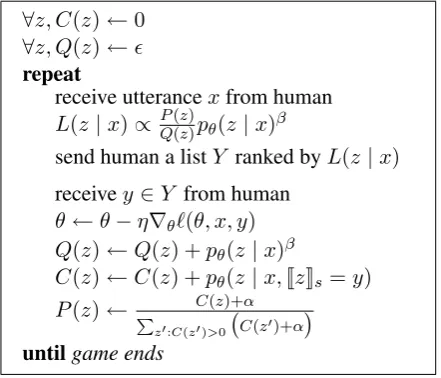
∀z, C(z)←0
∀z, Q(z)←
repeat
receive utterancexfrom human L(z|x)∝ QP((zz))pθ(z|x)β
send human a listY ranked byL(z|x)
receivey∈Y from human θ←θ−η∇θ`(θ, x, y)
Q(z)←Q(z) +pθ(z|x)β
C(z)←C(z) +pθ(z|x,JzKs=y)
P(z)← P C(z)+α
z0:C(z0)>0 C(z0)+α
untilgame ends
Algorithm 1: Online learning algorithm that
updates the parameters of the semantic parser θ as well as countsC, Q required to perform pragmatic reasoning.
Online learning with pragmatics. To
imple-ment the pragmatic listener as defined in (5), we need to compute the speaker’s normalization con-stantPxpθ(z|x)p(x)in order to computeS(x|
z) in (4). This requires parsing all utterances x based onpθ(z|x). To avoid this heavy
computa-tion in an online setting, we propose Algorithm 1, where some approximations are used for the sake of efficiency. First, to approximate the intractable sum over all utterancesx, we only use the exam-ples that are seen to compute the normalization constant Pxpθ(z | x)p(x) ≈ Pipθ(z | xi).
Then, in order to avoid parsing all previous exam-ples again using the current parameters for each new example, we storeQ(z) = Pipθi(z | xi)β,
whereθi is the parameter after the model updates
on theith examplexi. Whileθi is different from
the current parameterθ,pθ(z|xi) ≈ pθi(z |xi)
for the relevant examplexi, which is accounted for
4Of course, synonyms and variable word order occur in
[image:5.595.307.528.205.394.2]by bothθiandθ.
In Algorithm 1, the pragmatic listenerL(z |x)
can be interpreted as an importance-weighted ver-sion of the sharpened literal listenerpβθ, where it is downweighted by Q(z), which reflects which z’s the literal listener prefers, and upweighted by P(z), which is just a smoothed estimate of the ac-tual distribution over logical formsp(z). By con-struction, Algorithm 1 is the same as (4) except that it uses the normalization constantQbased on stale parameters θi after seeing example, and it
uses samples to compute the sum overx. Follow-ing (5), we also needp(z), which is estimated by P(z)using add-αsmoothing on the countsC(z). Note that Q(z) and C(z) are updated after the model parameters are updated for the current ex-ample.
Lastly, there is a small complication due to only observing the denotation y and not the logical form z. We simply give each consistent logical form {z | JzKs = y} a pseudocount based on
the model: C(z) ← C(z) +pθ(z |x,JzKs = y)
wherepθ(z |x,JzKs = y) ∝ exp(θTφ(x, z))for
JzKs=y(0 otherwise).
Compared to prior work where the setting is specifically designed to require pragmatic infer-ence, pragmatics arises naturally in ILLG. We think that this form of pragmatics is the most im-portant during learning, and becomes less impor-tant if we had more data. Indeed, if we have a lot of data and a small number of possible zs, then L(z|x) ≈ pθ(z|x) as Pxpθ(z|x)p(x) → p(z)
when β = 1.5 However, for semantic parsing, we would not be in this regime even if we have a large amount of training data. In particular, we are nowhere near that regime in SHRDLURN, and most of our utterances / logical forms are seen only once, and the importance of modeling pragmatics remains.
5 Experiments
5.1 Setting
Data. Using Amazon Mechanical Turk (AMT),
we paid 100 workers 3 dollars each to play SHRD-LURN. In total, we have 10223 utterances along with their starting states s. Of these, 8874 ut-terances are labeled with their denotationsy; the rest are unlabeled, since the player can try any ut-terance without accepting an action. 100 players completed the entire game under identical settings.
5Technically, we also needp
θto bewell-specified.
We deliberately chose to start from scratch for ev-ery worker, so that we can study the diversity of strategies that different people used in a controlled setting.
Each game consists of 50 blocks tasks divided into 5 levels of 10 tasks each, in increasing com-plexity. Each level aims to reach an end goal given a start state. Each game took on average 89 utterances to complete.6 It only took 6 hours to complete these 100 games on AMT and each game took around an hour on average according to AMT’swork timetracker (which does not account for multi-tasking players). The players were pro-vided minimal instructions on the game controls. Importantly, we gave no example utterances in or-der to avoid biasing their language use. Around 20 players were confused and told us that the in-structions were not clear and gave us mostly spam utterances. Fortunately, most players understood the setting and some even enjoyed SHRDLURN as reflected by their optional comments:
• That was probably the most fun thing I have ever done on mTurk.
• Wow this was one mind bending games [sic].
Metrics. We use thenumber of scrollsas a
mea-sure of game performance for each player. For each example, the number of scrolls is the position in the listY of the action selected by the player. It was possible to complete this version of SHRD-LURN by scrolling (all actions can be found in the first 125 ofY)—22 of the 100 players failed to teach an actual language, and instead finished the game mostly by scrolling. Let us call themspam players, who usually typed single letters, random words, digits, or random phrases (e.g. ‘how are you’). Overall, spam players had to scroll a lot: 21.6 scrolls per utterance versus only 7.4 for the non-spam players.
5.2 Human strategies
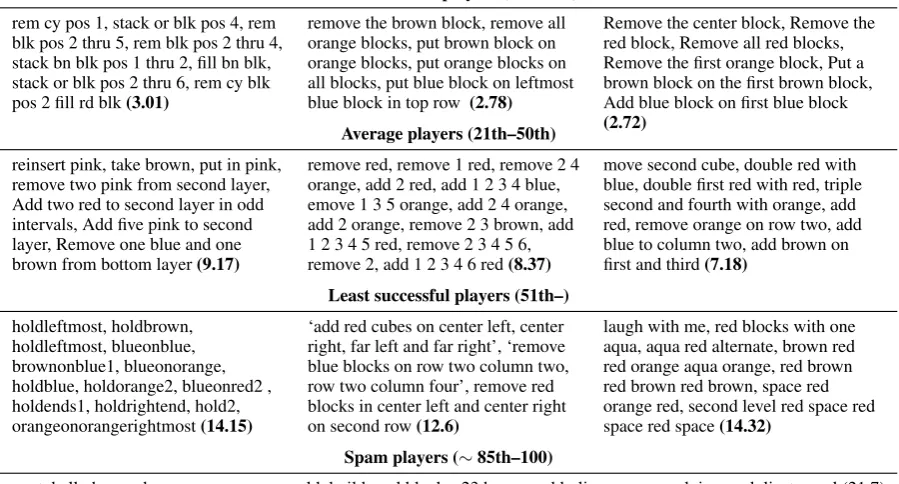
Some example utterances can be found in Table 3. Most of the players used English, but vary in their adherence to conventions such as use of determin-ers, plurals, and proper word ordering. 5 players invented their own language, which are more pre-cise, more consistent than general English. One player used Polish, and another used Polish nota-tion (bottom of Table 3).
6 This number is not 50 because some block tasks need
Most successful players (1st–20th)
rem cy pos 1, stack or blk pos 4, rem blk pos 2 thru 5, rem blk pos 2 thru 4, stack bn blk pos 1 thru 2, fill bn blk, stack or blk pos 2 thru 6, rem cy blk pos 2 fill rd blk(3.01)
remove the brown block, remove all orange blocks, put brown block on orange blocks, put orange blocks on all blocks, put blue block on leftmost blue block in top row (2.78)
Remove the center block, Remove the red block, Remove all red blocks, Remove the first orange block, Put a brown block on the first brown block, Add blue block on first blue block
(2.72) Average players (21th–50th)
reinsert pink, take brown, put in pink, remove two pink from second layer, Add two red to second layer in odd intervals, Add five pink to second layer, Remove one blue and one brown from bottom layer(9.17)
remove red, remove 1 red, remove 2 4 orange, add 2 red, add 1 2 3 4 blue, emove 1 3 5 orange, add 2 4 orange, add 2 orange, remove 2 3 brown, add 1 2 3 4 5 red, remove 2 3 4 5 6, remove 2, add 1 2 3 4 6 red(8.37)
move second cube, double red with blue, double first red with red, triple second and fourth with orange, add red, remove orange on row two, add blue to column two, add brown on first and third(7.18)
Least successful players (51th–)
holdleftmost, holdbrown, holdleftmost, blueonblue, brownonblue1, blueonorange, holdblue, holdorange2, blueonred2 , holdends1, holdrightend, hold2, orangeonorangerightmost(14.15)
‘add red cubes on center left, center right, far left and far right’, ‘remove blue blocks on row two column two, row two column four’, remove red blocks in center left and center right on second row(12.6)
laugh with me, red blocks with one aqua, aqua red alternate, brown red red orange aqua orange, red brown red brown red brown, space red orange red, second level red space red space red space(14.32)
Spam players (∼85th–100)
next, hello happy, how are you, move, gold, build goal blocks, 23,house, gabboli, x, run„xav, d, j, xcv, dulicate goal (21.7)
Most interesting
usu´n br ˛azowe klocki, postaw pomara´nczowy klocek na pierwszym klocku, postaw czerwone klocki na pomara´nczowych, usu´n
pomara´nczowe klocki w górnym rz˛edzie
rm scat + 1 c, + 1 c, rm sh, + 1 2 4 sh, + 1 c, - 4 o, rm 1 r, + 1 3 o, full fill c, rm o, full fill sh, - 1 3, full fill sh, rm sh, rm r, + 2 3 r, rm o, + 3 sh, + 2 3 sh, rm b, - 1 o, + 2 c,
mBROWN,mBLUE,mORANGE RED+ORANGEˆORANGE, BROWN+BROWNm1+BROWNm3, ORANGE +BROWN
[image:7.595.72.522.71.313.2]+ORANGEˆm1+ ORANGEˆm3 + BROWNˆˆ2 + BROWNˆˆ4
Table 3: Example utterances, along with the average number of scrolls for that player in parentheses. Success is measured by the number of scrolls, where the more successful players need less scrolls. 1) The 20 most successful players tend to use consistent and concise language whose semantics is similar to our logical language. 2) Average players tend to be slightly more verbose and inconsistent (left and right), or significantly different from our logical langauge (middle). 3) Reasons for being unsuccessful vary. Left: no tokenization, middle: used a coordinate system and many conjunctions; right: confused in the beginning, and used a language very different from our logical language.
Overall, we find that many players adapt in ILLG by becoming more consistent, less verbose, and more precise, even if they used standard En-glish at the beginning. For example, some players became more consistent over time (e.g. from us-ing both‘remove’and‘discard’to only using ‘re-move’). In terms of verbosity, removing function words like determiners as the game progresses is a common adaptation. In each of the following examples from different players, we compare an utterance that appeared early in the game to a sim-ilar utterance that appeared later:‘Remove the red ones’became‘Remove red.’;‘add brown on top of
red’became‘add orange on red’;‘add red blocks
to all red blocks’became‘add red to red’;‘dark
red’became‘red’; one player used‘the’in all of
the first 20 utterances, and then never used‘the’in the last 75 utterances.
Players also vary in precision, ranging from overspecified (e.g.‘remove the orange cube at the left’, ‘remove red blocks from top row’) to under-specified or requiring context (e.g. ‘change col-ors’, ‘add one blue’,‘Build more blocus’, ‘Move the blocks fool’,‘Add two red cubes’). We found that some players became more precise over time, as they gain a better understanding of ILLG.
Most players use utterances that actually do not match our logical language in Table 1, even the successful players. In particular, numbers are of-ten used. While some concepts always have the same effect in our blocks world (e.g. ‘first block’
neverthe-less. One possible explanation is because the ac-tion required is somewhat constrained by the logi-cal language and some tokens can have unintended interpretations. For example, the computer can correctly interpret numerical positional references, as long as the player only refers to the leftmost and rightmost positions. So if the player says‘rem blk pos 4’and‘rem blk pos 1’, the computer can interpret ‘pos’as rightmost and interpret the bigram (‘pos’,‘1’) as leftmost. On the other hand, players who deviated significantly by de-scribing the desired state declaratively (e.g. ‘red orange red’, ‘246’) rather than using actions, or a coordinate system (e.g. ‘row two column two’) performed poorly. Although players do not have to match our logical language exactly to perform well, being similar is definitely helpful.
Compositionality. As far as we can tell, all
players used a compositional language; no one in-vented unrelated words for each action. Interest-ingly, 3 players did not put spaces between words. Since we assume monomorphemic words sepa-rated by spaces, they had to do a lot of scrolling as a result (e.g., 14.15 with utterances like ‘or-angeonorangerightmost’).
5.3 Computer strategies
We now present quantitative results on how quickly the computer can learn, where our goal is to achieve high accuracy on new utterances as we make just a single pass over the data. The num-ber of scrolls used to evaluate player is sensitive to outliers and not as intuitive as accuracy. Instead, we consideronline accuracy, described as follows. Formally, if a player produced T utterances x(j)
and labeled themy(j), then
online accuracydef= T1
T
X
j=1
Ihy(j)=Jz(j)Ks(j)
i ,
where z(j) = arg max
zpθ(j−1)(z|x(j)) is the
model prediction based on the previous parame-ter θ(j−1). Note that the online accuracy is
de-fined with respect to the player-reported labels, which only corresponds to the actual accuracy if the player is precise and honest. This is not true for most spam players.
Compositionality. To study the importance of
compositionality, we consider two baselines. First, consider a non-compositional model (
mem-0.0 0.1 0.2 0.3 0.4 0.5 0.6 full model accuracy 0.0
0.1 0.2 0.3 0.4 0.5 0.6
full+pragmatics accuracy
(a)
0.0 0.1 0.2 0.3 0.4 0.5 0.6 half model accuracy 0.0
0.1 0.2 0.3 0.4 0.5 0.6
half+pragmatics accuracy
[image:8.595.311.523.61.178.2](b)
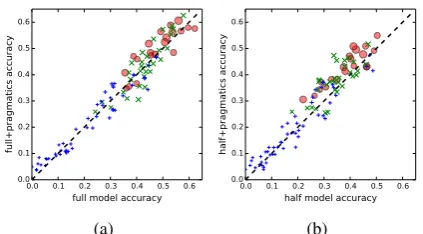
Figure 2: Pragmatics improve online accuracy. In these plots, each marker is a player. red o: play-ers who ranked 1–20 in terms of minimizing num-ber of scrolls, green x: players 20–50; blue +: lower than 50 (includes spam players). Marker sizes correspond to player rank, where better play-ers are depicted with larger markplay-ers. 2a: online accuracies with and without pragmatics on the full model;2b: same for the half model.
players ranked by # of scrolls Method top 10 top 20 top 50 all 100 memorize 25.4 24.5 22.5 17.6 half model 38.7 38.4 36.0 27.0 half + prag 43.7 42.7 39.7 29.4 full model 48.6 47.8 44.9 33.3 full + prag 52.8 49.8 45.8 33.8 Table 4: Average online accuracy under vari-ous settings. memorize: featurize entire utter-ance and logical form non-compositionally; half model: featurize the utterances with unigrams, bi-grams, and skip-grams but conjoin with the entire logical form; full model: the model described in Section 3; +prag: the models above, with our on-line pragmatics algorithm described in Section 4. Both compositionality and pragmatics improve ac-curacy.
orize) that just remembers pairs of complete ut-terance and logical forms. We implement this using indicator features on features (x, z), e.g.,
(‘remove all the red blocks’, zrm-red), and use a
large learning rate. Second, we consider a model (half) that treats utterances composition-ally with unigrams, bigrams, and skip-trigrams features, but the logical forms are regarded as non-compositional, so we have features such as
(‘remove’, zrm-red),(‘red’, zrm-red), etc.
Table 4 shows that the full model (Section 3) significantly outperforms both the memorize and
half baselines. The learning rate η = 0.1 is se-lected via cross validation, and we used α = 1
Pragmatics. Next, we study the effect of prag-matics on online accuracy. Figure 2 shows that modeling pragmatics helps successful players (e.g., top 10 by number of scrolls) who use precise and consistent languages. Interestingly, our prag-matics model did not help and can even hurt the less successful players who are less precise and consistent. This is expected behavior: the prag-matics model assumes that the human is coopera-tive and behaving rationally. For the bottom half of the players, this assumption is not true, in which case the pragmatics model is not useful.
6 Related Work and Discussion
Our work connects with a broad body of work on grounded language, in which language is used in some environment as a means towards some goal. Examples include playing games (Branavan et al., 2009, 2010; Reckman et al., 2010) interacting with robotics (Tellex et al., 2011, 2014), and following instructions (Vogel and Jurafsky, 2010; Chen and Mooney, 2011; Artzi and Zettlemoyer, 2013) Se-mantic parsing utterances to logical forms, which we leverage, plays an important role in these set-tings (Kollar et al., 2010; Matuszek et al., 2012; Artzi and Zettlemoyer, 2013).
What makes this work unique is our new inter-active learning of language games (ILLG) setting, in which a model has to learn a language from
scratchthrough interaction. While online gradient descent is frequently used, for example in seman-tic parsing (Zettlemoyer and Collins, 2007; Chen, 2012), we using it in a truly online setting, taking one pass over the data and measuring online accu-racy (Cesa-Bianchi and Lugosi, 2006).
To speed up learning, we leverage computa-tional models of pragmatics (Jäger, 2008; Golland et al., 2010; Frank and Goodman, 2012; Smith et al., 2013; Vogel et al., 2013). The main differ-ence is these previous works use pragmatics with a trained base model, whereas we learn the model online. Monroe and Potts (2015) uses learning to improve the pragmatics model. In contrast, we use pragmatics to speed up the learning pro-cess by capturing phenomena like mutual exclu-sivity (Markman and Wachtel, 1988). We also dif-fer from prior work in several details. First, we model pragmatics in the online learning setting where we use an online update for the pragmat-ics model. Second, unlikely the reference games where pragmatic effects plays an important role by
design, SHRDLURN is not specifically designed to require pragmatics. The improvement we get is mainly due to players trying to be consistent in their language use. Finaly, we treat both the utter-ance and the logical forms as featurized composi-tional objects. Smith et al. (2013) treats utterances (i.e. words) and logical forms (i.e. objects) as cat-egories; Monroe and Potts (2015) used features, but also over flat categories.
Looking forward, we believe that the ILLG set-ting is worth studying and has important implica-tions for natural language interfaces. Today, these systems are trained once and deployed. If these systems could quickly adapt to user feedback in real-time as in this work, then we might be able to more readily create systems for resource-poor languages and new domains, that are customizable and improve through use.
Acknowledgments
DARPA Communicating with Computers (CwC) program under ARO prime contract no. W911NF-15-1-0462. The first author is supported by a NSERC PGS-D fellowship. In addition, we thank Will Monroe, and Chris Potts for their insightful comments and discussions on pragmatics.
Reproducibility
All code, data, and experiments for this paper are available on the CodaLab platform:
https://worksheets. codalab.org/worksheets/
0x9fe4d080bac944e9a6bd58478cb05e5e
The client side code is here:
https://github.com/sidaw/shrdlurn/tree/ acl16-demo
and a demo:http://shrdlurn.sidaw.xyz
References
Y. Artzi and L. Zettlemoyer. 2013. Weakly super-vised learning of semantic parsers for mapping instructions to actions. Transactions of the As-sociation for Computational Linguistics (TACL)
1:49–62.
J. Berant, A. Chou, R. Frostig, and P. Liang. 2013. Semantic parsing on Freebase from question-answer pairs. InEmpirical Methods in Natural Language Processing (EMNLP).
mapping instructions to actions. In Associa-tion for ComputaAssocia-tional Linguistics and Inter-national Joint Conference on Natural Language Processing (ACL-IJCNLP). pages 82–90. S. Branavan, L. Zettlemoyer, and R. Barzilay.
2010. Reading between the lines: Learning to map high-level instructions to commands. In Association for Computational Linguistics (ACL). pages 1268–1277.
N. Cesa-Bianchi and G. Lugosi. 2006. Predic-tion, learning, and games. Cambridge Univer-sity Press.
D. L. Chen. 2012. Fast online lexicon learning for grounded language acquisition. InAssociation for Computational Linguistics (ACL).
D. L. Chen and R. J. Mooney. 2011. Learning to interpret natural language navigation instruc-tions from observainstruc-tions. InAssociation for the Advancement of Artificial Intelligence (AAAI). pages 859–865.
J. Duchi, E. Hazan, and Y. Singer. 2010. Adap-tive subgradient methods for online learning and stochastic optimization. In Conference on Learning Theory (COLT).
M. Frank and N. D. Goodman. 2012. Predicting pragmatic reasoning in language games. Sci-ence336:998–998.
H. Giles. 2008. Communication accommodation theory. Sage Publications, Inc.
D. Golland, P. Liang, and D. Klein. 2010. A game-theoretic approach to generating spatial descrip-tions. In Empirical Methods in Natural Lan-guage Processing (EMNLP).
N. Goodman and D. Lassiter. 2015. Probabilistic Semantics and Pragmatics: Uncertainty in Lan-guage and Thought. The Handbook of Contem-porary Semantic Theory, 2nd Edition Wiley-Blackwell.
H. P. Grice. 1975. Logic and conversation. Syntax and semantics3:41–58.
M. E. Ireland, R. B. Slatcher, P. W. Eastwick, L. E. Scissors, E. J. Finkel, and J. W. Pennebaker. 2011. Language style matching predicts rela-tionship initiation and stability. Psychological Science22(1):39–44.
G. Jäger. 2008. Game theory in semantics and pragmatics. Technical report, University of Tübingen.
T. Kollar, S. Tellex, D. Roy, and N. Roy. 2010. Grounding verbs of motion in natural language commands to robots. In International Sympo-sium on Experimental Robotics (ISER).
T. Kwiatkowski, L. Zettlemoyer, S. Goldwater, and M. Steedman. 2010. Inducing probabilistic CCG grammars from logical form with higher-order unification. In Empirical Methods in Natural Language Processing (EMNLP). pages 1223–1233.
P. Liang, M. I. Jordan, and D. Klein. 2011. Learning dependency-based compositional se-mantics. InAssociation for Computational Lin-guistics (ACL). pages 590–599.
E. Markman and G. F. Wachtel. 1988. Children’s use of mutual exclusivity to constrain the mean-ings of words. Cognitive Psychology 20:125– 157.
C. Matuszek, N. FitzGerald, L. Zettlemoyer, L. Bo, and D. Fox. 2012. A joint model of language and perception for grounded attribute learning. In International Conference on Ma-chine Learning (ICML). pages 1671–1678. W. Monroe and C. Potts. 2015. Learning in the
Rational Speech Acts model. InProceedings of 20th Amsterdam Colloquium.
P. Pasupat and P. Liang. 2015. Compositional se-mantic parsing on semi-structured tables. In As-sociation for Computational Linguistics (ACL). H. Reckman, J. Orkin, and D. Roy. 2010. Learning meanings of words and constructions, grounded in a virtual game. In Conference on Natural Language Processing (KONVENS).
N. J. Smith, N. D. Goodman, and M. C. Frank. 2013. Learning and using language via re-cursive pragmatic reasoning about other agents. InAdvances in Neural Information Processing Systems (NIPS).
S. Tellex, R. Knepper, A. Li, D. Rus, and N. Roy. 2014. Asking for help using inverse semantics. InRobotics: Science and Systems (RSS). S. Tellex, T. Kollar, S. Dickerson, M. R. Walter,
A. G. Banerjee, S. J. Teller, and N. Roy. 2011. Understanding natural language commands for robotic navigation and mobile manipulation. In
Association for the Advancement of Artificial Intelligence (AAAI).
multi-agent decision theory. In North Ameri-can Association for Computational Linguistics (NAACL). pages 1072–1081.
A. Vogel and D. Jurafsky. 2010. Learning to fol-low navigational directions. InAssociation for Computational Linguistics (ACL). pages 806– 814.
T. Winograd. 1972. Understanding Natural Lan-guage. Academic Press.
L. Wittgenstein. 1953. Philosophical Investiga-tions. Blackwell, Oxford.
Y. W. Wong and R. J. Mooney. 2007. Learn-ing synchronous grammars for semantic parsLearn-ing with lambda calculus. InAssociation for Com-putational Linguistics (ACL). pages 960–967. L. S. Zettlemoyer and M. Collins. 2005.
Learn-ing to map sentences to logical form: Struc-tured classification with probabilistic categorial grammars. In Uncertainty in Artificial Intelli-gence (UAI). pages 658–666.