ISSN Online: 2165-7416 ISSN Print: 2165-7408
DOI: 10.4236/ojoph.2017.74037 Nov. 6, 2017 281 Open Journal of Ophthalmology
Understanding Retinal Changes after Stroke
Varun Kumar
Department of Ophthalmology, School of Medicine, Stanford University, Stanford, CA, USA
Abstract
Stroke is the fifth leading cause of death and disability in the United States. According to World Heart Federation, every year, 15 million people suffer from stroke worldwide out of which nearly 6 million people die and another 5 million people are disabled. Out of many organs affected after stroke, one of them is eye. Majority of the stroke victims suffer vision loss due to stroke-induced re-tinal damage. However, stroke-induced rere-tinal damage and microvascular changes have not been given paramount importance in understanding stroke pathophysiology and predicting its occurrence. Retinal imaging can be a very powerful tool to understand and predict stroke. This review will highlight the importance of retinal changes in predicting occurrence of stroke, major retin-al changes, the relationship between retinretin-al diseases and stroke and moreover, molecular mechanisms delineating the stroke induced-retinal changes and therapeutics associated with it.
Keywords
Stroke, Retinal-Ischemia, Animal Models
1. Introduction
Stroke is one of the leading causes of adult death and disabilities in the world. According to American Heart association, it is the fifth leading cause of death and long term disability in the United States [1]. Approximately 800,000 people in the USA suffer from stroke every year. 87% percent of stroke is ischemic whereas, 13% is hemorrhagic. Only FDA approved treatment for stroke is tissue plasminogen activator (tPA), which is a thrombolytic agent. However, it can be used effectively only within 4 - 5 hours after stroke which is not always feasible. Therefore, better therapeutic targets should be investigated. Moreover, detection of early pathological changes after stroke can lead to new therapeutic targets. However, early detection becomes challenging due to difficult access, imaging How to cite this paper: Kumar, V. (2017)
Understanding Retinal Changes after Stroke. Open Journal of Ophthalmology, 7, 281-292. https://doi.org/10.4236/ojoph.2017.74037
Received: September 28, 2017 Accepted: November 3, 2017 Published: November 6, 2017
Copyright © 2017 by author and Scientific Research Publishing Inc. This work is licensed under the Creative Commons Attribution International License (CC BY 4.0).
DOI: 10.4236/ojoph.2017.74037 282 Open Journal of Ophthalmology and complex pathophysiology of the affected area after stroke. Therefore, there is an unmet need to investigate an area of brain, which is similar in vasculature and physiological changes, easily accessible and can be examined with noninva-sive or minimally invanoninva-sive methods so that such organ may become a direct window to the cerebral pathology. Eye, being one such part of brain, projects out of diencephalon, has similar embryonic origin, vasculature, blood barriers and pathophysiology. Various studies have suggested that there are specific changes associated with neurological diseases detected at a very stage of the disease in the retina of eye. For example, there is an aggregation of toxic huntingtin protein
[2], intra retinal amyloid deposition [3], loss of retinal dopaminergic neurons [4]
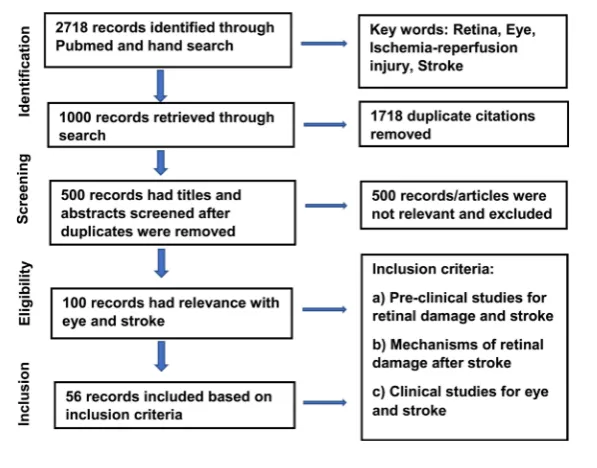
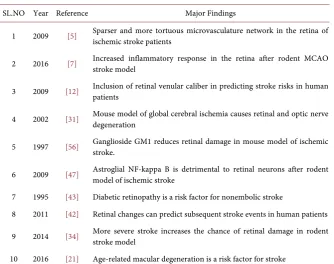
in mouse model of Huntington, Alzheimer and Parkinson’s disease respectively. Specifically, stroke is a cerebrovascular accident involving blood vessels. There-fore, understanding and imaging blood vessels is of paramount importance in understanding stroke. Retinal vessels can be easily accessed and examined using recent advanced imaging instruments such as optical coherence tomography an-giography (OCTA), optical coherence tomography (OCT) etc. Moreover, stroke patients indeed demonstrate microvascular changes in retina. For example, ischemic stroke patients have sparser and tortuous microvascular network in the retina [5]. Therefore, retinal imaging can be a powerful imaging tool to detect and understand the early pathological changes and can even predict the occur-rence of subsequent stroke. This review has been developed in a certain fashion as depicted in the flow chart diagram (Table 1) and summarizes important findings in the field of eye and stroke research (Table 2).
[image:2.595.227.526.502.736.2]2. Retina for Investigating Physiological Changes after Stroke
As described earlier, retina being a part of brain, shares common embryonic ori-gin, similar anatomy, vasculature, blood barrier and physiology thus, makes it aDOI: 10.4236/ojoph.2017.74037 283 Open Journal of Ophthalmology Table 2. Major literatures and key findings relevant for eye and stroke research.
SL.NO Year Reference Major Findings
1 2009 [5] Sparser and more tortuous microvasculature network in the retina of ischemic stroke patients
2 2016 [7] Increased inflammatory response in the retina after rodent MCAO stroke model
3 2009 [12] Inclusion of retinal venular caliber in predicting stroke risks in human patients
4 2002 [31] Mouse model of global cerebral ischemia causes retinal and optic nerve degeneration
5 1997 [56] Ganglioside GM1 reduces retinal damage in mouse model of ischemic stroke.
6 2009 [47] Astroglial NF-kappa B is detrimental to retinal neurons after rodent model of ischemic stroke
7 1995 [43] Diabetic retinopathy is a risk factor for nonembolic stroke
8 2011 [42] Retinal changes can predict subsequent stroke events in human patients
9 2014 [34] More severe stroke increases the chance of retinal damage in rodent stroke model
10 2016 [21] Age-related macular degeneration is a risk factor for stroke
ves-DOI: 10.4236/ojoph.2017.74037 284 Open Journal of Ophthalmology sel changes and can predict occurrence of stroke [10]. For example, De Silva et al. demonstrated that patients with severe focal retinal arteriolar narrowing were highly susceptible to recurrent cerebrovascular events as compared to those without arteriolar narrowing [11]. Most importantly as described earlier, retinal vasculature can be non-invasively visualized easily in vivo after stroke. Moreo-ver, retinal examination can also be useful for stroke risk stratification as well. For example, McGeechan et al., demonstrated that wider retinal venular caliber increases the risk of stroke in humans whereas the caliber of retinal arterioles was not associated with stroke [12]. They further put emphasis on considering inclusion of retinal venular caliber in prediction models containing stroke risk factors, which can reassign intermediate risk stroke category to lower risk. All the above studies strongly suggest that it will be worth understanding and imag-ing retina for early detection of pathophysiological changes after stroke. Moreo-ver, this will be important step forward in improving treatments for stroke since, it can provide sufficient molecular information which can be targeted for thera-peutics after stroke. Moreover, retinal damage after stroke has not been given paramount importance in the stroke treatment regime. However, the retinal damage caused by stroke and other complicated diseases is difficult to differen-tiate at this stage.
3. Relationship between Retinopathy Diseases and Stroke
Many diseases such as diabetic retinopathy, ischemic optic neuropathy, age re-lated macular degeneration, hypertension etc. are often associated with the oc-currence of stroke [13]. However, there are some conflicting studies as well. We will briefly discuss some of them. Diabetic retinopathy is one of the leading causes of blindness worldwide. Diabetes is a common risk factor for developing ischemic optic neuropathy [14]. However, there are some conflicting reportsbe-DOI: 10.4236/ojoph.2017.74037 285 Open Journal of Ophthalmology tween age related macular degeneration and stroke [21] [22] [23]. All these stu-dies suggest that various ocular diseases associated with retinopathy increases the incidence of stroke [24]. However, the strength to which it contributes to stroke incidence remains inconclusive. The association between retinal signs and stroke has been evaluated in all stroke affected populations. However, there are no studies suggesting the specific stroke subtypes (ischemic or hemorrhagic) and retinal signs. In the future, various studies will further confirm the association between stroke and retinopathy. However, researchers need to develop a stan-dardized photographic and grading classification to assess retinal diseases so that there is better comparison and confirmation of the findings. Moreover, as dis-cussed above, there is strong association between retinopathy and stroke. Therefore, retinal photography can act as a surrogate marker of treatment effi-cacy, which might be quite useful in clinics.
4. Retinal Imaging Technology
Over the years, the use of light has been the key in revealing the structural and functional information from the human and rodent’s retina. New scanning and imaging technologies have contributed significantly in imaging and under-standing the retinal blood vessels, nerve fiber layer and optic disc etc. These eye parts are mostly affected in many ocular as well as cerebrovascular diseases. Fundus photography has been the basis of imaging optic nerve and retina [25]. However, the lack of fine details generated in the fundus photography led to the additional ocular techniques such as stereo disc photography, red free retinal nerve fiber layer photography etc. There has been tremendous progress in the development of series of imaging ocular microscopes such as Confocal Scanning Laser Ophthalmoscope (cSLO), Adaptive Optics Scanning Laser Ophthalmos-cope (AOSLO), Scanning Laser Polarimeter (SLP), Optical Coherence Tomo-graphy (OCT), Polarization Sensitive Optical Coherence TomoTomo-graphy (PS OCT), Retinal Birefringence Scanning (RBS) etc., which are the developed ver-sions of one over other [26]. The details of each microscopy have not been dis-cussed here.
5. Development of Retinal Ischemia Using Animal Stroke
Models
DOI: 10.4236/ojoph.2017.74037 286 Open Journal of Ophthalmology internal carotid artery and internal carotid artery originally develops from the common carotid artery. Therefore, vascular obstruction of the common carotid artery in animal model of global cerebral ischemia also impairs ophthalmic blood supply, thereby developing retinal ischemia. There are reports of elimina-tion of b wave of the electroretinogram 7 days after global cerebral ischemia in animal model [28]. Global cerebral ischemia also damages optic nerve in the long-term post occlusion [29]. Brain damage is associated stroke along with many other definite changes such as loss of retinal ganglion cells, thinning of ganglion cell complex [30] [31] [32] apart from changes in the electroretinogram in different rodent stroke models. However, there are some reports which doesn’t support the hypothesis of detectable morphological changes in the retina for animal stroke models [32] [33]. This may be due to the time duration for which ischemic event has occurred. For example, severe middle cerebral occlu-sion (MCAO) in rats (neuroscore > 5) only causes loss of retinal ganglion cells where less severe MCAO (neuroscore < 5) exhibits delays in the electroretino-gram implicit time, which does not suggest the loss of retinal ganglion cells [34]. Retinal ischemia can also be developed by specific ligation of pterygopalatine ar-tery which supplies blood to central ophthalmic arar-tery [35]. However, this me-thod can produce unspecific effects caused by physical damage caused by liga-tion of the pterygopalatine artery, which might not happen after stroke [28]. Al-though, there are other models to develop retinal ischemia such as ligation of the optic nerve, intraocular pressure elevation [36] etc. Retinal changes observed through middle cerebral artery or common carotid artery occlusion may be a better approach to induce retinal ischemia for studying pathophysiological changes after stroke because it directly blocks ophthalmic artery leaving neigh-boring brain structures intact. The mechanisms of retinal ischemic damage might not be the same when developed using other models. Therefore, under-standing retinal changes using most relevant stroke model will be very useful in investigating therapeutics associated with stroke-induced retinal changes.
6. Molecular Mechanism of Parallel Retinal and Brain
Changes after Stroke
DOI: 10.4236/ojoph.2017.74037 287 Open Journal of Ophthalmology b-waves (depolarizing bipolar waves and potassium currents of muller cells) af-ter MCAO model [27]. The blood-eye barrier is severely compromised in rat model of MCAO [7], which is similar to severely compromised blood brain bar-rier in the same animal model [39]. Moreover, there is a significant increase in the inflammatory molecules (IL-1, TNF, CCL2, MPO etc.) in the eye after rat MCAO model [7], which also occurs in the cortex in the same model. As de-scribed above in previous paragraphs, there are other models of developing re-tinal ischemia such as specific ligation of central ophthalmic artery or vein [40]. In these models, there was 60 % loss of retinal ganglion cells, complete loss of optokinetic response, upregulation of p-STAT and p-ERK1/2 in retinal ganglion cells and muller glia respectively [40]. Global cerebral ischemia is another simple model to mimic cardiac arrest which ultimately creates global cerebral stroke. The two-vessel occlusion for developing global cerebra ischemia also causes atrophy of the optic nerve [29] and significant reduction in the b-waves of the electroretinogram [28]. These electroretinogram changes were associated with the upregulation of glial fibrillary acidic protein (GFAP) in the muller cells [41]. As discussed above, all these changes are observed both in the retina and brain. But the question remains whether early retinal changes can be used as a bio-marker for ischemic stroke in human patients? Some evidences suggest that re-tinal arteriovenous nicking (AVN) and rere-tinal focal arteriolar narrowing (FAN) can predict recurrent cerebrovascular events in ischemic stroke patients [11] [42]. Thus, understanding microvascular retinal changes will give insight into novel vascular risk factor for stroke. Moreover, these retinal molecular changes in different stroke models might be worth looking as therapeutic targets for at-tenuating retinal damage after stroke as well because they follow the similar pat-tern of regulation in the eye and brain.
7. Therapeutics for Ischemia-Induced Retinal Damage
DOI: 10.4236/ojoph.2017.74037 288 Open Journal of Ophthalmology TLR-4 deprivation reduces parenchymal stress in the retinal ganglion cells [48]. Moreover, brain-expressed X-lined (Bex) proteins (highly expressed in retinal ganglion cells) accumulates in the cytosol after optic nerve stroke [49]. The long- and short-term effects of the optic nerve stroke on the retina are observed by re-tinal Bex immunoreactivity [49]. Nonarteritic anterior ischemic optic neuropa-thy (NAION) is a type of white matter stroke resulting from optic nerve head ischemia and causes similar retinal ganglion cells apoptosis [50] as seen in other retinal ischemic models [51]. NAION leads to microglia activation and recruit-ment of macrophages to the infarct region [52] which also occurs in other ischemic stroke models. Thus, therapies targeting microglia and macrophages can lead to reduced RGCs apoptosis in NAION [52], which can be applied to other stroke models as well [53]. In summary, therapies which attenuate retinal damage might lead to improvements in cardiovascular and stroke treatment. This might be true otherwise as well. For example, erythropoietin has a neuro-protective effect on stroke-induced brain damage similar to the effect it has on retinal ganglion cells protection after axotomy [54]. Tacrolimus (immunosup-pressant) [55] GM1 (ganglioside) [56] abrogates the ischemic-induced retinal damage, which might be useful in attenuating stroke-induced brain damage.
8. Conclusion
[image:8.595.207.540.463.699.2]Stroke is a cerebrovascular accident caused by interruption of the blood supply to the brain. It is a life-threatening disease and is one of the leading causes of death and disability across the world. The functions of various organs including eye are compromised differently depending upon the affected parts of the brain after stroke and its severity. There is an urgent need to understand other similar
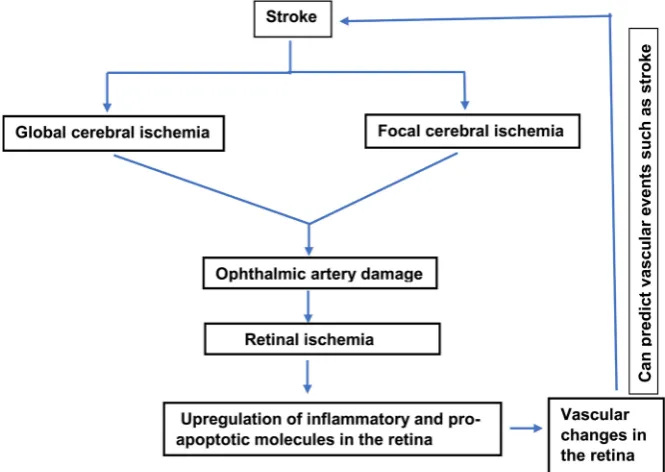
DOI: 10.4236/ojoph.2017.74037 289 Open Journal of Ophthalmology organs which can predict the occurrence of stroke. Eye is one such organ, which is easily accessible, shares similar vasculature, anatomy and physiology and can be used to predict the occurrence of stroke. Various studies have suggested that stroke affects eye resulting in loss of vision. Having similar physiology between brain and eye, the therapeutics effective in stroke might also be useful in reduc-ing retinal damage and vice versa. Therefore, retinal damage after stroke in clin-ics should not be neglected. In fact, eye should be considered as means to ob-serve pathophysiological changes and predict stroke. A flow chart diagram has been shown for depicting the possible relationship between eye and brain pa-thology (Figure 1). There should be more investigations targeted at reducing re-tinal damage after stroke. Moreover, the molecular understandings of rere-tinal damage after stroke and the therapeutic targets derived from it can be easily ap-plied to ameliorate other stroke-induced brain damage.
Conflict of Interest
None.References
[1] Benjamin, E.J., et al. (2017) Heart Disease and Stroke Statistics—2017 Update: A Report from the American Heart Association. Circulation, 135, e146-e603.
https://doi.org/10.1161/CIR.0000000000000485
[2] Karam, A., et al. (2015) A Novel Function of Huntingtin in the Cilium and Retinal Ciliopathy in Huntington’s Disease Mice. Neurobiology of Disease, 80, 15-28. https://doi.org/10.1016/j.nbd.2015.05.008
[3] Dutescu, R.M., et al. (2009) Amyloid Precursor Protein Processing and Retinal Pa-thology in Mouse Models of Alzheimer’s Disease. Graefe’s Archive for Clinical and Experimental Ophthalmology, 247, 1213-1221.
https://doi.org/10.1007/s00417-009-1060-3
[4] Archibald, N.K., et al. (2009) The Retina in Parkinson’s Disease. Brain, 132, 1128-1145. https://doi.org/10.1093/brain/awp068
[5] Ong, Y.T., et al. (2013) Microvascular Structure and Network in the Retina of Pa-tients with Ischemic Stroke. Stroke, 44, 2121-2127.
https://doi.org/10.1161/STROKEAHA.113.001741
[6] Muthaian, R., Minhas, G. and Anand, A. (2012) Pathophysiology of Stroke and Stroke-Induced Retinal Ischemia: Emerging Role of Stem Cells. Journal of Cellular Physiology, 227, 1269-1279.https://doi.org/10.1002/jcp.23048
[7] Ritzel, R.M., et al. (2016) Early Retinal Inflammatory Biomarkers in the Middle Ce-rebral Artery Occlusion Model of Ischemic Stroke. Molecular Vision, 22, 575-588. [8] Baker, M.L., et al. (2008) Retinal Signs and Stroke: Revisiting the Link between the
Eye and Brain. Stroke, 39, 1371-1379.
https://doi.org/10.1161/STROKEAHA.107.496091
[9] Tso, M.O. and Jampol, L.M. (1982) Pathophysiology of Hypertensive Retinopathy. Ophthalmology, 89, 1132-1145.
DOI: 10.4236/ojoph.2017.74037 290 Open Journal of Ophthalmology https://doi.org/10.1111/j.1469-7580.2005.00395.x
[11] De Silva, D.A., et al. (2011) Retinal Microvascular Changes and Subsequent Vascu-lar Events after Ischemic Stroke. Neurology, 77, 896-903.
https://doi.org/10.1212/WNL.0b013e31822c623b
[12] McGeechan, K., et al. (2009) Prediction of Incident Stroke Events Based on Retinal Vessel Caliber: A Systematic Review and Individual-Participant Meta-Analysis. American Journal of Epidemiology, 170, 1323-1332.
https://doi.org/10.1093/aje/kwp306
[13] Wong, T.Y. and Mitchell, P. (2007) The Eye in Hypertension. The Lancet, 369, 425-435.
[14] Chen, T., et al. (2013) The Association between Diabetes Mellitus and Nonarteritic Anterior Ischemic Optic Neuropathy: A Systematic Review and Meta-Analysis. PLoS ONE, 8, e76653.https://doi.org/10.1371/journal.pone.0076653
[15] Cheung, N., et al. (2007) Is Diabetic Retinopathy an Independent Risk Factor for Ischemic Stroke? Stroke, 38, 398-401.
https://doi.org/10.1161/01.STR.0000254547.91276.50
[16] Wong, T.Y. and Mitchell, P. (2004) Hypertensive Retinopathy. The New England Journal of Medicine, 351, 2310-2317.https://doi.org/10.1056/NEJMra032865 [17] Wong, T.Y., et al. (2001) Retinal Microvascular Abnormalities and Incident Stroke:
The Atherosclerosis Risk in Communities Study. The Lancet, 358, 1134-1140. [18] Klein, R., et al. (1999) Retinal Emboli and Stroke: The Beaver Dam Eye Study.
Arc-hives of Ophthalmology, 117, 1063-1068. https://doi.org/10.1001/archopht.117.8.1063
[19] Klein, R., et al. (2003) Retinal Emboli and Cardiovascular Disease: The Beaver Dam Eye Study. Archives of Ophthalmology, 121, 1446-1451.
https://doi.org/10.1001/archopht.121.10.1446
[20] Cugati, S., et al. (2006) Ten-Year Incidence of Retinal Vein Occlusion in an Older Population: The Blue Mountains Eye Study. Archives of Ophthalmology, 124, 726-732.https://doi.org/10.1001/archopht.124.5.726
[21] Wong, T.Y., et al. (2006) Age-Related Macular Degeneration and Risk for Stroke. Annals of Internal Medicine, 145, 98-106.
https://doi.org/10.7326/0003-4819-145-2-200607180-00007
[22] Klein, R., et al. (2003) Early Age-Related Maculopathy in the Cardiovascular Health Study. Ophthalmology, 110, 25-33.
[23] Klein, R., et al. (1999) Prevalence of Age-Related Maculopathy in the Atherosclero-sis Risk in Communities Study. Archives of Ophthalmology, 117, 1203-1210. https://doi.org/10.1001/archopht.117.9.1203
[24] Yeung, C.M., et al. (2010) More Severe Type 2 Diabetes-Associated Ischemic Stroke Injury Is Alleviated in Aldose Reductase-Deficient Mice. Journal of Neuroscience Research, 88, 2026-2034.https://doi.org/10.1002/jnr.22349
[25] Abramoff, M.D., Garvin, M.K. and Sonka, M. (2010) Retinal Imaging and Image Analysis. IEEE Reviews in Biomedical Engineering, 3, 169-208.
https://doi.org/10.1109/RBME.2010.2084567
[26] Gramatikov, B.I. (2014) Modern Technologies for Retinal Scanning and Imaging: An Introduction for the Biomedical Engineer. Biomed Eng Online, 13, 52. https://doi.org/10.1186/1475-925X-13-52
DOI: 10.4236/ojoph.2017.74037 291 Open Journal of Ophthalmology [28] Barnett, N.L. and Osborne, N.N. (1995) Redistribution of GABA Immunoreactivity
Following Central Retinal Artery Occlusion. Brain Research, 677, 337-340.
[29] Takamatsu, J., et al. (1984) Experimental Bilateral Carotid Artery Occlusion: A Study of the Optic Nerve in the Rat. Neuropathology and Applied Neurobiology, 10, 423-428.https://doi.org/10.1111/j.1365-2990.1984.tb00391.x
[30] Ames, A. and Nesbett, F.B. (1983) Pathophysiology of Ischemic Cell Death: I. Time of Onset of Irreversible Damage; Importance of the Different Components of the Ischemic Insult. Stroke, 14, 219-226.https://doi.org/10.1161/01.STR.14.2.219 [31] Stevens, W.D., Fortin, T. and Pappas, B.A. (2002) Retinal and Optic Nerve
Degene-ration after Chronic Carotid Ligation: Time Course and Role of Light Exposure. Stroke, 33, 1107-1112.https://doi.org/10.1161/01.STR.0000014204.05597.0C [32] Kalesnykas, G., et al. (2008) Neurodegeneration and Cellular Stress in the Retina
and Optic Nerve in Rat Cerebral Ischemia and Hypoperfusion Models. Neuros-cience, 155, 937-947.
[33] Steele, E.C., Guo, Q. and Namura, S. (2008) Filamentous Middle Cerebral Artery Occlusion Causes Ischemic Damage to the Retina in Mice. Stroke, 39, 2099-2104. https://doi.org/10.1161/STROKEAHA.107.504357
[34] Allen, R.S., et al. (2014) Severity of Middle Cerebral Artery Occlusion Determines Retinal Deficits in Rats. Experimental Neurology, 254, 206-215.
[35] Minhas, G., et al. (2015) Modeling Transient Retinal Ischemia in Mouse by Ligation of Pterygopalatine Artery. Annals of Neurosciences, 22, 222-225.
https://doi.org/10.5214/ans.0972.7531.220406
[36] Hartsock, M.J., et al. (2016) A Mouse Model of Retinal Ischemia-Reperfusion Injury through Elevation of Intraocular Pressure. Journal of Visualized Experiments, No. 113.
[37] Ramamoorthy, P. and Shi, H. (2014) Ischemia Induces Different Levels of Hypoxia Inducible Factor-1 Alpha Protein Expression in Interneurons and Pyramidal Neu-rons. Acta Neuropathologica Communications, 2, 51.
https://doi.org/10.1186/2051-5960-2-51
[38] Tirapelli, D.P., et al. (2010) Expression of HSP70 in Cerebral Ischemia and Neuro-protetive Action of Hypothermia and Ketoprofen. Arquivos de Neuro-Psiquiatria, 68, 592-596.https://doi.org/10.1590/S0004-282X2010000400021
[39] Yang, G.Y. and Betz, A.L. (1994) Reperfusion-Induced Injury to the Blood-Brain Barrier after Middle Cerebral Artery Occlusion in Rats. Stroke, 25, 1658-1664. [40] Joly, S., et al. (2014) New Mouse Retinal Stroke Model Reveals Direction-Selective
Circuit Damage Linked to Permanent Optokinetic Response Loss. Investigative Ophthalmology & Visual Science, 55, 4476-4489.
https://doi.org/10.1167/iovs.14-14521
[41] Kaja, S., et al. (2003) Estrogen Protects the Inner Retina from Apoptosis and Ische-mia-Induced Loss of Vesl-1L/Homer 1c Immunoreactive Synaptic Connections. Investigative Ophthalmology & Visual Science, 44, 3155-3162.
https://doi.org/10.1167/iovs.02-1204
[42] Malpass, K. (2011) Stroke: Retinal Changes Predict Subsequent Vascular Events in Ischemic Stroke. Nature Reviews Neurology, 7, 538.
https://doi.org/10.1038/nrneurol.2011.148
[43] Petitti, D.B. and Bhatt, H. (1995) Retinopathy as a Risk Factor for Nonembolic Stroke in Diabetic Subjects. Stroke, 26, 593-596.
DOI: 10.4236/ojoph.2017.74037 292 Open Journal of Ophthalmology [44] Delbarre, B., et al. (1995) Effect of Piribedil, a D-2 Dopaminergic Agonist, on Do-pamine, Amino Acids, and Free Radicals in Gerbil Brain after Cerebral Ischemia. Molecular and Chemical Neuropathology, 26, 43-52.
https://doi.org/10.1007/BF02814940
[45] Hyakkoku, K., et al. (2009) Thalidomide Protects against Ischemic Neuronal Dam-age Induced by Focal Cerebral Ischemia in Mice. Neuroscience, 159, 760-769. [46] Nakanishi, N., et al. (2009) Neuroprotection by the NR3A Subunit of the NMDA
Receptor. Journal of Neuroscience, 29, 5260-5265. https://doi.org/10.1523/JNEUROSCI.1067-09.2009
[47] Dvoriantchikova, G., et al. (2009) Inactivation of Astroglial NF-Kappa B Promotes Survival of Retinal Neurons Following Ischemic Injury. European Journal of Neu-roscience, 30, 175-185.https://doi.org/10.1111/j.1460-9568.2009.06814.x
[48] Kilic, U., et al. (2008) TLR-4 Deficiency Protects against Focal Cerebral Ischemia and Axotomy-Induced Neurodegeneration. Neurobiology of Disease, 31, 33-40. [49] Bernstein, S.L., et al. (2006) Analysis of Optic Nerve Stroke by Retinal Bex
Expres-sion. Molecular Vision, 12, 147-155.
[50] Levin, L.A. and Louhab, A. (1996) Apoptosis of Retinal Ganglion Cells in Anterior Ischemic Optic Neuropathy. Archives of Ophthalmology, 114, 488-491.
https://doi.org/10.1001/archopht.1996.01100130484027
[51] Minhas, G., Morishita, R. and Anand, A. (2012) Preclinical Models to Investigate Retinal Ischemia: Advances and Drawbacks. Frontiers in Neurology, 3, 75. https://doi.org/10.3389/fneur.2012.00075
[52] Salgado, C., et al. (2011) Cellular Inflammation in Nonarteritic Anterior Ischemic Optic Neuropathy and Its Primate Model. Archives of Ophthalmology, 129, 1583-1591. https://doi.org/10.1001/archophthalmol.2011.351
[53] Patel, A.R., et al. (2013) Microglia and Ischemic Stroke: A Double-Edged Sword. International Journal of Physiology, Pathophysiology and Pharmacology, 5, 73-90. [54] Weishaupt, J.H., et al. (2004) Effect of Erythropoietin Axotomy-Induced Apoptosis
in Rat Retinal Ganglion Cells. Investigative Ophthalmology & Visual Science, 45, 1514-1522.https://doi.org/10.1167/iovs.03-1039
[55] Tsujikawa, A., et al. (1998) Tacrolimus (FK506) Attenuates Leukocyte Accumula-tion after Transient Retinal Ischemia. Stroke, 29, 1431-1437.
https://doi.org/10.1161/01.STR.29.7.1431
[56] Mohand-Said, S., et al. (1997) Intravitreal Injection of Ganglioside GM1 after Ischemia Reduces Retinal Damage in Rats. Stroke, 28, 617-621.