University of Warwick institutional repository: http://go.warwick.ac.uk/wrap
This paper is made available online in accordance with
publisher policies. Please scroll down to view the document
itself. Please refer to the repository record for this item and our
policy information available from the repository home page for
further information.
To see the final version of this paper please visit the publisher’s website.
Access to the published version may require a subscription.
Author(s): C. Tappert, L. Schmidtobreick, A. Aungwerojwit, R. E.
Mennickent, D. Koester, B. T. Gänsicke
Article Title: The pre-cataclysmic variable, LTT 560
Year of publication: 2007
Link to published article:
http://dx.doi.org/10.1051/0004-6361:20077316
DOI: 10.1051/0004-6361:20077316
c
ESO 2007
Astrophysics
&
The pre-cataclysmic variable, LTT 560
C. Tappert
1, B. T. Gänsicke
2, L. Schmidtobreick
3, A. Aungwerojwit
2,4, R. E. Mennickent
5, and D. Koester
61 Departamento de Astronomía y Astrofísica, Pontificia Universidad Católica, Vicuña Mackenna 4860, 782-0436 Macul, Chile
e-mail:[email protected]
2 Department of Physics, University of Warwick, Coventry CV4 7AL, UK
e-mail:[Boris.Gaensicke;a.aungwerojwit]@warwick.ac.uk 3 European Southern Observatory, Casilla 19001, Santiago 19, Chile
e-mail:[email protected]
4 Department of Physics, Faculty of Science, Naresuan University, Phitsanulok 65000, Thailand 5 Departamento de Física, Universidad de Concepción, Casilla 160-C, Concepción, Chile
e-mail:[email protected]
6 Institut für Theoretische Physik und Astrophysik, University of Kiel, 24098 Kiel, Germany
e-mail:[email protected]
Received 16 February 2007/Accepted 11 August 2007
ABSTRACT
Aims. System parameters of the object LTT 560 are determined in order to clarify its nature and evolutionary status.
Methods. We apply time-series photometry to reveal orbital modulations of the light curve, time-series spectroscopy to measure radial velocities of features from both the primary and the secondary star, and flux-calibrated spectroscopy to derive temperatures of both components.
Results. We find that LTT 560 is composed of a low temperature (T ∼7500 K) DA white dwarf as the primary and an M5.5±1 main-sequence star as the secondary component. The current orbital period isPorb=3.54(07) h. We derive a mass ratioMsec/Mwd=0.36(03)
and estimate the distance tod=25–40 pc. Long-term variation of the orbital light curve and an additional Hαemission component on the white dwarf indicate activity in the system, probably in the form of flaring and/or accretion events.
Key words.binaries: close – stars: late-type – white dwarfs – novae, cataclysmic variables
1. Introduction
Cataclysmic Variables (CVs) are close interacting binaries with a white-dwarf (WD) primary accreting matter via Roche-lobe overflow from a late-type companion that is on, or at least close to, the main sequence. These systems are thought to form from initially detached binary stars that go through a common-envelope (CE) phase (Paczy´nski 1976, and references herein). In the course of its nuclear evolution, the more massive star expands, eventually fills its Roche lobe, and transfers matter onto the late-type dwarf at very high rates of up to ˙M1 ∼ 0.01...0.1 M yr−1 (e.g., Meyer & Meyer-Hofmeister 1979; Warner 1995). The CE configuration results, since the secondary star cannot adjust on such short timescales1. The CE provides an enhanced braking mechanism, rapidly reducing the binary sep-aration. After the expulsion of the CE, angular-momentum loss due to magnetic braking further reduces the orbital separation between the remaining WD and its red companion (on much longer timescales). Eventually the Roche lobe of the red dwarf shrinks into contact with the stellar surface, thus starting mass transfer and the proper CV phase. Following the convention of Schreiber & Gänsicke (2003), a post-CE binary is called a pre-CV if the time between the expelling of the CE and the start of the CV phase is less than the Hubble time. For a comprehensive overview on CVs and CV evolution see Warner (1995).
1 Note, however, that neither high mass-transfer-rates lead
necessar-ily to a CE, nor a CE phase to a CV (e.g., Beer et al. 2007; de Kool 1992 respectively).
Currently only ∼40 pre-CVs with established orbital peri-ods are known (Morales-Rueda et al. 2005), which is in strong contrast to the over 600 CVs with measured orbital periods that are listed in version 7.7 of the Ritter & Kolb (2003) catalogue. Furthermore, this small sample is severely biased by observa-tional selection effects towards young systems containing hot white dwarfs and low-mass companions (Schreiber & Gänsicke 2003).
LTT 560 is listed as a high proper motion system in the Luyten (1957) catalogue. The object was marked as a possible WD by Eggen (1968), and appeared as a nova-like variable in Vogt (1989) and in Downes et al. (1997), the latter using the designation Scl2. Spectroscopy by Hoard & Wachter (1998) re-vealed narrow Hαemission and a red continuum that was fitted well by an M5 dwarf. They also found a variable doubling of the Hα emission that led them to suspect a binary nature for LTT 560.
Here we present photometric light curves and time-resolved and flux-calibrated spectroscopy that reveal LTT 560 as being an old and nearby short-period pre-CV containing a very cool white dwarf.
2. Observations and data reduction
206 C. Tappert et al.: The pre-cataclysmic variable, LTT 560
Table 1.Log of observations. The configuration column for the spectroscopic data states the grism/grating, the wavelength range, and the spectral
FWHMresolution. Date and HJD refer to the start of night.
Date HJD Telescope Configuration ndata texp[s] ∆t[h]
2002-09-22 2 452 540 0.9 m CCD+R 130 120 5.67 2002-10-17 2 452 565 0.9 m CCD+R 90 120 3.84 2002-10-18 2 452 566 0.9 m CCD+R 90 120 3.87 2003-07-19 2 452 840 NTT g#3, 3350–9000 Å, 8.3 Å 3 400 0.25 2004-11-29 2 453 339 4.0 m KPGL3, 3500–7300 Å, 4.2 Å 27 600 5.57
were reduced using the quadred package implemented in IRAF2, which takes into account that the CCD is read out via 4 am-plifiers. Apart from that, the reduction process is standard, in-cluding bias and overscan subtraction, as well as flatfielding. Aperture photometry for all detected stars on the CCD was com-puted with IRAF’s daophot package, and additional daomatch and daomaster (Stetson 1992) routines were used for cross-identification of stellar sources on different CCD frames. The adopted aperture radius was chosen as the one that produced minimum noise in the differential light curve of two comparison stars with brightness similar to the target. An average light curve was computed out of several non-variable comparison stars, and then used to produce differential light curves for all stars in the field (e.g., Howell 1992).
Optical spectroscopy was performed on 2003-07-19 using EMMI on the NTT, at ESO La Silla. Grism #3 and a 1.0 slit yielded a wavelength range of 3350–9000 Å and a spectral res-olution of 8.3 Å. IRAF tasks were used for basic reduction (bias +flats), optimal extraction (Horne 1986), wavelength-, and flux calibration.
Time-resolved spectroscopic data were obtained on 2004-11-29 with the R-C spectrograph mounted on the 4.0 m Blanco telescope at CTIO. The grating KPGL3 was used with a 1.0slit, which yielded a wavelength range of 3500–7300 Å and a spectral resolution of 4.2 Å. Wavelength calibration data were taken with a HeAr lamp every 4 to 5 object spectra. The instru-mental wavelength flexure between two calibration exposures was later corrected for by measuring the position of the night sky emission line at 6863 Å and subtracting its variation with respect to the mean. Weather conditions during this run were far from photometric, with a layer of thin clouds during most of the time, so no flux calibration could be performed. Data reduction was carried out as outlined above.
LTT 560 was observed in the near-ultraviolet (NUV) and far-ultraviolet (FUV) by GALEX as part of its All Sky Survey on October 21, 2003. The 120 s exposures did not yield a detection in the FUV, but provided an NUV flux of 0.236±0.01 mJy.
A summary of our observations is presented in Table 1.
3. Results
3.1. The flux-calibrated spectrum
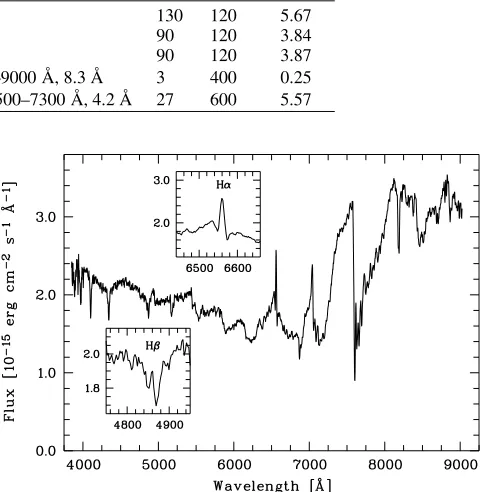
The three individual spectra taken on 2003-07-19 were averaged to yield the spectrum displayed in Fig. 1. It shows a blue con-tinuum with Balmer absorption lines, and a red concon-tinuum with molecular absorption bands. The relatively narrow width of the Balmer absorption lines suggests a cold (Teff<10 000 K) white dwarf, and the strength of the TiO bands an intermediate M-type secondary star. On closer inspection, the presence of narrow
2 NOAO PC-IRAF Revision 2.12.2-EXPORT.
Fig. 1. The average flux-calibrated spectrum. The two insets show close-ups of the regions around Hβand Hα.
Balmer emission is clearly seen in Hαand Hβ. Convolving the spectrum with Bessell (1990) filter curves yields spectrophoto-metric magnitudesV =15.7 andR=15.2 mag. This is roughly 0.2 mag brighter than previously reported (Hoard & Wachter 1998, and references therein), but such small difference can probably be attributed to the uncertainties of the flux calibra-tion, and we re-scaled our spectrum of LTT 560 toV =15.7 for the subsequent analysis.
We fitted a composite model consisting of a synthetic white dwarf spectrum and an observed M-dwarf template to the flux-calibrated spectrum of LTT 560. The synthetic white dwarf spec-tra were calculated with the code described by Koester et al. (2005) and earlier references given there. We used a mixing length ML/2α = 0.6, a pure hydrogen composition, a surface gravity logg = 8.0, corresponding to a white dwarf mass of
[image:3.595.321.562.124.370.2]Fig. 2.Two-component fit (thick grey line) to the flux-calibrated spec-trum of LTT 560 (solid black line). The individual components, a white dwarf with a temperature ofTwd = 7500 K and a surface gravity of
logg = 8.0, and our M5.5 template are shown as dashed lines. The bottom panel shows the residuals of the fit, which highlight the Balmer emission from the M-dwarf.
Fig. 3. Spectral energy distribution of LTT 560. The GALEX near-ultraviolet flux, the CTIO average spectrum, and the 2MASSJ,H, and
KS fluxes are shown in black. TheTwd =7500 K, logg = 8.0 white
dwarf and the M5.5 M-dwarf from Fig. 2 are plotted as grey lines. The grey dots represent an M5.5 template from S. Leggett’s M-dwarf library, scaled according to our fit to the optical data.
M5 and M6 templates, with both components scaled according to the best fit. Earlier and later spectral types for the secondary star result in much poorer fits, and we conclude that the spectral type of the main-sequence companion in LTT 560 is 5.5±1. This result is confirmed by recentK-band spectroscopy (Tappert et al. 2007).
Our fit to the optical spectrum of LTT 560 agrees well with the 2MASS magnitudes of LTT 560 (J = 12.65,H = 12.13, andKs =11.86) when extending the composite model into the infrared with Leggett’s library of M-dwarf spectra3(Fig. 3). The best-fit white dwarf model spectrum overpredicts the GALEX near-UV flux only by a few per cent. Given the uncertainty in the spectrophotometric calibration of our optical data, and the fact that the 2MASS data have been taken at unknown binary phases, an attempt to fit the overall spectral energy distribution would not result in more accurate stellar parameters, and has therefore not been attempted.
[image:4.595.45.265.73.239.2]3 http://ftp.jach.hawaii.edu/ukirt/skl/dM.spectra/
Fig. 4.Individual light curves from 09-22, 10-17, and 2002-10-18 (top to bottom). The data have been normalised by subtracting the average magnitude of the complete data set.
Assuming a Hamada & Salpeter (1961) carbon-core mass-radius relation for the white dwarf, the flux scaling factor be-tween the synthetic spectrum and the data of LTT 560 implies a distance ofd = 33 pc. This estimate depends somewhat on the white dwarf mass. Repeating the fit for logg =7.5 (Mwd = 0.33M) and logg =8.5 (Mwd =0.90M) results in tempera-tures lower and larger by 500 K, respectively. The implied dis-tance is 39 pc for logg =7.5 and 26 pc for logg=8.5, and we conclude 25 pc<∼d <∼40 pc. This makes the object a good target for a ground-based parallax measurement.
For d = 33 pc, the flux scaling factor of our M-dwarf spectral template implies a radius of the secondary ofRsec ∼ 8.0 ±1.3 ×109cm, which is consistent with an ∼M5V sec-ondary star (Delfosse et al. 2000; Ségransan et al. 2003). For a mass ratio ofMsec/Mwd =0.32 (Sect. 3.3) and an orbital pe-riod of 3.54 h (Sect. 3.2), the Roche lobe radius of the secondary star is∼2.1×1010cm, which implies that the secondary star is ∼50% Roche-lobe filling. Given the amplitude of the observed ellipsoidal modulation (Fig. 4), the inferred radius is clearly too small. This will be discussed further in Sect. 4.
3.2. The light curve
The resulting light curves of the two observing runs from September and in October 2002 are given in Fig. 4. All three data sets show as a common feature the presence of two minima of different depths, indicating ellipsoidal variation. In the first data set, from September 2002, the two maxima have different values as well.
[image:4.595.43.267.316.484.2]208 C. Tappert et al.: The pre-cataclysmic variable, LTT 560
Fig. 5.AOV periodogram of the photometric data. The best period and half its value are indicated.
Fig. 6.Light curves folded on the ephemeris in Eq. (1). Filled circles, triangles, and squares, mark data from 2002-09-22, 2002-10-17, and 2002-10-18, respectively. The data are repeated, without error bars, for a second cycle. For the lower plot, an offset of−0.008 mag has been applied to the data from 2002-09-22.
f1 =6.786 cyc d−1and f2 =13.609 cyc d−1, and thus f2 ≈2f1. We therefore adopt the lower frequency as corresponding to the orbital period, and describe the photometric variation as ellip-soidal: the two minima represent the inferior and superior con-junction of the late-type secondary star, the two maxima are the result of maximum visibility of the Roche-deformed sides of that star at quadrature. From f1 we derive a corresponding pe-riodP =3.54(07) h, with the uncertainty being estimated from the width of the signal in the periodogram. Figure 6 presents the phase-folded light curve. In principle, there are two effects that can account for the difference in the minima: at superior con-junction either illumination by the white dwarf causes an ele-vated minimum, or gravitational darkening of the deformed sec-ondary star results in a deeper minimum. Considering the very low temperature of the white dwarf, the latter scenario appears as the most probable one.
[image:5.595.365.519.99.148.2]Since the orbital phase is now defined we can go on to de-rive the photometric ephemeris. In the light curve there are three well defined minima that can be fitted with second-order poly-nomials in order to derive the timings of these minima. These include both the shallow and the deep minimum from 2002-10-17, and the shallow minimum from 2002-10-18. A linear fit to the such derived timings (Table 2) yields the zero point and the
Table 2.Timings of suitable photometric minima.
Cycle HJD (2 452 500+) Error [d] 0.0 65.6575 0.0097 0.5 65.7316 0.0055 7.0 66.6937 0.0064
orbital period. The latter results in 3.55(03) h, and thus, within the errors, is identical to the one derived from the periodogram. However, since it is based on only three data points, the formal error of 0.03 h is probably underestimated. We therefore adopt the period and uncertainties estimated from the periodogram, to obtain the ephemeris
T0(HJD)=2 452 565.6575(51)+0.1475(29)E, (1) withEgiving the cycle number with respect to the superior con-junction of the white dwarf.
We note that, while the two light curves from October are identical within the photometric errors, the September data set not only presents an enhanced second maximum, but on the whole appears to be displaced to∼0.01 mag fainter magnitudes. Comparison of the average magnitudes of common field stars in the September and the October run yields a standard deviation of 0.008 mag, so that this displacement can be explained as being within the photometric precision limit with respect to these two runs. If a corresponding offset of−0.008 mag is applied to the September data, the general shape of that light curve is identi-cal to the October data, with the notable exception of the second maximum (lower plot of Fig. 6). The latter feature is discussed in more detail in Sect. 4.
We used the program Nightfall written by Wichmann4 to test the parameters derived from the spectroscopic model (Sect. 3.1) by fitting synthetic light curves to the October 2002 data. A first light curve was calculated adopting the parameters from Table 3, in particular Porb = 0.1475 d,i = 60◦, Twd = 7500 K,Tsec 3000 K,Mwd 0.4−0.6M,Msec =0.17M,
Rwd0.012–0.016R, andRsec=0.115R. However, the ellip-soidal modulation of the resulting light curve is of much lower amplitude (∼0.0015) than the observed one. We then fitted the observed light curve by fixing all parameters above but leav-ingRsec as a free parameter. We find that, to reproduce an el-lipsoidal modulation corresponding to the observed light curve, the requiredRsec exceeds the spectroscopic result by a factor of two. The discrepancy between the spectrophotometric radius (Sect. 3.1) and that implied by the ellipsoidal modulation is sig-nificant and will be discussed in Sect. 4.
3.3. Radial velocities
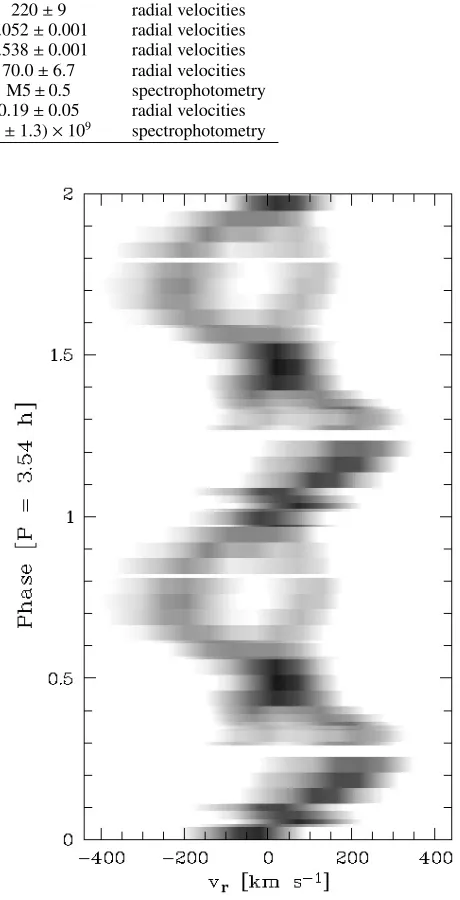
The Hαemission line is clearly double-peaked during substan-tial parts of the orbital cycle (Fig. 7). The trailed spectrogram (Fig. 8) reveals that the two components follow sinusoidal radial velocity variations with a phase difference of0.5. To measure the radial velocity variation, we fitted the spectra that present two clearly separated Hαcomponents with two Gaussians, finding that these components are unresolved at the spectral resolution of the CTIO spectra.
Next, we attempted to fit all individual spectra with two Gaussians ofFWHM=4.2 Å, i.e. with their widths fixed to the
[image:5.595.61.290.280.447.2]Table 3.System parameters of LTT 560.
White dwarf Main sequence star Method Orbital period [h] 3.54±0.07 h light curve
Inclination 60◦ radial velocities Distance [pc] 25–40 pc spectrophotometry
K[km s−1] 80±6 220±9 radial velocities T0[d] 0.566±0.002 0.052±0.001 radial velocities T0[HJD 2 453 339+] 0.463±0.002 0.538±0.001 radial velocities
γ[km s−1] 95.0±5.2 70.0±6.7 radial velocities Teff/spect. type 7500±500 K M5±0.5 spectrophotometry
Mass [M] 0.52±0.12 0.19±0.05 radial velocities Radius [cm] (9±1)×108 (8±1.3)×109 spectrophotometry
Fig. 7.The Hαline profile at the time of maximum separation of the two emission components (bottom), and half an orbital cycle later (top).
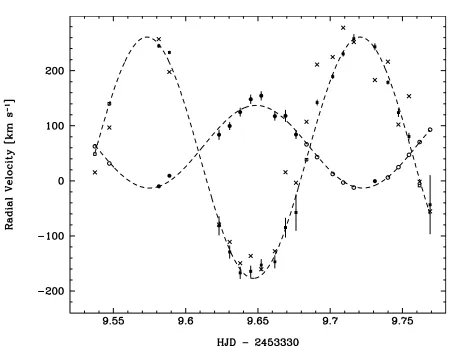
spectral resolution of our data, leaving only their position and amplitude free. For a number of spectra the fit failed to disentan-gle the two line profiles, especially during those orbital phases when both components cross, and for the spectra from the last third of our run, which suffered from degrading conditions, and where the weaker Hαcomponent was ill-defined. In the cases where one component was still clearly discernable, we fitted the combined profile with two Gaussians as described above, but fixed the position of the weaker component to the velocity predicted by a sine-fit to the radial velocities from the spectra where both components could unambiguously be disentangled. For four spectra, no meaningful result could be extracted from the line profiles. The radial velocity curves derived in this way are shown in Fig. 9.
The two radial velocity variations appear sinusoidal in shape, and are offset by half a cycle. We fitted both sets of radial veloc-ities with sine curves of the formKsin[2π(t−T0)/P]+γwithK the radial velocity amplitude,tthe time of the observation,T0an offset to account for the arbitrary phase during the observations,
P=0.1475 d the orbital period determined from the photometry, and a constant velocity offsetγ. The fit parameters are reported in Table 3.
In Fig. 9, we include radial velocities that were derived by fit-ting a single Gaussian to the absorption edge of the TiO molecu-lar band nearλ7040 Å. A sine fit yields the following parameters for this component:γ = 89±5 km s−1,K = 208±7 km s−1,
[image:6.595.305.535.147.597.2]T0(HJD) = 2 453 339.534±0.001, which both in amplitude and phase agrees well with the high-amplitude Hαcomponent, which is also the stronger of the two components.
Fig. 8. Trailed spectrogram of the 2004-11-29 data, folded on P =
3.54 h. Radial velocities refer to the rest wavelength of Hα. The data are repeated for a second cycle.
210 C. Tappert et al.: The pre-cataclysmic variable, LTT 560
Fig. 9. Radial velocities for both Hα components. For components marked with filled symbols, the velocities were obtained by simultane-ous Gaussian fits to both Hαemission line components. In some cases the weaker component was ill-defined, and the two-Gaussian fit was carried out with the position of the weaker component fixed to the wave-length predicted by a sine fit to the velocities obtained from the spectra where a two-Gaussian fit was possible. Those points with fixed veloci-ties are marked by open symbols. Four spectra were too poor to obtain any significant fit, and are marked by open symbols for both compo-nents. Additional radial velocities extracted from the TiO absorption edge at 7040 Å are marked by×. These data were not included in the fit, but are overplotted for comparison.
Kwd/Ksec = Msec/Mwd = 0.36±0.03. We note no substantial change in the equivalent width of the Hα emission line from the companion star, which implies that the motion of the cen-tre of light is equivalent to the motion of the cencen-tre of mass. Comparing the velocity offsets obtained from the two fits, it be-comes apparent thatγwdexceedsγsec by 25 km s−1. Assuming that γsec reflects the radial component of systemic velocity, we interpretγwd−γsec as the gravitational redshift of the Hα emission originating on the white dwarf. General relativity pre-dicts a redshift ofvgr = 0.635(M/M)/(R/R), and assuming again a Hamada & Salpeter (1961) mass-radius relationship,
vgr = 25±9 km s−1 corresponds to Mwd = 0.52 ± 0.12M. A caveat to this mass measurement is that if the Hαemission arises from a point somewhat above the white dwarf photosphere (O’Donoghue et al. 2003, find that the second component of the Hα emission in EC 13471-1258 has its origin somewhere between the white dwarf and L1), its mass would be underesti-mated. The mass of the secondary star implied by the mass ratio above isMsec =0.19±0.05M. If the companion star follows the spectral type-mass-radius relation of typical low-mass stars (Ségransan et al. 2003; Delfosse et al. 2000) the masses of both stars are likely to be on the lower side of the error ranges. Given the fact that the mass ratio and both radial velocity amplitudes are known, we can estimate the binary inclination as60◦.
4. Discussion
In comparison with other known pre-CVs, LTT 560 represents a special case in that it shows spectroscopic evidence for low-level accretion, and apparently irregular long-term variability in its light curve. Accretion from the wind of the companion star has been observed in other pre-CVs in the form of metal enrichment of the white dwarf photosphere or additional emission compo-nents (e.g., Sion et al. 1998; O’Brien et al. 2001; O’Donoghue et al. 2003; Maxted et al. 2007). Schmidt et al. (2005, 2007) also
ascribe the mass transfer mechansim in low accretion rate po-lars (LARPS, Schwope et al. 2002) to wind from the secondary star. Concerning the light curve, flaring activity from the sec-ondary star appears as the most likely explanation for the en-hanced photometric maximum in the September data, since the Hα component from the secondary star indicates the presence of chromospheric activity, and the duration of the “flare” feature with∼0.15 orbits≈30 min is within the usual time range of such flares (e.g., Garcia Alvarez 2000). Still, since the orbital phase in question is only covered once in the September data, it remains unclear whether this feature is not a periodic event, representing an additional light source in the system, perhaps due to enhanced accretion at that time.
A weak X-ray source at a count rate of 0.008±0.002 cts/s was serendipitously detected in a pointed ROSAT PSPC observation that coincides within the positional error with LTT 560 (White et al. 2000). Adopting a distance of 33 pc and the countrate-to-flux conversion factor of Fleming et al. (1993), we find an X-ray luminosity of6×1027erg/s, which is consistent with coronal activity on the M-dwarf.
A point worth further discussion is the disagreement between the spectrophotometric radius of the secondary star (Sect. 3.1) and that implied by the observed amplitude of the ellipsoidal modulation (Sect. 3.2). A well-known problem in the under-standing of low mass stars is that the radii of stars in eclipsing binaries with masses of0.4–0.8Mare larger by up to 15% than predicted by stellar models (Ribas 2006 for a review), and stellar activity is generally seen as a possible explanation for this discrepancy (e.g., López-Morales 2007). However, radii of low-mass stars from interferometric measurements also appear to be too large (Berger et al. 2006). In the context of pre-CVs, the companion star is tidally forced into rapid rotation, which is believed to result in increased stellar activity (Pallavicini et al. 1981; Pizzolato et al. 2003). Whether or not stellar activity is the cause of anomalies in the radii, masses, and spectral types of the companion stars in pre-CVs (e.g., O’Brien et al. 2001; Maxted et al. 2004) or CVs (e.g., Naylor et al. 2005) is not yet clear, as no fully detailed treatement of the structure and the observational properties of strongly active low-mass stars is available. In a pio-neering paper, Spruit & Weiss (1986) showed that for stars above the fully convective boundary, both the radius and the tempera-ture of the star will be underestimated if a large fraction of the star is covered by star spots. However, the effects of magnetic activity are thought to extend to lower masses as well (Mullan & MacDonald 2001), which is confirmed by observations (West et al. 2004). The calculations of Mullan & MacDonald demon-strated that for low mass M-dwarfs, magnetic activity may result in effective temperatures that are too low for their radii. While a full discussion has to await progress in the theoretical models of active stars, it appears possible that activity caused by rapid rota-tion induces anomalies in the relarota-tionships between mass, radius, and spectral type, and that this is the cause of the apparent mis-match of the spectrophotometric radius of the companion star in LTT560, and its radius implied by the ellipsoidal modulation.
The uncertainty in the stellar properties of the companion star propagates into a relatively wide range of possible peri-ods when LTT 560 will evolve into a semi-detached configura-tion (i.e. start mass transfer as a cataclysmic variable). For ex-ample, using equations (8) and (11) in Schreiber & Gänsicke (2003), and assuming that gravitational radiation is the main mechanism for angular momentum loss (Msec <0.3M) yields
Pcd = 0.165 d,Psd = 0.035 d ∼ 50 min (which is not a very probable value for a CV),tsd=2.9 Gyr, forRsec=0.115R, and
Pcdbeing the orbital period at the end of the CE phase,Psd the orbital period at which the system will start mass transfer (i.e., become a CV), andtsd the time the system will need to shrink from the current orbital period toPsd. Additionally, the spectral type derived in Sect. 3.1 suggestsPsd <2 h, while the mass ra-tio determined from the radial velocities and the gravitara-tional redshift indicatesPsd > 3 h. An accurate parallax determina-tion of LTT 560 would therefore be extremely useful for a better constraint on the stellar parameters and the future evolution of LTT 560.
The white dwarf cooling age of LTT 560, assuming Mwd 0.5M, is109yr (Wood 1995). The relatively low mass sug-gests that it may contain a helium core, which is a possible out-come of the common envelope evolution (Willems & Kolb 2004 and references therein). Better data are needed to improve the measurement of the white dwarf mass.
LTT 560 and RR Cae (Bragaglia et al. 1995; Bruch & Diaz 1998; Bruch 1999) represent the oldest among the ∼40 known post-common envelope binaries (Schreiber & Gänsicke 2003; Morales-Rueda et al. 2005; Shimansky et al. 2006). Both systems are nearby (33 pc and 12 pc, respectively) which suggests that they represent a fairly numerous population, as pre-dicted to exist by Schreiber & Gänsicke (2003). A principle dif-ficulty in finding old pre-CVs is their inconspicuousness com-pared to CVs. Both stellar components in old pre-CVs are in-trinsically faint, and hence only nearby systems will be found in shallow surveys. Pre-CVs do not undergo outburst, so will not be picked up by amatuer astronomers of sky patrols. They have at best some X-ray emission due to coronal activity of the main se-quence companion, indistinguishable from single M-dwarfs. Old pre-CVs are not particularly blue, so escaped discovery in the classic “blue” extragalactic surveys such as the Palomar Green Survey. The Sloan Digital Sky Survey (SDSS), being deeper and sampling a much larger colour space than any previous survey, is now rapidly changing the scene, identifying already
>
∼1000 white dwarf main sequence binaries (Silvestri et al. 2006; Eisenstein et al. 2006; Southworth et al. 2007), with more to come from SEGUE (Schreiber et al. 2007). However, follow-up work identifying post-CE/pre-CV binaries among those objects has just started (e.g. Rebassa-Mansergas et al. 2007), and will be limited (by the design of SDSS) predominantly to relatively faint systems. While SDSS will substantially improve our knowledge on pre-CVs in terms of better statistics, identifying nearby bright pre-CVs such as LTT 560 white dwarf main sequence binaries remains important as those systems are best-suited for detailed parameter studies.
Acknowledgements. This research has greatly benefited from discussions with Tom Marsh, Matthias Schreiber, Raymundo Baptista, and Stella Kafka. We also thank the anonymous referee for helpful suggestions.
C.T. and R.M. acknowledge financial support by FONDECYT grant 1051078. BTG was supported by a PPARC Advanced Fellowship. A.A. thanks the Royal Thai Government for a studentship. This work has made intensive use of the SIMBAD database, operated at CDS, Strasbourg, France, and of NASA’s Astrophysics Data System Bibliographic Services. IRAF is distributed by the National Optical Astronomy Observatories.
References
Beer, M. E., Dray, L. M., King, A. R., & Wynn, G. A. 2007, MNRAS, 375, 1000 Berger, D. H., Gies, D. R., McAlister, H. A., et al. 2006, ApJ, 644, 475 Bessell, M. S. 1990, PASP, 102, 1181
Beuermann, K. 2006, A&A, 460, 783
Beuermann, K., & Weichhold, M. 1999, in Annapolis Workshop on Magnetic Cataclysmic Variables, ed. C. Hellier, & K. Mukai, ASP Conf. Ser., 157, 283 Bochanski, J. J., West, A. A., Hawley, S. L., & Covey, K. R. 2007, AJ, 133, 531 Bragaglia, A., Renzini, A., & Bergeron, P. 1995, ApJ, 443, 735
Bruch, A. 1999, AJ, 117, 3031
Bruch, A., & Diaz, M. P. 1998, AJ, 116, 908 de Kool, M. 1992, A&A, 261, 188
Delfosse, X., Forveille, T., Ségransan, D., et al. 2000, A&A, 364, 217 Downes, R., Webbink, R. F., & Shara, M. M. 1997, PASP, 109, 345 Eggen, O. J. 1968, ApJ, 153, 195
Eisenstein, D. J., Liebert, J., Harris, H. C., et al. 2006, ApJS, 167, 40
Fleming, T. A., Giampapa, M. S., Schmitt, J. H. M. M., & Bookbinder, J. A. 1993, ApJ, 410, 387
Garcia Alvarez, D. 2000, Ir. Astron. J., 27, 117 Hamada, T., & Salpeter, E. E. 1961, ApJ, 134, 683 Hoard, D. W., & Wachter, S. 1998, PASP, 110, 906 Horne, K. 1986, PASP, 98, 609
Howell, S. B. 1992, in Astronomical CCD Observing and Reduction Techniques, ASP Conf. Ser., 23, ed. S. B. Howell
Koester, D., Napiwotzki, R., Voss, B., Homeier, D., & Reimers, D. 2005, A&A, 439, 317
López-Morales, M. 2007, ApJ, 660, 732
Luyten, W. J. 1957, A catalogue of 9867 stars in the Southern Hemisphere with proper motions exceeding 0.2 annually (Minneapolis: Lund Press) Maxted, P. F. L., Marsh, T. R., Morales-Rueda, L., et al. 2004, MNRAS, 355,
1143
Maxted, P. F. L., O’Donoghue, D., Morales-Rueda, L., Napiwotzki, R., & Smalley, B. 2007, MNRAS, 376, 919
Meyer, F., & Meyer-Hofmeister, E. 1979, A&A, 78, 167
Morales-Rueda, L., Marsh, T. R., Maxted, P. F. L., et al. 2005, MNRAS, 359, 648
Mullan, D. J., & MacDonald, J. 2001, ApJ, 559, 353
Naylor, T., Allan, A., & Long, K. S. 2005, MNRAS, 361, 1091 O’Brien, M. S., Bond, H. E., & Sion, E. M. 2001, ApJ, 563, 971 O’Donoghue, D., Koen, C., Kilkenny, D., et al. 2003, MNRAS, 345, 506 Paczy´nski, B. 1976, in Structure and Evolution of Close Binary Systems, ed.
P. Eggleton, S. Mitton, & J. Whelan, IAU Symp., 73, 75 Pallavicini, R., Golub, L., Rosner, R., et al. 1981, ApJ, 248, 279
Pizzolato, N., Maggio, A., Micela, G., Sciortino, S., & Ventura, P. 2003, A&A, 397, 147
Rebassa-Mansergas, A., Gänsicke, B., Rodríguez-Gil, P., Schreiber, M., & Koester, D. 2007, MNRAS, submitted
Ribas, I. 2006, Ap&SS, 304, 89
Ritter, H., & Kolb, U. 2003, A&A, 404, 301
Schmidt, G. D., Szkody, P., Vanlandingham, K. M., et al. 2005, ApJ, 630, 1037 Schmidt, G. D., Szkody, P., Henden, A., et al. 2007, ApJ, 654, 521
Schreiber, M., Nebot Gomez-Moran, A., & Schwope, A. 2007, in 15th European Workshop on White Dwarfs, ed. R. Napiwotzki, & R. Burleigh, ASP Conf. Ser., in press, [arXiv:astroph/0611461]
Schreiber, M. R., & Gänsicke, B. T. 2003, A&A, 406, 305 Schwarzenberg-Czerny, A. 1989, MNRAS, 241, 153
Schwope, A. D., Brunner, H., Hambaryan, V., & Schwarz, R. 2002, in The Physics of Cataclysmic Variables and Related Objects, ed. B. T. Gänsicke, K. Beuermann, & K. Reinsch, ASP Conf. Ser., 261, 102
Ségransan, D., Kervella, P., Forveille, T., & Queloz, D. 2003, A&A, 397, L5 Shimansky, V., Sakhibullin, N. A., Bikmaev, I., et al. 2006, A&A, 456, 1069 Silvestri, N. M., Hawley, S. L., West, A. A., et al. 2006, AJ, 131, 1674 Sion, E. M., Schaefer, K. G., Bond, H. E., Saffer, R. A., & Cheng, F. H. 1998,
ApJ, 496, L29
Southworth, J., Gänsicke, B., & Schreiber, M. 2007, MNRAS, submitted Spruit, H. C., & Weiss, A. 1986, A&A, 166, 167
Stetson, P. B. 1992, in Astronomical Data Analysis Software and Systems I, ed. D. M. Worrall, C. Biemesderfer, & J. Barnes, ASP Conf. Ser., 25, 297 Tappert, C., Gänsicke, B. T., Schmidtobreick, L., Mennickent, R. E., &
Navarrete, F. P. 2007, A&A, in press, [arXiv:0707.0501] Vogt, N. 1989 (Chichester: Wiley, ed. M. F Bode, A. Evans, 225
Warner, B. 1995, Cataclysmic variable stars, Cambridge Astrophysics Series (Cambridge, New York: Cambridge University Press)
West, A. A., Hawley, S. L., Walkowicz, L. M., et al. 2004, AJ, 128, 426 White, N. E., Giommi, P., & Angelini, L. 2000, VizieR Online Data Catalog,
9031, 0
Willems, B., & Kolb, U. 2004, A&A, 419, 1057