warwick.ac.uk/lib-publications
A Thesis Submitted for the Degree of PhD at the University of Warwick
Permanent WRAP URL:
http://wrap.warwick.ac.uk/104995/
Copyright and reuse:
This thesis is made available online and is protected by original copyright.
Please scroll down to view the document itself.
Please refer to the repository record for this item for information to help you to cite it.
Our policy information is available from the repository home page.
THE BRITISH LIBRARY
BRITISH THESIS SERVICE
t i t l e
MOVEMENT INTERFERENCE IN VISUO
-SPATIAL WORKING MEMORY
AUTHOR
Hussein Saud H.
AL - HELAL
DEGREE
phD
AWARDING
Warwick University
BODY
DATE
1996
THESIS
DX201377
NUMBER
THIS THESIS HAS BEEN MICROFILMED EXACTLY AS RECEIVED
The quality of this reproduction is dependent upon the quality of the original thesis submitted for microfilming. Every effort has been made to ensure the highest quality of reproduction. Some pages may have indistinct print, especially if the original papers were poorly produced or if the awarding body sent an inferior copy. If pages are missing, please contact the awarding body which granted the degree.
Previously copyrighted materials (Journal articles, published texts, etc.) are not filmed.
This copy of the thesis has been supplied on condition that anyone who consults it is understood to recognise that its copyright rests with its author and that no information derived from it may be published without the author's prior written consent.
No
MOVEMENT INTERFERENCE IN VISUO-SPATIAL
WORKING MEMORY
Hussein Saud H. Al-Helal, B.A., M.S.
T ab le of Contents
Acknowledgement... XII Declaration... XTTT Summary... XTV
CHAPTER 1
Short-term memory & Imagery...1
1.1. Introduction & an overview...1
1.2. Background & historical perspective...3
1.2.1. Atkinson & Shiffrin's Modal Model...6
1.2.2. Problem with the Modal Model... 8
1.2.3. Craik & Lockhart's Levels of Processing Model... 10
1.3. The Baddeley & Hitch Model of Working Memory...12
1.3.1. Development of the Working Memory Model... 12
1.3.2. Working Memory...14
1.3.3. The Central Executive...17
The Norman & Shallice Model... 18
The SAS as a Central Executive... 21
Functions of the Central Executive...23
1.3.4. The Articulatory Loop...26
The phonological similarity effect...27
Irrelevant speech effect...28
Word length effect... 28
Articulatory suppression...29
Functions of the Articulatory Loop...30
1.4. Paivio's Dual Coding Theory...32
1.5. Annett’s Action, Language & Imagination Model... 36
1.5.1. A comparison of Annett's Model to the Working Memory Model...42
CHAPTER 2 The Visuo-Spatial Scratchpad (VSSP)...46
2.1. Introduction...46
2.2. Early Development of the VSSP...47
The Brooks Matrix Task...49
2.3. Subsequent Development of the VSSP... 53
2.4. Dissociation between the VSSP & the Articulatory Loop...55
2.5. A model for the VSSP...56
Irrelevant Visual Input...57
Visual Similarity Effect...58
Visual Recency Effect...59
Other Phenomena... 61
2.6. Functions of the VSSP...62
2.7. Characteristics of the VSSP, some issues & debates... 65
2.7.1. The VSSP & the Central Executive... 65
2.7.2. Visual or Spatial... 68
Inner eye-inner Scribe... 71
2.7.3. The Role o f Movement...73
Encoding vs Maintenance...79
2.7.4. Movement or the Central Executive... 87
Problems with the Brooks Matrix Task...87
2.8. Concluding Remarks & the Research Problem...91
2.10. Imagery Questionnaires. .94
CHAPTER 3
Examining the cognitive processes involved in performance of the
Brooks Matrix task... 97
3.1. Experiment 1-A: The effect of replacing the digits on the Brooks Matrix task with simple & easily imageable objects. 3.1.1. Introduction... 100
3.1.2. Method... 101
3.1.3. Results... 106
3.1.4. Discussion... 108
3.2. Experiment 1-B: The effect of visual decoding on performance of the Standard & the Picture Brooks tasks. 3.2.1. Introduction... I l l 3.2.2. Method...112
3.2.3. Results... 115
3.2.4. Discussion... 117
3.3. Experiment 1-C: The effect of visual encoding on performance of the Standard & the Picture Brooks tasks. 3.3.1. Introduction... 120
3.3.2. Method...121
3.3.3. Results...125
3.3.4. Discussion... 128
3.4.2. Method... 133
3.4.3. Results... 136
3.4.4. Discussion... 139
3.5. Final Comparison... 143
Conclusion... 152
CHAPTER 4 4.1. A process-model of the Brooks Matrix task... 154
4.2. Experiment 2-A: Examining the process-model: The effect of some movement tasks on verbal & visual encoding of the Brooks Matrix task 4.2.1. Introduction... 163
4.2.2. Method...170
4.2.3. Results...182
4.2.4. Discussion...187
4.3. Experiment 2-B: A subsidiary experiment... 201
4.3.1. Introduction... 201
4.3.2. Method...205
4.3.3. Results...211
4.3.4. Discussion...215
4.4. General Discussion... 224
CHAPTER 5 Simplifying the Brooks Matrix task into a 'pure' visuo-spatial task... 232
5.1. Introduction...232
5.2. Experiment III... 239
5.2.2. Method... 247
5.2.3. Results...257
5.2.4. Discussion... 268
5.2.5. General discussion... 281
5.3. Imagery vividness & visuo-spatial memory tasks... 284
CHAPTER 6 Maintenance of Visuo-Spatial Information...292
Experiment IV: The effects of various movement tasks on maintenance of the 'simplified' variant of the Brooks Matrix task 6.1. Introduction...292
6.2. Method... 309
6.3. Results... 326
6.4. Discussion...338
6.5. General Discussion... 350
CHAPTER 7 Conclusion, positions and directions... 365
7.1. Overview...365
7.2. Conclusion from the present study... 365
7.3. A position on Visuo-Spatial Working Memory...372
7.4. Implications & directions for future work...376
References... 379
Appendix 1.1. Vividness of Movement Imagery Questionnaire... 396
Appendix 1.2. Vividness of Visual Imagery Questionnaire... 398
Appendix 2.2. Experiment I. The 8 Brooks sequences for the Standard
Brooks (SB) & Picture Brooks (PB) conditions... 404
Appendix 2.3. Experiment I. Verbal instructions...406
Appendix 3.1. Experiment II. The additional 8 Brooks sequences...410
Appendix 3.2. Experiment II. Illustrations of the material & experimental set-ups...411
Appendix 3.3. Experiment II. The HyperCard scripts...413
Appendix 3.4. Experiment II. Verbal instructions...414
Appendix 4.1. Experiment III. The HyperCard scripts...418
Appendix 4.2. Experiment III. Illustrations of the experimental set-ups... 419
Appendix 4.3. Experiment III. Verbal instructions...421
Appendix 4.4. Experiment III. Examples of subjects' reports... 423
Appendix 5.1. Experiment IV. Illustrations of the material & experimental set-ups...428
Appendix 5.2. Experiment IV. The additional 9 'shortened' sequences... 430
Appendix 5.3. Experiment IV. The HyperCard scripts...431
Appendix 5.4. Experiment IV. Verbal instructions... 433
TABLES
Table 3.a Experiment 1-a. Mean percentage of error for the
SB & PB conditions...106 Table 3.b Experiment 1-b. Mean percentage of error for the
SB & PB conditions...115 Table 3.c Experiment 1-c. Mean percentage of error for the
SB & PB conditions... 125 Table 3.d Experiment 1-d. Mean percentage of error for the
SB & PB conditions... 136 Table 3.e Mean percentage of error for the SB & PB conditions in
Experiments l-a,b,c&d...144 Table 3.f Experiment I. Mean response times for the SB & PB conditions... 145 Table 4.a Experiment 2-a. Mean percentage of error at each
interference condition... 183 Table 4.b Experiment 2-b. Mean percentage of error at each condition...211 Table 5.a Experiment HI. Mean percentage of errors for the standard &
shortened Brooks Matrix tasks... 258 Table 5.b Experiment III. Mean percentage of error for the shortened
Brooks task in Conditions 1,2,3&4... 259 Table 6.a Experiment IV. Mean percentage of error at each interference
condition... 326 Table 6.b Experiment IV. Mean inter-response interval & the MAD for
each trial in the simple tapping condition... 330 Table 6.c Experiment IV. Mean inter-response interval & the MAD for
each trial in the regular spatial tapping condition...331 Table 6.d Experiment IV. Mean inter-response interval & the MAD for
FIGURES
1.1. The Atkinson & Shiffrin Model of memory...7
1.2. A representation of the Working Memory Model...15
1.3. The Norman & Shallice Model of the control of action... 19
1.4. A representation of the Articulatory Loop...27
1.5. Paivio's Dual Coding Model... 34
1.6. Annett's Action, Language & Imagination Model... 37
2.1. Example of the Brooks Matrix Task...50
3.1. Experiment 1-A. Mean percentage of error at the SB & PB conditions...107
3.2. Experiment 1-A. The serial position (SP) curves...108
3.3. Experiment 1-B. Mean percentage of error at the SB & PB conditions... 115
3.4. Experiment 1-B. The SP curves...116
3.5. Experiment 1-C. Mean percentage of error at the SB & PB conditions...126
3.6. Experiment 1-C. The SP curves... 127
3.7. Experiment 1-D. Mean percentage of error at the SB & PB conditions...136
3.8. Experiment 1-D. The SP curves... 137
3.9. Mean percentage of error at the SB & PB conditions in Experiments 1-A,B,C&D... 144
3.10. Response time per trial in each condition. Experiments 1-A,B,C&D... 145
3.11. Experiment I. Interaction between task-type and administration order...148
3.12. Experiment I. Mean percentages of error using an alternative scoring method... 151
4.1. Experiment 2-A. The proposed process-model...157
4.2. Experiment 2-A. Summary of the cognitive processes involved in verbal & visual encoding of the Brooks Matrix task... 169
4.3. Experiment 2-A. Mean percentage of error at each movement interference condition under verbal & visual presentation... 183
4.5. Experiment 2-A. The SP curves under verbal & visual presentation of
the Brooks Matrix...186
4.6. Experiment 2-B. Mean percentage of error at each condition...211
4.7. Experiment 2-B. The no interaction between task-form & order of administration...213
4.8. Experiment 2-B. The SP curves...214
4.9. The SP curves for Experiments 2-A&B...218
5.1. Experiment III. Mean percentage of error at the standard & 'shortened' versions of the Brooks Matrix...259
5.2. Experiment III. Mean percentages of error in Conditions 1,2,3&4... 260
5.3. Experiment III. The SP curves for the SB & the 'shortened' Brooks... 264
5.4. Experiment III, Condition 2. The SP curve...265
5.5. Experiment III, Condition 3. The SP curve...265
5.6. Experiment III, Condition 4. The SP curve...266
6.1. Experiment IV. Mean percentage of error in each movement interference condition... 327
6.2. Experiment IV. The SP curve... 328
6.3a. Experiment IV. Performance operating characteristic plot for the simple tapping condition... 335
6.3b. Experiment IV. Performance operating characteristic plot for the regular spatial tapping condition...335
ABBREVIATIONS
A-L Bridge _ Action-Language Bridge
ADB Apple Desktop Bus
AL Articulatory Loop
ALI Action, Language & Imagination
Anova _ Analysis of variance
CE Central executive
cm Centimetre
df Degrees of freedom
ERP Event-related brain potentials
F F ratio
HC HyperCard
LTM Long-term memory
LTS Long-term store
MAD Median of the Absolute Deviations from the mean.
mm _ Millimetre
N Number of subjects
P Probability
PB Picture Brooks
POC Performance Operating Characteristic
QMI Questionnaire upon Mental Imagery
r _ Pearson correlation coefficient
rho Spearman correlation coefficient
SAS Supervisory attentional system
SB Standard Brooks
SD Standard Deviation
SP Serial position
STM Short-term memory
t - t test score
TBR _ T o-be-remembered
VMIQ - Vividness of Movement Imagery Questionnaire
vs — Versus
VSSP - Visuo-Spatial Scratchpad or Sketchpad
W IQ - Vividness of Visual Imagery Questionnaire
ACKNOWLEDGEMENT
I would like to express my deep gratitude and appreciation to many individuals whose help and support made it possible to achieve this work. The first person to whom I am grateful is Professor John Annett who accepted the supervision of this thesis despite his many commitments. Professor Annett has always been a source of tremendous support and assistance. During our numerous research meetings, he was always a source of encouragement and his comments and remarks have always helped in organising my thought. Indeed, the structure and development of this thesis owe much to his guidance. The second person to whom I must express my gratitude is Dr. Glyn Collis for his encouragement and also for his help in solving some of the statistical problems. The technicians at the Warwick Psychology Department were also of great assistance during the course of my research. I extend my gratitude to Martin Aldred, Andrew Barnacle, Greg Milligan and Jim Brockbank. I also thank the Psychology department at Warwick University for providing such a friendly working environment.
Furthermore, I must thank my employer, King Saud University, for their financial support, and also Professor A. Al-Nafea, former head of the Psychology
department at KSU, for his encouragement and support.
My deep gratitude and appreciation to my wife Lamya for her moral support. I owe her and our two little sons, Saud and Faisal, many thanks and sympathies for the considerable amount of neglect they suffered throughout the course of study in general and during the writing-up stage in particular.
D EC LA R A TIO N
The material presented in this thesis is entirely the work of the author and is not the outcome of work done in collaboration.
SUMMARY
This thesis sets out to examine movement interference in visuo-spatial working memory within the framework of the Baddeley & Hitch model of Working Memory (WM). Many studies have shown that concurrent movement interferes with visuo-spatial processing with interference being mainly marked during active encoding rather during image maintenance. However, it is not clear whether concurrent movement interferes because both tasks share a common visuo-spatial resource or whether interference is due to the involvement of the hypothetical Central Executive (CE).
This study approached this issue via the most widely used task, the Brooks Matrix. After reviewing the evidence which led to the abandonment of the notion of a unitary system and to the proposal of a multi-component model of WM, evidence was then reviewed for the existence of a specialised subsystem, the Visuo-Spatial Scratchpad (VSSP), dealing with the temporary processing of visuo-spatial information and images and that is linked to the planning and control of movement. After reviewing the literature on the VSSP and presenting evidence for the difficulty of the Brooks Matrix task, the thesis moves on to systematically examine the cognitive processes involved in performance of this task. A process- model is then proposed which combines features of both the WM model and Annett's Action, Language & Imagination model. The CE is assigned specific roles in image generation and verbal encoding of the task. Subsequent experiments, using movement interference paradigms, examined the interference effects of various movement tasks on the Brooks Matrix task or on new simplified variants that were assumed to minimise CE involvement. Movement interference was examined during both the encoding and the maintenance stages. Two broad issues were explored, the relationship between the VSSP and the CE, and the nature of the refresh mechanism in the VSSP.
The overall results point to the importance of the CE in visuo-spatial processing and support previous indications that the CE is 'coupled' to the VSSP during active processing. Further, the results appear to indirectly lend support to the notion that the VSSP may indeed comprise two separable spatial and visual subsystems. Finally, the results did not support the proposal of a 'motoric' refresh mechanism in the VSSP that is analogous to the refresh mechanism in verbal WM. Whether subjective reports of imagery vividness correlate with performance on the Brooks visuo-spatial task was examined by the use of the VMIQ and W IQ questionnaires. Inconsistent results were obtained and a discussion of this issue is provided.
Chapter 1
Short-term memory and Imagery
1.1. Introduction and an overview:
The ability to retain information over a short period of time appears to be crucial for a wide range of everyday tasks and skills. In order to know what we are going to do next, it is important to remember what we have just done. For instance, in reading we have to remember what we have just read if we are to make sense of what we are now reading. We also have to retain an unfamiliar telephone number just long enough to dial it. Similarly, when counting we have to remember how far we have gone through the counting sequence in order to know which number comes next (Della Sala & Logie, 1993). In addition, the representation of the spatial and visual characteristics of objects in the environment is central to everyday functioning. The visual form of objects and the relative location of objects can be mentally represented. This enables reaching out and manipulating some of these objects or simply imagining oneself mentally manipulating them. The cognitive abilities and systems that allow us to perform these tasks are different in both their nature and role from memory functions that store general knowledge of the world or information regarding past experiences and life events (Logie, 1995).
Short-term memory & Imagery
Over the past few decades there has been a considerable effort aimed at understanding how human temporary storage of information is achieved. During the 1950s the prevailing view was that memory was a single system with no distinction between a LTS and STS. It was assumed that retaining, for instance, an unfamiliar telephone number and recalling a lengthy sequence of prose learned at school, involved the same system. Furthermore, during that period, the prevailing experimental techniques involved verbal material rather than aspects of other everyday cognitive tasks although there has always been some research on memory for objects, events and motor performance (for a review see Annett, 1985, 1991b; Smyth & Wing, 1984).
Following the discussion of the WM model, two additional models will be discussed. These two models are the Dual Coding model presented by Paivio (1971, 1986) and the Action, Language and Imagination (ALI) model presented by Annett (1982). These two models, like the WM model, propose two independent STM systems, one for dealing with verbal material and the other for dealing with nonverbal material. The nonverbal system, like the VSSP, is implicated in the processing of visuo-spatial information and in the setting-up and manipulation of visuo-spatial images. The nonverbal system is often referred to by Paivio as the imagery system since one of its assumed functions is the generation and manipulation of visual images.
The second chapter will then be devoted to reviewing the literature on the VSSP and some controversies and debates within the VSSP domain will be addressed in detail. One of these debates relates to the role of movement in the VSSP, examining which is the main aim of this thesis. This will be followed by stating the research problem and describing the main experimental task. The subsequent four chapters will then describe a series of experiments which systematically attempted to tackle the research question. The thesis will then conclude with a final chapter that provides a summary and discussion of the main results and conclusions.
1.2. Background and historical perspective:
Short-term memory & Imagery
memory responsible for longer term storage. Information in primary memory was assumed to be displaced by new input unless it was maintained by rehearsal, and information could also be copied from primary memory to secondary memory by rehearsal. In the 1960s various sources of evidence were collected for a separation between a STM store and a LTM store. The following is a very brief description of the major sources of evidence (see e.g. Baddeley, 1986,1990 for details):
1) Recency effect and STM:
One of the major sources of evidence for a distinction between primary and secondary memory comes from the free-recall paradigm in which subjects are presented with a list of unrelated words and attempt to recall them in any order they wish. It has been shown (e.g. Glanzer & Cunitz, 1966) that when recall is immediate, there is a tendency for the last few items to be very well recalled (recency effect), recall of the first few items is reasonably good (primacy effect) whilst items in the middle are very poorly recalled. However, if recall is after a filled short delay, the recency effect disappears whilst the primacy effect is retained. This effect of delay on recency, but not on primacy, was interpreted as suggesting that the recency items are held in a STS whilst the primacy items are held and recalled from a LTS.
2) Acoustic and semantic coding;
A second source of evidence for a dichotomy comes from apparent differences in the nature of the memory coding. Studies of coding in immediate and delayed serial recall of letters and words (Conrad, 1964; Baddeley, 1966a&b) showed that with short-term recall, acoustically similar words were less well recalled than
short-term storage and semantic similarity appeared to affect long-term storage. This was taken as suggesting that the STS retains words in terms of their sounds (acoustic coding) whereas the LTS retains words in terms of their meaning (semantic coding).
3) Neuropsychological evidence:
A strong evidence for a separation between STS and LTS comes from several studies of amnesic and other brain-damaged patients in which a double dissociation has been shown between performance on STM and LTM tasks. For instance, studies of Milner (1966, 1970) described a patient (HM) who had a very pronounced amnesia with a grossly defective ability to learn new information. HM showed an unimpaired digit span coupled with an inability to remember what happened yesterday. This patient provided evidence for damage to LTS or to long term retention of new information whilst having an intact STS. In terms of the serial position (SP) effect, such patients were shown to have gross impairment in recalling the early (primary) items and to have a normal recency effect. The opposite pattern of impairment was shown in studies such as that of Shallice & Warrington (1970) in which a patient (KF) was described as having an impaired digit span (STS) coupled with normal long-term retention. In terms of the SP effect, such patients were also shown to have the opposite pattern. They show an impaired recency effect which was confined to the very last item in the list whilst showing excellent retention of the early or primary items. Recently, Van der Linden, Coyette & Seron (1992) described a similar case of a patient (AM) with a specific STM impairment and no LTM or intellectual deficit.
Short-term memory & Imagery
becoming clear that there are other means of rehearsal and storage. It has been shown, for example, that the use of visual imagery can bring about better memory performance in comparison to verbal rehearsal (Paivio, 1971). A number of models, that had much in common, were formulated to account for the more general notion of STM . The most influential of which was the model proposed by Atkinson & Shiffrin (1968) and which is sometimes termed the modal model.
1.2.1. The Modal Model:
Figure 1.1. The Atkinson & Shiffrin model of memory. (Adapted from Atkinson & Shiffrin, 1968).
Short-term memory & Imagery
assumed to be a working buffer performing certain other functions referred to as control processes which are:
-Rehearsal: rehearsal is a process whereby information was maintained in the STS and it requires a transformation of the selected incoming information into a rehearsable form such as a phonemic code for verbal material. Although Atkinson & Shiffrin recognised the existence of semantic coding, their concern was primarily with verbal rote rehearsal. It was postulated that the longer an item is held in the STS, the greater the probability that it will be transferred to the LTS.
-Coding: Maintenance rehearsal might not be enough for some tasks and we need to hold information so that something might be done with it. Further coding of information might be necessary by retrieving some aspects of its previous meaning to us from the LTS.
-Retrieval strategies: The different purposes for processing information such as answering a specific question or performing mental arithmetic are each likely to require different search and retrieval strategies from the LTS.
-Decision making: Such as deciding to shift the direction of a search or deciding that sufficient has been retrieved for an item.
Hence, by the early 1970s, there was reasonable consensus about the need to assume a separate STS. The Atkinson & Shiffrin model appeared to initially solve many of the problems of conceptualising the memory system and to offer a very good account of STM and its relationship to cognition. However, a number of phenomena failed to fit at all well within the framework of the modal model.
1.2.2. Problems with the modal model
1) STS and long-term learning:
A basic assumption of the modal model was that long-term learning was dependent upon the STS. The probability of an item being learnt increases with its time of maintenance in the STS. A number of researchers such as Tulving (1966) and Craik & Watkins (1973) attempted to test this assumption and found that this was not the case. Maintaining an item in the STS does not necessarily result in long-term learning. The assumption underlying the modal model of probabilistic but automatic transfer from STS to LTS was doubted. Atkinson & Shiffrin appeared to be wrong to suppose that the only route to LTM was via the STS.
2) Neuropsychological evidence:
If the single and limited capacity STS plays a crucial role in general cognition as suggested by Atkinson & Shiffrin, then patients with defective STS should show impaired learning and general impairment in intellectual capacity. Evidence from studies of such patients (e.g. Shallice & Warrington, 1970) showed that this was not the case. Such patients showed no such general impairment and they had normal long-term learning capacity and often lived an independent and normal life. This could only mean that either STM is not the gateway to LTM or that STM comprises several subsystems, not all of which were damaged in these patients.
3) Recency and the STS:
Short-term memory & Imagery
unitary and limited capacity STS and thus a massive interference should have been observed.
4) Coding:
The assumption that the STS operates entirely on phonological coding whereas the LTS on semantic coding was shown to be an over-simplification. For instance, in regard to LTM, there is a need to assume a wide range of coding dimensions including phonological coding since without it one could never learn to speak (Baddeley, 1986). However, it remained possible to argue for an absence of semantic coding in STS (Baddeley, 1972) but not to predict in detail where and when a specific type of encoding would occur.
1.2.3. Levels of processing
processing were associated with physical features of stimuli whereas deep levels of processing were associated with semantic features such as meaning or associations. The nature of the processing was regarded as more important than an intention to leam.
Levels of processing was greeted by researchers who held a belief in a unitary memory system such as Postman (1975) despite the fact that Craik & Lockhart retained a distinction between primary and secondary memory by suggesting that subjects could maintain information at a given level o f processing by a flexible primary memory system that could deal with various codes as required by a given level. However, Craik & Lockhart did not elaborate on the operation of STM within their model, as their model referred largely to the operation of LTM and the association between processing and subsequent retention in LTM.
Levels of processing encountered numerous difficulties during the 1970s, details of which are beyond the scope of this chapter (for details, see Baddeley, 1986, 1990). However, one of the major difficulties was the lack of any definition of depth that
Short-term memory & Imagery
1.3. The Working Memory Model
1.3.1. Development of the WM model
The WM model grew out of dissatisfaction with the Atkinson & Shiffrin (1968) modal model which conceived of STM as a unitary system reliant upon rehearsal for long-term retention. As mentioned above, the modal model faced numerous difficulties one o f which was the observation that certain patients with grossly impaired digit span (STM) can nonetheless learn quite norm ally. This is inconsistent w ith the view that a single unitary STM is essential for long-term learning. Such observation also means that either STM is not the gateway to LTM or that STM is not a unitary STS but rather comprises several systems only some of which were damaged in these patients. Another difficulty is related to the assumption that maintaining an item in the STS would ensure its transfer to the LTS which has proven to be poorly supported. Atkinson & Shiffrin emphasised the general importance of the unitary STS and assumed that this single STS acted as a WM system for temporarily holding and manipulating information. Baddeley &
Hitch (1974) attempted to investigate the STS and to ask whether it really does serve as a general WM. They did so by challenging the concept of a unitary STS and replacing it by a more complex multi-component WM model.
Baddeley & Hitch selected digit span as their concurrent memory task which is supposed to occupy the STS. They required their subjects to remember sequences of digits at the same time as they were performing each of a range of tasks that were also assumed to depend on WM for their performance. In one study, subjects were required to retain a sequence of digits and at the same tim e carry out a reasoning task devised by Baddeley (1968). This involved verifying a series of sentences that describe the order of a pair of successive letters. Pairs of letters were presented and the task was to decide whether or not the sentence was an accurate description of the letters. For example:
"A follows B - AB" is false, whereas "B doesn't follow A - BA" is true, and so forth.
The assumption was that if the STS was a single limited-capacity system that is used in reasoning, then loading this store with a concurrent task of remembering digits should impair performance. The larger the number of digits held, the greater the amount of WM capacity being absorbed, and the greater the interference with the reasoning task. This is in fact the prediction from the modal model, the digit
Short-term memory & Imagery
that there are separate cognitive mechanisms involved, one for processing the reasoning task and the other for storing the digits, and that these systems can operate concurrently with only a small amount of dual-task overhead.
From these results and other results, details of which are beyond the scope of this chapter, Baddeley & Hitch concluded that the assumption o f a unitary STS was
unjustified. They suggested that a solution is to abandon this assumption and accept that the limits of digit span may be set by one of a number of STM subsystems, leaving other subsystems relatively unimpaired. Hence, they proposed a tripartite WM system instead of a single WM system.
1.3.2. Working Memory
As indicated above, the WM model grew out of a dissatisfaction with the numerous problems inherent in the conception of a unitary STM system in the modal model. Atkinson & Shiffrin proposed that transient memory traces act as a WM, that is, a store that engages in processing information in real time. It became clear, however, that the plethora of information-processing capabilities of complex organisms, especially humans, could not be accounted for by a simple short- term/LTM dichotomy. Hence, Baddeley & Hitch (1974) proposed a multi- component WM model. The term WM refers to the temporary storage and
manipulation of information involved in the performance o f a wide range of cognitive tasks. WM (Baddeley & Hitch, 1974) is thought to provide the functions necessary for tasks that involve short-term storage and processing of information. It is assumed to involve moment-to-moment updating and rehearsal of information to prolong storage (Logie, 1989; Logie, Zucco & Baddeley 1990). The function of WM has been referred to (Richardson, 1993) as that of helping people to keep track of recent events in time (the AL) and space (the VSSP).
the CE, which is thought to be of a limited capacity and is responsible for reasoning, decision making, and coordinating the activities of two other modality- specific slave systems. The first subsystem, originally called the AL, was thought to be responsible for temporary processing and retention of verbal or speech-based information. The AL is being recently referred to as the phonological loop and the two terms are being interchangeably used here. The AL is assumed (Logie & Baddeley, 1990) to be involved in the translation of visually presented verbal material into a speech-based code. Baddeley & Logie (1992) proposed that the AL may represent the seat of auditory imagery and that there is evidence for its involvement in the temporary storage of auditory images.
The second subsystem, called the VSSP, was thought to be responsible for temporary processing and retention of visual and/or spatial information. The VSSP is assumed to be responsible for setting-up and manipulating visual images (e.g. Baddeley, 1986, Logie, 1989,1991). It is also assumed (Logie & Baddeley, 1990) to have some involvement in processing visually presented material. Figure 1.2 shows a simple representation of the WM model.
Central
[image:32.540.11.512.18.663.2]Short-term memory & Imagery
A succinct summary of the relationship between these three components has been provided by Baddeley (1981). "The CE which formed the control centre of the system was assumed to select and operate various control processes. It was assumed to have a limited amount of processing capacity, some of which could be devoted to the short-term storage of information. It was able to offload some of the storage demands onto subsidiary slave systems of which two were initially specified, namely the AL, which was able to maintain verbal material by subvocal rehearsal, and the VSSP, which performed a similar function through the visualisation of spatial material" (p.18).
The CE is depicted as having two components: an attentional mechanism and a general work space. The general work space is usually used in conjunction with one or more slave systems. The function of the attentional mechanism is to allocate resources. The AL is considered to be more complex than just an articulatory loop and is thought to involve memory for phonology (what words sound like) in addition to articulation (how words are said). The VSSP has also been conceived to be analogous in structure to the AL. These issues will be discussed when considering each of these three components in the next sections.
It has been indicated (e.g. Della Sala & Logie, 1993) that although Baddeley & Hitch (1974) proposed only two slave systems, they admitted that additional specialised subsystems might exist such as tactile, kinaesthetic or olfactory. Reisberg, Rappaport & O'Shaughnessy (1984) attempted to exam ine such possibility, but a recent study by Ellis (1991) has shown that these alternative codes are very poor predictors of memory performance in comparison to the effect of the verbal and visual codes.
this thesis will be discussed in detail in chapter 2. Chapter 2 will be fully devoted to examining the proposal that one function of STM is to store and manipulate visuo-spatial information and images. Various debates and controversies in the visuo-spatial WM domain w ill be considered in detail, particularly those pertaining to the role of movement in the VSSP.
1.3.3. The Central Executive
The CE is considered to be the most complex component of WM. It is thought to act as a general attentional resource and to be involved in decision making, reasoning, comprehension, calculation and long-term retention in addition to coordinating the operations of the two subsystems. The CE is also the core of WM that regulates the flow of information, the retrieval of information from LTM, and the general purpose storage and processing which allow operations to be applied to information held in memory. Baddeley (1992b) indicated that the CE is the most important but least well understood component of WM. It was initially neglected on the grounds that the peripheral subsystems offered more tractable problems,
but has subsequently began to attract more research. Naveh-Benjamin (1993) indicated that this is to be expected considering that the subsystems are more modular in nature and more peripheral, that is being closer to the input or the output stages. Unlike the CE, the greater accessibility of these subsystems facilitated progress in developing methods and paradigms to investigate them.
Short-term memory S c Imagery
requires postulating a general processor, as yet we do not have the necessary techniques to fractionate the system further. Baddeley (1981) predicted that further components of the central processor will be fractionated since it has been observed that heavy memory loads assumed to load the general store have rather small effects on other cognitive processes. Halliday & Hitch (1988) indicated that the CE is the least well understood component and that the related concept of a limited- capacity central processor has been criticised on a number of grounds (e.g., Allport 1980). It has even been suggested (Barnard, 1985) that the subsystems of WM may be able to co-operate without the need for a CE at all, although it is not clear how this might be achieved. M ost researchers have devoted their work to the more
tractable study of the subsystems in the hope that by delimiting their functions, that of the CE will become clearer.
The model for the CE is not developed within the WM framework but is derived from other research. Baddeley (1986,1990,1992a) argued that since many of the CE functions are basically attentional, it is possible to gain some understanding of the CE from theories of attention. In fact, Baddeley (1993) has indicated that the CE is primarily concerned with attention and coordination rather than with storage. However, Baddeley pointed out that much of the work on attention offered little help in attempting to formulate the functioning of the CE since this work has been concerned with perceptual selection (e.g. Broadbent, 1958, Posner, 1980) whereas the CE is basically concerned with the integration of information and the attentional control of action. One model, Baddeley argued, was however
concerned with exactly this problem and has proved to offer a good candidate for a preliminary model of the CE. This model was proposed by Norman & Shallice (1986) to provide a general account of the control of action.
The Norman & Shallice SAS model
assumption that a variety of processes are used in action and thought-processes, and suggested that the control of their on-line operation involved two qualitatively different types of mechanism. A representation of their model is shown in Figure 1.3.
Figure 1.3. A simplified version of the Norman & Shallice (1986) model representing the flow of control information. (Adapted from Shallice, Burgess, Schon & Baxter, 1989).
[image:36.549.19.515.26.666.2]Short-term memory & Imagery
"Contention Scheduling" whereby simple rules are built into the system and can be operated automatically. Coordination between different routine actions is also achieved by these contention scheduling procedures which, for instance, allow us to talk and walk at the same time. Hence, the selection of which schema or schemas is or are to be operative at one time was achieved by the contention scheduling mechanism which resolved conflicts through lateral inhibition between independently activated schemas (Shallice & Burgess, 1993).
The second component of the Norman & Shallice model is called the supervisory attentional system (SAS) which they liken to the operation of the will. Baddeley (1990) indicates that without this component, the model leaves the actor captive to habitual programs, interacting with whatever is encountered in the environment. The SAS was thought to be involved when coping with novelty or performing novel tasks, and it modulates the operation of contention scheduling by providing additional activation or inhibition of schemas competing in the lower-level component. The SAS involves conscious control and is called for when a situation arises in which the next stage is not obvious, or when a new high-priority stimulus occurs which needs to override the ongoing behaviour. The SAS was considered to be of limited-capacity and is called for under five types of situations that involve: 1) planning or decision making; 2 ) error-correction or trouble-shooting; 3) responses that are not well-learned or contain novel sequences of action; 4) danger
or are technically difficult; 5) the overcoming of a strong habitual response or the resisting of temptation (e.g. the stroop test).
assuming that the SAS, having set up the going to shop program, was preoccupied with something else and hence leaving the program to run on. Sight of the boots acted as a trigger for the chain of responses associated with the gardening routine and that this was able to override the original intention of getting into the car to go shopping. Patients suffering from the frontal lobe syndrome (e.g. Shallice & Burgess, 1993) are particularly prone to this tendency, sometimes showing a phenomenon known as 'utilisation behaviour' whereby any object incidentally encountered will be picked up and used, regardless of how appropriate the utilisation at that time.
Shallice (1982, 1988) suggested that the SAS depends on the functioning of the frontal lobes, and argued that the frontal lobes play a crucial role in planning and organising action. Patients suffering from the frontal lobe syndrome were assumed to have a deficit to the SAS. Recently, Shallice & Burgess (1993) described various studies involving patients with frontal lobes damage, and concluded that it would seem to be inappropriate to consider the SAS as a single resource, and argued that making the assumption that the SAS exists and can fractionate is proving to be a fruitful assumption.
The SAS as a Central Executive
Short-term memory & Imagery
Baddeley pointed out that the SAS model seems to be able to account for a wide range of WM data and in particular impairments and observations on patients with frontal lobe deficits and Alzheimer's disease. It has also been useful in interpreting the performance of normal subjects in tasks that are thought to involve the CE such as random generation and card sorting. For instance, in regard to random generation, Baddeley indicated that adopting the SAS provided an explanation for puzzling data on the capacity for random generation.
In this task (Baddeley, 1966c), subjects are required to generate and say letters from
the alphabet at random. After about 15 to 20 letters, subjects report an increased difficulty with the same few letters tending to crop up, and with a tendency for sequences to follow familiar acronyms such as BBC, or stereotyped patterns such as DEFG. Deviation from randomness is measured in terms of the frequency of individual letters or pairs of letters, or in terms of the number of alphabetic stereotypes that are produced. If the rate of generation is varied then a very lawful pattern emerges with the randomness increasing with the logarithm of the time available. A rapid rate leads to deviation from randomness with redundancy and stereotype increasing linearly with the logarithm of the rate of generation. Also, when the number of alternatives is systematically varied, the rate of generation decreases with set size up to about eight, at which point it levels off. This suggests that subjects can cope with up to 8 alternatives simultaneously, with smaller numbers allowing more attention and faster selection. Once the system's capacity
is reached (7 items), adding further alternatives will not affect performance.
intervene so as to select new strategies and ensure output randomness. If the SAS is of a limited capacity, then the faster the rate of generation the less capable will it be in monitoring outcome and switching strategies. Baddeley (1992a) indicated that in addition to illustrating the usefulness of the SAS model, random generation offers a potential tool for loading the CE as a secondary task.
Functions of the CE:
Within the WM model (Baddeley, 1986) the CE is assigned certain cognitive functions that require moment to moment monitoring and are not handled by the specialised subsystems such as decision making, problem solving, calculating, reasoning, and comprehension. The CE is also assigned the function of coordinating the activities of the subsystems since it is unlikely that the coordination could be provided by the subsystems themselves although some authors have argued otherwise (e.g. Barnard, 1985). The CE is further assigned the function of coordinating the flow of information between the subsystems and LTM. The following is a brief description of some of these functions (for details, see
Baddeley, 1986,1990; Logie, 1993; Della Sala & Logie, 1993).
1) Learning and retrieval:
The CE is assumed to be responsible for communication with LTM and other elements of the cognitive system (Halliday & Hitch, 1988). People can learn new information and can retrieve information that has been learned. Baddeley, Lewis, Eldridge & Thomson (1984) examined the effect of loading WM with a concurrent CE secondary task, on learning and retrieval and concluded that the CE is important for long-term learning. Della Sala, Laiacona, Spinnler & Trivelli (1992) have shown that autobiographical retrieval relies on intact functioning of the CE.
2) Language comprehension:
Short-term memory & Imagery
of comprehension, and that comprehension appears to depend more on the CE. Baddeley (1990) after discussing some studies in this area (e.g. Oakhill, Yuill & Parkin, 1986) concluded that the crucial feature that distinguishes good from poor comprehenders is not the AL but is the functioning of the CE.
3) Reasoning, problem solving, and planning:
The CE has been indicated to be involved in logical reasoning tasks (e.g. Baddeley & Hitch, 1974; Baddeley, 1986). Recently, Gilhooly, Logie, Wetherick & Wynn (1993) concluded from two studies that the CE played a major role in performance of syllogistic reasoning tasks whereas the AL had a lesser role and the VSSP was not involved. In addition, the use of the CE has been indicated (Logie, 1993) as being essential in mental arithmetic in addition to the AL.
4) Memory updating:
One of the functions suggested for the CE is that of updating information in memory. Morris & Jones (1990) used a dynamic memory updating task, running memory, in which subjects were presented with lists of consonants, one at a time and asked to keep remembering the last four consonants at any point so that they could recall them if they were asked to. Thus, subjects had to keep updating the four consonants they were holding for output, by dropping the oldest item and adding the most recent one. It was found that updating of WM in real time is coordinated by the CE. Recently, Van der Linden, Bredart & Beerten (1994) investigated age-related differences in updating WM using a running memory task. Their results showed that the more numerous the required updating operations, the more the older subjects' performance dropped. Hence, it was concluded that elderly subjects have decreased CE resources, with the processing functions of the CE, rather than its storage capacity, being particularly affected by
5) Dual task coordination:
A basic function of the CE is that of coordinating the activities of the subsystems and coordinating information from different sources (Baddeley, 1986, 1992a,b&c; Logie, 1993). A coordinating function implies that the system is involved in allocating attention. Within the literature on attention, there are parallels to the WM model specifically the framework of multiple resources (e.g. Wickens, 1984)
which concentrated on two specific resources that are involved in processing verbal and visuo-spatial material. The effect of dual-task performance has been referred to in the attention literature as "cost of concurrence" (e.g. Navon & Gopher, 1979). The coordinating function has also been referred to as an 'executive time-sharer' (e.g. Hunt & Lansman, 1981; Mcleod, 1977), a concept that closely resembles the coordinating function of the CE.
Support for this coordination function has been gathered from studies on patients with Alzheimer's disease. Normal adults are assumed to be able to perform two tasks concurrently with little overall cost, provided the tasks rely on separate cognitive systems (e.g. Baddeley & Hitch, 1974; Farmer, Berman & Fletcher, 1986). Alzheimer's disease has been indicated to be associated with a marked deficit in the functioning of the CE rather than the subsystems (e.g. Spinnler, Della Sala, Bandera & Baddeley, 1988). Thus, if the CE is responsible for coordinating information from separate subsystems, then a CE impairment should lead to an inability to coordinate two different tasks performed simultaneously.
Short-term memory & Imagery
that, as the disease progressed, performance on the combined tasks, but not on the individual tasks, deteriorated markedly, as would be predicted by the hypothesis of a CE deficit in Alzheimer's disease. It was concluded that these patients had an impairment in the coordinating function of the CE. A recent study by Dalrymple- Alford, Kalders, Jones & Watson (1994) examined whether Parkinson's disease patients have deficits in the coordination and integration function of the CE. Using a paradigm similar to that of Baddeley et al, they found that Parkinson's disease patients were less able, than matched controls, to coordinate two concurrent tasks, suggesting that these patients have an inefficient CE.
1.3.4. The Articulatory Loop
The first subsystem of WM is specialised in temporary storage and manipulation of verbal material and was originally called the AL, by analogy with a loop of audio-recording tape. It was thought to be a self-contained system which could keep on repeating a sequence without needing any central control (Smyth et al, 1994). Baddeley (1990, 1992c) indicated that this subsystem is the simplest and most extensively researched component of WM partly because it is so close to the earlier concept of STM. In contrast to the CE and indeed the VSSP, the concept of the AL has become significantly more sophisticated (Baddeley & Logie, 1992).
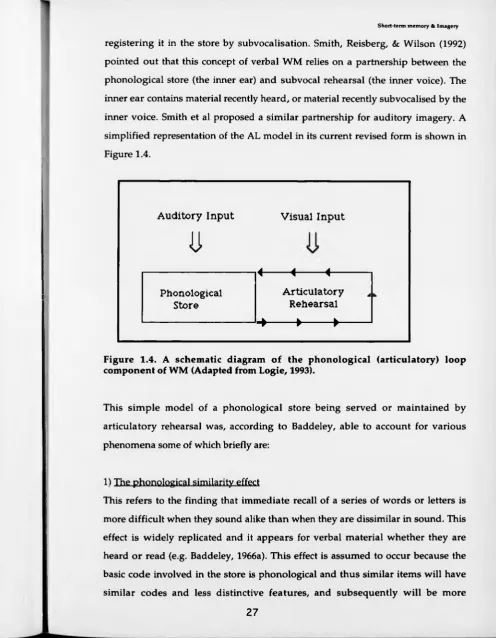
registering it in the store by subvocalisation. Smith, Reisberg, & Wilson (1992) pointed out that this concept of verbal WM relies on a partnership between the phonological store (the inner ear) and subvocal rehearsal (the inner voice). The inner ear contains material recently heard, or material recently subvocalised by the inner voice. Smith et al proposed a similar partnership for auditory imagery. A simplified representation of the AL model in its current revised form is shown in Figure 1.4.
Auditory Input
u
Visual Input
A A A
1
1
1
Phonological
Articulatory
4Store
Rehearsal
■ 4--- ► ►
---Figure 1.4. A schematic diagram of the phonological (articulatory) loop component of WM (Adapted from Logie, 1993).
This sim ple model of a phonological store being served or maintained by articulatory rehearsal was, according to Baddeley, able to account for various phenomena some of which briefly are:
1) The phonological similarity effect
Short-term memory & Imagery
susceptible to being forgotten. Similarity of meaning does not have this effect suggesting that this subsystem does not reflect semantic coding.
2) Irrelevant speech effect
Verbal serial recall is also disrupted by the concurrent presentation of irrelevant spoken material. The semantic characteristics of the material are also not important, with nonsense syllables being as disruptive as meaningful words. This effect has been referred to as the unattended speech effect (Salame & Baddeley, 1982) and is interpreted under the assumption that irrelevant speech gains obligatory access to the phonological store, corrupting the memory trace.
Salame & Baddeley found that irrelevant speech interfered with immediate recall o f visually presented verbal items, but that this was not affected further by word length. The more similar the irrelevant speech sounded to what was being remembered, the more it interfered. They argued that irrelevant speech was not articulated because this would have interacted with word length, but that it did get access to a store that is specific for the phonological characteristics of speech. Hence, they divided the AL into two components, a passive phonological store and an articulatory rehearsal process as explained above. These findings are indicated by Baddeley (1990) as having practical implications. For instance, in the studies of noise, most researchers have concentrated on sound intensity as the main variable of study whilst these findings suggest that the qualitative nature of noise may be more important in disrupting WM.
3) Word length effect
allow greater degree of trace decay of earlier words before the next rehearsal cycle. Memory span for items appear to inversely depend on their speaking rate. This phenomenon has been indicated to account for differences in digit span in different languages. Languages in which digits tend to have long vowel sounds or more than one syllable, take longer to rehearse and lead to shorter memory spans. For instance, digit spans in Welsh, Arabic and Hebrew have been shown (Ellis & Hennelley, 1980; Naveh-Benjamin & Ayres, 1986) to be lower than it is in English. This cross-language difference is indicated (Logie, 1993) as having implications for the design of mental ability tests in different languages. In addition, this word- length effect was used (e.g. Hitch & Halliday, 1983; Halliday & Hitch, 1988) to explain the tendency for digit span in children to increase with age. As children get older, the speed at which words can be rehearsed increases.
4) Articulatory suppression
Retention of a verbal sequence is impaired by requiring subjects to repeatedly articulate some irrelevant word such as "the the the". This occurs because this technique suppresses the use of the subvocal rehearsal process. This articulatory suppression prevents subjects from subvocally rehearsing the to-be remembered (TBR) material. Thus it removes the word-length effect for either auditorly or visually presented material since the word length effect relies on subvocalisation. It also blocks the articulatory rehearsal process, thus preventing subjects from registering visually presented verbal material in the phonological store leading to poorer recall and removal of the phonological similarity effect (Murray, 1968;
Baddeley et al, 1984).
Short-term memory & Imagery
remember 2 or 3 digits but otherwise have normal verbal and performance IQ, excellent LTM, and normal spans for visual patterns or sequences. They typically do not show phonological similarity effect with visual presentation, nor do they show word length effect with either visual or verbal presentation, or any influence of articulatory suppression. This was seen as reflecting a deficit in the phonological store component of the AL, and hence the AL is not used by these patients in verbal STM tasks. These patients were assumed as not attempting to feed visually presented material into the phonological store because it would simply feed information into a defective store which would do little to enhance performance. With auditory presentation, the information goes directly into this defective store.
Functions of the articulatory loop
The AL is assumed to play a functional role in learning and executing various skills. The following is a very brief description of some of these functions (Baddeley, 1990,1992a&b; Logie, 1993).
1) Learning to read:
Baddeley (1990) argued that this subsystem plays an important role in learning to read. Children with difficulties in learning to read despite having normal IQ, are
indicated to have a common feature which is an impaired verbal memory span. For these children, initial reading is handicapped by some form of phonological deficit. However, these data are considered to be equivocal as evidence for the importance of the AL in learning to read due to various reasons details of which are beyond the scope of this chapter.
2) Language comprehension:
the phonological input store plays a clear role in comprehension but only for complex or demanding material. Baddeley (1992c) indicated that this store serves as a backup system for comprehension of speech under taxing conditions, but may be less important with simple material. Saffran & Martin (1990) summed up several patterns of comprehension difficulties and their relation to STM by describing the phonological STM representation as the glue that binds together the various representations constructed when we process sentences.
3) Vocabulary acquisition:
Phonological STM has been found to be crucial in vocabulary development, both in children learning their first language and in older children learning a second
language. For instance, Gathercole & Baddeley (1990) showed that young children who had good phonological skills were much better at learning nonsense names than their counterparts who had poor phonological skills. Gathercole, Willis, Em slie & Baddeley (1992) found that nonword repetition capacity, which is assumed to depend on short-term phonological storage, was the best predictor of children's vocabulary in their first language. Finally, Baddeley, Papagno & Vallar (1988) showed that a patient (PV), with a specific phonological STM deficit, had a great difficulty in learning foreign language vocabulary relative to matched control subjects. This result was also taken as suggesting that short-term phonological storage is important for new long-term phonological learning.
4) Counting and mental arithmetic:
Short-term memory & Imagery
processing is accomplished by other parts of the WM system (i.e. the CE as explained earlier in this chapter), with only a partial but important reliance on verbal WM.
1.3.5. The Visuo-Spatial SketchPad
The second subsystem assumed by the WM model is the VSSP which is thought to be responsible for short-term representation of visual and/or spatial information, and the setting-up and manipulation of visuo-spatial images. A full account of this subsystem, which forms the theoretical basis for the to be described empirical work, will be provided in the next chapter. Evidence for the dissociation between the AL and the VSSP will be discussed, followed by a description of the literature on the development of the VSSP. Various issues and debates regarding the characteristics and the structure of the VSSP will then be considered, leading up to the issue of movement interference in visuo-spatial memory and imagery.
However, it is thus far clear that the WM model proposed two separate subsystems, one for temporary processing and manipulation of verbal material, and possibly representing a seat for auditory imagery; and the other for temporary processing and manipulation of visuo-spatial information and images. The remainder of this chapter will provide a description of two other relevant models which also assume the relative independence of the verbal and nonverbal coding systems. These two models are Paivio's dual coding model and Annett's ALI model.
1.4. Dual Coding Theory
symbolic (stands for something) and varies in abstractness (from pictures to linguistic descriptions). Paivio's proposal was that information could be stored either visually or verbally, and that these two codes together could lead to better retention than one code alone.
Paivio based his theory on the view that cognition consists of symbolic representational systems that are specialised for dealing with environmental information in a way that serves functional and adaptive behavioural goals. A view which implies that representational systems must include perceptual, affective, and behavioural knowledge. Human cognition, Paivio argues, is unique
since it has become specialised for dealing simultaneously with language and with nonverbal objects and events. The language system is also peculiar in that it has a functional duality, it deals directly with linguistic input and output in the form of speech or writing whilst at the same time serving a symbolic function regarding nonverbal objects, events, and behaviours.
The theory assumes that verbal and nonverbal information are represented and processed in independent, but interconnected, symbolic systems, and that the
Short-term memory & Imagery
N
o
N V E R B A L
S Y S T E M
Figure 1.5. A schematic diagram of the structure of verbal and nonverbal symbolic systems. (Adapted from Paivio, 1986).
The two representational systems are assumed to be structurally different in terms of the nature of representational units and the way the units are organised into higher order structures. The structural representations refer to relatively stable LTM information corresponding to perceptually identifiable objects and activities, both verbal and nonverbal. The two systems are also functionally independent in
[image:51.547.1.511.16.658.2]metaphor in dual coding is that one system triggers activity in the other, rather than the idea that information flows from one to the other.
This interconnectedness is indicated (Hall, 1980) as capturing the idea that nonverbal information can be transferred into verbal or vice versa; pictures can be named, words can evoke nonverbal images, and similar transformations can occur entirely at the cognitive level. The ability of the verbal and imagery systems to translate input into the opposite system suggests a common code exists between the two systems. Paivio indicated that it is not clear that the referential relations are symmetrical. For instance, people can name focal colours as quickly as familiar objects, but can they image as quickly to colour names as to object names? And when they image colour, do they image colours alone or concrete objects for which the named colour is a typical attribute?
Hence, according to Paivio, the two classes of representation could be engaged by various functional activities including the activation of either by appropriate stimuli (encoding), activation of one by the other (recoding), organisation and
elaboration of information within each, as well as transformation, manipulation, and retrieval of information from either class. Each system is also depicted as consisting of subsystems that correspond to different sensory modalities and are
capable of functioning independently.
Short-term memory & Imagery
model assumes that semantic information is rather entertained by the CE not the AL. In addition, Logie argues, it appears from new evidence that image generation is the prerogative of the CE whilst properties of the image are retained by the VSSP. Hence, Logie concluded that the dual coding model bears only a superficial resemblance to the WM model.
1.5. Action. Language & Imagination (ALI) Model.
The overall purpose of this research program is to examine the role of movement in motor STM and imagery. A relevant model to this issue was proposed by Annett (1982) which was designed to account for research into action and motor representation. Annett presented a theoretical framework which was aimed at integrating ideas on the relationship between declarative and procedural knowledge and the process of learning motor skills from demonstrations and verbal instructions, and also providing some insight into the nature of motor imagery.
Figure 1.6. The Action, Language & Imagination Model (Adapted from Annett, 1982)
As can be seen in the Figure, each channel comprises two elements, one representational and the other executive or productive. Annett (1990) indicated that each channel comprises a representational component, actions are represented as schemata, or generalised motor programmes, and the language representational system contains semantic and syntactic elements or 'logogens' employed in language production. Within each channel, the representational (sensory) and productive (motoric) elements are represented separately in recognition of the fact that production can be inhibited, although an intimate relationship between them can be assumed (Annett, 1991b). The representational processes are involved in
[image:54.540.2.513.14.653.2]