Does treat-to-target strategy compared to
usual care reduce long-term structural joint
List of abbreviations
ACR American College of Rheumatology Anti-CCP Anti-cyclic citrullinated peptide
BMI Body Mass Index
CI Confidence Interval
CRP C-reactive protein
DAS28 Disease activity score in 28 joints
RDAS Remission disease activity score
LDAS Low disease activity score
MDAS Moderate disease activity score
HDAS High disease activity score
DMARD Disease modifying antirheumatic drugs
bDMARD Biological disease modifying antirheumatic drugs
sDMARD Synthetic disease modifying antirheumatic drugs e.g. For example (in Latin: exempli gratia)
EQ-5D EuroQol five dimensions
ESR Erythrocyte sedimentation rate
EULAR European League Against Rheumatism HAQ Health Assessment Questionnaire
HR Hazard Ratio
HRQOL Health related quality of life
MST Medisch Spectrum Twente
MTX Methotrexate
PATGL Patient estimate of global status
RA Rheumatoid Arthritis
RAAD Rheumatoid Arthritis Articular Damage
Rf Rheumatoid factor
SD Standard deviation
SJC Swollen joint count
TJC Tender joint count
T2T Treat-to-Target
VAS Visual Analogue Scale
vs. Versus
Table of contents
Samenvatting ... I
Abstract ... III
Introduction ... 1
Methods ... 2
Study design and study population ... 2
Treatment profiles ... 2
Outcome ... 3
Statistical analysis ... 4
Results ... 5
Patient characteristics (and treatment strategy) ... 5
Treatment strategy and disease activity in first 5 years ... 6
Treatment strategy and long-term outcome ... 7
Associations for clinically relevant differences in long-term outcome between groups ... 12
References ... 17
Appendix ... 21
Appendix 1: Informed consent form ... 21
Appendix 2: Survival analysis ... 23
Appendix 3: Detailed multivariate regression output ... 26
N.L. Moekotte
1,2, C.J.M. Doggen
2, L.M.A. Braakman-Jansen
3H.J. Bernelot Moens
11Afdeling Reumatologie, Ziekenhuisgroep Twente (ZGT), Hengelo, Nederland;
2Afdeling Health Technology and Services Research, Gezondheidswetenschappen, MIRA Instituut voor Biomedische
Technologie en Technische Geneeskunde, Universiteit Twente, Enschede, Nederland;
3Afdeling Psychologie, Gezondheid en Technologie, Center for eHealth and Wellbeing Research, Enschede, Nederland;
Correspondentie adres: H.J. Bernelot Moens, Ziekenhuisgroep Twente (ZGT).
Samenvatting
Achtergrond Het doel van deze studie is om de relatie tussen baseline variabelen en behandelstrategie te evalueren
(Treat-to-Target (T2T) of reguliere zorg) met ziekteactiviteit en lange termijn uitkomsten van structurele
gewrichtsschade van reumatoïde artritis (RA). T2T bestaat uit strikte behandeldoelstellingen die gericht zijn op een
lage RA-ziekteactiviteit (DAS28 ≤2.6) met behulp van synthetische en biologische ziekte veranderende
antireumatische geneesmiddelen (DMARD). Een tweede doelstilling is om te analyseren of praktijkvariatie, in de zin
van variatie in prestaties van reumatologen, klinische relevante verschillen oplevert in remissie of op de lange termijn.
Methode Deze cohortstudie omvatte 548 patiënten met RA tussen 2006 en 2011 in een regionaal
onderwijsziekenhuis in Nederland. Baseline variabelen betreffende eigenschappen van patiënten met RA en
behandeling met DMARD’s in één van de twee groepen (T2T, reguliere zorg) werden geregistreerd tijdens
routinezorg. Ziekteactiviteit werd onderzocht aan de hand van ziekteactiviteit scores (DAS28). Lange termijn uitkomst
(Health Assessment Questionnaire (HAQ)) en structurele gewrichtsschade (Rheumatoid Arhtritis Articular Damage
(RAAD)) werd na 5 tot 10 jaar beoordeeld tijdens routine poliklinische bezoeken. Onafhankelijke t-testen, Mann
Whitney U, χ2 testen zijn gebruikt om associaties en verschillen tussen baselinevariabelen en uitkomstmaten te
vinden. Kaplan-Meier testen zijn gebruikt voor het berekenen van de cumulatieve overlevingskans tot schade. Cox
regressie modellen zijn gebruikt om de invloed van tijd en (baseline) variabelen op RAAD-score voor elke groep te
bepalen. Variabelen die significant geassocieerd zijn (p<0.05) in univariate analyses zijn gebruikt in het multivariabele model. Resultaten werden uitgedrukt in Hazard ratio (HR) met een 95% betrouwbaarheidsinterval (CI).
Resultaten Er zijn geen grote verschillen tussen de reguliere zorg (n=267) en T2T groep (n=281) bij start diagnose. Meer patiënten stierven in de reguliere zorggroep (8%), maar een gelijk percentage (7%) beëindigde follow-up als
gevolg van vroegtijdig drugsvrije remissie. De ziekteactiviteit scores (DAS28) zijn verdeeld in de categorieën: remissie (RDAS ≤2.6), laag (LDAS >2.6-3.2) en medium tot hoog (MDAS – HDAS ≥3.2). De DAS28 is beter na 5 jaar in de T2T
groep in vergelijking met de reguliere zorg (RDAS: reguliere zorg 50% vs. T2T 64.3%). De HAQ ondersteunt deze
bevindingen met een beter dagelijks functioneren (p<0.01) bij patiënten in remissie (RDAS 0.31, vs. LDAS 0.42, vs. MDAS – HDAS 0.80) uitgedrukt in ‘health related quality of life’ (HRQOL). De lange termijn uitkomst (RAAD-score) in
beide groepen, is niet significant verschillend tussen de reguliere zorg en T2T groep (RAAD=0: reguliere zorg 55% vs.
T2T 60%). Er is praktijkvariatie tussen de reumatologen bij het toewijzen van patiënten aan de reguliere zorg of T2T
de aantallen patiënten in remissie). Praktijkvariatie komt ook voor in het verschil in het aantal beoordeling van
RAAD-scores. Structurele gewrichtsschade is geassocieerd met de baseline variabelen leeftijd en erosie. Een toename van
leeftijd, en de aanwezigheid van erosie bij de start van diagnose hebben een verhoogd risico op gewrichtsschade.
Conclusie T2T-strategie is superieur aan de reguliere zorg in het bereiken van een betere ziekteactiviteit (remissie). Patiënten in remissie, hebben meer kans op een betere lange termijn uitkomst. Structurele gewrichtsschade is niet
significant meer aanwezig in de reguliere zorg of T2T groep, maar meer patiënten in de T2T-groep hebben een beter
dagelijks functioneren (HAQ). Leeftijd en de aanwezigheid van erosie op moment van diagnose zijn geassocieerd met
structurele gewrichtsschade. Reumatologen hebben een voorkeur en beïnvloeden derhalve in welke groep de patiënt
wordt behandeld, met klinische verschillen onderling van de DAS28 scores.
N.L. Moekotte
1,2, C.J.M. Doggen
2, L.M.A. Braakman-Jansen
3H.J. Bernelot Moens
11Dept. of Rheumatology, Ziekenhuisgroep Twente (ZGT), Hengelo, the Netherlands;
2Dept. of Health Technology and Services Research (HTSR), Health Sciences, MIRA, Institute of Biomedical Technology and
Technical Medicine, University of Twente, Enschede, the Netherlands;
3Dept. of Psychology, Health and Technology (PHT), Center for eHealth and Wellbeing Research, Enschede, the Netherlands;
Address of correspondence: H.J. Bernelot Moens, Ziekenhuisgroep Twente (ZGT).
Abstract
Background The aim of the study is to assess the relation between baseline variables and treatment strategy
(Treat-to-Target strategy (T2T) or usual care) with disease activity and long-term outcome of structural joint damage of rheumatoid arthritis (RA). T2T consist out of a strict treatment targets aiming for low RA disease activity (DAS28 ≤2.6)
with the use of synthetic and biological disease modifying antirheumatic drugs (DMARD). A second objective is to
analyze whether practice variation, in terms of variation in performance of rheumatologists, results in clinically relevant
differences in remission or in long-term outcome.
Methods This cohort study included 548 patients diagnosed with RA between 2006 and 2011 in a regional teaching
hospital in the Netherlands. Baseline variables concerning characteristics of patients with RA, and treatment with
DMARDs in one of the two groups (T2T, usual care) were recorded during routine care. Disease activity was
examined with disease activity scores (DAS28). Long-term outcome (Health Assessment Questionnaire (HAQ)) and
structural joint damage (Rheumatoid Arthritis Articular Damage (RAAD)) was assessed after 5 to 10 years during
routine outpatient visits. Independent t tests, Mann Whitney U, and χ2 tests are used to find associations and differences between the baseline variables and outcome measurements. Kaplan-Meier tests were used to calculate
cumulative survival probability. Cox regression models were used to determine the influence of time and (baseline)
variables on RAAD-score for each group. Variables found to be significantly associated (p<0.05) in univariate analyses were used into the multivariable model. Results were expressed as Hazard ratios (HR) with a 95%
confidence interval (CI).
Results There are no major differences between the usual care (n=267) and T2T group (n=281) at baseline. More patients died in the usual care group (8%), but an equal percentage (7%) ended follow-up because of early drug-free
remission. Disease activity scores (DAS28) are divided in the categories: remission (RDAS ≤2.6), low (LDAS >2.6-3.2) and moderate to high (MDAS – HDAS ≥>2.6-3.2). The DAS28 is better after 5 years in the T2T group compared to the
usual care group (RDAS usual care 50% vs. T2T 64.3%). The HAQ supports these findings with a better daily
functioning rate (p<0.01) in patients who are in remission (RDAS 0.31, vs. LDAS 0.42, vs. MDAS – HDAS 0.80) expressed in health related quality of life (HRQOL). The long-term outcome of the RAAD-score in both groups, is not
significant different between the groups (RAAD=0: T2T 60% vs. usual care 55%). There is practice variation between
the rheumatologists in allocating patients to the usual care or T2T group. Practice variation also occurs in the
age and erosion. An increase in age, and the presence of erosion at the onset of diagnosis, give an increasing risk of
joint damage.
Conclusions T2T strategy is superior to usual care in achieving faster remission and better disease activity. Patients
who are in remission are more likely to have better long-term outcome. Structural joint damage is not significantly
more present in the usual care or T2T group, yet more patients in the T2T group do have better functional ability
(HAQ). Age and erosion at baseline are associated with structural joint damage. Rheumatologists have a preference
and therefore influence in which group the patient is treated, with clinical differences of the DAS28 scores.
Introduction
An important gap in our knowledge concerns the effects of early interventions on long-term (>5 years) structural joint
damage in patients with rheumatoid arthritis (RA) (1,2). The prognosis of RA has improved in the last decades because of the use of synthetic disease modifying antirheumatic drugs (sDMARDs) and biologicals (bDMARDs) (3–5).
It was amply demonstrated, that early interventions are effective in reducing radiological joint damage in the first three
years in hand – and foot joints (1,6,7). Early initiation of DMARD therapy, that is used in Treat-to-Target (T2T)
strategies, aiming for low disease activity or remission of RA after 12 months, reduces radiographic progression (6,8).
During T2T quarterly appointments in the first years is advised, in which treatment is adjusted to actual disease
activity (DAS28 score). Usually, these appointments are every 2 to 3 months with the rheumatology nurse, supervised
by rheumatologists. Based on the judgment of the attending rheumatologist a patient is allocated to the T2T group or
treated with usual care group. Usual care treats patients with one or multiple DMARDs, but without pre-defined strict
treatment targets as in the T2T strategy. It uses DAS28 as a guideline but without a timeframe, as in the T2T strategy,
in which medication is immediately adjusted to the DAS28.
Until now, long-term outcome is commonly measured with questionnaires for well-being and functioning, such as
the Health Assessment Questionnaire (HAQ) and the EuroQol five dimensions (EQ-5D) questionnaire (9,10).
Limitations of this approach are that these are also influenced by fluctuations of disease activity (11,12). Furthermore,
when a destructed joint is replaced with a prosthesis, the outcome may be good, while the result from a perspective of
RA treatment is not successful. Another measure of long-term outcome is radiological damage. This is widely used in
clinical trials, but is limited to hands and feet. In 2002 the Rheumatoid Arthritis Articular Damage (RAAD) score was
developed to quantify structural joint damage in RA (13). The RAAD-score is a clinical count of damage in 35 large
and small joints (11). It accounts for orthopedic surgery, does not correlate with actual disease activity, and thus
overcomes the limitations of previously used tests.
Long-term disease outcome is determined by many variables, including patient characteristics, treatment strategy,
adherence to prescribed medication and individual variation in the response to treatment. Despite guidelines and
protocols, there is considerable practice variation between rheumatologists in the treatment of early RA (14). For
example, there are differences in guideline adherence and resource utilization (e.g. lab tests and imaging) between
rheumatologists (15,16). This raises the question whether such variations can result in relevant differences in
long-term outcome.
In this study we assess the complex relations between (i) patient characteristics and treatment strategy (T2T or
usual care) of early RA patients, and (ii) disease activity with long-term structural joint damage after 5 to 10 years. A
second objective is to analyze (iii) whether practice variation results in clinically relevant differences in remission
Methods
Study design and study population
This cohort study included all patients diagnosed with RA between 2006 and 2011 in the regional teaching hospital
Ziekenhuisgroep Twente (ZGT) in the Netherlands. In this time-frame patients could be invited to a prospective cohort
study with a T2T strategy including protocoled visits by rheumatology nurses. Whether or not patients were included,
was based on patients wish or the judgment of the attending rheumatologist. This judgment was presumably
influenced by factors such as the certainty of the diagnosis, comorbidity, and if a strict T2T protocol was suited to a
particular patients’ need. However, patients not included in the T2T cohort were treated according to their clinical diagnosis with standard treatments for RA (“usual care”).
For this study we used as inclusion criteria: clinical diagnosis of RA between January 1, 2006 and December 31,
2011 in the ZGT. Exclusion criteria were: initial treatment and follow-up in another hospital and rejection of clinical
diagnosis of RA during follow-up. End of follow-up was obtained by review of electronic patients records and defined
as: death, drug-free remission or other reasons such as continuation of care or care in another hospital.
Ethics
The medical ethics committee of the Medisch Spectrum Twente (MST), Enschede exempt this study from ethical
approval, in accordance with Dutch law of Medical Research Involving Human Subjects Act, because the T2T patients
have been informed in the past concerning their treatment data being used for research and no action or behavior is
imposed on participating patients (protocol and informed consent in appendix 1). Patients treated with usual care were
not asked to fill in an informed consent form because no particularities were applied in their treatment. Also the
advisory committee on local feasibility scientific research (ALU) of the ZGT gave approval for this study (confirmation
of METC and ALU in appendix 3).
Treatment profiles
Patients were allocated to the usual care or T2T group. No reason was indicated in the records for allocating a patient
to the usual care or T2T group. The T2T strategy is recommended by the European League Against Rheumatism
(EULAR) for management of RA with synthetic DMARDs and biologicals (17). The T2T strategy entails quarterly
appointments in the first years, in which treatment is adjusted to actual disease activity score (DAS28).In the ZGT,
these appointments are every 2 to 3 months with the rheumatology nurse, supervised by the rheumatologists. The
T2T protocol comprised a start with methotrexate 15 mg per week, with dose increments or addition of sulphasalazine
according to disease activity (DAS28). bDMARDs could be added with sustained disease activity after 6 months,
which at the time was quite early compared to usual care, and prednis(ol)on was used according to the
rheumatologists judgment.
Usual care is traditional routine care without a strict protocol. Patients in this group are treated with one or multiple
DMARDs, but without pre-defined strict treatment targets as in the T2T strategy. It uses DAS28 as a guideline but
without a timeframe, as in the T2T strategy, in which medication is immediately adjusted to the DAS28. Also the use
of biologicals is less strict which may result in a longer time to start a first bDMARD. In the usual care group
rheumatologists were of course aware of the T2T protocol, but made personal choices according to their best
Outcome
Baseline
Baseline characteristics including ACR 2010 criteria, DAS28 measurements, DMARD use and HAQ are routinely
recorded in the hospital information system. All data were exported from the electronic patient records to an
anonymized database. Baseline variables made at the time of diagnosis, between the years 2006 and 2011, were
completed by the nurses and rheumatologists in the hospital information system. These variables have been collected
until end follow-up, with end date May 1, 2017.
Clinical parameters are variables with factual data such as age and date of assessment. Laboratory
measurements include: serology (rheumatoid factor (Rf) and
anti-cyclic citrullinated peptide (anti-CCP)), acute
phase reactants (C-reactive protein (CRP) and erythrocyte sedimentation rate (ESR)). The ACR/EULAR 2010 score
exists of multiple components (3): affected joints, duration of symptoms (<6 weeks, >6 weeks), serology and acute
phase reactants. All clinical and laboratory variables are measured directly at start diagnosis, except for anti-CCP
(measured since 2006).
Primary outcome: Long-term: RAAD and HAQ
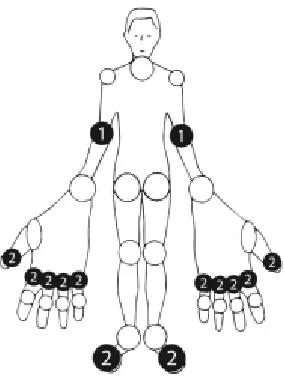
Long-term structural joint damage after 5 to 10 years is assessed with the
RAAD-score. The RAAD is a scoring method integrated in the electronic
patient record (EPR) system of the ZGT since 2014. The RAAD is a reliable
and valid tool to measure irreversible damage in 35 joints (13). In the
RAAD-score each joint is RAAD-scored on a 3-point scale (0: no irreversible damage, 1:
partly damaged, 2: severe damage). The maximum total score is 70, with
higher scores indicating more damage (13) (Figure 1).
Another long-term outcome is evaluated with the HAQ. The HAQ is proven
to be a valid and reliable instrument to assess health related quality of life
(HRQOL) (18). On a 4-point scale the questions of the HAQ are divided in 9
categories: dressing, arising, eating, walking, hygiene, reach, grip, activity,
satisfaction (19). Experienced difficulties in the past week were scored by the
patient on a scale of 0 to 3 (0: without difficulty, 1: with some difficulty, 2: with
much difficulty, 3: unable to do).
Intermediate outcome: DAS28
The intermediate outcome measured in disease activity was assessed in 28 joints by the DAS28, consisting out of
four elements: tender joint count (TJC), swollen joint count (SJC), ESR/CRP, and patient estimate of global status
(PATGL) on a VAS (20,21). The DAS28 is an intermediate outcome to evaluate whether disease activity is a predictor
for the long-term outcome. DAS28 is a validated instrument to measure underlying inflammation for use in RA clinical
trials and individual monitoring of patients (20). For this analysis the mean DAS28 score for each patient during the
first 5 years was used to allocate patients in one of three categories: remission (RDAS ≤2.6), low (LDAS >2.6-3.2), moderate to high (MDAS – HDAS ≥3.2) disease activity (10,22). DAS28 scores assessed within the first three weeks
after diagnosis are excluded because of high and distortionary DAS28 scores due to the early stage of DMARD
[image:10.612.396.538.306.497.2]treatment.
Practice variation
To assess the influence of possible practice variation on the intermediate and long-term outcome variables, separate
analyses per rheumatologist were performed. Rheumatologists who treated less than 15 patients between 2006 and
2011 were excluded from these analyses. Small numbers of patients were due to rheumatologists being no longer
active as rheumatologists, or because they were a new member of the team, that limits comparability with other
rheumatologists based on their population size.
Statistical analysis
In the baseline table descriptive statistics for categorical variables were reported as frequencies (n), percentages (%).
Quantitative variables were reported with means and standard deviations. Independent t tests and ANOVA are used to find differences between normally distributed variables (and categorical variables). For not normally distributed
variables, median and interquartile range (IQR) is reported. Mann Whitney U test was used to test for differences
between not normally distributed variables. Differences in categorical variables are tested with the χ2 tests.
Kaplan-Meier tests were used to calculate cumulative survival probability per group. Cox regression models were used to
estimate the influence of time and (baseline) patient characteristics on RAAD-score. Variables found to be significantly
associated (cut-off point: p<0.15) in univariate analyses were used into the multivariable model. Results of the multivariable model were expressed as Hazard ratios (HR) with a 95% confidence interval (CI): a p-value of less 0.05
Results
Patient characteristics (and treatment strategy)
Table 1 summarizes baseline patient characteristics and DMARD use in the first 5 years of both groups. From the 548
RA patients included, 267 (49%) patients are in the usual care group and 281 (51%) in the T2T group. Patients in the
usual care group have a mean follow-up of 7.6 years, in the T2T group 8.9 years (appendix 2, figure 6).
There are some small differences in patient characteristics between the two groups, such as the first DAS28 and
affected joints. The DAS28 is higher in the T2T group (3.4 vs. 4.9). There were more patients with one affected large joint in the usual care group, and more patients with 4 – 10 small joints in the T2T group (p<0.01). In the usual care group more patients (14.2% vs. 4.6%) received prednis(ol)one before RA diagnosis compared to the T2T group
[image:12.612.109.494.201.507.2](p<0.01). During the entire study period, the majority of patients (87.4%) were treated with MTX. More patients in the T2T group were treated with MTX compared to the usual care group (74.9% vs. 99.3%; p<0.01). Patients in the T2T group also received more bDMARDs (18% vs. 31%; p<0.01), an expected result from the T2T protocol.
Table 1 RA patient characteristics at baseline (2006 – 2011), DMARD use after first 5 years
Characteristics Usual care
(n=267)
Treat-to-Target (n=281)
P
Female, sex, n (%) 170 (63.7%) 169 (60.1%) Age, years, mean ±SD 61.1 ±15.6 59.3 ±14.4 ESR (mm/h)1, median (IQR) 29 (16 – 47) 28 (15 – 46)
CRP, mg/L2, median (IQR) 13 (5 – 42) 14 (5 – 34)
ACR 2010 score, ≥ 6 (%) 152 (56.9%) 155 (55.2%) Anti-CCP3 positive, n (%) 78 (53.1%) 75 (48.1%)
Rf-positive4, n (%) 153 (58.2%) 147 (52.9%)
Erosions5, n (%) 42 (16.5%) 53 (18.9%)
BMI6, kg/m2, mean ±SD
DAS28 (t=0)7, mean ±SD
27.2 ±4.8 3.4 (±1.7)
26.4 ±4.7 4.9 (±1.3)
<0.01 Affected joints, n (%)
1 medium-large joint 1-3 small joints
2-10 medium-large joints 4-10 small joints
>10 joints (at least 1 small joint)
0 (0%) 76 (28.5%) 22 (8.2%) 107 (40.1%) 62 (23.2%) 4 (1.4%) 36 (12.8%) 37 (13.2%) 128 (45.6%) 76 (27.0%) <0.01
Smoking status8, n (%)
Smoking
Quit smoking (before RA diagnosis) Never smoked
Quit during study
74 (30.7%) 81 (33.6%) 86 (35.7%) 10 (4.1%) 91 (34.9%) 86 (33.0%) 84 (32.2%) 19 (6.8%) DMARD9, n (%)
MTX sDMARD bDMARD Predis(ol)on
Prednis(ol)on before RA diagnosis, n (%)
200 (74.9%) 174 (65.2%) 48 (18.0%) 97 (36.3%) 38 (14.2%) 279 (99.3%) 183 (65.1%) 87 (31.0%) 81 (28.8%) 13 (4.6%) <0.01 <0.01 <0.01
ESR erythrocyte sedimentation rate, CRP C-reactive protein, anti-cyclic citrullinated peptide, ACR American College of Rheumatology, Rf rheumatoid factor, Anti-CCP Anti cyclic citrullinated peptides, BMI body mass index, DAS28 disease activity score in 28 joints, MTX methotrexate, sDMARD synthetic disease modifying antirheumatic drugs, bDMARD biological disease modifying antirheumatic drugs, Pred Prednis(ol)on.
Missing
Treatment strategy and disease activity in first 5 years
Intermediate outcome: DAS28
A total of 420 patients (usual care: 139, T2T: 281) had DAS28 recorded during the first 5 years after diagnosis; with all
128 missing’s in the in the usual care group. After excluding patients with DAS28 within the first 3 weeks, 382 patients
remained (usual care: 102, T2T: 280, missing: 166). On average the DAS28 was recorded 4 times per patient in the
usual care group, against 19 times in the T2T group between year 1 and 5. As reported in table 1, the first DAS28 is
different between the groups with a mean of 3.4 in the usual care group and 4.9 T2T group (95% confidence interval
[CI] usual care: 3.1 – 3.8, vs. T2T: 4.7 – 5.0; p<0.01).
Table 2 reports the differences in DAS28 score between the usual care and T2T group divided in categories (RDAS,
LDAS, MDAS – HDAS). Overall 57% (n=218) of the patients with DAS28 scores were in remission over the entire 5-year follow-up. In the first five 5-years, more patients in the T2T group were in remission (51% vs. 59.3%) but also more
low disease activity scores (19.6% vs. 22.8%; p<0.05). In the usual care group, more patients had higher DAS28 scores (MDAS – HDAS: 29.4% vs. 17.9%) compared to the T2T group.
Figure 2 illustrates the time (in years) to achieve remission
(DAS28 ≤2.6) for the usual care and T2T group. The T2T groups
starts from a difficult position with higher DAS28 scores higher at
the start (t=0). After year 0, the line drops steeper for the T2T
group during the period of 5 years. In the usual care group the
mean time to reach remission is 1.7 years, versus 0.9 years in
the T2T group (95% CI usual care: 1.4 – 2.0, vs. T2T: 0.7 – 1.0).
Patients in the T2T group reach earlier remission compared to
usual care (p<0.01).
As table 2 and figure 2 illustrate, the T2T group reaches
faster remission, we should however consider there are more
patients in the usual care group lost to follow-up because of
being in remission, which will be discussed in paragraph 3, figure
[image:13.612.108.489.231.295.2]3 and appendix 2, figure 7.
Table 2 DAS28 in the first 5 years per group
Usual care (n=102)
Treat-to-Target (n=280)
P
DAS28, n (%) RDAS LDAS
52 (51.0%) 20 (19.6%)
166 (59.3%) 64 (22.8%)
<0.05 MDAS – HDAS 30 (29.4%) 50 (17.9%)
DAS28 disease activity score in 28 joints: RDAS remission disease activity score, LDAS low disease activity score, MDAS moderate disease activity score, HDAS high disease activity score
Missing
[image:13.612.343.556.456.671.2]1 DAS28: 166 (165 UC, 1 T2T)
Treatment strategy and long-term outcome
The effects between the usual care and T2T group are assessed in this chapter based on the long-term outcome
variables: RAAD and HAQ. Because not all patient were assessed with RAAD or HAQ-scores, the analysis only uses
patients who contain RAAD or HAQ-scores.
Treatment strategy and long-term outcome: RAAD-score
As expected in this study of “real-life practice cohorts”, some patients were longer in the follow-up than others, and
since the RAAD-score was added as an outcome measure in 2014, it could not be assessed from all patients. The
flowchart in figure 3 illustrates how many patients are eligible for RAAD-scores in each group (usual care, T2T), and
how many actually contain RAAD-scores. In the usual care group, 144 patients quit during the follow-up period
(January 1, 2006 – May 1, 2017) because of multiple reasons (deceased, remission, other). A smaller amount of
patients (33%) quit from the study in the T2T group because of similar reasons as in the usual care group (54%).
Notably, more patients in the usual care group died compared to the T2T group (23% vs. 15%; p<0.01). There were also more patients in the usual care group (19% vs. 12%) who ended the follow-up because of early drug-free
remission (p<0.01). Overall 237 patients were lost for follow up, 103 patients died, 86 patients were in remission, 13 patients moved, and 35 patients had other reasons; 311 patients are still in follow-up at May 1, 2017.
The patients with scores (usual care group: 92, T2T: 171) are included for analysis. The number of
RAAD-scores is spread over 4 years (2014 – 2017), with a maximum of 4 RAAD-scores per patient. The most recent
assessed RAAD-score is used for this analysis: considering the last RAAD-score is the actual irreversible joint
damage.
548 patients assessed
281 (51%) T2T 267 (49%) UC
93 (33%) end follow-up 42 (15%) deceased 35 (12%) remission 16 (6%) other 144 (54%) end follow-up
61 (23%) deceased 51 (19%) remission 32 (12%) other
188 (67%) eligible for RAAD-score 123 (46%) eligible for RAAD-score
171 (91%) RAAD-scores assessed 92 (75%) RAAD-scores assessed
RAAD: Usual care versus Treat-to-Target
To assess whether patients with RAAD-scores differ at baseline between the usual care and T2T group, a second
baseline table is created (table 3). There are some differences in patient characteristics between the two groups, such
as DAS28, affected joints, MTX and prednis(ol)one use before diagnosis. Patients in the T2T group start (t=0) with a
[image:15.612.119.492.232.538.2]higher DAS28 compared to the usual care group (3.5 vs. 4.9). There were more patients with one affected large joint in the usual care group, and more patients with 4 – 10 small joints in the T2T group (p<0.01). All patients in the T2T group used MTX, versus a smaller amount of patients in the usual care group (94.6% vs. 100%; p<0.01). In the usual care group more patients (15.2% vs. 4.1%) received prednis(ol)one before RA diagnosis (p<0.01).
Table 3 Baseline (2006 – 2011) characteristics of only RA patients with a RAAD-score
Characteristics Usual care
(n=92)
Treat-to-Target (n=171)
P
Female, sex, n (%) 65 (70.7%) 100 (58.5%) Age, years, mean ±SD 55.0 ±13.6 56.3 ±13.5 ESR (mm/h)1, median (IQR) 29 (17 – 43) 26 (14 – 44)
CRP, mg/L2, median (IQR)
ACR 2010 score, ≥ 6 (%)
13 (5 – 36) 59 (64.1%)
14 (3 – 34) 99 (57.9%) Anti-CCP3 positive, n (%) 28 (54.9%) 50 (54.9%)
RF-positive4, n (%) 57 (62.6%) 95 (55.9%)
Erosions5, n (%) 18 (19.8%) 30 (17.5%)
BMI6, kg/m2, mean ±SD
DAS28 (t=0)7, mean ±SD
27.2 ±5.1 3.5 (±1.8)
26.2 ±4.0
4.9 (±1.3) <0.01 Affected joints, n (%)
1 medium-large joint 1-3 small joints
2-10 medium-large joints 4-10 small joints
>10 joints (at least 1 small joint)
0 (0%) 26 (28.3%) 7 (7.6%) 40 (43.5%) 19 (20.7%) 2 (1%) 21 (12%) 23 (14%) 83 (48%) 42 (25%) <0.01
Smoking status8, n (%)
Smoking (currently) Quit smoking (before study) Never smoked
Quit during study
26 (30.6%) 29 (34.1%) 30 (35.3%) 6 (7.1%) 52 (31.9%) 60 (36.8%) 51 (31.3%) 14 (8.5%) DMARD, n (%)
MTX s-DMARD b-DMARD Predis(ol)on
Prednis(ol)on before RA diagnosis, n (%)
87 (94.6%) 73 (79.3%) 38 (41.3%) 37 (40.2%) 14 (15.2%) 171 (100%) 120 (70.2%) 70 (40.9%) 50 (29.2%) 7 (4.1%) <0.01 <0.01
ESR erythrocyte sedimentation rate, CRP C-reactive protein, anti-cyclic citrullinated peptide, ACR
American College of Rheumatology, Anti-CCP Anti cyclic citrullinated peptides, Rf rheumatoid factor, BMI
body mass index, DAS28 disease activity score in 28 joints, MTX methotrexate, sDMARD synthetic disease modifying antirheumatic drugs, bDMARD biological disease modifying antirheumatic drugs, Pred
Prednis(ol)on.
Missing
Another comparison between the two groups with RAAD-scores is made based on outcome variables (table 4). The
DAS28 reports the mean disease activity after 5-years categorized in groups, the HAQ and RAAD are outcome
measures after 5 to 10 years. The RAAD-score is categorized in three categories (0, 1 – 4 and ≥5) to illustrate the
variety and to divide patients by severity of joint damage. It is evident that T2T results in better suppression of disease
activity (RDAS: 50% vs. 64.3%; p<0.01).
As may be expected with the low disease activity over the first 5 years, the outcome in terms of HAQ is better in
the T2T group. For the HAQ, there is a higher functional ability in the T2T group compared to the usual care group
(0.56 vs. 0.39; p<0.05). However, for the RAAD-score there are no significant differences between the two groups.
Treatment strategy and long-term outcome: HAQ-score
The HAQ-score is a long-term outcome that complements the
short-term outcome of the DAS28 with subjective data of a
questionnaire filled in by the patient. A total of 204 patients were
assessed for HAQ-scores. Patients in the usual care group
(n=69) have a mean HAQ-score of 0.55 (±0.56) compared to a lower mean HAQ-score of 0.37 (±0.45) in the T2T group (n=135) (p<0.05). The HAQ-scores improved between the first and second HAQ-score with 30% in the usual care group (0.63 vs.
0.44), and in the T2T group with 57% (0.44 vs. 0.19).
Figure 4 illustrates the time to a patient achieving a
HAQ-score below the cut-off point of 0.3 (0=no functional impairment,
3=complete impairment). The mean time patients in the T2T
group reach a low HAQ-score is 7.4 years, versus 8.4 years in
the usual care group (p<0.01). We should take into account that
patients in the T2T group also are earlier assessed for
[image:16.612.108.492.232.362.2]HAQ-scores (appendix 2, figure 7: usual care 7.3 years vs. T2T 6.7
Table 4 DAS28 mean after first 5 years, HAQ and RAAD after 5 – 10 years for patients with RAAD-scores
Characteristics Usual care
(n=92) Treat-to-Target (n=171) P DAS281 RDAS LDAS
MDAS – HDAS
34 (50.0%) 12 (17.6%) 22 (32.4%) 110 (64.3%) 42 (24.6%) 19 (11.1%) <0.01
HAQ2, mean ±SD
RAAD, n (%) 0 1-4 ≥5 0.55 (±0.56) 51 (55.4%) 29 (31.5%) 12 (13.0%) 0.37 (±0.44) 102 (59.6%) 57 (33.3%) 12 (7.0%) <0.05
DAS28 disease activity score in 28 joints: RDAS remission disease activity score, LDAS low disease activity score, MDAS moderate disease activity score, HDAS high disease activity score, HAQ Health Assessment Questionnaire, RAAD Rheumatoid Arthritis Articular Damage score.
Missing
[image:16.612.344.555.457.673.2]1 DAS28: 24 (24 UC, 0 T2T) 2 HAQ: 59 (23 UC, 36 T2T)
Interrelations between intermediate and long-term outcome variables
This extra section examines the relation between the outcome variables in previous paragraphs because we know
from previous studies there is an association between the DAS28 and HAQ, also reported in table 5. Due to this fact,
it is interesting to analyze whether the same association occurs between the DAS28 and RAAD This provides us an
in-depth analysis of the outcome variables.
From the patients with HAQ-scores (n=204), patients with lower DAS28-scores (RDAS) have better HAQ-scores compared to low-, moderate-, or high DAS28 scores (0.31 vs. 0.42 vs. 0.80) (p<0.01). The situation in DAS28-scores, where the lowest score contain better functional ability, does not apply for patients with low RAAD-scores (RAAD=0
0.38). Patients with lower RAAD-scores (RAAD<4) indicate to have better functional ability (0.38, ±SD 0.52 and 0.37, ±SD 0.38) compared to patients with higher RAAD-scores ≥5 (0.78, ±SD 0.51) (p<0.01).
Sub-analyses (n=239) examined interrelationships between disease activity (DAS28) and structural joint damage (RAAD). Apart from the strategy chosen by the rheumatologists, table 6 illustrates that disease remission in the first 5
years is associated with reduced long-term joint damage. A large proportion (65.3%) of the patients in remission have
no joint damage (RAAD=0). However, from the patients in remission, still 4.9% contains high RAAD-scores (≥5)
[image:17.612.155.438.271.395.2](p<0.01). Table 6 illustrates the same relation between DAS28 and RAAD, as the relation between DAS28 and HAQ. Table 5 Comparison of HAQ scores between short-term and long-term outcome
measurements
HAQ P
n(%) Mean, ±SD
DAS281
RDAS LDAS MDAS – HDAS RAAD2
0 1 – 4 ≥5 109 (57.4%) 46 (24.1%) 36 (18.8%) 101 (54.9%) 64 (34.8%) 19 (10.3%) 0.31 (±0.41) 0.42 (±0.41) 0.80 (±0.59) 0.38 (±0.52) 0.37 (±0.38) 0.78 (±0.51) <0.01 <0.01
HAQ Health Assessment Questionnaire, DAS28 disease activity score in 28 joints:
RDAS remission disease activity score, LDAS low disease activity score, MDAS
moderate disease activity score, HDAS high disease activity score, RAAD
Rheumatoid Arthritis Articular Damage score.
Table 6 Interrelationship RAAD and DAS28
0
RAAD
1 – 4 ≥5 Total P
DAS28 mean 1-5, n(%)
RDAS 94 (65.3%) 43 (29.9%) 7 (4.9%) 144 LDAS 29 (53.7%) 21 (38.9%) 4 (7.4%) 54 MDAS – HDAS 15 (36.6%) 16 (39.0%) 10 (24.4%) 41
Total 138 80 21 239 <0.01
[image:17.612.114.482.575.643.2]RAAD: structural joint damage versus no structural joint damage
Patients differ significantly between the usual care and T2T group on several baseline variables in table 3. When we
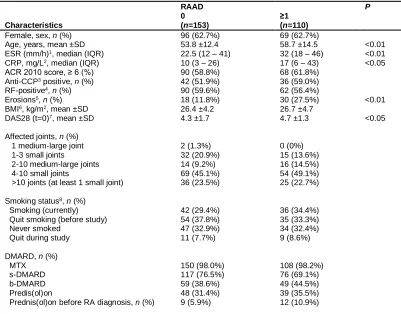
regroup these patients in groups of ‘no damage’ (n=153) and ‘damage’ (n=110), by combining category: RAAD 1 – 4 and category: RAAD ≥5, it also evaluates the differences at baseline based on the outcome variable (table 7).
The baseline variables, age, ESR, CRP, erosion and first DAS28 significantly differ between patients with no
damage and patients with damage. Patients with no structural joint damage are younger (53.8 vs. 58.7), have lower
[image:18.612.102.503.217.531.2]ESR (22.5 vs. 32) and CRP (10 vs. 17), less erosion (11.8% vs. 27.5%) and a lower DAS28 at baseline (4.3 vs. 4.7).
Table 7 Baseline (2006 – 2011) characteristics of RA patients divided by RAAD-score
Characteristics RAAD 0 (n=153) ≥1 (n=110) P
Female, sex, n (%) 96 (62.7%) 69 (62.7%)
Age, years, mean ±SD 53.8 ±12.4 58.7 ±14.5 <0.01 ESR (mm/h)1, median (IQR) 22.5 (12 – 41) 32 (18 – 46) <0.01
CRP, mg/L2, median (IQR)
ACR 2010 score, ≥ 6 (%)
10 (3 – 26) 90 (58.8%)
17 (6 – 43) 68 (61.8%)
<0.05 Anti-CCP3 positive, n (%) 42 (51.9%) 36 (59.0%)
RF-positive4, n (%) 90 (59.6%) 62 (56.4%)
Erosions5, n (%) 18 (11.8%) 30 (27.5%) <0.01
BMI6, kg/m2, mean ±SD
DAS28 (t=0)7, mean ±SD
26.4 ±4.2 4.3 ±1.7
26.7 ±4.7
4.7 ±1.3 <0.05 Affected joints, n (%)
1 medium-large joint 1-3 small joints
2-10 medium-large joints 4-10 small joints
>10 joints (at least 1 small joint)
2 (1.3%) 32 (20.9%) 14 (9.2%) 69 (45.1%) 36 (23.5%) 0 (0%) 15 (13.6%) 16 (14.5%) 54 (49.1%) 25 (22.7%) Smoking status8, n (%)
Smoking (currently) Quit smoking (before study) Never smoked
Quit during study DMARD, n (%) MTX s-DMARD b-DMARD Predis(ol)on
Prednis(ol)on before RA diagnosis, n (%)
42 (29.4%) 54 (37.8%) 47 (32.9%) 11 (7.7%) 150 (98.0%) 117 (76.5%) 59 (38.6%) 48 (31.4%) 9 (5.9%) 36 (34.4%) 35 (33.3%) 34 (32.4%) 9 (8.6%) 108 (98.2%) 76 (69.1%) 49 (44.5%) 39 (35.5%) 12 (10.9%)
ESR erythrocyte sedimentation rate, CRP C-reactive protein, anti-cyclic citrullinated peptide, ACR American College of Rheumatology, Anti-CCP Anti cyclic citrullinated peptides, Rf rheumatoid factor, BMI body mass index, DAS28 disease activity score in 28 joints, MTX methotrexate, sDMARD synthetic disease modifying antirheumatic drugs, bDMARD biological disease modifying antirheumatic drugs, Pred Prednis(ol)on.
Missing
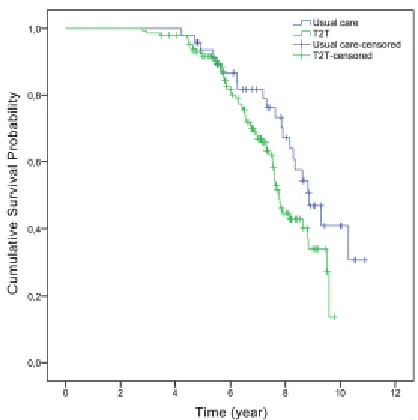
Associations for clinically relevant differences in long-term outcome between groups To examine the actual difference for the long-term outcome of
the RAAD, between the usual care and T2T group, in
combination with time to damage figure 5 illustrates the estimate
time to assessed damaged joint (RAAD≥1). Because for some
patients variables were missing, those were excluded from the
analyses in this section and therefore from the 263 patients with
RAAD-scores, 197 remain available for analysis. The estimate
mean time in reaching damaged joints between the groups is 8.5
years in the usual care group and 7.6 years in the T2T group
(95% CI usual care: 7.9 – 9.2, vs. T2T: 7.3 – 7.9). Based on the
first survival analysis, table 8 reports no significant differences
between the usual care and T2T group based on time to damage
(HR1.65, 95% CI 0.98 – 2.76). Variables that were significant
different between the groups and the outcome (RAAD=0 vs. (RAAD≥1), or variables that could be relevant as ‘influencers’,
are used to examine whether they are associated to the
long-term outcome of the RAAD-score.
In the univariate analyses the variables ‘prednis(ol)one use before diagnosis’ and ‘first DAS28’ are considered (cut-off
point: p<0.15) significant different (both significant in table 3 and 7). Variables that are not significant different, but could be relevant to include in the multivariate analyses are: age, gender, time to first assessed RAAD-score and the
mean DAS28 after 5 years. The relevance of these variables is based on a significant difference in one of the two
tables (table 3 or table 7) or because of additional analysis that show significant differences such as the first assessed
RAAD-score (appendix 2, figure 8). In appendix 3, the full detailed table with all p-values and Hazard ratios for each
variable is presented.
[image:19.612.341.550.99.309.2]Figure 5 Kaplan-Meier overall survival of RA patients in the usual care and T2T group achieving ≥1 RAAD-score
Table 8 Cox regression multivariate analysis baseline variables
Variables (n=213) Multivariate, Hazard Ratio*
P 95% C.I. for Exp (B)
Group 0.056 1.65 (0.98 – 2.76) Group, DAS28 (t=0), pred 0.242 1.38 (0.80 – 2.38) Group, DAS28 (t=0), pred, age, sex 0.308 1.34 (0.76 – 2.34) Group, DAS28 (t=0), pred, ESR, CRP, BMI 0.194 1.46 (0.82 – 2.59) Group, DAS28 (t=0), pred, time to first RAAD 0.717 1.10 (0.65 – 1.88) Group, DAS28 (t=0), pred, age, sex, time to first RAAD, DAS28 category, ESR, CRP, BMI, Erosion 0.870 1.05 (0.57 – 1.95)
DAS28 disease activity score in 28 joints, Pred Prednis(ol)on *From Cox regression models with covariates.
(1) Reference
[image:19.612.68.568.520.636.2]The first multivariate regression with only the significant variables (p<0.15: DAS28 and prednis(ol)on) reports no associations that significantly affect structural joint damage (Table 8). Multiple other multivariate analyses with other
relevant variables report other findings. The combination of commonly used variables like age and sex, shows no
associations. When we ad variables such as ESR, CRP and BMI, it seems ESR is associated to the outcome. A
combination of the DAS28, predni(sol)on and time to first assessed RAAD-score reports significant findings of
association between prednis(ol)on use before diagnosis (p<0.05) and the time to first RAAD-score (p<0.01), on the outcome. The last combination with all significant and relevant variables combined reports that age (p<0.05), erosion and time to first assessed RAAD-score (p<0.01) are significant related to the outcome and decrease the HR from 1.65 to 1.05. Meaning higher age increases the risk with 1.02, the presence of erosion with 2.89 an time until first
RAAD-score with 0.28 (shorter time from diagnosis until RAAD-assessed results in earlier detection of damage).
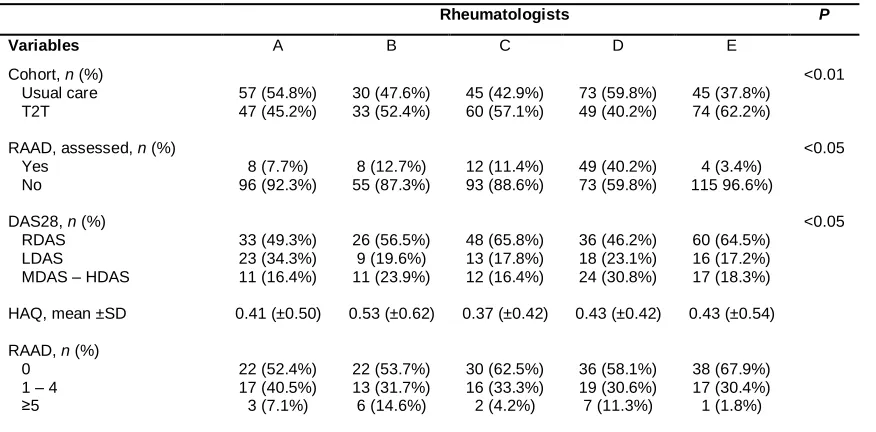
To evaluate further the differences between the rheumatologists table 9 reports the amount of patients treated per
rheumatologist and the amount of patients assessed with RAAD-scores. The second objective of this study was to
determine whether practice variation results in clinically relevant differences in short-term and long-term outcome.
Because not all rheumatologists are included (due to certain conditions described in the method section) for these
analyses 7 rheumatologists and 35 patients excluded, which means 5 rheumatologists with 513 patients were
included. Table 9 shows the differences between the rheumatologists and in which group the patient is treated
(p<0.01). The number of RAAD-scores assessed is reported as the number of patients for which the rheumatologists personally assessed the RAAD-score. Rheumatologists differ in their assessment of the RAAD-score, however we
should also consider some cases the RAAD-score is assessed, but by a different rheumatologists. Which makes it
look like some rheumatologists barely assess scores by their patients, but their patients do contain
RAAD-scores. The amount of patients in remission, with low, moderate or high disease activity, significantly differs between
[image:20.612.74.512.263.479.2]the rheumatologists (p<0.05). There are no significant differences based on the HAQ or RAAD-scores. Table 9 Distribution of outcomes relative to rheumatologists
Rheumatologists P
Variables A B C D E
Cohort, n (%) Usual care T2T 57 (54.8%) 47 (45.2%) 30 (47.6%) 33 (52.4%) 45 (42.9%) 60 (57.1%) 73 (59.8%) 49 (40.2%) 45 (37.8%) 74 (62.2%) <0.01
RAAD, assessed, n (%) Yes No 8 (7.7%) 96 (92.3%) 8 (12.7%) 55 (87.3%) 12 (11.4%) 93 (88.6%) 49 (40.2%) 73 (59.8%) 4 (3.4%) 115 96.6%) <0.05
DAS28, n (%) RDAS LDAS
MDAS – HDAS
33 (49.3%) 23 (34.3%) 11 (16.4%) 26 (56.5%) 9 (19.6%) 11 (23.9%) 48 (65.8%) 13 (17.8%) 12 (16.4%) 36 (46.2%) 18 (23.1%) 24 (30.8%) 60 (64.5%) 16 (17.2%) 17 (18.3%) <0.05
HAQ, mean ±SD 0.41 (±0.50) 0.53 (±0.62) 0.37 (±0.42) 0.43 (±0.42) 0.43 (±0.54) RAAD, n (%)
0 1 – 4 ≥5 22 (52.4%) 17 (40.5%) 3 (7.1%) 22 (53.7%) 13 (31.7%) 6 (14.6%) 30 (62.5%) 16 (33.3%) 2 (4.2%) 36 (58.1%) 19 (30.6%) 7 (11.3%) 38 (67.9%) 17 (30.4%) 1 (1.8%)
RAAD Rheumatoid Arthritis Articular Damage score, RAAD Rheumatoid Arthritis Articular Damage score, moderate to high disease activity, HAQ Health Assessment Questionnaire, DAS28 disease activity score in 28 joints: RDAS remission disease activity score, LDAS low disease activity score, MDAS moderate disease activity score, HDAS high disease .activity score
Discussion
This study provides further support for the use of T2T strategies in the treatment of early RA. The results of this study
suggest that patient characteristics do not relate to the group (usual care or T2T) or treatment patients are assigned
to. However, treatment strategy does influence the intermediate and long-term outcome after 5 to 10 years for RA.
Compared to the usual care group patients in the T2T strategy (with RAAD-scores) achieve faster and more DAS28
remission during the entire first 5 years of treatment (50% vs. 64.3%), resulting in a better functional outcome (0.55
vs. 0.37), but not in significant differences of damaged joints (55.4% vs. 59.6%) after a follow-up of 5 – 10 years.
Compared to table 1 (n=548), the baseline characteristics of patients with a RAAD-score (n=263) in table 3 are
similar, but also contain small differences. The first DAS28 are for both groups equal. In the usual care group, more
patients died (23% vs. 15%), but also stopped the follow-up period because of remission (19% vs. 12%). Patients with
RAAD-scores received more MTX, as well in the usual care (74.9% vs. 94.6%) as in the T2T group (99.3% vs. 100%)
(p<0.01). Also the use of prednis(ol)on before RA diagnosis is slightly higher for the groups that contain RAAD-scores in table 3 (14.2% vs. 15.2%, and 4.6% vs. 4.1%). There is no difference in the use of biologicals in patients with
RAAD-scores, compared to table 1 that does reports significant differences of biologicals (18% vs. 31%).
Besides more patients being in remission (51% vs. 59.3%), patients in the T2T group also achieve 8 months
earlier remission (mean time 1.7 vs. 0. 9 years) compared to usual care. These results are also in line with findings of
earlier studies that assess the relation between disease activity and T2T strategy (23–25). The mean HAQ is lower in
the T2T group (0.55 vs. 0.37), which relates to the finding that patients treated with T2T usually have a HAQ score
below 0.50 (11). The HAQ-scores improved between the first and second HAQ-score with 30% in the usual care
group (0.63 vs. 0.44), and in the T2T group with 57% (0.44 vs. 0.19). Confirmed by sub analyzes, the HAQ is
associated with DAS28 scores, in which patients with RDAS have better HAQ outcomes compared to patients with MDAS – HDAS with higher functional limitations. These relations are also find in other studies with strong associations (10–12,26,27).
There are no other studies that evaluate the RAAD-score in combination with T2T strategy. However the aim of the
T2T strategy is to prevent long-term structural joint damage, which is evaluated in multiple studies by its influence on
the long-term outcome in terms of HAQ and radiographic progression (28). Evaluating those results illustrates that
tight control of the T2T results in low radiologic progression, especially in small joints but less in larger joints (29).
Examining the long-term structural joint damage (RAAD) in this study, reports no large differences between the two
groups. In the T2T group, a small portion of 4.2% patients contained less joint damage, (55% vs. 60%), however not
significantly different compared to the usual care group. The findings of the sub analysis in table 6 underline the significant association between disease activity in the first years after onset if RA and outcome after 5 – 10 years: low
disease activity corresponds to less joint damage. This confirms the relevance of the T2T aim of a DAS28 below 2.6,
could therefore support the use of the novel RAAD-score as a tool, however does not reflect in the outcome of the
groups with the RAAD-score. There are no significant differences between the usual care and T2T group of time until
joint damage (HR1.65, 95% CI 0.98 – 2.76). Variables significant associated to the groups (usual care and T2T) and to the outcome of structural joint damage (RAAD=0, RAAD ≥1), or variables relevant for the multivariate decrease the
HR from 1.65 to 1.05. The variables age, erosion at baseline and time until first assessed RAAD-score are
The second objective of this study was to determine whether practice variation results in clinically relevant differences
in intermediate and long-term outcome. Based on the results there are clinical differences between the
rheumatologists based on the intermediate outcome of disease activity (DAS28) (p<0.05). Some rheumatologists do have more patients with lower disease activity compared to others. There is no unambiguous statement for this
finding, but an explanation could be find in the findings of studies that examined guideline adherence. Guideline
adherence relates to determinants of patient characteristics (DAS28) and rheumatologists characteristics (scientific
education status) that influence why rheumatologists act in every patient’s case. For example in cases of patients with
DAS28>3.2, 67% of rheumatologists change the patients medication, others do not, which ultimately reflects in the
DAS28 for their patients (15).
Besides the clinical differences there are also differences between the amount of patients treated in the T2T
or usual care group (p<0.01). Reasons for this deviation could be related to guideline adherence, which is linked to ‘lack of agreement’, where some rheumatologist simply do not agree with the concept of a guideline, which reflects in
the amount of patients treated in one of the two groups (16,30). Also patient-related barriers, such as patient
preferences or patient background (comorbidity) resulting in rejecting of the treatment, could influence the group the
patient in treated in (30). But we could also consider other determinants such as economic constraints or knowledge
regarding the outcome of strategies, (16,31)
Because we have established that rheumatologist differ in allocating patients to one of the groups, there could be
confounding by indication between the two groups. The reason for this distribution is unknown, but suggest some background influences from the patients (age, comorbidity) or rheumatologists (education) (32–34). Also the
differences between the groups of patients lost to follow-up due to death suggest there is more going on. Another
limitation related to the rheumatologists comes from including only rheumatologists for analysis who are comparable
to each other. The reason for this comes from making the equitation ‘fair’ based on equal patients treated, however
this excludes other cases with possible other results. The DAS28 scores are divided in categories by the mean
DAS28 between the first 5 years. Which does not mean patients were consistently that DAS28 category over the entire study, the fluctuations of DAS28 over time are ignored, by presenting only the average DAS28 ‘dose’(10). For
the RAAD analyses choices have been made to include hip joints. By this choice, the final RAAD-scores are for 11
patients higher and would have been distorted differently when the hip joint would have been excluded. Reasons for
excluding the hip would have been because they may be related to osteoarthritis rather than RA. Missing values of
baseline variables and comorbidity for the usual care group may lead to over- or underestimation of the treatment
strategies outcomes (35). Also the limited number of HDAS patients makes it impossible to analyze how these
patients are in relation to the long-term outcome measurements.
A major strength of this non-randomized controlled study are the results from daily clinical practice. It tells us what
actually happens over a longer period of time, and what that entails for short- and long-term outcomes. Also,
compared to other studies, this study with a good sample size of patients (n=548) gives a good representation of the
intervention effects (2). At last, the evaluation for RAAD and HAQ scores after 5 to 10 years in relation to treatment
strategies, contributes to our knowledge of the long-term outcomes for RA patients.
It is recommended for future research to analyze the complex relation between structural joint damage and the
presence of other background determinants (e.g. comorbidity, rheumatologists education) that could influence the
outcome of structural joint damage within a randomized controlled setting of the T2T strategy, with a higher
Conclusion
T2T strategy is superior to usual care in achieving faster remission and better disease activity. Patients who are in
remission are more likely to have better long-term outcome. Structural joint damage is not significantly more present in
the usual care or T2T group, yet more patients in the T2T group do have better functional ability. Structural joint
damage is associated with baseline variables age and erosion. Rheumatologists have a preference and therefore
influence in which group the patient is treated, with clinical differences of the DAS28 scores.
Competing interest None declared.
Ethics approval
The medical ethics committees of the Medisch Spectrum Twente, Enschede exempt this study from ethical approval,
in accordance with Dutch law of Medical Research Involving Human Subjects Act, because the T2T patients have
been informed in the past concerning their treatment data being used for research and no action or behavior is
References
1. Immediato Daien C, Hua C, Combe B, Landewé R. Non-pharmacological and pharmacological interventions in
patietns with early arthritis: a systematic literature review informing the 2016 update of EULAR
recommendations for the management of early arthritis. RMD Open [Internet]. 2016;3:1–10. Available from:
http://dx.doi.org/10.1136/rmdopen-2016-0000406
2. Steunebrink LMM, Versteeg GA, Vonkeman HE, ten Klooster PM, Kuper HH, Zijlstra TR, et al. Initial combination
therapy versus step-up therapy in treatment to the target of remission in daily clinical practice in early
rheumatoid arthritis patients: results from the DREAM registry. Arthritis Res Ther [Internet]. 2016 [cited 2017
Mar 1];18(1):60. Available from:
http://www.pubmedcentral.nih.gov/articlerender.fcgi?artid=4784382&tool=pmcentrez&rendertype=abstract
3. Aletaha D, Neogi T, Silman AJ, Funovits J, Felson DT, Bingham CO, et al. 2010 Rheumatoid arthritis classification
criteria: An American College of Rheumatology/European League Against Rheumatism collaborative initiative.
Arthritis Rheum. 2010;62(9):2569–81.
4. Ruyssen-Witrand A, Guernec G, Nigon D, Tobon G, Jamard B, Rat A-C, et al. Aiming for SDAI remission versus
low disease activity at 1 year after inclusion in ESPOIR cohort is associated with better 3-year structural
outcomes. Ann Rheum Dis [Internet]. 2014 Sep [cited 2017 Feb 13];74(9):1676–83. Available from:
http://ard.bmj.com/lookup/doi/10.1136/annrheumdis-2013-204906
5. Steunebrink LMM, Vonkeman HE, ten Klooster PM, Hoekstra M, van Riel PLCM, van de Laar MAFJ. Recently
diagnosed rheumatoid arthritis patients benefit from a treat-to-target strategy: results from the DREAM
registry. Clin Rheumatol [Internet]. 2016 Mar [cited 2017 Feb 13];35(3):609–15. Available from:
http://www.ncbi.nlm.nih.gov/pubmed/26852313
6. Lukas C, Combe B, Ravaud P, Sibilia J, Landewé R, Van Der Heijde D. Favorable effect of very early
disease-modifying antirheumatic drug treatment on radiographic progression in early inflammatory arthritis: Data from
the ôtude et Suivi des polyarthrites indifférenciées récentes (study and followup of early undifferentiate.
Arthritis Rheum. 2011;63(7):1804–11.
7. Finckh A, Bansback N, Marra CA, Anis AH, Michaud K, Lubin S, et al. Treatment of Very Early Rheumatoid
Arthritis With Symptomatic Therapy, Disease-Modifying Antirheumatic Drugs, or Biologic Agents. Ann Intern
Med [Internet]. 2009 Nov 3 [cited 2017 Mar 1];151(9):612–21. Available from:
http://www.ncbi.nlm.nih.gov/pubmed/19884622
8. Bijlsma JWJ, Welsing PMJ, Woodworth TG, Middelink LM, Pethö-Schramm A, Bernasconi C, et al. Early
rheumatoid arthritis treated with tocilizumab, methotrexate, or their combination (U-Act-Early): a multicentre,
randomised, double-blind, double-dummy, strategy trial. Lancet (London, England). 2016;388(10042):343–55.
9. Van Gestel AM, Haagsma CJ, Van Riel PLCM. Validation of rheumatoid arthritis improvement criteria that include
simplified joint counts. Arthritis Rheum [Internet]. 1998 [cited 2017 Feb 21];41(10):1845–50. Available from:
http://onlinelibrary.wiley.com/doi/10.1002/1529-0131(199810)41:10%3C1845::AID-ART17%3E3.0.CO;2-K/abstract
10. Nikiphorou E, Norton S, Young A, Carpenter L, Dixey J, Walsh DA, et al. Association between rheumatoid arthritis
disease activity, progression of functional limitation and long-term risk of orthopaedic surgery: combined
analysis of two prospective cohorts supports EULAR treat to target DAS thresholds. Ann Rheum Dis
[Internet]. 2016;75:2080–6. Available from:
http://www.ncbi.nlm.nih.gov/pubmed/26979104%5Cnhttp://ard.bmj.com/lookup/doi/10.1136/annrheumdis-2015-208669
11. Soubrier M, Lukas C, Sibilia J, Fautrel B, Roux F, Gossec L, et al. Disease activity score-driven therapy versus
routine care in patients with recent-onset active rheumatoid arthritis: data from the GUEPARD trial and
ESPOIR cohort. Ann Rheum Dis [Internet]. 2011 Apr [cited 2017 Jun 27];70(4):611–5. Available from:
http://www.ncbi.nlm.nih.gov/pubmed/21242235
12. Goekoop-Ruiterman YPM, de Vries-Bouwstra JK, Kerstens PJSM, Nielen MMJ, Vos K, van Schaardenburg D, et
al. DAS-driven therapy versus routine care in patients with recent-onset active rheumatoid arthritis. Ann
Rheum Dis [Internet]. 2010 Jan 1 [cited 2017 Jun 27];69(1):65–9. Available from:
http://www.ncbi.nlm.nih.gov/pubmed/19155234
13. Zijlstra TR, Moens HJB. The rheumatoid arthritis articular damage score: first steps in developing a clinical index
of long term damage in RA. Ann Rheum Dis. 2002;61:20–3.
14. Hoekstra M, van de Laar MAFJ, Moens HJB, Kruijsen MWM, Haagsma CJ. Longterm Observational Study of
Methotrexate Use in a Dutch Cohort of 1022 Patients with Rheumatoid Arthritis. J Rheumatol.
2003;30(11):2325–9.
15. Lesuis N, den Broeder AA, Hulscher MEJL, van Vollenhoven RF. Practice what you preach? An exploratory
multilevel study on rheumatoid arthritis guideline adherence by rheumatologists. RMD Open [Internet].
2016;2(1):1–9. Available from: http://rmdopen.bmj.com/lookup/doi/10.1136/rmdopen-2015-000195 16. Gorter S, van der Linden S, Brauer J, van der Heijde D, Houben H, Rethans JJ, et al. Rhemulatologists’
performance in dailiy practice. Arthritis Rheum [Internet]. 2001 [cited 2017 May 24];45(1):16–27. Available
from:
http://onlinelibrary.wiley.com/store/10.1002/1529-0131(200102)45:1%3C16::AID-ANR79%3E3.0.CO;2-W/asset/79_ftp.pdf?v=1&t=j338j1rb&s=a93410eeae9d15f8980ebea4aaf27d48181698e6
17. Smolen JS, Landewé R, Breedveld FC, Buch M, Burmester G, Dougados M. EULAR recommendations for the
management of rheumatoid arthritis with synthetic and biological disease-modifying antirheumatic drugs: 2013
update. Ann Rheum Dis [Internet]. 2014 [cited 2017 May 25];73:492–509. Available from:
http://dx.doi.org/10.1136/
18. Linde L, Sørensen J, Østergaard M, Hørslev-Petersen K, Lund Hetland M, Linde L, et al. Health-Related Quality of
Life: Validity, Reliability, and Responsiveness of SF-36, EQ-15D, EQ-5D, RAQoL, and HAQ in Patients with
Rheumatoid Arthritis. J Rheumatol [Internet]. 2008 [cited 2017 Feb 21];35(15):1528–37. Available from:
http://www.jrheum.org/content/35/8/1528.long
19. Fries JF, Spitz P, Kraines RG, Holman HR. Measurement of parient outcome in arthritis. Arthritis Rheum [Internet].
1980 [cited 2017 May 25];23(2):137–45. Available from:
http://onlinelibrary.wiley.com/store/10.1002/art.1780230202/asset/1780230202_ftp.pdf?v=1&t=j33k03pz&s=51
f8ad927309f1392a1ce161bb87c3eadb7a97c6
20. Fransen J, van Riel PLCM. The Disease Activity Score and the EULAR response criteria. Clin Exp Rheumatol
[Internet]. 2005 [cited 2017 May 13];23(Supp. 39):S93–9. Available from:
http://www.clinexprheumatol.org/article.asp?a=2693..
21. Castrejón I, Pincus T. Assessing Remission in Rheumatoid Arthritis on the Basis of Patient Reported Outcomes.
Bull Hosp Joint Dis [Internet]. 2014;72(2):136–41. Available from:
https://www.ncbi.nlm.nih.gov/pubmed/25150340
22. Mäkinen H, Hannonen P, Sokka T. Definitions of remission for rheumatoid arthritis and review of selected clinical