Virtual Interrogation:
The influence of Virtual Entity Perception on Lie Detection
Jaron Plochg
Master thesis
Faculty of Behavioral sciences Psychology of Conflict Risk and Safety
University of Twente Dr. E.G. Ufkes
Dr. M. Stel
Abstract
In this study we examine how individuals perceive a virtual interrogator and how this influences the process of truth finding. Previous work demonstrated that deception is accompanied by cognitive load. In our experiment we discriminate liars from truth tellers using measures of skin conductance, an indicator of cognitive load. Participants (N = 72) were randomly devided in a 2 x 2 (veracity x interrogator input) between-subjects factorial design. We find that skin conductance is significant higher for the lie condition compared with the truth condition. More importantly we find that the lie condition and truth condion are discriminated best when individuals think that the virtual interrogator is human-controlled compared with individuals who think the virtual interrogator is computer-controlled. These results provide evidence that agency beliefs (computer- vs human-controlled) influence lie detection during virtual interrogation. We conclude that suspects should be informed that a virtual interrogator is human-controlled to conduct robust lie detection.
Contemporary methods in accurate lie detection are shortcoming. Research shows us that human deception detection performs slightly above chance level with an average accuracy level of 54 percent (Bond & DePaulo, 2006). Deception detection is a challenging field of interest because valid cues to deception are scarce and weak (Davies & Beech, 2012). In light of recent terror attacks in Brussels and Paris, societies could benefit of new methods and techniques for robust lie detection.
Since 1983 intelligence services use computers in search for lie detection. In 2014 a C.I.A. rapport was released, covering the program ANALIZA, in which a computer called A.I. was interviewing an alleged C.I.A. agent. This is the first known step to computer interrogation. Still the rapport (Interrogation, 1983) stated that using artificial intelligence for investigative interviewing has a long way to go since it cannot reach the capabilities of human interrogators. The digital revolution in the 80s makes it possible to start new studies based on the original idea underlying ANALIZA. Unfortunatly, conceivable follow up studies about virtual interrogation by intelligence agencies are still declared top secret.
One important aspect may be how suspects perceive a virtual interrogator interviewing them. The perception of a virtual interrogator might be associated with the validity of
Virtual interrogation has several advantages regarding face-to-face interrogation in lie detection. A first advantage of computer mediated interrogation is that nonverbal
communication is not directly visible for the suspect. Interviewees receive no cues about their attempt to manipulate the interviewer. Without this nonverbal feedback they lack important cues to assess whether their attempt to deceive is successful. Monitoring the receiver of a message when stating a lie is an essential part in the Interpersonal Deception Theory (Buller & Burgoon, 1996). Since 60% of communication is nonverbal (Philpott 1983; Buller & Burgoon, 1996) it becomes harder for a deceiver to check if he or she is seen as truthful. Therefore we reason that manipulating the interrogator becomes more difficult for the liar when interviewed by a virtual interrogator.
A second advantage of virtual interrogation is that the interrogator has no need to be in the same location as the suspect. This makes fast employability of virtual interrogation possible. When the computer is fully automatic controlled with artificial intelligence, there is no need for a professional interrogator. This makes it possible to use virtual interrogation in settings where standard safety issues are at stake. For instance at border control a standard script can be used to ask travelers about their travel intentions. In short, liars can be detected faster and with less human capital if virtual interrogators are applied.
The cognitive load approach
In practice the polygraph is one of the most used methodsin deception detection (Davies & Beech, 2012). It is used for criminal investigation across the world in several countries like the United States, Canada, Japan, Belgium, Israel and Turkey (Davies & Beech, 2012). In the polygraph test at least three different physiological systems like skin
conductance, heart rate and blood pressure are measured. All three physiological systems are part of the sympathetic nervous system. Skin conductance, also known as electrodermal activity (EDA), is one of the most used measures of the polygraph to indicate deceit (Vrij, 2008). The practice of EDA as indicator of deceit can be explained with the cognitive load approach.
A discriminating factor is required to distinguish liars from truth tellers. According the cognitive load approach lying costs more mental effort than telling the truth (Vrij et al., 2008). This assumption is based on the idea that lying is more difficult than telling the truth.
Consistent with this assumption a false statement must be consistent with facts known by the interrogator, simple enough to remember, but detailed and logic to make it appear as self-experienced (Burgoon, Buller, & Guerrero, 1995). Field research of high-stakes police
interviews with real-life suspects indicated that lies were related to increased pauses in speech and other factors related to cognitive load (Mann, Vrij, & Bull, 2002). Another reason why lying is associated with cognitive load is that liars will track their behavior to appear honest and check if the misled individual takes a stated lie for the truth (DePaulo, Kirkendol, Tang, & O’Brien, 1988; Buller & Burgoon, 1996). In experimental studies participants reported that lying is more cognitively demanding (Vrij, 2008). A meta-analysis shows us that cognitive load is related to deception (Christ, Van Essen, Watson, Brubaker, & McDermott, 2009). This is supported by fMRI research that demonstrated lying to be associated with activating
Cognitive load activates the sympathetic nervous system (Engström, Johansson, & Östlund, 2005; Nourbakhsh, Wang, Chen, & Calvo, 2012). An activated sympathetic nervous system results in more sweating. Sweat is an electrolyte solution, and therefore skin
conductivity increases. Sweating can be measured with EDA sensors attached to the skin. EDA can be used as indicator for cognitive load, stress and arousal (Shackman et al., 2011). Previous research found increased EDA for lying compared with truth telling (Nakayama, 2002; Ströfer, Noordzij, Ufkes, & Giebels, 2015). EDA is an autonomic-based physiological response what makes it hard to control and therefore less susceptible to strategic
manipulations (Gronau, Ben-Shakhar, & Cohen, 2005) and therefore a good indicator of deceit. EDA is the most used physiological measure in the polygraph test to indicate deceit (Vrij, 2000). In our study EDA is used as indicator for cognitive load, which is related to deception. Deception might be detected by conducting an interrogation with EDA measures.
Interrogation
In this study interrogation refers to investigative interviewing. Investigative interviewing focuses on both giving and receiving of information instead of mainly
confession-seeking by the interrogator (Davies & Beech, 2012). Different strategies from the interrogator can influence interview effectiveness. Influencing behavior can affect the quality of the relationship of the interrogator with the suspect and the number of admissions made
(Beune, Giebels, & Sanders, 2009). Effective interviewing is most likely to occur when rapport is established and maintained (Walsh & Bull, 2012). Therefore we reason that the social interaction between interrogator and suspect plays a major role in effective
Humans tend to act social towards computers (Reeves & Nass, 1996; Nass & Moon, 2000). In order to behave social towards computers humans must assume the computer has human, virtual or artificial intellect. In computer science the access to another intellect or intelligence is defined as social presence. According to Biocca (1997) social presence is activated when an entity shows some minimal intelligence in its reactions to the user and environment. The assumption of an intellect makes it possible to experience social interaction with a computer. For that reason the same influencing behavior during human-mediated interaction might influence the effectiveness of computer interrogation. We assume that computers should act or be mediated according the rules of social interaction in order to realize effective computer interrogation. A major factor of influence might be how we perceive the entity of the interrogator, in this paper referred to as agency beliefs.
Agency beliefs
According to Daniel Dennett (1996) individuals have adopted an evolutionary strategy to interact with unknown agencies. From this perspective individuals treat all entities as rational agents. Individuals instantly create a mental model of an unknown intellect (Nowak & Biocca, 2003). According to this perspective we reason that individuals make inferences about the capabilities, goals or intentions of the virtual interrogator. With those inferences individuals can apply tactics to influence their chances of success by appearing truthful.
The individual’s concept about the entity of the virtual interrogator, also known as agency, might vary from computer-controlled to human-controlled. The computer-controlled concept would indicate artificial intelligence, where the human-controlled concept would indicate a human driven avatar as stated in the introduction.
2014). Agency beliefs can be steered with a simple message from the experiment leader. Individuals who are convinced that a computer is human-controlled experience more physiological arousal compared with individuals who are convinced that a computer is artificial controlled in exactly the same virtual environment (Lim & Reeves, 2010). Agency beliefs are also influenced by the level of adaptive responses of the interacting computer (Schuetzler et al., 2014). Agency beliefs influence the psychological and physiological system of individuals and are therefore important aspects of human-computer interaction.
The present study
In the present study we test if we can discriminate liars from truth tellers and if agency beliefs influence this process. Earlier studies demonstrated increased skin conductance for lie conditions compared to truth conditions using an actor as interrogator (Ströfer et al., 2015). In the current study we use a virtual human instead of an actor as interrogator. According the cognitive load approach we predict that skin conductance will increase more for liars than for truth tellers. First we expect EDA to be higher for the lie condition compared with the truth condition (Hypothesis 1).
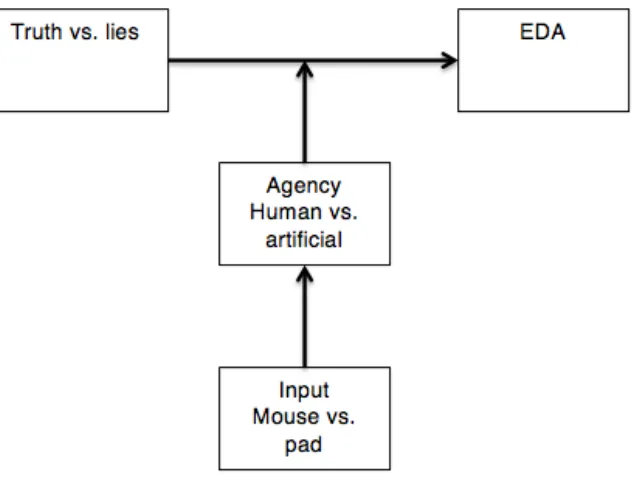
Response patterns in computer interaction are influenced by minor changes in the environment. Dynamic and static human-computer interaction leads to changes in perceptions and behavior of individuals during human-computer interaction (Schuetzler et al., 2014). As stated before in a constant environment contradicting agency beliefs can be formed with only a message from the experiment leader (Lim & Reeves, 2010). Therefore we think that minor environmental cues can influence the agency beliefs that individuals project on a virtual interrogator. In the current study we conduct the interview with two different input
controlled with a pad. The pad makes no sound, giving no cues about human agency. We think that input tools may influence the agency beliefs of suspects. Therefore we expect that participants in the mouse condition score higher on human agency beliefs compared with participants in the pad condition (Hypothesis 2).
When interacting with a human-controlled entity we can refer to computer mediated interactions in normal life and make sure if our conversational partner receives our message they way we intent to deliver it. When interacting with an artificial agent there is no control mechanism to make sure our conversational partner understands and believes our message. Therefore interacting with an artificial agent might cost more cognitive load resulting in higher EDA measures independent from truth or lie conditions. We expect an interaction effect for agency beliefs with the relationship of veracity with EDA. We expect that human agency beliefs will have a stronger discriminating effect on the relationship of deception with EDA compared with participants with computer agency beliefs (Hypothesis 3).
Environmental cues can influence perception and behavior during human-computer interaction (Schuetzler et al., 2014.) Therefore we reason that minor environmental cues from the input system can influence agency perceptions and behavior during human-computer interaction. We predict an interaction effect for input tools with the relation of deception with EDA. We expect that mouse input will have a stronger discriminating effect on the
Figure 1. Hypothetical influence of input and agency on the relationship of veracity with EDA.
In this study we test if we can discriminate liars from truth tellers and if agency beliefs influence this process. According to the cognitive load approach we expect that liars
experience more cognitive load than truth tellers. As in polygraph test we discriminate liars from truth tellers with measures of EDA, and indicator of cognitive load.
Method Participants
Experimental design
The experiment was conducted in a 2 x 2 between-subjects factorial design. The independent variable consisted of veracity (truth and lie condition1) and input (mouse and pad condition). Subjects were randomly assigned to one of the four between-subject conditions. To operationalize the independent variable participants received an advice how to respond to the questions of the virtual human. In the lie condition participants were advised to lie to all questions. Participants who did not follow these instructions were excluded from the analysis as stated in the previous section. In the truth condition participants were advised to tell the truth to all questions. We used a standard script for the virtual human consisting of ten questions. The virtual human was able to answer to questions of participants using scripted answers applicable for all questions.
Procedure
First, participants were informed about the survey and asked to read and sign an informed consent. Second, they completed a questionnaire to measure demographics. Third, participants completed an in-basket task. Participants were informed the in-basket task was part of an assessment test to conceal the main goal of our study. One task consisted as operationalization of the transgression. The assistant of the experimenter checked the signature when participants finished the assessment task that was used as mock-crime
leverage for the interview. Next, participants were attached to EDA sensors and were told this was to measure their effort during the assessment. Next the experimenter and assistant left the room. EDA baseline measures were conducted. After 5 minutes the experimenter entered the room and accused the participant of unauthorized behavior. The experimenter advised the
participant how to behave best during the following interview with the virtual interrogator. The advice consisted of a truth or lie condition. Next we interrogated the participant with the virtual interrogator. At last the participants were asked to fill in a second questionnaire.
In-basket task
An in-basket task is a tool often used for assessment tests to indicate future
performance (Cascio & Aguinis, 2011). The in-basket test consisted of four tasks. The task stated to sympathize with the role of manager as substitute for a sick colleague. One task consisted of a contract that had to be signed and served as a transgression. Participants had no legal right to sign the document themselves because the name of the sick colleague was stated under the contract. When signed it was used as leverage of a mock crime.
EDA measurement and analysis
EDA measures consist of tonic EDA. Tonic EDA changes are measured for relatively long lasting changes of EDA. Phasic EDA is sensitive for short-term changes of EDA. We are interested in the general level of arousal during deception. Therefore we measured tonic EDA changes to discriminate liars from truth tellers.
performed on log-transformed data, but the reported descriptive statistics were based on the raw data (in μS).
Agency beliefs
We developed a 5-item construct to measure virtual interrogation perceptions. The construct consisted of items such as “According to me the interviewer is controlled by..” and “According to me the interview is conducted by..”. The scoring possibilities ranging from “A human” to “A computer” are based on a Bystander Turing Test (Person & Graesser, 2002). In this test individuals rated a text dialog to indicate if it was human or computer generated. A principal components analysis reveals that one item had an Eigenvalue greater than 1 (Eigenvalue is 4,00). All items correlate positive with the first item. The scale has a good reliability, Cronbach’s alfa = 0.84. For the agency beliefs scale, see Appendix A.
One question was added to the second questionnaire to check if individuals project agency on the virtual interrogator. “If you should make a clear decision, what do you think? The interviewer is..” ranging from 1 (A human) to 7 (A computer).
The virtual interrogator
Figure 2. Representation of the virtual interrogator.
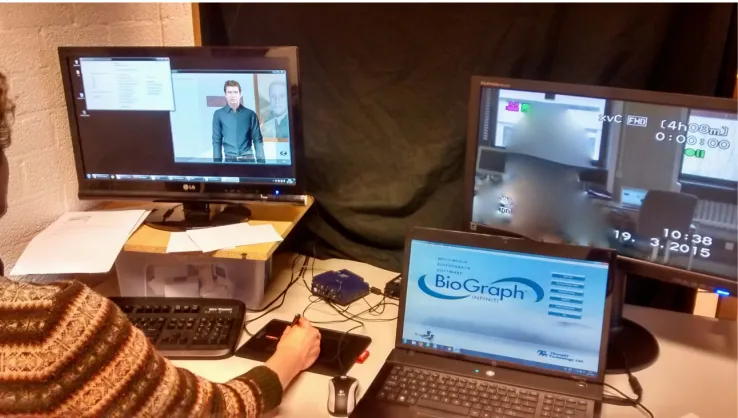
Figure 3. The set-up of the experiment with the virtual interrogator, skin conductance technology, input
tools and the video screen.
Results
[image:14.595.72.441.308.517.2]Graphic 1. Projected agency on virtual interrogator ranging from human- to computer-controlled.
To test the main effect of veracity on EDA (Hypothesis 1) and the input equipment on the relationship of veracity with EDA (Hypothesis 4) we conducted a two-way variance analysis with veracity as independent variable and EDA as dependent variable. We found a
significant main effect for veracity on EDA, F(1,53) = 4.55, p = .037, η2 = .052. In line with Hypothesis 1 skin conductance was significantly higher for the lie condition (M= 2.31, SD = 2.07) compared with the truth condition (M = 1.51, SD = 1.22). We also found a significant
main effect of interrogator input on EDA, F(1,53) = 6.89, p = .011, η2 = .078. Skin conductance was significantly increased for the mouse condition (M = 2.29, SD = 1.88) compared with the pad condition (M = 1.45, SD = 1.44). We did not find an interaction
between veracity and avatar input on EDA, F(1,53) = 1.07, p = .305, η2 = .01 and therefore Hypothesis 4 is not confirmed.
We also expected that participants in the mouse condition scored higher on human agency beliefs compared with participants in the pad condition (Hypothesis 2).
0 2 4 6 8 10 12 14
A human! Probably a human!
Not sure, but guess human!
I don't know!Not sure, but guess computer!
Probably a computer!
A computer!
F re q u e n cy !
We conducted a one-way ANOVA to compare the effect of interrogator input on agency beliefs. Results did not indicate a significant effect for pad input (M = 3.67, SD = 1.33) compared with mouse input (M = 3.41, SD = 1.83) on agency beliefs, F(1,55)= 0.34, p=0.56,
η2 = 0.006. The relationship between interrogator input and agency was not significant. Hypothesis 2 is not confirmed.
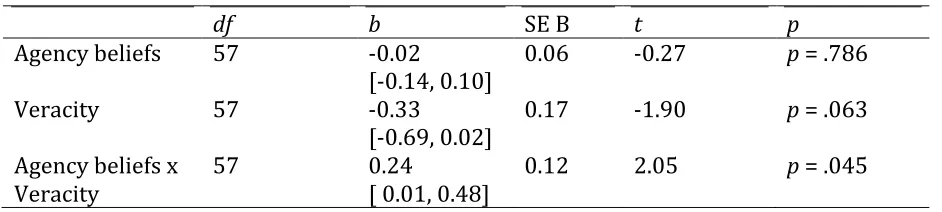
[image:16.595.62.533.560.666.2]We performed a PROCESS (Hayes, 2012) moderator analysis to predict the effect of agency beliefs on the relationship of veracity with EDA (Hypothesis 4). For results of the main moderation analysis see Table 1. We found a significant interaction effect of the moderator agency beliefs on the relationship of veracity with EDA, b = 0.24, 95% CI [0.01, 0.48 ], t(57) = 2.05. p = .045. When agency beliefs are mostly human-controlled (-1SD), there is a significant relationship between veracity and EDA, b = -0.73, 95% CI [-1.18, -0.28], t(57) = -3.26. p = .002. When perceptions are mostly computer-controlled (+1SD), there is no relationship between veracity and EDA, b = 0.06, 95% CI [-0.53, 0.65, t = 0.21, p = .831. In line with Hypothesis 3 we thus found a moderation effect of agency beliefs. When agency beliefs are more human-controlled it becomes easier to discriminate liars from truth tellers, see graphic 2.
Table 1
PROCESS main moderation analysis for veracity and agency perceptions on tonic EDA.
df b SE B t p
Agency beliefs 57 -0.02
[-0.14, 0.10] 0.06 -0.27 p = .786
Veracity 57 -0.33
[-0.69, 0.02] 0.17 -1.90 p = .063 Agency beliefs x
Graphic 1. Mean EDA scores for veracity conditions and direction of avatar perception.
Discussion
The recent developments in artificial intelligence make the application of automatic lie detection more realistic and studies about the application of virtual interrogation relevant. In this paper we studied how individuals perceive a virtual interrogator during lie detection and how this influences the process of truth finding. We found that it is possible to discriminate liars form truth tellers with measures of skin conductance while being interviewed by a virtual interrogator. More important we found that discriminating liars from truth tellers works best when individuals believe that the virtual interrogator is human-controlled instead of
computer-controlled. We did not find a relationship of interrogator input with agency beliefs. According to the cognitive load approach, which states that cognitive load is stronger during lying than truth telling (Vrij et al., 2008) and leading to an increase in skin
conductance (DePaulo et al, 2003; Vrij et al, 2008; Zuckerman, DePaulo, & Rosenthal, 1981), we discriminated liars and truth tellers with measures of skin conductance. Next we indicated that the relationship of cognitive load with veracity is bound to the agency beliefs individuals
0 0.5 1 1.5 2 2.5 3 3.5
Human agency beliefs! Computer agency beliefs!
T o n ic ED A ( μ S ) ! Liars!
project on their interrogator. Our study demonstrates according Dennett’s theory (1996), that individuals have developed an evolutionary strategy to communicate with unknown entities. Almost all individuals project a form of agency on the virtual interrogator. Our research shows that the sort of agency individuals project on a virtual interrogator varies widely from computer-controlled to human-controlled. However previous research showed that those perceptions can be manipulated (Lim & Reeves, 2010). For example, agency beliefs can be manipulated with a message by an authority figure. Therefore, our finding is not in conflict with the utilization of artificial interrogation. We recommend that suspects are informed that the virtual interrogation is human-controlled. If our recommendation is not met, accurate lie detection is difficult and cannot be a valid goal of the virtual interrogation.
In this study we did not find a link between environmental cues and agency beliefs. Agency beliefs were not explained by the input of the virtual interrogator. A possible explanation might be that agency beliefs are already formed at the first contact with the virtual interrogator and not in the course of a complete interrogation. Scientists suggested in line with social presence theory that a mental model of an entity is immediately activated when the presence of another intelligence is detected (Biocca, 1997; Nowak, 2000). To reduce uncertainty, individuals try to model the intentions that the virtual entity has towards him or her (Biocca, Harms, & Burgoon, 2003). Consistent with the suggestions of Dennet (1996) individuals reduce uncertainty by using their evolutionary strategy to interact with unknown agencies. We showed that almost all participants project some agency on the virtual
We found an unexpected main effect of interrogator input on skin conductance. When mouse input was applied to control the virtual interrogator individuals experienced increased skin conductance compared with individuals who were interrogated with pad input. The predicted relationship of interrogator input with agency beliefs was not verified . Therefore, environmental cues, such as mouse clicks indicating a human-controlled interrogator, are unlikely to explain this relationship. A hypothetical explanation might be that minor
deviations in reaction time of the input tool resulted in different experiences in the dynamic of the interrogation, such that mouse input compared with pad input led to experience of more engagement. Increased engagement might lead increased cognitive load to process the interaction with the virtual interrogator, which might cause increased skin conductance. In real life practice we advise to keep the input method consistent to minimize possible confounding variables.
individuals with computer agency beliefs does not relate to the process of deception but relates to the experience of perceived control.
Increased cognitive load for individuals with computer agency beliefs might be associated with emotional stress such as fear for the artificial interrogator derived from uncertainty about how the computer works. If individuals project computer agency beliefs on the virtual interrogator they might experience a general amount of emotional stress because they are not able to check if the artificial intellect believes their statement. Even for truth tellers this can lead to an increase in cognitive load, because they might fear an artificial intellect takes their statement for a lie and they have no mechanism to check if the computer believes their statement. Emotional stress such as fear is related to deception (Ekman, 1989), but in our study emotional stress might be associated with uncertainty and therefore interfere with measures of deception. Individuals with human agency beliefs might benefit from the perception of control over the virtual interrogator and experience less emotional stress than individuals with computer agency beliefs. In stressful situations the perception of control is important to regulate emotional responses (Leotti, Iyengar, & ochsner, 2010; Bandura, Taylor, Williams, Mefford, & Barchas, 1985). The perception of control inhibits autonomic arousal and stress (Mineka & Hendersen, 1985) and individuals with human agency beliefs might experience more subjective control and therefore experience less cognitive load than individuals with computer agency beliefs.
Personal qualities like computer knowledge might explain the increased variety in skin conductance measures for individuals with computer agency beliefs compared with
individuals with human agency beliefs. Individuals who have little knowledge about
computers might have increased skin conductance during interrogation because the interaction with the virtual interrogator is more demanding of their cognitive system. They might
individuals with more computer knowledge. The level of computer knowledge might explain why we found more variety on the level of skin conductance when individuals have computer agency beliefs compared with individuals who have human agency beliefs. In follow up studies the level of computer knowledge can be manipulated to investigate if computer knowledge influences the discriminability of liars and truth tellers. If follow up research indicates that computer knowledge influences the discriminability of liars and truth tellers then professionals should be aware that computer knowledge is a dynamic factor and changes fast with current technology developments.
In this study we measured agency beliefs with a self-report measure. Projected agency is not manipulated in this study and therefore the relationship of agency beliefs on the
relationship of veracity with skin conductance is not causal. However, the developed agency scale is a reliable measure to indicate the association of agency beliefs on the relationship of veracity with skin conductance. In follow up studies agency beliefs should be manipulated to verify a cause-effect relationship of the strengthening effect of human projected agency on a virtual interrogator on the relationship of veracity with skin conductance.
In our study all participants committed a transgression by signing a document they were legally not allowed to sign. During real life interrogations this might not be the case. It would be more likely to find only one person that made a particular transgression instead of all suspects. Committing a transgression is related to stress, and emotional stress is related to higher skin conductance (Hout, Jong, & Kindt, 2000). Therefore our truth condition might have scored higher on skin conductance levels, compared when they would not have
committed a transgression. However we still managed to discriminate liars form truth tellers in our study.
computer interactions. Individuals will know more about the nature of an artificial system, resulting in different strategies to influence that system. This might result in shifts of validity and reliability to indicate deception. Therefore the findings of our study should be checked overtime. If lie detection is included in automated interviewing systems, studies about the perception of virtual interrogators should be performed regular to check the validity of the indicators of deception.
The C.I.A. rapport (Interrogation, 1983) stated that development of artificial interrogation has a long way to go since it cannot reach the capabilities of human
References
Algemene Inlichtingen- en Veiligheidsdienst. (2016). Jaarverslag. Den Haag, Zuid-Holland: Author.
Bandura, A., Taylor, C. B., Williams, S. L., Mefford, I. N., & Barchas, J. D. (1985). Catecholamine secretion as a function of perceived coping self-efficacy. Journal of consulting and clinical psychology, 53(3), 406. doi: http://dx.doi.org/10.1037/ 0022-006X.53.3.406
Benedek, M., & Kaernbach, C. (2010). A continuous measure of phasic electrodermal activity. Journal of neuroscience methods, 190(1), 80-91. doi: 10.1016/j.jneumeth. 2010.04.028
Beune, K., Giebels, E., & Sanders, K. (2009). Are you talking to me? Influencing behavior and culture in police interviews. Psychology, Crime & Law, 15(7), 597-617. doi: http://dx.doi.org/10.1080/10683160802442835
Biocca, F. (1997). The cyborg's dilemma: progressive embodiment in virtual environments. Journal of Computer-Mediated Communication, 3(2). doi: 10.1111/j.1083-6101. 1997.tb00070.x
Biocca, F., Harms, C., & Burgoon, J. K. (2003). Toward a more robust theory and measure of social presence: Review and suggested criteria. Presence, 12(5), 456-480.
doi:10.1162/105474603322761270
Bond, C. F., & DePaulo, B. M. (2006). Accuracy of deception judgments. Personality and social psychology Review, 10(3), 214-234. doi: 10.1207/s15327957pspr1003_2
Burgoon, J. K., Buller, D. B., & Guerrero, L. K. (1995). Interpersonal deception IX. Effects of social skill and nonverbal communication on deception success and detection
Buller, D. B., & Burgoon, J. K. (1996). Interpersonal deception theory. Communication theory, 6(3), 203-242. doi: 10.1111/j.1468-2885.1996.tb00127.x
Cascio, W. F., & Aguinis, H. (2011). Applied Psychology in Human Resource Management. (7th ed.) New Jersey: Pearson
Central Intelligence Agency (1983). Studies in intelligence: Interrogation of an alleged CIA agent. Author.
Christ, S. E., Van Essen, D. C., Watson, J. M., Brubaker, L. E., & McDermott, K. B. (2009). The contributions of prefrontal cortex and executive control to deception: evidence from activation likelihood estimate meta-analyses. Cerebral Cortex, 19(7), 1557-1566. Dennett, D. (1996) Kinds of minds: Toward an understanding of consciousness (1st ed.). New
York: Basic Books. doi: 10.5860/CHOICE.34-2455
Davies, G. M., & Beech, A. R. (Eds.). (2012). Forensic Psychology: Crime, Justice, Law, Interventions. John Wiley & Sons.
DePaulo, B. M., Kirkendol, S. E., Tang, J., & O'Brien, T. P. (1988). The motivational impairment effect in the communication of deception: Replications and extensions. Journal of Nonverbal Behavior, 12(3), 177-202. doi: 10.1007/BF00987487
DePaulo, B. M., Lindsay, J. J., Malone, B. E., Muhlenbruck, L., Charlton, K., & Cooper, H. (2003). Cues to deception. Psychological bulletin, 129(1), 74. doi: http://dx.doi.org/ 10.1037/0033-2909.129.1.74
Ekman, P. (1989). Why lies fail and what behaviors betray a lie. In J. C. Yuille (Ed.), Credibility assessment (pp. 71-81). New York: Springer + Business Media LLC. Engström, J., Johansson, E., & Östlund, J. (2005). Effects of visual and cognitive load in real
Gamer, M. (2011). Detecting of deception and concealed information using neuroimaging techniques. Memory detection: Theory and application of the concealed information test, 90-113. doi: http://dx.doi.org/10.1017/CBO9780511975196.006
Gronau, N., Ben-Shakhar, G., & Cohen, A. (2005). Behavioural and physiological measures in the detection of concealed information. Journal of Applied Psychology, 90, 147-158. doi: http://dx.doi.org/10.1037/0021-9010.90.1.147
Hout, M. A., Jong, P., & Kindt, M. (2000). Masked fear words produce increased SCRs: An anomaly for Öhman's theory of pre‐attentive processing in anxiety. Psychophysiology, 37(3), 283-288. Doi: 10.1111/1469-8986.3730283
Leotti, L. A., Iyengar, S. S., & Ochsner, K. N. (2010). Born to choose: The origins and value of the need for control. Trends in cognitive sciences, 14(10), 457-463. doi: 10.1016/ j.tics.2010.08.001
Lim, S., & Reeves, B. (2010). Computer agents versus avatars: Responses to interactive game characters controlled by a computer or other player. International Journal of Human– Computer Studies, 68(1/2), 57–68. doi: 10.1016/j.ijhcs.2009.09.008
Mann, S., Vrij, A., & Bull, R. (2002). Suspects, lies and videotape: An analysis of authentic high-stakes liars. Law and Human Behavior, 26, 365–376. doi: http://dx.doi.org/ 10.1023/A:1015332606792
Mineka, S., & Hendersen, R. W. (1985). Controllability and predictability in acquired motivation. Annual review of psychology, 36(1), 495-529. Doi: 10.1146/annurev. ps.36.020185.002431
Nakayama, M. (2002). Practical use of the concealed information test for criminal
investigation in Japan. In M. Kleiner (Ed.), Handbook of polygraph testing (pp. 49-86). San Diego, CA: Academic Press.
Nass, C., & Moon, Y. (2000). Machines and mindlessness: Social responses to computers. Journal of social issues, 56(1), 81-103. doi: 10.1111/0022-4537.00153
Nourbakhsh, N., Wang, Y., Chen, F., & Calvo, R. A. (2012). Using galvanic skin response for cognitive load measurement in arithmetic and reading tasks. In Proceedings of the 24th Australian Computer-Human Interaction Conference (pp. 420-423). ACM. doi: http://dx.doi.org/10.1145/2414536.2414602
Nowak, K. (2000). The influence of anthropomorphism on mental models of agents and avatars in social virtual environments. Unpublished doctoral dissertation, Michigan State University: 164, East Lansing, MI.
Nowak, K. L., & Biocca, F. (2003). The effect of the agency and anthropomorphism on users' sense of telepresence, copresence, and social presence in virtual environments.
Presence, 12(5), 481-494. doi: http://dx.doi.org/10.1162/105474603322761289
Person, N., Graesser, A. C., & Tutoring Research Group. (2002, January). Human or computer? AutoTutor in a bystander Turing test. In Intelligent tutoring systems (pp. 821-830). Springer Berlin Heidelberg. doi: 10.1007/3-540-47987-2_82
Philpott, J. S. (1983). The relative contribution to meaning of verbal and nonverbal channels of communication: A meta-analysis. Unpublished master’s thesis, University of Nebraska, Lincoln.
Schuetzler, R., Grimes, M., Giboney, J., & Buckman, J. (2014). Facilitating natural conversational agent interactions: Lessons from a deception experiment.
Shackman, A. J., Salomons, T. V., Slagter, H. A., Fox, A. S., Winter, J. J., & Davidson, R. J. (2011). The integration of negative affect, pain and cognitive control in the cingulate cortex. Nature Reviews Neuroscience, 12(3), 154-167. doi: http://dx.doi.org/10.1038/ nrn2994
Ströfer, S. (2016). Deceptive intent: physiological reactions in different interpersonal contexts. doi: http://dx.doi.org/10.3990/1.9789036540308
Ströfer, S., Noordzij, M. L., Ufkes, E. G., & Giebels, E. (2015). Deceptive Intentions: Can Cues to Deception Be Measured before a Lie Is Even Stated? PloS one, 10(5), e0125237-e0125237. doi:10.1371/journal.pone.0125237
Vrij, A. (2000). Detecting lies and deceit: The psychology of lying and implications for professional practice. Chichester: John Wiley & Sons Ltd.
Vrij, A. (2008). Detecting lies and deceit: Pitfalls and opportunities. John Wiley & Sons. Vrij, A., Fisher, R., Mann, S., & Leal, S. (2006). Detecting deception by manipulating cognitive load. Trends in Cognitive Sciences, 10(4), 141-142. doi: 10.1016/j.tics. 2006.02.003
Vrij, A., Granhag, P. A., Mann, S., & Leal, S. (2011). Outsmarting the liars: Toward a cognitive lie detection approach. Current Directions in Psychological Science, 20(1), 28-32. doi: 10.1177/0963721410391245
Walsh, D., & Bull, R. (2012). Examining rapport in investigative interviews with suspects: Does its building and maintenance work?. Journal of police and criminal psychology, 27(1), 73-84. doi: 10.1007/s11896-011-9087-x
Appendix A
What is your impression of the interviewer in this study? Complete the following statements. According to me..
… the interviewer is controlled by… … the interview is conducted by… … the questions were selected by…
… the interviewer was during the interview operated by… … I communicated mostly with…
If you have to make one clear decision, what would you think? 6. The interviewer is…
1 2 3 4 5 6 7
A human Probably a human
Not sure, but guess human
I don’t know
Not sure, but guess computer
Probably a computer
A
Appendix B Protocol van interviewer:
Ik zal ons even voorstellen: Ik ben Dirk Jansen van de opsporingseenheid fraude van de veiligheidsregio Twente. Zoals je weet ben je hier omdat we je
verdenken van valsheid in geschrifte en mogelijk witwassen, een ernstige vorm van fraude. Ik wil je daarover zo graag een aantal vragen stellen. Ik kan me goed voorstellen dat het spannend is, maar ik wil je vragen om zo gedetailleerd mogelijk te zijn in je antwoorden. Dat helpt ons de zaak zo goed mogelijk op te lossen. Tot slot is het belangrijk om te weten dat je niet tot antwoorden verplicht bent. Ok?
1. Kun je iets vertellen over jouw link met de UT? Hoe vaak kom je hier, waarvoor, wat doe je dan precies?
2. Waarom kwam je vandaag naar de UT?
3. Kun je stap voor stap beschrijven wat je hebt gedaan na binnenkomst? 4. Ben je daarbij nog andere mensen tegengekomen? Wie?
5. Kun je andere bijzonderheden beschrijven? Heb je nog iets gedaan? Gezien? 6. Heb je meegedaan aan een assessment center oefening?
7. Heb je dit formulier wel eens eerder gezien? 8. Is dat jouw handtekening daaronder?
9. Dit waren mijn vragen. Heb je verder zelf nog iets toe te voegen? 10. Was alles duidelijk?
Ja Dat is niet van belang
Nee Ga gewoon verder
Okee Dat moet je zelf weten