http://www.scirp.org/journal/am ISSN Online: 2152-7393
ISSN Print: 2152-7385
Modified Function Projective Synchronization
of Complex Networks with Multiple
Proportional Delays
Xiuliang Qiu
1, Honghua Bin
2*, Licai Chu
21Chengyi University College, Jimei University, Xiamen, China 2School of Science, Jimei University, Xiamen, China
Abstract
This paper deals with the modified function projective synchronization prob-lem for general complex networks with multiple proportional delays. With the existence of multiple proportional delays, an effective hybrid feedback control is designed to attain modified function projective synchronization of net-works. Numerical example is provided to show the effectiveness of our result.
Keywords
Complex Networks, Modified Function Projective Synchronization, Proportional Delays, Hybrid Feedback Control
1. Introduction
In recent decades, synchronization as a popular research topic of complex networks has been widespread concern around the world [1] [2] [3] [4]. With the deepening of research on complex networks synchronization problems, the concept and theory of synchronization have been greatly developed, and many different types of synchronization concepts have been found and put forward. such as complete synchronization [5], cluster synchronization [6], lag synchro- nization [7], generalized synchronization [8], quasi-synchronization [9], phase synchronization [10], anti-synchronization [11], projective synchronization [12], function projective synchronization [13] [14].
Modified function projective synchronization(MFPS) has been proposed and extensively investigated in the latest. MFPS means that the drive and response systems could be synchronized up to a desired scaling function matrix [15]. It is easy to see that the definition of MFPS encompasses projective synchronization How to cite this paper: Qiu, X.L., Bin,
H.H. and Chu, L.C. (2017) Modified Func-tion Projective SynchronizaFunc-tion of Com-plex Networks with Multiple Proportional Delays. Applied Mathematics, 8, 537-549. https://doi.org/10.4236/am.2017.84043 Received: March 24, 2017
Accepted: April 25, 2017 Published: April 28, 2017 Copyright © 2017 by authors and Scientific Research Publishing Inc. This work is licensed under the Creative Commons Attribution International License (CC BY 4.0).
http://creativecommons.org/licenses/by/4.0/
and function projective synchronization. The MFPS of general complex networks can reveal that the nodes of complex networks could be synchronize up to an equilibrium point or periodic orbit with a desired scaling function matrix. Because the unpredictability of the scaling function in MFPS can additionally enhance the security of communication, MFPS has attracted the interest of many researchers in various fields. On the basis of an adaptive fuzzy nonsingular terminal sliding mode control scheme, a general method of MFPS of two different chaotic systems with unknown functions was investigated in
[16]. The work in [17] gives MFPS of a class of chaotic systems. MFPS of a classic chaotic systems with unknown disturbances was investigated by adaptive integral sliding mode control [18]. Ref. [19] investigates the adaptive MFPS of a class of complex four-dimensional chaotic system with one cubic cross-product term in each equation. Ref. [20] investigates the MFPS of two different chaotic systems with parameter perturbations.
A simple general scheme of MFPS in complex dynamical networks (CDNs) is investigated in this paper, considering that external disturbances and unmodeled dynamics are always unavoidably in the practical evolutionary processes of synchronization, MFPS in CDNs with proportional delay and disturbances will be investigated by the proposed scheme.The rest of this paper is organized as follows. Some definitions and a basic lemma are given in Section 2. In Section 3, the synchronization of the complex networks with proportional delays by the pinning control method is discussed by the way of equivalent system. Finally, computer simulation is performed to illustrate the validity of the proposed method in Section 4.
2. Preliminaries
Consider a generally controlled complex dynamical networks consisting of N identical linearly coupled nodes with multiple proportional delays by the following equations:
( )
(
( )
)
( )
( )
1
, 1, 2, , , 1,
N
i i ij j ij i
j
t t g q t t i N t
=
= +
∑
+ = ≥x f x x u (2.1)
where i=1, 2,,N t, ≥1, xi=
(
xi1,xi2,,xin)
T∈Rn denotes the state vector of the ith node, f R: n→Rn is a continuously differentiable vector function determining the dynamic behavior of the nodes,( )
ni t ∈
u R is the control input.
( )
N Nij
g ×
= ∈
G R is the coupling configuration matrix representing the topolo- gical structure of the network, where gij >0 if there is a connection between
node i and node j; otherwise gij=gji=0, and the diagonal elements of matrix
G are defined by
1,
, 1, 2, , ,
N
ii ij
j j i
g g i N
= ≠
= −
∑
= (2.2), , 1, 2, ,
ij
q i j= n are proportional delay factors and satisfy
{ }
1 ,
0 ij 1, min ij
i j n
q q q
≤ ≤
Definition 1. (MFPS) The network (2.1) with proportional delays is said to achieve modified function projective synchronization if there exists a continu- ously differentiable scaling function matrix M
( )
t such that( )
( ) ( )
lim i 0, 1, 2, , ,
t→+∞ x t −M t x t = i= N (2.3) where ⋅ stands for the Euclidean vector norm, M
( )
t =diag(
αi( )
t)
is a modified function matrix, and each modified functionα
i( )
t is a continuously differential function and is bounded as αi( )
t ≤δi< ∞, αi( )
t ≠0, δi is a finite constant, and( )
nt ∈
x R can be an equilibrium point, or a periodic orbit, or an orbit of a chaotic attractor, which satisfies x
( )
t = f x(
( )
t)
.Considering the actual evolutionary processes of synchronization, external disturbances and unmodeled dynamics are always unavoidable. MFPS in CDNs with disturbances will be investigated further as follows:
( )
(
( )
)
( )
( )
( )
1
, 1, 2, , , 1,
N
i i ij j ij i i
j
t t g q t t t i N t
=
= +
∑
+ + = ≥x f x x d u (2.4)
where
(
)
T1, 2, ,
n i= xi xi xin ∈
x R denotes the state vector of the ith node,
: n → n
f R R is a continuously differentiable vector function determining the dynamic behavior of the nodes,
( )
ni t ∈
u R is the control input and di
( )
t ∈Rn is the mismatched terms, which could exist in many perturbation, noise disturbance.( )
N Nij
g ×
= ∈
G R is the coupling configuration matrix represent- ing the topological structure of the network, and the diagonal elements of matrix
G are defined by Equation (2.2).
In the following, some necessary assumptions are given.
Assumption 1. The derivative of scaling function
α
i( )
t is bounded, that is( )
*i t a
α ≤ (2.5)
for all t∈R+, where a*∈R+ is the upper limit of the αi
( )
t ,i=1, 2,,N.Assumption 2. The norm of the mismatched terms di
( ) (
t i=1, 2,,N)
are bounded, that is( )
*i t ≤di < ∞
d (2.6)
where * i
d ∈R+ is the upper limit of the norm of d ti
( )
.In this paper, M M1, 2 denote the upper limit of the norm of M
( )
t f y(
( )
t)
,( ) ( )
t tM y , respectively. Q= ⊗G In, ⊗ represent the Kroncecker product,
( )
max
λ
A denotes the maximum eigenvalue for symmetric matrix A.Lemma 1. [21] For any vector x y, ∈Rn and positive definite matrix
n n× ∈
S R , the following matrix inequality holds:
T T T 1
2x y≤x Sx+ y S y− (2.7)
3.
MFPS
in Complex Networks with Multiple
Proportional Delays
Let yi
( )
t =xi( )
et , then a couple of networks (2.1) and (2.4) is equivalentlytransformed into the following couple of complex networks with constant delay and time varying coefficients
( )
(
( )
)
(
)
( )
1
e , 1, 2, , ,
N t
i i ij j ij i
j
t t g t τ t i N
=
= + − + =
∑
y f y y U (3.1)
and
( )
(
( )
)
(
)
( )
( )
1
e , 1, 2, , ,
N t
i i ij j ij i i
j
t t g t τ t t i N
=
= + − + + =
∑
y f y y D U
(3.2)
where t≥0 , τij = −loge
( )
qij ≥0 ,( )
( )
e ,t( )
( )
eti t = i i t = i
D d U u , and
( )
( )
(
[
, 0 ,]
)
i i
y s =x s ∈C −τ , in which x si
( )
=xi0,s∈ −[
τ
, 0]
,{ }
1 ,maxi j n ij
τ τ
≤ ≤
= .
Definition 2. The network (3.2) is said to achieve modified function projec- tive synchronization if there exists a continuously differentiable scaling function matrix M
( )
t such that( )
( )
( ) ( )
lim i lim i 0, 1, 2, , ,
t→+∞ e t =t→+∞ y t −M t y t = i= N (3.3) where ⋅ stands for the Euclidean vector norm, M
( )
t =diag(
αi( )
t)
is amodified function matrix, and each modified function
α
i( )
t is a continuously differential function and is bounded as αi( )
t ≤δi< ∞,α
i( )
t ≠0, δi is a finite constant, and y( )
t ∈Rn can be an equilibrium point, or a periodic orbit, or an orbit of a chaotic attractor, which satisfies y( )
t =etf y(
( )
t)
.Theorem 1. Suppose Assumptions 1 and 2 hold. For a given synchronization scaling function matrix M
( )
t , if there exist positive constants 1i
k , 2 i
k and
3 i
k which satisfy ki1≥di*+M1, 2
2 i
k ≥M and
T 3
max
1
2 2
i
k ≥λ +
, CDNs
with disturbance (3.2) can realize modified function projective synchronization via the control law :
( )
(
( )
)
(
1 2)
(
( )
)
3( )
e t , 1, 2, , ,
i t i t ki ki sgn i t ki i t i N
−
= − − + − =
U f y e e (3.4)
where sgn
( )
⋅ denotes the sign function.Proof. Define
( )
( )
( ) ( )
, 1, 2, , ,i t = i t − t t i= N
e y M y (3.5)
where M
( )
t is a modified function matrix. It follows from (3.2) and (2.2) that( )
(
( )
)
(
)
( )
( )
( ) ( )
( )
(
( )
)
1 e
e , 1, 2, , , N
t
i i ij j ij i i
j
t
t t g t t t
t t t t i N
τ =
= + − + +
− − =
∑
e f y e D U
M s M f y
(3.6)
Construct the Lyapunov function
( )
T( ) ( )
T( ) ( )
1 1
1 1
e d ,
2 2 ij
N t N
t
i i t i i
i i
V t − t t −τ v v v
= =
=
∑
e e +∫
∑
e e (3.7)( )
( ) ( )
( ) ( )
( ) ( )
(
) (
)
( ) ( )
( ) ( )
(
) (
)
( )
(
( )
)
(
)
( )
( )
( ) ( )
( )
(
( )
)
T T T T
1 1 1 1
T T T
1 1 1
T
1 1
1 1 1
e e
2 2 2
1 1
e
2 2
e e e
N N N N
t t
i i i i i i i ij i ij
i i i i
N N N
t
i i i i i ij i ij
i i i
N N
t t t
i i ij j ij i i
i j
V t t t t t t t t t
t t t t t t
t t g t t t t t t t
τ τ τ τ τ − − = = = = − = = = − = = = − + + − − − ≤ + − − − = + − + + − −
∑
∑
∑
∑
∑
∑
∑
∑
∑
e e e e e e e e
e e e e e e
e f y e D U M y M f y
( ) ( )
(
) (
)
( )
(
( )
)
( )
( )
( ) ( )
( )
(
( )
)
( )
(
)
( ) ( )
(
) (
)
( )
( )
(
)
(
( )
)
( )
( ) ( )
( )
(
( )
)
T T 1 1 T 1T T T
1 1 1 1
T 1 2 3
1 1 1 2 2 e 1 1 2 2 e e N N
i i i ij i ij
i i
N
t
i i i i
i
N N N N
i ij j ij i i i ij i ij
i j i i
N
t t
i i i i i i i
i
t t t t
t t t t t t t t
t g t t t t t
t t k k sgn t k t t t t t
τ τ
τ τ τ
= = − = = = = = − − = + − − − = + + − − + − + − − − = + − − − − −
∑
∑
∑
∑∑
∑
∑
∑
e e e e
e f y D U M y M f y
e e e e e e
e D e e M y M f y
( )
(
)
( ) ( )
(
) (
)
( )
( )
(
)
(
( )
)
( ) ( )
( )
(
( )
)
( ) ( )
( )
(
)
( ) ( )
(
) (
)
T T T
1 1 1 1
T 1 2
1
3 T T T T
1 1 1 1 1
1 1 1 2 2 e e 1 1 2 2
N N N N
i ij j ij i i i ij i ij
i j i i
N
t t
i i i i i
i
N N N N N
i i i i ij j ij i i i ij i ij
i i j i i
N
i
t g t t t t t
t t k k sgn t t t t t
k t t t g t t t t t
τ τ τ
τ τ τ
= = = = − − = = = = = = = + − + − − − = + − − − − − + − + − − − ≤
∑∑
∑
∑
∑
∑
∑∑
∑
∑
∑
e e e e e e
e D e M y M f y
e e e e e e e e
e
( )
( )
(
)
( ) ( )
( )
(
( )
)
( ) ( )
( )
(
)
( ) ( )
(
) (
)
T 1 2
3 T T T T
1 1 1 1 1
e e
1 1
2 2
t t
i i i i
N N N N N
i i i i ij j ij i i i ij i ij
i i j i i
t t k k t t t t
k t t t g t τ t t t τ t τ
− − = = = = = + − − + + −
∑
+∑∑
− +∑
−∑
− − D M y M f y
e e e e e e e e
(3.8)
Because chaos systems and the scaling function are bounded, y
( )
t and( )
i tα
are bounded. Furthermore, f is a continuously vector function, thereexists a positive constants M1 satisfying M
( )
t f y(
( )
t)
≤M1 . BecauseAssumption 1 holds, there exists a positive constant M1 satisfying
( ) ( )
t t ≤M2M y . Because Assumption 2 holds, there exists a positive constant *
i
d satisfying
( )
*(
1, 2, ,)
i t ≤di i= N
D :
( )
( )
( ) ( )
( )
(
)
( ) ( )
(
) (
)
( )
(
) (
)
( ) ( )
( )
(
)
T * 1 2 3 T
1 2
1 1
T T T
1 1 1 1
T * 1 2 3 T
1 2
1 1
T
1 1 1
e e 1 1 2 2 e 1 2 N N t t
i i i i i i i
i i
N N N N
i ij j ij i i i ij i ij
i j i i
N N
t
i i i i i i i
i i
N N
i ij j ij
i j i
V t t d k k M M k t t
t g t t t t t
t d M k M k k t t
t g t
τ τ τ
τ − − = = = = = = − = = = = = ≤ − − + + − + − + − − − = + − + − − + − +
∑
∑
∑∑
∑
∑
∑
∑
∑∑
e e e
e e e e e e
e e e
e e
( ) ( )
(
) (
)
T T 1 1 2 N Ni i i ij i ij
i
t t t τ t τ
=
− − −
∑
e e∑
e e(3.9)
Tanking 1 * 1
i i
k ≥d +M and ki2≥M2, i=1, 2,,N, we obtain
( )
( ) ( )
( )
(
)
( ) ( )
(
) (
)
3 T T
=1 1 1
T T
1 1
1 1
2 2
N N N
i i i ij j ij
i i j
N N
i i i ij i ij
i i
V t k t t t g t
t t t t
τ
τ
τ
= = = = ≤ − + − + − − −∑
∑∑
∑
∑
e e e e
e e e e
where 3
(
3 3 3)
1 2min , , , N
k = k k k .
Let
( )
(
T( )
T( )
T( )
)
T 1 , 2 , ,nN N
t = t t t ∈
e e e e R . Then by Lemma 1, we have
( )
( ) ( )
( )
(
)
( ) ( )
(
) (
)
( ) ( )
( )
( )
( ) ( )
( ) ( )
3 T T
T T
3 T T T T
T
3 T
max
1 1
2 2
1 1
2 2
1
2 2
ij
ij ij
V t k t t t t
t t t t
k t t t t t t
k t t
τ
τ τ
λ
≤ − + −
+ − − −
≤ − + +
≤ − + +
e e e Qe
e e e e
e e e QQ e e e
e e
(3.11)
Taking 3 T
max
1
2 2
k ≥λ +
, we obtain
( )
0.V t ≤ (3.12)
According to the Lyapunov stability theory, the error system (3.6) is asymptotically stable. This completes the proof.
Corollary 1. Suppose Assumptions 1 hold. For a given synchronization scaling function matrix M
( )
t , if there exist positive constants ki1,2 i
k , ki3, which satisfy 1
1 i
k ≥M , ki2 ≥M2 and
T 3
max
1
2 2
i
k ≥λ +
, CDNs without
disturbance (3.1) can realize modified function projective synchronization via the control law :
( )
(
( )
)
(
1 2)
(
( )
)
3( )
et , 1, 2, , ,
i t i t ki ki sgn i t ki i t i N
−
= − − + − =
U f y e e (3.13)
where sgn
( )
⋅ denotes the sign function.By Theorem 1, it is easy to see that a similar proof holds for
( ) (
0 1, 2, ,)
i t = i= N
D . Thus, the proof is omitted here.
Though the proposed error feedback control method is very simple, Choosing the appropriate feedback gains 1
i
k , 2 i
k and 3 i
k is still difficult. Thus, finding
appropriate gains 1 i
k , ki2 and 3 i
k to achieve synchronization is still a
challenging problem. In the following, an adaptive scheme is established in order to select the appropriate gains 1
i
k , ki2 and 3 i
k to realize MFPS in CDNs with
or without disturbances.
Theorem 2. Suppose Assumptions 1 and 2 hold. For a given synchronization scaling function matrix M
( )
t , CDNs with disturbance (3.2) can realizemodified function projective synchronization via the control law :
( )
(
( )
)
(
1( )
2( )
)
(
( )
)
3( ) ( )
, 1, 2, , ,
t
i t i t ki t ki t sgn i t ki t i t i N
−
= − + − − − =
U f y e e e (3.14)
( )
( )
(
( )
)
1 1 T
, 1, 2, , ,
i i i i
k t =le t sgn e t i= N (3.15)
( )
( )
(
( )
)
2 2 T
et , 1, 2, , ,
i i i i
k t =l −e t sgn e t i= N (3.16)
( )
( ) ( )
3 3 T , 1, 2, , ,
i i i i
k t =l e t e t i= N (3.17)
where sgn
( )
⋅ denotes the sign function. l1i >0,li2 >0 and 30 i
l > are arbi-
( )
( ) ( )
( ) ( )
(
( )
)
( )
(
)
(
( )
)
2
T T 1 1
1
1 1 1
2 2
2 2 3 3
2 3
1 1
1 1 1 1
e d
2 2 2
1 1 1 1
,
2 2
ij
N t N N
t
i i t i i i i
i i i i
N N
i i i i
i i i i
V t t t v v v k t k
l
k t k k t k
l l τ − − = = = = = = + + − + − + −
∑
∫
∑
∑
∑
∑
e e e e
(3.18)
The time derivative of V(t) along the trajectories of (3.6) is
( )
( ) ( )
( ) ( )
( ) ( )
(
) (
)
( )
(
)
( )
(
( )
)
( )
(
( )
)
( )
( ) ( )
( ) ( )
(
) (
)
T T T T
1 1 1 1
1 1 1 2 2 2 3 3 3
1 2 3
1 1 1
T T T
1 1 1
1 1 1
e e
2 2 2
1 1 1
1 1
e
2 2
N N N N
t t
i i i i i i i ij i ij
i i i i
N N N
i i i i i i i i i
i i i i i i
N N N
t
i i i i i ij i ij
i i i
V t t t t t t t t t
k t k k t k t k k t k t k k t
l l l
t t t t t t
τ τ τ τ − − = = = = = = = − = = = = − + + − − − + − + − + − ≤ + − − − +
∑
∑
∑
∑
∑
∑
∑
∑
∑
∑
e e e e e e e e
e e e e e e
( )
(
)
( )
(
( )
)
( )
(
( )
)
( )
( )
(
( )
)
(
)
( )
( )
( ) ( )
( )
(
( )
)
( ) ( )
(
) (
)
(
)
1 1 1 2 2 2 3 3 3
1 2 3
1 1 1
T
1 1
T T 1 1 1
1
1 1 1
1 1 1
e e e
1 1 1
2 2
N N N
i i i i i i i i i
i i i i i i
N N
t t t
i ij j ij i i
i j
N N N
i i i ij i ij i i i
i i i i
i
k t k k t k t k k t k t k k t
l l l
t z t g t t t t t t t
t t t t k k k
l τ τ τ = = = − = = = = = = − + − + − = + − + + − − + − − − + − +
∑
∑
∑
∑
∑
∑
∑
∑
e f e D U M y M f y
e e e e
(
)
(
)
( )
(
( )
)
( )
( )
( ) ( )
( )
(
( )
)
( )
(
)
( ) ( )
(
) (
)
(
)
(
)
2 2 2 3 3 3
2 3
1 1
T
1
T T T
1 1 1 1
1 1 1 2 2 2 3
1 2 3
1 1 1
1 1
e
1 1
2 2
1 1 1
N N
i i i i i i
i
i i
N
t
i i i
i
N N N N
i ij j ij i i i ij i ij
i j i i
N N N
i i i i i i i i
i i i i i i
k k k k k k
l l
t z t t t t t t t
t g t t t t t
k k k k k k k k
l l l
τ τ τ
= − = = = = = = = = − + − = + + − − + − + − − − + − + − + −
∑
∑
∑
∑∑
∑
∑
∑
∑
∑
e f D U M y M f y
e e e e e e
(
)
( )
( )
(
)
(
( )
)
( )
( ) ( )
( )
(
( )
)
( )
(
)
( ) ( )
(
) (
)
(
)
(
)
(
)
( )
3 3T 1 2 3
1
T T T
1 1 1 1
1 1 1 2 2 2 3 3 3
1 2 3
1 1 1
T
1
e
1 1
2 2
1 1 1
i
N
t t
i i i i i i i
i
N N N N
i ij j ij i i i ij i ij
i j i i
N N N
i i i i i i i i i
i i i i i i
N
i i
i
k
t t k k e sgn t k t t t t t
t g t t t t t
k k k k k k k k k
l l l
t
τ τ τ
− − = = = = = = = = = = + − − − − − + − + − − − + − + − + − =
∑
∑∑
∑
∑
∑
∑
∑
∑
e D e e M y M f y
e e e e e e
e D
( )
( ) ( )
( )
(
( )
)
( )
(
)
( ) ( )
(
) (
)
(
)
( )
(
( )
)
( ) ( )
( )
( )
( ) ( )
( )
(
( )
)
( )
(
)
( ) ( )
T T
1 1 1
T 1 2 T 3 T
1 1 1
T T
1 1 1
T 1 1 2 1 e 2 e 1 1 2 2
N N N
t
i ij j ij i i
i j i
N N N
t
i ij i ij i i i i i i i
i i i
N N N
t
i i i ij j ij
i i j
N
i i
i
t t t t t t g t t t
t t k k t sgn t k t t
t t t t t y t t g t
t t τ τ τ τ − = = = − = = = − = = = = − − + − + − − − − + − ≤ + + + − + −
∑∑
∑
∑
∑
∑
∑
∑∑
∑
e M y M f y e e e e
e e e e e e
e D M y M f e e
e e
(
) (
)
(
)
( )
( ) ( )
( )
(
( )
( )
(
( )
)
)
{
( ) ( )
}
( )
(
)
( ) ( )
(
) (
)
( ) ( )
T 1 2 T 3 T
1 1 1
T 1 2
1
T T T 3 T
1 1 1 1 1
e
e
1 1
2 2
N N N
t
i ij i ij i i i i i i
i i i
N
t
i i i i
i
N N N N N
i ij j ij i i i ij i ij i i i
i j i i i
t t k k t k t t
t t t y t k t t k
t g t t t t t k t t
τ τ
τ τ τ
− = = = − = = = = = = − − − + − = + − + − + − + − − − −
∑
∑
∑
∑
∑∑
∑
∑
∑
e e e e e
e D M f M y
e e e e e e e e
Because chaos systems and the scaling function are bounded, y
( )
t and( )
i tα
are bounded. Furthermore, f is a continuously vector function, thereexists a positive constants M1 satisfying M
( )
t f y(
( )
t)
≤M1. Because As-sumption 1 holds, there exists a positive constant M2 satisfying M
( ) ( )
t y t ≤M2.Because Assumption 2 holds, there exists a positive constant * i
d satisfying
( )
*(
1, 2, ,)
i t ≤di i= N
D :
( )
( )
(
)
(
)
( )
(
)
( ) ( )
(
) (
)
( ) ( )
T * 1 2
1 2
1
T T
1 1 1
T 3 T
1 1
e
1 2 1
2
N
t
i i i i
i
N N N
i ij j ij i i
i j i
N N
i ij i ij i i i
i i
V t t d M k M k
t g t t t
t t k t t
τ
τ τ
− =
= = =
= =
≤ + − + −
+ − +
− − − −
∑
∑∑
∑
∑
∑
e
e e e e
e e e e
(3.20)
Tanking 1 * 1
i i
k ≥d +M and ki2≥M2, i= 1, 2,,N, we obtain
( )
( )
(
)
( ) ( )
(
) (
)
( ) ( )
T T
1 1 1
T 3 T
1 1
1 2
1 2
N N N
i ij j ij i i
i j i
N N
i ij i ij i i
i i
V t t g t t t
t t k t t
τ
τ
τ
= = =
= =
≤ − +
− − − −
∑∑
∑
∑
∑
e e e e
e e e e
(3.21)
where 3
(
3 3 3)
1 2
min , , , N
k = k k k .
Let
( )
(
( )
( )
( )
)
T T T T 1 , 2 , ,nN N
t = t t t ∈
e e e e R . Then by Lemma 1, we have
( )
( )
(
)
( ) ( )
(
) (
)
( ) ( )
( )
(
)
( )
( ) ( )
( ) ( )
( ) ( )
T T
T 3 T
T T T 3 T
T
3 T
max
1 2 1
2
1 1
2 2
1
2 2
ij
ij ij
V t t t t t
t t k t t
t t t t k t t
k t t
τ
τ τ
λ
≤ − +
− − − −
≤ + −
≤ + −
e Qe e e
e e e e
e QQ e e e e e
e e
(3.22)
Taking 3 T
max
3
2 2
k =λ +
, we obtain
( )
T( ) ( )
.
V t ≤ −e t e t (3.23)
According to the Lyapunov stability theory, the error system (3.6) is asymptotically stable. This completes the proof.
Corollary 2. Suppose Assumptions 1 hold. For a given synchronization scaling function matrix M
( )
t , CDNs without disturbance (3.1) can realizemodified function projective synchronization via the control law (3.14)-(3.17). By Theorem 2, it is easy to see that a similar proof holds for
( )
0(
1, 2, ,)
i t = i= N
D . Thus, the proof is omitted here.
4. Computer Simulation
Consider the following single Lorenz system:
(
)
(
)
1 2 1
2 3 1 2
3 1 2 3
x a x x
x b x x x
x x x cx
= −
= − −
= −
(4.1)
where 10, 28, 8
3
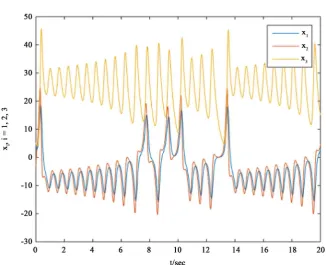
a= b= c= . Figure 1 and Figure 2 depict the chaotic attractor
[image:9.595.209.536.102.722.2] [image:9.595.214.535.228.430.2]and components of the Lorenz system respectively. The coupling configuration matrix G=
( )
gij is chosen to beFigure 1. Chaotic attractor of the Lorenz system.
[image:9.595.210.537.450.715.2]1 0 1
1 1 0
0 1 1
−
= −
−
G
Complex networks with proportional delays can be described as follows:
( )
( )
( )
( )
( )
(
)
( )
(
)
( )
( )
( ) ( )
( )
( )
( )
2 1
1 3
2 3 1 2
1 3
1 2 3
10
28 , 1, 2, 3
8 3
i i
i
i i i i ij j ij i
j i
i i i
x t x t
x t
x t x t x t x t g q t t i
x t
x t x t x t
=
−
= − − + + =
−
∑
x u
(4.2)
where the controllers ui
( )
t satisfied:( )
( )
e t i t = iU u , Ui
( )
t can be designed by using Theorem 2 as follows:( )
( )
( )
(
)
( )
(
)
( )
( )
( ) ( )
( )
( )
( )
(
)
(
(
( )
( )
)
)
( )
(
)
( )
( )
( )
( )
2 1 1 1
1 2 3
3 1 2 2 2
3 3
1 2 3
10
28 e
8 3
i i i i
t
i i i i i i i i i
i i
i i i
y t y t sgn e t e t
t y t y t y t k t k t sgn e t k t e t
e t
sgn e t
y t y t y t
−
= − − − + − − −
−
U
with
( )
( )
(
( )
)
( )
( )
(
( )
)
( )
( )
3 1 1
1 3 2 2
1 3 3 3 2
1
e
i i ij ij
j
t
i i ij ij
j
i i ij
j
k t l t sgn t
k t l t sgn t
k t l t
=
=
=
=
=
=
∑
∑
∑
e e
e e
e
where yi
( )
t =xi( )
et , ei( )
t = yi( )
t −M( ) ( )
t y t , i=1, 2, 3.In this numerical simulation, we take the initial states as
( )
[
]
T 1 0 3 4 4x = − ,
( )
[
]
T2 0 4 1 4
x = − , x3
( )
0 = −[
2 0 5]
T, x( )
0 =[
5 −3 5]
T. We take k11( )
0 =1,( )
1 2 0 2
k = , k31
( )
0 =3 , k12( )
0 =4 , k22( )
0 =5 , k32( )
0 =6 , k13( )
0 =12 ,( )
3
2 0 15
k = , 3
( )
3 0 16
k = , 3
( )
3 0 16
k = and
( )
4 sin2π , 4 cos2π , 4 sin2π10 10 10
t t t
t =diag + + +
M . The numerical results are
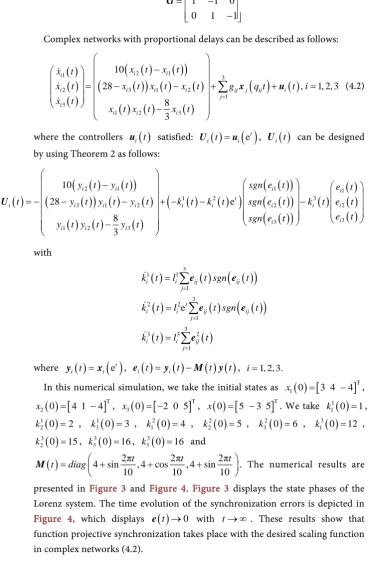
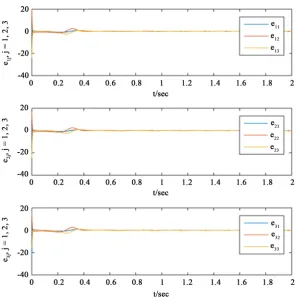
[image:10.595.173.544.93.662.2]presented in Figure 3 and Figure 4. Figure 3 displays the state phases of the Lorenz system. The time evolution of the synchronization errors is depicted in
Figure 4, which displays e
( )
t →0 with t→ ∞. These results show thatfunction projective synchronization takes place with the desired scaling function in complex networks (4.2).
5. Concluding Remarks
Figure 3. State phases of the Lorenz system.
Figure 4. The time evolution of the synchronization errors e.
Acknowledgements
[image:11.595.225.522.336.635.2]References
[1] Ott, E., Grebogi, C. and Yorke, J.A. (1990) Controlling Chaos. Physical Review Let-ters, 11, 1196-1199. https://doi.org/10.1103/PhysRevLett.64.1196
[2] Gang, H. and Qu, Z.L. (1994) Controlling Spatiotemporal Chaos in Coupled Map Lattice Systems. Physics Letters A, 72, 68-73.
https://doi.org/10.1103/PhysRevLett.72.68
[3] Carroll, T.L. and Pecora, L.M. (1990) Synchronization in Chaotic Systems. Physical Review Letters, 64, 821-824. https://doi.org/10.1103/PhysRevLett.64.821
[4] Yang, T. (2004) A Survey of Chaotic Secure Communication Systems. International Journal of Computational Vision and Robotics, 2, 81-130.
[5] Lu, J.Q. and Cao, J.D. (2005) Adaptive Complete Synchronization of Two Identical or Different Chaotic (Hyperchaotic) Systems with Fully Unknown Parameters. Chaos, 15, 4-9. https://doi.org/10.1063/1.2089207
[6] Wang, T., Li, T., Yang, X., Fei, S. (2012) Cluster Synchronization for Delayed Lur’e Dynamical Networks Based on Pinning Control. Neurocomputing, 83, 72-82. [7] Shahverdiev, E.M. and Sivaprakasam, S. (2002) Lag Synchronization in Time
De-layed Systems. Physics Letters A, 292, 320-324. https://doi.org/10.1016/S0375-9601(01)00824-6
[8] Rulkov, N.F., Sushchik, M.M. and Tsimring, L.S., et al. (1995) Generalized Syn-chronization of Chaotic Oscillators. Physical Review Letters, 51, 980-994.
[9] Wang, L., Qian, W. and Wang, Q. (2015) Bounded Synchronization of a Time Va-rying Dynamical Network with Nonidentical Nodes. International Journal of Sys-tems Science, 46, 1-12. https://doi.org/10.1080/00207721.2013.815825
[10] Rosenblum, M.G., Pikovsky, A.S. and Kurths, J. (1996) Phase Synchronization of Chaos in Directionally Coupled Chaotic Systems. Physical Review Letters, 761, 804- 807.
[11] Kim, C., Rim, S., Kye, W., Yu, J.R. and Park, Y. (2003) Anti-Synchronization of Chaotic Oscillators. Physics Letters A, 320, 39-46.
https://doi.org/10.1016/j.physleta.2003.10.051
[12] Mainieri, R. and Rehacek, J. (1999) Projective Synchronization in Three-Dimen- sional Chaotic Systems. Physical Review Letters, 82, 3042-3045.
[13] Tang, X., Lu, J. and Zhang, W. (2007) The FPS of Chaotic System Using Backstep-ping Design.International Journal of Dynamics and Control, 5, 216-219.
[14] Chen, Y. and Li, X. (2009) Function Projective Synchronization between Two Iden-tical Chaotic System. Chaos, Solitons & Fractals, 42, 2399-2402.
https://doi.org/10.1016/j.chaos.2009.03.120
[15] Du, H., Zeng, Q. and Wang, C. (2010) Modified Function Projective Synchroniza-tion of Chaotic Systems. Nonlinear Analysis: Real World Applications, 11, 705-712. [16] Park, J., Lee, J. and Won, S. (2013) Modified Function Projective Synchronization
for Two Different Chaotic Systems Using Adaptive Fuzzy Nonsingular Terminal Sliding Mode Control. 13th International Conference on Control, Automation and Systems, Gwangju, 20-23 October 2013, 28-33.
https://doi.org/10.1109/iccas.2013.6703858
[17] Li, J. and Li, N. (2011) Modified Function Projective Synchronization of a Class of Chaotic Systems. Acta Physica Sinica, 60, 147-149.
Design and Engineering Applications,Gwangju, 6-7 November 2013, 382-385. [19] Feng, M. (2013) Adaptive Modified Function Projective Synchronization for
Com-plex Four-Dimensional Chaotic Systems. Proceedings of 2013 International Confe-rence on Computing, Networking and Communications, Honolulu, 3-6 February 2013, 1537-1541.
[20] Du, H., Lu, N. and Li, F. (2012) Modified Function Projective Synchronization of Two Different Chaotic Systems with Parameter Perturbations. Proceedings of 2012 International Conference on Measurement, Information and Control, Harbin, 18-20 May 2012, 761-764.
[21] Lu, J. and Cao, J. (2009) Synchronization-Based Approach for Parameters Identifi-cation in Delayed Chaotic Neural Networks. Physics Letters A, 382, 672-682.
Submit or recommend next manuscript to SCIRP and we will provide best service for you:
Accepting pre-submission inquiries through Email, Facebook, LinkedIn, Twitter, etc. A wide selection of journals (inclusive of 9 subjects, more than 200 journals)
Providing 24-hour high-quality service User-friendly online submission system Fair and swift peer-review system
Efficient typesetting and proofreading procedure
Display of the result of downloads and visits, as well as the number of cited articles Maximum dissemination of your research work