Socio-maternal risk factors of ADHD among Iraqi
children: A case-control study
Hussain R. Saadi1*, Khadijah Shamsuddin1, Rosnah Sutan1, Serene A. Alshaham2
1Department of Community Health, Universiti Kebangsaan Malaysia Medical Centre, Kuala Lumpur, Malaysia;
*Corresponding Author: [email protected]
2Department of Family Medicine, University Malaya Medical Centre, Kuala Lumpur, Malaysia
Received 16 January 2013; revised 12 March 2013; accepted 19 April 2013
Copyright © 2013 Hussain R. Saadi et al. This is an open access article distributed under the Creative Commons Attribution License,
which permits unrestricted use, distribution, and reproduction in any medium, provided the original work is properly cited.
ABSTRACT
Background: Attention-deficit hyperactivity dis- order (ADHD) is a chronic disorder that appears first in childhood at preschool age (4 - 5) years, and is manifested by a symptomatic pattern of difficulties with attention, motor activity and impulsivity. Maternal factors like stress, socio- demographic and maternal life style factors are potential risk factors for ADHD. Methodology: A retrospective case-control study was conducted in Baghdad-Iraq. Cases have been taken from 5 private paediatric clinics. Controls were chosen from kindergartens within the same residential area of the paediatric private clinics. Mothers of cases and controls were investigated for the risk factors of ADHD using a self-administered ques- tionnaire. The total sample size was 260. Num- ber of cases was 130 and number of controls was 130. Results: Five variables were signifi- cantly associated with development of ADHD after using a multivariate logistic regression model, maternal war stress (Adjusted OR 9.08, 95% CI 4.70 - 17.52 and P value < 0.001), mater- nal smoking (Adjusted OR 3.27 95% CI 1.40 - 7.63, P < 0.001), father lost job (Adjusted OR 2.81, 95% CI 1.51 - 5.24, P value < 0.001), and house damaged (Adjusted OR 2.55, 95% CI 1.04 - 6.24, P < 0.05). Family income was also associated with risk of ADHD (OR 1.02 95% CI 1.00 - 3.12, P value < 0.05). Conclusion and suggestion: Ma- ternal exposure to war stress has 9 times higher risk of developing ADHD among offspring. This study aimed to offer to the policy makers a good benchmark to plan more programmes related to women and child health with respect to the fourth and fifth Millennium Development Goals (MDGs) in reduction of child mortality and mor-
bidity and improvement of maternal health. There is a real necessity to address the need of vul- nerable pregnant mothers at war and disaster’s time for programmes which will be able to con- trol the stress that those pregnant mothers would encounter during those hard times.
Keywords:
ADHD; Socio-Maternal; Risk Factors;
Case-Control1. INTRODUCTION
Attention-deficit hyperactivity disorder (ADHD) is one of the most common mental disorders, affecting both children and adolescents with prevalence in no referred samples of 3% - 10% [1]. ADHD is also considered the most common cognitive and behavioral disorder diag- nosed among school children) [2].
ADHD is a neurobehavioral disorder characterized by pervasive inattention and/or hyperactivity-impulsivity resulting in a significant functional impairment mainly problem solving, deficient attention along with hyperac- tivity and difficulty withholding incorrect answers [3].
Although, the prevalence of ADHD decreases with increasing age, symptoms persist throughout adulthood in about 50% of affected children [4].
If left untreated, the symptoms of ADHD can signifi- cantly affect a child’s academic and social functioning. Moreover, these symptoms have been shown to predis- pose patients to accidents due to their inattentive state. In general, there are 2 types of ADHD. These are the inat- tentive and hyperactive/impulsive types according to the Diagnostic and Statistical Manual of Mental Disorders, The Fourth Edition (DSM IV) [3].
etiology of ADHD, most investigators endorse a neural foundation to the origin of the disorder [6].
The etiology of ADHD is multifactorial. There are many factors whether directly or indirectly affecting the individual and can lead to the development of ADHD. In order to understand the etiology of ADHD we need to classify it into many risk factors which can cause ADHD. The mechanism by which maternal stress causes devel- opmental problems in offspring is still unclear, but sev- eral hypotheses exist. Even though there are no direct connections between the maternal and foetal nervous systems, the mother’s emotional state can influence the foetus’s reactions and development [7].
It has been shown that, the activation of the sympa- thetic nervous system which, occurs during stress, causes an increase in uterine artery resistance that subsequently reduces blood flow to the fetus [7]. This decrease in blood flow to the fetus may impair the development of organs, including the brain of the fetus. Moreover, it has been shown that, although 50% - 90% of the cortisol which is released in the mother’s blood in response to maternal stress, is deactivated by special enzyme, a cer- tain amount of cortisol can escape this deactivation and reaches the fetus [8]. By this mechanism, the increased fetal cortisol can alter the development of the baby’s nervous system and deregulate the hypothalamo-pitui- tary-adrenal (HPA) axis in the fetus, causing deregulated HPA response to stress in the child postnatally (ADHD like disorder).
In human being, gestational stress has been shown to be a potential factor associated with a higher risk to de- velop some neurological and psychiatric disorders. Similarly, in animal models, stress can induce lasting deficits in the offspring. Long-lasting effects of stress have been linked to disturbances in the function of the hypothalamo-pituitary-adrenocortical axis. Moreover, stress during pregnancy may cause alteration in brain devel- opment, leading to altered synaptic connectivity and per- sistent deficits in brain function [9].
A direct link between antenatal maternal mood and fe- tal behavior was observed by ultrasound from 27 to 28 weeks of gestation onwards [10]. Moreover, 14 inde- pendent prospective studies have shown a link between antenatal maternal anxiety or stress and cognitive, be- havioural, and emotional problems in the child. This link generally persisted after controlling for postnatal mater- nal mood and other relevant confounders in the pre- and post-natal periods [11].
Stress following wars and disasters is considered ca- pable of affecting pregnant mothers. In a study by Xiong et al. of 301 women from New Orleans and Baton Rouge, pregnant women were interviewed about their experi- ences during the hurricane, and whether they experienced
symptoms of post-traumatic stress disorder (PTSD) or depression. In this study, “high hurricane exposure” was defined as having experienced 3 or more of the 8 severe hurricanes to have hit the area, having gone through the feeling that one’s life was in danger, have walked through floodwaters, or have had a loved one die.
The conclusion derived from that study was that women who have had high hurricane exposure were at an increased risk of having low birth weight infants. Rather than a general exposure to disaster, exposure to specific severe disaster events and the intensity of the disaster experience may be better predictors of poor pregnancy outcomes. It was suggested that to prevent poor preg- nancy outcomes during and after disasters, future disaster preparedness may need to include the planning of earlier evacuation of pregnant women to minimize their expo- sure to severe disaster events [12].
The effects of natural disasters, war, and family vio- lence on the mental health of 296 children and adoles- cents in Sri Lanka were studied. These children and ado- lescents (9 to 15 years old), who were exposed to civil war and the Asian Tsunami, completed a survey regard- ing war-related events, tsunami exposure, and family violence. Of those surveyed, 82% had experienced at least 1 war-related event in their lifetimes. The most common events were seeing a dead or mutilated body (44%), being close to a combat situation (40%), and witnessing gunfire or shelling (33%). Seventy-one per- cent of the children were directly affected by the tsunami; more than half had seen the wave close by; almost all had to flee; and about a quarter had been caught by the wave [13].
In another study, the efficacy of school-based inter- vention was assessed in a sample of 403 children (mean age, 10 years) who had been exposed to armed conflict in Central Sulawesi, Indonesia. These children had symp- toms of PTSD and anxiety. They were randomized to a 15-session, school-based intervention or a wait-list con- trol group. The intervention included cognitive-beha- vioral techniques, cooperative play, and creative-expres- sive elements (e.g., drama, dance, music).
2. METHODS AND MATERIALS
In the present study, the aim was to include children of all types of ADHD as cases regardless what type of ADHD they are.
A total number of 260 participants were chosen for retrospective case-control study (one hundred and thirty cases and 130 controls). This study was carried out in Baghdad city (The Capital city of Iraq) where most of the war events in 2003 happened, which gives the re- searcher a great opportunity to assess the correlation be- tween ADHD as a dependent variable of this study and maternal war stress and other independent variables like sociodemographic and maternal life style variables.
Baghdad city is a big city with nearly 6.5 million populations. It is a multiethnic, multinational and multi religious city which gives the researchers more freedom to generalize the findings.
Populations for this study were preschool children (4 - 6 years old) with their mothers along. Cases were chosen from 5 private pediatric clinics in districts of Baghdad city. Controls were chosen from 20 kindergartens within the same geographical zone of the private pediatric clin- ics. Cases were diagnosed as ADHD by consultant Pe- diatricians using the Diagnostic and Statistical Manual of Mental Disorders, form, the fourth edition (DSM IV).
Sampling method for cases was simple random sam- pling by choosing 130 children randomly from a pool containing 520 children diagnosed with ADHD. Sam- pling method or technique for controls was systematic sampling by choosing 130 names of 4 - 6 years old chil- dren from a list of 1300 children; each 10th name was chosen (systematic random sampling). Inclusion criteria were: children (4 - 6 years old), born and cared by their biological mothers, Iraqis, and their mothers are still alive to be contacted. Exclusion criteria were: Children who may have a history of other mental disorder like mental retardation or psychoses which might interact with ADHD diagnosis.
Mothers of cases and controls were contacted and were asked to sign consent forms participate in this study. Then a self-administered questionnaire was dispersed to all mothers. Response rate was 100%. The questionnaire contained questions related to sociodemographic charac- teristics of those mothers, maternal life style (mainly smoking and caffeine intake during pregnancy). Maternal stress questionnaire was developed based on some parts of the Harvard post-traumatic stress questionnaire (the Arabic version). The stress questionnaire included 10 very specific questions related to events or scenarios of wars. Each yes answer is given 1 point and no answer a zero point. Scoring for the stress is as following: 0 = No stress, 1 - 5 = mild-moderate stress, more than 5 is severe stress. In our study, we decided to consider the severe
stress as a risk factor for ADHD. We did extra validation for the questionnaire and a pretest for the participants was done for 30 mothers to ensure that the questionnaire items were easily understood. Approval for this study was obtained from the pediatric private clinics and from the kindergarten’s management. The study was con- ducted between June-September 2008.
3. RESULTS
Table 1 shows sociodemographic and lifestyle distri- bution of study samples (N = 300).
The highest percentages of mothers enrolled in the study aged 25 - 33 (47.7% for mothers of cases and 46.2% for mothers of controls). Arabic mothers were the most participants compared to Kurdish and Turkman.
Table 2 shows that 65.4% of mothers of cases were significantly exposed to stress during pregnancy com- pared to only 13.8% of mothers of controls (P value < 0.001). This indicates that more mothers of ADHD chil- dren were exposed to stress during pregnancy than moth- ers of children who do not have ADHD.
There was about 27.7% of mothers of cases who were significantly exposed to cigarette smoking during preg- nancy compared to only 8.5% of mothers of controls, (P value < 0.001). This means more mothers of ADHD chil- dren were smokers during pregnancy than mothers of children who do not have ADHD.
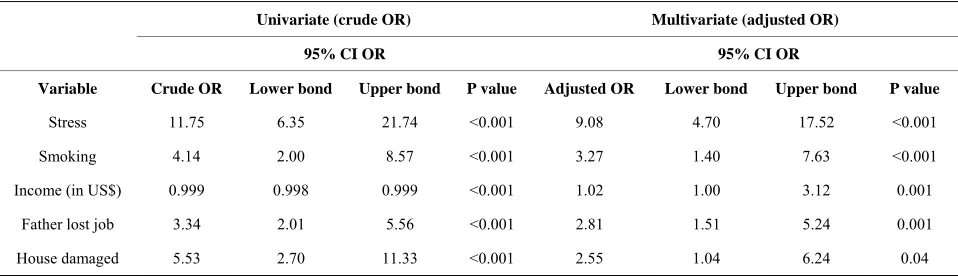
Table 3 shows univariate and multivariate logistic re- gression analyses. The full model included the 9 signifi- cant variables; income, stress, smoking, family member hit & injured, father lost the job and house damaged & relocate, family member hit at war family member died at war house damaged. After adjusting the effect of the independent variables, the final model included only five variable as shown below which gives Hosmer and Le- meshow Test P = 0.924 ( goodness of fit of the model).
Looking into the final model, the stress factor was in- dependently significant, with an adjusted odd ratio of 9.08 (95%CI 4.70 - 17.52, P < 0.001). Smoking was also independently significant, with an adjusted odd ratio of 3.27 (95% CI 1.40 - 7.63 P < 0.001). The income vari- able had also a significant association with ADHD (ad- justed OR 1.02 95%1.00 - 3.12, P < 0.001). Another in- dependently significant variable was loss of father’s job with an adjusted odd ratio of 2.81 (95% CI 1.51 - 5.24 P < 0.001). The last independently significant variable was house damaged with an adjusted odd ratio of 2.55 (95% CI 1.04 - 6.22 P value < 0.05).
4. DISCUSSION
Table 1. Distribution of selected sociodemographic and life style characteristics of mothers and children participating in the study.
Variable %
Mother age group
≤24 31.1
25 - 33 46.9
34 - 41 20.8
>41 1.2
Mother race
Arabic 88.1
Kurdish 6.1
Turkman 5.8
Employment
Yes 62.7
No 37.3
Educational level
Illiterate 10
Primary 16.2
Secondary 23.8
Graduate 25
Postgraduate 25
Gender of child
Male 44.2
Female 55.8
Smoking status
Zero cigarette per day 80.8
1 - 9 cigarettes per day 12.7
≥10 cigarettes per day 6.5
Drinking coffee
Zero cup per day 71.2
One cup per day 17.3
More than one cup per day 11.5
Drinking tea
Zero cup per day 39.2
One cup per day 16.9
two cup per day 23.1
More than 3 cups 20.8
Table 2. Bivariate analyses of Sociodemographic, maternal life style and stress among cases and controls.
ADHD (%) Factors
Yes % No % Odd ratio P value
Stress during pregnancy 11.75 <0.001
Yes 65.4 13.8
No 34.6 86.2
Smoking during pregnancy 4.14 <0.001
Yes 27.7 8.5
No 72.3 91.5
Coffee drinking in pregnancy 1.30 0.34
Yes 31.5 26.2
No 68.5 73.8
Age of mother at pregnancy
of enrolled child 1.00 0.86
≤24 30 32.3
25 - 33 47.7 46.2
34 - 41 22.3 19.2
>41 0 2.3
Education 1.13 0.14
Illiterate 12.3 7.7
Primary 16.2 16.2
Secondary 26.9 20.8
Graduate 26.1 23.8
Postgraduate 18.5 31.5
Mother employment 0.90 0.248
Yes 59.2 66.1
No 40.8 33.9
ing a child affected with ADHD. Exposure to other so- ciodemographic, and maternal life style risk factors like cigarette smoking and caffeine ingestion among mothers of cases and controls were identified.
[image:4.595.128.524.112.722.2]Table 3. Crude and adjusted odd ratios of significant variables.
Univariate (crude OR) Multivariate (adjusted OR)
95% CI OR 95% CI OR
Variable Crude OR Lower bond Upper bond P value Adjusted OR Lower bond Upper bond P value
Stress 11.75 6.35 21.74 <0.001 9.08 4.70 17.52 <0.001
Smoking 4.14 2.00 8.57 <0.001 3.27 1.40 7.63 <0.001
Income (in US$) 0.999 0.998 0.999 <0.001 1.02 1.00 3.12 0.001
Father lost job 3.34 2.01 5.56 <0.001 2.81 1.51 5.24 0.001
House damaged 5.53 2.70 11.33 <0.001 2.55 1.04 6.24 0.04
behavioral problems [14].The current study supports the present literature which indicates that, exposure of the pregnant mother to stress exposes her foetus to the same sort of stress too [7].
Another study highlighted this association [15] who suggested that, especially during months 3 to 5 and 9 to 10 of pregnancy, maternal stress may increase the risk of the child for psychiatric disorders. These findings were similar with all previous studies which showed that child behavioral disturbance was directly related to maternal stress [16]. Although many studies have found a correla- tion between maternal stress and the subsequent devel- opment of ADHD symptoms in children [17] including this current study, but this association may not necessar- ily be a causal relationship. As ADHD is a very heritable disorder. It might be that, mothers who have experienced greater prenatal stress have a more significant history of ADHD themselves and confer greater genetic risk for ADHD to their offspring. Bearing in mind that our study did not investigate the genetic risk factor of developing ADHD, this would possibly constitute a limitation to our current study.
Another significant association in our study was an independent three-fold increased risk for ADHD associ- ated with maternal exposure to nicotine smoking (Ad- justed OR 3.27 95% CI 1.40 - 7.63 and P value < 0.001). In other words we can simply infer that, mothers who smoked during pregnancy were 3 times more susceptible to have children affected with ADHD. There is a contro- versy in the literature on this issue. One researcher [18] on twin siblings study found that, risk for ADHD was not significantly increased in subjects whose, mothers smok- ed during pregnancy.
Another researcher [19] however, found a positive as- sociation between smoking during pregnancy and ADHD in a big population-based sample. In one study [20] they have also found the same results.
On the other hand, there were many human studies which failed to find a significant link between maternal smoking during pregnancy and ADHD in the offspring.
On contrary they found a protective association. One researcher [21] found a lower score on general cognitive functioning in 3-year-old children of mothers who smoked ≥ 10 cigarettes throughout pregnancy as com- pared with children whose mothers quit smoking just before pregnancy.
In spite of the findings of this current study of a sig- nificant association between maternal smoking and ADHD in the offspring, as well as some other similar findings in clinical studies, much more attention and caution should be paid before concluding that, those as- sociations are causal relationships. One of the limitations of this study regarding the maternal smoking factor was that, only smoking status during pregnancy was investi- gated but the number and types of smoking were not included in this study.
Out of the other risk factors investigated in this study, we found an independent 2 fold increased risk for ADHD associated with one of the war stressors which is the damage of the family house and relocation. There was also an independent 3 fold increased risk for ADHD as- sociated with another war stressor which is the loss of job for the father. Those stressors reflect the specific entity of the stress that most affected the pregnant mother. Stress in general was significant factor.
The last significant association in this study was the income of the family. The study found a significant as- sociation between the income of the family and ADHD (adjusted OR 1.02 95% 1.00 - 3.12, P < 0.001). The load of work pressure that the middle and high income fami- lies face may have a negative impact on their children. This fact may well explain the finding of this association.
qualitatively different information than mothers of con- trols. It is difficult to predict in which direction this bias would impact the current findings.
Mothers of children with ADHD might have been more keen to discover the main reason behind their chil- dren’s disorder, and could have inspired themselves more to remember the previous levels of exposure with very specific details. This may lead to inaccurate in- crease in odds ratio. On the other hand, mothers of ADHD children who have used substances during their pregnancy like nicotine or caffeine may feel guilty and therefore, try to underestimate their true levels of use more than mothers who have also used these substances during pregnancy but their children did luckily not suffer any illness or disorder. In this case the true odds ratio would have also been incorrectly decreased this time.
This study is one of the few studies that investigated the war effect on children. To our knowledge it’s the first study in Iraq investigating the association of war stress and ADHD. The place of the study is Baghdad (the Capital of Iraq) which is a big city with different, ethnic, national and religious backgrounds gives the study more strength and giving us more freedom to generalize our findings to all Iraq. Finally the multivariate logistic re- gression model used in the analyses of this study helped in adjusting and clearing the effects that may arise from effects of independent variables on each other’s and con- trolled for confounders.
On Post-traumatic stress among pregnant mothers, this study suggests psychosocial care in wars and disasters which involves:
1) Community self-help groups for emotional support and reestablishment of social connections;
2) Relaxation exercises for controlling and mastering physiological and psychological stress reactions, includ- ing hyper vigilance and avoidance;
3) Cultural metaphors and spiritual beliefs to facilitate cognitive processing and coming to terms with an over- whelming experience.
Protecting the pregnant mother and her baby from ex- posure to pollutants and toxins, including cigarette smoke, agricultural or industrial chemicals, is another recommendation that this study suggests in order to pre- vent ADHD occurrence in children.
Last but not least, this study aims to present policy makers a good benchmark for planning more pro- grammes related to women and child health with respect to the fourth and fifth Millennium Development Goals (MDGs) for reduction of child mortality and morbidity and improvement of maternal health.
Attention deficit hyperactivity syndrome is a subject which draws attention of many scientists and physician worldwide due to the vague nature of the causes of it. The study which we did was a retrospective case-control
study focusing on children with ADHD. It would be in- teresting in the future to follow a prospective cohort from conception to birth to latency age to examine how stress and other environmental factors would affect the devel- opment of various psychopathologies and how maternal stress influences the expression of selective symptoms in children who may be genetically predisposed to certain psychopathologies.
REFERENCES
[1] Faraone, S.V., Sergeant, J.A., Gillberg, C. and Biederman,
J. (2003) The worldwide Prevalence of ADHD: Is it an American condition? World Psychiatry, 2, 104-113.
[2] Rohade, L.A., Beiderman, J., Busnello, E.A., et al. (1999)
ADHD in a school sample of Brazilian Adolescents: A study of prevalence, comorbid conditions, and impair-
ments. Journal of the American Academy of Child &
Adolescent Psychiatry, 38, 716-722.
doi:10.1097/00004583-199906000-00019
[3] Behrman, E. and Kleigman, M.J. (2004) Attention deficit
hyperactivity disorder: Psychologic disorders. Nelson Text-
book of Pediatrics, 3, 70-73.
[4] Biederman, J. and Faraone, S.V. (2005) Attention deficit
hyperactivity disorder. Lancet, 48, 327-366.
[5] AlObaidi, A. and Ali, N.S. (2009) Attention deficit/hy-
peractivity disorder among schoolchildren in Baghdad.
Journal of the American Academy of Child and Adoles- cent Psychiatry, 18, 4-5.
[6] Barkley, R.A., DuPaul, G.J. and McMurray, M.B. (1990)
A comprehensive evaluation of attention deficit disorder
with and without hyperactivity. Journal of Consulting and
Clinical Psychology, 58, 775-789.
doi:10.1037/0022-006X.58.6.775
[7] Teixeira, J.A.M., Fisk, N.M. and Glover, V. (1999) Asso-
ciation between maternal anxiety in pregnancy and in- creased uterine artery resistance index: Cohort based study. British Medical Journal, 318, 153-157.
doi:10.1136/bmj.318.7177.153
[8] Modell, M., Mughal, Z. and Boyd, R. (1998) Brain de-
velopment of the fetus: Neurological development of at- tention. Brain Development in Pediatrics, 6, 92-96.
[9] Rangon, C.M., Fortes, S., Lelièvre, V., Leroux, P., Plai-
sant, F., Joubert, C., Lanfumey, L., Cohen-Salmon, C. and Gressens, P. (2007) Chronic mild stress during gestation
worsens neonatal brain lesions in mice. Journal of Neu-
roscience, 27, 7532-7540.
[10] Barrot, M., Marinelli, M., Abrous, D., Pont, F., Moal, M.
and Piazza, P. (2001) The dopaminergic hyper-respon- siveness of the shell of the nucleus accumbens is hormone-
dependent. European Journal of Neuroscience, 12, 973-
979. doi:10.1046/j.1460-9568.2000.00996.x
[11] Van den Berg, M.P. (2005) Prenatal psychopathology and
the early developing child: The generation R study. Euro-
pean Journal of Neuroscience, 17, 55-58.
[12] Xu, X., Harville, E.W., Mattison, D.R., Elkind-Hirsch, K.,
Katrina, post-traumatic stress disorder and birth outcome: Errature. American Journal of Medical Sciences, 341, 85.
[13] Catani, C., Jacob, N., Schauer, E., et al. (2008) Family
violence, war, and natural disasters: A study of the effect of extreme stress on children’s mental health in Sri Lanka.
BMC Psychiatry, 8, 33. doi:10.1186/1471-244X-8-33
[14] Tol, W.A., Komproe, I.H., Susanty, D., et al. (2008)
School-based mental health intervention for children af- fected by political violence in Indonesia: A cluster ran-
domized trial. Journal of the American Medical Associa-
tion, 300, 655-662. doi:10.1001/jama.300.6.655
[15] Wadhawa, P. (1998) Prenatal stress and life-span devel-
opment. In: Friedman, H.S., Ed., Encyclopedia of Mental
Health, Academic Press, San Diego, 265-280.
[16] Huttunen, M.O. and Niskanen, P. (1987) Prenatal loss of
father and psychiatric disorders. Archives of General
Psychiatry, 35, 429-431.
doi:10.1001/archpsyc.1978.01770280039004
[17] Mash, E.J. and Johnston, C. (1990) Determinants of par-
enting stress: Illustrations from families of hyperactive
children and families of physically abused children. Jour-
nal of Clinical Child Psychology, 19, 313-328.
doi:10.1207/s15374424jccp1904_3
[18] Knopik, V.S., Sparrow, E.P., Madden, P.A., et al. (2005)
Contributions of paternal alcoholism, prenatal substance exposure, and genetic transmission to child ADHD risk: A female twin study. Psychological Medicine, 35, 625-635.
doi:10.1017/S0033291704004155
[19] Linnet, K.M., Wisborg, K., Obel, C., et al. (2005) Smok-
ing during pregnancy and risk of hyperkinetic disorder in offspring. Pediatrics, 116, 462-467.
doi:10.1542/peds.2004-2054
[20] Langley, K., Rice, F., Van den Bree, M.B. and Thapar, A.
(2005) Maternal smoking during pregnancy as an envi- ronmental risk factor for attention deficit hyperactivity disorder behavior: A review. Minerva Pediatrica, 57, 359- 371.
[21] Sexton, M., Fox, N.L. and Hebel, J.R. (1990) Parental