ISSN Online: 2158-2750 ISSN Print: 2158-2742
Improved Representation of Biological
Information by Using Correlation as Distance
Function for Heatmap Cluster Analysis
Axel Tiessen1, Edgar A. Cubedo-Ruiz1, Robert Winkler2
1Department of Genetic Engineering, Cinvestav Irapuato, Irapuato, Mexico
2Department of Biochemistry and Biotechnology, Cinvestav Irapuato, Irapuato, Mexico
Abstract
Heatmap cluster figures are often used to represent data sets in the omic sciences. The default option of the frequently used R heatmap function is to cluster data according to Euclidean distance, which groups data mainly to their numerical value and not to its relative behaviour. The disadvantage of using the default clustering dendrograms of R is demonstrated. Instead, a script is provided that uses correlation as distance function, which better re-veals biologically meaningful information. This optimized script was used to detect heterotic groups in Vitamaize hybrids (purple maize with high nutra-ceutical value). A field trial with different genetic combinations was per-formed through an agricultural phenomics approach (holistic evaluation of the phenotype). The grain yield data and other phenotypic variables were represented through heatmap figures. In the data set of Mexican tropical ma-ize germplasm, at least three heterotic groups were detected, in contrast to only two heterotic groups reported earlier in temperate yellow maize from USA and Europe. This optimized script for heatmap correlation bicluster can also be used to better represent metabolomic fingerprints and transcriptomic data sets.
Keywords
Clusters, Corn, Dendogram, Grain Yield, Heterosis, Hybrid Vigour, Plant Breeding, Phenotyping, Pearson Correlation Coefficient, Zea mays
1. Introduction
The bidirectional linkage between the genotype and the phenotype is one of the central challenges of experimental research in biological systems. To better un-derstand the complexity of living organisms, the omic sciences such as genomics
How to cite this paper: Tiessen, A., Cu-bedo-Ruiz, E.A. and Winkler, R. (2017) Improved Representation of Biological Information by Using Correlation as Dis-tance Function for Heatmap Cluster Analy-sis. American Journal of Plant Sciences, 8, 502-516.
https://doi.org/10.4236/ajps.2017.83035
Received: November 7, 2016 Accepted: February 14, 2017 Published: February 17, 2017
Copyright © 2017 by authors and Scientific Research Publishing Inc. This work is licensed under the Creative Commons Attribution International License (CC BY 4.0).
http://creativecommons.org/licenses/by/4.0/
[1], transcriptomics [2][3], proteomics [4], metabolomics [5][6][7], and phe-nomics [8] are continuously developing new technologies that generate a large amount of digital data from nucleic acids, proteins, and metabolites. Bioinfor-matic [9], chemometric [10], cell fractionation [11], and biostatistical methods
[12] are optimized in parallel, to automatize data mining, so that biological meaningful conclusions can be drawn from the vast amounts of numbers and letters. Raw data from the omic experiments need to be analysed and converted into figures, models, and other visual representations to be shared among the scientific community. The holistic measurement of the phenotype of a crop plant such as maize or rice is the main objective of agricultural phenomics, also called field-omics [13]. Currently, yield and phenotypic data obtained by public breeding institutions such as Centro Internacional de Mejoramiento de Maiz y Trigo (CIMMYT) and the International Rice Research Institute (IRRI) are mostly provided as numbers within large tables in spreadsheet format. Numeri-cal field trial data of phenomic experiments need to be converted into adequate charts to better visualize the major environmental and genetic effects [14][15].
One of the most powerful types of figures for that purpose is heatmap biclus-ters. These can be produced in the statistical programming environment R [16], which is widely used in the scientific community of genomics. Heatmaps can summarize data from large transcriptomic [2] and metabolomic experiments
[17]. The data from rows and columns can be rearranged automatically employ-ing different clusteremploy-ing algorithms [18]. Generated dendrograms demonstrate the relationships between groups in rows and columns. Since heatmaps have not yet been used for agricultural phenomics, we tested the algorithms for plant breeding and other heterogenic phenotypic data types. The default parameters of R heatmap function produced a graph that is not congruent with the real bio-logical context. Thus, we created an R script that uses correlation as a distance measure for clustering and tested this procedure in several scenarios and data sets that are typical of plant research, molecular breeding, and biochemical phe-notyping.
Heterosis in plants is reflected by the fact that plants from the F1 generation (cross between two parents A × B) have much more vigour and produce higher grain yield than the parental homozygous lines A and B. Heterosis in crop plants such as maize is caused by genetic [19] [20] and epigenetic factors [21], both with additive and non-additive effects (e.g. overdominance). Heterotic vigour of corn provides the economic basis of a billion dollar business for selling hybrid seeds with agrochemicals in a package [22]. Breeding programs of modern corn varieties in Europe and USA usually consider only two heterotic groups, the northern flint and the southern dent types [23]. Inbred lines of these two hete-rotic groups are sexually crossed in order to produce a commercial F1 hybrid
[24]. For example, the line B73 has typically been crossed with the line Mo17 resulting in a hybrid with larger cobs and higher grain yield [25].
prop-erties, such as grain colour, cob size, and biochemical profile are available in the gene pool [27]. Therefore, it can be expected that heterotic patterns in tropical and subtropical maize are different and not limited to only two groups such as in Europe and the USA.
In an effort to produce more nutritious corn for human consumption, the Vi-tamaize breeding program of the department of genetic engineering of CINVESTAV Irapuato has developed several tropical maize varieties that have grains with higher levels of antioxidants such as anthocyanins, phenols, and ca-rotenes. Through sexual breeding (non-transgenic approach), inbred lines were generated that have dark purple grain colour. We started the work with the fol-lowing questions: Are the default clustering parameters of R heatmaps adequate to represent the data from phenomic experiments? Could an optimized R script better reveal the heterotic pattern of tropical Vitamaize? How many heterotic groups can be found in a small set of twelve inbred Vitamaize lines?
2. Methods
2.1. Biological Materials: Vitamaize Lines and Hybrids
Our research group developed, through a non-transgenic approach (sexual breeding), several new varieties of tropical purple corn. We started with Mexican landraces of purple colour (Xoxocotla and Tepalcingo) as donor parents and elite homocygotic lines from the subtropical and tropical breeding program of CIMMYT as recurrent parents. Near isogenic lines (NILs) were obtained by al-lele introgression, through repetitive backcrossing of purple corn to recurrent parents (white and yellow elite lines from CIMMYT). For example, the Vitama-ize lines VM311, VM321 and VM451 were generated as the corresponding NILs from CML311, CML321 and CML451 from CIMMYT. Backcrossing was done for 4 - 6 generations and selfings were continued for 3 - 5 further generations. In each generation, segregating seeds were carefully screened (non-destructively) for colour, revealing the profile of biochemical compounds such as anthocyanins, polyphenols, and carotenes. Fifty-two inbred lines were obtained that had dark purple grain colour, and twelve entries were selected for the genetic experiment and phenomic evaluation. Female lines were planted in rows and sexually crossed with pollen of 3 male tester lines (VM311, VM321 and VM451) to gen-erate enough seeds of the 36 hybrids. A replicated field trial was established in a tropical environment at sea level (Rancho La Esperanza near Puerto Vallarta, Mexico) during the spring-summer season of 2014. Agronomic management was standard for the field station (drip irrigation every week, fertilization with 100 kg + 400 kg of urea per ha, application of pesticides against insects and fungi when needed). Grain yield of the 36 Vitamaize hybrids was measured for 8 rep-licate plots distributed across a homogenous field and the average calculated as tons/ha.
2.2. Heatmap Bicluster Graphs
val-ues are represented as colors or grayscale. Large numerical valval-ues are usually represented by dark squares and smaller values by lighter squares. It is a 2D dis-play of data from two independent and one dependent variable (3 dimensional data). Heatmap bicluster figures combine the heatmap display with a specific reordering by a dendrogram tree. Results from a cluster analysis are displayed by permuting the rows and the columns of the heatmap to place similar values near each other [28]. The matrix data can be rearranged automatically with different clustering methods [18]. The relationships between groups of rows and columns are shown by the dendrogram branches. Heatmaps biclusters have not been pre-vioulsy used for agricultural phenomics. Therefore algorithms for plant breeding and phenotypic experiments had to be developed and validated. An R script was created that uses the correlation coefficients as a distance measure for clustering. Comparisons are made with the graphs that are generated by the default para-meters of R heatmap function.
2.3. Script for Generating a Simulated Data Matrix
#individual ABC data series 50 data points each
A = runif (50) × 10; B = runif(50) × 10 + 3; C = runif(50) × 10 + 18 #Build a data frame with 6 columns
datam = data.frame (A100 = A + 100, B100 = B + 100, C100 = C + 100, A200 = A + 200, B200 = B + 200,C200 = C + 200)
datam = as.matrix (datam)
#simulated CDE data series with both negative and positive correlation C = runif (50) × 10; D = runif(50) × 10 + 5; E = runif(50) × 10 + 10
dataPNC = data.frame (C1 = C + 100, D1 = D + 100, E1 = E + 100, C2 = C + 150, D2 = D + 150, En = 100-E)
dataPNC = as.matrix (dataPNC)
2.4. Script for Generating Correlation Graphs
#Function to put histograms on the diagonal. Add-in to pairs function panel.hist = function(x, ...) {
usr = par("usr"); on.exit(par(usr)) par(usr = c(usr[1:2], 0, 1.5) )
h = hist(x, plot = FALSE) breaks = h$breaks nB = length(breaks) y = h$counts; y = y/max(y)
rect(breaks[-nB], 0, breaks[-1], y, col="cyan", ...)}
#Function to put R2 values and p values in the upper panels. Add-in to pairs function
panel.cor2 = function(x, y, digits=2, prefix="", cex.cor) { usr = par("usr"); on.exit(par(usr))
par(usr = c(0, 1, 0, 1))
r2 = r*r
txt = format(c(r2, 0.123456789), digits = digits) [1]
txt = paste(prefix, txt, sep="")
if(missing(cex.cor)) cex.cor = 0.8/strwidth(txt) text(0.5, 0.5, txt, cex = cex.cor)
modelo=summary(lm(x~y))
valorP=signif(modelo$coefficients [8], digits = digits) text(0.7, 0.2, valorP)}
2.5. Script for Figure 1 and Figure 2
#Figure 1(a): boxplot
boxplot(datam, col = 8, las = 2) #Figure 1(b): Correlation plot
Pairs (datam, lower.panel = panel.smooth, upper.panel = panel.cor2, diag.panel = panel.hist, gap = 0, main = "Correlations")
#default heatmap with Euclidean distance. Figure 2(a) scaled by column hv <- heatmap(datam, col = gray(24:0/24), scale="col", main="colscaled") #default heatmap with Euclidean distance. Figure 2(b) scaled by row hv <- heatmap(datam, col = gray(24:0/24), scale="row", main="rowscaled")
2.6. Script for Heatmap Clustering with Correlation as Distance
#definition of function for distance based on R value (both negative and posi-tive)
cor.dist<- function(x){ as.dist(1 -cor(t(x), use="pairwise.complete.obs"))} #definition of function for distance based on R2 value (only positive)
cor2.dist <- function(x){ as.dist(1- cor(t(x), use="pairwise.complete.obs")^2)}
2.7. Differences between the Correlation Measures
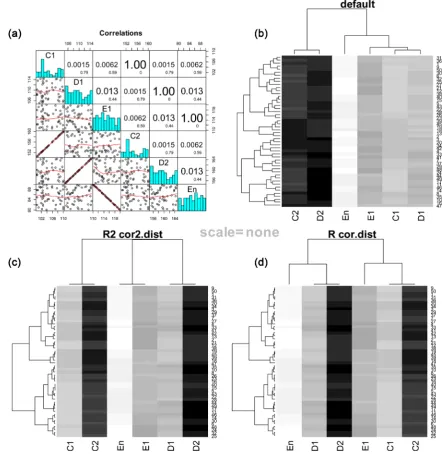
The previously defined functions cor.dist and cor2.dist are both based on linear correlation (Pearson coefficient). The difference is that the cor2.dist function provides only positive values, whereas cor.dist provides both negative and posi-tive values. The function cor2.dist produces a distance rage from 0 to 1, whereas the cor.dist produces a distance range from 0 to 2, with the maximal distance being for samples with R = −1. The consequence is that samples with a high negative correlation will be separated more strongly than samples with zero cor-relation when using the cor.dist function for clustering. On the contrary, the cor2.dist function will cluster samples with negative R = −1 together with posi-tive R = 1.
The function cor2.dist is useful for mathematical purposes, but the cor.dist function is more adequate to reflect biological reality. A sample that behaves with negative correlation is mathematically similar, but biologically and chemi-cally it is the total opposite and should be clustered far apart from the other. The choice of either R or R2 as distance measure depends on the experimental
majority of plant phenotypic traits, we recommend using the cor.dist function.
2.8. Script for Figure 3 and Figure 4
#correlation plot. Figure 3(a)
pairs(dataPNC, lower.panel=panel.smooth, upper.panel=panel.cor2, di-ag.panel=panel.hist, gap=0, main="Correlations")
#default heatmap. Figure 3(b)
hv <- heatmap(dataPNC, col = gray(24:0/24), scale="none", main="default") #heatmap with cor2.dist Figure 3(c)
hv <- heatmap(dataPNC, distfun=cor2.dist, col = gray(24:0/24), scale="none", main="R2 cor2.dist")
#heatmap with cor.dist Figure 3(d)
hv <- heatmap(dataPNC, distfun=cor.dist, col = gray(24:0/24), scale="none", main="R cor.dist")
#heatmap with optimized distance measure based on R2 correlation. Fig. 4A scaled by column
hv <- heatmap(datam, distfun=cor2.dist, col = gray(24:0/24), scale="column", main="Cor2Distcol ")
#heatmap with optimized distance measure based on R2 correlation. Fig. 4B scaled by row
hv <- heatmap(datam, distfun=cor2.dist, col = gray(24:0/24), scale="row", main="Cor2Distrow")
2.9. Script for Heatmap Correlation Using Vitamaize Data (Figure 5)
#import data. Copy Table 1 with column titles and row names into clipboard. data=read.table(file="clipboard", header=T, sep="\t", na.strings = ".")
datam=as.matrix(data[,-1]) #remove row names and convert to numerical matrix
rownames(datam)=data[,1] #define rownames on first imported column #non-scaled default heatmap. Figure 5(a)
hv <- heatmap(datam, col = gray(24:0/24), scale="none", main="default ") #non-scaled heatmap with optimized distance measure based on negative and positive R values. Figure 5(b)
hv <- heatmap(datam, distfun=cor.dist, col = gray(24:0/24), scale="none", main="R cor.dist")
3. Results and Discussion
3.1. Figures Produced with Simulated Data Demonstrate the Suitability of the Default Option Parameters for Each Experimental Purpose
box-plot figure best demonstrated that samples A100, B100, and C100 had a higher median value than samples A200, B200, and C200 (Figure 1(a)). A plot figure produced by our optimized script using the pair function demonstrated that the A, B, and C data series did not correlate to each other (Figure 1(b)). However, sample A100 correlated perfectly only to A200 (R2 ≈ 1), B100 to B200 and C100
to C200, respectively (Figure 1(b)).
The heatmap function of R with the default procedure for clustering (based on Euclidean distance) produced two figures (Figure 2). We implemented grayscale coding to indicate the numerical value of each data point, with darker colour representing higher units. Depending on the selected scaling option, the figures look different despite representing identical data (Figure 2). Nevertheless, the hierarchical clusters of the heatmaps scaled by column (Figure 2(a)) or by row (Figure 2(b)) are both identical. The default clustering function groups the six samples in two big nodes (Figure 2). Samples A100, B100 and C100 are grouped together and clearly separated from samples A200, B200 and C200 (Figure 2). The dendrogram branches according to intensity of the colour (Figure 2(b)) and not because of the relative behaviour of the data (Figure 1(a)). The vertical den-drogram (on top) follows the colour according to rowwise scaled data (Figure 2(b)), whereas the horizontal dendrogram (on the left) follows the colour ac-cording to columnwise scaled data (Figure 2(a)). This clearly demonstrates that the default clustering function reflects the numerical values rather than the cor-
Figure 2. Heatmaps with the default clustering method of R (Euclidean distance). (a) Default heatmap with the option scale by column. (b) Default heatmap with the option scale by row. In both panels it can be seen that the upper cluster branches in two major nodes. Samples A100, B100, C100 cluster separately from samples A200, B200, and C200. This clustering reflects the absolute numerical values rather than the correlation across data points (see Figure 1).
relation among the data series (compare to Figure 1(b)).
A more appropriate heatmap can be prepared when using our optimized R script instead (Figure 3). The cor2.dist function uses the R2 value of correlation
as a distance measure to construct the hierarchical cluster dendrogram. The heatmap correlation groups the six samples correctly in three big nodes (Figure 3) and not in two nodes as demonstrated previously with the default R options (Figure 2).
In this optimized heatmap sample A100 correctly clusters together with A200 and is clearly discriminated from B100 and all other samples (Figure 3), as one would expect from the data, in stark contrast to the clustering presented in Fig-ure 2(b). The graphs of Figure 3 are better suited for experiments from biologi-cal systems since they better reflect the correlation among the data series regard-less of the median value of the numerical units (Figure 1(a)).
Evidently, Figures 1-3 are very different from each other, despite having be-ing prepared with an identical set of simulated data. Each figure allows drawbe-ing a different sort of conclusion, some better suited for mathematical purposes and others better suited for chemical or biological questions. The default dendogram (Figure 2) groups samples according to the absolute value as shown in a boxplot
(Figure 1(a)), whereas the optimized heatmap (Figure 3) clusters samples
ac-cording to the relative behavior of the data as shown in the correlation plots (Figure 1(b)).
Figure 3. Heatmaps with an optimized clustering method. (a) Optimized heatmap with the option ‘scale by col-umn’. (b) Optimized heatmap with the option “scale by row”. In both panels the upper dendrogram correctly branches into three nodes. This clustering reflects the correlation across the data series regardless of the absolute numerical values (see Figure 1).
breeder results need to be represented “as is” in the figure, without manipulation by any type of normalization or transformation algorithm to enable synchronous comparison of values across rows and across columns. If one applies any type of scaling or normalization, meaningful comparisons are strictly limited either among rows only or among columns only (compare Figure 3(a) and Figure 3(b)).
3.2. Heatmap Clustering for Biological Scenarios That Include Negative Correlation
Figure 4. Heatmaps of simulated data with both positive and negative correlation. (a) Panel of correlation plots. R2 values and p values are given in the upper panels. (b) Heatmap with default clustering (Euclidean distance). (c) Heatmap with cor2.dist function that uses only positive R2 values. In this case, samples E1 and En were grouped to-gether, similarly as C1 and C2 were also grouped. (d) Heatmap with cor.dist function that uses negative and positive R values. In this case, sample E1 is clustered very far apart from sample En since it correlates negatively (it displays the total opposite behaviour).
3.3. Heatmap Clustering with Correlation Better Reveals Heterotic Groups in Vitamaize Hybrids
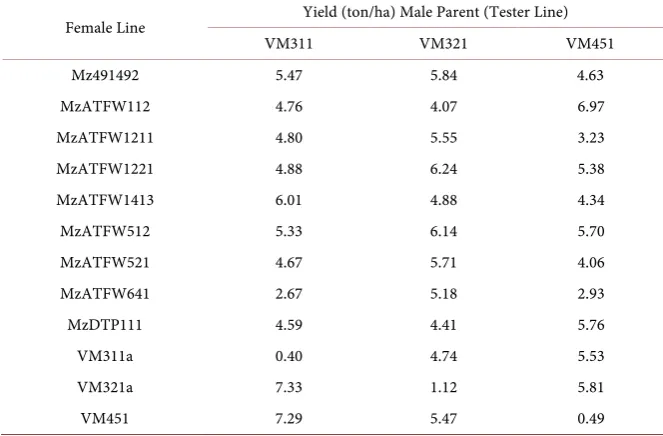
Table 1. Grain yield of thirty-six Vitamaize hybrids evaluated during the spring-summer season 2014 by field trial in Puerto Vallarta, Mexico. Data is given in tons/ha and represents the average of eight replicate plots distributed across a homogenous field expe-riment (n = 8).
Female Line Yield (ton/ha) Male Parent (Tester Line)
VM311 VM321 VM451
Mz491492 5.47 5.84 4.63
MzATFW112 4.76 4.07 6.97
MzATFW1211 4.80 5.55 3.23
MzATFW1221 4.88 6.24 5.38
MzATFW1413 6.01 4.88 4.34
MzATFW512 5.33 6.14 5.70
MzATFW521 4.67 5.71 4.06
MzATFW641 2.67 5.18 2.93
MzDTP111 4.59 4.41 5.76
VM311a 0.40 4.74 5.53
VM321a 7.33 1.12 5.81
VM451 7.29 5.47 0.49
Most lines expressed a higher heterosis when crossed to one male line than to the other two. For example, VM311 crossed to itself (VM311a) resulted in low yield (Table 1). It expressed no heterosis as expected, since this hybrid is equiv-alent to an inbred line. However, crosses VM311 × VM321 and VM311 × VM451 demonstrated increased productivity. The same effect may be observed for the line MzATFW1211, which crossed best with VM321 and VM311 but poorly with VM451. A similar effect was observed for the line MzATFW641, which crossed best with VM321 but poorly with VM451 and VM311 (Table 1).
The two hybrids with the highest grain yield were VM321 × VM311 and VM451 × VM311 indicating that the line VM311 worked well as male parent rather than as female parent. The line VM451 worked both well as female as male parent, since the crosses VM451 × VM311 and MzATFW112 × VM451 had also good yield (Table 1).
In order to genetically classify the inbred lines, the data matrix of grain yield was used to prepare two heatmap figures without scaling (Figure 5). The default clustering parameters of R (Euclidean distance) produced the first heatmap
(Figure 5(a)) that grouped the samples (female lines) in many branches of
dif-ferent lengths.
Figure 5. Heatmaps of grain yield across Vitamaize hybrids. The darker the colour, the higher the yield in ton/ha. (a) Heatmap with default clustering (Euclidean distance). (b) Heatmap with clustering according to correlation (positive and negative R values). The female lines are shown in the rows, whereas the 3 male tester lines are shown in the col-umns. The colour coding of the female lines correspond to the heterotic grouping.
The cluster dendrogram in Figure 5(a) has no biological meaning besides grouping samples by the average yield, whereas cluster groups in Figure 5(b)
elegantly revealed an important biological feature, which is the genetic corres-pondence to a specific heterotic group. Default clustering of R heatmaps (Figure 5(a)) revealed mathematical proximity of the numerical values of grain yield, whereas the optimized heatmap based on correlation (Figure 5(b)) better represented genetic patterns of heterosis in those twelve Vitamaize lines.
This information is further useful as a tool to continue and expand the breed-ing program by intercrossbreed-ing lines of the same heterotic group, to improve their per se performance, and to cross them among complementary heterotic groups. It is expected that this procedure will generate a hybrid with high yield and im-proved nutritional quality (antioxidants) that can be commercially released to farmers.
Maize varieties and inbred lines from temperate regions belong to a strict pat-tern of two heterotic groups, which facilitates hybrid breeding programs, since a line from group A is always crossed to a line from group B in order to generate a commercial hybrid. Either A × B or B × A are crossed, depending of the choice of the female and male lines. In comparison, tropical maize germplasm such as the Vitamaize hybrids were classified into three groups by the heatmap correla-tion funccorrela-tion (Figure 5(b)). The existence of at least three heterotic groups opens many more breeding possibilities to generate F2 hybrids. Different types of three way F2 hybrids are possible such as A × B/C, A × C/B, B × A/C, B × C/A, C × A/B, or C × B/A. The occurrence of three heterotic groups in tropical germplasm may explain the fact that in Mexico three way hybrids are the pre-dominant form of released commercial varieties, whereas in temperate regions maize lines are classified as flint or dent (one way F1 hybrids are much more common.
optimize the genotypes for production. The numerical data matrices should to be analyzed with optimized data mining algorithms and visualization tools in order to better explain the complex link between genotype and phenotype in a worldwide crop plant such as maize. Our optimized script for heatmap correla-tion bicluster is not only is useful for agricultural phenomics, but also to im-prove the interpretation of other omic sciences, such as metabolomic finger-prints [29][30] and transcriptomic data sets [2].
4. Conclusion
The program environment R allows efficiently analyzing a vast amount of data from omic experiments. Heatmap cluster figures are powerful tools to summar-ize large data matrices. Many users with chemical and biological background are unaware of the advantages/disadvantages of different clustering algorithms available in R. The challenge for experimental scientists is to carefully select and adjust the function parameters in order to produce figures that support mea-ningful biological conclusions. The default parameters of R heatmaps based on Euclidean distance were chosen for mathematical purposes, but they are not adequate for the representation of biological experiments in the omics fields. We provide a short R script based on correlation (either R or R2 values) that allow
plotting optimized heatmap dendrograms. This procedure was suitable to classi-fy samples according to phenotypic or genetic traits. The script can be used to prepare meaningful heatmap figures for molecular breeding programs, but it can also be applied for data matrices obtained from transcriptomic and/or metabo-lomic experiments [31] of any biological system.
Acknowledgements
We acknowledge funding by CONACYT and SAGARPA. We also thank support from CINVESTAV and the National Laboratory Plan TECC.
References
[1] Mochida, K. and Shinozaki, K. (2010) Genomics and Bioinformatics Resources for Crop Improvement. Plant and Cell Physiology, 51, 497-523.
https://doi.org/10.1093/pcp/pcq027
[2] Masclaux-Daubresse, C., Clement, G., Anne, P., Routaboul, J.M., Guiboileau, A., Soulay, F., et al. (2014) Stitching Together the Multiple Dimensions of Autophagy Using Metabolomics and Transcriptomics Reveals Impacts on Metabolism, Devel-opment, and Plant Responses to the Environment in Arabidopsis. Plant Cell, 26, 1857-1877. https://doi.org/10.1105/tpc.114.124677
[3] Hirai, M.Y., Yano, M., Goodenowe, D.B., Kanaya, S., Kimura, T., Awazuhara, M., et al. (2004) Integration of Transcriptomics and Metabolomics for Understanding of Global Responses to Nutritional Stresses in Arabidopsis thaliana. Proceedings of the National Academy of Sciences of the United States of America, 101, 10205-10210. https://doi.org/10.1073/pnas.0403218101
[4] Usadel, B., Schwacke, R., Nagel, A. and Kersten, B. (2012) GabiPD—The GABI Primary Database Integrates Plant Proteomic Data with Gene-Centric Information.
[5] Tohge, T., de Souza, L.P. and Fernie, A.R. (2014) Genome-Enabled Plant Metabo-lomics. Journal of Chromatography B—Analytical Technologies in the Biomedical and Life Sciences, 966, 7-20. https://doi.org/10.1016/j.jchromb.2014.04.003
[6] Palmer, L.J., Dias, D.A., Boughton, B., Roessner, U., Graham, R.D. and Stangoulis, J.C.R. (2014) Metabolite Profiling of Wheat (Triticum aestivum L.) Phloem Ex-udate. Plant Methods, 10.
[7] Lisec, J., Schauer, N., Kopka, J., Willmitzer, L. and Fernie, A.R. (2006) Gas Chro-matography Mass Spectrometry-Based Metabolite Profiling in Plants. Nature Pro-tocols, 1, 387-396. https://doi.org/10.1038/nprot.2006.59
[8] Furbank, R.T. and Tester, M. (2011) Phenomics—Technologies to Relieve the Phe-notyping Bottleneck. Trends in Plant Science, 16, 635-644.
https://doi.org/10.1016/j.tplants.2011.09.005
[9] Bylesjo, M., Eriksson, D., Kusano, M., Moritz, T. and Trygg, J. (2007) Data Integra-tion in Plant Biology: The O2PLS Method for Combined Modeling of Transcript and Metabolite Data. Plant Journal, 52, 1181-1191.
https://doi.org/10.1111/j.1365-313X.2007.03293.x
[10] Yu, Y.J., Xia, Q.L., Wang, S., Wang, B., Xie, F.W., Zhang, X.B., et al. (2014) Che-mometric Strategy for Automatic Chromatographic Peak Detection and Back-ground Drift Correction in Chromatographic Data. Journal of Chromatography A, 1359, 262-270. https://doi.org/10.1016/j.chroma.2014.07.053
[11] Geigenberger, P., Tiessen, A. and Meurer, J. (2011) Use of Non-Aqueous Fractiona-tion and Metabolomics to Study Chloroplast FuncFractiona-tion in Arabidopsis. Methods Molecular Biology, 775, 135-160. https://doi.org/10.1007/978-1-61779-237-3_8 [12] Sriyudthsak, K., Iwata, M., Hirai, M.Y. and Shiraishi, F. (2014) PENDISC: A Simple
Method for Constructing a Mathematical Model from Time-Series Data of Metabo-lite Concentrations. Bulletin of Mathematical Biology, 76, 1333-1351.
https://doi.org/10.1007/s11538-014-9960-8
[13] Alexandersson, E., Jacobson, D., Vivier, M.A., Weckwerth, W. and Andreasson, E. (2014) Field-Omics-Understanding Large-Scale Molecular Data from Field Crops.
Frontiers in Plant Science, 5, 286.
[14] Colmsee, C., Mascher, M., Czauderna, T., Hartmann, A., Schluter, U., Zellerhoff, N., et al. (2012) OPTIMAS-DW: A Comprehensive Transcript-Omics, Metabolom-ics, IonomMetabolom-ics, Proteomics and Phenomics Data Resource for Maize. BMC Plant Bi-ology, 12, 245. https://doi.org/10.1186/1471-2229-12-245
[15] Schauer, N. and Fernie, A.R. (2006) Plant Metabolomics: Towards Biological Func-tion and Mechanism. Trends in Plant Science, 11, 508-516.
https://doi.org/10.1016/j.tplants.2006.08.007
[16] R Core Team (2013) R: A Language and Environment for Statistical Computing. R Foundation for Statistical Computing, Vienna.
[17] Riedelsheimer, C., Lisec, J., Czedik-Eysenberg, A., Sulpice, R., Flis, A., Grieder, C.,
et al. (2012) Genome-Wide Association Mapping of Leaf Metabolic Profiles for Dissecting Complex Traits in Maize. Proceedings of the National Academy of Sciences of the United States of America, 109, 8872-8877.
https://doi.org/10.1073/pnas.1120813109
[18] Verbanck, M., Le, S. and Pages, J. (2013) A New Unsupervised Gene Clustering Al-gorithm Based on the Integration of Biological Knowledge into Expression Data.
BMC Bioinformatics, 14, 42. https://doi.org/10.1186/1471-2105-14-42
https://doi.org/10.1016/j.tplants.2007.08.005
[20] Chen, Z.J. (2010) Molecular Mechanisms of Polyploidy and Hybrid Vigor. Trends in Plant Science, 15, 57-71. https://doi.org/10.1016/j.tplants.2009.12.003
[21] Groszmann, M., Greaves, I.K., Fujimoto, R., Peacock, W.J. and Dennis, E.S. (2013) The Role of Epigenetics in Hybrid Vigour. Trends in Genetics, 29, 684-690. https://doi.org/10.1016/j.tig.2013.07.004
[22] Troyer, A.F. (1996) Breeding Widely Adapted, Popular Maize Hybrids. Euphytica, 92, 163-174. https://doi.org/10.1007/BF00022842
[23] Tracy, W.F. and Chandler, M.A. (2006) The Historical and Biological of Basis of the Concept of Heterotic Patterns in Corn Belt Dent Maize. In: Lamkey, K.R. and Lee, M., Eds., Plant Breeding: The Arnel R. Hallauer International Symposium, Black-well Publishing, Ames, 219-233. https://doi.org/10.1002/9780470752708.ch16 [24] Soengas, P., Ordas, B., Malvar, R.A., Revilla, P. and Ordas, A. (2006) Combining
Abilities and Heterosis for Adaptation in Flint Maize Populations. Crop Science, 46, 2666-2669. https://doi.org/10.2135/cropsci2006.04.0230
[25] Stojakovic, M., Ivanovic, M., Bekavac, G. and Stojakovic, Z. (2010) Grain Yield of B73 x Mo17-Type Maize Hybrids from Different Periods of Breeding. Cereal Re-search Communications, 38, 440-448. https://doi.org/10.1556/CRC.38.2010.3.14 [26] Mir, C., Zerjal, T., Combes, V., Dumas, F., Madur, D., Bedoya, C., et al. (2013) Out
of America: Tracing the Genetic Footprints of the Global Diffusion of Maize. Theo-retical and Applied Genetics, 126, 2671-2682.
https://doi.org/10.1007/s00122-013-2164-z
[27] Prasanna, B.M. (2012) Diversity in Global Maize Germplasm: Characterization and Utilization. Journal of Biosciences, 37, 843-855.
https://doi.org/10.1007/s12038-012-9227-1
[28] Sneath, P.H.A. (1957) The Application of Computers to Taxonomy. Journal of General Microbiology, 17, 201-226. https://doi.org/10.1099/00221287-17-1-201 [29] Gao, W., Sun, H.X., Xiao, H.B., Cui, G.H., Hillwig, M.L., Jackson, A., et al. (2014)
Combining Metabolomics and Transcriptomics to Characterize Tanshinone Bio-synthesis in Salvia Miltiorrhiza. BMC Genomics, 15, 73-86.
[30] Garcia-Flores, M., Juarez-Colunga, S., Garcia-Casarrubias, A., Trachsel, S., Winkler, R. and Tiessen, A. (2015) Metabolic Profiling of Plant Extracts Using Direct-Injec- tion Electrospray Ionization Mass Spectrometry Allows for High-Throughput Phe-notypic Characterization According to Genetic and Environmental Effects. Journal of Agricultural and Food Chemistry, 63, 1042-1052.
https://doi.org/10.1021/jf504853w
[31] Witt, S., Galicia, L., Lisec, J., Cairns, J., Tiessen, A., Araus J.L., et al. (2012) Meta-bolic and Phenotypic Responses of Greenhouse-Grown Maize Hybrids to Experi-mentally Controlled Drought Stress. Molecular Plant, 5, 401-417.
Submit or recommend next manuscript to SCIRP and we will provide best service for you:
Accepting pre-submission inquiries through Email, Facebook, LinkedIn, Twitter, etc. A wide selection of journals (inclusive of 9 subjects, more than 200 journals)
Providing 24-hour high-quality service User-friendly online submission system Fair and swift peer-review system
Efficient typesetting and proofreading procedure
Display of the result of downloads and visits, as well as the number of cited articles Maximum dissemination of your research work
Submit your manuscript at: http://papersubmission.scirp.org/