
About one form of writing of the Hardy-Weinberg law
Andrey N. Volobuev, Peter I. Romanchuk, Vladimir K. Malishev
Samara State Medical University, Samara, Russia; [email protected]
Received 4 April 2013; revised 6 May 2013; accepted 14 May 2013
Copyright © 2013 Andrey N. Volobuev et al. This is an open access article distributed under the Creative Commons Attribution Li-cense, which permits unrestricted use, distribution, and reproduction in any medium, provided the original work is properly cited.
ABSTRACT
On the basis of the Hardy-Weinberg law written down for a continuous scale of alternation of generations, populating dynamics of genome is considered at absence of mutagen influence and at presence of the mutagen factor of stochastic character. Influence of the stochastic mutagen factor as cancerogenes on the population is shown. In the countries with the homogeneous population and advanced medicine, it inevitably results in growth of death rate of the population from newgrowths to proportional a root square from time of a life of the population. The carried out research allows estimate a level of the po- pulation condition in the country from the point of view of health.
Keywords:Stochastic Mutagen Factor; Newgrowths; Allele; Alternation of Generations
1. INTRODUCTION
The Hardy-Weinberg law was formulated in 1908 in- dependently from each other English mathematician H. Hardy (1877-1947) and German doctor W. Weinberg (1862-1937) which was interested in genetic problems of twins. This law expresses display of Mendel laws for inheritance in a population.
The Hardy-Weinberg law in the elementary kind of two alleles of a gene establishes, that relative frequencies of genotypes in generations at autosoming inheritance correspond to term of binomial expansion
under condition of , where p and q is the fre- quencies of alleles in a population [1]. For genome linked to a sex the frequencies of genotypes correspond to product2
p q
1
p q
f f
m m
, where is the fre-quency of dominant allele A at men and
p q p q pm
f
p is the fre- quency of dominant allele at women. For recessive allele
a it is accordingly qm and qf.
Though the Hardy-Weinberg law has populating char- acter, but the good description of a population with the
help of this law is inconvenient. The matter is that the population will consist of family trees which crossed among themselves. Development of a population is a development of family trees under condition of their pe- riodic contact.
The Hardy-Weinberg law concerns to a separate fam- ily tree. Implicitly this law includes time since alterna- tion of generations occurs through certain time—time of a life of generation. Usually use some average time of a life of one generation years. Thus, the Hardy-Weinberg law on time has the expressed discrete character. The population lives in continuous real time. Alternation of generations of a plenty of family trees results to that generations in a population vary actually according to a continuous time scale.
25 - 30
Т
Therefore, it is interest of the writing of the Hardy- Weinberg law for a population existing in a continuous time scale. In this case, it will be possible to estimate the vital life of all population more correctly.
2. POPULATING DYNAMICS OF
GENOME AT DISCRETE
ALTERNATION OF GENERATIONS
According to the Hardy-Weinberg law the genotypes
AA, Aa and aa at autosoming inheritance have the fol- lowing frequency ratio:
2
2: 2 :
AA p Aa pq aa q , (1)
The Hardy-Weinberg balance is indifferent [2]. For autosoming inheritance it is obvious. Really, using dis- tribution of genotypes (1) it is possible to receive, for example, the frequency of recessive allele a in the fol- lowing
n1
generation. For this purpose it is neces- sary the summation of the half frequency of heterozygoteAa and frequency of the homozygote aa:
2 1
1 2 2
n n n n n n n
q p q q q p q qn. (2)
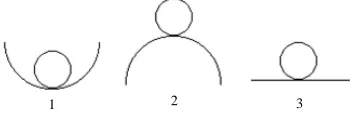
Mechanical analogy of three possible types of balance: stable—1, unstable—2, indifferent—3 it is shown on Fig- ure 1.
Indifferent character of the Hardy-Weinberg balance results to occurrence of the external influence leading to deterioration of a population compensated of the popula- tion cannot be even if this influence has stopped. Reduc- tion of an initial ratio of alleles is possible only due to their receipt from the outside.
For genome, linked to a sex the complex analysis is required more. At crossing in the first generation there is a following ratio of genotypes at women:
AA p pf m:
Aa
p qm f p qf m
:
aa q qm f. (3)Using distribution of genotypes (3), we shall find fre- quency of allele a at women in the following
n1
generation:
1
1 2 1
1 1
2 1 2
mn fn fn mn mn fn f n
mn fn fn mn mn fn
fn mn
q p q p q q q
q q q q q q
q q
(4)
At the deduction (4) the following obvious formulas and
1
mn mn
p q pfn 1 fn are used. Formula (4)
can be copied in the following kind:
q
0
1 0
2
2 0
1
2
fn f n mn
q q q . (5)
For convenience of the further analysis Formula (5), we shall write down with displacement on one genera- tion back:
1 2 fn
f n m n
q q q . (6)
The frequency of allele a at men is equal to the fre- quency of this allele at women of the previous generation
. Using the given condition from (6) we
shall find: 1
m n f n
q q
1 2 fn
f n f n
q q q . (7)
The solution of the differencing Eq.7 we search as , where in this case a is constant. Substituting this solution in Formula (7), we have:
n fn
q a
2
[image:2.595.84.259.641.701.2]1 3
Figure 1. Mechanical realization of three possi- ble types of balance: stable—1, unstable—2, in- different—3.
1 2
n n n
a a a 20
. (8)
Let’s divide the Eq.8 on an2: 2
2 1
a a 0. (9) We find two roots of the characteristic quadratic (9):
1 2
1 1 and
2
a a . (10)
Hence, the general solution of the differencing Eq.7 looks like:
1 2
1 2
n
fn
q С С
. (11)
Constants of integration 1 also 2 we shall find on the basis of the initial conditions: at
C C
0
n , 0
fn f
q q and at n1 according to (4) 0
1 2
m f
fn f
0
q q q q . Thus:
0 0 0
1 2
2
and
3 3
f m f m
q q q q
C C 0
. (12)
Therefore the solution (11) finally looks like:
0 0 0 0
2 1
3 3
n
f m f m
fn
q q q q
q
2 . (13)
3. POPULATING DYNAMICS OF
GENOME AT CONTINUOUS
ALTERNATION OF GENERATIONS
Let’s transit to a continuous time scale n. Under size n in this case we mean time of a life of the population, normalized on average in a population time of a life of one generation, i.e. actually dimensionless time.
Let’s find out, whether there is the differential equa- tion having the characteristic equation similar (8). For this purpose we shall consider the differential equation:
2
1 1
2
d d
0 d d
f n f n
q q
n
n
, (14)
where is a constant.
Let’s transform the Eq.14 to finite-difference form:
1 2 1 2
2
2
0
fn f n f n f n f n
q q q q q
n
n
. (15)
Uniting similar members and multiplying the Eq.15 on 2, we shall find:
1
22qfn 2 2 n qf n 2 1 n qf n 0
. (16)
2 2 n 1 and 2 1 n 1. (17) Wonderful feature of the Eq.17 is that they have one and too the solution:
3 2
n
. (18)
It means, that the difference’s Eq.7 and the differen- tial Eq.14 can have the same characteristic equation. Taking into account (18), the Eq.14 can be copied as:
2 1 2
d 3 d
0
2 d
d
f n f n
q q n n n 1
. (19)
The Eq.19 can be integrated once:
1 1 1 d 3 d 2 f n f n q q С n n
. (20) where 1 is a constant of integration.
Further integrating the Eq.20 method of separation of variables: С 0 1 0 1 1 d d 3 2 fn f q n f n q f n q n С q n
. (21)We shall find:
3 2
1 1 0
2 2 e 3 3 n n fn f n n
q C С q
. (22) Identifying the solution (22) with the solution (13), we shall find: 0 0 1 0 0 1 0 2 2 3 3 2 and 3 3 f m f m f
q q n
C
q q nС q
. (23)
As one would expect, Formula (23) do not contradict each other. Hence, the solution (22) can be written down as:
3
0 0 0 0 2
2
e
3 3
n
f m f m n
fn
q q q q
q
. (24)
Formula (24) is correct for frequency of allele only in even generations. This consequence of transition to a continuous scale of generations n.
Comparing (13) and (24), for even generations, we
have
3 2
2ne nn or 3 2 ln 2 n
. Hence, (24) it will be transformed to a kind:
0 0 0 0 ln 2
2
e
3 3
f m f m n
fn
q q q q
q
, (25)
that is identical to Formula (13) at even generations.
Taking into account (18) and 3 2 ln 2 n
, we find ln 2
. Thus, the differential Eq.19 will be written down as: 2 1 2 d d
ln 2 0
d d
f n f n
q q
n n
1
. (26)
Formula (26) it is Hardy-Weinberg law in case of con- tinuous alternation of generations, i.e. for a continuous time scale.
Let’s note the important feature of the found form of the Hardy-Weinberg law. In this law completely there are no reasons of alternation of generations, the reason of the termination of ability to live of the previous generation at occurrence of new generation. It results to that the popu- lation numerically indefinitely increases that contradicts the basic biological laws. Thus, there should be a way of correction of the Hardy-Weinberg law with the purpose of more correct description it of the population existence.
4. ACTION OF THE STOCHASTIC
MUTAGEN FACTOR
Let’s consider existence of a population which the stochastic mutagen factor influences.
Eq.26 is the equation of indifferent balance of genome, linked with a sex, at continuous alternation of genera- tions.
That of it to be convinced, we will address to other, well investigated physical phenomenon—the Brownian motion [3]. Brownian motion of a particle in a liquid at first sight should not exist. Really, on Brownian particle, for example, flower pollen, impacts of molecules of a liquid which are counterbalanced operate from different directions. Therefore, the most probable state of a parti- cle is motionless. The particle should shiver only, but should not have some constant displacement from a point of supervision. Einstein and Smoluchowski have shown that physically the Brownian motion is consequence of statistical properties of the second law of thermodynam- ics. If the researcher has relatively a small number of molecules the essential deviation from the most probable state of system should be observed, in this case a mo- tionless state of the Brownian particles.
Let’s note the main generality of two phenomena: the Brownian motion and existence of a population in condi- tions of action of the stochastic mutagen factor.
At the Brownian motion on the determined system—a particle in a liquid—stochastic force acts from the mole- cules of a liquid.
In a researched case on the determined system—re- productive genome—some stochastic mutagen factor acts.
a particle looks like:
2
2
d d
d d
S S
m r
t
t F, (27) where m is a mass of a particle, S—displacement of a particle from initial position, r—factor of resistance of medium to movement of a particle, t—time, F—the sto- chastic force acting on a particle from the molecules of a liquid. We shall note absence in the Eq.27 elastic forces which is determined returned a particle in initial position, causing its oscillation around of a point of balance.
The Eq.27 is the equation to which at absence of sto- chastic function F complies with a solving Sconst.
i.e. at the particle can steadily be in any position- indifferent balance. The Eq.26 is similar to the Eq.27 at . Function 1 complies with the Eq.26, i.e. frequency of allele a is steady at its any value that reflects indifferent character of Hardy-Weinberg ba- lance.
0
F
0
F qf n const
If there is some stochastic mutagen factor D n
, ran- domly time-dependent lives of a population (in condi- tions of a continuous scale of alternation of generations) the Eq.26, by analogy with (27), it is necessary to copy as:
2
1 1
2
d d
ln 2 d d
f n f n
q q
D n n
n
(28)
Using the result for the first time received by Einstein [3] for the Brownian motion
S 2 ~t, we shall note that an average square of a deviation of the allele fre- quency from norm (25) at action on a population of the stochastic mutagen factor proportionally time of a life ofa population
qf n 1
2 ~n. Angular brackets mean averaging on individuals of a population.Thus, during a life of a population at action of the sto- chastic mutagen factor a root mean square deviation of the allele frequency from norm proportionally to a root square from time of a life of a population
21 ~
f n
q
n. At the certain level the root mean
square deviation of allele frequency from norm can lead to a lethal outcome. For a separate individual a lethal deviation is individually.
5. CANCEROGENES AS THE
STOCHASTIC MUTAGEN FACTOR
The received result shows, that during a life of a population and alternation of generations at action of the stochastic mutagen factor death rate inevitably grows (similarly to displacement of the Brownian particles from a point of initial supervision). This conclusion has com- pletely general biology-mathematical character.
As the stochastic mutagen factor it is possible to use cancerogenes. The matter is that among other kinds of diseases occurrence of the newgrowths has some features. First of all, it is the big variability of a newgrowths site. It can practically arise in any place of an organism. Be- sides for oncological diseases typically a variety of fac- tors of cancerogenes: the poor-quality food, the polluted environment, a way of life and professional work, smok- ing, high-frequency electromagnetic radiations and many other things.
All these cancerogenic factors, finally, affect the re- productive-genetic function of a cell causing its malig- nant transformation. Is generalized we shall consider, that set of the reasons resulting to occurrence of malig- nant newgrowths is an influence on an organism of some stochastic mutagen factor.
Despite of stochastic character of influence, it is diffi- cult to present a situation at which the given stochastic mutagen factor completely would be absent. It concerns even completely isolated primitive societies. Especially such factor in any kind always is present at a modern civilized society.
On Figure 2 dynamics death rates (mortality rate co- efficient) of the population in the various countries from newgrowths is shown [4]. A mortality rate coefficient this ratio of quantity of died people in the country for a year to an average number of population in the given year multiplied on 1000.
Time interval of 20 years during which death rate was investigated is small term but it is possible to make some conclusions.
In two countries Japans and Canada the law: death rate
[image:4.595.319.529.545.700.2]~ n is obviously observed. Distinctive feature of these countries is, first, very high level of medicine second, high uniformity of the population which is almost with- out exception uses these achievements of medicine. Some other social factors determining as a whole a posi-
During a life of a population at action of the stochastic mutagen factor root mean square deviation of allele fre- quency from norm proportionally to a root square from time of a life of a population.
tive psychological climate in these countries influence also. In other words, the situation with detection at the earliest stage and treatment of the newgrowths in these countries has approached to the stationary limit on the given level of development of the country. The not changes in this direction, the law-death rate ~ n
therefore is carried out. The further decrease in death rate will take place at occurrence and universal application of essentially new methods of diagnostics and treatment of a cancer. In the given countries death rate from new- growths is the basic natural factor of alternation of gen- erations.
At action of the stochastic mutagen factors resulting in occurrence of the newgrowths, death rate of the popula- tion in the country is proportional to a root square of time of a life of a population only at demographic stationary,
i.e. in case of uniformity of the population and the high level of development of medicine accessible to all popu- lation. In such countries death rate from oncological dis- eases has a role of the natural factor of alternation of generations.
For other countries, first, the big heterogeneity of the population, second, high immigration of the population which gradually joins modern medicine that conducts or to decrease in the general death rate from newgrowths (USA, Great Britain), or to its invariance (Germany, Russia, France) is characteristic. As a whole it is possible to speak about the general demographic non stationary in these countries.
Demographic non stationary, first of all, was connect- ed to immigration, results or in decrease in death rate of the population from the newgrowths, or to its invari- ance.
REFERENCES
We speak about dynamics of death rate, instead ofabout its absolute value which analysis is not the purpose of article. Absolute value of death rate in many countries is frequently defined not natural, but social factors.
[1] Vogel, F.and Motulsky A. (1990) Human genetics.Springer- Verlag, Berlin.
[2] Volobuev, A.N. and Petrov, E.S. (2011) Modelling of the populating development of the genome in the radiation of the environment. Natural Science, 3, 1029-1033.
doi:10.4236/ns.2011.312128 The attention an example of Italy for which the law-
death rate ~ n is carried out with periodic fluctua- tions. Apparently, it is connected by that Italy is basically the transit state for immigrants. However arising due to change of rules, the delay of immigrants in the country results in fluctuations of a death rate on a background of the law of death rate ~ n.
[3] Matveev, A.N. (1981) Molecular physics. High School, Moscow.
[4] Kalabekov, I.G. (2010) Russian reforms in digits and facts. (2010) RUSAKI, Moscow.
![Figure 2. Dynamics of the population death rates (mor- tality rate coefficient) in the various countries from the newgrowths [4]](https://thumb-us.123doks.com/thumbv2/123dok_us/7777401.719981/4.595.319.529.545.700/figure-dynamics-population-tality-coefficient-various-countries-newgrowths.webp)
