Munich Personal RePEc Archive
Advances in Auctions
Kaplan, Todd R and Zamir, Shmuel
University of Exeter, University of Haifa, University of Exeter
20 March 2014
Advances in Auctions
Todd R. Kaplan∗ Department of Economics
University of Exeter Business School, UK and Department of Economics
University of Haifa, Israel
Shmuel Zamir Department of Economics
University of Exeter Business School, UK The Center for the Study of Rationality The Hebrew University of Jerusalem, Israel
March 2014
Abstract
As a selling mechanism, auctions have acquired a central position in the free market econ-omy all over the globe. This development has deepened, broadened, and expanded the theory of auctions in new directions. This chapter is intended as a selective update of some of the developments and applications of auction theory in the two decades since Wilson (1992) wrote the previous Handbook chapter on this topic.
∗This paper is a chapter in the forthcomingHandbook of Game Theory, Volume 4, edited by Peyton Young and
Contents
1 Introduction 4
2 First-Price Auctions: Theoretical Advances 5
2.1 Mixed-Strategy Equilibria . . . 5
2.2 Asymmetric Buyers: Existence of Mixed and Pure-Strategy Equilibria . . . 6
2.3 Relaxation of Symmetry and Independence . . . 7
2.4 Monotonicity and the Role of Tie-Breaking Rules . . . 9
2.5 Revenue Comparisons . . . 10
3 Multi-Unit Auctions 11 3.1 Efficient Ascending-Bid Auctions . . . 11
3.2 Multiple Heterogeneous Items . . . 14
4 Dynamic Auctions 16 4.1 Dynamic Population . . . 16
4.2 Repeated Ascending-Price Auctions . . . 19
5 Externalities in Single-Object Auctions 21 5.1 A General Social Choice Model . . . 21
5.2 Complete Information . . . 22
5.3 Incomplete Information . . . 23
6 Auctions with Resale 24 6.1 First-Price and Second-Price Auctions . . . 24
6.2 Seller’s Optimal Mechanism . . . 25
6.3 Further Results . . . 26
7 All-Pay Auctions 27 7.1 Complete Information . . . 28
7.2 Incomplete Information . . . 30
7.3 Multiple Prizes . . . 30
7.4 Bid-Dependent Rewards . . . 32
7.5 Contests versus Lotteries . . . 33
7.6 All-Pay Auctions with Spillovers . . . 34
7.7 Bid Caps . . . 34
7.8 Research Contests . . . 35
7.9 Blotto Games . . . 36
8 Incorporating Behavioral Economics 38
8.1 Regret . . . 38
8.2 Impulse Balance . . . 40
8.3 Reference Points . . . 41
8.4 Buy-It-Now Options . . . 42
8.5 Level-K Bidding . . . 42
8.6 Spite . . . 43
8.7 Ambiguity . . . 44
9 Position Auctions in Internet Search 46 9.1 First-Price Pay-Per-Click Auctions . . . 47
9.2 Second-Price Pay-Per-Click Auctions . . . 48
9.3 Other Formats . . . 49
10 Spectrum Auctions 52 10.1 3G Auctions . . . 52
10.2 4G Auctions . . . 55
1
Introduction
Auction theory is a prominent and attractive topic of game theory and economic theory.1 There are two main reasons for this: the first is that despite its simple rules, it is mathematically challenging and often leads to both surprising and elegant results. The second and probably the more important reason is that as a useful market mechanism, auctions have been widely practiced since ancient history.2
Both reasons have become even more relevant and convincing since the chapter “Strategic Analysis of Auctions” was written in the first volume of this Handbook (Wilson, 1992). The mathematical developments became more challenging as the theory branched in many directions, such as multi-unit auctions, dynamic auctions, combinatorial auctions, auctions with externalities, and more general incomplete information frameworks. The embracing of free market economic principles around the world made auctions the main vehicle for executing the huge volume of privatization that took place and is still occurring.
The theory and practice of auctions have stimulated one another. The massive use of spectrum auctions, online auctions and the privatization via auctions of big economic units (such as oil refineries and power plants) called for theoretical investigations, and the availability of new theoretical results and tools encouraged and facilitated the practical use of auctions, as reflected in the title of Milgrom’s book,Putting Auction Theory to Work (Milgrom, 2004). The importance of mechanism design, of which auction theory is a central part, was recognized not only by politicians and regulators but also by the academic community, as expressed by awarding the 2007 Nobel Prize in Economics to Hurwicz, Maskin, and Myerson. Game theorists and economists became more and more involved in the practice of auctions both in helping regulators to design ‘the right auction’ and in consulting competing companies to choose the ‘right bidding strategy’ (for instance, Binmore, Cramton, Klemperer, McAfee, McMillan, Milgrom, Weber, Wilson, and Wolfstetter, to mention only a few, all acted in at least one of those roles). ‘Econlit’ lists 20 books3 and 3,432 works with the word Auction or Auctions in the title that were written since 1992 (according to ‘Google Scholar’ the number is much higher – about 20,000).4
Given the volume of work done in the past two decades, we cannot hope to provide a fair and comprehensive presentation of all research and applications on auctions since Wilson’s chapter in 1992, within the framework of one chapter. It is even clearer that our bibliography cannot be
1As an illustration of the importance of auction theory within game theory, see the recent textbookGame Theory
(Maschler, Solan, and Zamir, 2013), where auction theory is presented and developed as one of its chapters.
2Herodotus describes Babylonian bridal auctions in 500 B.C. where revenue from the most attractive maidens was
used to subsidize the less attractive ones (see Baye et al., 2012b, for an analysis). In 200 B.C., Ptolemy IV of Egypt ran an auction for the tax-farming rights for Palestine and Syria. When the highest bid was at 8000 talents of silver (232 tons), Joseph the Tobiad told the Pharaoh that the bidders were colluding and offered 16000 talents with the condition that he would be lent soldiers to help in the collection. The profits allowed him to be king of Israel (see Montefiore, 2011, and Adams, 1992).
3Among the relevant books are Cramton, Shoham, and Steinberg (2006), Klemperer (2004), Krishna (2002, 2009),
Menezes and Monteiro (2005), Milgrom (2004), Paarsch and Hong (2006), Smith (1989), and Wolfstetter (1999).
4Econlit lists 1,993 academic journal articles, 977 working papers, 254 papers in collective volumes, 185
exhaustive. Instead, we made a selection of the theoretical themes of research and a sample of important applications of auction theory. As with any selection, it is prone to be biased by the taste of the selectors. We hope that, nonetheless, a non-expert reader will get a reasonably good picture, directly or indirectly through the references, of many of the important developments in auctions in the past few decades.
2
First-Price Auctions: Theoretical Advances
Theoretical and empirical studies of auctions are focused almost exclusively on the prominent so-lution concept of Nash equilibrium or more precisely Bayes-Nash equilibrium (BNE), as auctions are games of incomplete information. However, an explicit expression of the BNE is mathemati-cally hard to obtain and so far it is available only for simple models, subject to highly restrictive assumptions. For example, Kaplan and Zamir (2012) provide explicit forms of the equilibrium bid functions in an asymmetric first-price auction with two buyers whose valuesv1 andv2 are uniformly
distributed in [v1, v1] and [v2, v2], respectively. Furthermore, even the existence of a BNE is a
dif-ficult issue since auctions are games with discontinuous payoff functions and hence many of the standard results on the existence of Nash equilibrium cannot be applied in a straightforward way to auctions. Other tools, specifically tailored for this kind of model, are called for. In this section, we highlight the main results on existence of Nash equilibrium in auctions. We will mainly focus on auctions of a single indivisible object.5
Let us begin with the basic first-price auction model. Vickrey (1961) is the first to analyze auctions with independent, private values drawn from a uniform distribution. Riley and Samuelson (1981) extend Vickrey’s analysis to n symmetric buyers, with values that are independent and identically distributed from a general distribution F that is strictly increasing and continuously differentiable. They find that there exists a unique equilibrium that is symmetric with bid function
b(v) =v−Rv
v Fn−1(x)dx/Fn−1(v) for all bidders; that is, each bidder bids the conditional
expec-tation of the other bidders’ highest value given that he wins the auction. Since this contribution, there have been various works extending it to auctions in which one or more of the key assumptions of Riley and Samuelson no longer hold. These assumptions are symmetry and independence of the value distributions and smoothness of the common distributionF.
2.1 Mixed-Strategy Equilibria
When one relaxes one of Riley and Samuelson’s (1981) three basic assumptions about the distri-butions (symmetry, independence and smoothness), for a first-price auction, a pure-strategy Nash equilibrium may not exist. A simple example is the case of two buyers each with a value drawn from the discrete distribution of 0 and 1 each with probability 1/2. The equilibrium here is unique and in mixed strategies. In a classic example, Vickrey (1961) shows that when one buyer’s value is commonly known there is a unique equilibrium where that buyer uses a mixed strategy.6
Jackson and Swinkels (2005) demonstrate that without independence even when both buyers have private values drawn from a continuous distribution, there may not exist a pure-strategy monotonic equilibrium in a first-price auction. As an example consider an auction with two buyers with values v1 and v2 uniformly distributed on the triangle v1 ≥ 0, v2 ≥ 0, and v1 +v2 ≤ 1. The intuition is that a buyer with value 1 knows that the other buyer has value 0 and hence in equilibrium he should not bid above 0. By monotonicity, each buyer should bid 0 for all his values ,which cannot be an equilibrium.
Jackson and Swinkels then prove the existence of equilibrium in mixed strategies in a gen-eral model that covers in particular both first-price and all-pay auctions as special cases. More specifically, they consider an environment with multiple identical items of the same indivisible ob-ject. Each buyer has an additive, but not necessarily linear, utility for multiple items, he is endowed with a finite (possibly zero) number of items, and he may want to sell or buy some items. Formally, the typeθi= (ei, vi) of buyer iconsists of the numberei of items that he is endowed with and his
values vi= (vi1, vi2, . . . , viℓ), where vik is his marginal utility from the k-th item andℓ is the total
number of items in the economy. The key assumptions of the model are that the type space Θ is compact and the distributionF on Θ is continuous and absolutely continuous with respect to the product of its marginal distributions (which they call imperfect correlation). Finally, the utility functions over the payoff are assumed to be continuous.
2.2 Asymmetric Buyers: Existence of Mixed and Pure-Strategy Equilibria
The symmetry of buyers was central and crucial for the results of Milgrom and Weber (1982). Existence results for models with asymmetric buyers were obtained by several authors, primarily by Lebrun (1996, 2006) and by Maskin and Riley (2000b).
An early general existence result for equilibria in first-price asymmetric auctions is due to Lebrun (1996) who proved that an equilibrium in mixed (distributional) strategies exists in an
n-buyer first-price auction for an indivisible single good, under the following assumptions:
• The value distributionsF1, . . . , Fnare independent, with compact supports contained in [c, K]
for some finite cand K (c < K).
• None of the distributions Fi has an atom atc. • The allowed bidding range is [c, K].
The condition of no atoms at c is needed to avoid payoffs discontinuities at c, with the standard tie-breaking rule (all the highest bidders have equal probability of winning). This difficulty can be avoided by ‘augmenting’ the game to include messages to be sent by the bidders and to be used in case of a tie. In this augmented first-price auction, the existence is then proved without the assumptions of no atoms at c. However, this is not very appealing: not only is this ‘augmentation’ rather artificial, but the resulting equilibrium may include buyers using weakly dominated strategies.
paper (Lebrun, 2002) to prove (under the assumptions in Lebrun, 1996) the upper-hemicontinuity of the Nash-equilibrium correspondence with respect to the valuation distributions. This implies the continuity of the Nash-equilibrium under the conditions that guarantee its existence and uniqueness (that is, when the Nash-equilibrium correspondence is single valued). Lebrun views these results as a proof of robustness of the theoretical existence results and the usefulness of the numerical approximations of the Nash equilibrium.
Lebrun (2006) provides results on the existence and uniqueness of the equilibrium in asym-metric first-price auctions withnrisk-neutral bidders, reserve pricer, and the fair tie-breaking rule. Lebrun makes the following assumptions:
• The value distributions F1, . . . , Fn are independent with supports [ci, di];ci< di,i= 1. . . n. • For eachi= 1, . . . , n, the cumulative distribution Fi is differentiable over (ci, di] with
deriva-tive (density) fi locally bounded away from zero over this interval. Assume further that
Fi(ci) = 0 for all i.
Assume without loss of generality thatc1 ≥c2 ≥ci for all i≥2; then the main result is:
Theorem 1 If the above assumptions hold and no bidder bids above his value, then under any of the following conditions, the first-price auction has one and only one equilibrium: (i) r > c1; (ii) c1 > c2; (iii) There exists δ >0 such that Fi is strictly log-concave over (c1, c1+ δ)T(ci, di), for
all i≥1, that is, fi/Fi, the reverse hazard rate, is strictly decreasing over this interval.7
2.3 Relaxation of Symmetry and Independence
Athey (2001) proves existence of a Bayes-Nash equilibrium in nondecreasing pure strategies for a large class of games of incomplete information. Her general result was widely used and in particular it was adapted and used for auctions by Athey herself and other authors (e.g., Reny and Zamir, 2004, to be discussed below). The novelty of Athey’s work is that for studying the question of existence of pure-strategy Nash equilibrium (PSNE), which is basically a fixed-point problem, she introduces thesingle-crossing condition (SCC) which plays a central role in the proof of existence. Verifying this condition requires comparative statics analysis for a single-player problem (which is a simpler problem than showing the existence of a fixed point). The SCC of Athey is built on a related notion ofsingle-crossing propertydue to Milgrom and Shannon (1994), who developed comparative statics analysis using only conditions that are ordinal (that is, invariant under order-preserving transformations of the utilities). Let X be a lattice, Θ a partially ordered set, andh:X×Θ→R
a real function on the product set.
Definition 2 The functionh:R2 →Rsatisfies the (Milgrom-Shannon)single-crossing property of
incremental returns(SCP-IR) in(x;θ)if, for allxH > xLand allθH > θL, h(xH, θL)−h(xL, θL)≥
(>)0impliesh(xH, θH)−h(xL, θH)≥(>)0. The functionhsatisfies weak SCP-IR if for allxH > xL
and all θH > θL, h(xH, θL)−h(xL, θL)>0 implies h(xH, θH)−h(xL, θH)≥0.
This condition requires that the incremental return to x, h(xH,·)−h(xL,·), as a function
of θ, crosses zero at most once, from below.
Athey considers a game of incomplete information with a finite set of playersI ={1, . . . , I}. The players’ type sets are intervals in the real line, Ti = [ti, ti], and the action sets are compact
convex sets in the real line,Ai ⊂R. The prior probability on the types is assumed to have density
(with respect to the Lebesgue measure). Finally a technical integrability condition is assumed on the utility functions (henceforth Assumption (A1)) to ensure that the objective functionUi(ai, ti;α−i)
of playeriof type ti, when all other players are using nondecreasing strategiesα−i, is well defined
and finite. For this model, she defines the following single-crossing condition.
Definition 3 The Single-Crossing Condition for games of incomplete information (SCC) is satis-fied if for each playeri∈I, whenever every other playerj6=iuses a strategyαj that is
nondecreas-ing (in his type), playeri’s objective function,Ui(ai, ti;α−i), satisfies single crossing of incremental
returns (SCP-IR) in (ai;ti).
The method adopted by Athey to prove that the SCC is sufficient for the existence of PSNE is to prove it first for the case of finite action sets and then, for the case of a continuum of actions, to use a sequence of appropriately designed grid approximations to prove that a certain selection of a sequence of monotone PSNE for the finite approximations converges to a monotone PSNE in the original game. The result for finite action sets is:
Theorem 4 If Assumption (A1) is satisfied, SCC holds, and the action setAi is finite for alli∈I,
then the game has a PSNE where each player’s equilibrium strategy, βi(·), is nondecreasing.
The results for continuous actions sets are derived from Theorem 4 and the following theo-rem.
Theorem 5 If Assumption (A1) is satisfied and the following hold: (i) for alli∈I, Ai = [ai, ai],
(ii) for all i ∈ I, ui(a, t) is continuous in a, and (iii) for any finite A′ ⊂ A =
×
i∈IAi, a PSNEexists in nondecreasing strategies, then a PSNE exists in nondecreasing strategies in the game where players choose actions from A.
Athey applies these results to supermodular and log-supermodular utility functions and affiliated types. Then she shows that the results can be extended with additional assumptions to certain cases of discontinuous utility functions that include some auction games. However, a more general result on the existence of PSNE in asymmetric first-price auctions using Athey’s result was given by Reny and Zamir (2004) (henceforth RZ).
RZ notice that the SCC can fail in two possible ways. First, if there are ties at winning bids and, second, if a buyer uses a strategy that yields a negative payoff. They define a single-crossing condition that states that SCC holds whenever we avoid these two possibilities.
Definition 6 The Individually Rational, Tieless, Single-Crossing Condition (IRT-SCC) is satisfied if for each playeri∈I, actionsai, a′i, and nondecreasing strategiesαj such thatP r(maxj6=iαj(·) =
ai or a′i) = 0, Ui(ai′, ti;α−i)≥0, then Ui(a′i, ti;α−i) ≥Ui(ai, ti;α−i) is maintained when ti rises if
Using their definition IRT-SCC, RZ are able to prove the existence of PSNE for asymmetric buyers, interdependent values, and affiliated one-dimensional signals. They note, by way of a counterexample, that these results cannot extend to multidimensional signals.
A further significant generalization was obtained by Reny (2011), who proved the existence of monotone pure-strategy equilibria in Bayesian games with locally complete metric semilattices action spaces and type spaces that are partially ordered probability spaces. The novel idea that enabled this generalization was to use the Eilenberg and Montgomery (1946) fixed-point theorem rather than the Kakutani’s fixed-point theorem used in Athey (2001). The point is that while Kakutani’s theorem requires that the sets of monotone pure-strategy best replies be convex, which may be hard to establish, the Eilenberg and Montgomery fixed-point theorem requires that these sets be contractible. This condition turns out to be rather easy to verify for the general class of Bayesian games studied by Reny. Finally, we note that in a recent unpublished work Zheng (2013) proves the existence of a monotone PSNE in a first-price auction with (endogenous) resale.
2.4 Monotonicity and the Role of Tie-Breaking Rules
The study of Nash equilibrium in first-price auctions has concentrated primarily on monotone pure-strategy equilibria(MPSE). Whenever the existence of such MPSE is established, the natural questions to be asked are: Is there only one MPSE? Are there any non-monotone pure-strategy equilibria? Are there mixed-strategy equilibria (MSE)? These questions, which turned out to be related to each other, were partially or fully answered for various models (under various sets of assumptions), and some are not answered to date. The answers to these questions also often hinge on thetie-breaking ruleused. For example, in the general symmetric modelof Milgrom and Weber (1982) where they established a unique symmetric MPSE, it was only 24 years later that McAdams (2006) proved that there are no asymmetric MPSE and in a subsequent paper, McAdams (2007a), he ruled out non-monotone equilibria in this model (including mixed-strategy equilibria).8 In these works, McAdams considered two tie-breaking rules:
• The standardcoin-flip ruleaccording to which the winner of the object is chosen by a uniform probability distribution over the set of buyers who submitted the highest bid.
• The priority rule according to which the winner is the buyer with the highest rank in a pre-specified (prior to the bidding) order (permutation) of the buyers.
The results of McAdams are for a general asymmetric model with any (finite) number of buyers with affiliated types and interdependent values. More precisely, he considers the general model of Reny and Zamir (2004) restricted by the additional assumption that the utility functions are strictly decreasing in the bids. In addition he considered two types of bidding sets: the con-tinuum price grid where bi ∈[0,∞) and the general price grid where the bids are restricted to an
arbitrary subset of bi∈[0,∞). For this model, McAdams proves that:
• Given a continuum price grid and the coin-flip rule, every MSE of the first-price auction with no ties is outcome-equivalent to some MPSE.
• Given a general price grid and the priority rule, every MSE of the first-price auction is outcome-equivalent to some MPSE.
• Given the coin-flip rule, every MPSE of the first-price auction has no ties.
Thus, non-monotone equilibria can exist under the coin-flip rule but they are distinguish-able: all non-monotone equilibria have positive probability of ties whereas all monotone equilibria have zero probability of ties. McAdams provided an example of a non-monotone pure-strategy equilibrium in a first-price auction (such an example requires three buyers with affiliated types and interdependent values).
In yet another paper, McAdams (2007b) addressed the issue of the uniqueness of the MPSE proved to exist in the RZ model. He proves this uniqueness under considerable restriction of the RZ model. In particular he assumes a symmetric model (roughly: the distribution and the utilities are invariant to any permutation of the buyers). For this he proves:
• There is a unique MPSE in the symmetric first-price auction, up to the bids made by a set of measure zero of types.
2.5 Revenue Comparisons
An important property of symmetric auctions with independent private values that is lost as soon as we relax the symmetry condition isrevenue equivalenceamong a large class of auctions. Although symmetry is not a condition in the Revenue Equivalence Theorem of Myerson (1981), the asymmetry implies different equilibrium allocations for different types of auctions (e.g., first-price and second-price auctions), which violates the requirement that equilibrium allocations be the same. Now, the investigation of revenue comparisons between selling mechanisms in general and types of auctions in particular naturally follows. This comparison turns out to be rather difficult, and so far, no strong general results are available. Even the question of which of the two auctions, first price or second price, generates a higher revenue in an asymmetric setting is very partially answered. In this subsection, we review some of these results.
Maskin and Riley (2000a) study an asymmetric environment with two buyers: a strong one and a weak one. This ranking of the buyers means that the distribution of the strong buyer’s value, Fs, Conditionally Stochastic Dominates (CSD) the distribution of the weak buyer’s value,
Fw. Formally, CSD is defined as follows. For all x < y in the common support ofFs and Fw,
P r{vs < x|vs< y}=
Fs(x)
Fs(y)
< Fw(x) Fw(y)
=P r{vw < x|vw < y}.
Under CSD,9 in a first-price auction, the weak buyer bids more aggressively than a strong
buyer. Furthermore, a strong buyer would prefer a second-price auction while a weak buyer would prefer a first-price auction. Revenue comparisons between the two formats are mixed. When there is a shift (Fs(x+α) = Fw(x), α > 0) or stretch (e.g., for distributions that start at zero,
Fs(x) =α·Fw(x), 0< α <1, holds on the common support) a first-price auction generates higher
revenue, while when there is a move of probability to the lower end of the support, a second-price auction generates higher revenue (Fw(x) =α·Fs(x) +δ, 0< α <1,δ= 1−α).10
Kirkegaard (2012) expands Maskin and Riley’s (2000a) revenue comparison between first-price and second-first-price auctions. He finds that under CSD, no atoms, and the conditionRFs−1(Fw(x))
x (fw(x)−
fs(y))dy ≥0 for all x, a first-price auction generates higher revenue than a second-price auction.
This also holds in the presence of a reserve price. Kirkegaard (2014) provides additional sufficient conditions for revenue comparisons of first-price and second-price auctions. Outside the indepen-dent private value model, de Castro (2012) finds that with certain cases of dependence, revenue in a first-price auction may be higher than that in a second-price auction even under symmetry, in contrast to Milgrom and Weber (1982), who find the opposite holds in the case of affiliated values.
3
Multi-Unit Auctions
The literature on multi-unit auctions for environments in which buyers exhibit demand for multiple units of the same good is of great practical importance. The U.S. government treasury auctions three trillion dollars worth of securities annually (to finance public debts). The underpricing of one cent per $100 would lead to a loss of $300 million!
Treasury auctions are typically sealed-bid auctions in which each buyer submits a demand function (either as the total price P(x) that he is willing to pay for x units, or equivalently his marginal bid p(x) for the x-th unit). The submitted demands determine a clearing price and there are two commonly used pricing methods: uniform pricing, in which all units are sold at the highest price that clears the market, and discriminatory pricing, in which each buyer pays his own bid (for the units that he won). In practice, both pricing methods are used in treasury auctions of various countries and empirically it is not clear which one generates higher revenue (see, for example, Bartolini and Cottarelli, 1997, Binmore and Swierzbinski, 2000, and Brener et al., 2009). Theoretically, it is known that both types of auctions are inefficient (see, for example, Wilson, 1979, Back and Zender, 1993, and Ausubel et al., 2013) and both are vulnerable to manipulation and cooperative behavior among buyers (see Goswami et al., 1996, Kremer and Nyborg, 2003). In addition to sealed-bid auctions, ascending auctions are commonly used in wine auctions (see Février et al., 2005), timber auctions (see Athey and Levin, 2001, and Athey et al., 2011), spectrum auctions (see Section 10), and other instances where multiple units of the same object or similar objects are for sale. These can be run either simultaneously or sequentially.
3.1 Efficient Ascending-Bid Auctions
Effective auction design is guided by two principles; both are related to information. The first principle is that the price paid by the winner should be independent of his own bid, inducing the buyer to reveal his information (his true value of the good).11 This was achieved brilliantly by
10For more precise (and general) definitions of shifts, stretches, and probability moves, see Maskin and Riley
(2000a).
11The independence of the price of the bidder’s own bid is not a sufficient condition for bidding the true value in
Vickrey in the second-price auction and was later generalized to the Vickrey-Clarke-Groves (VCG) mechanism. The second principle is to maximize the information of each bidder when placing his bid, as in the English ascending auction. This principle is important if the objective of the design is revenue maximization. When the buyers’ values for the object are interdependent and signals are affiliated (roughly speaking, positively correlated), gathering more information about the other bidders’ signals will typically induce buyers to bid more aggressively and hence increase seller revenue (increasing the expectation of the second-highest bid).12
Ausubel (2004) proposes an efficient auction design with these two features for multi-unit auctions. He calls it a “dynamic auction” but it is not dynamic in the same sense as in the dynamic auction literature where the dynamic component is either that of the buyers’ population or that of the information available to a fixed population of buyers. The dynamic in Ausubel’s auction is that of the auction mechanism: information is revealed (implicitly) during the process as the buyers change their demand with the change of prices. It is a dynamic auction in the same sense that the ascending English auction is dynamic. It could therefore be called anopen multi-unit auction.13
The starting point of Ausubel is what he calls the ‘static multi-unit Vickrey auction,’ which is actually the VCG mechanism for selling homogeneous items. This is a sealed-bid auction that generalizes the second-price auction to multiple units: each buyer submits a sealed-bid demand function, which with discrete items is a list of prices that he is willing to pay for the first, second, third item, etc. A market clearing price is determined (where the number of bids above or equal to that price equals the number of units available). Each bid exceeding the clearing price is winning and for each unit won the buyer pays the opportunity cost of assigning this unit to him, that is, the bid of the buyer (other than himself) that was rejected as a result of him receiving the unit. For example, if a buyer receives two items, and the highest rejected prices other than his own were 5 and 3, he pays 5 for his first unit and 3 for his second. Note that these are neither the uniform nor the discriminatory prices and, just as in the second-price auction for a single unit, the prices paid by the buyer are independent of his bids for these two units (which are each of course at least 5). 14 The declared objective of Ausubel in this work was to design an open ascending auction that generalizes the single-unit English clock auction and is analogous to the multi-unit Vickrey auction in the same way that the English auction is analogous to the second-price auction for a single unit.
setting), every bidder bids more than his value (see Kagel and Levin, 1993). It is also not a necessary condition since in an environment having two buyers with values independently drawn from the uniform distribution, a first-price auction where the winning bidder pays half his bid will induce truthful bidding.
12However, it is not always true that the seller’s revenue increases monotonically as more information is given to the
buyers. A counterexample is provided by Landsberger et al. (2001), who show that when the (two) buyers (in addition to privately knowing their own values) commonly know (only) the ranking of their values, the revenue is higher than the case of complete information when the values are commonly known. This was also shown in Kaplan and Zamir (2000) in the context of the strategic use of seller information in a private-value first-price auction: revealing only part of his information may yield the seller higher revenue than revealing all of it.
13In the auction literature, it is also referred to as the Ausubel auction.
14For the pure independent private-value setting, the Vickrey multi-unit auction achieves an (ex-post) efficient
For a homogeneous multi-unit auction ofM units for sale, the auction proceeds as follows: starting at a low per-unit price, the auctioneer raises the price continuously (or in discrete steps) while each of the buyers posts his demand (i.e., the number of units he is willing to buy) at the current price. The auction ends with the price at which the total demand equals the number of units offered for sale and each buyer receives the number of items that he demanded at this price. The payment made by each buyer is calculated as follows. As the process of increasing the price proceeds, at each price pt for which the demand d(pt) at that price drops (by one unit or more),
andd(pt)≥M, it is determined whether for buyerithe demandd−i(pt) of all other buyers at that
price is strictly less thanM, that is, whetherd−i(pt) =M−kwherek >0. If so, then buyer ihas
clinchedwinning kunits. If his last clinch at a previous stage was at pricept′ when the demand of
all other buyers was d−i(pt′) = M −k′, then buyer i pays a price pt for each of the last (k−k′)
units. In other words, the buyer buys “the newly clinched” units for the price pt at which they
were clinched.15
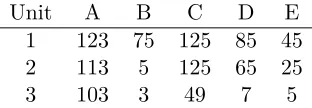
Illustrating the process is the following example of Ausubel (2004), loosely patterned after the first U.S. Nationwide Narrowband Auction in which there were five spectrum licenses and five bidders with the limitation that each can buy only up to three licenses. The bidders marginal values for the licenses (their inverse demand functions) are given as columns in Table 1 in millions of dollars.
Unit A B C D E
1 123 75 125 85 45
2 113 5 125 65 25
[image:14.612.228.384.372.426.2]3 103 3 49 7 5
Table 1: Marginal values of the buyers in Ausubel’s (2004) example.
When the auctioneer starts from a low price, say 10, the demands will be (3,1,3,2,2) for bidders (A,B,C,D,E), respectively. As the price goes up (say continuously), the demands become (3,1,3,2,1) at price p = 25 (a bidder chooses not to buy when indifferent), then (3,1,3,2,0) at pricep= 45, then (3,1,2,2,0) at pricep= 49, and then (3,1,2,1,0) at pricep= 65. At this price, the total demand is 7, which still exceeds the supply of 5. Yet, the total demand of all bidders but A is 4 = 5−1. In the language of Ausubel, ‘bidder A has clinched winning one unit’ at price 65 (expressing the fact that at that point it was guaranteed that he would end up with at least one unit). At pricep= 75, the demand drops to (3,0,2,1,0) and bidder A clinches winning two items, paying 75 for his second item, and bidder C clinches one item at price 75. The total demand is still higher than the supply and so the price goes on increasing until it reachesp = 85, where the demand becomes (3,0,2,0,0) and hence supply equals demand. At this price 85, bidder A clinches
15If the demand drops fromd(p
t−1)> M tod(pt)< M, then the total number of units clinched will exceed the
supplyMand the process ends at timet. (For example, the supply is 10, there are two symmetric buyers, there are 0 clinched units att−1, and the demand drops tod(pt) = 8. Here, each buyer would clinch 10-(8/2)=6 units.) In this
his third unit (3 = 5−2) and bidder C clinches his second unit (2 = 5−3). The outcome of the auction is therefore: bidder A wins three licenses and pays 65 + 75 + 85 = 225 million, and bidder C wins two licenses and pays 75 + 85 = 160 million.
This mechanism yields an efficient allocation: the process allocates the items to the buyers who value them the most, and for this homogeneous discrete multi-item environment with inde-pendent values it yields the same allocation as the sealed-bid multi-unit Vickrey auction described previously.
For comparison, in a uniform-price ascending-clock auction, the closing price in this example would be 75 (assuming full information), buyer A would reduce his demand and ask for two items at price 75 and end the auction (preferring to get two items at price 75 each rather than three items at price 85 each) with the inefficient allocation (2,0,2,1,0). Furthermore, the example can be slightly perturbed to make this inefficient outcome the unique outcome of iterated elimination of weakly dominated strategies.
The Ausubel model is for independent values but otherwise it is quite general: it allows for both discrete and divisible objects, both complete information when demand functions are commonly known, and incomplete information when demand functions are only privately known. Ausubel considers two versions of the model, one with a continuous-time clock and one with a discrete-time clock. For private values, the main result about this mechanism which he calls ‘the alternative ascending-bid auction’ is that sincere bidding by all bidders is an ex-post perfect equi-librium yielding the efficient outcome of the multi-unit Vickrey auction.
To provide a generalization of the Milgrom-Weber model of interdependent values, Ausubel needs to make some assumptions and limit his general model. He considers a continuous-time game with symmetric interdependent values. A seller offers M discrete and indivisible homogeneous goods. Each buyer i has constant marginal utility vi for each unit up to a capacity of λi units
and zero marginal utility for any additional unit beyond this capacity. The marginal values vi are
interdependent: they are derived from affiliated private signals. The main result for this model is that if all buyers have the same capacityλ, andM/λ is an integer, then under certain assumptions (analogous to those in the Milgrom-Weber model) both the multi-unit Vickrey auction and the alternative ascending-bid auction attain full efficiency. However, the alternative ascending-bid auction yields the same or higher expected revenue than the multi-unit Vickrey auction. This is analogue to the the Milgrom and Weber result for a single-unit auction: with affiliation, the ascending English auction generates higher revenue than its sealed-bid analogue, the second-price auction.
3.2 Multiple Heterogeneous Items
In a subsequent paper, Ausubel (2006) extends his multi-unit open ascending auction to K het-erogeneous commodities with available supply S = (S1, . . . , SK) among n buyers. The starting
dis-cussion). In this selling mechanism, a ‘fictitious’ auctioneer announces a price vector for the K
commodities and the buyers report their demand (vectors), the auctioneer then adjusts the prices by increasing the prices of commodities with positive excess demand and decreasing the prices of commodities with negative excess demand. The process continues until a price is reached in which demand equals supply for all commodities. The trade takes place only at the final (market clearing) price and the buyers’ payments are linear in quantities; all buyers pay the same price for all units of the same commodity that was allocated to them.
This process is vulnerable to strategic manipulation as the linear payment method provides an incentive for the bidders to underreport their true demand at the announced price (see Ausubel, 2004, for the ascending auction, and Ausubel, 2002, for the sealed-bid auction.) Consequently the process typically does not result in a Walrasian outcome. An extreme empirical demonstration of this is the GSM spectrum auction in Germany (see Grimm et al., 2003, and Riedel and Wolfstetter, 2006). To overcome this drawback, Ausubel replaces the linear pricing by the non-linear pricing in ‘clinches’ introduced in his above-described one-commodity multi-unit ascending auction. Similarly to the process in the homogeneous case, the price vectorP(t) is changing (according to an adapted Walrasian Tâtonnement process), and units of each commodityℓare allocated (clinched) to buyeri
at that pricePℓ(t) when the demand of all other buyers for that commodity is less than the available
supplySℓ. Thus, in Ausubel’s dynamic mechanism, payments are made along the process and they
are determined by the prices at various points in time. Hence, buyers pay different prices for units of the same commodity clinched to them at different stages in the process. As a result, there are technical issues to ensure that payments are well defined, i.e., do not depend on the trajectory of the price vectorp(t) provided it satisfies certain conditions.
When a bundle of heterogeneous objects is purchased by a bidder in an auction, there is the issue ofcomplementarityand substitutabilityof different commodities that affects the efficiency of the auction. For his open ascending auction, Ausubel assumes a substitutes condition (or gross substitutes) which is needed for the existence of Walrasian equilibrium. This condition requires that if the prices of some commodities are increased while the prices of the remaining commodities are held constant, then a bidder’s sincere demand weakly increases for each of the commodities whose prices were held constant.
The issue of complementarity was raised in environments where heterogeneous objects are sold in separate auctions. As it was pointed out in Milgrom (2000), this situation may lead to inefficiency due to what is called exposure: a bidder may purchase object A while paying more than his value forA alone or a bidder may purchase bundle AB while paying more than his value for the bundle. This situation may occur, for instance, if, while bidding for A, the price of the complementary objectB is not yet determined. The price of B may eventually be too high for it to be worthwhile to purchase B, or the marginal benefit of purchasingB may be worthwhile but the total purchase price of bundleAB is higher than its value to the bidder.16
Zheng (2012) considers a sale of two objectsAandB with two types of bidders: one type is interested in only one object and another type has an added value for the bundleAB. The author
designs a mechanism consisting of two simultaneous ascending English auctions modified so as to allow for jump bidding (and other rules accompanying it). The author shows that this modified auction can avoid exposure and restore efficiency since the jump bids can serve as signals.
For divisible goods and strictly concave utility functions and mandatory participation, Ausubel proves that sincere bidding by every buyer is an ex-post perfect equilibrium of the auction game. With sincere bidding, the price vector converges to a Walrasian equilibrium price vector and the outcome is that of a modified VCG mechanism with the same initial price vector P(0).
For the algorithmic aspects of multi-unit auctions see the chapter “Algorithmic Mechanism Design” in this Handbook.
4
Dynamic Auctions
The literature on dynamic auctions provides natural extensions to the well-established static auc-tions theory to common economic environments: situaauc-tions where the populaauc-tions of sellers and buyers, the amount of goods for sale, and the state of information of the various agents are changing dynamically. These changes present the agents and the market designers with dynamic decision problems. Examples are airlines managing their prices when customers enter the market at different times, government surplus auctions where the amount being sold is stochastically changing, owners of internet search engines managing their advertisements when the number of people searching for terms varies, and selling a start-up company when the actual value becomes clearer over time.
The framework of modeling and analyzing such economic environments is that ofdynamic mechanism design within which dynamic auctions are a special case of such mechanisms. There is no clear line between the two bodies of literature and often a paper with the title ‘Dynamic Auctions’ is actually a paper on ‘Dynamic Mechanism Design’. This is the case with the survey by Bergemann and Said (2011). This paper surveys the literature on dynamic mechanism design by grouping it in a two dimensional way. In the first dimension the distinction is between models in which the population of agents change over time while their private information is fixed and models in which the population of agents is fixed but the information of the agents is changing over time. In the second dimension, they group the works according to whether they aim to find mechanisms maximizing social welfare or maximizing revenue.
4.1 Dynamic Population
cost) to inform bidder i about the rules of the auction, the identity of the other bidders, and the distribution of their valuations. Bidder ithen privately learns his type xi and decides whether to
participate or not. If he agrees to participate, he signs a binding contingency contract. While the types of the bidders are independent, there are interdependent valuations of the object: bidderi’s value is ui(x1, . . . , xI) =xi+Pj6=ieij(xj). All bidders have the same discount factorδ∈(0,1].
At the start of each period t the seller approaches a set of potential entrants. Those who decide to enter (after learning their type) and sign a contract send a message to the seller who decides whether to stop the mechanism and sell the object to one of the participants (entrants and incumbents) according to the contracts or to approach new bidders. There are variants of informa-tion disclosure policies, whether or not the seller reveals to the new entrants the messages received in previous stages. In principle, bidders may send a message at each stage they participate in but there is no loss of generality in limiting the mechanism to a single message at the entering stage. The authors apply a revelation principle argument to observe that any perfect Bayes equilibrium (PBE) outcome can be obtained by anincentive feasible mechanismin which the bidders communi-cate their types truthfully. The main result is that under some technical differentiability conditions, the optimal (seller’s profit-maximizing) mechanism is an optimal search procedure relative to the ex-post virtual utilityfunctions Vi(x1, . . . , xI) =xi−1−fiF(ix(ix)i)+Pj6=ieij(xj). An interesting part of
the result is that the seller’s optimal revenue does not depend on the information disclosure policy adopted.
For the special case of private values (eij(·) = 0 for alli, j) andδ= 1, the optimal mechanism
can be implemented by a sequence of Myerson’s optimal auctions where a new entrant joins at each period as long as the object is not sold. In the symmetric case where the bidders have the same distribution of values, the mechanism consists of a sequence of second-price auctions with a reserve price that declines over time. Crémer et al. show that in this special case the optimal design problem is similar to the Weitzman (1979) pandora problem of searching for the highest reward box when only one box can be opened (at a cost) at each period.
In a subsequent paper, Crémer et al. (2009) consider a variant of the model where the costly recruitment of bidders by the seller is replaced by a cost for a bidder to find out his valuation. The seller can force the bidder to pay an entry fee before finding out his type. They show that the seller can obtain the same profit as if he had full control over the bidders’ acquisition of information and could directly observe their valuations once they are informed (intuitively because the bidders are ex-ante identical).
As we move to multiple units for sale, Vulcano et al. (2002) and Pai and Vohra (2013) have similar models in which a seller withKidentical items for sale faces a random arrival of buyers with a demand for one unit. The value for the item and the latest time that it has to be purchased by are the private information of the arriving buyer. Both papers address the revenue maximization problem. Board and Skrzypacz (2013) consider a seller withKidentical indivisible items for sale in a discrete time span of{1, . . . , T}. At time t, a random number Nt of buyers arrive to the market
where {Nt}∞
t=1 are i.i.d. random variables. The number of buyers is observed by the seller but
information). The values are also i.i.d. There is a discount factor δ for the buyers’ utilities.17
Compared to the Crémer et al. model, in the Board and Skrzypacz model the seller has multiple units of the same object rather than one, the set of potential buyers is infinite, and the process of entering the market is random and exogenously given (while it is controlled strategically by the seller in the Crémer et al. model). The values are assumed to be i.i.d. while Crémer et al. allow for interdependent values.
The authors design a selling mechanism in which a buyer, when entering the market and observing his valuevi, declares his value to be ˜vi and the mechanism determines (probabilistically)
the allocation and the transfers. They prove that the optimal (profit-maximizing) allocation is obtained by the following mechanism: at time t with k units left to sell, the seller sells the next unit to the highest-valued agent with a value exceeding a certaincutoffxk
t. Interestingly, the cutoff
levelxk
t depends on the time remaining and the number of items for sale but not on the number of
agents who have entered in the past and their values. The endogenously determined cutoffsxk t are
decreasing both intand k. The cutoffxkt is determined by an equation asserting that the seller is
indifferent between selling to the agent with the cutoff value today and waiting one more period. The implementation is achieved by setting, for t < T, pricespk
t such that the ‘cutoff agent’
with value xk
t will be indifferent between buying and not buying. At the last period t = T, the
seller allocates the items to thek-highest-value buyers, subject to these values exceeding the static monopoly price. Note that it is sufficient to base these prices only on the items remaining. For example, the price for an item in period 3 would be the same if three items were allocated in period 1 and one item in period 2 or two items were allocated in each period.
For the case of a single item (K = 1), this allocation can be implemented by a sequence of second-price auctions with pre-determined reserve prices Rt. For the multiple-item case (K >1),
a sequence of second-price auctions cannot implement the optimal allocation since the optimal allocation may have more than one item allocated in the first period. The optimal allocation in period 2 depends upon how many items were allocated in period 1. Hence, if a second-price auctions with reserve prices were to be used to implement the optimal allocation, then the second-period reserve prices would need to be a function of how many items were sold in the first second-period (or equivalently the number of items remaining to be sold). Thus, as with prices in the optimal allocation, the mechanism needs to have reserve prices that depend upon the period and the number of remaining items, that is, Rk
t.
Board and Skrzypacz also consider the continuous time version of the model in which buyers enter the market according to a Poisson process at arrival rate λ, and instantaneous discount rate
r. The optimal mechanism becomes simpler to implement in this case since at any time instant t
at most one unit is sold. The cutoff valuesxk
t are determined as before but now by the continuous
form of the indifference condition for the seller. The implementation is made by setting a take-it-or-leave-it selling pricepk
t that makes the agent with value equal to the cutoffxkt indifferent between
buying at timet and waiting.
17For a model of allocating heterogeneous objects to impatient agents arriving sequentially (with privately known
4.2 Repeated Ascending-Price Auctions
Said (2008) highlights the difference between static and dynamic auctions by demonstrating that even with a single object for sale and a random arrival of buyers (similar to the Board and Skrzypacz model) repeated sealed-bid second-price auctions may not lead to an efficient allocation.
In his leading example, two buyers are present in the market with values v1, v2 ∈ [0,1], and w.l.o.g. assume v1 > v2. A third potential buyer with value v3 ∼ F, whereF is the uniform
distribution on [0,1], may enter the market with probabilityq ∈[0,1]. Assume thatv1 and v2 are
commonly known by the players but the valuev3of the new entrant is his private information. Each
buyer wishes to purchase exactly one unit of the object. There are three units that are sold via a sequence of three second-price auctions in which the buyers’ bids are revealed after each round and subsequent rounds are discounted byδ per period. Note that at the first round, buyers 1 and 2 do not know whether buyer 3 has entered or not but, as the bids of the first round are announced, this becomes known to them in the second and third rounds. The efficient allocation should have the highest-valued buyer receiving the unit in the first round, the second-highest-valued buyer receiving the unit in round 2, and the third-highest-valued buyer (if there is one) receiving the last unit.
To see why this situation may lead to inefficiency, let us sketch the equilibrium of the specific case (adapted from Said, 2008) in whichv1 = 23, v2 = 13, δ = 109 , andq >0. Buyer 1 knows that
even if he loses the first round there is a probability of 1−qthat he will be alone in the next round, will receive an item at price zero, and obtain a utility of δ times his value. Therefore, his bid in the first round will be at most (1−(1−q)δ)v1 = (0.1 + 0.9q)v1, which is considerably lower than
his value for small q. The same holds for buyer 2.
However, unlike buyers 1 and 2, buyer 3 knows whether or not he has entered the market in round 1. If entering in round 1, buyer 3 knows that he cannot pay zero for the item in round 2 since he would face another buyer. Since in any equilibrium, in round 1, buyer 1 outbids buyer 2, in round 2 buyer 3 faces buyer 2 who bids (1−δ)v2 (since the round 3 price is zero). From this,
if buyer 3’s value is larger than 13, then his potential round 2 profit is v3−1
3(1−δ). Therefore, in
round 1, buyer 3 will bid v3−(v3−13(1−δ))δ = 0.1v3+ 0.03. Consequently, for small enoughq, a
buyer 3 entering the market with value slightly less than v1 = 2/3 will win the first item, which is inefficient. This happens when 0.1v3+ 0.03>(0.1 + 0.9q)v1, for example, v3= 0.6 and q= 0.03.
The author suggests that this result is driven first by the fact that the future is discounted and hence the order in which objects are allocated matters. But more importantly, there is a fundamental information asymmetry: while the values of buyers 1 and 2 and their presence are commonly known, the presence of the new entrant and his value are his private information. With this insight, Said shows that efficiency is recovered if the sealed-bid second-price auction is replaced by its open-auction counterpart, namely, the open ascending price auction (while there is still one object per round). The intuition is that with this auction more information is revealed to make up for the initial asymmetry of information.
auction is efficient. However, this cannot be viewed as a ‘more general’ result since the model here differs from the one in Said’s previous work. In Said’s (2012) model, the author considers an infinite-horizon discrete-time process with a single seller. In each period t ∈N, the seller has Kt
units of a homogeneous and indivisible good available for sale. The amountsKt are independently
distributed according toµt. Objects are perishable: any object that is not allocated or sold perishes
at the end of each period. Each periodtbegins with the arrival ofNtbuyers. The variables{Nt}∞t=1
are independent with distributions λt; t= 1,2, . . .. Each buyer ipresent in the market wishes to
obtain a single unit and is endowed with a privately-known valuevi for that single unit. The values
vi are independent and with distributions Fi. In addition, buyers may exogenously depart from
the market (and never return) after each period, where the (common) probability of any buyer i
surviving from periodttot+ 1 isγt∈[0,1]. Otherwise, buyers remain present on the market until
they obtain an object. Buyers are risk neutral, with quasilinear and time-separable preferences. All buyers, as well as the seller, discount the future with the common discount factor δ ∈ (0,1). Finally, it is assumed that every buyer is aware of the presence of all other buyers in the market.
In this model, Said shows first that a sequence of second-price sealed-bid auctions with no bid disclosure does not admit an efficient equilibrium. Again, the main reason is that the dynamics creates asymmetry of beliefs between the incumbents and the entrants: the incumbents of a certain round are the losers of the previous round, and each knows his bid and the information disclosed at the end of the previous round (e.g., selling prices). Thus, an incumbent has information on the other incumbents that the new entrant at this period does not have. Also, even when private values are independent, market dynamics and repeated competition generate interdependence: the value of winning an object in a round compared to not winning it in that round depends upon the opportunity cost of not participating in subsequent rounds. This opportunity cost depends upon the competitors’ values. Thus, the net values are interdependent.
Here again, efficiency can be restored, by replacing the sealed-bid second-price auction by its open-auction counterpart, namely, the ascending auction. In such an auction, a price clock rises continuously from zero and buyers drop out of the auction at various points. The auction ends as soon as the number of active buyers is Kt or less. Each one will then receive a unit and pay
the closing price. If at the beginning of the round there are less than Kt buyers, the auction ends
5
Externalities in Single-Object Auctions
Externalities in auctions are where a player cares not only about winning the object but also about who wins it in case of losing.18 Two well-suited examples are given by Jehiel et al. (1996). After the
breakup of the Soviet Union, Ukraine was left with 176 intercontinental nuclear missiles. Although neither the United States nor Russia had any interest in these old-fashioned missiles, they each paid Ukraine (in various ways) about one billion dollars to dismantle this arsenal. The second example is when China agreed in 1994 not to sell its M-9 and M-11 missiles to Arab countries; as a reward, the United States agreed to lift its one-year-old embargo on satellite exports to China. Although these are not proper auctions, they are cases in which a party is willing to pay, not to have an object, but to prevent a third party from having it. More generally, these are cases in which ‘whoever wins’ may affect the downstream interaction between the players. Typical economic examples are auctioning of a cost-reducing patent to oligopolists, auctioning spectrum licenses to incumbents, and a retailer competing in an auction for a neighboring plot of land against a competitor who, if he wins, intends to build a polluting factory on it.
5.1 A General Social Choice Model
Major contributions to this topic are by Jehiel and Moldovanu in numerous papers including a review (Jehiel and Moldovanu, 2006). In this review, they make the distinction betweenallocative externalitydue to the final allocation of the object andinformational externalitydue to information held by the other competitors in the auction. They provide a general social choice mechanism in which multi-object auctions with both types of externalities, as well as combinations of the two and complementarities, are special cases. In this model there areN+ 1 agents, indexed byi= 0, . . . , N
(agent 0 is the seller) andK social alternatives, indexed byk= 1, . . . , K. Each agent gets a private
ℓ-dimensional signal about the state of the worldθi ∈Θi ⊂Rℓ. The vector of all private signals is
θ= (θ0, . . . , θN)∈Θ =
×
Ni=0Θi. Agents have quasi-linear utility functions ui(k;θ;ti) =vki(θ) +ti
that depends on the chosen alternative k, on the vector of private signals θ, and on monetary paymentsti.
For an auction allocating a set M of (heterogeneous) objects, a partition of M is P = (P1, . . . , PN), wherePi is the bundle of objects allocated to agent i. In this model, the number of
alternativesK is equal to the number of possible partitions. Thus, we can write utility asviP(θ)+ti. In addition, agents receive a signal for each possible partition, and so ℓ=K. Hence, we can also write, for each partition P, agenti’s signal asθi
P.
The pure private value is obtained when both the signalθi
P and the valuevPi (θ) depend only
on the bundlePi allocated to the agent; that is, for any two partitionsP and P′, Pi=Pi′ implies
θi
P = θPi′ ≡θPii and vPi (θ) =vPi′(θ) ≡vPi (θiPi). The pure allocative externalities case is obtained
when vi
P(θP) ≡ vPi(θiP); that is, while the value of an agent depends on the whole distribution
of bundles (allocative externalities), it depends only on his own signal and not on the signals of
18Externalities can extend beyond the identity of the winner such as in the case where there is a positive spillover
the other agents (no informational externalities). In the case of pure informational externalities and no allocative externalities, the agent cares only about his bundle and about the information of other agents about this bundle; that is, for any two partitions P and P′, Pi = P′
i implies
vi
P(θ) =vPi′(θ)≡vPii(θ) for all θ. In addition, since viPi(θ) depends on the signals of other agents
only to the extent that they concern information ‘about’ the bundle Pi, the signals of any agentj
can be partitioned into equivalence classes (with respect to their effect on vi
Pi(θ)) indexed by Pi;
θj = (θj
Pi)Pi⊆M and we can write v
i
Pi(θ) as v
i Pi(θ
0
Pi, . . . , θ
N
Pi). Finally, the dependence of the value
vi
P on the partitionP accommodates complementarities and substitutabilities in the usual way.
5.2 Complete Information
Considering first the issue of allocative externalities, it turns out that traditional auction formats need not be efficient, and they may give rise to multiple equilibria and strategic non-participation. The first observation is that even in the simplest case of a single object and complete information, the very notion of value becomesendogenous: if we denote by vi
i the value of agent i when iwins
the object (e.g., a license of a cost reducing patent) and by vij (typically negative) the externality exerted on agent iif agentj wins the object, then the net value for agentifor winning the object compared to losing the auction is vi
i −vij if he expects agent j to win or vii −vik if he expects
agent k to win in the case where he loses the auction. Jehiel and Moldovanu (1996) demonstrate this point and show that, even in a simple second-price auction, not only is there no dominant strategy but there can be multiple equilibria with different allocations of the good. They illustrate this possibility in the following example: N = 3 and vi
i = v for all i, the externality terms are
v2
1 =v21 =−α,v31 =v23=−γ, andv31=v32 =−β, whereα > γ > β >0. In one equilibrium, agents
1 and 2 compete (being ‘afraid’ of each other winning the object) and one of them wins and pays
v+α. In a second equilibrium, agent 3 competes with agent 1 (or with 2) and wins the object paying v+β (sinceγ > β, agent 3 is more afraid from 1 than 1 is afraid of 3).
Another phenomenon pointed out by Jehiel and Moldovanu (1996) is that with the presence of allocative externalities there isstrategic non-participation. By staying out, an agent may induce an outcome that turns out to be more favorable to him than the outcome that would have arisen if he had participated. An example where firms are the agents (taken from Jehiel and Moldovanu, 2006) has N = 3, where firms 1 and 2 are incumbents, while firm 3 is a potential entrant. The incumbents do not value the object per se (such as an innovation that is irrelevant for their pro-duction technologies): v11 = v22 = 0. Moreover, v12 = v12 = 0. The entrant has value v33 = v, and it creates a negative externality of α on each of the incumbents, which is greater than his value;