doi:10.4236/jsip.2011.23022 Published Online August 2011 (http://www.SciRP.org/journal/jsip)
A Genetic Programming-PCA Hybrid Face
Recognition Algorithm
Behzad Bozorgtabar, Gholam Ali Rezai Rad
School of Electrical Engineering, Iran University of Science and Technology, Tehran, Iran. Email: [email protected], [email protected]
Received June 11th, 2011; revised July 24th, 2011; accepted August 5th, 2011.
ABSTRACT
Increasing demand for a fast and reliable face recognition technology has obliged researchers to try and examine dif-ferent pattern recognition schemes. But until now, Genetic Programming (GP), acclaimed pattern recognition, data mining and relation discovery methodology, has been neglected in face recognition literature. This paper tries to apply GP to face recognition. First Principal Component Analysis (PCA) is used to extract features, and then GP is used to classify image groups. To further improve the results, a leveraging method is also utilized. It is shown that although GP might not be efficient in its isolated form, a leveraged GP can offer results comparable to other Face recognition solu-tions.
Keywords: Face Recognition, Principal Component Analysis, Genetic Programming, Leveraging Algorithm
1. Introduction
Face recognition has become one of the most active re-search areas of pattern recognition since the early 1990s. In the past 20 years, significant advances have been made in design of successful classifier for face recogni-tion [1]. However the diversity of the face patterns makes it difficult to create robust recognition systems and the complexity of the algorithms makes them hard to imple-ment.
Principal components analysis (PCA) method [2], which is the base of well-known face recognition algo-rithm, Eigenfaces [3,4], is an appearance-based technique used widely for the feature extraction and has recorded a great performance in face recognition. PCA based ap-proaches typically include two phases: training and clas-sification. In the training phase, an eigenspace is estab-lished from the training samples using PCA and the training face images are mapped to the eigenspace for classification. In the classification phase, an input face is projected to the same eigenspace and classified by an appropriate classifier, such as Support Vector Machines (SVMs) or Neural Networks [5].
Genetic programming is an evolutionary algorithm methodology inspired by biological evolution [6]. Evolu-tionary algorithms create a population of abstract repre-sentations of candidate solutions, which is evolved using biology inspired operators such as selection, cross-over
and mutation towards better solutions.
In recent years, Genetic Programming and other evo-lutionary algorithms has been used in classification and pattern recognition problems [7,8], although to the au-thors’ knowledge, Genetic Programming has never been used in Face Recognition Domain.
In many applications, Genetic programming yields simplified symbolical representation of the underlying system it tries to model. This leads to efficient checking of a new sample [9]. On the other hand the complexity and the time needed to find such representation discour-ages its use in many applications.
Leveraging algorithms are a group of deterministic algorithms where a set of weak learners are used to cre-ate a strong learner [10]. While it is not algorithmically constrained, most leveraging algorithms iteratively em-ploy weak learners based on a distribution and combine them with weighting to form a final strong learner.
Programming classifications as a single strong classifier. The rest of paper is organized as follows: in Sections 2 and 3, PCA and Genetic Programming are introduced respectively. Section 4 presents the introduced algorithm, where Genetic Programming is used with and without leveraging. In Section 5, simulations are done on a se-lected face database and results are compared to previous studies.
2. Feature Extraction
Principal Component Analysis
Let there be R face images in the training set, where each
image Xi is a 2-dimensional array of size m × n of inten-sity values. The image Xi can be converted into a vector of D (where D = m × n) pixels. The rows of pixels of the
image are placed one after another to form the vector. If the training set of R images is defined by
1, 2, RX X X X , then the covariance matrix is de-fined as:
1 1 R
T
i i
I T
X X X X
R
(1)where
1, 2, R
D R R and
1 1 R
i i
X x
R
(2)is the mean image of the training set. Also the dimen-sion of the covariance matrix is D × D.
The eigenvalues and eigenvectors are then calculated from the covariance matrix.
Let
1, 2,
D R rQ Q Q Q R (generally, r < R) be
the r normalized eigenvectors corresponding to r largest
eigenvalues. Each of the r eigenvectors is called an
Ei-genface. Now, each of the face images of the training set
X is projected into the Eigenface space to obtain its
cor-responding Eigenface based feature D R i
Z R , which
is defined as:
, 1.2, ,
i i
Z QTY i R (3)
where Yi is the mean-subtracted image of Xi [11].
3. Genetic Programming
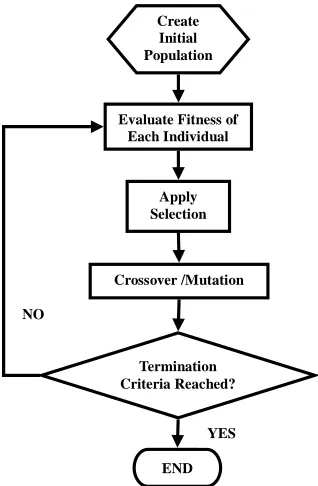
Genetic programming is a methodology inspired by bio-logical evolution to find equations, computer programs, analog circuits or in general any suitable structure for a predefined problem [9]. Genetic programming’s general mechanisms are almost identical to genetic algorithms, as genetic programming is considered either a specialized form of genetic algorithms or an expansion of it [6]. Ge-netic programming is usually implemented similar to the following algorithm:
1) Create initial population. Individual solutions (call-
ed chromosomes) are usually generated randomly. 2) Evaluate the fitness of each individual in the popu-lation.
3) Select best-ranking individuals to reproduce.
4) Breed new generation through crossover and/or mutation (genetic operations) and give birth to offspring.
[image:2.595.341.500.458.701.2]5) Repeat from step 2 until a termination condition is reached (time limit or sufficient fitness achieved).
Figure 1 illustrates the general Genetic programming algorithm.
In GP individual population members (chromosomes) are not fixed length linear character strings that encode possible solution to the problem like in GA, but they are programs that, when executed, provide solution to the problem.
These programs are expressed in GP as parse trees of varying sizes and shapes, what makes these methods flexible in their application to the wide range of prob-lems.
The difference in chromosomes representation is the main and almost the only difference between this method and GA. The overall Darwinian idea of survival stays the same, but there are changes in mutation and crossover operators and in fitness function calculation.
Each node of tree can be function, operator, variable or constant number. Trees can be evaluated in a recursive manner, in which each node’s operator or function is executed up on the results of its children’s evaluation. Tree structure can easily represent a mathematical equa-tion or a Turing complete program.
Create Initial Population
Apply Selection Evaluate Fitness of
Each Individual
Crossover /Mutation
NO
END Termination Criteria Reached?
YES
4. Classification Algorithm
where fj,m is result of nth iteration on the jth group, n is the iteration number from total N repetitions, and errj,k is sum of total errors for all images in the training group.4.1. Using Genetic Programming
To determine a new image’s class, all values acquired from (6) are compared. The class which yields the great-est C is nominated as the new candidate class. It should
be noted that a threshold could be defined, as if the re-sults of all classifiers for an image yield lower than a certain value, the image is certainly misclassified. To classify a given dataset, it is usually enough to find a
way for differentiating classes. Using genetic program-ming, this translates to finding a function which outputs a unique value for each different class:
0
1 0 1
n
X C
X C
f X
n X C
(4)
5. Simulation and Results
The algorithms were implemented in Python and then were tested on the AT&T face image database [12]. The AT&T database consists of 40 groups, each containing ten 112 × 92 gray scale images of a single subject. Each subject’s images differ in lighting, facial expression and details (smiling/frowning, glasses/no glasses, etc.). This is proven to be difficult. As a result, genetic
pro-gramming is used to find a function per class that can discriminate only a certain class from others:
0 1 1i i
i
X C
f X
X C
(5) base; For the Five-to-Five dataset, five random images of Two set of images were created from the AT&T
data-each group were selected for training while the others were used for testing. For the Leave-One-Out set, 9 im-ages were used for training and the remaining image was kept for validation.
This method creates N different functions for a total of N classes. Test images are tested one by one against the
functions, and the first function to return a non-zero val-ue is used to determine the image’s class.
First Genetic Programming was tested without lever-aging. To evolve the population, an Evolutionary Strat-egy (ES) of 1 + λ with λ = 4 was chosen. Mutation rate was set to 15 percent.
4.2. Leveraging Algorithm
Leveraging is a method of using multiple results to im-prove detection. A leveraging algorithm employs multi-ple weak classifiers to create a strong classifier. The
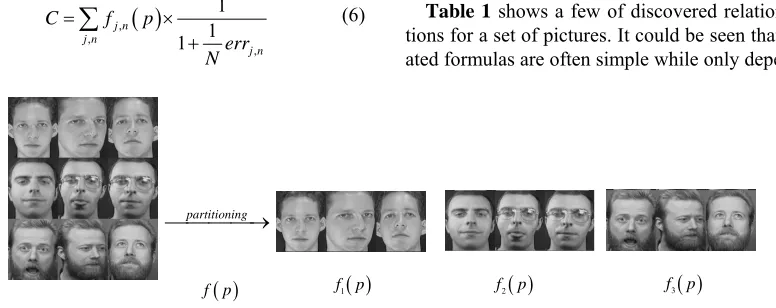
fol-lowing leveraging algorithm is used in this paper: Instead of using all training images as input, the whole group is partitioned to k different groups. Figure 2 shows sample face images which are partitioned to three various clusters.
The selected function set was {+, –, ×, <, >, MIN, MAX, AND, OR, NOT, CNST} where Boolean operators
first compare their operands with 0 and CNST returns a
random constant floating point number in range of [–10, 10]. Inputs were chosen from all available PCA results. To limit algorithm time and prevent bloat, each chromo-some’s depth was limited to 25 and a maximum of 20000 iterations for each evolution was maintained.
Detector function fi,j is then obtained as a function which can detect class i from other classes in group j. To
further improve the results of classification, algorithm above could be repeated N times. For a given image X,
the following equation creates the results of classifica-tion:
To test the leveraged algorithm, algorithm was exe-cuted with the same parameters. Also the number of it-erations was set to N = 8, while the set was divided to k =
8 different groups.
, ,
, 1 1 1
j n j n
j n
C f p
err N
(6) Table 1 shows a few of discovered relationship func-tions for a set of pictures. It could be seen that the gener-ated formulas are often simple while only depending on apartitioning
[image:3.595.116.212.175.234.2]f p f1 p f2 p f3 p
[image:3.595.105.493.554.708.2]Table 1. Examples of Acquired Relationship Functions for Detecting Image Group 1. PCA[n] Is the Nth Value on PCA Vector.
No Function
1 (PCA[8]- MAX(PCA[19], PCA[7]))> PCA[12]
2 AND((PCA[2]< PCA[13]), MIN(PCA[1], 1))
3 (PCA[0]× NOT(PCA[5]))
4 (PCA[1]× (PCA[21]> (PCA[2]-PCA[18])))
few components and as a result have a relatively low computational overhead.
Results are brought in Table 2, where they are com-pared to EigenFace [3] and SVM [13] clustering methods. It is observed that Genetic Programming without lever-aging has the worst results. On the other hand, Leveraged Genetic programming beats other methods in Five-to- Five. In leave-one-out the results are repeated for Genetic Programming, although this time Leveraged Genetic Programming fell %2.5 (one image in total of 40 images) short of SVM.
While it could be inferred that the Genetic Program-ming is usable as a feature detector, it is believed that PCA is limited in reducing data dimension [14]. Further research is required to investigate Genetic Program-ming’s results with 2D PCA and Multilinear PCA.
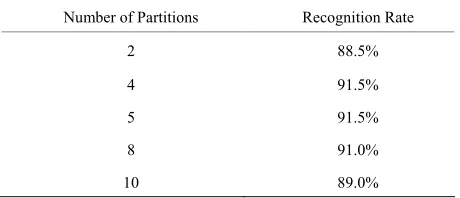
To further investigate Genetic Programming’s per-formance, number of partitioned class groups was changed and the results were brought in Table 3. It was observed that the further partitioning of the images in-creases recognition error, while decreasing k might
man-dates increase in time spent for Genetic Programming’s evolution.
6. Conclusions
[image:4.595.309.539.114.213.2]Genetic programming is a general purpose search algo-rithm that can be utilized in classification problems. In this paper, Genetic programming was exploited to clas-sify face images. The results showed that Genetic Pro-gramming alone is not suitable, as required time and computational overhead surpasses that of other methods, and also its recognition ratio is usually lower.
Table 2. Comparision of Different Algorithms Recognition Rate.
Method Five-to-Five Leave One Out
Eigenface 87.0% 85.0%
SVM 91.0% 95.0%
GP 63.5% 67.5%
Leveraged GP 91.5% 92.5%
Table 3. Effect of Number of Partitions in Leveraged Ge-netic Programming on Recognition Rate.
Number of Partitions Recognition Rate
2 88.5%
4 91.5%
5 91.5%
8 91.0%
10 89.0%
To improve results, a leveraging algorithm was ap-plied to Genetic Programming. The leveraged Genetic Programming showed a good recognition rate, compara-ble to or in some cases even better than that of other me-thods.
REFERENCES
[1] S. Liu, Y. Tian and D. Li, “New research Advances of Facial Expression Recognition,” International Conference
on Machine Learning and Cybernetics, Baoding, Vol. 2,
July 2009, pp. 1150-1155.
[2] I. T. Jolliffe, “Principal Component Analysis,” Springer- Verlag New York, Inc., 2002.
[3] M. Turk and A. Pentland, “Eigenfaces for Recognition,”
Journal of Cognitive Neurosicence, Vol. 3, No. 1, 1991, pp.
71-86.
[4] A. Pentland, B. Moghaddam and T. Starner, “View-Based and Modular Eigenspaces for Face Recognition,”
Pro-ceedings CVPR’94, 1994 IEEE Computer Society
Con-ference on, Seattle, July 1994, pp. 84-91.
[5] A. Eleyan and H. Demirel, “PCA and LDA Based Face Recognition Using Feedforward Neural Network Classi-fier,” Lecture Notes in Computer Science, Vol. 4105, 2006,
pp. 199-206.
doi:10.1007/11848035_28
[6] J. R. Koza, “Genetic Programming: On the Programming of Computer by Means of Natural Selection,” MIT Press: Cambridge, 1992.
[7] S. Xuesong and Y. Zhou, “Gray Intensity Images Proc-essing for PD Pattern Recognition Based on Genetic Pro-gramming,” International Joint Conference on Artificial
Intelligence JCAI’09, Haikou, 2009, pp. 711-714.
[8] A. Teredesai and V. Govindaraju, “Issues in Evolving GP Based Classifiers for a Pattern Recognition Task,”
Pro-ceedings of the 2004 IEEE Congress on Evolutionary
Computation, 20-23 June 2004, pp. 509-515.
[9] J. R. Koza, M. A. Keane, M. J. Streeter, W. Mydlowec, J. Yu and G. Lanza, “Genetic Programming IV: Routine Human-Competitive Machine Intelligence,” Kluwer Aca-demic Publishers, Norwell, 2003.
[10] N. Krause and Y. Singer, “Leveraging the Margin More Carefully,” Proceedings of the Twenty-First International
[image:4.595.55.286.122.203.2] [image:4.595.58.286.636.722.2][11] J. K. Sing, S. Thakur, D. K. Basu and M. Nasipuri1, “Di-rect Kernel PCA with RBF Neural Networks for Face Recognition,” IEEE TENCON Region 10 Conference,
Hyderabad, 2008, pp. 1-6.
[12] AT&T, “The Database of Faces,” 2011.
http://www.cl.cam.ac.uk/research/dtg/attarchive/facedatas e.html.
[13] Y. Q. Pan and Y. Liu, “Face Recognition Using Kernel PCA and Hybrid Flexible Neural Tree,” Proceedings of
the 2007 International Conference on Wavelet Analysis
and Pattern Recognition, Beijing, 2-4 November 2007, pp.
1361-1366.
[14] J. Wang, Y. Chen and M. Adjouadi, “A Comparative Study of Multilinear Principal Component Analysis for Face Recognition,” 37thIEEE Applied Image Pattern
Recognition Workshop, 2008, pp. 1-6.