DOES THE AVAILABILITY AND UTILIZATION OF NATURAL RESOURCES ENSURE DEVELOPMENT
OF THE RURAL PEOPLE OF NAGALAND? A STUDY WITH SPECIAL REFERENCE TO
LONGLENG DISTRICT OF NAGALAND
Lenangh
Department of Rural Development, University of Science
ARTICLE INFO ABSTRACT
Forest resources represent the richest natural resources in our country. The present study was undertaken in
they utilize, conserve and preserve the resources available in the district. The research was conducted at different range of Longleng district with the aim to find ou
resources and how they contribute for the economic development of the region for their livelihood through forest resources and forest product. For the purpose of study 24 respondents were selected by dividing the Dis
i.e., 6 villages, of this 4 person was selected randomly from each village to represent the entire district. The analysis has been made with a view to address the problem of
special reference to Longleng district of Phom Naga.
Copyright © 2018, Lenangh Angh, and Papiya Dutta. unrestricted use, distribution, and reproduction in any medium,
INTRODUCTION
Forestry in India is a significant rural industry and major environment resources. India is one of the ten most forest countries of the world along with the Russian Federation, Brazil, Canada, United States of America, China, Democratic Republic of the Congo, Australia, Indonesia and Sudan. Together, India and these countries account for 67 percent of total forest area of the world. India’s forest cover grew at 0.22% annually over 1990-2000 and has grown at the rate of 0.46% per year over 2000-2010, after decades where forest degradation was a matter of serious concern.
resources’ includes ‘all resources’ that exist in a natural state and all systems that are or can be useful to the man in the actual technological, economic and social circumstances (Flavin, 2002). Frequently used in the economic specialty literature, the term ‘resources’ was associated with the one of the ‘reserves’ that indicate well-defined resources that is known to exist. Nevertheless, the data concerning the reserves are sub due to frequent changes and, supplementary; seem to support a high level of uncertainty. Therefore, the term of ‘reserves’ is the most frequently mentioned in connection with non-renewable reserves (for example, fossil fuels, iron and non-iron ores, deposits of stones, marbles, uranium
used classification of natural resources is that which divides
*Corresponding author: Papiya Dutta,
Department of Rural Development, University of Science and Technology, Meghalaya, India.
ISSN: 0975-833X
Article History:
Received 24th March, 2018
Received in revised form 07th April, 2018
Accepted 20th May, 2018
Published online 28th June, 2018
Citation: Lenangh Angh, K. and Papiya Dutta, 201
Nagaland? A study with special reference to Longleng District of Nagaland
Key words:
Resources, Conserve, Management, Economic Development, Rural.
RESEARCH ARTICLE
DOES THE AVAILABILITY AND UTILIZATION OF NATURAL RESOURCES ENSURE DEVELOPMENT
OF THE RURAL PEOPLE OF NAGALAND? A STUDY WITH SPECIAL REFERENCE TO
LONGLENG DISTRICT OF NAGALAND
Lenangh Angh, K. and *Papiya Dutta
Department of Rural Development, University of Science and Technology, Meghalaya
ABSTRACT
Forest resources represent the richest natural resources in our country. The present study was undertaken in order to understand the variable forest resources that contribute to the people and how they utilize, conserve and preserve the resources available in the district. The research was conducted at different range of Longleng district with the aim to find out the conserve and management of forest resources and how they contribute for the economic development of the region for their livelihood through forest resources and forest product. For the purpose of study 24 respondents were selected by dividing the District into North and South Block and selected 3 villages from North and South area i.e., 6 villages, of this 4 person was selected randomly from each village to represent the entire district. The analysis has been made with a view to address the problem of
special reference to Longleng district of Phom Naga.
This is an open access article distributed under the Creative Commons medium, provided the original work is properly cited.
industry and major environment resources. India is one of the ten most forest-rich countries of the world along with the Russian Federation, Brazil, Canada, United States of America, China, Democratic Republic of the Congo, Australia, Indonesia and Sudan. Together, India and these countries account for 67 percent of total forest area of the world. India’s forest cover grew at 2000 and has grown at the rate of 2010, after decades where forest a matter of serious concern. The term ‘natural resources’ includes ‘all resources’ that exist in a natural state and all systems that are or can be useful to the man in the actual technological, economic and social circumstances used in the economic specialty literature, the term ‘resources’ was associated with the one of defined resources that is known to exist. Nevertheless, the data concerning the reserves upplementary; seem to support a high level of uncertainty. Therefore, the term of ‘reserves’ is the most frequently mentioned in connection with renewable reserves (for example, fossil fuels, iron and iron ores, deposits of stones, marbles, uranium). The most used classification of natural resources is that which divides
Department of Rural Development, University of Science and Technology,
them into renewable resources (that is, solar
energy, tidal energy, agricultural lands, forests, air and waters) and non-renewable resources (that is, mineral substances and fossil fuels). The renewable attribute of the natural resources depends more on the proper use of some unrestrictiv administrative methods, as in the case of agricultural lands and proper storage of wastes, because some changes in the system of natural resources can be proven to be irreversible. The supplementation of stocks of natural resources is generated as a result of discoveries by explorations. For this reason, the process of exploration is highly linked with the administration of natural resources. The renewable resources possess proper rate of increasing or regeneration.
tried to conserve forests by closing it to the public in 1990. This caused major changes in the access to food for the villagers, as they used the forest both directly for food collection and indirectly as a source of income.
identified that there were extremel
rice production was insufficient to cover their yearly food requirements. Hence, they were the most vulnerable to food insecurity. These households relied on work as day labourers. The composition of these "pristine" forests have be
by long term preferential section of some species over others in the course of harvesting, planting, hunting and
(Richardson 1990, Fellowes and Hau 1997). Many decision makers have focused narrowly on the natural aspect of forests and marginalized their importance to people. It is necessary to build a solid knowledge base about the integration of protected
International Journal of Current Research
Vol. 10, Issue, 06, pp.70027-70032, June, 2018
2018. “Does the availability and utilization of natural resources ensure development of the rural people of Nagaland? A study with special reference to Longleng District of Nagaland”, International Journal of Current Research,
Available online at http://www.journalcra.com
z
DOES THE AVAILABILITY AND UTILIZATION OF NATURAL RESOURCES ENSURE DEVELOPMENT
OF THE RURAL PEOPLE OF NAGALAND? A STUDY WITH SPECIAL REFERENCE TO
Technology, Meghalaya, India
Forest resources represent the richest natural resources in our country. The present study was order to understand the variable forest resources that contribute to the people and how they utilize, conserve and preserve the resources available in the district. The research was conducted t the conserve and management of forest resources and how they contribute for the economic development of the region for their livelihood through forest resources and forest product. For the purpose of study 24 respondents were selected by trict into North and South Block and selected 3 villages from North and South area i.e., 6 villages, of this 4 person was selected randomly from each village to represent the entire district. The analysis has been made with a view to address the problem of rural people of Nagaland with
Commons Attribution License, which permits
them into renewable resources (that is, solar energy, wind energy, tidal energy, agricultural lands, forests, air and waters) renewable resources (that is, mineral substances and fossil fuels). The renewable attribute of the natural resources depends more on the proper use of some unrestrictive administrative methods, as in the case of agricultural lands and proper storage of wastes, because some changes in the system of natural resources can be proven to be irreversible. The supplementation of stocks of natural resources is generated as lt of discoveries by explorations. For this reason, the process of exploration is highly linked with the administration of natural resources. The renewable resources possess proper rate of increasing or regeneration. In Thailand the government serve forests by closing it to the public in 1990. This caused major changes in the access to food for the villagers, as they used the forest both directly for food collection and indirectly as a source of income. It was identified that there were extremely poor households whose rice production was insufficient to cover their yearly food requirements. Hence, they were the most vulnerable to food insecurity. These households relied on work as day labourers. composition of these "pristine" forests have been modified section of some species over others in the course of harvesting, planting, hunting and gathering (Richardson 1990, Fellowes and Hau 1997). Many decision makers have focused narrowly on the natural aspect of forests marginalized their importance to people. It is necessary to build a solid knowledge base about the integration of protected
INTERNATIONAL JOURNAL OF CURRENT RESEARCH
areas and local people, in order to preserve the ecological integrity of many nature reserves in China (Harkness 1998, Herrold 1999). Forests are important for their biodiversity, their role as 'lungs of the earth' and as natural capital sustaining the livelihoods of many people. Large numbers of people in 13 the developing countries are relying on forests as source of livelihood and many others regard economic activities related to forests an attractive livelihood option. There are cases where forests continue to be central to livelihood systems, local people are or should be the main stakeholders. Meeting their needs on a sustainable basis should be the principal objective of forest management, and this should be reflected in control and tenure arrangements (Peluso and Padoch 1996). Although evaluation of reserves of a natural resource is important, the interactions with other systems as well as the potential irreversible changes are even more important. Open mining of coal may lead to the complete interruption of ground water motion and the permanent exhaustion of some rivers and wells, the acid formed through the sulphur contact with the atmospheric air may lead to pollution of water reserves and killing of the aquatic plants and fishes (Zaharia, 2004). For this reason, the natural resources must be looked at as component parts of the extended ecosystems for conservation and management.
The use of natural resources in the technological production process, it must be remembered, takes place as a direct consumption of resources with a goal of satisfaction of demand and/or necessity of goods and services. Resource exploitation is thus a complex, coordinated activity for simultaneous satisfaction of consumer demands. Forest represents the richest natural resources of the state. Nagaland is also very rich in bio-diversity with abundance of animals, insects and plant species. The state has wealth of herbal, medicinal and aromatic plants with tremendous economic potentials. The rich forest cover holds tremendous potential for bio-technology manipulations and also indicates strength for a sustainable timber industry, especially through tree cultivation. Though the size of Nagaland is small compared to others states in the Indian Union, yet it has rich variety of forests and natural resources cover due to its unique geographical location and climate types. The state is endowed with rich forest resources including various types of flora and fauna. About 20 percent of the total geographical area is under the cover of tropical evergreen forest including palms, bamboo and rattan as well as timber and mahogany forests. Recently, some forest area has been cleared for the bamboo of jhum cultivation. The forests of Nagaland also give habitats to species of monkeys sambars, deers, oxen and buffaloes. The great Indian hornbill is one of the famous birds found in the state. The total forest area in Longleng district is 461.68 sq km and 97.99 sq km non forest areas. The forest cover map of Longleng district shows that the district has 0.34 sq km of very dense forest, 189.47 sq.km dense forest, 233.35 sq.km open forest and 38.52 sq.km scrub forest. The district can be divided into three regions topographically, namely Chingmei Range in the northern region, Shemong Range in Central Longleng district and Yingnyu Range in the southern region. The attitude of the district varies from 150 metres to 2000 metres above the sea level. Longleng town, the Headquarters is around 1067 metres above the sea level. There are two forest Ranges in the district and both of these ranges are headed by range officer. The Forest Department of Longleng functions under Tuensang Forest Division. Forest Department has purchased land both in Longleng and shetap and a proposal has been submitted to the
Government of Nagaland for the up-gradation of Longleng Forest department to a full-fledged Forest division.
MATERIALS AND METHODS
The study has been done to know about the forest resource available in the region and how the rural people of Longleng district are utilising and conserving the forest resource. Every village of each selected area has their peculiar system of ownership and practice of forest resources and the law regulates it. The research is done with the help of stratified sampling and to select the respondent from each selected village, snowball sample is applied with a schedule.
In the backdrop, the objectives of the present study include:
To know the resources available in the study area. To study the utilisation of resources and constraints
faced by the community if any.
After visiting all the selected villages, the data that was collected from the respondents were compiled up to know their present situation and as well as their conservation and lifestyle. From each North and South block, 6 village was selected with 4 respondent from each village i.e., altogether 24 respondent, the respondent was selected by applying the method of snowball sample in order to find out the forest resources available in the region and how they conserve and utilise it. However the selection of this survey was not focused on gender wise but to know the lifestyle of the chosen village. The study was carried out during the month of October 2017. The collection of the data was done with the help of primary data and secondary data. The primary data was done in-depth interview of the respondent and through spot observation. Secondary data was collected from published books, articles and internet sources. The secondary data is used to study the micro economic purpose and to analysis the historical perspective of research. A sample design is a part of whole items selected from the population for the purpose of getting information about the forest resources. The primary data was collected by undertaking field study and in-depth interview to the respondents. For present study the sample survey was conducted following the method of Non-Probability sampling (Convenience sample and snowball sample) total sample was collected by dividing the Longleng district into North block and South block. In collecting samples from the Longleng, 3 villages was selected from 2 block (North and South) i.e., 6 villages. From each block of 6 villages, 4 respondents were selected i.e., altogether 24 respondents by applying the method of Snowball sample. Information on the forest resources that are available in the region has been collected by interviewing the respondents of particular village. For carrying out these interviews the collection of information a standard schedule of question was used.
RESULTS AND DISCUSSION
Longleng is the hill area and most of the hill people are dependent on forest, they are dependent on forest /wood land / tree derived goods and services. Utilisation of water, fuel wood, shelter, medicinal plants and culinary herbs, nutritionally important forest fruits and other foods, timber, fodder, dry-season grazing, the broad suite of non timber forest products (NTFPs) such as bamboos, rattans, gums, etc are 70028 Lenangh Angh, and Papiya Dutta,Does the availability and utilization of natural resources ensure development
important to these communities. The 'forest communities' referred here would mean the people living in the forest villages of Reserved Forests which came up as a necessity at the time that these forests were notified as Reserved Forests. Almost all the village of Longleng has reserved the forest. Reserved Forests are such forests notified by the Government under Clause 4(a & b) of the Indian Forest Act, 1927 which states that 'The State Government may constitute an
land or waste-land which is the property of Government, or over which the Government has proprietary rights, or to the whole or any part of the forest produce of which the Government is entitled, a reserved forest in the manner hereinafter provided'. A significant percentage of global population has a direct relationship with forest and trees. In every region of the world there are communities that live within or immediately adjacent to forested areas and who depend on them for sustenance. It has been estimated that one quarter of the world's poor depend directly or indirectly on forest for their livelihood (World Bank 2000a). It is because of reasons more than these that such populations are dependent on forest resources.
Forest resources available in the district are
Tree bamboo fruit crop lang
banana powder leave pau 8) bang
chujing haujing youh
shalak ngo kau lag mei pu yau and etc.
The most important tree and which has the most economic value are: Tita chapa, dei pu,Yep pu, Kao mei, Nut pu, Ak pu, Ovang chan pu. Of these Nut pu, Len-no pu, tita chapa are mainly used for making truck body and used in train to support during the transportation of heavy load. Also use for construction of house, building, firewood, timber, truck body, train support, handicraft, local bridge, different
and local pistol gun boot, and for all kinds of furniture and different use.
Some few medicinal use of trees are as follows
A. Din pu: The cover of the din pu is use for stomach pain by boiling it into the water.
B. Chau-jing hau-jing lag : The leaves of the chau hau-jing tree is a vexed and it is also use for all kinds of fever.
C. Shuk hak : The shuk hak leave and branch are use for
earth worm both for animals and human beings. Animals eat this by raw but human beings eat by boiling it into the water.
The most important and has the most economic value are; Nut pu, Lao-po mung, Thum po, Tho and Company ao from japan (Japan ao is only for supply). Use for house, building, bamboo 70029 International Journal of Current Research,
important to these communities. The 'forest communities' referred here would mean the people living in the forest villages of Reserved Forests which came up as a necessity at ied as Reserved Forests. Almost all the village of Longleng has reserved the forest. Reserved Forests are such forests notified by the Government under Clause 4(a & b) of the Indian Forest Act, 1927 which states that 'The State Government may constitute any
forest-land which is the property of Government, or over which the Government has proprietary rights, or to the whole or any part of the forest produce of which the Government is entitled, a reserved forest in the manner A significant percentage of global population has a direct relationship with forest and trees. In every region of the world there are communities that live within or immediately adjacent to forested areas and who een estimated that one quarter of the world's poor depend directly or indirectly on forest for their livelihood (World Bank 2000a). It is because of reasons more than these that such populations are dependent
which has the most economic value are: Tita chapa, dei pu,Yep pu, Kao mei, Nut pu, Ak-khe no pu, tita chapa are ck body and used in train to support during the transportation of heavy load. Also use for construction of house, building, firewood, timber, truck body, train support, handicraft, local bridge, different local gun boot, all kinds of furniture and
Some few medicinal use of trees are as follows
cover of the din pu is use for stomach pain
leaves of the chau-jing and it is also use for all kinds of
shuk hak leave and branch are use for earth worm both for animals and human beings. Animals eat this by raw but human beings eat by
onomic value are; Nut po mung, Thum po, Tho and Company ao from japan (Japan ao is only for supply). Use for house, building, bamboo
shoot, handicraft, local bridge, local dust pin, paper, roof, fencing, and for different use.
Medicinal use of bamboo is
Bamboo shoot: This bamboo shoot water is use for eye
purpose and accident, this will apply into the affected area and also use when someone cut in their body in order to control the blood to stop.
Some few medicinal use of fruits are:
Gova: Gova leaves are used for stomach pain by boiling the leaves into the water.
Odi-leg: the Odi-leg leaves are used for high pressure. Hang-leg: Hang-leg fruit is used for cough etc
Some of the few medicinal crop is as follows:
Kainam: Kainam leaves are used for
prevent from poisoning.
The figure (Fig1) can clearly explain about the resources that are use by the people of the region. It can be depicted that out of total number of 24 respondent’s majority of the people prefer the same resources.
[image:3.595.309.560.357.490.2]Data compiled from primary sources, survey 2017.
Fig. 1. People who say yes to forest resources that is most important and has the most economic value
(Data compiled from primary source 2017).
Fig. 2. Among the trees and bamboos which is the most important and has the most economic value
74% 83.40%
Some of those who say yes to forest resources which has the most economic value?
Trees Bamboos
100%
100% 100%
100%
100%
Some of those who say yes to trees.
100%
100% 100%
100% 100%
Some of those who say yes to bamboos.
International Journal of Current Research, Vol. 10, Issue, 06, pp.70027-70032, June, 2018
shoot, handicraft, local bridge, local dust pin, paper, roof,
bamboo shoot water is use for eye purpose and accident, this will apply into the affected area and also use when someone cut in their body in order to control the
Some few medicinal use of fruits are:
eaves are used for stomach pain by boiling
leg leaves are used for high pressure. leg fruit is used for cough etc.
Some of the few medicinal crop is as follows:
Kainam leaves are used for poison, in order to
The figure (Fig1) can clearly explain about the resources that are use by the people of the region. It can be depicted that out of total number of 24 respondent’s majority of the people
Data compiled from primary sources, survey 2017.
People who say yes to forest resources that is most important and has the most economic value
(Data compiled from primary source 2017).
Among the trees and bamboos which is the most important and has the most economic value
100%
100%
Some of those who say yes to forest resources which has the most economic value?
Bamboos Fruits Crops
100%
100%
Some of those who say yes to trees.
Tita chapa Yep pu Kao mei Nut pu Ak- khe pu
100%
100%
Some of those who say yes to bamboos.
Nut
Lapo mung
Thum po
Mung-au
Company ao
[image:3.595.307.558.515.777.2]The people of Phom Nagas make their living by gathering and selling different varieties of fruits, crops, trees and bamboo which are available in their own forest resources. Majority of the people are depending on forest resources and moreover government owned land are very less in the region. However the district endowed with a vast amount of forest resources cannot exploit them properly unless it has adequate supply of labour in the near future. But the supply of labour should be also depending upon the growth of population.
(Data compiled from primary source, survey 2017)
Fig 3. Among the Fruits and Crops which is the most important and has the most economic value
The lush of the District is also home to variety of fauna paradise foe animal and bird lovers and researchers. Dominant wild animals include Stag, Bear, Mithun, Slot
Wild Hog, the rare Pangolin, varieties of Monkey, Wild Cat, Porcupinr, Flying Fox, Flying Squirrel, Himalayan Giant Squirrel and varieties of Squirrel, Civet cat, Python and Otter etc. the rivulets and rivers teem with different varieties fishes and other water creatures are found, out of which trout is a rare species. Dominant birds in the district includes Hornbill, varieties of pigeon including royal pigeon, parrot, mama, mountain peacock, the rare and elusive Blythii Tragopar, varieties of jungle fowl, and smaller bird species.
87% 46%
6250%
7083% 71%
4583% 83.34%
Some of those who say yes to fruits.
Orange Pineapple Gova
Jackfruit Litu Banana
87.50%
83.34%
79.17% 83.34%
79.17% 75%
96%
Some of those who say yes to crops.
Yam Peans Squash
Table 1. The most importance among the forest resources with their name
Sl no Name of the trees Yes
1 Tita chapa 24
2 Yep pu 24
3 Kao mei 24
4 Nut pu 24
5 Ak-khe pu 24
6 Ovang chan pu 24
7 Len-no pu 24
Data compiled from primary source, survey 2017 70030 Lenangh Angh, and Papiya Dutta
of the rural
The people of Phom Nagas make their living by gathering and selling different varieties of fruits, crops, trees and bamboo available in their own forest resources. Majority of the people are depending on forest resources and moreover government owned land are very less in the region. However the district endowed with a vast amount of forest resources ly unless it has adequate supply of labour in the near future. But the supply of labour should be also depending upon the growth of population.
Among the Fruits and Crops which is the most important and has the most economic value
The lush of the District is also home to variety of fauna- a paradise foe animal and bird lovers and researchers. Dominant wild animals include Stag, Bear, Mithun, Sloth, Barking Deer, Wild Hog, the rare Pangolin, varieties of Monkey, Wild Cat, Porcupinr, Flying Fox, Flying Squirrel, Himalayan Giant Squirrel and varieties of Squirrel, Civet cat, Python and Otter etc. the rivulets and rivers teem with different varieties of fishes and other water creatures are found, out of which trout is Dominant birds in the district includes Hornbill, varieties of pigeon including royal pigeon, parrot, mama, mountain peacock, the rare and elusive Blythii Tragopar,
ies of jungle fowl, and smaller bird species.
According to the District Human development report 2013, there were more than 20 birds found in Longleng area and more than 5 varieties of wild animals found in Longleng.
District human development report sample survey 2013.
Fig. 4. Accessibility of wild lives
Data compiled from primary source of survey 2017.
Fig. 5. Problems that are faced while marketing the products
Some of the initiatives taken by the department is listed (Source: Longleng District Human Development Report 2015 page 115,116.):
Forest development Agency:
Afforestation programme (NAP), Forest Department implements afforestation schemes in selected villages
6250%
Some of those who say yes to fruits.
Papaya
83.34%
79.17%
Some of those who say yes to crops.
Gilli
96.70%
(a) No. of Birds found in your area more than 20?.
99.16%
(b) No. of Animals found in your area is more than 5?.
91.67%
83.34%
Some of those who say yes to different types of problem face in the region
Communication Marketing
Table 1. The most importance among the forest resources with their name
Name of the bamboos yes Name of the Fruits Yes Name of the Crops
Nut 24 Orange 21 Yam
La-po mung 24 Pineapple 11 Peans
Thum po 24 Gova 15 Squash
Mung- au 24 Papaya 17 Chilli
Tho 24 Jackfruit 17 Ginger
Company ao 24 Litu 11 Bumking
Banana 20 Alchi
Data compiled from primary source, survey 2017
Papiya Dutta,Does the availability and utilization of natural resources ensure development of the rural people of Nagaland? A study with special reference to
According to the District Human development report 2013, there were more than 20 birds found in Longleng area and more than 5 varieties of wild animals found in Longleng.
development report sample survey 2013.
Accessibility of wild lives
Data compiled from primary source of survey 2017.
ed while marketing the products
Some of the initiatives taken by the department is listed below (Source: Longleng District Human Development Report 2015
Forest development Agency: Under the national
Afforestation programme (NAP), Forest Department implements afforestation schemes in selected villages
3.27% (a) No. of Birds found in your area more than
20?.
Yes
No
0.84% (b) No. of Animals found in your area is more
than 5?.
Yes
No
20.84%
100% 83.34%
Some of those who say yes to different types of problem face in the region
Transportation Financial
Table 1. The most importance among the forest resources with their name
Name of the Crops Yes 21
Peans 20
Squash 19
Chilli 20
Ginger 19
Bumking 18
Alchi 23
through the involvement of the local community. In selected village a Joint Forest Management Committee (JFMC) is set up and works for nursery creation, creation of plantation and maintenance is carried out by the JFMC. Under this scheme money for entry point activity, soil and moisture conservation are also provided to the villages.
Bio-Diversity Conservation: To encourage the
villagers to conserve the rich natural forest, the Department gives financial assistance to the villages having good natural forest for conservation of these forest. Assistance is given for effective protection of the forest area and afforestation of degraded areas.
Betel Vine Plantation: in order to promote the
economy of the people and conservation of forest in the district, the department gives financial assistance to the villagers to take up betel vine plantation in suitable area. Betel vine is planted underneath tall trees, hence tree plantation and betel vine cultivation goes simultaneously.
Conservation of water and its resources: The
department takes up water conservation and harvesting measures such as rain water harvesting structure and identification of water sources and its conservation.
Awareness Programmes: The department initiates
[image:5.595.74.251.433.514.2]awareness programmes to generate awareness among the public about conservation of natural resources such as forest, wildlife and bio-diversity, climate change, its adaptation and mitigation measures.
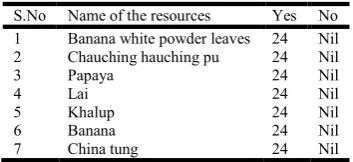
Table 2. The forest resources which grow throughout the year
S.No Name of the resources Yes No
1 Banana white powder leaves 24 Nil
2 Chauching hauching pu 24 Nil
3 Papaya 24 Nil
4 Lai 24 Nil
5 Khalup 24 Nil
6 Banana 24 Nil
7 China tung 24 Nil
Data compiled from primary source of survey, 2017.
100% of the respondents agree that the forest resources mentioned in the region could grow almost all the time of the year regardless of any season. We can see clearly in the figure (Fig 5) that the community face different types of problems during the production, supply and selling of the forest products. Out of total number of respondent, 20.84% face communication problem, 100% face transportation problem, 91.67% face marketing problems and 83.34% face financial problems. Thus, the problem of transportation is severe as compared to the other problems in the region.
Concluding Remarks
The people of Longleng district have abundant forest resources. Half of the populations are dependent on forest product and some are engaged in public and private sectors. Inspite of having forest resources, villagers are not aware about the utilization of forest resources in the process of sustainable development. The cardamom (elaichi) which is only for supply is faced with the problem of intervention by middle man (local mandi) and is not able to be sold in good price due to lack of price rate information and people does not benefit much on it. This is also because of the neglect by the Government, lack of
information, infrastructure facilities and knowledge. However due to some awareness programmes spread through forest department, church, media, students’ body, youth organisation, the people are influenced and many villages have learned to reserve and conserve the forest for their health as well as for their livelihood. Some of the major finding are given below which is found in the forest of Longleng district and still people practice it but government fail to identify these forest resources and products.
Am pu: the cover of the am pu is grinded and mixed with
pure mud and this mixture can be used as gum. It can use for joining and fixing furniture and for other purpose. Sung pu: the sung pu will be first cut on the sides and its
gum will be extracted. Banana leaf will be burned on fire and later ashes will be mixed into sung pu gum and the misture will turn black .This mixture can be used as colour which cannot be removed once applied. In olden days it is used for colouring the Morung. Still it is found in the forest in several areas.
Kai nam: After boiling the leaf of kai nam, the water and
the leaf can be consumed if in case someone is poisoned. Limestone: limestone is still found in some particular
areas. the limestone will be mixed into water and cooked for some time and again that water will be boiled and dried up. Injuries caused by hot water and fire can be healed if it is applied in the body. It can also be used as ingredient in tobacco products.
Banana white powder Leaf: this banana leaf powder (see
annexure I image 2) is used for handloom purposes in order to make it smooth while making different kinds of cloths. Still it is practiced in the region and is used in place of company made powders.
Lang: the lang leaf is used for making house roofs in order to protect it from rain. This leaf is very much durable and can even last for more than 50 years.
Pang: in olden days, pang is used for washing hair in place of soap. some of the people still use this pang as soap in the region.
Shalak: in olden days the shalak is used for combing hair.
It is still found in the forest but nowadays person does not use it.
Kai pu: The kai pu tree is used for fishing purposes. It will be grinded and thrown into the river. After sometimes the fishes will die and come up to the surface of the water. It is also one of the best medicines found in the forest.
Ngo kah lag: the Ngo kah lag leaf is used for keeping banana. The bananas will be ripened soon in good shape and size under the ngo kah lag leaf.
Hei nyak: hai nyak is a seed which is the food for the people in olden days. It is consumed by people as breakfasts and still this hei-nyak is eaten by the people. Yu chen: Yu chen is another kind of food which is
consumed as lunch or dinner by the people. It is consumed till date.
Yau: The last and most important major findings is yau this yau is used for making different kinds of handcrafts and it can last for more than 50 years. If the roots of yau is cut off, still its branch and leaf can last for 1 ½ year without the help of root. Surprisingly this yau is not supposed to be cut by anyone who is less than 70 years old except by the old people and the aged.
Cultivation of medicinal plants will not only provide employment to the rural youth but will also bring a chain of development activities through setting up of processing units and value addition of the products. The rich biodiversity of Nagaland in terms of its varied and substantial flora and fauna holds great promise and potential for providing and environmental need and services to the people. Forests continue to acquire increasing importance for their role in meeting human material needs and also for their ecological and environmental services. Therefore, sustainable use of forest resources with strong conservation approaches is the key element for forestry management practices for Nagaland. Forests and the products they provide are universally required for the continuation of human society as we know it. To change our society to one that does not depend on the forest (to the forest's detriment) and its associated benefits requires such an enormous paradigm shift that we generally do not even consider it worthy of further investigation. Given this situation therefore, it is imperative that we discover mechanisms to manage the forest for all the benefits it can provide, in a sustainable manner.
REFERENCES
Fellowes and Hau, 1997. A Faunal Survey of Nine Forest Reserves in Tropical South China with a Review of Conservation Priorities in the Region, Kadoorie Farm and Botanic Garden, Hong Kong, 152 pp.
Flavin C. 2002. Starea lumli (The Worls State), Edit, Tehnica, Bucuresti, Romania
Harkness, J.A. and Schoua-Glusberg, A. 1998.Questionnaires in Translation. ZUMA-Nachrichten Spezial, 3, 87-127. Herold, D. W. 1999. Solvent-extracted germ meal for
ruminants. PhD Dissertation, University of Nebraska Padoch, X. and N. L. Peluso (Eds.) 1996. Borneo in
Transition: People, Forests, Conservation, and Development. Kuala Lumpur: Oxford University Press. Richardson S.D. 1990. Forest and Forestry in China: Changing
Patterns of Resource Development, Inland press, Washington D.C.,
World Bank, 2000a. FAO corporate document repository, State of world forest part II. Key issues in the forest sector today- The state of forest: the global forest resources Assessment 2000.
Zaharia, 2004. Energie si mediul, (Energy and the Environment), Edit, Univ. “Al.l. Cuza”, Iasi, Romania. www.http://planningcommission.nic.in/sectors/index.php?sect
ors=nagaland as retrieved on 12th October 2017.
*******