Modelling String Structure in Vector Spaces
Richard Connor1[0000−0003−4734−8103], Alan Dearle2[0000−0002−1157−2421], and Lucia Vadicamo3[0000−0001−7182−7038]
1
Division of Mathematics and Computing Science, University of Stirling, Scotland
2 School of Computer Science, University of St Andrews, St Andrews, Scotland
3 Institute of Information Science and Technologies (ISTI), CNR, Pisa, Italy
Abstract. Searching for similar strings is an important and frequent database task both in terms of human interactions and in absolute world-wide CPU utilisation. A wealth of metric functions for string comparison exist. However, with respect to the wide range of classification and other techniques known within vector spaces, such metrics allow only a very restricted range of techniques. To counter this restriction, various strate-gies have been used for mapping string spaces into vector spaces, ap-proximating the string distances within the mapped space and therefore allowing vector space techniques to be used.
In previous work we have developed a novel technique for mapping metric spaces into vector spaces, which can therefore be applied for this purpose. In this paper we evaluate this technique in the context of string spaces, and compare it to other published techniques for mapping strings to vectors. We use a publicly available English lexicon as our experimental data set, and test two different string metrics over it for each vector mapping. We find that our novel technique considerably outperforms previously used technique in preserving the actual distance.
Keywords: Metric Mapping ·n-Simplex projection ·Pivoted embed-ding·String·Jensen-Shannon distance·Levenshtein distance
1
Introduction
Searching over strings has been a central activity of database systems since their inception. In addition to their use in documents composed of character se-quences, strings are commonly used to encode the structure of molecules, DNA sequences, product descriptions and many other objects drawn from the real world. The need to search for similar strings arises due to differences in encod-ing and spellencod-ing, textual descriptions beencod-ing slightly different, and the need to find partial matches. In addition to common tasks such as Web searching, string
similarity also plays an important role in many real-world database tasks includ-ing deduplication and cleaninclud-ing. Similarity search is also important in the context of record linkage where similar representations of real word entities require uni-fication. Searching for similar strings is therefore an important and frequent database task both in terms of human interactions and in absolute worldwide CPU utilisation.
A wealth of metric functions for string comparison exist. In previous work, we have identified then-Simplex projectionas a way of mapping a class of metric space into lower-dimensionality Euclidean spaces with better indexing properties [1, 5, 6]. Previously we have applied this mapping only to the problem of similar-ity search: that is, finding those objects which are most similar to a given query object from a very large space. As part of this work we have identified a subclass of proper metrics, called supermetric, which are amenable to our techniques. This class includes those spaces which have the so-called four-point property [3], which in turn includes all metric spaces which can be isometrically embed-ded in Hilbert space. Furthermore, any Hilbert-embeddable space has a deeper property, in that any finite set ofnpoints can be isometrically embedded in an (n−1)-dimensional Euclidean space.
So far, we have examined only metrics and data within Rn spaces. Here, we extend the work beyond metric indexing, and to non-numeric spaces for the first time. Our techniques allow certain string spaces to be represented in vector spaces in such a way that the distances are maintained with various degrees of approximation. Our main contribution is to explain the mapping from the string space to the vector space. Based on a sound mathematical framework, we demonstrate that this mapping into vector spaces is significantly better than those previously known.
2
Background and Related Work
Our domain of interest is string spaces, by which we refer to a (typically large) finite set of character strings S, and a distance function d: S×S→R+ which compares them. With only a little loss of generality we restrict our interest further to proper metrics which are common over strings. Such spaces are very important in many domains; not just where strings themselves are the objects of interest (e.g., natural language analysis), but also where another semantic domain is represented in string form (e.g., genome analysis).
Table 1: The nearest few terms from the SISAP lexicon for a selection of four tokens, showing both Levenshtein and Jensen-Shannon Shingle distances
“string” “metric” “simplex” “error”
lev jsd lev jsd lev jsd lev jsd
string string metric metric simples simple error error strings stringing matric meteoric dimpled simples terror terror surfing strings eric metricize triplex simpler mirror err
tin striking dearie metrical bingley simplest frog borrower ringing stirring petted symmetric names pimples racy emperor briefing staring makeup mimetic jugular simply petted horror
spaces, whilst attempting to preserve the integrity of the distance function, but none of these appear to be particularly effective.
This paper presents a mechanism for transforming metric string spaces to vector spaces, which can be applied whenever the distance functiondis a proper metric; this includes most edit distances.
2.1 String Metrics
In the literature, many string distance functions have been proposed to measure the dissimilarity between two text strings. In this work we restrict our attention to theLevenshtein Distance and Jensen-Shannon distance as explained below. These two metrics are representative of the wide range of more or less sophis-ticated metrics available. For our purposes, we also note a deep mathematical property which is important to our context: the Jensen-Shannon distance is iso-metrically Hilbert embeddable, whereas the Levenshtein distance is not. The importance of this will be made clear later in the text.
Levenshtein Distance: the best known edit distance between strings defined as the minimum number of single-character edit operations (insertions, dele-tions or substitudele-tions) needed to transform one string into the other. For example, the distance between “error” and “horror” is 2 (one insertion and one substitution), the distance between “writing” and “writer” is 3 (one dele-tion, two substitutions). Note that the Levenshtein distancedLev between
two strings of lengthmandnis at least|m−n|, and at mostmax(m, n).
ω in the following example. For example, the string ”ann” is composed of the characters and diagrams “φa”,“an”, “nn” “nω”,“a”, and “n” with cor-responding frequencies 16,16,16,16,16, and 13.
Jensen-Shannon distance is then applied over these probability ensembles4.We recall that the Jensen-Shannon distance between two probability vectors
x, yis defined asdJ S(x, y) =
p
J SD(x, y), whereJ SD(x, y) is the Jenson-Shannon divergence.
J SD(x, y) = 1−1
2
X
i
xilog2xi+yilog2yi−(xi+yi) log2(xi+yi). (1)
To show a characterisation of these two metrics, Table 1 shows the nearest few strings within the SISAP lexicon to an appropriate selection of tokens.
2.2 String space to Vector space mappings
The only information available within our context derives from the distance function over the string domain; this is treated as a “black box” function and therefore any approach to map the string space into a vector space must rely only upon these distances. Usually, the distances between each string and a fixed set of pivots (i.e., reference objects) is exploited to map the string space to a vector space. There are however various different ways of using this information, five of are compared in this paper.
In this section we explain three string-to-vector mappings which are vari-ously described in the literature, and indeed are the only methods that we know of other than our own. To introduce a unifying terminology, we refer to these mechanisms by the following terms:Pivoted Embedding -`∞,Pivoted Embedding
-`2, LMDS -`2, which we will continue to compare experimentally with two of our own invention, referred to here asnSimplex - lwb andnSimplex - zen.
In terms of the construction of a pivot set, it should be noted that in all cases other than LMDS, the selection of n pivot objects leads to the construction of an n-dimensional vector space; in the case of LMDS, the dimension of the constructed space equals the number of positive eigenvalues of the matrix of the squared distance between the pivots, which is at mostn−1.
We continue by giving explanations of each of these mechanisms; the first three in this section, the two nSimplex mappings in Section 3.
Pivoted Embedding with `∞. Pivoted Embedding is a metric space
trans-formation based on the distances between data objects and a set ofpivots. Given a metric space (U, d), and a set of pivots {p1, . . . , pn}, the Pivoted Embedding fP maps an object o ∈ U to a n-dimensional vector fP(o) =
4 We appreciate this outline description is insufficient to accurately describe the
[d(o, p1), . . . , d(o, pn)]. Using the triangle inequality it can be proven that for
anyo, q∈U
max
i |d(o, pi)−d(q, pi)| ≤d(o, q)≤mini |d(o, pi) +d(q, pi)|. (2)
The maximum distance at any dimension is captured by the Chevyshev5 (`∞) distance, and therefore the distance`∞(fP(o), fP(q)) is guaranteed to
be a lower-bound ofd(o, q). As the number of pivots increases, this lower-bound distance can reasonably be expected to provide a better approxima-tion to the true distance, and this technique has been used to effect in some metric space contexts, e.g. [7, 19].
Pivoted Embedding with `2. Other distances over the same pivoted embed-ding spaces have also been used. For example, in the context of string spaces (i.e.U =S), Spillmann et al [17] used the family of Minkowski metrics, which encompasses the well-known Euclidean distance (`2). It should be noted that there is no underlying theory for this technique, and in particular the`2 met-ric applied over the pivoted embedding space has no formal guarantees that we know of with respect to the string space it is intended to model. The authors primarily investigate the selection of pivots to best effect within several different contexts, but make no particular justification for their choice of vector representation - except, perhaps, that it is the most straightforward possible mapping.
LMDS. In the general metric space context, perhaps the best known technique ismetric Multidimensional Scaling(MDS) [12]. MDS aims to preserve inter-point distances. Givenmobjects and the distancesδi,jbetween those points,
it finds a set of m points {x1, . . . , xm} in a Euclidean space Rk such that
`2(xi, xj) is close as possible to δi,j. Those coordinates are computed using
spectral analysis of the matrix of the squared interpoint distances.
For any metric which is isometrically Hilbert embeddable, it is possible to find a perfect`2embedding for anynobjects withinn−1 Euclidean dimen-sions [11]. However, when the numbermof data points is large the classical MDS is too expensive in practice due to a requirement forO(m2) distance computations and spectral decomposition of anm×m matrix.
The Landmark MDS (LMDS) [9] is a fast approximation of MDS. LMDS uses a set of k landmark points (i.e. pivots) to compute k×m distances of the data points from the landmark points. It applies classical MSD to the landmark points and uses a distance-based triangulation procedure to project the remaining data points. Specifically ifXk∈Rk×k is the output of MDS on the pivot set, the embedding of a new pointsintoRk is computed asxs=−12Xk+(δs2−δ2µ), where (δ2s)i=d(s, pi), (δµ2)j =n1Pni=1d(pi, pj) and
Xk+ is the pseudo inverse ofXk.
5
3
The n-Simplex Projection
The n-Simplex Projection projection is described in full in [6]; here we give a sketch of the approach. Although it requires a little mathematical background, the outcome is that there exists a relatively simple and efficient mapping from any space with the correct properties into ann-dimensional Euclidean space for an arbitrary choice of n. The mapping is contractive, and the associated error asymptotically approaches zero as nincreases.
1. Any metric space (U, d) which is isometrically embeddable in a Hilbert space has the so-called n-point property. This means that, for any finite selec-tion of n objects, an isometric embedding of just those objects exists in (n−1)-dimensional Euclidean space. That is, for any set{u1, . . . , un} ⊂U there exists a mapping f : {u1, . . . , un} → R(n−1) such that d(ui, uj) =
`2(f(ui), f(uj)) for any two objects ui, uj. This background work is
at-tributed to mathematicians such as Blumenthal, Menger, Wilson etc. [3, 14, 18]
2. In practical terms, we have identified that metrics with this property in-clude: Euclidean, Cosine, Jensen-Shannon, Triangular, and Quadratic Form distances [4]. In this context we also note that other proper metrics such as Chebyshev, Levenshtein, and Hamming donot possess the property. How-ever, for any metric space (U, d) and any n ≥ 4 there exist a constant
αn ≤ 1/2 such that for all the 0 < α ≤ αn the space (U, dα) has the
n-point property [10]. Specifically, Blumenthal proved thatα4= 1/2, and thus for any proper metric space (U, d), the space (U,√d) has the 4-point prop-erty. Forn >4, Deza and Maehara [10] proved thatαn ≥0.72/n, thus for
any 0< α ≤0.72/n the space (U, dα) has then-point property. Moreover,
it is worth noting that for any finite metric space (U, d) ofnegative type [10] (e.g. hypermetric, `1-embeddedable metric, ultrametric) then (U,
√
d) has then-point property.
3. In [6], we give the simple corollary of the n-point property that anyn ob-jects in the space can be used to form the vertices of asimplex in (n− 1)-dimensional space, such that the edge lengths of the simplex are in one-to-one correspondence with the distances measured in the original space, and fur-thermore we give an algorithm to construct the Euclidean coordinates of its vertices. This therefore gives a concrete instantiation of the existential functionf mentioned above.
3.1 Dissimilarity functions over the n-Simplex projected points
For a fixed set of pivots,{p1, . . . , pn}, letfS :U →Rn be the n-Simplex projec-tion obtained using the pivots to form the vertices of the base simplex. We have shown [6] that for any two objectso, q∈(U, d)
v u u t
n
X
i=1
(xi−yi)2≤d(o, q)≤
v u u t
n−1
X
i=1
(xi−yi)2+ (xi+yi)2, (3)
where fS(o) = [x1, . . . , xn], fS(q) = [y1, . . . yn]. Thus the Euclidean distance
`2(fS(o), fS(q)) between any two apexes is a lower-bound of the distance between
the corresponding objects within the original space, and an upper-bound could be computed as well. Furthermore, as more dimensions are chosen for the base simplex, these distance bounds asymptotically approach the true distance. The lower-bound (d0
Lwb) is a proper metric function on R
n, while the upper-bound
(d0U pb) is a dissimilarity function but not a proper metric, because it does not satisfy the identity postulate (i.e.d0U pb(x, x) may not be equal to zero).
Other dissimilarity functions over the apex vectors may be considered as well, in particular, any function that is always between the lower-bound and the upper-bound will asymptotically approach the true distance when increasing the number of pivots. An example is themean between the lower- and upper-bound, which as been proved to be particularly effective for similarity search task [1]. Here we introduce theZenithdissimilarity function
d0Zen(x, y) =
v u u t
n−1
X
i=1
(xi−yi)2+x2i +y
2
i, ∀x, y∈R
n (4)
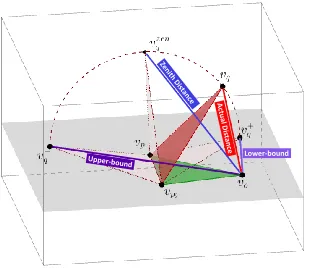
which always satisfies d0Lwb(x, y)≤ dZen0 (x, y)≤ d0U pb(x, y), but has a geomet-rical interpretation stronger than the arithmetic mean between the upper- and the lower-bound. In fact, the Zenith distance, as well as the lower-bound and the upper-bound, can be interpreted as the Euclidean distance between two points in Rn+1. Figure 2 shows the casen= 2.
In general, given the pivots{p1, . . . , pn} and two objects o, qwe know that there exists anisometric embedding of thosen+ 2 points intoRn+1.
Letvo, vq, vp1, . . . , vpn be the mapped points, i.e. vectors such thatd(o, q) =
`2(vo, vq),d(o, pi) =`2(vo, vpi),d(q, pi) =`2(vq, vpi),d(pi, pj) =`2(vp1, vpj), for all i, j = 1. . . , n. The pointsvp1, . . . , vpn are the vertices of the so-called base simplex, which lies in a (n−1)dimensional subspace. The points vp1, . . . , vpn and vo lies in a hyperplane of Rn+1, which we refer to as H. By rotating vq
around the base simplex (i.e. rotate the point while preserving the distances to the pivots) we have two possible projections onto the hyperplaneH (one above and one below the base simplex). Letv+
q andv−q be those points, which coincide
with the intersections of hyperplane H and the n balls of centrepi and radius
d(pi, q). In general, we don’t explicitly know the distance d(o, q), so we don’t
Lower-bound
Fig. 1: Example of n-Simplex projection forn= 2, where the two pivots p1, p2 and two data objectso, qare first isometrically embedded in 3D Euclidean space and then projected in 2D Euclidean plane. The mapped points are indicated withvp1, vp2, vo, vq in the graph. By rotatingvq around the edgevp1vp2 until it is coplanar withvp1, vp2, vo, we obtain two possible apices (v
+
q andvq−), that are
the intersections of the hyperplane containingvp1, vp2, vo, and the the two balls centred invp1, vp2 and radiid(q, p1),d(q, p2), respectively. The apexv
zen q is that
at the highest altitude over the hyperplane that still preserves the distance to the two pivots.
v+
q andvq− are those obtained by approximatingvq with points at zero altitude
such that the distances to the pivots are preserved. Another possible choice is considering the zenith point vzen
q which is the point at the highest altitude
over H that still preserves the distances to the pivots. In [6] we show that the quantities`2(vo, v+q) and`2(vo, v−q) provide a lower-bound and an upper-bound
of d(o, q). By construction, the quantity `2(vo, vqzen) will always been between
those bounds, and it corresponds to thequadratic meanof the lower- and
upper-bounds, i.e.d0Zen=
q(d0
Lwb)2+(d0U pb)2
2 .
3.2 Application of n-Simplex to Levenshtein
As previously mentioned, with respect to our techniques there is one essential difference between the two metrics we are testing: Jensen-Shannon distance is Hilbert-embeddable, and therefore has the n-point property; Levenshtein does not. This means that, in the form defined above, it cannot be used to build a simplex in n-dimensional space for some arbitraryn.
However, as observed above, for anyn >4 there exists some exponentαnwith
0.72/n≤αn≤0.5, such that for anyα∈(0, αn] the space (S, dαlev) satisfies the
n-point property [10]. Therefore, for a fixedαin the desired range we can use the
n-simplex projection to transform the space (S, dα
lev) into (Rn, d0), where d0 is a
then we can approximate the actual distance dlev(si, sj) with (d0(vi, vj))1/α. It
is worth noting that using the value ˜αn = 0.72/n guarantees that (U, dα˜n) has
then-point property forany metric space (U, d); however for a specified metric space it is possible to find a suitable exponent that is greater than ˜αn. We
experimentally observed that, in our context, α= 0.5 works well for (S, dlev);
in fact we have found no counter-examples where it is impossible to embed any
n objects from our domain into an (n−1)-dimensional Euclidean space. Thus we applied the n-Simplex projection on (S,
√
dlev). Note we do not claim this
property forSin general, although we are interested in pursuing this further as we suspect it to be the case.
Given the above, when comparing the n-Simplex techniques in the context of the Levenshtein distance, we first cast the space (S, dlev) into (S,
√
dlev) to
cre-ate the vector space, and then square the results before comparison. In terms of intrinsic dimensionality, or discriminability, this is very undesirable; the applica-tion of this metric-preserving transformaapplica-tion decreases the variance of measured distances, which makes a proximity query more unstable as the the square-rooted distance has less power in discriminating between nearest and furthest neighbour [2]. Thus, the techniques which do not require to perform this mapping should benefit considerably in terms of relative error. This effect shows in some of our results, as mentioned later.
4
Experimental Analysis
To test the five techniques outlined above, we use a single collection of strings drawn from a public English lexicon of 69,069 words6 and consider Levenshtein distance (dLev) and Jensen-Shannon distance (dJ S) over this collection. For
vary-ing numbers of pivots, we apply the five different methods and measure distor-tion, relative error, and absolute squared error.
For each measured numbernof pivots, we repeatedly select a subset random subset of n strings to act as pivots, and a further random selection of 10,000 strings to act as the finite data set. We consider all n2
pairwise distances within the set, i.e. nearly 50 million distances, and for each pair measure both the original distance and the mapped distance to calculate the properties listed. We repeat this process until the standard error of the mean for each measurement is within an acceptable limit, and then report the mean values obtained.
Notationally, we refer to an original metric space (S, d) which is mapped into a new space (¯S,d¯), wheresi, sj ∈Smap tos0i, s0j∈S¯and so on. We measure the
following properties of the mapped data:
Distortion For each mapping, the distortion is the minimumR≥1 such that there exists a multiplying factorr >0 such that, for allsi, sj∈S,
r·d¯(s0i, s0j)≤d(si, sj)≤rR·d¯(s0i, s 0 j).
6
Note that distortion gives a “worst case” analysis and is driven by outliers within the mapping rather than typical errors; the larger the sample of dis-tances, the larger the distortion is likely to be.
Average Relative Error For each pair of distances d(si, sj) and ¯d(s0i, s0j) we
calculate the ratio, and use the mean of these ratios as a scaling factorγ. Then the average relative error is calculated as
1
|S|
2
X
i,j
|d(si, sj)−γ·d¯(s0i, s0j)|
d(si, sj)
Mean Squared Error For each pair of distancesd(si, sj) and ¯d(s0i, s0j) we
cal-culate the ratio, and use the mean of these ratios as a scaling factorγ. Then the mean squared error is calculated as
1
|S|
2
X
i,j
(d(si, sj)−γ·d¯(s0i, s 0 j))
2
4.1 Results
The results of these experiments are plotted in Figure 2.
The clearest observation is that, for almost all measures, the nSimplex-Zenith projection is the best. It is clearly by far the best estimator for all measures over Jensen-Shannon distance, and also for Levenshtein in all aspects other than distortion. Note the scale of the improvement is quite dramatic, the Y axis being given in log scale for all charts. It is also notable how little the performance degrades when less pivots are used compared with the other projections.
The n-Simplex lower-bound estimator also performs well, and our conclusion is that, at least for the Jensen-Shannon space, the n-Simplex projection is clearly preferable to any of the other established methods.
The difference between the two metrics is, we believe, due to the presence of the Hilbert embedding property of the Jensen-Shannon metric, and thus we expect this behaviour to extend to other such metrics. The problem with Leven-shtein, which again we would expect to extend to other non-embeddable metrics, is that in order to apply the projection it is necessary to scale the original dis-tance into a much less discriminable form; this we believe in particular is the reason for the relatively poor figures for distortion. This effect deserves further attention to give a better understanding.
5
Conclusions
3 7 14 24 0,01 0,10 1,00
4 8 16 32
Mean R ela ti ve Err or pivots Levenshtein Distance
Pivoted Embedding - ℓ2 Pivoted Embedding - ℓ∞ LMDS - ℓ2 nSimplex - lwb nSimplex - zen
3 7 15 31 0,01 0,10 1,00
4 8 16 32
Mea n R ela tiv e Err or pivots Jensen-Shannon Distance
Pivoted Embedding - ℓ2 Pivoted Embedding - ℓ∞ LMDS - ℓ2 nSimplex - lwb nSimplex - zen
(a)Mean Relative Error
3 7 14 24 0,01 0,10 1,00 10,00 100,00
4 8 16 32
Mean Squ ar ed Err or pivots Levenshtein Distance
Pivoted Embedding - ℓ2 Pivoted Embedding - ℓ∞ LMDS - ℓ2 nSimplex - lwb nSimplex - zen
3 7 15 31 0,0001 0,0010 0,0100 0,1000 1,0000
4 8 16 32
Mea n Squar ed Er ror pivots Jensen-Shannon Distance
Pivoted Embedding - ℓ2 Pivoted Embedding - ℓ∞ LMDS - ℓ2 nSimplex - lwb nSimplex - zen
(b)Mean Squared Error
3 7 14 24 1,00 10,00 100,00
4 8 16 32
Dis
torti
on
pivots Levenshtein Distance
Pivoted Embedding - ℓ2 Pivoted Embedding - ℓ∞ LMDS - ℓ2 nSimplex - lwb nSimplex - zen
3 7 15 31 1,00 10,00 100,00 1000,00 10000,00
4 8 16 32
Dis
tortion
pivots Jensen-Shannon Distance
Pivoted Embedding - ℓ2 Pivoted Embedding - ℓ∞ LMDS - ℓ2 nSimplex - lwb nSimplex - zen
[image:11.612.138.490.119.598.2](c)Distortion
Fig. 2: Results from varying the number nof pivots. Left figures give measure-ments for Levenshtein Distance, the right for Jensen-Shannon Distance. We recall that both Pivoted Embedding and n-Simplex projection provide a mapping into
Acknowledgements
Lucia Vadicamo acknowledges financial support from the VISECH ARCO-CNR project, CUP B56J17001330004, and the Italian National Research Council (CNR) for a Short-Term Mobility Grant (STM) at the University of Stirling.
References
1. Amato, G., Ch´avez, E., Connor, R., Falchi, F., Gennaro, C., Vadicamo, L.: Re-ranking permutation-based candidate sets with the n-Simplex projection. In: Pro-ceedings of SISAP 2018. pp. 3–17. Springer (2018)
2. Beyer, K., Goldstein, J., Ramakrishnan, R., Shaft, U.: When is nearest neighbor meaningful? In: Proceedings of ICDT 1999. pp. 217–235. Springer (1999)
3. Blumenthal, L.M.: Theory and applications of distance geometry. Clarendon Press (1953)
4. Connor, R., Cardillo, F.A., Vadicamo, L., Rabitti, F.: Hilbert exclusion: Improved metric search through finite isometric embeddings. ACM T Inform. Syst.35(3), 17:1–17:27 (Dec 2016)
5. Connor, R., Vadicamo, L., Cardillo, F.A., Rabitti, F.: Supermetric search. Inform. Syst.80, 108 – 123 (2019)
6. Connor, R., Vadicamo, L., Rabitti, F.: High-dimensional simplexes for supermetric search. In: Proceedings of SISAP 2017. pp. 96–109. Springer (2017)
7. Connor, R.C.H., MacKenzie-Leigh, S., Moss, R.: High dimensional search using polyhedral query. In: Proceedings of SISAP 2014. pp. 176–188. Springer (2014) 8. Connor, R.C.H., Simeoni, F., Iakovos, M., Moss, R.: A bounded distance metric
for comparing tree structure. Inform. Syst.36(4), 748–764 (2011)
9. deSilva, V., Tenenbaum, J.B.: Global versus local methods in nonlinear dimension-ality reduction. In: Proceedings NIPS. vol. 15, p. 721728 (2003)
10. Deza, M., Maehara, H.: Metric transforms and euclidean embeddings. T Am. Math. Soc.317(2), 661–671 (1990)
11. Dokmanic, I., Parhizkar, R., Ranieri, J., Vetterli, M.: Euclidean distance matrices: Essential theory, algorithms, and applications. IEEE Signal Proc. Mag.32(6), 12– 30 (Nov 2015)
12. Kruskal, J.B.: Multidimensional scaling by optimizing goodness of fit to a non-metric hypothesis. Psychometrika29(1), 1–27 (Mar 1964)
13. Manber, U.: Finding similar files in a large file system. In: USENIX Winter 1994 Technical Conference. pp. 1–10 (1994)
14. Menger, K.: New Foundation of Euclidean Geometry. Amer. J. Math.53(4), 721– 745 (1931)
15. Mikolov, T., Sutskever, I., Chen, K., Corrado, G.S., Dean, J.: Distributed represen-tations of words and phrases and their compositionality. In: Proceedings of NIPS 2013, pp. 3111–3119. Curran Associates, Inc. (2013)
16. Pennington, J., Socher, R., Manning, C.: Glove: Global vectors for word represen-tation. In: Proceedings of EMNLP 2014. pp. 1532–1543 (2014)
17. Spillmann, B., Neuhaus, M., Bunke, H., Pekalska, E., Duin, R.: Transforming strings to vector spaces using prototype selection. In: Structural, Syntactic, and Statistical Pattern Recognition. pp. 287–296. Springer (09 2006)
18. Wilson, W.A.: A Relation Between Metric and Euclidean Spaces. Amer. J. Math. 54(3), 505–517 (1932)