FORMULATION, DEVELOPEMNT AND EVALUATION OF
ZIPRASIDONE HYDROCHLORIDE CAPSULES BY DRY
GRANULATION METHOD
Sangita B. Laware*, Deepak G. Wagh, Dr. Parag Kulkarni and Dr. Sadhana R. Shahi
Department of Pharmaceutics, Siddhant Colloege of Pharmacy, Pune Maharashtra, India.
ABSTRACT
The oral route is considered as the most promising route of drug
delivery. Effective oral drug delivery may depend upon the factors
such as gastric emptying process, gastrointestinal transit time of dosage
form, drug release from the dosage form and site of absorption of
drugs. Most of the oral dosage forms possess several physiological
limitations such as variable gastrointestinal transit.[1] Variable gastric emptying gives non-uniform absorption profiles, incomplete drug
release and shorter residence time of the dosage form in the required
site. This leads to incomplete absorption of drugs having absorption
window especially in the upper part of the small intestine, as once the
drug passes down the absorption site, the remaining quantity goes
unabsorbed.[2] The gastric emptying of dosage forms in humans is affected by several factors because of which wide inter- and intra-subject variations are observed. Since many drugs are
well absorbed in the upper part of the gastrointestinal tract, such high variability may lead to
non-uniform absorption and makes the bioavailability unpredictable. Hence a beneficial
delivery system would be one which possesses the ability to control and prolong the gastric
emptying time and can deliver drugs in higher concentrations to the absorption site (i.e. upper
part of the small intestine). Floating systems are one of the important categories of drug
delivery systems with gastric retentive behaviour.[3]
Capsules are solid dosage forms in which the drug is enclosed within either a hard or soft
soluble container or ‘shell.’ The shells are usually formed from gelatin; however, they also
may be made from starch or other suitable substances. Capsule is the most versatile of all
dosage forms. Capsules are solid dosage forms in which one or more medicinal and inert
Volume 6, Issue 8, 1652-1665. Research Article ISSN 2277– 7105
*Corresponding Author Sangita B. Laware Department of
Pharmaceutics, Siddhant
Colloege of Pharmacy,
Pune Maharashtra, India. Article Received on 01 June 2017,
Revised on 22 June 2017, Accepted on 13 July 2017
ingredients are enclosed in a small shell or container usually made of gelatin. The medication
may be a powder, a liquid or a semisolid mass. Capsules are usually intended to be
administered orally by swallowing them whole. Occasionally, capsules may be administered
rectally or vaginally.[4]
KEYWORDS: Dry granulation, direct compression, Roller compactor.
INTRODUCTION
Ziprasidone, commercially available as Geodon capsules, is an atypical antipsychotic used in
the treatment of schizophrenia and bipolar disorder. It is a BCS Class II drug that shows up to
a 2-fold increase in absorption in the presence of food. Because compliance is a major issue
in this patient population, we developed and characterized solubilized formulations of
ziprasidone in an effort to improve absorption in the fasted state, thereby resulting in a
reduced food effect.[5]
This formulation increase solubility and dissolution rate of ziprasidone hydrochloride. For
increasing the solubility of drug solubility study is carried out without SLS, with 1%SLS,
with 2% SLS in different dissolution media. The pre-formulation study carried out like
Identification test, water content, particle size, granules parameter(bulk density
,compressibility index), drug-excipient compatibility studies are carried out up to one month
period at 250C±20 C /60%RH ± 5% RH (2Weeks) and (1 month), 40°C ± 2 0C/75%RH ± 5% RH (2Weeks) and (1 month) and 600C± 2 0C for open condition. The first trail was carried out by direct compression method but because of improper flow trail is taken with dry
compression with roller compaction. Trail taken as per innovator formula. Formula
optimization and process optimization batches carried out and select the design space for
parameters by ANOVA software.[6]
Capsules were evaluated based on different parameters such as thickness, weight variation,
content uniformity, disintegration test, assay, water content, impurity study, in-vitro
dissolution studies, content of active ingredient and IR studies. The physico-chemical
properties of the finished product complied with the specifications. In vitro release from the
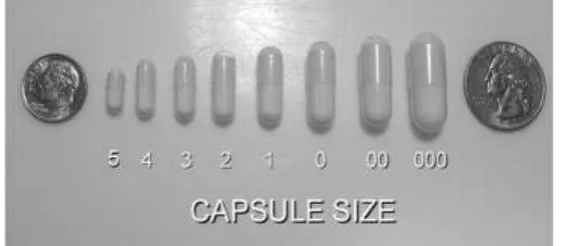
Fig.No.1 Capsule sizes.
Sizes
• 000 (largest) > 00 > 0 > 1 > 2 > 3 > 4 > 5
The compaction of powder by use of pressure roll can also be accomplished by a machine
called chilsonator. Unliketablet machine, the chilsonator turns out a compacted mass in a
steady continuous flow. The powder is fed down between the rollers from the hopper which
contains a spiral auger to feed the powder into the compaction zone. Like slugs, the
aggregates are screened or milled to produce granules.in the production of directly
compressible excipients, the compaction of drugs and drug formulations, the granulation of
inorganic materials, the granulation of dry herbal material and the production of
immediate/sustained release formulations.[8]
Fig No. 2: Chilsonator.
MATERIALS AND METHOD
Ziprasidone Hydrochloride was received as gift sample from Ajanta Pharma Ltd Mumbai,
Lactose Monohydrate, Lactose anhydrous, magnesium stearate, Colloidal Anhydrous Silica,
Pregelatinised starch, Povidone, Polysorbate 80 were procured as gift samples from Signet,
[image:3.595.139.457.461.625.2]EXPERIMENTAL
The objective of formulation development was arrive at a stable & effective formula for
Ziprasidone Hydrochoride Capsule with the similar characteristics of innovator product.
Ziprasidone Hydrochloride is cohesive and displays poor flowability as evidenced by the
compressibility index, Hausner ratio. Poor material flow may produce tablets with high
weight and content variability due to an uneven distribution of the drug substance in the
blend, uneven bulk density and eventually, uneven filling of capsules. Initial trial was taken
by direct compression was according to innovator formula but blend had poor flow, capsules
were not filled properly. Further trials were taken by Dry granulation method by roller
compaction which was according to Innovator and its composition. For dry granulation by
roller compaction, the powder particles of drug substance and fillers are aggregated under
high pressure to form a ribbon and then broken down to produce granules by milling before
filling. Due to the problem of flow properties of blend, the formulation could not make
satisfactory. So the Dry granulation shifted to wet granulation by Fluidized bed processer and
achieved optimum flow properties. The formulations were optimized by applying 22 factorial designs and process was optimized 23-1 fractional factorial designs. The stability study of best optimized formulation was done.[9]
Direct Compression Method
a) Trial 1: ZHC1.
[image:4.595.45.551.508.721.2]Batch size -1000 tablets.
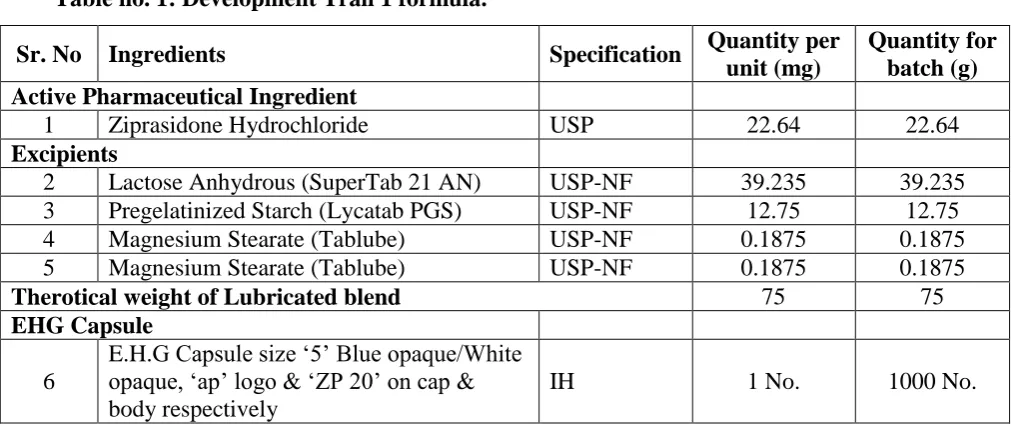
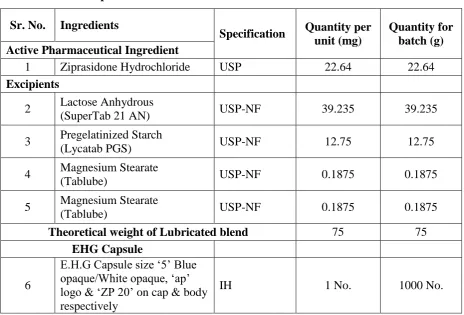
Table no. 1: Development Trail 1 formula.
Sr. No Ingredients Specification Quantity per
unit (mg)
Quantity for batch (g) Active Pharmaceutical Ingredient
1 Ziprasidone Hydrochloride USP 22.64 22.64
Excipients
2 Lactose Anhydrous (SuperTab 21 AN) USP-NF 39.235 39.235 3 Pregelatinized Starch (Lycatab PGS) USP-NF 12.75 12.75 4 Magnesium Stearate (Tablube) USP-NF 0.1875 0.1875 5 Magnesium Stearate (Tablube) USP-NF 0.1875 0.1875
Therotical weight of Lubricated blend 75 75
EHG Capsule
6
E.H.G Capsule size ‘5’ Blue opaque/White opaque, ‘ap’ logo & ‘ZP 20’ on cap & body respectively
IH 1 No. 1000 No.
Conclusion: Next trial was planned to improve BD and flow properties. Trial taken with
Roller Compaction method.
By Dry granulation method.
a. Trial 2: ZHC2.
[image:5.595.93.501.200.492.2]Batch size -1000 tablets.
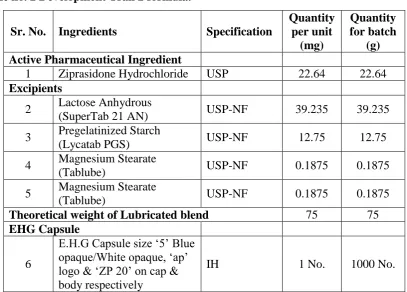
Table no. 2 Development Trail 2 formula.
Sr. No. Ingredients Specification
Quantity per unit
(mg)
Quantity for batch
(g) Active Pharmaceutical Ingredient
1 Ziprasidone Hydrochloride USP 22.64 22.64 Excipients
2 Lactose Anhydrous
(SuperTab 21 AN) USP-NF 39.235 39.235
3 Pregelatinized Starch
(Lycatab PGS) USP-NF 12.75 12.75
4 Magnesium Stearate
(Tablube) USP-NF 0.1875 0.1875
5 Magnesium Stearate
(Tablube) USP-NF 0.1875 0.1875
Theoretical weight of Lubricated blend 75 75
EHG Capsule
6
E.H.G Capsule size ‘5’ Blue opaque/White opaque, ‘ap’ logo & ‘ZP 20’ on cap & body respectively
IH 1 No. 1000 No.
Observation: All flow and related parameters were improved.BD and TD was improved
from 0.2 to 0.4-0.5 and 0.4 to 0.7-0.8.
Conclusion: Next trial planned with increasing Roller pressure and lubricating two times.
b. Trial 3: ZHC3.
Batch size -1000 tablets.
This batch was taken by increasing roller pressure and lubricating two times.
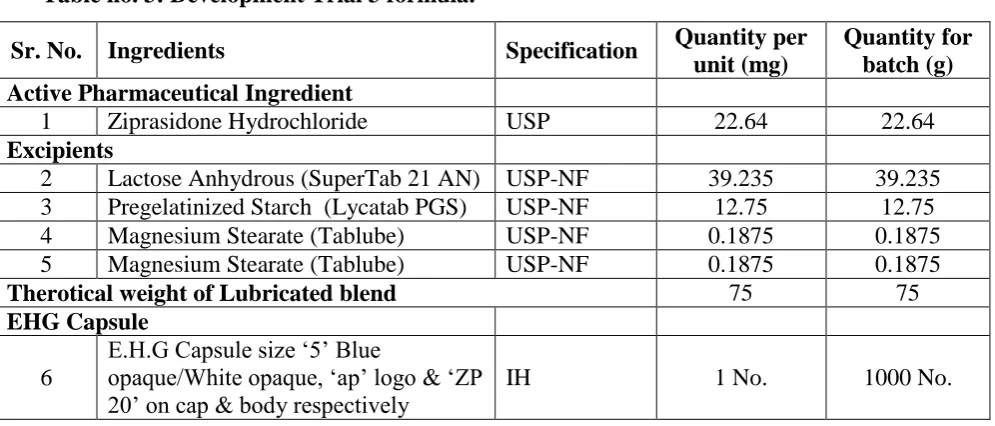
Table no. 3: Development Trial 3 formula.
Sr. No. Ingredients Specification Quantity per
unit (mg)
Quantity for batch (g) Active Pharmaceutical Ingredient
1 Ziprasidone Hydrochloride USP 22.64 22.64
Excipients
2 Lactose Anhydrous (SuperTab 21 AN) USP-NF 39.235 39.235 3 Pregelatinized Starch (Lycatab PGS) USP-NF 12.75 12.75 4 Magnesium Stearate (Tablube) USP-NF 0.1875 0.1875 5 Magnesium Stearate (Tablube) USP-NF 0.1875 0.1875
Therotical weight of Lubricated blend 75 75
EHG Capsule
6
E.H.G Capsule size ‘5’ Blue
opaque/White opaque, ‘ap’ logo & ‘ZP 20’ on cap & body respectively
IH 1 No. 1000 No.
Observation: Flakes formed were to hard .passing these through 20 mesh was not smooth.
Conclusion: Next trial was planned with different compaction parameter.
c. Trial 4: ZHC4
Batch size -1000 tablets
Batch taken with Roller pressure 4T Roller pressure, Roller speed 6 rpm.
Table no. 4: Development Trial 4 formula.
Sr. No. Ingredients Specification
Quantity per unit
(mg)
Quantity for batch (g)
Active Pharmaceutical Ingredient
1 Ziprasidone Hydrochloride USP 22.64 22.64
Excipients
2 Lactose Anhydrous (SuperTab 21 AN) USP-NF 39.235 39.235 3 Pregelatinized Starch (Lycatab PGS) USP-NF 12.75 12.75 4 Magnesium Stearate (Tablube) USP-NF 0.1875 0.1875 5 Magnesium Stearate (Tablube) USP-NF 0.1875 0.1875
Therotical weight of Lubricated blend 75 75
EHG Capsule
6
E.H.G Capsule size ‘5’ Blue
opaque/White opaque, ‘ap’ logo & ‘ZP 20’ on cap & body respectively
IH 1 No. 1000 No.
Observation: Pressing required for capsule filling.
[image:6.595.44.554.437.658.2]d. Trial 5: ZHC5.
Batch size -1000 tablets.
Batch taken with Roller pressure 4T Roller pressure, Roller speed 6 rpm. Capsules filled
[image:7.595.66.531.181.496.2]with automated capsule filling machine.
Table no. 5 Development Trial 5 formula.
Sr. No. Ingredients
Specification Quantity per
unit (mg)
Quantity for batch (g) Active Pharmaceutical Ingredient
1 Ziprasidone Hydrochloride USP 22.64 22.64
Excipients
2 Lactose Anhydrous
(SuperTab 21 AN) USP-NF 39.235 39.235
3 Pregelatinized Starch
(Lycatab PGS) USP-NF 12.75 12.75
4 Magnesium Stearate
(Tablube) USP-NF 0.1875 0.1875
5 Magnesium Stearate
(Tablube) USP-NF 0.1875 0.1875
Theoretical weight of Lubricated blend 75 75
EHG Capsule
6
E.H.G Capsule size ‘5’ Blue opaque/White opaque, ‘ap’ logo & ‘ZP 20’ on cap & body respectively
IH 1 No. 1000 No.
Observation: required weight achieved and capsules were filled properly by automated
capsule filling machine.
Conclusion: It is an optimized batch .based on this formulation the process and formula
optimization to be carried out.
Manufacturing process: - Batch – ZHC1 to ZHC5
1.1.1. Dispensing of Raw Materials.
1) All the ingredients were weighed accurately including the Ziprasidone Hydrochloride.
1.1.2. Manufacturing Process.
1.1.2.1 Sifting, Pre- compaction mixing, and Compaction.
1) Co-sifted Ziprasidone Hydrochloride, Lactose Anhydrous (SuperTab 21 AN) and
Pregelatinized Starch (Lycatab PGS) through # 30 S.S. sieve.
2) Magnesium Stearate (Tablube) sifted through # 60 S.S. sieve
3) Transfered the co-sifted materials of step 1 into blender.
4) Added sifted Magnesium stearate of step 2 into blender
5) Mixed the materials for 10 minutes at 10 rpm.
6) Unloaded the blend from the Blender.
7) Loaded the blend of step 6 into hopper of roller compactor. The blend was compacted by
maintaining the roller speed 4 to 10 rpm, roller pressure 2 to 8 Tones (12 to 100 Bar),
augar speed 5 to 30 rpm, and roller direction forward and sifted through #30 to separate
powder adhered to compacts. The compacted material collected into double polyethylene
lined container.
1.1.2.2 Milling and Sifting
1. Transferred the compacted material from step 7 to mill.
2. Milled the material using 1.5 mm screen at slow speed.
3. Sifted milled material through #30 SS sieve.
1.1.2.3. Lubrication
4. Loaded the material of step 2.2 into Blender.
5. Weighed and sifted the remaining quantity of Magnesium stearate through #60 S.S. sieve
6. Co-sifted granules of step 2.2 and sifted Magnesium Stearate (Tablube) of step 2.3.2
through #30 SS sieve and transferred in to the Blender and mixed the materials for 5
minutes at 10 rpm.
7. Weighed and recorded the net weight of the lubricated blend.
8. Capsule filling was done by manual capsule filling machine.
1.2 Formula optimization by Roller Compaction method
1.2.1 Factorial designs[30]
It is well known that traditional experimentation involves a good soal of efforts and time
especially when complex formulation are to be developed. It is desirable to develop an
expectable pharmaceutical formulation in the shortest period of time using minimum number
efficient method of indicating the relative significance of a number of variables and their
interaction. Factorial design approach shows interaction between factors that a ‘one factor at
a time’ model cannot reveal.
1.2.2 Two Level Factorial Designs[30]
A two-level factorial design is an experimental design in which data is collected for all
possible combinations of the two factors by considering two levels of each. Hence the two
level factorial design was applied for optimization experiments. The table 5.8 shows two
factors such as Pre-gelatinized starch and Magnesium stearate (Binding agent and
Lubricating agent) in low and high levels of concentration. The table 5.9 shows the lowest
concentration for Pre-gelatinized starch and Magnesium stearate was 7.0% and 0.25%,
respectively, whereas the highest concentration for the same agents was 27% and 0.75%,
respectively.
Table 6: Two factors for DOE.
Levels
-1 +1
Factor 1 Pre-gelatinized starch Pre-gelatinized starch
Factor 2 Magnesium stearate Magnesium stearate
Table 7: Two factors with, low and high concentration for DOE.
Levels
-1 +1
Pregelatinised starch 7 27
Magnesium stearate 0.25 0.75
In factorial design the Anova software has given responses for two factors considering one
centre point. Given responses includes main effect plots and some specified set of two factor
interactions plots. The table 5.10 shows five experiments considering centre point. In case of
Response Surface Method (RSM) center point was not considered. Hence the software has
given four experiments which include the contour plots and surface plots.
Table 8: Factorial design batches with center point.
Batch No Pre-gelatinized starch Magnesium stearate
ZHC6 17 0.5
ZHC7 27 0.75
ZHC8 27 0.25
ZHC9 7 0.75
1.2.3 Optimization Batches by Roller compaction
Total 5 optimization batches taken place including one center point.
Table no 9: Optimization batches formula (mg/ tab).
Sr.
no. Ingredients
ZHC6 ZHC7 ZHC8 ZHC9 ZHC10
mg/tab mg/tab mg/tab mg/tab mg/tab
Intra granular
1 Ziprasidone
Hydrochloride 22.64 22.64 22.64 22.64 22.64 2 Lactose Anhydrous 39.23 31.50 31.50 46.51 46.51 3 Pregelatinized starch 12.75 20.29 20.66 5.29 5.6
Lubrication
4 Magnesium Stearate 0.38 0.563 0.188 0.563 0.188
Total 75 75 75 75 75
1.2.4 Process Optimization by Roller compaction Method:
For Process optimization 23-1 Fractional factorial applied with considering following parameters.
i. Pre-lubrication time(mixing)
ii. Roller pressure
iii. Screen used
iv. Lubrication time
The table 5.10 shows 9 experiments considering center point. In case of Response Surface
Method (RSM) center point was not considered. Hence the software has given four
experiments which include the contour plots and surface plots.
Table no. 10: Process variables for process optimization batches.
Batches Process variables
Pre-lubrication time Roller pressure Screen used Lubrication time
ZHC11 10 4 1.5 5
ZHC12 5 2 1 3
ZHC13 5 6 1 7
ZHC14 15 6 1 3
ZHC15 15 2 2 3
ZHC16 15 6 2 7
ZHC17 15 2 1 7
ZHC18 5 2 2 7
RESULT AND DISCUSSION
Evaluation of Development batches.
[image:11.595.69.528.111.315.2]1.1Capsules parameter.
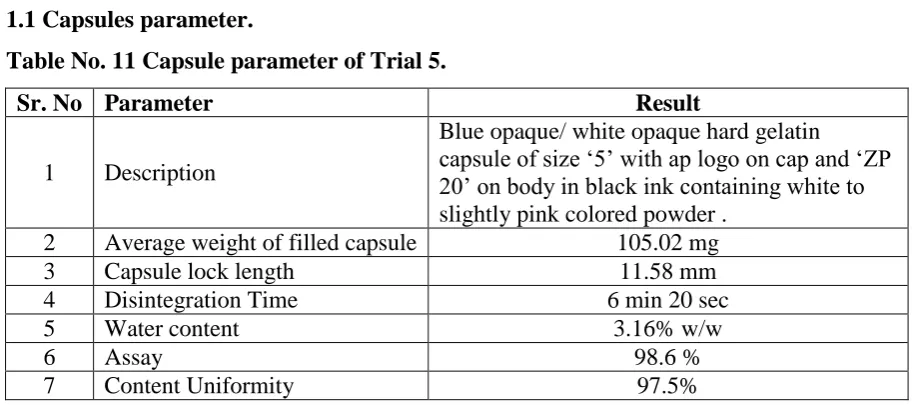
Table No. 11 Capsule parameter of Trial 5.
Sr. No Parameter Result
1 Description
Blue opaque/ white opaque hard gelatin
capsule of size ‘5’ with ap logo on cap and ‘ZP 20’ on body in black ink containing white to slightly pink colored powder .
2 Average weight of filled capsule 105.02 mg
3 Capsule lock length 11.58 mm
4 Disintegration Time 6 min 20 sec
5 Water content 3.16% w/w
6 Assay 98.6 %
7 Content Uniformity 97.5%
Weight Variation
In weight variation test, the Pharmacopoeial limit for percent of deviation for capsules
weighing less than 300 mg is not more than 10%. The average percent deviation of all
capsules was found to be within the limit and hence all formulation passes the weight
variation test.
Capsule lock length
Capsule lock length of capsules was found to be uniform among all formulations and range d
from 11.00 to 11.80 mm.
Content Uniformity
The drug content was found to be uniform among all formulation and ranged from 85.00% to
115.00%.
Assay
Assay of all the formulations was found to be between 95-105% and assay of ZHC5
1.2Particle size analysis.
Table No 12: Particle size analysis of Trial 5.
Sieve no. Empty
wt.
Wt. with
blend Wt. of blend % Retained Cumulative
30 384 384 0 0 0
40 357.5 358 0.5 1.92 1.92
60 350.5 357.5 7 26.92 28.85
80 343 349.5 6.5 25.00 53.85
100 328 331.5 3.5 13.46 67.31
Pan 549 557.5 8.5 32.69 100.00
26 g 100
1.4.1 Dissolution results.
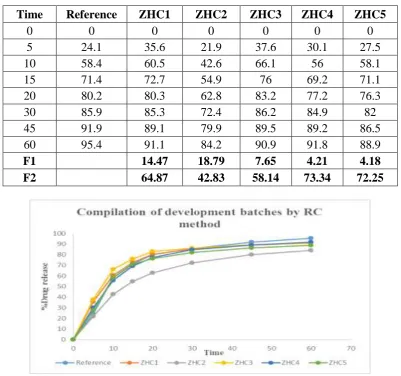
Compilation of development batches dissolution.
Dissolution media: Sodium Phosphate buffer pH 7.5% with 2 % SLS (OGD), 75 rpm, 900
ml, USP-II.
Table No 13: Compilation of Dissolution result of development batches.
Time Reference ZHC1 ZHC2 ZHC3 ZHC4 ZHC5
0 0 0 0 0 0 0
5 24.1 35.6 21.9 37.6 30.1 27.5
10 58.4 60.5 42.6 66.1 56 58.1
15 71.4 72.7 54.9 76 69.2 71.1
20 80.2 80.3 62.8 83.2 77.2 76.3
30 85.9 85.3 72.4 86.2 84.9 82
45 91.9 89.1 79.9 89.5 89.2 86.5
60 95.4 91.1 84.2 90.9 91.8 88.9
F1 14.47 18.79 7.65 4.21 4.18
F2 64.87 42.83 58.14 73.34 72.25
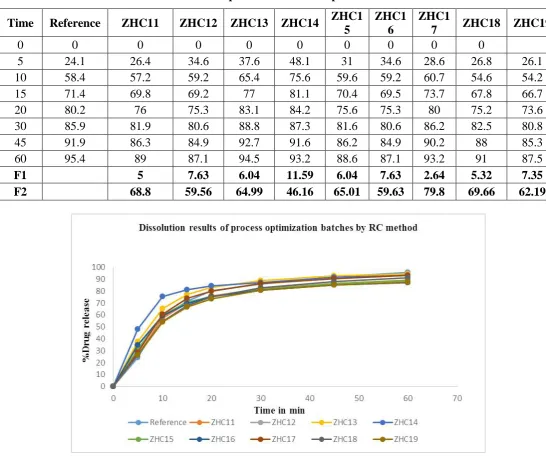
[image:12.595.97.499.369.745.2]6.4. Compilation of dissolution profile of Process Optimization batches.
Table No 14: Dissolution data compilation of Process optimization batches.
Time Reference ZHC11 ZHC12 ZHC13 ZHC14 ZHC1
5
ZHC1 6
ZHC1
7 ZHC18 ZHC19
0 0 0 0 0 0 0 0 0 0
5 24.1 26.4 34.6 37.6 48.1 31 34.6 28.6 26.8 26.1
10 58.4 57.2 59.2 65.4 75.6 59.6 59.2 60.7 54.6 54.2
15 71.4 69.8 69.2 77 81.1 70.4 69.5 73.7 67.8 66.7
20 80.2 76 75.3 83.1 84.2 75.6 75.3 80 75.2 73.6
30 85.9 81.9 80.6 88.8 87.3 81.6 80.6 86.2 82.5 80.8
45 91.9 86.3 84.9 92.7 91.6 86.2 84.9 90.2 88 85.3
60 95.4 89 87.1 94.5 93.2 88.6 87.1 93.2 91 87.5
F1 5 7.63 6.04 11.59 6.04 7.63 2.64 5.32 7.35
F2 68.8 59.56 64.99 46.16 65.01 59.63 79.8 69.66 62.19
Fig. No. 4: Compilation of Dissolution result of process optimization by RC method.
CONCLUSION
The Formulation of Ziprasidone Hydrochloride Capsules was successfully developed and
optimized for immediate drug release profile & assay. The Capsules were prepared by dry
compression method (Roller compaction) a Formula optimization carried out by 22 factorial design. The concentration Binding agent and Lubricating agent were important variables
Process optimization carried out by 23-1 fractional factorial design. Screen used, pre-lubrication and pre-lubrication time are important variables which show effect on formulation.
The evaluation results of optimized batch comply with USP criteria.
Accelerated stability studies shows that formulation is stable for 1 month.
REFERENCES
1. M. Nagar, V. Chopra, Formulation and evaluation of mouth dissolving film of
antipsychotic drug aripiprazole, Scolar research library, 2012; 4(4): 1221-1227.
2. J. Horacek, V. Bubenikova J. Pecenak, Mechanism of action of atypical antipsychotic
drugs and the neurobiology of Schizophrenia, Adis Data Information BV. Drugs, 2006;
20(5): 389-409.
3. P. Narang, M. Refai, R. Parlapalli, Antipsychotic Drugs, Psychiatry (Edgmont), 2010;
7(10): 25–29.
4. N. Prasanthi, S. Manikiran, Formulation and Evaluation of Solid binary systems of an
Antipsychotic Drug by Using a modified Carrier, Scolar research library, 2010; 2(5):
165-175.
5. C. Chauhan, P. Naruka, R. Kamble, Osmotic Delivery of Ziprasidone Hydrocloride,
Pelagia Research Library, 2011; 2(5): 154-162.
6. M. Kishore, Y. Hanumantha Rapid determination, of Ziprasidone and Buclizine
Hydrocloride in Pharmaceutical Formulationby simple spectrophotometric method,
International Journal of Pharma Science and REsearch (IJPSR), 2010; 1(10): 438-444.
7. B. Bhatt, S. Agrawal, Pharmaceutical technology capsules, 2007; 556-583.
8. S. Jain A comprehensive understanding of implementation and challenges in
pharmaceuticals development, International journal of pharmacy and pharmaceutical
sciences, 2014; 6(1): 29-35.
9. R.T. Pusapati, T.R. Venkateswara, Advanced granulation technology, Indian Journal of