PHYTOCHEMICAL AND ANTIMICROBIAL SCREENING OF
POLY-HERBAL FORMULATION FOR ANTI ACNE ACTIVITY
Vishnu Raj*, Ashok Peepliwal and S. K. Lariya
*
NIMS Institutes of Pharmacy, NIMS University, Jaipur. Radharaman Institutes of Pharmaceutical Sciences, Bhopal.
ABSTRACT
The present study was undertaken anti-bacterial and anti-oxidant activity of methanol extract of Curcuma longa, Bombax ceiba, Ficus bengalensis, Lens culinaris. Theantibacterial activity, total phenolics and flavinoids were determined by agar-well diffusion method. The zones of inhibition of methanol extracts of Curcuma longa, Bombax ceiba,
Ficus bengalensis and Lens culinaris were found to be 13.375, 11.35, 9.725, 8.625 mm respectively the DMSO did not show any significant antibacterial activity. Anti-oxidant potential was evaluated by using in vitro methods such as 1,1- diphenyl-2- picrylhydrazyl (DPPH), nitro blue tetrazolium chloride test (NBT), OH-, and O2- inhibition free
radical assay. The absorbance was measured in UV/vis. Spectroscopy at 590. The total phenolic content (TPC) was expressed as mg/gm of gallic acid equivalent of dry extract sample in order Bombax ceiba 27.56 mg/gm > Ficus bengalensi 15.65 mg/gm,> Curcuma longa 11.27 mg/gm, > Lens culinaris 9.68 mg/gm. Total flavonoids content (TFC) was expressed as mg/gm of quercetin in order Curcuma longa 21.23 mg/gm> Bombax ceiba
18.56 mg/gm> Ficus bengalensi 16.56 mg/gm> Lens culinaris 12.56 mg/gm. The different fractions significantly (p < 0.05) reduce DPPH radical in a dose dependent manner at a concentration for inhibition effect of methanol extract. Suitable ploy herbal formulation is prepared using combination of effacious bioactive and evaluated for anti acne activity.
KEYWORDS: P. acnes, anti-bacterial, anti-oxidant, total phenolic content, total flavonoids content, UV- absorption spectra, gel.
Article Received on 01 Jan 2016,
Revised on 23 Jan 2016, Accepted on 14 Feb 2016
*Correspondence for
Author
Vishnu Raj
NIMS Institutes of
Pharmacy, NIMS
University, Jaipur.
INRODUCTION
Acne is an affection that concern 80% of young people in the world with the significant impact on their quality of life.A peak of frequencywas noted in the age group of 21-25 years in the 2 sexes. The prevalence of disease results in 20% of all visits to dermatologist belonging for acne.[1] Acne vulgaris is a most common dermatological disorder of pilosebaceous units and topical therapy is recommended for the management of acne with comedolytic, anti-inflammatory agents ,along with antimicrobials.[2] Propionibacterium acnes (P. acnes) play an important role in the pathogenesis of acne inflammation by producing polymorphonuclear leukocyte and monocyte or macrophage to produce proinflammatory mediators. Moreover, P. acnes can also induce follicular keratinocytes to release interleukin-1, which causes keratinocytes to proliferate and contributes to the formation of the preclinical micromedo. Therefore, the compounds for targeting acne vulgaris should be able to inhibit P. acnes.[3] Many plant species including Agelica anomala, Garcinia mangostana, Eucommmia ulmoides etc. have shown anti Propionibacterium acnes effect and exhibit potential activity for anti acne treatment.[4] Curcuma longa,is widely used as a gold-colouredspice in India act as medicinal herb curcumin a ployphenolic compound derived has the potential to affect systemic iron metabolism by reducing the level of certian metal ions by chemically scavanging them.[5] The areal root of Ficus bengalensis L. contain maximum inhibition of bacterial species[6], Bombax ceiba in recent phytochemical studies resulted in the identification of flavinoids, xanthones, coumarin, and other aromatic compounds from this plant[7] and contain anti-inflammatory activities.[8] Seeds of Lens culinaris,contain phenolic compounds showed antioxidant and radical-scavenging properties[9], Due to wide therapeutic use of bioactive componentsused for thetreatment of acne this work was aimed to determine and compare the bioactive components i.e. total phenolic compounds, total flavonoids, isolation of different compounds. Moreover antibacterial, anti-inflammatory and antioxidant activities against P.acnes, bacteria involved in acne development. Further combination of the bioactive extracts may have the great potential for treatment of acne in an effective manner without exhibiting side effect or toxicity as indicated by synthetic molecules.
MATERIAL AND METHOD Preparation of extracts
(M.P.) and preserved in the herbarium of the College. Specimen Voucher no: 449/Bot./Saifia/13. was assigned for further reference. The air-dried and powdered defatted marc of the drugs was subjected to extraction with methanol. The crude was soaked in 2.5 L of methanol for 6-7 days accompanying occasional shaking and stirring. The whole mixture was then filtered through a wool plug followed by Whatman filter paper and the filtrate thus obtained was concentrated at 40°C with a rotary evaporator.
Quantitative analysis of bioactive compound content in all Methanolic extracts Total Phenolic content estimation[10,11]
Principle: The total phenolic content of the extract was determined by the modified Folin-Ciocalteu method.
Preparation of Standard: 50 mg Gallic acid was dissolved in 50 ml methanol, various aliquots of 25- 150 µg/ml was prepared in methanol.
Preparation of Extract
1gm of dried powder of drug was extracted with 100 ml methanol separately for all extract in 100 ml volumetric flask, filter, and make up the volume up to 100 ml. One ml (1mg/ml) of this extract was for the estimation of flavonoids.
Procedure: 1 ml of extract or standard was mixed with 5 ml of Folin-Ciocalteu reagent (previously diluted with distilled water 1:10 v/v) and 4 ml (75g/l) of sodium carbonate. The mixture was vortexed for 15s and allowed to stand for 30min at 40°C for colour development. The absorbance was measured at 765 nm using a spectrophotometer.
Total flavonoid content estimation Principle
Determination of total flavonoids content was based on aluminium chloride method.
Preparation of standard: 50 mg quercetin was dissolved in 50 ml methanol, and various aliquots of 25- 150 µg/ml were prepared in methanol.
Procedure: 1 ml of 2% AlCl3 methanolic solution was added to 1 ml of extract or standard
and allowed to stand for 60 min at room temperature; absorbance was measured at 420 nm.
Determination of free radical scavenging activity.[12,13] 2.1 In-Vitro antioxidant activity
Chemicals
DPPH, NBT, riboflavin and ascorbic acid were purchased from HiMedia Chemicals Ltd. Rest of the chemicals (FeSO4, FeCl2, MeOH, Deionised water, Sodium Salicylate, etc.) were
procured from the departmental chemical stores. All the chemicals and reagents used were of highest commercially available purity.
Methods for Evaluating Antioxidant Activity
For the evaluation of the antioxidant activity, in-vitro models were screened for the methanol extract for selected materials. The preparations of extract have been already mentioned.
(a) O2- scavenger activity assay
Reaction mixture contained 50 mM PBS (pH 7.6), 20 μg riboflavin, 12 mM EDTA, 0.1 mg/3 ml NBT, added in that sequence. The reaction was started by illumination the reaction the reaction mixture with different concentration of samples. Immediately after illumination, the absorbance was measured in UV/vis. Spectroscopy at 590 nm. Ascorbic acid was used as positive control. Readings were taken at 15, 30 and 45 min.
Preparation of reaction mixtures and measurement of scavenging
Methodology - 100 μl riboflavin solutions, 200 μl EDTA solutions, 200 μl ethanol and 100
μl of NBT solution was mixed in a Borosilicate test tube and the reaction mixture was diluted up to 3 ml with PBS and the whole reaction mixture was illuminated for 15 min. Just after illumination the reading were taken at 590 nm using PBS as a blank. This was taken as control reading.
* Note: Methanol extracts 10 mg/ml were used for this study.
Percent reduction of O2- generation was calculated as Control abs. – Test abs.
% reduction = × 100
Control abs.
(b)Determination of 1, 1-diphenyl-2-picryl hydrazyl (DPPH) radical scavenging activity
Each methanolic extract (0–20 mg/ml) dissolved in deionized water (2 ml), was mixed with 2 ml of methanol solution containing DPPH radicals, resulting in a final concentration of 0.1 mM DPPH. The mixture was shaken vigorously and left to stand for 30 min in the dark, and the absorbance was then measured at 517 nm against a blank. Ascorbic acid was used as the positive control.
The percentage scavenging was calculated as:
Control abs. – Test abs.
% I scavenging = × 100 Control abs.
(c) OH- scavenging assay
OH- scavenging ability was measured according to a literature procedure with a few modifications. OH- radicals were generated from FeSO4 and H2O2, and detected by their
ability to hydroxylate salicylate. The reaction mixture (3 ml) contained 1 ml FeSO4 (1.5
mM), 0.7 ml H2O2 (6 mM), 0.3 ml sodium salicylate (20 mM) and varying concentrations of
methanolic extract. After incubation for 1 h at 37oC, the absorbance of the hydroxylated salicylate complex was measured at 562 nm. The percentage scavenging effect was calculated as.
The percentage scavenging was calculated as:
Control abs. – Test abs.
% I scavenging = × 100 Control abs.
Determination of antimicrobial activity Bacterial Stock Culture
Preparation of Sample
Solutions of methanol extracts of selected plants were prepared using 10 mg of each in 10 ml of dimethyl sulfoxide (DMSO). Tetracycline (10 mg/ml) was used as a positive and DMSO as a negative control.
Agar Diffusion Method [3]
The antibacterial activity of selected plants extracts were determined by modified agar well diffusion method. The agar diffusion test was used to investigate antibacterial effects of methanol extracts of selected plants. In this method plates containing 10 ml of agar media and Sabouraud agar medium were over laid with 10 ml of inoculated stock solution of P. acnes
bacteria. Equidistant holes were made in the agar. A sterile 8 mm borer was used to cut four wells of equidistance in each of plates. 1ml volume of selected plant extracts, and standard drug (10 mg/ml) was pipetting into the agar the wells at randomly. Standard compound tetracycline (10 mg/ml) was used as positive control and the negative control was DMSO. After 24 h and 3-5 days incubation the diameter of the inhibition zones, (no growth) around the holes in the bacterial turf were measured. A positive result was defined as an inhibition zone (halo size) of 9 mm or more around the holes, therefore indicating the presence of antibacterial substance in the tested sample. The experiments were repeated four times.
RESULTS AND DISCUSSION
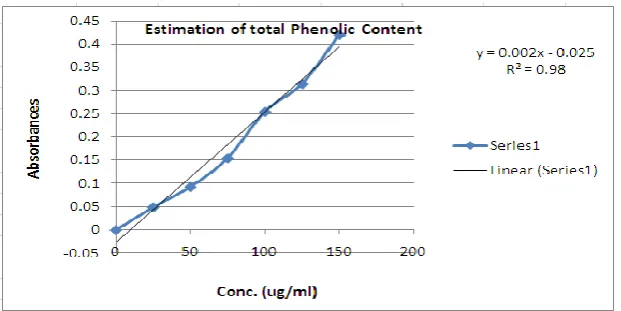
1.6 Total Phenolic content estimation (TPC). [14]
[image:6.595.144.455.588.743.2]The content of total phenolic compounds (TPC) and to total tannin content was expressed as mg/gm of gallic acid equivalent of dry extract sample using the equation obtained from the calibration curve: Y = 0.002X+ 0.025, R2= 0.980, where × is the absorbance and y is the tannic acid equivalent (GAE).
Table 1: Total Phenolic content estimation (TPC)
S.No. Conc. Absorbance
0 0 0 1 25 0.049 2 50 0.093 3 75 0.155 4 100 0.255 5 125 0.315 6 150 0.421
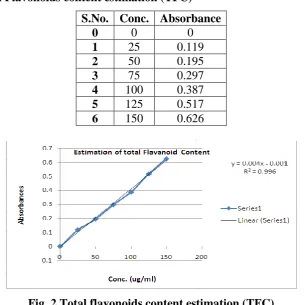
1.7 Total Flavonoids content estimation (TFC).[15]
Total flavonoids content was calculated as quercetin equivalent (mg/g) using the equation based on the calibration curve: Y=0.004 X+0.001, R2=0.996, where X is the absorbance and Y is the quercetin equivalent (QE).
Table 2: Total Flavonoids content estimation (TFC) S.No. Conc. Absorbance
0 0 0
1 25 0.119
2 50 0.195
3 75 0.297
4 100 0.387
5 125 0.517
[image:7.595.146.452.328.633.2]6 150 0.626
Fig. 2 Total flavonoids content estimation (TFC) Table 3: Estimation of Total phenolics and Total flavonoids content
S. No Methanolic Extracts
Total phenolic Content (mg/gm)
Total flavonoids content (mg/gm)
RESULTS AND DISCUSSION
The antioxidant activity of methanol extract of selected plant was evaluated using in vitro
models.
Inhibition of superoxide anion radical
Superoxide radical is very harmful to cellular components as a precursor of ROS. Methanol extract inhibited O2- radical generated in riboflavin-NBT light system. The results were found
statistically significant shown in (table. 4 ) and (fig. 3).
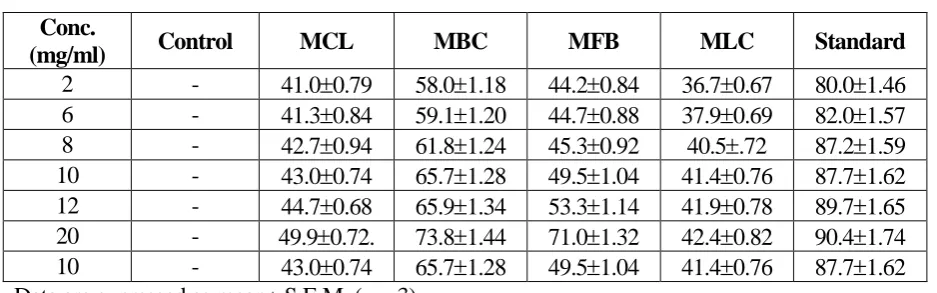
5. 2 Inhibition of DPPH radical
The antioxidant reacts with DPPH radical (purple colour) and converts it into a colourless
--diphenyl--picrylhydrazyl. The amount of DPPH reduced could be quantified by measuring decrease in absorbance at 517 nm. The different fractions significantly (p < 0.05) reduce DPPH radical in a dose dependent manner at a concentration. The inhibition effect of methanolic extract was show in (table 5& 7), (fig. 4).
Inhibition of OH- radical
The highly reactive OH- radical can cause oxidative damage to DNA, lipid and proteins .The effect of extract on the inhibition of free radical mediated deoxyribose damage was assessed by means of iron (II) dependent DNA damage assay. The Fenton reaction generate OH -radical, which degrade deoxyribose sugar of DNA using Fe2+ salt as an important catalytic component. The inhibition effect of methanolic extract was show in (table 6,8) and (fig. 5).
Table 5 : % Inhibition by DPPH scavenging activity
Group Scavenging agent %Inhibition
2 mg/ml 6 mg/ml 8 mg/ml 10 mg/ml 12 mg/ml 20 mg/ml
I. Control - - - -
II. Methanolic extract of
Curcuma longa 41.0 % 41.3 % 42.7 % 43.0 % 44.7 % 49.9 %
III. Methanolic extract of
Bombax ceiba 58.0 % 59.1 % 61.8 % 65.7 % 65.9 % 73.8 %
IV. Methanolic extract of
Ficus benghalensis 44.2% 44.7 % 45.3 % 49.5 % 53.3 % 71.0 %
V. Methanolic extract of
Lens culinaris 36.7 % 37.9 % 40.5 % 41.4 % 41.9 % 42.4%
Table 6: % inhibition by OH- scavenging activity
Table 4 : Superoxide anion free radical scavenging activity of chosen drugs
Table 7 : % inhibition of free radical scavenging activity of chosen drugs by DPPH method
Table 8 : % inhibition of OH- free radical scavenging activity of chosen drugs Conc.
(mg/ml) Control MCL MBC MFB MLC Standard
2 - 41.00.79 58.01.18 44.20.84 36.70.67 80.01.46 6 - 41.30.84 59.11.20 44.70.88 37.90.69 82.01.57 8 - 42.70.94 61.81.24 45.30.92 40.5.72 87.21.59 10 - 43.00.74 65.71.28 49.51.04 41.40.76 87.71.62 12 - 44.70.68 65.91.34 53.31.14 41.90.78 89.71.65 20 - 49.90.72. 73.81.44 71.01.32 42.40.82 90.41.74 10 - 43.00.74 65.71.28 49.51.04 41.40.76 87.71.62 Data are expressed as mean± S.E.M. (n = 3)
Group no. Scavenging agent 2 mg/ml 6 mg/ml 8 mg/ml 10 mg/ml 12 mg/ml 20 mg/ml
I. Control - - - -
II. Methanolic extract of
Curcuma longa 39.3 % 40.3 % 40.7 % 42.1 % 44.4 % 48.0 %
III. Methanolic extract of
Bombax ceiba 68.0 % 69.1 % 69.8 % 71.7 % 71.0 % 77.7 %
IV. Methanolic extract of
Ficus benghalensis 40.0 % 40.5 % 43.3 % 43.7 % 53.9 % 67.3 %
V. Methanolic extract of
Lens culinaris 39.3 % 40.3 % 40.7 % 42.1 % 44.4 % 48.0 %
VI. Std. 77.7 % 79.0 % 80.2 % 81.7 % 83.7 % 85.0 %
Time
(min) Control MCL MBC MFB MLC Standard
15 - 49.90.86 78.01.38 62.91.08 33.00.67 89.01.76 30 - 47.20.84 68.81.23 54.21.02 32.70.66 84.21.68 45 - 42.50.79 67.01.18 52.50.97 32.00.62 82.71.61
Conc.
(mg/ml) Control MCL MBC MFB MLC Standard
[image:9.595.65.534.575.721.2]0 20 40 60 80 100
MCL MBC MFB MLC Standard
%
In
h
ib
it
io
n
Scavenging Agent
2 6 8 10 12 20
MCL = Methanol extract of Curcuma longa
MBC = Methanol extract of Bombax ceiba
MFB = Methanol extract of Ficus bengalensis
[image:10.595.148.451.72.291.2]MLC = Methanol extract of Lens culinaris
Fig. 3: Superoxide anion free radical scavenging activity of chosen drugs.
Fig. 4 : % inhibition of free radical scavenging activity of chosen drugs by DPPH method in different concentration.
[image:10.595.144.453.338.489.2] [image:10.595.151.447.544.715.2]RESULTS AND DISCUSSION
From the above investigations it was revealed that methanol extract of Curcuma longa,Lens culinaris, Bombax ceiba, and Ficus bengalensis was bring into being to scavenge DPPH, OH, and O2- inhibition. Methanol extract of all selected plants shown strong antioxidant activity in
compression of selected plant. This methanol extract of Bombax ceiba has shown strong antioxidant activity due to presence of terpenoids and flavonoids therein as revealed by the quenching of the DPPH radical. The antioxidant activity can be endorsed due to the existence of different fractions, which were confirmed by phytochemical tests. The positive free radical scavenging property of Bombaxceiba isvaluable therapeutic potential. The facts obtained in the current study imply that methanol extract of selected plants have persuasive antioxidant activity in a concentration dependent manner.
RESULTS AND DISCUSSION
The data obtained from agar well diffusion method using different methanol extracts and standard were shown in Table:9. The zones of inhibition of methanol extracts of Curcuma longa,Bombax ceiba, Ficus bengalensis and Lens culinaris were found to be 13.375, 11.35, 9.725, 8.625 mm respectively. The results of this investigation showed that all methanol extracts had inhibitory effect on the P. acnes.
The present research work deals with the antibacterial activity against P. acnes bacteria of selected plants. The Zones of inhibitions for the antibacterial activity were compared with the standard tetracycline with the methanol extracts. The results of present investigation showed that methanolic extracts of curcuma longa and Ficus bengalensis had better inhibitory effect against P. acnes bacteria compare to other extracts. However, the activity of the standard tetracycline shown best activity in comparisons with extract of selected plants.DMSO did not show any significant antibacterial activity.
Table 9: Antibacterial activities of selected methanol extracts
S. No. Treatment Zones of inhibition in mm Mean (n= 4)
1 2 3 4
1. Tetracycline (10 mg/ml) 20 19 18.2 17.9 18.775 2. Methanol extract of
Curcuma longa (10 mg/ml) 13.2 13.8 13.7 12.8 13.375 3. Methanol extract of Ficus
bengalensis (10 mg/ml) 11.7 11.4 10.5 11.8 11.35 4. Methanol extract of
5. Methanol extract of Lens
culinaris (10 mg/ml) 8.2 8.7 8.3 9.3 8.625 6. DMSO --- --- --- --- ---
PREPARATION OF THE COMBINATION OF SELECTED HERBS
On the bases of results of antibacterial and antioxidant activity of individual selected plant extract (methanol) carried out reveals that methanol extracts of Curcuma longa and Ficus bengalensis have shown good antibacterial activity in comparisons to other methanol extract. The methanol extracts of Bombaxceiba had exert the best antioxidant activity in comparisons to other extracts.It has also provided antibacterial activity against P. acne bacteria.
After the study of antioxidant, antibacterial activity of methanol extract of selected plants, Methanol extract of Curcuma longa, Ficus bengalensis and Bombax ceiba was selected for preparation of combination.
It was believed that the combination effect of these drugs may give more significant effect as, antibacterial and antioxidant activity. Hence it was decided to carry out the combination study of these drug samples.
The combinations of different plants methanol extract (Curcuma longa, Ficus benghalensis,
Bombax ceiba) were prepared in 500 µl ethanol for evaluation of their antibacterial activity.[16] Show in (table. 10).
Table 10: Combination of Methanol extracts Combination
Methanol Extract of Plant Curcuma
longa (mg)
Ficus benghalensis (mg)
Bombax ceiba (mg)
Total Quantity (mg)
1 250 --- 250 500
2 250 250 --- 500
3 --- 250 250 500
4 200 200 100 500
The antibacterial activity of different combinations was determined by modified agar well diffusion method. The agar diffusion test was used to investigate antibacterial effects of combinations of selected plants. In this method plates containing 10 ml of agar media and Sabouraud’s agar medium were over laid with 10 ml of inoculated stock solution of P. acne
was used as positive control and the negative control was DMSO. After 24 h incubation the diameter of the inhibition zones, (no growth) around the holes in the bacterial lawn were measured. A positive result was defined as an inhibition zone (halo size) of 9 mm or more around the holes, therefore indicating the presence of antibacterial substance in the tested sample.[17] The experiments were repeated four times.
Table 11: Antibacterial activity of selected Methanol extracts
S.No. Treatment Zones of inhibition in mm Mean ±SEM (n= 4)
1 2 3 4
1. Indomethacin
(10 mg/ml) 20 19 18.2 17.9 18.775 2. Combination 1 13.2 13.8 13.7 13.4. 13.566 3. Combination 2 15.7 14.8 15.5 15.1 15.275 4. Combination 3 9.9 9.7 9.5 9.8 9.725 5. Combination 4 19.7 20.2 19.2 18.8 19.475 6. DMSO --- --- --- --- ---
4.3.4 Statistical Treatment of Data
All the statistical analysis was performed by statistical treatment mean ±SEM (n= 4) [11]. The antibacterial activity of an combination of methanolic extract of Curcuma longa, Ficus benghalensis and Bombax ceiba was evaluated in the present study. The combination demonstrated antibacterial activity against P. acnes strains tested in this study. The results of present investigation showed that combination 4 (methanolic extracts curcuma longa, Ficus benghalensis and Bombaxceiba)had better inhibitory effect 19.475 against P. acnes bacteria compare to other combinations. However, combination1, 2 and 3 shown zones of inhibition were 13.566, 15.275 and 9.725 respectively. DMSO did not show any significant antibacterial activity. These results suggested that the herbal combination 4 may be a more effective against P. acnes. Shown in (table.11).
RESULT AND DISCUSSION
CONCLUSION
The study proves that the antibacterial and antioxidant properties of the chosen drugs and at the end were suitable in developing a Gel formulation from utilize the bio-actives of extracts as combination 4 comprising a methanol extracts of (i) Curcumalonga (ii) Ficus bengalensis
(iii) Bombaxceiba for the effective management of the Acne.
ACKNOWLEDGEMENT
This study is a part of Ph.D. thesis of National University of Medical Sciences, Jaipur, Rajasthan.
REFERENCE
1. Adegbidi H, Christiane Koudoukpo, Felix Atadokpede, Florenica de Ango-Padonou, Hubert G yedomon. Epideminological and clinical aspects of acne in the dermatology department of the teaching hospital of parakou benin. J of Cosmetics., 2014; 4: 129-134. 2. Haris H H, et.al. Evaluation of efficacy and saftery of eolo acne gel for acne : an open,
single centric, non comparative study for 8 weeks. Asian J Pharm Clin Res, 2012; 5(3): 73-76.
3. Luangnarumitchai S, Lamlertthon S, Tiyoboonchai W. Antimicrobial activity of esstential oils against five strains of propionibactrium acnes.MUJPS., 2007; 34(1-4): 60-64.
4. Eshtiaghi M N, Kuldiloke J. Formulation of anti acne cream containing natural antimicrobials. Int.Res. J. Pharm., 2013; 4(11): 20-25.
5. Choudhary N, Sing S Bhupender, Potential therapeutic effect of crucumin-an update. J Pharm Educ Res., 2012; 3(2): 64-71.
6. Dewan PD,Gadhikr YA. Phytochemical composition and inhibition of oral pathogens by
ficus Bengalis linn root extracts. IJPPS., 2014; 6(3): 111-114.
7. Joshi R K, Devkota H P, Yahara S.Simalin A and B : Two new aromatic compounds from the stem bark of bombax cebia.Phytochemistry letters., 2014; 7: 26-29.
8. Verma V, Jalalpure S S, Sahu A, Bhardwaj Y P. Bimbax cebia linn: Pharmacognostical, phytochemistry, ethanobotany and pharmacology studies.Internationale Pharmacutica Sciencia., 2011; 1(1): 62-68.
10.Akaram H, Farhan H, Rammal, H,Badran B. Preliminary Phytochemical screening and extraction of polyphenol from stems and leaves of a Lebanese plant Malva parviflora I,Int J Curr Pharm Res., 2012; 4(1): 55-59.
11.Pothitirat W, Chomnawang M T , Supabphol R, Gritsanapan W. Comparison of bioactive compounds contents, free radical scavenging and anti cane inducing bacterial activities of extracts from the mangosteen fruit rind at two stages of maturity. Fitoterapia., 2009; 80: 442-447.
12.Sati N, Singh R, Dhaiya R, Sing P, Sati O P. Antioxidant and anti-inflammatory activity of ribes glaciale wall extracts. IJPPS., 2015; 7(7): 344-347.
13.Shah K, Shrivastav R K. Evaluation of Antioxidant and anti-acne activities (in-Vitro) of the formulated herbal gels. Int. J Curr. Pharm. Res., 2015; 7(3): 47-50.
14.Harborne JB. Phytochemical Methods A guide to modern techniques of plant analysis,London: Chapman and hall.,1984; 39-69.
15.Muhit Md. A, Tareq S.M, Apu A.S. Basak D, Islam M S. Isolation and identification of compounds from the leaf extract of Dillenia indica linn. Bangladesh Pharmaceutical Journal., 2010; 13(1): 49-53.
16.Patel N A, Patel M, Patel R P. formulation and evaluation of polyherbal gel for wound healing. Intl. R. J. of Pharmaceuticals., 2011; 1(1): 15-20.