“TO STUDY THE PREVALENCE OF STRESS IN SCHOOL GOING
CHILDREN AGED 10-16 YEARS OLD”
Dr. Shilpa Khandare1*, Sanjana Chakrabarty2, Dr. Preeti Gazbare3, Dr. Mayura
Deshmukh4, Dr. Tanpreet Kaur Bagga5 and Dr. Tushar Palekar Ph.D.6
*1,3,4,5,6Associate Professor, Dr. D. Y. Patil College of Physiotherapy, Dr. D. Y. Patil Vidyapeeth Pune, India.
2
Intern, Dr. D. Y. Patil College of Physiotherapy, Dr. D. Y. Patil Vidyapeeth Pune, India.
ABSTRACT
Background: The purpose of this study was to study the prevalence of
stress in school going children aged 10-16 years old. Method:
Perceived stress scale (PSS-C) was used on school going children aged
10-16 years to assess the level of stress. The participants included 100
children from PCMC, School Kharalwadi, Pune. Result: The results
suggested that a large number of students were having stress related
issues. It was reflected by PSS-C scale scores. Conclusion: The
conclusion of this study is that stress is very much prevalent in school
going children aged between 10-16 years. All the results show a large
number of students are having poor mental health, leading to stress
related problems.
KEYWORDS: The purpose Perceived stress Kharalwadi, Pune.
INTRODUCTION
STRESS
In the recent past much emphasis has been provided on the physical & mental wellbeing of
children and adolescents, to prevent and promote overall wellbeing in society. Because of
globalization and modernization the present age has become highly competitive, and children
and youth have to face this competition at every phase of their life. There are many stressors
acting upon school children. Today a child is overloaded with daily living stressors, and he
Volume 7, Issue 7, 2011-2018. Research Article ISSN 2277– 7105
Article Received on 20 Feb. 2018,
Revised on 12 Mar. 2018, Accepted on 01 April 2018,
DOI: 10.20959/wjpr20187-11810
*Corresponding Author
Dr. Shilpa Khandare
Associate Professor, Dr. D.
Y. Patil College of
Physiotherapy, Dr. D. Y.
Patil Vidyapeeth Pune,
related ailments and psychological problems which poses threat and challenges for the
physical as well as mental well being of the school going children.[2]
By Lazarus and Folkman : Stress is an internal state which can be caused by[1]
By physical demands on body : disease conditions, exercise, extremes of temperature By environmental and social situations,
These are evaluated as harmful, uncontrollable or exceeding our resources for coping.
STRESSORS
Causes of stress – physical, environmental, social causes – stressors
When induced by stressors, internal stressors – lead to various responses.
While psychological responses – such as anxiety, hopelessness, depression, irritation and
feeling that not been able to cope with the world are due to stress.
Effects of stress: 75% of physical problems / diseases: are stress related
Diabetes, blood pressure, heart attack, acidity, ulcer, cancer.
NEED FOR STUDY
There are many stressors acting upon school children. Today in the era of increasing
competition, distractions of social media, diversion and influence of environment, child is
exposed to various level of stress which makes it difficult for the child to cope up with the
family and social requirement. The pressure starts at a very young age. In fact it starts when a
child enters in school and the pressures rises as the child grows up and reaches a high during
adolescence. This results in various stress related ailments and psychological problems which
forges threats and challenges for the psychological as well as mental well being of the school
going children. The consequences may lead to rise in school drop, underperformance, teenage
violence, suicide, alcoholism, drug abuse, disaffection, demoralization, delusion, depression,
anxiety, boredom, fatigue, frustration, guilt, shame, low self-esteem, nervousness, apathy and
aggression. All these problems may not seem very evident at first or at an early age, but may
rise later. If untreated, this may cause bigger issues later in life. So the early detection of the
mental health of a child is very important to take the necessary steps to help the child when
AIM AND OBJECTIVES
To study the prevalence of stress in school going children aged 10-16 years using Perceived
Stress Scale (PSS-C) method.
MATERIALS AND METHODOLOGY
The experimental study design was conducted at PCMC School Kharalwadi, Pune. The target
population was school children aged between 10-16 years. The sample population was
selected from the 6th to 9th grades students of the school with proper consent from the teachers. Total 100 participants were selected for the experimental study. Students having
known mental health issues were excluded from the study group. Consent forms were filled
from the respective class teachers. For outcome measures Perceived Stress Scale (PSS-C)
was used.
PROCEDURE
The study was approved by the Institutional Ethical Committee of Dr. D. Y. Patil College of
Physiotherapy Pimpri, Pune. Samples for the study were taken from PCMC Marathi Medium
School, Kharalwadi, Pune, who fulfill the inclusion and exclusion criteria.
A brief introduction about this research project and consent form was given to the children’s
respective Class Teachers. The Pre-assessment was done by using Perceived Stress Scale
(PSS-C).
Out of 100 students 82 reported mild to high stress level in PSS-C scale. 18 students reported
low stress level.
DATA ANALYSIS AND INTERPRETATION
Out of 100 sample group, we selected only 82 students for the intervention plan based on
pre-therapy PSS-C scale score. PSS-C scale score of less than 14 was considered low stress level,
PSS-C score of 14-26 was considered mild stress level and PSS-C score >26 was considered
high stress level.
Table 1: AGE DISTRIBUTION.
Age 10 Yrs 11 Yrs 12 Yrs 13 Yrs 14 Yrs 15 Yrs 16 Yrs Total
Graph 1:
Interpretation of Graph 1:
This shows that we have a fair age-wise distribution of students in our study group. There are
more girls than boys in our study group.
Table 2: GRADE-WISE DISTRIBUTION.
Grade 6th 7th 8th 9th Total
Boys 6 10 8 10 34
Girls 24 22 12 8 66
Total 30 32 20 18 100
Graph 2:
Interpretation of Graph 2:
Table 3: PSS-C Scale Scores.
PSS-C Score Number Of Students
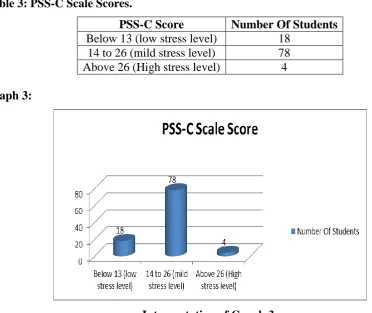
Below 13 (low stress level) 18 14 to 26 (mild stress level) 78 Above 26 (High stress level) 4
Graph 3:
Interpretation of Graph 3:
From the graph we can see that 78 students out of 100 were having mild stress level and 4
students were having high stress level. Overall 82 students out of 100 were having stress
related issues.
Table 4: PSS-C Scale Score Mean Value and Standard Deviation.
Perceived Stress Scale (PSS-C) Mean Value 17.57 Standard Deviation 4.53
From the graph we can see that the mean value of PSS-C score is 17.57 which is more than
the normal value 13. It indicated stress is common issue among students.
RESULTS
PSS-C scale score shows that 18 % participants were having low stress, while 82%
participants were having mild to high stress level.
Students having PSS-C scale score below 13 are considered to have low stress level. The
mean value of PSS-C scale scores is 17.57 with standard deviation of 4.53.
This also indicates that the stress related issues are very common in students. Students having
PSS-C scale score below 13 are considered to have low stress level.
It can be stated from PSS-C scale results that stress in school going children aged 10-16
years is very much prevalent.
DISCUSSION
The purpose of study is to find out the prevalence of stress in school going children. Stress
emerges as a significant mental problem in recent years. It has been estimated that 10 to 30
percent students experience related stress that affect their academic performance,
psychosocial adjustment along with their overall emotional and physical well being.
Information load, high expectation, academic burden or pressure, unrealistic ambitions,
limited opportunities, high competitiveness are some of the important sources of stress which
create tension, fear and anxiety. Poor academic performance, diminished peer popularity,
attention difficulties, depression, somatic complaints, substance abuse are commonly
problems among the victims of academic stress without being aware of how to cope with
them.
The highly competitive environment in which today’s children are living can lead to various
stress related ailments and psychological problems which forges threats and challenges for
the psychological as well as mental well being of the school going children. The
consequences may lead to rise in school drop, underperformance, teenage violence, suicide,
alcoholism, drug abuse, disaffection, demoralization, delusion, depression, anxiety, boredom,
The effort of social work research can only contribute to more knowledge and a more
successful outcome in treating mental health in children. Education and knowledge about
mindfulness based treatments in addition to more knowledge about children’s mental health
can only contribute to the benefits of treating individuals in the future.[5]
The purposive study was done in PCMC Marathi Medium School, Kharalwadi. Sample age
group was 10-16 years and sample size was 100 in which 34 samples were male and 66
samples were female. A consent form was given to the respective class teachers of the
children. Out of 100 students 82 reported mild or high stress in PSS-C scale score.
Similar study done by Vibha Sharma et.al April 2010 -“Yoga and Cognitive Behavior
Techniques for Academic Stress and Mental Wellbeing among School Students”, which had
similar results. Results of the present study have led to some very important findings that a
large number of school students in present time are suffering with high levels of academic
anxiety and poor mental well-being, which is very harmful for their growth, development,
performance and overall well-being.[2]
Sanjiv K Bhasin, Rahul Sharma1 and N.K. Saini, (2010) – “Depression, Anxiety and Stress
among Adolescent Students Belonging to Affluent Families: A School-based Study”(10) also found that significantly high proportions of the students were found to be having high levels
of stress, anxiety and depression.
CONCLUSION
The conclusion of this study is that stress is very much prevalent in school going children
aged between 10-16 years. All the results show a large number of students are having poor
mental health, leading to stress related problems.
LIMITATIONS
1. Small sample size
2. Gender distribution was not equal, so comparison between the genders couldn’t be done.
REFERENCES
2. Vibha Sharma, Smita Srivastava, S malhotra, Ravinder Singh, Tej Bahadur Singh “Yoga
and Cognitive Behaviour Techniques for Academic Stress and Mental Wellbeing among
School Students”., April 2010.
3. Erin E. Centeio, Laurel Whalen, Erica Thomas, Noel Kulik, Nate McCaughtry “Using
Yoga to Reduce Stress and Bullying Behaviors among Urban Youth”. March 2017.
4. Kaye Standke - “The effects of Yoga for Youth with Anxiety”. August 2013.
5. Lindsay J. Kaplan – “The experience of Yoga on Children with Anxiety”.
6. Caroline Smith, Heather Hancock, Jane Blake Mortimer, Kerena Eckert - “A randomised
comparative trial of yoga and relaxation to reduce stress and anxiety”. June 2006.
7. Berger DL, Silver EJ, Stein RE - “Effects of Yoga on Inner City Children’s well being”.
September 2009.
8. Laura Santangelo White PhD, RN, CPNP, “Reducing Stress in School-age Girls Through
Mindful Yoga”., March 2011.
9. G Kirkwood, H Rampes, V Tuffrey, J Richardson, K Pilkington, “Yoga for anxiety: a
systematic review of the research evidence”, 2004.
10.Sanjiv K Bhasin, Rahul Sharma1 and N.K. Saini, “Depression, Anxiety and Stress among