Original citation:
Rolls, Edmund T.. (2013) The mechanisms for pattern completion and pattern separation
in the hippocampus. Frontiers in Systems Neuroscience, 7 . 00074.
Permanent WRAP url:
http://wrap.warwick.ac.uk/78016
Copyright and reuse:
The Warwick Research Archive Portal (WRAP) makes this work of researchers of the
University of Warwick available open access under the following conditions.
This article is made available under the Creative Commons Attribution-ShareAlike 4.0
International (CC BY-SA 4.0) and may be reused according to the conditions of the
license. For more details see:
https://creativecommons.org/licenses/by-sa/4.0/legalcode
A note on versions:
The version presented in WRAP is the published version, or, version of record, and may
be cited as it appears here.
The mechanisms for pattern completion and pattern
separation in the hippocampus
Edmund T. Rolls1,2
*
1Oxford Centre for Computational Neuroscience, Oxford, UK
2Department of Computer Science, University of Warwick, Coventry, UK
Edited by:
Federico Bermudez-Rattoni, Universidad Nacional Autónoma de México, Mexico
Reviewed by:
José M. Delgado-García, University Pablo de Olavide, Spain
Jorge Medina, Universidad de Buenos Aires, Argentina
*Correspondence:
Edmund T. Rolls, Department of Computer Science, University of Warwick, Coventry, CV4 7AL, UK e-mail: [email protected]
The mechanisms for pattern completion and pattern separation are described in the context of a theory of hippocampal function in which the hippocampal CA3 system operates as a single attractor or autoassociation network to enable rapid, one-trial, associations between any spatial location (place in rodents, or spatial view in primates) and an object or reward, and to provide for completion of the whole memory during recall from any part. The factors important in the pattern completion in CA3 together with a large number of independent memories stored in CA3 include a sparse distributed representation which is enhanced by the graded firing rates of CA3 neurons, representations that are independent due to the randomizing effect of the mossy fibers, heterosynaptic long-term depression as well as long-term potentiation in the recurrent collateral synapses, and diluted connectivity to minimize the number of multiple synapses between any pair of CA3 neurons which otherwise distort the basins of attraction. Recall of information from CA3 is implemented by the entorhinal cortex perforant path synapses to CA3 cells, which in acting as a pattern associator allow some pattern generalization. Pattern separation is performed in the dentate granule cells using competitive learning to convert grid-like entorhinal cortex firing to place-like fields. Pattern separation in CA3, which is important for completion of any one of the stored patterns from a fragment, is provided for by the randomizing effect of the mossy fiber synapses to which neurogenesis may contribute, by the large number of dentate granule cells each with a sparse representation, and by the sparse independent representations in CA3. Recall to the neocortex is achieved by a reverse hierarchical series of pattern association networks implemented by the hippocampo-cortical backprojections, each one of which performs some pattern generalization, to retrieve a complete pattern of cortical firing in higher-order cortical areas.
Keywords: hippocampus, pattern separation, pattern completion, episodic memory, attractor network, pattern association network, competitive network, recall
INTRODUCTION
There is great interest in how pattern separation and pattern com-pletion in the hippocampus contribute to its functions in memory and spatial function (Rolls and Treves, 1998; Nakazawa et al., 2002, 2003; Wills et al., 2005; Rolls and Kesner, 2006; Kesner, 2007, 2013; Leutgeb et al., 2007; McHugh et al., 2007; Hunsaker and Kesner, 2008, 2013; Giocomo et al., 2011; Jezek et al., 2011; Kesner et al., 2012; Nakashiba et al., 2012).
The aim of this paper is to describe some of the different types of pattern separation and pattern completion in the hippocampal system, and the mechanisms that implement them. It is impor-tant to appreciate that there are different mechanisms each of which contributes to pattern separation or pattern completion in the hippocampal system, for this helps not only in the under-standing of how the hippocampal system operates, but also helps in the evaluation of the effects of changes that influence each of these mechanisms. These different mechanisms are separated into different subsections of this paper, so that the operation and
competitive networks has been described elsewhere (Hertz et al., 1991; Rolls and Treves, 1998; Rolls, 2008).
BACKGROUND TO THE APPROACH TO HIPPOCAMPAL FUNCTION
EVENT AND EPISODIC MEMORY
The focus is on a fundamental property of episodic memory, the ability to store and retrieve the memory of a particular single event involving an association between items such as the place and the object or reward seen at that place. Episodic memory in the sense of a series of linked events requires this type of event memory, and could be implemented by linking together a series of events.
An event consists of a set of items that occur together, such as seeing a particular object or person’s face in a particular place. An everyday example might be remembering where one was for din-ner, who was present, what was eaten, what was discussed, and the time at which it occurred. The spatial context is almost always an important part of an episodic memory (Dere et al., 2008), and it may be partly for this reason that episodic memory is linked to the functions of the hippocampal system, which is involved in spa-tial processing and memory. The ability to recall a whole memory from a partial cue is an important property of episodic memory, and is referred to as completion.
SYSTEMS-LEVEL FUNCTIONS AND CONNECTIONS OF THE PRIMATE HIPPOCAMPUS
Any theory of the hippocampus must state at the systems level what is computed by the hippocampus. Some of the relevant evidence about the functions of the hippocampus in memory comes from the effects of damage to the hippocampus, the responses of neurons in the hippocampus during behavior, and the systems-level connections of the hippocampus, described in more detail elsewhere (Rolls and Kesner, 2006; Rolls and Xiang, 2006; Rolls, 2008, 2010b). Many of the memory func-tions are important in event or episodic memory, in which the ability to remember what happened where on typically a sin-gle occasion (or trial in a learning experiment) is important. It is suggested that an autoassociation memory implemented by the CA3 neurons enables event or episodic memories to be formed by enabling associations to be formed between spatial and other including object or reward representations, and for com-pletion to then occur in recall. An important property of this autoassociation and completion is that completion of a whole memory can occur from any part. This is different from pattern association memory, in which a visual stimulus might become associated with a taste by associative synaptic modification. Later presentation of the visual stimulus would retrieve the taste rep-resentation. However, presentation of the taste would not retrieve the visual representation, and this is an important and fundamen-tal difference between autoassociation and pattern association, as described in detail elsewhere (Rolls and Treves, 1998; Rolls, 2008, 2014a).
Information stored in the hippocampus will need to be retrieved and affect other parts of the brain in order to be used. The information about episodic events recalled from the hip-pocampus could be used to help form semantic memories (Rolls,
1989b,c, 1990a; Treves and Rolls, 1994). For example, remember-ing many particular journeys could help to build a geographic cognitive map in the neocortex. The hippocampus and neocortex would thus be complementary memory systems, with the hip-pocampus being used for rapid, “on the fly,” unstructured storage of information involving activity potentially arriving from many areas of the neocortex; while the neocortex would gradually build and adjust on the basis of much accumulating information, often recalled from the hippocampal unstructured store, the semantic representation (Rolls, 1989b; Treves and Rolls, 1994; McClelland et al., 1995; Moscovitch et al., 2005). The theory shows how infor-mation could be retrieved within the hippocampus, and how this retrieved information could enable the activity in neocor-tical areas that was present during the original storage of the episodic event to be reinstated, thus implementing recall, by using hippocampo-neocortical backprojections as described elsewhere (Treves and Rolls, 1994; Rolls, 1995, 1996b, 2008, 2010b)(see
Figure 1).
To understand the functions of the primate hippocampus in event or episodic memory, it is necessary to understand which other parts of the brain it receives information from. Does it for example receive object as well as spatial informa-tion as indicated by its anatomical connectivity? The primate hippocampus receives inputs via the entorhinal cortex (area 28) and the highly developed parahippocampal gyrus (areas TF and TH) as well as the perirhinal cortex from the ends of many processing streams of the cerebral association cor-tex, including the visual and auditory temporal lobe associa-tion cortical areas, the prefrontal cortex, and the parietal cortex (Van Hoesen, 1982; Amaral, 1987; Amaral et al., 1992; Suzuki and Amaral, 1994b; Witter et al., 2000b; Lavenex et al., 2004; Rolls and Kesner, 2006; Rolls, 2008) (see Figure 1). The hip-pocampus is thus by its connections potentially able to asso-ciate together object and spatial representations. In addition, the entorhinal cortex receives inputs from the amygdala, and the orbitofrontal cortex, which could provide reward-related information to the hippocampus (Suzuki and Amaral, 1994a; Carmichael and Price, 1995; Stefanacci et al., 1996; Pitkanen et al., 2002).
The primary output from the hippocampus to neocortex orig-inates in CA1 and projects to subiculum, entorhinal cortex, and parahippocampal structures (areas TF-TH) as well as pre-frontal including orbitopre-frontal cortex (Van Hoesen, 1982; Witter, 1993; Delatour and Witter, 2002; Van Haeften et al., 2003) (see
Figure 1), though there are other outputs (Rolls and Kesner, 2006;
Rolls, 2014b). These are the pathways that are likely to be involved in the retrieval of information from the hippocampus back to the neocortex.
The theory is a quantitative theory, and the numbers of synapses on the different types of neuron is an important feature of the circuitry emphasized next.
HIPPOCAMPAL CIRCUITRY
FIGURE 1 | Forward connections (solid lines) from areas of cerebral association neocortex via the parahippocampal gyrus and perirhinal cortex, and entorhinal cortex, to the hippocampus; and backprojections (dashed lines) via the hippocampal CA1 pyramidal cells, subiculum, and parahippocampal gyrus to the neocortex.There is great convergence in the forward connections down to the single network implemented in the
CA3 pyramidal cells; and great divergence again in the backprojections.Left:
block diagram.Right: more detailed representation of some of the principal
excitatory neurons in the pathways. Abbreviations: D, deep pyramidal cells; DG, dentate granule cells; F, forward inputs to areas of the association cortex from preceding cortical areas in the hierarchy; mf, mossy fibres; PHG, parahippocampal gyrus and perirhinal cortex; pp. perforant path; rc, recurrent collateral of the CA3 hippocampal pyramidal cells; S, superficial pyramidal cells; 2, pyramidal cells in layer 2 of the entorhinal cortex; 3, pyramidal cells in layer 3 of the entorhinal cortex. The thick lines above the cell bodies represent the dendrites.
Projections from the entorhinal cortex layer 2 reach the gran-ule cells (of which there are 106in the rat) in the dentate gyrus (DG), via the perforant path (pp) (Witter, 1993). The granule cells project to CA3 cells via the mossy fibres (mf), which provide
asparsebut powerful connection to the 3×10⁵ CA3 pyramidal
cells in the rat. Each CA3 cell receives approximately 46 mossy fiber inputs, so that the sparseness (or dilution) of this connectiv-ity is thus 0.000046. By contrast, there are many more—possibly weaker—direct perforant path inputs also from layer 2 of the entorhinal cortex onto each CA3 cell, in the rat of the order of 3600. The largest number of synapses (about 1.2×10⁴in the rat)
on the dendrites of CA3 pyramidal cells is, however, provided by the (recurrent) axon collaterals of CA3 cells themselves (rc) (see
Figure 2). It is remarkable that the recurrent collaterals (RCs) are
distributed to other CA3 cells largely throughout the hippocam-pus (Amaral and Witter, 1989, 1995; Amaral et al., 1990; Ishizuka et al., 1990; Witter, 2007), so that effectively the CA3 system pro-vides a single network, with a connectivity of approximately 2% between the different CA3 neurons given that the connections are bilateral. The CA3-CA3 RC system is even more extensive in macaques than in rats (Kondo et al., 2009). The neurons that comprise CA3, in turn, project to CA1 neurons via the Schaffer
collaterals. In addition, projections that terminate in the CA1 region originate in layer 3 of the entorhinal cortex (seeFigure 1).
CA3 AS AN AUTOASSOCIATION OR ATTRACTOR MEMORY: PATTERN COMPLETION
ARBITRARY ASSOCIATIONS, AND PATTERN COMPLETION IN RECALL
FIGURE 2 | The numbers of connections from three different sources onto each CA3 cell from three different sources in the rat.(AfterTreves and Rolls, 1992; Rolls and Treves, 1998).
Treves, 1998; Rolls and Deco, 2002, 2010; Rolls, 2010a) including
Memory, Attention, and Decision-Making(Rolls, 2008)].
The architecture of an autoassociation network is effectively that of the RC synapses shown inFigure 2, and the learning rule for the change in the synaptic weights is as shown in Equation (1) (Rolls and Treves, 1998; Rolls, 2008).
δwij=k.ri.rj (1)
where k is a constant,ri is the activation of the dendrite (the postsynaptic term), rj is the presynaptic firing rate, and δwij is the change in the synaptic weightwij. (wij refers to the j’th synapse onto thei’th neuron. An introduction to autoassocia-tion, competitive, and pattern association networks is provided in the Appendices ofMemory, Attention and Decision-Making: A
Unifying Computational Neuroscience ApproachRolls, 2008.)
The hypothesis is that because the CA3 operates effectively as a single network, it can allow arbitrary associations between inputs originating from very different parts of the cerebral cor-tex to be formed. These might involve associations between information originating in the temporal visual cortex about the presence of an object, and information originating in the parietal cortex about where it is. I note that although there is some spatial gradient in the CA3 recurrent connections, so that the connectivity is not fully uniform (Ishizuka et al., 1990; Witter, 2007), nevertheless the network will still have the prop-erties of a single interconnected autoassociation network allow-ing associations between arbitrary neurons to be formed, given the presence of many long-range connections which overlap from different CA3 cells, and the ability of attractor networks to operate with diluted connectivity shown in our computa-tional studies prompted by this issue (Treves, 1990; Treves and
Rolls, 1991; Rolls, 1995, 2012a; Rolls and Webb, 2012). It is very interesting indeed that in primates (macaques), the asso-ciational projections from CA3 to CA3 travel extensively along the longitudinal axis, and overall the radial, transverse, and longitudinal gradients of CA3 fiber distribution, clear in the rat, are much more subtle in the non-human primate brain (Kondo et al., 2009). The implication is that in primates, the CA3 network operates even more as a single network than in rodents.
Crucial issues include how many memories could be stored in this system (to determine whether the autoassociation hypothesis leads to a realistic estimate of the number of memories that the hippocampus could store); whether the whole of a memory could be completed from any part; whether the autoassociation mem-ory can act as a short term memmem-ory, for which the architecture is inherently suited; and whether the system could operate with spatial representations, which are essentially continuous because of the continuous nature of space. These and related issues are considered in the remainder of section Storage Capacity and in more detail elsewhere (Rolls and Kesner, 2006; Rolls, 2008).
STORAGE CAPACITY
We have performed quantitative analyses of the storage and retrieval processes in the CA3 network (Treves and Rolls, 1991, 1992; Webb et al., 2011; Rolls, 2012a; Rolls and Webb, 2012). We have extended previous formal models of autoassociative mem-ory (seeAmit, 1989) by analyzing a network with graded response units, so as to represent more realistically the continuously vari-able rates at which neurons fire, and with incomplete connectivity (Treves, 1990; Rolls, 1991; Treves and Rolls, 1991; Rolls et al., 1997b; Webb et al., 2011; Rolls and Webb, 2012). We have found that in general the maximum numberpmaxof firing patterns that
can be (individually) retrieved is proportional to the numberCRC
of (associatively) modifiable RC synapses on to each neuron, by a factor that increases roughly with the inverse of the sparse-nessaof the neuronal representation. [Each memory is precisely defined in the theory: it is a set of firing rates of the population of neurons (which represent a memory) that can be stored and later retrieved, with retrieval being possible from a fraction of the originally stored set of neuronal firing rates.] The neuronal population sparsenessaof the representation can be measured by extending the binary notion of the proportion of neurons that are firing to any one stimulus or event as
a=
⎛
⎝
i=1,n
ri/N
⎞ ⎠
2
/
i=1,n
ri2/N (2)
whereriis the firing rate of thei’th neuron in the set ofNneurons. The sparseness ranges from 1/N, when only one of the neurons responds to a particular stimulus (a local or grandmother cell rep-resentation), to a value of 1.0, attained when all the neurons are responding to a given stimulus. Approximately,
pmax∼= C
RC
where k is a factor that depends weakly on the detailed struc-ture of the rate distribution, on the connectivity pattern, etc., but is roughly in the order of 0.2-0.3 (Treves and Rolls, 1991). For example, forCRC=12,000 anda=0.02,pmaxis calculated to be
approximately 36,000. This analysis emphasizes the utility of hav-ing a sparse representation in the hippocampus, for this enables many different memories to be stored. [The sparsenessain this equation is strictly the population sparseness (Treves and Rolls, 1991; Franco et al., 2007). The population sparsenessapwould be measured by measuring the distribution of firing rates of all neurons to a single stimulus at a single time. The single neuron sparseness or selectivityas would be measured by the distribu-tion of firing rates to a set of stimuli, which would take a long time. The selectivity or sparseness as of a single neuron
mea-sured across a set of stimuli often takes a similar value to the population sparsenessap in the brain, and does so if the tun-ing profiles of the neurons to the set of stimuli are uncorrelated (Franco et al., 2007). These concepts are elucidated byFranco et al. (2007).] (I note that the sparseness estimates obtained by measuring early gene changes, which are effectively population sparsenesses, would be expected to depend greatly on the range of environments or stimuli in which these were measured. If the environment was restricted to one stimulus, this would reflect the population sparseness. If the environment was changing, the measure from early gene changes would be rather undefined, as all the populations of neurons activated in an undefined number of testing situations would be likely to be activated.)
In order for most associative networks to store information efficiently, heterosynaptic Long Term Depression (as well as LTP) is required (Rolls and Treves, 1990, 1998; Treves and Rolls, 1991; Fazeli and Collingridge, 1996; Rolls and Deco, 2002; Rolls, 2008). Simulations that are fully consistent with the analytic theory are provided byRolls (1995, 2012a); Simmen et al. (1996)andRolls et al. (1997b).
A number of points that arise, including measurement of the total amount of information (in bits per synapse) that can be retrieved from the network, the computational definition of a memory, the computational sense in which CA3 is an attrac-tor network, and the possible computational utility of memory reconsolidation, are treated elsewhere (Rolls and Kesner, 2006; Rolls, 2008). Here I note that given that the memory capacity of the hippocampal CA3 system is limited, it is necessary to have some form of forgetting in this store, or other mechanism to ensure that its capacity is not exceeded. (Exceeding the capacity can lead to a loss of much of the information retrievable from the network.) Heterosynaptic LTD could help thisforgetting, by enabling new memories to overwrite old memories (Rolls, 1996a, 2008). The limited capacity of the CA3 system does also provide one of the arguments that some transfer of information from the hippocampus to neocortical memory stores may be useful (see Treves and Rolls, 1994). Given its limited capacity, the hippocam-pus might be a useful store for only a limited period, which might be in the order of days, weeks, or months. This period may well depend on the acquisition rate of new episodic memories. If the animal were in a constant and limited environment, then as new information is not being added to the hippocampus, the represen-tations in the hippocampus would remain stable and persistent.
These hypotheses have clear experimental implications, both for recordings from single neurons and for the gradient of retro-grade amnesia, both of which might be expected to depend on whether the environment is stable or frequently changing. They show that the conditions under which a gradient of retrograde amnesia might be demonstrable would be when large numbers of new memories are being acquired, not when only a few mem-ories (few in the case of the hippocampus being less than a few hundred) are being learned.
RECALL AND COMPLETION
A fundamental property of the autoassociation model of the CA3 RC network is that the recall can be symmetric, that is, the whole of the memory can be retrieved and completed from any part (Rolls and Treves, 1998; Rolls and Kesner, 2006; Rolls, 2008). For example, in an object-place autoassociation memory, an object could be recalled from a place retrieval cue, and vice versa. In a test of this, Day, Langston andMorris (2003)trained rats in a study phase to learn in one trial an association between two flavors of food and two spatial locations. During a recall test phase they were presented with a flavor which served as a cue for the selection of the correct location. They found that injec-tions of an NMDA receptor blocker (AP5) or AMPA/kainate receptor blocker (CNQX) to the dorsal hippocampus prior to the study phase impaired encoding, but injections of AP5 prior to the test phase did not impair the place recall, whereas injections of CNQX did impair the place recall. The interpretation is that somewhere in the hippocampus NMDA receptors are necessary for learning one-trial odor-place associations, and that recall can be performed without further involvement of NMDA receptors.
Evidence that the CA3 system is not necessarily required dur-ing recall in a reference memory spatial task, such as the water maze spatial navigation for a single spatial location task, is that CA3 lesioned rats are not impaired during recall of a previously learned water maze task (Brun et al., 2002; Florian and Roullet, 2004). However, if completion from an incomplete cue is needed, then CA3 NMDA receptors are necessary (presumably to ensure satisfactory CA3-CA3 learning) even in a reference memory task (Nakazawa et al., 2002; Gold and Kesner, 2005). Thus, the CA3 system appears to be especially needed in rapid, one-trial object-place recall, and when completion from an incomplete cue is required (see further section Pattern Separation Performed by Dentate Granule Cells).
Especially important though in assessing the implications of all such tests is that the theory sets out how the system operates when large numbers of memories, in the order of thousands, are to be stored and retrieved, and this is difficult to test adequately in behavioral experiments. Effects found when the storage and retrieval of just a few memories are tested may not reflect well the operation of the system when it is heavily loaded, as it is expected to be when operating in the natural environment.
sites before LTP, thus demonstrating pattern completion in CA3 (Jackson, 2013).
CONTINUOUS, SPATIAL, PATTERNS AND CA3 REPRESENTATIONS
The fact that spatial patterns, which imply continuous represen-tations of space, are represented in the hippocampus has led to the application of continuous attractor models to help under-stand hippocampal function. This has been necessary, because space is inherently continuous, because the firing of place and spatial view cells is approximately Gaussian as a function of the distance away from the preferred spatial location, because these cells have spatially overlapping fields, and because the the-ory is that these cells in CA3 are connected by Hebb-modifiable synapses. This specification would inherently lead the system to operate as a continuous attractor network. Continuous attrac-tor network models have been studied byAmari (1977); Zhang (1996); Samsonovich and McNaughton (1997); Battaglia and Treves (1998); Taylor (1999); Stringer and Rolls (2002); Stringer et al. (2002a,b, 2004)andRolls and Stringer (2005) [seeRolls (2008)], and are described briefly next.
A “Continuous Attractor” neural network (CANN) can main-tain the firing of its neurons to represent any location along a continuous physical dimension such as spatial view, spatial position, head direction, etc. It uses excitatory RC connections between the neurons (as are present in CA3) to reflect the dis-tance between the neurons in the state space of the animal (e.g., place or head direction). These networks can maintain the bubble or packet of neural activity constant for long periods wherever it is started to represent the current state (head direction, position, etc.) of the animal, and are likely to be involved in many aspects of spatial processing and memory, including spatial vision. Global inhibition is used to keep the number of neurons in a bubble or packet of actively firing neurons relatively constant, and to help to ensure that there is only one activity packet.
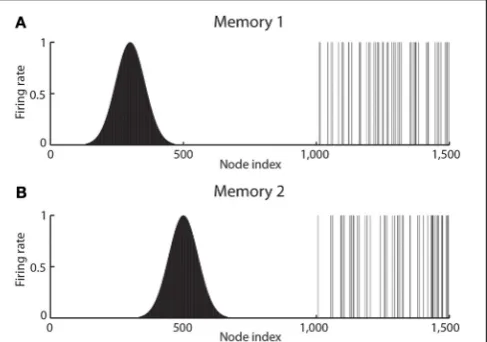
Continuous attractor networks can be thought of as very simi-lar to autoassociation or discrete attractor networks (Rolls, 2008), and have the same architecture. The main difference is that the patterns stored in a CANN are continuous patterns, with each neuron having broadly tuned firing which decreases with for example a Gaussian function as the distance from the optimal firing location of the cell is varied, and with different neurons having tuning that overlaps throughout the space. Such tuning is illustrated inFigure 3. For comparison, autoassociation networks normally have discrete (separate) patterns (each pattern imple-mented by the firing of a particular subset of the neurons), with no continuous distribution of the patterns throughout the space
(see Figure 3). A consequent difference is that the CANN can
maintain its firing at any location in the trained continuous space, whereas a discrete attractor or autoassociation network moves its population of active neurons toward one of the previously learned attractor states, and thus implements the recall of a particular pre-viously learned pattern from an incomplete or noisy (distorted) version of one of the previously learned patterns.
[image:7.595.306.550.62.233.2]Space is continuous, and object representations are discrete. If these representations are to be combined in for example an object-place memory, then we need to understand the oper-ation of networks that combine these representoper-ations. Rolls
FIGURE 3 | The types of firing patterns stored in continuous attractor networks are illustrated for the patterns present on neurons 1–1000 for Memory 1 (when the firing is that produced when the spatial state represented is that for location 300), and for Memory 2 (when the firing is that produced when the spatial state represented is that for location 500).The continuous nature of the spatial representation results from the fact that each neuron has a Gaussian firing rate that peaks at its optimal location. This particular mixed network also contains discrete representations that consist of discrete subsets of active binary firing rate neurons in the range 1001–1500. The firing of these latter neurons can be thought of as representing the discrete events that occur at the location. Continuous attractor networks by definition contain only continuous representations, but this particular network can store mixed continuous and discrete representations, and is illustrated to show the difference of the firing patterns normally stored in separate continuous attractor and discrete attractor networks. For this particular mixed network, during learning,
Memory 1 is stored in the synaptic weights(A), then Memory 2(B), etc.,
and each memory contains part that is continuously distributed to represent physical space, and part that represents a discrete event or object.
et al. (2002) have shown that attractor networks can store both continuous patterns and discrete patterns (as illustrated
in Figure 3), and can thus be used to store for example the
location in (continuous, physical) space (e.g., the place “out there” in a room represented by spatial view cells) where an object (a discrete item) is present. We showed this by stor-ing associated continuous and discrete representations in the same single attractor network, and then showing that the rep-resentation in the continuous space could be retrieved by the discrete object that was associated with that spatial position; and that the representation of the discrete object could be retrieved by providing the position in the continuous representation of space.
We have considered how spatial representations could be stored in continuous attractor networks, and how the activity can be maintained at any location in the state space in a form of short-term memory when the external (e.g., visual) input is removed. However, a property of some spatial representations is that they can be updated by self-motion, idiothetic, input, and mechanisms have been proposed for how this could be achieved (Samsonovich and McNaughton, 1997; Stringer et al., 2002a,b, 2005; Rolls and Stringer, 2005; Stringer and Rolls, 2006; Walters et al., 2013), including in the entorhinal cortex grid cell system (Kropff and Treves, 2008; Giocomo et al., 2011; Zilli, 2012). The ways in which path integration could be implemented in recurrent networks such as the CA3 system in the hippocampus or in related sys-tems are described elsewhere (Samsonovich and McNaughton, 1997; Stringer et al., 2002a,b; McNaughton et al., 2006), and have been applied to primate spatial view cells by Rolls and colleagues (Stringer et al., 2004, 2005; Rolls and Stringer, 2005). Cognitive maps (O’Keefe and Nadel, 1978) can be understood by the oper-ations of these attractor networks, and how they are updated by learning and by self-motion (Rolls, 2008). It has been argued that the bumpiness of the CA3 representation of space is more consis-tent with episodic memory storage, as argued in this paper, than with spatial path integration using the CA3 system as a contin-uous attractor network implementing path integration (Cerasti and Treves, 2013; Stella et al., 2013).
PERFORANT PATH INPUTS TO CA3 CELLS INITIATE RECALL IN CA3 AND CONTRIBUTE TO GENERALIZATION
By calculating the amount of information that would end up being carried by a CA3 firing pattern produced solely by the per-forant path input and by the effect of the recurrent connections, we have been able to show (Treves and Rolls, 1992) that an input of the perforant path type, alone, is unable to direct efficient information storage. Such an input is too weak, it turns out, to drive the firing of the cells, as the “dynamics” of the network is dominated by the randomizing effect of the RCs. On the other hand, an autoassociative memory network needs afferent inputs to apply the retrieval cue to the network. We have shown (Treves and Rolls, 1992) that the perforant path system is likely to be the one involved in relaying the cues that initiate retrieval in CA3. The concept is that to initiate retrieval, a numerically large input (the perforant path system, seeFigure 2) is useful so that even a partial cue is sufficient [see Equation 17 ofTreves and Rolls (1992)]; and that the retrieval cue need not be very strong, as the RCs (in CA3) then take over in the retrieval process to pro-duce good recall (Treves and Rolls, 1992, 2008). In this scenario, the perforant path to CA3 synapses operate as a pattern associa-tor, the quantitative properties of which are described elsewhere (Rolls and Treves, 1990, 1998; Rolls, 2008). If an incomplete recall cue is provided to a pattern association network using distributed input representations, then most of the output pattern will be retrieved, and in this sensepattern association networks general-ize between similar retrieval patterns to produce the correct output
firing (Rolls, 2008, 2014a), and this generalization performed
at the perforant path synapses to CA3 cells helps in the fur-ther completion produced by the RC CA3-CA3 autoassociation process.
In contrast, during storage, strong signals, in the order of mV for each synaptic connection, are provided by the mossy fiber inputs to dominate the RC activations, so that the new pattern of CA3 cell firing can be stored in the CA3 RC connections (Treves and Rolls, 1992; Rolls, 2008).
THE DILUTION OF THE CA3 RECURRENT COLLATERAL CONNECTIVITY ENHANCES MEMORY STORAGE CAPACITY AND PATTERN
COMPLETION
Figure 2shows that in the rat, there are approximately 300,000
CA3 neurons, but only 12,000 RC synapses per neuron. The dilu-tion of the connectivity is thus 12,000 / 300,000 = 0.04. The connectivity is thus not complete, and complete connectivity in an autoassociation network would make it simple, for the con-nectivity between the neurons would then be symmetric (i.e., the connection strength from any one neuron to another is matched by a connection of the same strength in the opposite direction), and this guarantees energy minima for the basins of attraction that will be stable, and a memory capacity than can be calcu-lated (Hopfield, 1982). We have shown how this attractor type of network can be extended to have similar properties with diluted connectivity, and also with sparse representations with graded fir-ing rates (Rolls and Treves, 1990; Treves, 1990, 1991; Treves and Rolls, 1991; Webb et al., 2011; Rolls and Webb, 2012).
However, the question has recently been asked about whether there are any advantages to diluted autoassociation or attractor networks compared to fully connected attractor networks (Rolls, 2012a). One biological property that may be a limiting factor is the number of synaptic connections per neuron, which is 12,000 in the CA3-CA3 network just for the RCs (see Figure 2). The number may be higher in humans, allowing more memories to be stored in the hippocampus than order 12,000. I note that the storage of large number of memories may be facilitated in humans because the left and right hippocampus appear to be much less connected between the two hemispheres than in the rat, which effectively has a single hippocampus (Rolls, 2008). In humans, with effectively two separate CA3 networks, one on each side of the brain, the memory storage capacity may be doubled, as the capacity is set by the number of RCs per neuron in each attractor network (Equation 3). In humans, the right hippocampus may be devoted to episodic memories with spatial and visual compo-nents, whereas the left hippocampus may be devoted to memories with verbal / linguistic components, i.e., in which words may be part of the episode (e.g., who said what to whom and when) (Barkas et al., 2010; Bonelli et al., 2010; Sidhu et al., 2013).
probabilistically there were more than one connection between any two neurons, it was shown by simulation of an autoassoci-ation attractor network that such connections would dominate the attractor states into which the network could enter and be stable, thus strongly reducing the memory capacity of the net-work (the number of memories that can be stored and correctly retrieved), below the normal large capacity for diluted connectiv-ity. Diluted connectivity between neurons in the cortex thus has an important role in allowing high capacity of memory networks in the cortex, and helping to ensure that the critical capacity is not reached at which overloading occurs leading to an impair-ment in the ability to retrieve any memories from the network (Rolls, 2012a). The diluted connectivity is thus seen as an adap-tation that simplifies the genetic specification of the wiring of the brain, by enabling just two attributes of the connectivity to be specified (e.g., from a CA3 to another CA3 neuron chosen at random to specify the CA3 to CA3 RC connectivity), rather than which particular neuron should connect to which other particular neuron (Rolls and Stringer, 2000; Rolls, 2012a). Consistent with this hypothesis, there are NMDA receptors with the genetic speci-fication that they are NMDA receptors on neurons of a particular type, CA3 neurons (as shown by the evidence from CA3-specific vs. CA1-specific NMDA receptor knockouts) (Rondi-Reig et al., 2001; Nakazawa et al., 2002, 2003, 2004). A consequence is that the vector of output neuronal firing in the CA3 region, i.e., the number of CA3 neurons, is quite large (300,000 neurons in the rat). The large number of elements in this vector may have consequences for the noise in the system, as we will see below.
The role of dilution in the connectivity of the CA3 RC connec-tivity includes enabling this large number of separate memories to be recalled from any part of each memory, that is, in pattern completion (Rolls, 2012a).
The dilution of the CA3-CA3 RC connectivity at 0.04 may be greater dilution than that in a local neocortical area, which is in the order of 0.1 (Rolls, 2008, 2012a). This is consistent with the hypothesis that the storage capacity of the CA3 system is at a premium, and so the dilution is kept to a low value (i.e., great dilution), as then there is lower distortion of the basins of attraction and hence the memory capacity is maximized (Rolls, 2012a).
NOISE AND STABILITY PRODUCED BY THE DILUTED CONNECTIVITY AND THE GRADED FIRING RATES IN THE CA3-CA3 ATTRACTOR NETWORK
Many processes in the brain are influenced by the noise or vari-ability of neuronal spike firing (Faisal et al., 2008; Rolls and Deco, 2010; Deco et al., 2013). The action potentials are generated in a way that frequently approximates a Poisson process, in which the spikes for a given mean firing rate occur at times that are essentially random (apart from a small effect of the refractory period), with a coefficient of variation of the interspike interval distribution (CV) near 1.0 (Rolls and Deco, 2010). The sources of the noise include quantal transmitter release, and noise in ion channel openings (Faisal et al., 2008). The membrane potential is often held close to the firing threshold, and then small changes in the inputs and the noise in the neuronal operations cause spikes to be emitted at almost random times for a given mean firing
rate. Spiking neuronal networks with balanced inhibition and excitation currents and associatively modified recurrent synaptic connections can be shown to possess a stable attractor state where neuron spiking is approximately Poisson too (Amit and Brunel, 1997; Miller and Wang, 2006). The noise caused by the variabil-ity of individual neuron spiking which then affects other neurons in the network can play an important role in the function of such recurrent attractor networks, by causing for example an otherwise stable network to jump into a decision state (Wang, 2002; Deco and Rolls, 2006; Rolls and Deco, 2010). Attractor networks with this type of spiking-related noise are used in the brain for mem-ory recall, and for decision-making, which in terms of the neural mechanism are effectively the same process (Rolls, 2008). Noise in attractor networks is useful for memory and decision-making, for it makes them non-deterministic, and this contributes to new solutions to problems, and indeed to creativity (Rolls and Deco, 2010; Rolls, 2014a).
To investigate the extent to which the diluted connectivity affects the dynamics of attractor networks in the cerebral cortex (which includes the hippocampus), we simulated an integrate-and-fire attractor network taking decisions between competing inputs with diluted connectivity of 0.25 or 0.1 but the same number of synaptic connections per neuron for the RC synapses within an attractor population as for full connectivity (Rolls and Webb, 2012). The results indicated that there was less spiking-related noise with the diluted connectivity in that the stability of the network when in the spontaneous state of firing increased, and the accuracy of the correct decisions increased. The deci-sion times were a little slower with diluted than with complete connectivity. Given that the capacity of the network is set by the number of RC synaptic connections per neuron, on which there is a biological limit, the findings indicate that the stability of cortical networks, and the accuracy of their correct deci-sions or memory recall operations, can be increased by utilizing diluted connectivity and correspondingly increasing the num-ber of neurons in the network (which may help to smooth the noise), with little impact on the speed of processing of the cortex. Thus, diluted connectivity can decrease cortical spiking-related noise, and thus enhance the reliability of memory recall, which includes completion from a partial recall cue (Rolls and Webb, 2012).
simulations of an attractor decision-making network, we showed that the noise is indeed greater for a given sparseness of the rep-resentation for graded, exponential, than for binary firing rate distributions (Webb et al., 2011). The greater noise was measured by faster escaping times from the spontaneous firing rate state when the decision cues are applied, and this corresponds to faster decision or reaction times. The greater noise was also evident as less stability of the spontaneous firing state before the decision cues are applied. The implication is that spiking-related noise will continue to be a factor that influences processes such as decision-making, signal detection, short-term memory, and memory recall and completion (including in the CA3 network) even with the quite large networks found in the cerebral cortex. In these net-works there are several thousand RC synapses onto each neuron. The greater noise with graded firing rate distributions has the advantage that it can increase the speed of operation of cortical circuitry (Webb et al., 2011). The graded firing rates also by oper-ating in a non-linear network effectively increase the sparseness of the representation, and this itself is a pattern separation effect (Webb et al., 2011).
PATTERN SEPARATION OF CA3 CELL POPULATIONS ENCODING DIFFERENT MEMORIES
For the CA3 to operate with high capacity as an autoassociation or attractor memory, the sets of CA3 neurons that represent each event to be stored and later recalled need to be as uncorrelated from each other as possible. Correlations between patterns reduce the memory capacity of an autoassociation network (Marr, 1971; Kohonen, 1977, 1984; Kohonen et al., 1981; Rolls and Treves, 1998), and because storage capacity is at a premium in an episodic memory system, there are several mechanisms that reduce the correlations between the firing of the population vectors of CA3 neuron firing each one of which represents a different event to be stored in memory. In the theoretical physics approach to the capacity of attractor networks, it is indeed assumed that the dif-ferent vectors of firing rates to be stored are well separated from each other, by drawing each vector of firing at random, and by assuming very large (infinite) numbers of neurons in each pattern (Hopfield, 1982; Rolls and Treves, 1998).
We have proposed that there are several mechanisms that help to achieve this pattern separation, namely the mossy fiber pattern separation effect produced by the small number of connections received by a CA3 neuron from mossy fibers which dominate the CA3 cell firing; the expansion recoding, and the sparse rep-resentation provided by the dentate granule cells that form the mossy fiber synapses; and the sparseness of the CA3 cell represen-tation. Neurogenesis of dentate granule cells is a fifth potential contributor to achieving pattern separation of CA3 cell firing. The five factors are described next. Before this, it is remarked that some of this architecture may be special to the hippocam-pus, and not found in the neocortex, because of the importance of storing and retrieving large numbers of (episodic) memories in the hippocampus. The neocortex in contrast is more concerned with building new representations for which competitive learn-ing is more important, and thus neocortical circuitry does not use a mossy fiber system to produce new random sets of neurons activated (Rolls, 2008).
PATTERN SEPARATION AND THE SPARSE CONNECTIVITY OF THE MOSSY FIBRE INPUTS TO CA3 CELLS
We hypothesize that the mossy fiber inputs force efficient infor-mation storage by virtue of their strong and sparse influence on the CA3 cell firing rates (Rolls, 1987, 1989b,c; Treves and Rolls, 1992). [The strong effects likely to be mediated by the mossy fibres were also emphasized byMcNaughton and Morris (1987) and McNaughton and Nadel (1990)]. We (Rolls and Treves) (Rolls, 1987, 1989b,c, 1990b, 2008; Treves and Rolls, 1992; Rolls and Treves, 1998) hypothesize that the mossy fiber input appears to be particularly appropriate in several ways. First, the fact that mossy fiber synapses are large and located very close to the soma makes them relatively powerful in activat-ing the postsynaptic cell. Second, the firactivat-ing activity of dentate granule cells appears to be very sparse (Jung and McNaughton, 1993; Leutgeb et al., 2007) and this, together with the small number of connections on each CA3 cell, produces a sparse signal, which can then be transformed into sparse firing activ-ity in CA3 by a threshold effect. The hypothesis is that the mossy fiber sparse connectivity solution performs the appro-priate function to enable learning to operate correctly in CA3 (Treves and Rolls, 1992; Cerasti and Treves, 2010). The per-forant path input would, the quantitative analysis shows, not produce a pattern of firing in CA3 that contains sufficient infor-mation for learning (Treves and Rolls, 1992) (see further section 3.2.6).
The particular property of the small number of mossy fiber connections onto a CA3 cell, approximately 46 (see Figure 2), is that this has arandomizing effecton the representations set up in CA3, so that they are as different as possible from each other (Rolls, 1989b,c, 2008; Treves and Rolls, 1992; Rolls and Treves, 1998; Rolls and Kesner, 2006). (This means for exam-ple that place cells in a given environment are well separated to cover the whole space.) The result is that any one event or episode will set up a representation that is very different from other events or episodes, because the set of CA3 neurons acti-vated for each event is random. This is then the optimal situation for the CA3 RC effect to operate, for it can then associate together the random set of neurons that are active for a particular event (for example an object in a particular place), and later recall the whole set from any part. It is because the representations in CA3 are unstructured, or random, in this way that large numbers of memories can be stored in the CA3 autoassociation system, and that interference between the different memories is kept as low as possible, in that they are maximally different from each other (Hopfield, 1982; Treves and Rolls, 1991; Rolls and Treves, 1998; Rolls, 2008).
information transfer from dentate granule cells to CA3 cells is in the order of 35–50 (Treves and Rolls, 1992; Cerasti and Treves, 2010). The mossy fibres also make connections useful for feed forward inhibition in CA3 (Acsady et al., 1998), which is likely to be useful to help in the sparse representations being formed in CA3.
On the basis of these and other points, we predicted that the mossy fibres may be necessary for new learning in the hippocampus, but may not be necessary for the recall of existing memories from the hippocampus (Treves and Rolls, 1992; Rolls and Treves, 1998; Rolls, 2008). Experimental evi-dence consistent with this prediction about the role of the mossy fibres in learning has been found in rats with dis-ruption of the dentate granule cells (Lassalle et al., 2000) (section Pattern Separation Performed by Dentate Granule cells).
We (Rolls and Kesner, 2006) have hypothesized that non-associative plasticity of mossy fibres (see Brown et al., 1989, 1990) might have a useful effect in enhancing the signal-to-noise ratio, in that a consistently firing mossy fiber would pro-duce non-linearly amplified currents in the postsynaptic cell, which would not happen with an occasionally firing fiber (Treves and Rolls, 1992). This plasticity, and also learning in the den-tate, would also have the effect that similar fragments of each episode (e.g., the same environmental location) recurring on sub-sequent occasions would be more likely to activate the same population of CA3 cells, which would have potential advan-tages in terms of economy of use of the CA3 cells in dif-ferent memories, and in making some link between difdif-ferent episodic memories with a common feature, such as the same location in space. Consistent with this, dentate neurons that fire repeatedly are more effective in activating CA3 neurons (Henze et al., 2002).
As acetylcholine turns down the efficacy of the RC synapses between CA3 neurons (Hasselmo et al., 1995; Giocomo and Hasselmo, 2007), then cholinergic activation also might help to allow external inputs from the mossy fibers rather than the internal RC inputs to dominate the firing of the CA3 neurons during learning, as the current theory proposes. If cholinergic activation at the same time facilitated LTP in the RCs (as it appears to in the neocortex), then cholinergic activation could have a useful double role in facilitating new learning at times of behavioral activation (Hasselmo et al., 1995; Giocomo and Hasselmo, 2007), when presumably it may be particularly rel-evant to allocate some of the limited memory capacity to new memories.
PATTERN SEPARATION AND THE SPARSENESS OF THE FIRING OF THE DENTATE GRANULE CELL INPUT VIA THE MOSSY FIBRES TO CA3 CELLS
The firing activity of dentate granule cells appears to be very sparse (Jung and McNaughton, 1993; Leutgeb et al., 2007) and this, together with the small number of dentate mossy fiber con-nections on each CA3 cell, produces a sparse signal, which can then be transformed into sparse firing activity in CA3 by a thresh-old effect. The pattern separation mechanisms that enable the dentate to provide a sparse firing input to CA3 are described below.
PATTERN SEPARATION AND THE LARGE NUMBER OF DENTATE GRANULE CELLS PROVIDING INPUTS VIA THE MOSSY FIBRES TO CA3 CELLS
Expansion recoding can decorrelate input patterns, and this can be performed by a stage of competitive learning with a large num-ber of neurons (Rolls, 2008). A mechanism like this appears to be performed by the dentate granule cells, which are numerous (1×10⁶in the rat, compared to 300,000 CA3 cells), have associa-tively modifiable synapses (required for a competitive network), and strong inhibition provided by the inhibitory interneurons. This may not represent expansion of numbers relative to the number of entorhinal cortex cells, but the principle of a large number of dentate granule cells, with competitive learning and strong inhibition through inhibitory interneurons, would pro-duce a decorrelation of signals like that achieved by expansion recoding (Rolls, 2008).
SPARSENESS OF THE CA3 CELL REPRESENTATION AND PATTERN SEPARATION
The firing of CA3 cells is relatively sparse, and this helps to decorrelate different population vectors of CA3 cell firing for different memories. [Sparse representations are more likely to be decorrelated with each other (Rolls, 2008).] Evidence on the sparseness of the CA3 cell representation in rats includes evi-dence that CA3 cell ensembles may support the fast acquisition of detailed memories by providing a locally continuous, but glob-ally orthogonal spatial representation, onto which new sensory inputs can rapidly be associated (Leutgeb and Leutgeb, 2007). In the macaque hippocampus, in which spatial view cells are found (Rolls et al., 1997a, 1998; Robertson et al., 1998; Georges-François et al., 1999), for the representation of 64 locations around the walls of the room, the mean single cell sparsenessas was 0.34, and the mean population sparseness ap was 0.33 (Rolls et al.,
1998; Rolls, 2008; Rolls and Treves, 2011). For comparison, the corresponding values for inferior temporal cortex neurons tuned to objects and faces were 0.77 (Franco et al., 2007; Rolls, 2008; Rolls and Treves, 2011); for taste and oral texture neurons in the insular cortex the population sparseness was 0.71; for taste and oral texture neurons in the orbitofrontal cortex was 0.61; and for taste and oral texture neurons in the amygdala was 0.81 (Rolls, 2008; Rolls and Treves, 2011). Thus, the evidence is that the hip-pocampal CA3 / pyramidal cell representation is more sparse in macaques than in neocortical areas and the amygdala, and this is consistent with the importance in hippocampal CA3 of using a sparse representation to produce a large memory capacity.
NEUROGENESIS OF DENTATE GRANULE CELLS TO PROVIDE NEW REPRESENTATIONS IN CA3 UNCORRELATED WITH PREVIOUS CA3 REPRESENTATIONS
the radial arm maze was impaired for arms that were presented with little separation, but no deficit was observed when the arms were presented farther apart (Clelland et al., 2009). Consistently, impaired neurogenesis in the dentate also produced a deficit for small spatial separations in an associative object-in-place task (Clelland et al., 2009).
THE DIRECT PERFORANT PATH TO CA3 CELL INPUT: POOR AT PATTERN SEPARATION AND FORCING A NEW MEMORY PATTERN INTO CA3 CELL FIRING
It has been suggested that the feed forward connectivity from the entorhinal cortex via the perforant path to the CA3 neu-rons may act as a feed forward pattern association network that is more important than the CA3-CA3 RC autoassociation system (Cheng, 2013). The quantitative properties of pattern association networks are described elsewhere (Rolls and Treves, 1990, 1998; Rolls, 2008). If an incomplete recall cue is provided to a pattern association network using distributed input representations, then most of the output pattern will be retrieved, and in this sense
pattern association networks do generalize. (As noted above,
pat-tern association networks do not perform patpat-tern completion, in that the unconditioned stimulus cannot recall the conditioned stimulus.) The analyses described in these sources shows that the capacity of pattern association networks (the maximum number of memories that can be stored and retrieved, here denoted by
pmax) is approximately
pmax≈ C
PA
[aoln(1/ao)] (4)
whereCPAis the number of feed forward associatively modifiable
connections per neuron, andao is the sparseness of the repre-sentation in the output neurons of the pattern associator (Rolls, 2008). Given that there are fewer feed forward (perforant path) synaptic connections onto CA3 neurons (3,600) than recurrent synaptic connections between CA3 neurons (12,000 in the rat)
(seeFigure 2), then the capacity of the feed forward system would
be considerably smaller than that of the RC CA3-CA3 system. [It is noted that theaoof Equation (4) would be the same number
as theaof equation (3), as that is just the sparseness of the fir-ing of the population of CA3 neurons. The number of perforant path synapses is sufficiently large that it can generalize given even a partial retrieval pattern, so that the CA3-CA3 connections can then complete the retrieval, given that the recall signal for the per-forant path pattern associator is proportional to the square root of the number of perforant path synapses, as shown by Equation 17 ofTreves and Rolls (1992).] The feed forward hypothesis (Cheng, 2013) thus has a strong argument against it of storage capacity, which would be much less (∼3600 / 12,000) than that of the CA3-CA3 RC system operating as an autoassociation memory. Another disadvantage of the feed forward hypothesis is that the attractor properties of the CA3-CA3 connections would be lost, and these potentially contribute to holding one or more items simultaneously active in short-term memory (Rolls, 2008; Rolls et al., 2013), and providing a basis for temporal order mem-ory as described in section The Dilution of the CA3 Recurrent Collateral Connectivity Enhances Memory Storage Capacity and
Pattern Completion. Another disadvantage is that we have been able to show (Treves and Rolls, 1992) that an input of the per-forant path type, alone, is unable to direct efficient information storage. Such an input is too weak, it turns out, to drive the fir-ing of the cells, as the “dynamics” of the network is dominated by the randomizing effect of the RCs. Another disadvantage of the feed forward hypothesis is that a pattern associator may not with an incomplete cue be able to recall the complete pattern that was stored, whereas an attractor network has the property that it can fall into an attractor basin that can reflect perfect retrieval of the complete memory (Rolls and Treves, 1998; Rolls, 2008).
PATTERN SEPARATION PERFORMED BY DENTATE GRANULE CELLS
The theory is that the dentate granule cell stage of hippocampal processing which precedes the CA3 stage acts as a competitive net-work in a number of ways to produce during learning the sparse yet efficient (i.e., non-redundant) representation in CA3 neurons that is required for the autoassociation implemented by CA3 to perform well (Rolls, 1989b,c, 1990b; Treves and Rolls, 1992; Rolls and Kesner, 2006; Rolls et al., 2006). An important property for episodic memory is that the dentate by acting in this way would perform pattern separation (or orthogonalization) (Rolls, 1989b; Treves and Rolls, 1992; Rolls and Kesner, 2006; Rolls et al., 2006), enabling the hippocampus to store different memories of even similar events, and this prediction has been confirmed (Gilbert et al., 2001; Rolls and Kesner, 2006; Leutgeb and Leutgeb, 2007; McHugh et al., 2007; Goodrich-Hunsaker et al., 2008; Rolls, 2008; Kesner et al., 2012). Consistently with this evidence for pattern separation by dentate granule cells, in rats small changes in the shape of the environment in which rats are exploring can substan-tially alter the activity patterns among place-modulated granule cells (Leutgeb et al., 2007).
visual features formed over such a wide visual angle would effec-tively define a position in space that is a place (De Araujo et al., 2001).
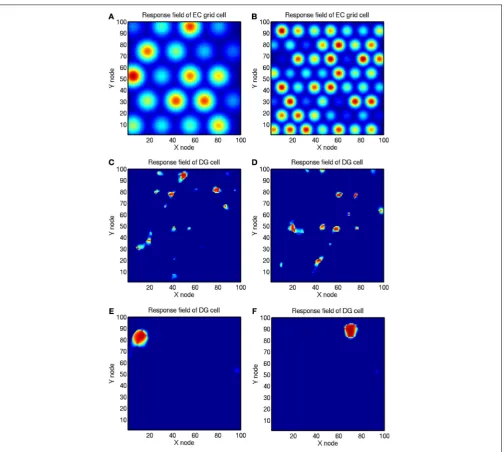
The entorhinal cortex contains grid cells, which have high fir-ing in the rat in a two-dimensional spatial grid as a rat traverses an environment, with larger grid spacings in the ventral entorhi-nal cortex (Fyhn et al., 2004; Hafting et al., 2005). This may be a system optimized for path integration (McNaughton et al., 2006) which may self-organize during locomotion with longer time constants producing more widely spaced grids in the ven-tral entorhinal cortex (Kropff and Treves, 2008). How are the grid cell representations, which would not be suitable for asso-ciation of an object or reward with a place to form an episodic memory, transformed into a place representation that would be appropriate for this type of episodic memory? I have proposed that this could be implemented by a competitive network (Rolls, 2008) in the dentate gyrus which operates to form place cells, implemented by each dentate granule cell learning to respond to particular combinations of entorhinal cortex cells firing, where each combination effectively specifies a place, and this has been shown to be feasible computationally (Rolls et al., 2006). The sparse representations in the dentate gyrus, implemented by the mutual inhibition through inhibitory interneurons and compet-itive learning, help to implement this “pattern separation” effect (Rolls, 1989b,c; Rolls and Treves, 1998; Rolls, 2008). The inves-tigations showed that learning in the perforant path to dentate granule cell representation, and the sparse representation in the dentate granule cells, are both important in the formation of place-like fields in dentate granule cells from the grid cells in the entorhinal cortex (Rolls et al., 1997a, 1998; Robertson et al., 1998; Georges-François et al., 1999). To illustrate this,Figure 4shows from these simulations the responses of the simulated grid cells (A,B), the dentate receptive fields formed by feed forward con-nections and a sparse representation in the dentate gyrus (C,D), and the dentate receptive fields formed when Hebbian synaptic modification and training is included in the feed forward con-nections to implement competitive learning (E,F). It is only with the full competitive learning that the dentate receptive fields self-organized to become small place-like receptive fields (Rolls et al., 2006) similar to those found in the rat dentate granule cells.
In primates, there is now evidence that there is a grid-cell like representation in the entorhinal cortex, with neurons having grid-like firing as the monkey moves the eyes across a spatial scene (Killian et al., 2012). Similar competitive learning processes may transform these entorhinal cortex “spatial view grid cells” into hippocampal spatial view cells, and may help with the idiothetic (produced in this case by movements of the eyes) update of spa-tial view cells (Robertson et al., 1998). The presence of spaspa-tial view grid cells in the entorhinal cortex of primates (Killian et al., 2012) is of course predicted from the presence of spatial view cells in the primate CA3 and CA1 regions (Rolls et al., 1997a, 1998; Robertson et al., 1998; Georges-François et al., 1999; Rolls and Xiang, 2006; Rolls, 2008). Further support for this type of rep-resentation of space being viewed “out there” rather than where one is located as for rat place cells is that cells in the human entorhinal cortex with spatial view grid-like properties have now been described (Jacobs et al., 2013).
CA1 CELLS AND PATTERN COMPLETION PRIOR TO HIPPOCAMPO-DIRECTED RECALL TO THE NEOCORTEX
The CA3 cells connect to the CA1 cells by the Schaeffer collat-eral synapses. The associative modifiability in this connection helps the full information present in CA3 to be retrieved in the CA1 neurons (Treves and Rolls, 1994; Rolls, 1995; Treves, 1995; Schultz and Rolls, 1999). Part of the hypothesis is that the sepa-rate sub-parts of an episodic memory, which must be represented separately in CA3 to allow for completion, can be combined together by competitive learning in CA1 to produce an efficient retrieval cue for the recall via the backprojection pathways to the neocortex of memories stored in the neocortex (Rolls, 1989a,b, 1995, 1996b; Treves and Rolls, 1994). Associative recall by pat-tern association in the CA3 to CA1 feed forward connections is a prominent property which implements generalization, so that if completion in CA3 was not perfect, CA1 could generalize to the closest CA1 representation (Rolls, 1995, 2008; Schultz et al., 2000).
BACKPROJECTIONS TO THE NEOCORTEX, AND MEMORY RETRIEVAL FROM THE HIPPOCAMPUS TO PROVIDE A COMPLETE NEOCORTICAL MEMORY REPRESENTATION
The need for information to be retrieved from the hippocampus to affect other brain areas was noted in the Introduction. The way in which this could be implemented via backprojections to the neocortex (Treves and Rolls, 1994; Rolls, 1995, 1996b, 2008, 2010b) is considered here in the context of recalling a complete memory representation in the complete set of cortical areas that provide inputs to the hippocampus (seeFigure 1).
FIGURE 4 | Simulation of competitive learning in the dentate gyrus to produce place cells from the entorhinal cortex grid cell inputs. (A and B) Firing rate profiles of two entorhinal cortex
(EC) grid cells with frequencies of 4 and 7 cycles. (C and D)
Firing rate profiles of two dentate gyrus (DG) cells with no
training using competitive learning. (E and F) Firing rate profiles of
two dentate gyrus (DG) cells trained using competitive learning.
(After Rolls et al., 2006).
The hypothesis of the architecture with which this would be achieved is shown in Figure 1. The feed forward connections from association areas of the cerebral neocortex (solid lines in
Figure 1), show major convergence as information is passed to
CA3, with the CA3 autoassociation network having the smallest number of neurons at any stage of the processing. The backpro-jections allow for divergence back to neocortical areas. The way in which I suggest that the backprojection synapses are set up to have the appropriate strengths for recall is as follows (Rolls, 1989a,b,c). During the setting up of a new episodic memory, there would be strong feed forward activity progressing toward the hippocampus. During the episode, the CA3 synapses would be modified, and via
the CA1 neurons and the subiculum, a pattern of activity would be produced on the backprojecting synapses to the entorhinal cor-tex. Here the backprojecting synapses from active backprojection axons onto pyramidal cells being activated by the forward inputs to entorhinal cortex would be associatively modified. A similar process would be implemented at preceding stages of neocortex, that is in the parahippocampal gyrus/perirhinal cortex stage, and in association cortical areas, as shown inFigure 1.
would by pattern association from the backprojecting synapses to the cortical pyramidal cells become associated with whichever cortical cells were being made to fire by the forward inputs. Then later on, during recall, a recall cue from perhaps another part of cortex might reach CA3, where the firing during the origi-nal episode would be completed. The resulting backprojecting activity would then, as a result of the pattern association learned previously, bring back the firing in any cortical area that was present during the original episode. Thus, retrieval involves rein-stating the activity that was present in different cortical areas that was present during the learning of an episode. (The pat-tern association is also called heteroassociation, to contrast it with autoassociation. The pattern association operates at mul-tiple stages in the backprojection pathway, as made evident in
Figure 1). If the recall cue was an object, this might result in recall
of the neocortical firing that represented the place in which that object had been seen previously. As noted elsewhere in this paper and byMcClelland et al. (1995), that recall might be useful to the neocortex to help it build new semantic memories, which might inherently be a slow process and is not part of the theory of recall. A plausible requirement for a successful hippocampo-directed recall operation, is that the signal generated from the hippocam-pally retrieved pattern of activity, and carried backwards toward neocortex, remain undegraded when compared to the noise due, at each stage, to the interference effects caused by the concurrent storage of other patterns of activity on the same backprojecting synaptic systems. That requirement is equivalent to that used in deriving the storage capacity of such a series of heteroassociative memories, and it was shown byTreves and Rolls (1994, 1991) that the maximum number of independently generated activity patterns that can be retrieved is given, essentially, by the same formula as (3) above where, however,ais now the sparseness of the representation at any given stage, andCis the average num-ber of (back-)projections each cell of that stage receives from cells of the previous one. (k’ is a similar slowly varying factor to that introduced above.) Ifpis equal to the number of memories held in the hippocampal memory, it is limited by the retrieval capac-ity of the CA3 network,pmax. Putting together the formula for
the latter with that shown here, one concludes that, roughly, the requirement implies that the number of afferents of (indirect) hippocampal origin to a given neocortical stage (CHBP), must be
CHBP=CRCanc/aCA3, whereCRCis the number of RCs to any
given cell in CA3, the average sparseness of a representation is
anc, andaCA3is the sparseness of memory representations there
in CA3.
The above requirement is very strong: even if representations were to remain as sparse as they are in CA3, which is unlikely, to avoid degrading the signal,CHBPshould be as large asCRC, i.e., 12,000 in the rat. If thenCHBPhas to be of the same order asCRC, one is led to a very definite conclusion: a mechanism of the type envisaged here could not possibly rely on a set of monosynap-tic CA3-to-neocortex backprojections. This would imply that, to make a sufficient number of synapses on each of the vast number of neocortical cells, each cell in CA3 has to generate a dispropor-tionate number of synapses (i.e.,CHBP times the ratio between the number of neocortical and that of CA3 cells). The required divergence can be kept within reasonable limits only by assuming
that the backprojecting system is polysynaptic, provided that the number of cells involved grows gradually at each stage, from CA3 back to neocortical association areas (Treves and Rolls, 1994) (cf.
Figure 1).
The theory of recall by the backprojections thus provides a quantitative account of why the cerebral cortex has as many backprojection as forward projection connections (Rolls, 2008).
These concepts show how the backprojection system to neo-cortex can be conceptualized in terms of pattern completion, as follows. The information that is present when a memory is formed may be present in different areas of the cerebral cor-tex, for example of a face in a temporal cortex face area (Rolls, 2012b), of a spatial location in a neocortical location area, and of a reward received in the orbitofrontal cortex (Rolls, 2014a). To achieve detailed retrieval of the memory, reinstatement of the activity during recall of the neuronal activity during the original memory formation may be needed. This is what the backprojec-tion system described could achieve, and is a form of complebackprojec-tion of the information that was represented in the different cortical areas when the memory as formed. In particular, the concept of completion here is that if a recall cue from a visual object area is provided, then the emotional parts of the episodic memory can be recalled in the orbitofrontal cortex, and the spatial parts in parietal cortical areas, with the result that a complete mem-ory is retrieved, with activity recalled into several higher-order cortical areas. Because such a wide set of different neocortical areas must be content-addressed, a multistage feedback system is required, to keep the number of synapses per neuron in the back-projection pathways down to reasonable numbers. (Having CA1 directly address neocortical areas would require each CA1 neuron to have tens of millions of synapses with cortical neurons. That is part of the computational problem solved by the multistage back-projection system shown inFigure 1.) Thus, the backprojection system with its series of pattern associators can each be thought of as retrieving the complete pattern of cortical activity in many different higher-order cortical areas that was present during the original formation of the episodic memory.
Further aspects of the operation of the backprojecting systems are described elsewhere (Rolls, 2008).
TESTS OF PATTERN SEPARATION AND PATTERN COMPLETION