Abstract—Cloud service providers are interested both in a revenue maximizing allocation of their limited capacity resources (as goal of revenue management) and the establishment of long-term business relations with their clients (as goal of customer relationship management). Confronted with these partly diametric objectives, the paper introduces a framework for integrating the information systems that are assigned to often separate departments and have to meet the increased requirements of information processing due to the desired incorporation of both management concepts. Promising aspects of the integrated information system for supporting the development of a long-term profitable customer base are then demonstrated. Finally, revenue potentials of a customer value-based booking policy and said increase in worthiness of the customer portfolio are evaluated via simulation.
Index Terms—integration, cloud computing, customer relationship, information system, revenue management
I. INTRODUCTION
AVIOUS IT applications (e.g. data mining, simulations)
and services (e.g. hosting) used by firms are subject to a highly fluctuating demand for IT resources. To guarantee availability of resources, these firms are confronted with high investments in appropriate IT infrastructure [23]. However, concentration on core areas of expertise in order to develop new products and services for customers and optimization of processes is required due to constantly growing competitive pressure – with the aim of keeping IT costs as low as possible [4]. Cloud computing as a promising approach has shown a considerable increase in interest from both researchers and practitioners as it allows for the accommodation of the IT users’ variable demand for IT services at reasonable costs [3]. Cloud computing comprises a large pool of easily usable and accessible virtualized resources (such as hardware, development platforms and/or services) that can be dynamically re-configured to adjust to a variable load scale [27]. In so-called clouds, resources such as CPU, memory, storage and bandwidth are bundled into single services which are then offered to cloud users at different prices. By using these
Manuscript received December 31, 2012.
Michael Mohaupt is doctoral candidate at Dresden University of Technology, Germany (corresponding author, e-mail: mohaupt@ wiid.wiwi.tu-dresden.de).
Prof. Dr. Andreas Hilbert is chair of Business Intelligence Research at Dresden University of Technology, Germany (e-mail: hilbert@ wiid.wiwi.tu-dresden.de).
cloud services, about 60 to 80 percent of the IT costs can be reduced [9].
In the market environment, cloud service providers face uncertain, temporally distributed demand for service classes of different worthiness [3]. This requires a non-trivial decision to control the acceptance or denial of booking requests [26]. But also because the risk of miscalculating the client’s future IT demand is transferred from the customer to the cloud provider [9], the latter is more than interested in the efficient usage of its limited, inflexible and perishable capacity [14]. The concept of revenue management tries to meet the main objective of (short-term) revenue maximizing resource allocation by means of sophisticated information systems with complex booking control methods and a large data base [26]. As the customers in cloud computing attach great importance to permanent availability of IT resources, in particular [27], the booking control decisions of the provider to accept or deny incoming requests can therefore have an effect on loyalty [19], [30]. So, a denial (meaning a refused service consumption) can prove to be critical for the requesting client’s core business and success of its own services. Hence, the availability of IT services (typically arranged by service level agreements) is considered as a quality criterion in judging the cloud provider and assures customer satisfaction and trust [7], [27]. However, the focus of revenue management on short-term maximization only, may negatively impact customer relationship [14]. But by strengthening business relations to long-term profitable clients (as goal of customer relationship management) increasing intensity of competition should be countered. In order to allow for the establishment of such relationships, customer value-related information should be regarded by revenue management [15]. Customer value (as a key figure) represents the long-term value of a customer for the provider [6] and is regarded as being closely connected to shareholder value [14]. Here, a realignment of all business processes towards customer orientation and the appliance of integrated information systems are of crucial importance [7]. In a holistic approach, the integration of both management concepts, each of decisive competitive impact, is suggested [16].
Even though the essential function of integrating information systems from separate departments and increased requirements on data processing had been underlined oftentimes [14], [17], [28], their specific design and aspects of integration (as design objective in computer science [18]) are only poorly examined. Thus, after further addressing the set of revenue optimization problems in a
Integrated Decision Support System for
Establishing a Long-term Profitable Customer
Base in Cloud Computing
Michael Mohaupt, Andreas Hilbert
cloud computing environment (see section II), a framework for integrating the information systems in customer value-based revenue management is developed (see section III). It will disclose which requisites on information systems arise and how they have to be designed to support the development of a long-term profitable customer base. Based on this work and the specification of decision variables how limited capacity resources should be provided to most valuable customers, a further gap is analyzed: regardless of emphasized benefits of long-term customer relationships [7], [28], to the best of our knowledge, there is as yet no investigation concerning a service provider with inflexible capacity that examines a customer base’s growth in value over several consecutive booking periods (see section IV). By means of simulation (as common research method [2]) such performance is analyzed for a cloud service provider and potential revenues are evaluated (see section V). The paper then discusses results and limitations (see section VI) and ends with a conclusion (see section VII).
II. REVENUE MANAGEMENT IN CLOUD COMPUTING
The customer’s participation and integration implies an uncertain influencing factor for the cloud provider with regard to amount, value and arrival of requests and the client’s reaction if the desired service is not available [26]. Confronted with inflexible and perishable capacity, the absence of an adequate booking control policy can result in a situation where majority of capacity is reserved for early, but low-class requests, available capacity is overbooked or cancelled reservations are causing costs of unutilized capacity [14]. By bundling capacity resources to service classes of different worthiness, services (and therefore requesting customers as well) compete for those resources. Thus, the provider is faced with a well-conceived usage of its limited capacity [23], in particular if demand exceeds supply, e.g. problems in practice, such as (1) additional scheduling of suddenly incoming major order for reference purposes [2], (2) increased demand for hosting services due to seasonally-induced rise in hits on websites and online shops [19], (3) strategic limitation in order to keep service quality like accessibility high [22], (4) increased demand of provider for IT resources used for own services [1], (5) a pricing seeking continuously high capacity utilization, or (6) a pricing inducing an unexpected high number of new customers to request. Although facing uncertain and heterogeneous demand, for each incoming booking request a decision whether to accept or deny is needed. The acceptance of a lower-value booking requests may prevent sufficient capacity from being available for later booking requests of higher value (revenue displacement) [16]. Conversely, declining too many low-class requests may lead to idle capacity if such higher-value requests fail to appear (revenue loss) [26]. Revenue management governs the proper control and balance between these contrary revenue-relevant effects.
In general, the booking control decisions of the cloud provider can have effects on customer relations. Whereas an acceptance can have a positive influence on customer loyalty, a denial can put the customer loyalty at risk [13], [30]. In particular, non-availability of IT services can lead to
negative customer reactions like dissatisfaction, product change, decrease in buying frequency and even customer churn [14], [19], [21], [28]. These changes in customer loyalty will have an impact on the amount of future business and cross selling [6], [20]. In order to maximize long-term profits, cloud service providers should establish loyalty with prospective customers with low actual but high future contributions and reference customers with low own but high induced contributions [15]. In an electronic market environment like cloud computing, strengthening relations to the right clients is vital as only loyal customers are profitable in the long run due to high costs of acquisition [24]. Because a lot of cloud users can be identified by customer number [1], [9], the information systems have to make proper use of the additional customized data [14] for orienting the booking control decisions to establish a long-term profitable customer base.
Overall and due to these high requisites, revenue management systems can be considered as intelligent information systems that decisively support analysts regarding a total revenue maximizing resource allocation. Only information systems with a homogeneous data view [17] will allow for the right information (required and understood by the analyst) at the right time (for taking booking control decisions) in the right quantity (as much as necessary, as little as possible) at the right place (e.g. for calculations during optimization or transaction control, or evaluations in forecasting or analysis, see section III) and in the right quality (sufficiently detailed, valid and directly applicable) [11]. As a result, an integrated revenue management system can enable advantages over competitors and serve as a crucial success factor [15]. Therefore, the information system’s decision support function is of considerable importance to establish a profitable customer portfolio. So, the levels of integration in the customer-oriented revenue management system have to be clarified next.
III. INTEGRATION OF INFORMATION SYSTEMS
departments have a single view of the data and can coordinate actions with the goal of overall and long-term profit optimization [17].
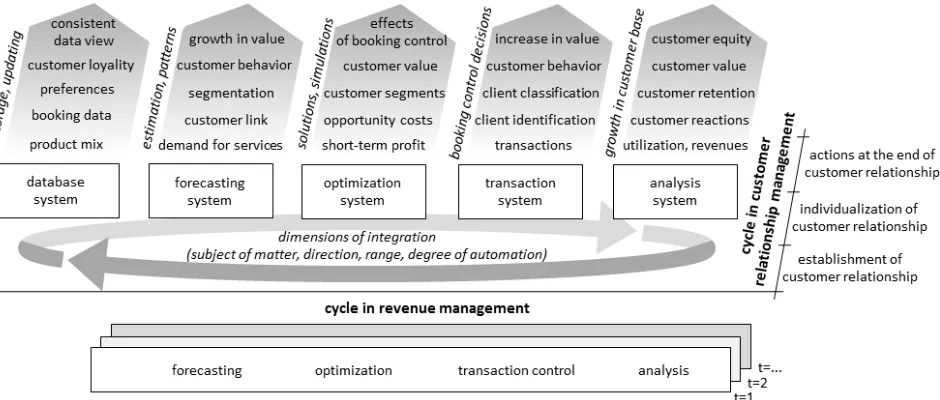
In general, the integrated information system is caught between repeating activities during the revenue management process (cycling in every booking period [14]) and – with ample planning horizon – the customer life cycle (in terms of customer relationship management [7]) with the goal of establishing a long-term profitable customer base (see axes in Fig. 1). According to the activities in a revenue manage-ment for cloud services that built upon one another, the corresponding information systems should be closely examined and statements not only about dimensions of integration (subject of matter, direction, range, degree of automation [11], [18]) but also aspects for decision support should be made.
A. Database system
A comprehensive database system is regarded as vital basis for customer value-based revenue management. It comprises current and historical booking data (e.g. acceptance and denial of requests), control data (e.g. cloud service characteristics, cloud resource availabilities) and information about customer base relevant for decision-making [8], [14]. Such a systematic integration of different data sources is an important prerequisite for the analysis of customer preferences and willingness to pay and forecasting of customer behavior – even to the point of individual customer’s values [17]. Particular attention has to be paid to a regular and prompt updating of data (risk of obsolete data [26]) and its immediate synchronization via appropriate interfaces [17]. Besides horizontal data integration over all fields of activity, the database system should also provide opportunities of merging and consolidating the data (e.g. data marts) in order to present the analysis reports in diverse levels of detail (vertical integration [11]).
B. Forecasting system
On the basis of identified relations and patterns in booking transactions and cloud service reservations stored in the database, the valuation, segmentation and forecast models are developed [14] that can be used to estimate
information needed for optimization and transaction control (process integration [11]). Therefore, the used data in the database (data integration [11]) often has to be preprocessed in the first place [8], [29]. By means of determinants (e.g. prospective contribution margin, buying frequency), the (averaged) customer segments’ value or even the individual worthiness of cloud users are estimated. Represented as a monetary value or score, customer values serve as a basis for calculating segment-specific contingents or value-related revenues of booking requests [16]. Such a forecast rests upon the assumption that relations of the past (historical transaction data) can be transferred to future booking control decisions [14]. High demands are placed on the forecasting system if a growth in customer value (i.e. transition of clients to another customer life cycle phase) should be modeled. This may be the case if a startup’s business model reached critical mass and its demand for IT services will explode [2]. But the valuation of potential customers during acquisition phase can become a real challenge. In general, forecasts should be updated throughout the booking process [26], in particular, for such events that have specific characteristics and influence demand for cloud services (e.g. increased website traffic at hosting providers during Christmas [19]). So, the resulting intervention of the revenue management analyst prevents a total process automation.
C. Optimization system
[image:3.612.76.546.528.728.2]The requisites for capability of the optimization system and integrated data processing are very high as the decision problems are of ample complexity, data-intense and to be taken quickly [19], such as for transaction control, the opportunity costs for capacity usage (bid prices) have to be determined [16]. The decision to accept short-term higher-paying customers but not necessarily the most loyal ones [30] should take opportunity costs in terms of lost customer values into account if in return the denied prospective customers will reduce their future purchases or even abort the relationship with the provider [21]. Depending on state
of the market and planned marketing actions (e.g. discount for new cloud users), the integrated information system has to allow for a weighting between short- and long-term potential for success [14] (see also parameter α in section IV). The final weighting can be supported by simulations in the optimization system [2]. The target figures of optimization attain particular high informative value regarding long-term growth of customer base if effects of booking control on customer behavior (identified during analysis phase) are incorporated directly into the optimization model. So, Mohaupt and Hilbert (2012) take a decrease of customer loyalty in response to the provider’s denial of the booking request into consideration [19]. D. Transaction system
By means of transaction system the booking control decisions to either accept or deny requests for cloud services are taken [8]. As target figures from preceded information systems (e.g. bid prices of optimization system, customer segment-based information of forecasting system) are needed for this purpose [14], particular attention has to be paid to their interfaces during (horizontal) process integration [11]. In case the requesting customer could be identified and stored customer history is available, the customized information could be used to estimate future buying frequency and average revenue (prospective view), and assist with the decision to invest in that customer relationship (if the customer is interested in a low-class cloud service at present time, but is predominantly characterized by a high willingness to pay; retrospective view) vs. exploiting the short-term revenues only. Thus, besides special booking control rules for new customers (without transaction history), an addressing of customers on an individual, personalized basis is enabled, and where applicable, even a disestablishment of (long-term) unprofi-table customers (by denying their requests) could be realized. The analysts can also be notified by the integrated information system that customers are classified as liable to churn due to their past behavior (i.e. anticipation of avoidable costs for reactivation) or have to be treated with priority next time they will request [17].
E. Analysis system
On the one hand, the analysis system is used for monitoring the booking process and quality of forecasts during the booking period [26]. On the other hand, it should not only evaluate capacity- and relationship-oriented goals by means of key figures at the end of each booking period but also review the suitability of used application systems and procedures to establish a long-term profitable customer base [14]. The provider can strategically benefit from real-time profitability reports as a faster respond to market change is facilitated. The information generation for supporting such an assessment requires a data integration of all information systems. For evaluating the booking control decisions, current revenues may be compared to potential ones [5], [14]. Hence, the integrated information system should be able to execute runs for evaluation purposes without influencing real-time calculations in present booking period (process integration [11]). Moreover, the
integrated data processing stipulates an adjustment of the information systems’ different levels of detail (i.e. vertical integration [11]) as desired analysis should be carried out on varying aggregation levels, i.e. overall worthiness of customer base (customer equity [12]), at customer segment level or even for individual cloud users. So, different customer clusters can be defined with the aid of data mining methods that can then be analyzed regarding their development of buying behavior as a result of varying booking control decisions [19]. Such results can also be enriched with customer surveys on planned IT budget and potential reactions of clients (in case of denial) [27]. So at highest level of detail, customers can be purposefully selected for marketing actions or be identified as preferential. With regard to key figures, degree of capacity utilization, average revenue of customer per booking, ratio of revenue and capacity consumption, prospective buying frequency and duration of customer retention are focus of interest.
IV. OPTIMIZATION AND BOOKING CONTROL APPROACH
During optimization the revenue management system conducts the allocation of (still) available capacity on expected demand based on forecasted information [26]. The resulting contingents of capacity resources or bid prices (as opportunity costs of capacity utilization) are then introduced to transaction control in order to decide on acceptance or denial of the requests within the booking period [14]. In dependence of applied revenue element and time horizon (short- vs. long-term), these booking control decisions may vary – with different implications on future demand and profitability of customer base.
The following statements are based on general assumptions in revenue management literature [8], [14], [26] and specific characteristics in cloud computing [2], [3], [19]. A cloud service provider has H resources (like CPU power, memory or storage, each with a total capacity gh)
available and offers I types of cloud services by bundling these resources through a time interval of N consecutive booking periods. In practice, a booking period in the cloud service domain is considerably smaller than in airline revenue management. This contributes to a more spontaneous setting with clients booking IT-services according to the more agile business environment and changing requirements for those services [3]. The element chi represents the usage of resource h by one unit of service
type i (see real Amazon’s service parameter [1] in Table 1) offered at a price of ei. Due to publicly accessible price
tables, service prices are fixed over the predefined time interval. But the provider will grant a discount on ei in
dependence of the time of requesting. Thereto each booking period is split into Z arrival periods. The earlier the customers detect their own need for IT-services and therefore make a reservation, the greater the discount az
offered by the provider. In other words, customers willing to book early can save money but have to accept a longer activation time until service utilization in the subsequent booking period.
arrive at different points in time with certain probability but according to customer’s preference, predominantly in a particular arrival period (with correspondent discount ãk).
As part of forecasting, this demand-pattern is used to establish S customer segments (with averaged revenue ēs
over all service types). Each segment represents exactly that arrival period where future requests (with correspondent discount ãs) are predominantly to be expected. The
customized value pksiz determines the probability that
customer k assigned to segment s requests service i in arrival period z. High-class customers (with predominantly late arriving requests and therefore lower discount but identical resource consumption) are thus more profitable.
The provider will base the booking control decisions on value-related revenue [16] representing a combination of short-term revenue riz, i.e. the price ei of requested service i
adjusted to referring discount az, see (1), and long-term
value contributions ls, that is, the predominantly to be
expected revenue ēs of the segment (averaged over all
service types and with correspondent discount ãs) the client
is assigned to, see (2):
z
iiz
a
e
r
1
(1)
s
ss
a
e
l
1
~
(2)A weighting factor α є [0;1] emphasizes either short or long-term value contributions and allows for defining various booking control methods, i.e. short-term (α=1), long-term (α=0) revenue maximization and a hybrid control (α=0.5). The lower the α, the greater the extent to which current booking-class revenue is modified by long-term value contributions.
The allocation of the capacity in each booking period can now be formulated as a Linear Programming Model where xsiz represents the contingent assigned to a combination of
customer segment s, arrival period z and service i,and bsiz
(as an element of B) is the amount of the already reserved service i requested from segment s in arrival period z. The objective-value function U is obtained by:
B
Ss iI Zz
r
iz
l
s
x
sizU
max
1 1 1
1
(3)
H
h
g
x
b
c
S s
I
i h
Z
z hi siz siz
,..,
1
s.t.
1 1 1
(4)
S
i
I
z
Z
s
b
p
x
ksiz sizK k k siz
,..,
1
,
,..,
1
,
,..,
1
f
;
0
min
0
1
(5)
accept request if:
a
e
U
B
U
B
M
r
iz
1
1
~
k k
(6)The objective function maximizes the sum of short-term and predominantly to be expected future revenue (both adjusted for corresponding discount) over all segments,
arrival periods and service types and in dependence of α, see (3). Whereas equation (4) ensures that the capacity used to satisfy present bookings and contingents does not exceed total amount of capacity, equation (5) guarantees that contingents do not exceed demand forecasted from customer base minus present bookings. The decision of accepting or denying a request is based on bid prices. Hence, opportunity costs have to be calculated by comparing the values U of the remaining capacity for the rest of the booking period both in case of declining and accepting the request [21]. An incoming request (represented by matrix M) is accepted as long as the sum of short-term and predominantly to be expected averaged future revenue ēk of the costumer (both
adjusted for corresponding discount) outweighs the opportunity costs (6).
V. SIMULATION RESULTS AND EVALUATION
Even though the application of simulations to analyze relations in complex demand environments is very common [3], [25] and the advantageousness of long-term customer retention is emphasized frequently [28], there is no simulation dealing with the long-term growth of the customer base of a provider with limited resources over several booking periods. Although Martens (2009) does use segment-based customer values as basis for decision-making, the simulation does not account for consecutive booking periods and radically assumes that rejected customer requests are lost instantly and forever [14]. Referring to this, Mohaupt and Hilbert (2012) model a prospective decrease in customer value in case of denial of the customer’s request but again forgo a simulation with temporally linked booking periods [19]. This relationship is incorporated in the optimization model by Kolb (2012) but with a simplifying assumption that customers always request the identical service [10]. In the absence of a comprehensive simulation, no conclusions and a revenue comparison between customer value-based and transaction-based booking control at the end of a multi-periodic planning horizon can be drawn. Whereas Pfeifer and Ovchinnikov (2011) optimize over consecutive booking periods, they again only allow for homogeneity in service preference and also assume that denied customers are lost forever [22]. In addition, booking control decisions are not taken for each single client individually but simultaneously for all customer segments. Thus, a detailed evaluation of the long-term effects of a booking control policy is not possible. By defining the accumulated transaction revenues over all booking periods as a new performance indicator, our paper should close this gap and enable the benchmark of a customer value-based method vs. a transaction-based counterpart maximizing short-term revenues in every single booking period only. The cloud computing environment with long-term customer relationships is suitable for such a consideration [24].
General aim of the simulation implemented in Matlab R2012b is a benchmark of the booking controls short, hybrid vs. long (see section IV) by comparing the accumulated transaction revenues ykum over all N=60
booking control decisions influencing the development of the customer base cannot be observed. But choosing N too long will hinder the forecast of customized changes in preference and buying frequency (with view to prospective IT-budget).
With initialization of customer base, one third of K=90 customers request with arrival probability fk=0.5 leaving the
rest with a fk=0.25 (i.e. high vs. low demand for
IT-services). A repeated denial of the provider will reduce fk as
a consequence of the negative effect on customer satisfaction to the next smaller value or even result in a fk=0,
respectively. The exact number of denials until (repeated) decrease in buying frequency varies from customer to customer and is determined by an uniformly distributed random drawing, i.e. okє {1, 2, 3}. The customized values
of ēk and ãk comply with the assigned segment s at time of
initialization and, for the sake of simplicity, have the values of ēs and ãs. Please see Table 1 for the configuration of all
parameters.
TABLE1 SIMULATION PARAMETERS
service type e1 = 10
arrival period z=1
early zlate =2 gh chi
CPU cores 4 4 80
RAM (GB) 8 8 160
storage (GB) 850 850 17,000
discount az 0.5 0
initial expected demand
15 15 ēs ãs
pksiz
s=1 (predominantly early requesting)
0.8 0.2 10 0.5 s=2 (predominantly
late requesting) 0.2 0.8 10 0 Altogether, 1,000 different arrival processes have been simulated resulting in demand fluctuations. Due to the random demand generation the results have been averaged over all runs (see Table 2). Given the simulation design, the tolerance of a short-term loss in revenue (or meaning an investment in a customer relationship) regarding a high-class customer who currently requests a cloud service early and therefore gets a discount, can turn out to be a long-term meaningful decision as this customer will contribute predominantly high revenues with constant buying frequency in future booking periods. So, by the (weighted) incorporation of the predominantly to be expected future revenue, booking control hybrid can achieve higher accumulated transaction revenues ykum in contrast to method
short at the end of the 18th booking period for the first time.
In the remaining time interval hybrid can extend its lead. Method long (entirely without consideration of short-term transaction revenues) is just slightly behind method hybrid. At the end of all N booking periods, method hybrid realizes 3.2% higher revenues (on average) compared to method short and shows a more profitable customer base in the future. Thus, the value of the customer base (determined as the sum of arrival probability times averaged revenue per request for all customers in the next N booking periods) is
9.6% (10%) higher for method hybrid (long) in contrast to method short. The booking control decisions of hybrid and long with a long-term component are a determining factor for this result as there are finally 7 more high-class clients in the customer base (compared to method short) that actively request (i.e. fk > 0) the cloud services of the provider.
TABLE2
SIMULATION RESULTS (AVERAGED OVER 1,000 RUNS)
method
key figure short hybrid long hybridshort /
ykum 8,391 8,661 8,531
1.032
ykum/ N 139.9 144.4 142.2
initial value of
customer base 26,978 1
value of customer base after N
booking periods 15,859 17,377 17,454 1.096 One should bear in mind that even if the initial excess demand can be stemmed with the help of an increase in capacity and/or prices in the future (but always associated with imminent costs of unutilized capacity due to uncertain demand), the previous booking control decisions could have impaired the customer values already as a consequence of reduced buying frequency. In case of a general decline in demand during the market cycle, the methods hybrid and long can better absorb this altered revenue situation due to the higher value of the customer portfolio. With view to the prototypical simulation results, a (weighted) incorporation of long-term revenue indicators for a suitable selection of customers to accept vs. to deny seems reasonable, if the booking control decisions of the service provider are likely to have a (negative) effect on future customer behavior (e.g. decrease in buying frequency after denial) and customers may have a heterogeneity concerning prospective revenues. It is provided that requests can be classified into customer segments accordingly and a sufficient forecast of customers’ worthiness (with the aid of a revenue management system integrating required information sources) is feasible.
VI. DISCUSSION AND LIMITATIONS
willingness to pay and buying frequency) may also be included in the simulation design (albeit much more difficult to forecast), e.g. promising startups with an initially low amount of bought cloud services. At that point, the weighting factor α introduced in the simulation may even be applied on an individual client level in order to dynamically adjust the focus of the planning horizon (short vs. long) to be optimized. Thus, the integration of revenue management and customer relationship management remains a highly promising research area with significant implications on improving competitiveness not only of cloud service providers.
VII. CONCLUSIONS
The efficient utilization of limited capacity resources is a crucial success factor for cloud service providers. But due to high degree of competition, strengthening of long-term customer relationships is becoming increasingly important as well. However, the desired incorporation of revenue and customer relationship management with partly diametric goals causes increased standards of the underlying informa-tion systems. As a systematic analysis and examinainforma-tion of their precise design and aspects of integration are still missing, a framework for integrating those information systems with the objective to establish a long-term profitable customer base is developed. Applied to a cloud service environment, promising aspects of the integrated information system for decision support are illustrated. Furthermore, first results of the subsequent simulation in Matlab emphasize the significance of a long-term oriented revenue maximization.
REFERENCES
[1] Amazon. (2012, December). Amazon Elastic Compute Cloud (Amazon EC2). [Online] Available: http://aws.amazon.com/de/ec2/
[2] A. Anandasivam and C. Weinhardt, “Towards an efficient Decision Policy for Cloud Service Providers”, in Proc. of ICIS, 2010, Paper 40. [3] A. Anandasivam, S. Buschek and R. Buyya, “A Heuristic Approach
for Capacity Control in Clouds”, in Proc. 11th IEEE Conf. on Commerce & Enterprise Computing, 2009, pp. 90-97.
[4] M. Armbrust, A. Fox, R. Griffith, A. D. Joseph, R. H. Katz, A. Konwinski and G. Lee, “Above the Clouds - A Berkeley View of Cloud Computing”, UC Berkeley Technical Report, 2009, Paper UCB/EECS-2009-28.
[5] K. Donaghy, U. McMahon-Beattie, I. Yeoman and A. Ingold, “The Realism of Yield Management”, Progress in Tourism and Hospitality Research, vol. 4, no. 3, pp. 187-195, 1998.
[6] S. Gupta, D. Hanssens, B. Hardie, W. Kahn, V. Kumar, N. Lin, N. Ravishanker and S. Sriram, “Modeling Customer Lifetime Value”. Journal of Service Research, vol. 9, no. 2, 2006, 139-155.
[7] H. Hippner, „Customer Relationship Management“, in Grundlagen des CRM [Basics of CRM], 2nd ed., H. Hippner and K. D. Wilde, Eds. Wiesbaden: Gabler, 2006, pp. 15-44.
[8] R. Klein and C. Steinhardt, Revenue Management. Berlin: Springer, 2008.
[9] P. Koehler, A. Anandasivam, M. A. Dan and C. Weinhardt, “Customer Heterogeneity and Tariff Biases in Cloud Computing”, in Proc. of ICIS, 2010, Paper 106.
[10] J. Kolb, “On the Integration of Customer Lifetime Value into Revenue Management”, in Operations Research Proceedings, D. Klatte, H. J. Lüthi and K. Schmedders, Eds. Berlin: Springer, 2012, pp. 559-564.
[11] H. Krcmar, „Integration in der Wirtschaftsinformatik - Aspekte und Tendenzen [Integration in computer science - aspects and trends]“, in Integrierte Informationssysteme [Integrated information systems], H. Jacob, J. Becker and H. Krcmar, Eds. Wiesbaden: Gabler, 1991, pp. 3-18.
[12] V. Kumar and M. George, “Measuring and Maximizing Customer Equity - A Critical Analysis”, Journal of the Academy of Marketing. Science, vol. 35, no. 2, 2007, pp. 157-171.
[13] J. Lindenmeier and D. K. Tscheulin, “The Effects of Inventory Control and Denied Boarding on Customer Satisfaction - The Case of
Capacity-based Airline Revenue Management”, Tourism
Management, vol. 29, no. 1, 2008, pp. 32-43.
[14] T. von Martens, “Kundenwertorientiertes Revenue Management im Dienstleistungsbereich [Customer value-based revenue management in services industry]“, Wiesbaden: Gabler, 2009.
[15] T. von Martens, A. Hilbert, “Incorporation of Customer Value into Revenue Management”, in Operations Research Proceedings, B. Fleischmann, K. H. Borgwardt, R. Klein and A. Tuma, Eds. Berlin: Springer, 2009, pp. 383-388.
[16] T. von Martens, A. Hilbert, “Customer-value-based revenue management”, Journal of Revenue and Pricing Management, vol. 10, no. 1, 2011, pp. 87-98.
[17] K. McGuire and S. Pinchuk, “The Future of Revenue Management”, in Proc. of SAS Global Forum, SAS Institute Inc., Cary, NC, 2009, Paper 342.
[18] P. Mertens, Integrierte Informationsverarbeitung [Integrated information processing]. Wiesbaden: Gabler, 2005.
[19] M. Mohaupt and A. Hilbert, “Ein Revenue-Management-System zur multikriteriellen Kapazitätssteuerung im Umfeld des Cloud Computing [A revenue management system for multi-criteria booking control in cloud computing]“, in Proc. of Multikonferenz der Wirtschaftsinformatik [Proc. of multi-conference in computer science], Braunschweig, Germany, 2012, pp. 1183-1194.
[20] B. M. Noone, S. E. Kimes and L. M. Renaghan, “Integrating Customer Relationship Management and Revenue Management - A Hotel Perspective”, Journal of Revenue and Pricing Management, vol. 2, no. 1, 2003, pp. 7-21.
[21] K. Pak, “Revenue Management - New Features and Models”, Ph.D. dissertation, Erasmus University Rotterdam, 2005.
[22] P. Pfeifer and A. Ovchinnikov, “A Note on Willingness to Spend and Customer Lifetime Value for Firms with Limited Capacity”, Journal of Interactive Marketing, vol. 25, 2011, pp. 178-189.
[23] T. Pueschel, A. Anandasivam, S. Buschek and D. Neumann, “Making Money with Clouds - Revenue Optimization through automated Policy Decisions”, in Proc. 17th European Conference on Information Systems, 2009, pp. 355-367.
[24] F. F. Reichheld and P. Schefter, “E-loyalty - Your Secret Weapon on the Web”, Harvard Business Review, pp. 105-113, Jul-Aug 2000. [25] G. J. van Ryzin, “Models of Demand”, Journal of Revenue and
Pricing Management, vol. 4, no. 2, 2005, pp. 204‐210.
[26] K. T. Talluri G. J. van Ryzin, The Theory and Practice of Revenue Management. Berlin: Springer, 2004.
[27] I. Uusitalo, K. Karppinen, A. Juhola and R. Savola, “Trust and Cloud Services - An Interview Study”, in Proc. of CLOUDCOM, 2010, pp. 712-720.
[28] X. L. Wang and D. Bowie, “Revenue Management - The Impact on Business-to-Business Relationships”, Journal of Services Marketing, vol. 23, no. 1, 2009, pp. 31-41.
[29] K. Weber, J, Sun, Z. Sun, G. Kliewer, S. Grothklags and N. Jung, “Systems Integration for revenue-creating Control Processes”, Journal of Revenue and Pricing Management, vol. 2, no. 2, 2003, pp. 120-137.