Study of Behavior of RCC Building With and
Without Bracing by Using STAD Pro.V8i
Suraj Deshmukh1, Anmol Chachane2, Ayushi Jadhav3, Manali Bokde4, Sanjay Bagade5
1, 2, 3, 4, 5
Civil Engineering, Jd College Of Engineering, Nagpur
Abstract: The Behavior of RCC Building Subjected To Earthquake Force Has Been Obtained Is 1893-2000 For RCC Building In Zone3 Used For Better Performance Of Building During And After Earthquake. It Is Proved That Many Of Structure Are Totally Damaged Due To Earthquake. So It Is Necessary To Determine Seismic Structure Of Building And RCC Bracing System Is easy to Handle ,It Require less Space , Economical.
The Load Are Produced Due Wind Load And Earthquake to Resist Lateral Load Acting On Building With Different Type Of Bracing. And It Has Potential Advantageous Than Other Bracing Like High Stiffness And Stability bracing System Is One Of Which Reinforced By Steel member Which Increase Tensile As Well As Compressive Strength Of Building. so that’s why here we have provided two types of bracing x ,v bracing to prevent natural activity by using STAAD Pro.
I. INTRODUCTION
Seismic analysis is calculating the response of structure to earthquake. In recent year growth of cities have been on rise an any rcc building depend on many factor like strength of material used soil, amount of mass. Bracing are most prominent method used by structural increase lateral load resistance by bracing .
India is fast developing country which demands hybrid structure or building with high seismic resistance. the multistoried building require safety due to earthquake and wind force damage to rcc building cause seismic wave of earthquake and low strength of material used.
Steel bracing mostly used in RCC structure .mostly seen that retrofitting of building more economical then rebuilding or reconstructive most of structure collapse due to seismic. the bracing is provided for peripheral columns and at any two parallel side of building models. Generally the purpose of bracing is provided for is to transfer primary gravity load safely. common gravity load are dead load ,live load also the structure should withstand lateral load caused by earthquake ,blasting and wind depending on terrain category and lateral load reduce stability of structure producing sway moment and induced high stress. So in such case stiffness is more important than strength to resist lateral load.
A. Objective
1) The objective of this paper is evaluate response of braced and unbraced structure subjected to seismic load and to identify the
suitable bracing system for resisting seismic load efficiently.
2) To find out better strengthening or retrofitting technique that can be adopted in specific zone.
3) Establishing a comparison between the two type of structure and and analyzing the result and establishing a needful similarity
with effectiveness in tabular form.
a) Following are the different type of model
i) Model without bracing
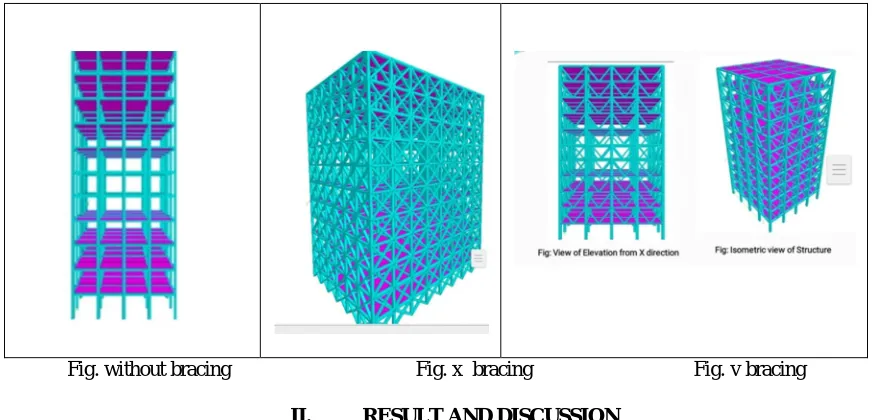
ii) Model with different bracing system(x bracing,v bracing)
iii) Description of the building:-
b) The data of modeled building is given below
i) Plan dimension-
ii) No. of storey-G+10
iii) Floor to floor height-3.00m
iv) Type of building- residential
v) Foundation type-raft or mat foundation
©IJRASET: All Rights are Reserved
943
c) Material properties
i) Grade of concrete-M25
ii) Grade of steel-Fe-415
iii) Density of concrete-25KN/m3
iv) Density of brick-20KN/m3
v) Modulus of elasticity of concrete –25KN/mm2
vi) Modulus of elasticity of steel-2x10⁵ N/mm2
vii) Member properties
viii) Thickness of slab-0.125m
ix) Size of beam-(0.23x0.4)m
x) Column size-(0.4x0.4)m
xi) Steel bracing size-(0.23x0.23)m
xii) External wall thickness-230mm
xiii) Internal wall thickness-115mm
d) Load intensity
i) Floor finish-1.0KN/m2
ii) Live load-2kN/m2
B. Design Preparation 1) Plan of Srtucture
2) Elevation of structure G+10 multistoried building height 33m
The figures are given below.
Fig. without bracing Fig. x bracing Fig. v bracing
II. RESULT AND DISCUSSION
The comparison of rcc building with and without bracing by using stad-pro. Here we have checked different parameter which is on building by using stad-pro.
A. Nodal Displacement
©IJRASET: All Rights are Reserved
945
C. Support ReactionIII. QUANTITY OF BUILDING
So here we have calculated quantity of building so as compared to normal building the quantity of concrete in x bracing system is more than 7.32% and v bracing system is more than 10.43%
IV. CONCLUSION
Based on analysis result following conclusion are given
A. Drift produced due to seismic vibration.
B. The displacement of building decreases depending upon the different bracing system.
C. The storey drift of braced building decreases as compare to unbraced building which indicated that the overall response of
building decreases.
D. Out of various arrangement of bracing v bracing came out to be least efficient and x bracing was most effective bracing system.
REFFERENCE
[1] International research journal of engineering and technology (IRJET) volume: 04 issue: 09 sep -2017 “STRENGTHENING OF REINFORCED CONCRETE AND STEEL STRUCTURE BY USING STEEL BRACING SYSTEMS” soundarya N. Gandhi1, Y. P. Pawar2, dr. C. P. Pise3, S.S. Kadam2, C. M. Deshmukh2, D. D.Mohite2 China “BEHAVIOR OF MOMENT RESISTING REINFORCED CONCRETE CONCENTRIC BRACED FRAMES (rc-mrcbfs) IN SEISMIC ZONES’’ E.A. Godínez-domíngue
[2] International Journal of Mechanics and Solids. ISSN 0973-1881 Volume 12, “Effect of Steel Bracings on RC Framed Structure” Anes Babu1, Dr. Chandan KumarPatnaikuni2, Dr. Balaji, K.V.G.D.3, B.Santhosh Kumar
[3] International Journal of Engineering Research & Technology (IJERT) “Analysis of RC Building Frames for Seismic Forces Using Different Types of Bracing Systems” Rishi Mishra1 Dr. Abhay Sharma2 Dr. Vivek Garg
[4] International Journal of Civil Engineering and Technology (IJCIET) Volume 8, Issue 3, March 2017, “SEISMIC BEHAVIOR OF DIFFERENT BRACING SYSTEMS IN HIGH RISE RCC BUILDINGS” Bharat Patel
[5] International Journal of Engineering and Techniques - Volume 4 Issue 2, Mar-Apr 2018 “Review Paper on Seismic Behavior of RC Frame Structure With Different Types of Bracing System” 1Kartik prashar , 2Jagdeep Singh Gahir.
[6] International Journal of Advance Engineering and Research Development Volume 3, Issue 2, February -2016 “ Comparison study of RC structure with different arrangement of rcc bracing system” Mr. Mehul M. Kanthariya 1, Haresh P. Vaghasiya 2, Harsh C. Vagadiya 3 Chirag R. Akoliya 4, Mitesh H. Patel5 [7] IOSR Journal of Mechanical and Civil Engineering (IOSR-JMCE) e-ISSN: 2278-1684,p-ISSN: 2320-334X, Volume 12, Issue 5 Ver. V (Sep. - Oct. 2015), PP
08-12 www.iosrjournals.org “Analysis of Reinforced Concrete Building with Different Arrangement of Concrete and Steel Bracing system” Prof. Bhosle Ashwini Tanaji
[8] The 14th World Conference on Earthquake Engineering October 12-17, 2008, Beijing
[9] IS: 875 (Part 3): 1987, “Code of practice for design loads (other than earthquake) for buildings and structures: part 3 wind loads”, Bureau of Indian Standards, 1987, New Delhi.
[10] IS: 1893-2002, “Criteria for earthquake resistant design of structures: part–1 general provisions and buildings”. Bureau of Indian Standards, 2002, New Delhi. [11] G. GhodratiAmiri and H. HamidiJamnani “THE EFFECT OF ANALYSIS METHODS ON THE RESPONSE OF STEEL DUAL-SYSTEM FRAME