Inducing Neural Models of Script Knowledge
Ashutosh Modi
MMCI,
Saarland University, Germany [email protected]
Ivan Titov
ILLC,
University of Amsterdam, Netherlands [email protected]
Abstract
Induction of common sense knowledge about prototypical sequence of events has recently received much attention (e.g., Chambers and Jurafsky (2008); Regneri et al. (2010)). Instead of inducing this knowledge in the form of graphs, as in much of the previous work, in our method, distributed representations of event real-izations are computed based on distributed representations of predicates and their ar-guments, and then these representations are used to predict prototypical event or-derings. The parameters of the composi-tional process for computing the event rep-resentations and the ranking component of the model are jointly estimated. We show that this approach results in a sub-stantial boost in performance on the event ordering task with respect to the previous approaches, both on natural and crowd-sourced texts.
1 Introduction
It is generally believed that natural language un-derstanding systems would benefit from incorpo-rating common-sense knowledge about prototyp-ical sequences of events and their participants. Early work focused on structured representations
of this knowledge (called scripts (Schank and
Abelson, 1977)) and manual construction of script knowledge bases. However, these approaches do not scale to complex domains (Mueller, 1998; Gordon, 2001). More recently, automatic induc-tion of script knowledge from text have started to attract attention: these methods exploit ei-ther natural texts (Chambers and Jurafsky, 2008, 2009) or crowdsourced data (Regneri et al., 2010), and, consequently, do not require expensive pert annotation. Given a text corpus, they ex-tract structured representations (i.e. graphs), for
example chains (Chambers and Jurafsky, 2008) or more general directed acyclic graphs (Regneri et al., 2010). These graphs are scenario-specific, nodes in them correspond to events (and associ-ated with sets of potential event mentions) and arcs encode the temporal precedence relation. These graphs can then be used to inform NLP applica-tions (e.g., question answering) by providing in-formation whether one event is likely to precede or succeed another. Note that these graphs en-code common-sense knowledge about prototypi-cal ordering of events rather than temporal order of events as described in a given text.
Though representing the script knowledge as graphs is attractive from the human interpretability perspective, it may not be optimal from the appli-cation point of view. More specifically, these rep-resentations (1) require a model designer to choose an appropriate granularity of event mentions (e.g., whether nodes in the graph should be associated with verbs, or also their arguments); (2) do not provide a mechanism for deciding which scenario applies in a given discourse context and (3) often do not associate confidence levels with informa-tion encoded in the graph (e.g., the precedence re-lation in Regneri et al. (2010)).
Instead of constructing a graph and using it to provide information (e.g., prototypical event or-dering) to NLP applications, in this work we ad-vocate for constructing a statistical model which is capable to “answer” at least some of the questions these graphs can be used to answer, but doing this without explicitly representing the knowledge as a graph. In our method, the distributed representa-tions (i.e. vectors of real numbers) of event real-izations are computed based on distributed repre-sentations of predicates and their arguments, and then the event representations are used in a ranker to predict the prototypical ordering of events. Both the parameters of the compositional process for computing the event representation and the
ing component of the model are estimated from texts (either relying on unambiguous discourse clues or natural ordering in text). In this way we build on recent research on compositional distri-butional semantics (Baroni and Zamparelli, 2011; Socher et al., 2012), though our approach specif-ically focuses on embedding predicate-argument structures rather than arbitrary phrases, and learn-ing these representation to be especially informa-tive for prototypical event ordering.
In order to get an intuition why the embedding approach may be attractive, consider a situation
where a prototypical ordering of events the bus
disembarked passengersand the bus drove away
needs to be predicted. An approach based on fre-quency of predicate pairs (Chambers and Jurafsky, 2008) (henceforth CJ08), is unlikely to make a right prediction as driving usually precedes disem-barking. Similarly, an approach which treats the whole predicate-argument structure as an atomic unit (Regneri et al., 2010) will probably fail as well, as such a sparse model is unlikely to be ef-fectively learnable even from large amounts of un-labeled data. However, our embedding method would be expected to capture relevant features of the verb frames, namely, the transitive use for the
predicatedisembarkand the effect of the particle
away, and these features will then be used by the
ranking component to make the correct prediction. In previous work on learning inference rules (Berant et al., 2011), it has been shown that enforcing transitivity constraints on the inference rules results in significantly improved performance. The same is likely to be true for the event ordering task, as scripts have largely
linear structure, and observing that a ≺ b and
b ≺ cis likely to imply a ≺ c. Interestingly, in
our approach we learn the model which satisfies transitivity constraints, without the need for any explicit global optimization on a graph. This results in a significant boost of performance when using embeddings of just predicates (i.e. ignoring arguments) with respect to using frequencies of ordered verb pairs, as in CJ08 (76% vs. 61% on the natural data).
Our model is solely focusing on the ordering task, and admittedly does not represent all the in-formation encoded by a script graph structure. For example, it cannot be directly used to predict a missing event given a set of events (the narrative cloze task (Chambers and Jurafsky, 2009)).
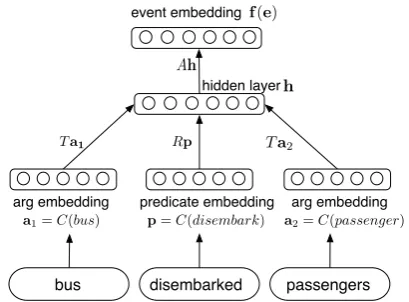
Nev-disembarked passengers bus
predicate embedding event embedding
arg embedding
Ta1 Rp Ta2
f(e)
a1=C(bus) p=C(disembark) a2=C(passenger) arg embedding hidden layerh
[image:2.595.316.521.61.212.2]Ah
Figure 1: Computation of an event representation
for a predicate with two arguments (the bus
disem-barked passengers), an arbitrary number of argu-ments is supported by our approach.
ertheless, we believe that the framework (a proba-bilistic model using event embeddings as its com-ponent) can be extended to represent other aspects of script knowledge by modifying the learning ob-jective, but we leave this for future work. In this paper, we show how our model can be used to pre-dict if two event mentions are likely paraphrases of the same event.
The approach is evaluated in two set-ups. First, we consider the crowdsourced dataset of Regneri et al. (2010) and demonstrate that using our model
results in the 13.5% absolute improvement inF1
on event ordering with respect to their graph in-duction method (84.1% vs. 70.6%). Secondly, we derive an event ordering dataset from the Gi-gaword corpus, where we also show that the em-bedding method beats the frequency-based base-line (i.e. reimplementation of the scoring compo-nent of CJ08) by 22.8% in accuracy (83.5% vs. 60.7%).
2 Model
In this section we describe the model we use for computing event representations as well as the ranking component of our model.
2.1 Event Representation
learned in the language modeling setting (i.e. learned to be predictive of local word context), though they can also be specialized by learning in the context of other NLP applications such as PoS tagging or semantic role labeling (Collobert et al., 2011). More recently, the area of dis-tributional compositional semantics have started to emerge (Baroni and Zamparelli, 2011; Socher et al., 2012), they focus on inducing represen-tations of phrases by learning a compositional model. Such a model would compute a represen-tation of a phrase by starting with embeddings of individual words in the phrase, often this composi-tion process is recursive and guided by some form of syntactic structure.
In our work, we use a simple compositional model for representing semantics of a verb frame
e(i.e. the predicate and its arguments). We will
refer to such verb frames as events. The model is
shown in Figure 1. Each word ci in the
vocabu-lary is mapped to a real vector based on the
cor-responding lemma (the embedding function C).
The hidden layer is computed by summing linearly
transformed predicate and argument1embeddings
and passing it through the logistic sigmoid func-tion. We use different transformation matrices for
arguments and predicates, T andR, respectively.
The event representationf(e)is then obtained by
applying another linear transform (matrixA)
fol-lowed by another application of the sigmoid func-tion. Another point to note in here is that, as in previous work on script induction, we use lemmas for predicates and specifically filter out any tense markers as our goal is to induce common-sense knowledge about an event rather than properties predictive of temporal order in a specific discourse context.
We leave exploration of more complex and
linguistically-motivated models for future work.2
These event representations are learned in the con-text of event ranking: the transformation parame-ters as well as representations of words are forced to be predictive of the temporal order of events. In our experiments, we also consider initialization of predicate and arguments with the SENNA word embeddings (Collobert et al., 2011).
1Only syntactic heads of arguments are used in this work.
If an argument isa coffee maker, we will use only the word
maker.
2In this study, we apply our model in two very
differ-ent settings, learning from crowdsourced and natural texts. Crowdsourced collections are relatively small and require not over-expressive models.
2.2 Learning to Order
The task of learning stereotyped order of events naturally corresponds to the standard ranking set-ting. We assume that we are provided with se-quences of events, and our goal is to capture this order. We discuss how we obtain this learning ma-terial in the next section. We learn a linear ranker
(characterized by a vectorw) which takes an event
representation and returns a ranking score. Events are then ordered according to the score to yield the model prediction. Note that during the
learn-ing stage we estimate not only w but also the
event representation parameters, i.e. matricesT,
R andA, and the word embeddingC. Note that by casting the event ordering task as a global rank-ing problem we ensure that the model implicitly exploits transitivity of the relation, the property which is crucial for successful learning from finite amount of data, as we argued in the introduction and will confirm in our experiments.
At training time, we assume that each training example k is a list of events e(k)1 , . . . , e(k)n(k)
pro-vided in the stereotypical order (i.e. e(k)i ≺e(k)j if i < j),n(k) is the length of the listk. We
mini-mize theL2-regularized ranking hinge loss:
�
k �
i<j≤n(k)
max(0,1−wTf(ei(k); Θ)+wTf(e(k)j ; Θ))
+α(�w�2+�Θ�2),
where f(e; Θ) is the embedding computed
for event e, Θ are all embedding
parame-ters corresponding to elements of the matrices {R, C, T, A}. We use stochastic gradient descent,
gradients w.r.t.Θare computed using back
propa-gation.
3 Experiments
We evaluate our approach in two different set-ups. First, we induce the model from the crowdsourced data specifically collected for script induction by Regneri et al. (2010), secondly, we consider an arguably more challenging set-up of learning the model from news data (Gigaword (Parker et al., 2011)), in the latter case we use a learning
sce-nario inspired by Chambers and Jurafsky (2008).3
3Details about downloading the data and models are at:
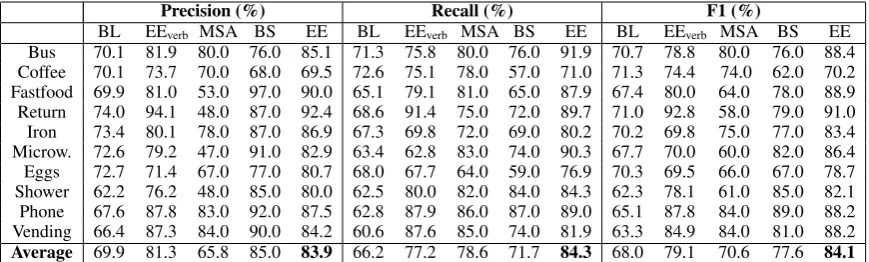
Precision (%) Recall (%) F1 (%)
BL EEverb MSA BS EE BL EEverb MSA BS EE BL EEverb MSA BS EE
Bus 70.1 81.9 80.0 76.0 85.1 71.3 75.8 80.0 76.0 91.9 70.7 78.8 80.0 76.0 88.4 Coffee 70.1 73.7 70.0 68.0 69.5 72.6 75.1 78.0 57.0 71.0 71.3 74.4 74.0 62.0 70.2 Fastfood 69.9 81.0 53.0 97.0 90.0 65.1 79.1 81.0 65.0 87.9 67.4 80.0 64.0 78.0 88.9 Return 74.0 94.1 48.0 87.0 92.4 68.6 91.4 75.0 72.0 89.7 71.0 92.8 58.0 79.0 91.0 Iron 73.4 80.1 78.0 87.0 86.9 67.3 69.8 72.0 69.0 80.2 70.2 69.8 75.0 77.0 83.4 Microw. 72.6 79.2 47.0 91.0 82.9 63.4 62.8 83.0 74.0 90.3 67.7 70.0 60.0 82.0 86.4 Eggs 72.7 71.4 67.0 77.0 80.7 68.0 67.7 64.0 59.0 76.9 70.3 69.5 66.0 67.0 78.7 Shower 62.2 76.2 48.0 85.0 80.0 62.5 80.0 82.0 84.0 84.3 62.3 78.1 61.0 85.0 82.1 Phone 67.6 87.8 83.0 92.0 87.5 62.8 87.9 86.0 87.0 89.0 65.1 87.8 84.0 89.0 88.2 Vending 66.4 87.3 84.0 90.0 84.2 60.6 87.6 85.0 74.0 81.9 63.3 84.9 84.0 81.0 88.2
[image:4.595.82.517.62.193.2]Average 69.9 81.3 65.8 85.0 83.9 66.2 77.2 78.6 71.7 84.3 68.0 79.1 70.6 77.6 84.1
Table 1: Results on the crowdsourced data for the verb-frequency baseline (BL), the verb-only
embed-ding model (EEverb), Regneri et al. (2010) (MSA), Frermann et al. (2014)(BS) and the full model (EE).
3.1 Learning from Crowdsourced Data 3.1.1 Data and task
Regneri et al. (2010) collected descriptions (called
event sequence descriptions, ESDs) of various types of human activities (e.g., going to a restau-rant, ironing clothes) using crowdsourcing (Ama-zon Mechanical Turk), this dataset was also com-plemented by descriptions provided in the OMICS corpus (Gupta and Kochenderfer, 2004). The datasets are fairly small, containing 30 ESDs per activity type in average (we will refer to different
activities as scenarios), but in principle the
col-lection can easily be extended given the low cost of crowdsourcing. The ESDs list events forming the scenario and are written in a bullet-point style. The annotators were asked to follow the prototyp-ical event order in writing. As an example,
con-sider a ESD for the scenarioprepare coffee:
{go to coffee maker} → {fill water in coffee maker} → {place the filter in holder} → {place coffee in filter} → {place holder in coffee maker} → {turn on coffee maker}
Regneri et al. also automatically extracted pred-icates and heads of arguments for each event, as needed for their MSA system and our composi-tional model.
Though individual ESDs may seem simple, the learning task is challenging because of the limited amount of training data, variability in the used vo-cabulary, optionality of events (e.g., going to the coffee machine may not be mentioned in a ESD), different granularity of events and variability in the ordering (e.g., coffee may be put in the filter before placing it in the coffee maker). Unlike our work, Regneri et al. (2010) relies on WordNet to provide extra signal when using the Multiple
Se-quence Alignment (MSA) algorithm. As in their work, each description was preprocessed to extract a predicate and heads of argument noun phrases to be used in the model.
The methods are evaluated on human anno-tated scenario-specific tests: the goal is to classify event pairs as appearing in a stereotypical order or
not (Regneri et al., 2010).4
The model was estimated as explained in Sec-tion 2.2 with the order of events in ESDs treated as gold standard. We used 4 held-out scenarios to choose model parameters, no scenario-specific tuning was performed, and the 10 test scripts were not used to perform model selection. The selected model used the dimensionality of 10 for event and word embeddings. The initial learning rate and the regularization parameter were set to0.005and1.0, respectively and both parameters were reduced by the factor of 1.2 every epoch the error function
went up. We used2000epochs of stochastic
gradi-ent descgradi-ent. Dropout (Hinton et al., 2012) with the rate of 20% was used for the hidden layers in all our experiments. When testing, we predicted that the event pair (e1,e2) is in the stereotypical order
(e1 ≺e2) if the ranking score fore1exceeded the
ranking score fore2.
3.1.2 Results and discussion
We evaluated our event embedding model (EE)
against baseline systems (BL,MSAandBS). MSA
is the system of Regneri et al. (2010). BS is a hierarchical Bayesian model by Frermann et al. (2014). BL chooses the order of events based on the preferred order of the corresponding verbs in the training set: (e1, e2) is predicted to be in the
4The event pairs are not coming from the same ESDs
stereotypical order if the number of times the
cor-responding verbs v1 and v2 appear in this order
in the training ESDs exceeds the number of times they appear in the opposite order (not necessary at adjacent positions); a coin is tossed to break ties
(or ifv1andv2are the same verb). This frequency
counting method was previously used in CJ08.5
We also compare to the version of our model
which uses only verbs (EEverbs). Note that
EEverbsis conceptually very similar to BL, as it
es-sentially induces an ordering over verbs. However, this ordering can benefit from the implicit
transi-tivity assumption used in EEverbs(and EE), as we
discussed in the introduction. The results are pre-sented in Table 1.
The first observation is that the full model im-proves substantially over the baseline and the pre-vious method (MSA) in F1 (13.5% improvement over MSA and 6.5% improvement over BS). Note also that this improvement is consistent across sce-narios: EE outperforms MSA and BS on 9 scenar-ios out of 10 and 8 out of 10 scenarscenar-ios in case of BS. Unlike MSA and BS, no external knowledge (i.e. WordNet) was exploited in our method.
We also observe a substantial improvement in all metrics from using transitivity, as seen by
com-paring the results of BL and EEverb(11%
improve-ment in F1). This simple approach already sub-stantially outperforms the pipelined MSA system. These results seem to support our hypothesis in the introduction that inducing graph representa-tions from scripts may not be an optimal strategy from the practical perspective.
We performed additional experiments using the SENNA embeddings (Collobert et al., 2011). In-stead of randomly initializing arguments and pred-icate embeddings (vectors), we initialized them with pre-trained SENNA embeddings. We have not observed any significant boost in performance from using the initialization (average F1 of 84.0% for EE). We attribute the lack of significant im-provement to the following three factors. First of all, the SENNA embeddings tend to place antonyms / opposites near each other (e.g., come and go, or end and start). However, ‘opposite’ predicates appear in very different positions in scripts. Additionally, the SENNA embeddings have dimensionality of 50 which appears to be
5They scored permutations of several events by summing
the logarithmed differences of the frequencies of ordered verb pairs. However, when applied to event pairs, their approach would yield exactly the same prediction rule as BL.
too high for small crowd-sourced datasets, as it
forces us to use larger matrices T andR.
More-over, the SENNA embeddings are estimated from Wikipedia, and the activities in our crowdsourced domain are perhaps underrepresented there. 3.1.3 Paraphrasing
Regneri et al. (2010) additionally measure para-phrasing performance of the MSA system by com-paring it to human annotation they obtained: a sys-tem needs to predict if a pair of event mentions are paraphrases or not. The dataset contains 527 event pairs for the 10 test scenarios. Each pair consists of events from the same scenario. The dataset is fairly balanced containing from 47 to 60 examples per scenario.
This task does not directly map to any statisti-cal inference problem with our model. Instead we use an approach inspired by the interval algebra of Allen (1983).
Our ranking model maps event mentions to po-sitions on the time line (see Figure 2). However, it would be more natural to assume that events are intervals rather than points. In principle, these in-tervals can be overlapping to encode a rich set of temporal relations (see (Allen, 1983)). However, we make a simplifying assumption that the inter-vals do not overlap and every real number belongs to an interval. In other words, our goal is to induce a segmentation of the line: event mentions corre-sponding to the same interval are then regarded as paraphrases.
One natural constraint on this segmentation is the following: if two event mentions are from the same training ESD, they cannot be assigned to the same interval (as events in ESD are not supposed to be paraphrases). In Figure 2 arcs link event mentions from the same ESD. We look for a seg-mentation which produces the minimal number of segments and satisfy the above constraint for event mentions appearing in training data.
Though inducing intervals given a set of tem-poral constraints is known to be NP-hard in gen-eral (see, e.g., (Golumbic and Shamir, 1993)), for our constraints a simple greedy algorithm finds an optimal solution. We trace the line from the left maintaining a set of event mentions in the current unfinished interval and create a boundary when the constraint is violated; we repeat the process un-til we processed all mentions. In Figure 2, we
would create the first boundary between arrive
bev-Ente r a
rest aura
nt
Arri ve in
a
rest aura
nt ...
Ord er
beve rage
s
Bro wse
a me nu
Revie w op
tions
in a me
[image:6.595.310.521.59.197.2]nu
Figure 2: Events on the time line, dotted arcs link events from the same ESD.
erages andenter a restaurant are from the same ESD and continuing the interval would violate the constraint. It is not hard to see that this re-sults in an optimal segmentation. First, the seg-mentation satisfies the constraint by construction. Secondly, the number of segments is minimal as the arcs which caused boundary creation are non-overlapping, each of these arcs needs to be cut and our algorithm cuts each arc exactly once.
This algorithm prefers to introduce a bound-ary as late as possible. For example, it would
introduce a boundary between browse a menu
and review options in a menu even though the corresponding points are very close on the line. We modify the algorithm by moving the bound-aries left as long as this move does not result in new constraint violations and increases mar-gin at boundaries. In our example, the boundary
would be moved to be between order beverages
andbrowse a menu, as desired.
The resulting performance is reported in Ta-ble 2. We report results of our method, as well as results for MSA, BS and a simple all-paraphrase baseline which predict that all mention pairs in a
test set are paraphrases (APBL).6We can see that
interval induction technique results in a lower F1 than that of MSA or BS. This might be partially due to not using external knowledge (WordNet) in our method.
We performed extra analyses on the
develop-ment scenariodoorbell. The analyses revealed that
the interval induction approach is not very robust to noise: removing a single noisy ESD results in a dramatic change in the interval structure induced and in a significant increase of F1. Consequently, soft versions of the constraint would be beneficial. Alternatively, event embeddings (i.e. continuous vectors) can be clustered directly. We leave this
6The results for the random baseline are lower: F1 of
40.6% in average.
Scenario F1 (%)
APBL MSA BS EE
Take bus 53.7 74.0 47.0 63.5 Make coffee 42.1 65.0 52.0 63.5 Order fastfood 37.0 59.0 80.0 62.6 Return food back 64.8 71.0 67.0 81.1 Iron clothes 43.3 67.0 60.0 56.7 Microwave cooking 43.2 75.0 82.0 57.8 Scrambled eggs 57.6 69.0 76.0 53.0 Take shower 42.1 78.0 67.0 55.7 Answer telephone 71.0 89.0 81.0 79.4 Vending machine 56.1 69.0 77.0 69.3
[image:6.595.78.291.65.150.2]Average 51.1 71.6 68.9 64.5
Table 2: Paraphrasing results on the crowdsourced data for Regneri et al. (2010) (MSA), Frermann et al. (2014)(BS) and the all-paraphrase baseline (APBL) and using intervals induced from our model (EE).
investigation for future work. 3.2 Learning from Natural Text
In the second set of experiments we consider a more challenging problem, inducing knowledge about the stereotyped ordering of events from nat-ural texts. In this work, we are largely inspired by the scenario of CJ08. The overall strategy is the following: we process the Gigaword corpus with a high precision rule-based temporal classi-fier relying on explicit clues (e.g., “then”, “after”) to get ordered pairs of events and then we train our model on these pairs (note that clues used by the classifier are removed from the examples, so the model has to rely on verbs and their argu-ments). Conceptually, the difference between our approach and CJ08 is in using a different tempo-ral classifier, not enforcing that event pairs have the same protagonist, and learning an event em-bedding model instead of scoring event sequences based on verb-pair frequencies.
We also evaluate our system on examples ex-tracted using the same temporal classifier (but val-idated manually) which allows us to use much larger tests set, and, consequently, provide more detailed and reliable error analysis.
3.2.1 Data and task
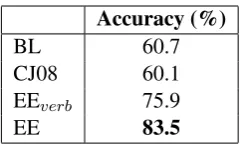
Accuracy (%)
BL 60.7
CJ08 60.1
EEverb 75.9
EE 83.5
Table 3: Results on the Gigaword data for the verb-frequency baseline (BL), the verb-only
em-bedding model (EEverb), the full model (EE) and
CJ08 rules.
training. This selection strategy was chosen to cre-ate a negative bias for our model which is more expressive than the baseline methods and, conse-quently, better at memorizing examples.
As a rule-based temporal classifier, we used high precision “happens-before” rules from the VerbOcean system (Chklovski and Pantel, 2004).
Consider “to �verb-x� and then�verb-y�” as one
example of such rule. We used predicted collapsed Stanford dependencies (de Marneffe et al., 2006) to extract arguments of the verbs, and used only
a subset of dependents of a verb.7 This
prepro-cessing ensured that (1) clues which form part of a pattern are not observable by our model both at train and test time; (2) there is no systematic dif-ference between both events (e.g., for collapsed dependencies, the noun subject is attached to both verbs even if the verbs are conjoined); (3) no in-formation about the order of events in text is avail-able to the models. Applying these rules resulted in 22,446 event pairs for training, and we split additional 1,015 pairs from the AFP section into 812 for final testing and 203 for development. We manually validated random 50 examples and all 50 of them followed the correct temporal order, so we chose not to hand correct the test set.
We largely followed the same training and eval-uation regime as for the crowdsourced data. We set the regularization parameter and the learning
rate to 0.01 and5.e−4respectively. The model
was trained for 600 epochs. The embedding sizes were 30 and 50 dimensions for words and events, respectively.
3.2.2 Results and discussion
In our experiments, as before, we use BL as a
baseline, and EEverb as a verb-only simplified
version of our approach. We used another baseline
7The list of dependencies not considered: aux,auxpass,
attr,appos,cc,conj,complm,cop,dep,det,punct,mwe.
consisting of the verb pair ordering counts
pro-vided by Chambers and Jurafsky (2008).8 We
[image:7.595.121.243.60.132.2]re-fer this baseline as CJ08. Note also that BL can be regarded as a reimplementation of CJ08 but with a different temporal classifier. We report results in Table 3.
The observations are largerly the same as be-fore: (1) the full model substantially outperforms
all other approaches (p-level<0.001 with the
per-mutation test); (2) enforcing transitivity is very
helpful (75.9 % for EEverb vs. 60.1% for BL).
Surprisingly CJ08 rules produce as good results as BL, suggesting that maybe our learning set-ups are not that different.
However, an interesting question is in which sit-uations using a more expressive model, EE, is ben-eficial. If these accuracy gains have to do with memorizing the data, it may not generalize well to other domains or datasets. In order to test this hypothesis we divided the test examples in three frequency bands according to the frequency of the corresponding verb pairs in the training set (to-tal, in both orders). There are 513, 249 and 50 event pairs in the bands corresponding to unseen
pairs of verbs, frequency≤ 10 and frequency >
10, respectively. These counts emphasize that cor-rect predictions on unseen pairs are crucial and these are exactly where BL would be equivalent to a random guess. Also, this suggest, even before looking into the results, that memorization is
irrel-evant. The results for BL, CJ08, EEverb and EE
are shown in Figure 3.
One observation is that most gains for EE and
EEverbare due to an improvement on unseen pairs.
This is fairly natural, as both transitivity and in-formation about arguments are the only sources of information available. In this context it is
im-portant to note that some of the verbs are light,
in the sense that they have little semantic content
of their own (e.g.,take,get) and the event
seman-tics can only be derived from analyzing their
argu-ments (e.g.,take an examvs. take a detour). On
the high frequency verb pairs all systems perform equally well, except for CJ08 as it was estimated from somewhat different data.
In order to understand how transitivity works, we considered a few unseen predicate pairs where
the EEverb model was correctly predicting their
order. For many of these pairs there were no
infer-8These verb pair frequency counts are available at
50.0 57.2
71.0 82.4
62.7 77.8
81.8 83.1
81.2 96.0
94.1 96.0
[image:8.595.72.299.61.199.2]CJ08 BL EEverb EE
Figure 3: Results for different frequency bands: unseen, medium frequency (between 1 and 10)
and high frequency (>10) verb pairs.
ence chains of length 2 (e.g., chain of length 2 was
found for the pair accept≺carry: accept≺ get
andget ≺carry but not many other pairs). This observation suggest that our model captures some non-trivial transitivity rules.
4 Related Work
Additionally to the work on script induction discussed above (Chambers and Jurafsky, 2008, 2009; Regneri et al., 2010), other methods for unsupervised learning of event semantics have been proposed. These methods include
unsu-pervised frame induction techniques (O’Connor,
2012; Modi et al., 2012). Frames encode situa-tions (or objects) along with their participants and properties (Fillmore, 1976). Events in these un-supervised approaches are represented with cate-gorical latent variables, and they are induced rely-ing primarily on the selectional preferences’ sig-nal. The very recent work of Cheung et al. (2013) can be regarded as their extension but Cheung et al. also model transitions between events with Markov models. However, neither of these ap-proaches considers (or directly optimizes) the dis-criminative objective of learning to order events, and neither of them uses distributed representa-tions to encode semantic properties of events.
As we pointed out before, our embedding ap-proach is similar (or, in fact, a simplification of) the phrase embedding methods studied in the re-cent work on distributional compositional seman-tics (Baroni and Zamparelli, 2011; Socher et al., 2012). However, they have not specifically looked into representing script information. Approaches which study embeddings of relations in knowledge bases (e.g., Riedel et al. (2013)) bear some
similar-ity to the methods proposed in this work but they are mostly limited to binary relations and deal with predicting missing relations rather than with tem-poral reasoning of any kind.
Identification of temporal relations within a text is a challenging problem and an active area of re-search (see, e.g., the TempEval task (UzZaman et al., 2013)). Many rule-based and supervised ap-proaches have been proposed in the past. How-ever, integration of common sense knowledge in-duced from large-scale unannotated resources still remains a challenge. We believe that our approach will provide a powerful signal complementary to information exploited by most existing methods.
5 Conclusions
We have developed a statistical model for rep-resenting common sense knowledge about proto-typical event orderings. Our model induces dis-tributed representations of events by composing predicate and argument representations. These representations capture properties relevant to pre-dicting stereotyped orderings of events. We learn these representations and the ordering component from unannotated data. We evaluated our model in two different settings: from crowdsourced data and natural news texts. In both set-ups our method outperformed baselines and previously proposed systems by a large margin. This boost in perfor-mance is primarily caused by exploiting transitiv-ity of temporal relations and capturing information encoded by predicate arguments.
The primary area of future work is to exploit our method in applications such as question an-swering. Another obvious applications is discov-ery of temporal relations within documents (Uz-Zaman et al., 2013) where common sense knowl-edge implicit in script information, induced from large unannotated corpora, should be highly ben-eficial. Our current model uses a fairly naive se-mantic composition component, we plan to extend it with more powerful recursive embedding meth-ods which should be especially beneficial when considering very large text collections.
6 Acknowledgements
References
James F Allen. 1983. Maintaining knowledge
about temporal intervals. Communications of
the ACM, 26(11):832–843.
Marco Baroni and Robert Zamparelli. 2011. Nouns are vectors, adjectives are matrices: Rep-resenting adjective-noun constructions in
se-mantic space. InProceedings of EMNLP.
Yoshua Bengio, R´ejean Ducharme, and Pascal Vincent. 2001. A neural probabilistic language
model. InProceedings of NIPS.
Jonathan Berant, Ido Dagan, and Jacob Gold-berger. 2011. Global learning of typed
entail-ment rules. InProceedings of ACL.
Nathanael Chambers and Dan Jurafsky. 2009. Un-supervised learning of narrative schemas and
their participants. InProceedings of ACL.
Nathanael Chambers and Daniel Jurafsky. 2008. Unsupervised learning of narrative event chains. InProceedings of ACL.
Jackie Chi Kit Cheung, Hoifung Poon, and Lucy Vanderwende. 2013. Probabilistic frame
induc-tion. InProceedings of NAACL.
Timothy Chklovski and Patrick Pantel. 2004. Ver-bocean: Mining the web for fine-grained
se-mantic verb relations. In Proceedings of
EMNLP.
R. Collobert, J. Weston, L. Bottou, M. Karlen, K. Kavukcuoglu, and P. Kuksa. 2011. Natural language processing (almost) from scratch.
Journal of Machine Learning Research, 12:2493–2537.
Marie-Catherine de Marneffe, Bill MacCartney, and Christopher D. Manning. 2006. Generating typed dependency parses from phrase structure
parses. InProceedings of LREC.
Charles Fillmore. 1976. Frame semantics and the
nature of language. Annals of the New York
Academy of Sciences, 280(1):20–32.
Lea Frermann, Ivan Titov, and Manfred Pinkal. 2014. A hierarchical bayesian model for un-supervised induction of script knowledge. In
EACL, Gothenberg, Sweden.
Martin Charles Golumbic and Ron Shamir. 1993. Complexity and algorithms for reasoning about
time: A graph-theoretic approach. Journal of
ACM, 40(5):1108–1133.
Andrew Gordon. 2001. Browsing image collec-tions with representacollec-tions of common-sense ac-tivities. JAIST, 52(11).
Rakesh Gupta and Mykel J. Kochenderfer. 2004. Common sense data acquisition for indoor
mo-bile robots. InProceedings of AAAI.
Geoffrey E. Hinton, Nitish Srivastava, Alex Krizhevsky, Ilya Sutskever, and Ruslan Salakhutdinov. 2012. Improving neural net-works by preventing co-adaptation of feature
detectors. arXiv: CoRR, abs/1207.0580.
Ashutosh Modi, Ivan Titov, and Alexandre
Kle-mentiev. 2012. Unsupervised induction of
frame-semantic representations. InProceedings
of the NAACL-HLT Workshop on Inducing Lin-guistic Structure. Montreal, Canada.
Erik T. Mueller. 1998.Natural Language
Process-ing with Thought Treasure. Signiform.
Brendan O’Connor. 2012. Learning frames from text with an unsupervised latent variable model.
CMU Technical Report.
Robert Parker, David Graff, Junbo Kong, Ke Chen, and Kazuaki Maeda. 2011.
En-glish gigaword fifth edition. Linguistic Data
Consortium.
Michaela Regneri, Alexander Koller, and Manfred Pinkal. 2010. Learning script knowledge with
web experiments. InProceedings of ACL.
Sebastian Riedel, Limin Yao, Andrew McCal-lum, and Benjamin Marlin. 2013. Relation ex-traction with matrix factorization and universal
schemas. TACL.
R. C Schank and R. P Abelson. 1977. Scripts,
Plans, Goals, and Understanding. Lawrence Erlbaum Associates, Potomac, Maryland. Richard Socher, Brody Huval, Christopher D.
Manning, and Andrew Y. Ng. 2012. Seman-tic compositionality through recursive
matrix-vector spaces. InProceedings of EMNLP.
Joseph Turian, Lev Ratinov, and Yoshua Bengio. 2010. Word representations: A simple and gen-eral method for semi-supervised learning. In
Proceedings of ACL.
Naushad UzZaman, Hector Llorens, Leon Der-czynski, James Allen, Marc Verhagen, and James Pustejovsky. 2013. Semeval-2013 task 1: Tempeval-3: Evaluating time expressions,
events, and temporal relations. InProceedings