Abstract—This paper presents a bibliometric overview of the research carried out between 1990 and 2014 in computer science with a focus on artificial intelligence. The work analyses all the journals available in Web of Science during this period and presents their publication and citation results. The study also considers the most cited articles in this area during the last twenty-five years. IEEE Journals obtain the most remarkable results publishing more than half of the most cited papers.
Index Terms— Bibliometrics, Web of Science, journals, citations.
I. INTRODUCTION
Artificial intelligence is a research area that studies how systems can think artificially or in related ways. It represents an important part of computer science. In the Web of Science (WoS) database there is one specific research category of the 251 categories strictly dedicated to this field, “Computer Science, Artificial Intelligence”. This area is becoming very popular due to the strong development of computers and technology. In order to assess the publications in this field, we can use bibliometrics which analyses the bibliographic material quantitatively [4]. In the literature, there are many articles that have developed a bibliometric analysis of a research field including management [18], economics [3,5], innovation, [8], fuzzy research [16], aggregation systems [7,23], grey systems [22] and computational intelligence [21]. Focusing on computer science, there are also some bibliometric studies. For example, Guan and Ma [12] developed a comparative analysis of the research performance, Tsai [20] studied the citation impact of computer science journals, and Feitelson and Yovel [9] analysed authors through the CiteSeer data. Some other studies have analysed computer science in specific regions including India [19], Brazil [15], Spain [14], Argentina [11] and Malaysia [2].
The aim of this paper is to analyse the artificial intelligence section of computer science. For doing so, we follow the WoS database which classifies a group of journals in this category. Thus, we study all the articles published in these journals between 1990 and 2014. Note that some journals may partially publish material in this discipline. However, our focus is on analyse the journals strictly dedicated to this area and identifying the most cited papers.
Manuscript received March 18, 2016. This paper is supported by the Chilean National Science Foundation through the FONDECYT program.
J.M. Merigó, G. Zurita, and V. Lobos-Ossandón are with the Department of Management Control and Information Systems, School of Economics and Business, University of Chile, Av. Diagonal 257, 8330015 Santiago, Chile (corresponding author: +56-2-29772164; e-mail: [email protected]).
This paper is organized as follows. Section II briefly reviews the bibliometric methodology used in the paper. Section III, presents the results and Section IV summarizes the main findings and conclusions of the paper.
II. METHODS
WoS is usually regarded as the most influential database for scientific research. Usually, those journals included here are recognized of those with the highest quality. WoS contains more than 15.000 journals and 50.000.000 documents. Currently, it continues growing, especially with the newest expansion produced by the creation of the Emerging Sources Citation Index that will include journals of high quality that need a period of evaluation before receiving an impact factor although already available in the database. The scientific material is divided in 251 research categories. Computer science encompasses seven of these categories and one of them is focused on Artificial Intelligence.
In order to analyze the data, this study uses several bibliometric indicators [17]. Particularly, we use the total number of publications and citations, the h-index [13], the cites per paper, and the number of papers among the thirty most cited in the field between 1990 and 2014. Note that the h-index is a modern index that tries to integrate publications with citations. In summary, if a set of papers have an h-index of X, it means that X papers of the total set, have received X or more citations. In general, this index works quite well although it is not able to consider some exceptional situations. For example, if an author has five papers and two of them have one thousand citations and the other three zero, his h-index is two. However, if another author have five papers with five citations each, he has an h-index of five. Here, the second author gets a better result although it is clear that the first one is more influential. Due to this, some other measures have appeared in the literature including the g-index [6] and the hg-index [1].
The search process looks for the documents published in the WoS category of Computer Science, Artificial Intelligence between 1990 and 2014. Only articles, reviews, letters and notes are considered. The main reason is that the other types of documents are usually not scientific material. All the journals are ranked according to the total number of citations. However, WoS does not distinguish between the sources that give the citations. From a general perspective, this should not bring important deviations but it is worth mentioning. This issue also affects the most cited papers.
An additional column indicating the year and the volume when it first appeared in WoS is also available. Note that if the journal was available in 1990 or before, the table only shows 1990 and the volume at that time.
Computer Science Research in Artificial
Intelligence
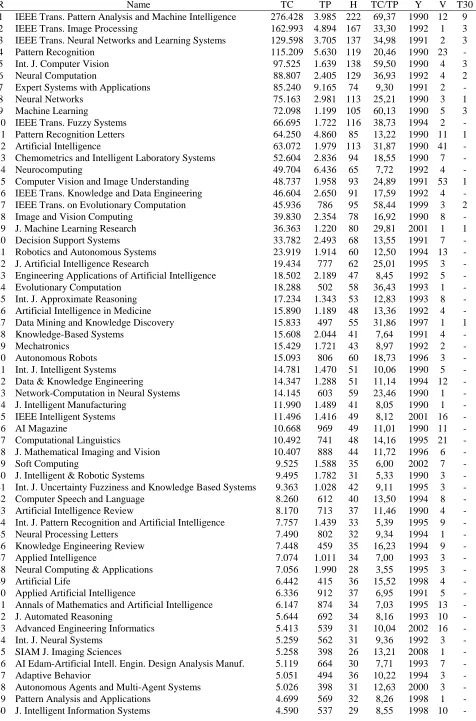
Table 1. Journals in Computer Science: Artificial Intelligence
R Name TC TP H TC/TP Y V T30
1 IEEE Trans. Pattern Analysis and Machine Intelligence 276.428 3.985 222 69,37 1990 12 9
2 IEEE Trans. Image Processing 162.993 4.894 167 33,30 1992 1 3
3 IEEE Trans. Neural Networks and Learning Systems 129.598 3.705 137 34,98 1991 2 3
4 Pattern Recognition 115.209 5.630 119 20,46 1990 23 -
5 Int. J. Computer Vision 97.525 1.639 138 59,50 1990 4 3
6 Neural Computation 88.807 2.405 129 36,93 1992 4 2
7 Expert Systems with Applications 85.240 9.165 74 9,30 1991 2 -
8 Neural Networks 75.163 2.981 113 25,21 1990 3 1
9 Machine Learning 72.098 1.199 105 60,13 1990 5 3
10 IEEE Trans. Fuzzy Systems 66.695 1.722 116 38,73 1994 2 -
11 Pattern Recognition Letters 64.250 4.860 85 13,22 1990 11 1
12 Artificial Intelligence 63.072 1.979 113 31,87 1990 41 -
13 Chemometrics and Intelligent Laboratory Systems 52.604 2.836 94 18,55 1990 7 -
14 Neurocomputing 49.704 6.436 65 7,72 1992 4 -
15 Computer Vision and Image Understanding 48.737 1.958 93 24,89 1991 53 1 16 IEEE Trans. Knowledge and Data Engineering 46.604 2.650 91 17,59 1992 4 - 17 IEEE Trans. on Evolutionary Computation 45.936 786 95 58,44 1999 3 2
18 Image and Vision Computing 39.830 2.354 78 16,92 1990 8 -
19 J. Machine Learning Research 36.363 1.220 80 29,81 2001 1 1
20 Decision Support Systems 33.782 2.493 68 13,55 1991 7 -
21 Robotics and Autonomous Systems 23.919 1.914 60 12,50 1994 13 -
22 J. Artificial Intelligence Research 19.434 777 62 25,01 1995 3 - 23 Engineering Applications of Artificial Intelligence 18.502 2.189 47 8,45 1992 5 -
24 Evolutionary Computation 18.288 502 58 36,43 1993 1 -
25 Int. J. Approximate Reasoning 17.234 1.343 53 12,83 1993 8 -
26 Artificial Intelligence in Medicine 15.890 1.189 48 13,36 1992 4 - 27 Data Mining and Knowledge Discovery 15.833 497 55 31,86 1997 1 1
28 Knowledge-Based Systems 15.608 2.044 41 7,64 1991 4 -
29 Mechatronics 15.429 1.721 43 8,97 1992 2 -
30 Autonomous Robots 15.093 806 60 18,73 1996 3 -
31 Int. J. Intelligent Systems 14.781 1.470 51 10,06 1990 5 -
32 Data & Knowledge Engineering 14.347 1.288 51 11,14 1994 12 - 33 Network-Computation in Neural Systems 14.145 603 59 23,46 1990 1 -
34 J. Intelligent Manufacturing 11.990 1.489 41 8,05 1990 1 -
35 IEEE Intelligent Systems 11.496 1.416 49 8,12 2001 16 -
36 AI Magazine 10.668 969 49 11,01 1990 11 -
37 Computational Linguistics 10.492 741 48 14,16 1995 21 -
38 J. Mathematical Imaging and Vision 10.407 888 44 11,72 1996 6 -
39 Soft Computing 9.525 1.588 35 6,00 2002 7 -
40 J. Intelligent & Robotic Systems 9.495 1.782 31 5,33 1990 3 - 41 Int. J. Uncertainty Fuzziness and Knowledge Based Systems 9.363 1.028 42 9,11 1995 3 -
42 Computer Speech and Language 8.260 612 40 13,50 1994 8 -
43 Artificial Intelligence Review 8.170 713 37 11,46 1990 4 -
44 Int. J. Pattern Recognition and Artificial Intelligence 7.757 1.439 33 5,39 1995 9 -
45 Neural Processing Letters 7.490 802 32 9,34 1994 1 -
46 Knowledge Engineering Review 7.448 459 35 16,23 1994 9 -
47 Applied Intelligence 7.074 1.011 34 7,00 1993 3 -
48 Neural Computing & Applications 7.056 1.990 28 3,55 1995 3 -
49 Artificial Life 6.442 415 36 15,52 1998 4 -
50 Applied Artificial Intelligence 6.336 912 37 6,95 1991 5 -
51 Annals of Mathematics and Artificial Intelligence 6.147 874 34 7,03 1995 13 -
52 J. Automated Reasoning 5.644 692 34 8,16 1993 10 -
53 Advanced Engineering Informatics 5.413 539 31 10,04 2002 16 -
54 Int. J. Neural Systems 5.259 562 31 9,36 1992 3 -
55 SIAM J. Imaging Sciences 5.258 398 26 13,21 2008 1 -
56 AI Edam-Artificial Intell. Engin. Design Analysis Manuf. 5.119 664 30 7,71 1993 7 -
57 Adaptive Behavior 5.051 494 36 10,22 1994 3 -
58 Autonomous Agents and Multi-Agent Systems 5.026 398 31 12,63 2000 3 -
59 Pattern Analysis and Applications 4.699 569 32 8,26 1998 1 -
61 Computational Intelligence 4.504 596 31 7,56 1995 11 -
62 AI Communications 4.291 527 25 8,14 1994 7 -
63 J. Web Semantics 4.129 290 30 14,24 2005 3 -
64 Information Fusion 3.529 395 30 8,93 2006 7 -
65 Int. J. Information Technology & Decision Making 3.246 532 24 6,10 2004 3 - 66 J. Experimental & Theoretical Artificial Intelligence 3.196 549 25 5,82 1993 5 -
67 J. Intelligent & Fuzzy Systems 3.151 1.303 21 2,42 1995 3 -
68 IEEE Computational Intelligence Magazine 3.068 260 25 11,80 2006 1 - 69 Int. J. Software Engineering and Knowledge Engineering 2.979 963 23 3,09 1991 1 -
70 Expert Systems 2.662 771 22 3,45 1994 11 -
71 Minds and Machines 2.601 523 22 4,97 1992 2 -
72 Connection Science 2.546 308 23 8,27 1998 10 -
73 Int. J. Applied Mathematics and Computer Science 2.086 518 18 4,03 2003 13 - 74 Int. J. Computational Intelligence Systems 1.690 592 18 2,85 2008 1 -
75 Cognitive Systems Research 1.644 289 17 5,69 2005 6 -
76 Fuzzy Optimization and Decision Making 1.464 193 20 7,59 2007 6 - 77 Int. J. Artificial Intelligence Tools 1.285 557 14 2,31 2005 14 - 78 Int. J. Document Analysis and Recognition 1.220 221 17 5,52 2006 8 -
79 Intelligent Data Analysis 1.184 502 14 2,36 2005 9 -
80 Int. J. Fuzzy Systems 1.154 348 14 3,32 2007 9 -
81 ACM Trans. Intelligent Systems and Technology 1.108 259 7 4,28 2010 1 -
82 Int. J. Bio-Inspired Computation 1.040 204 15 5,10 2009 1 -
83 Computing and Informatics 1.008 663 11 1,52 2001 20 -
84 Intelligent Automation and Soft Computing 992 768 13 1,29 1998 4 - 85 ACM Trans. Autonomous and Adaptive Systems 901 190 13 4,74 2006 1 - 86 Int. J. Machine Learning and Cybernetics 888 206 13 4,31 2011 2 - 87 J. Multiple-Valued Logic and Soft Computing 887 455 12 1,95 2004 10 - 88 Int. J. Semantic Web and Information Systems 857 127 13 6,75 2006 2 -
89 J. Real-Time Image Processing 837 286 13 2,93 2006 1 -
90 Cognitive Computation 808 280 13 2,89 2009 1 -
91 IEEE Trans. Autonomous Mental Development 803 154 13 5,21 2009 1 - 92 Advances in Electrical and Computer Engineering 766 481 9 1,59 2007 7 -
93 Neural Network World 763 429 10 1,78 2005 15 -
94 Genetic Programming and Evolvable Machines 760 160 13 4,75 2007 8 -
95 IET Computer Vision 704 293 11 2,40 2007 1 -
96 Turkish J. Electrical Engineering and Computer Sciences 618 589 8 1,05 2008 16 - 97 IEEE Trans. Computational Intelligence and AI in Games 613 162 12 3,78 2009 1 - 98 J. Ambient Intelligence and Smart Environments 569 238 11 2,39 2009 1 -
99 Natural Computing 527 296 9 1,78 2010 9 -
100 Wiley Interdis. Reviews-Data Mining Knowledge Disc. 496 137 11 3,62 2011 1 -
101 J. Applied Logic 310 167 9 1,86 2009 7 -
102 Swarm Intelligence 226 67 8 3,37 2010 4 -
103 Natural Language Engineering 172 134 7 1,28 2009 15 -
104 Traitement du Signal 61 210 3 0,29 2007 24 -
105 Memetic Computing 61 74 4 0,82 2012 4 -
106 IET Biometrics 59 79 4 0,75 2012 1 -
Abbreviations: R = Ranking according to TC; TC = Total citations; TP = Total papers; TC/TP = Average citations per paper; Y= Year; V = Volume; IF = Impact factor; IF5 = 5-year impact factor; T50 = Number of papers among the 50 most cited of the category; T200 = Number of papers among the 200 most cited in all fields of computer science since 1990; T200 < 1990 = Number of papers among the 200 most cited in all fields of computer science before 1990; GR = Global ranking considering all the computer science journals.
III. RESULTS
Currently, there are 106 journals in WoS in the category of Computer Science, Artificial Intelligence. However, note that this number is constantly changing, especially now with the introduction of the Emerging Sources Citation Index. Table 1 presents the journals ranked according to their number of citations obtained between 1990 and 2014.
The IEEE Transactions Journals obtain the most remarkable results [10]. Particularly, the IEEE Transactions
on Pattern Analysis and Machine Intelligence, the IEEE Transaction on Image Processing and the IEEE Transactions on Neural Networks and Learning Systems, obtain the first three positions. Note that some other journals obtain better results according to other indicators including the International Journal of Computer Vision, Machine Learning and the IEEE Transactions on Evolutionary Computation.
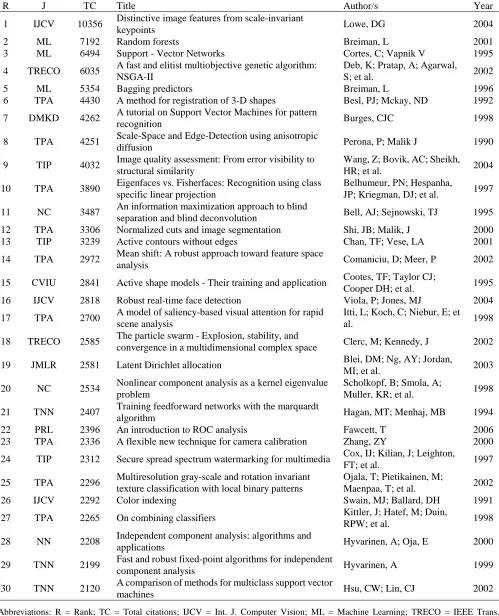
Table 2. Most cited papers in Computer Science: Artificial Intelligence
R J TC Title Author/s Year
1 IJCV 10356 Distinctive image features from scale-invariant
keypoints Lowe, DG 2004
2 ML 7192 Random forests Breiman, L 2001
3 ML 6494 Support - Vector Networks Cortes, C; Vapnik V 1995
4 TRECO 6035 A fast and elitist multiobjective genetic algorithm: NSGA-II
Deb, K; Pratap, A; Agarwal,
S; et al. 2002
5 ML 5354 Bagging predictors Breiman, L 1996
6 TPA 4430 A method for registration of 3-D shapes Besl, PJ; Mckay, ND 1992 7 DMKD 4262 A tutorial on Support Vector Machines for pattern
recognition Burges, CJC 1998
8 TPA 4251 Scale-Space and Edge-Detection using anisotropic
diffusion Perona, P; Malik J 1990
9 TIP 4032 Image quality assessment: From error visibility to structural similarity
Wang, Z; Bovik, AC; Sheikh,
HR; et al. 2004
10 TPA 3890 Eigenfaces vs. Fisherfaces: Recognition using class specific linear projection
Belhumeur, PN; Hespanha,
JP; Kriegman, DJ; et al. 1997 11 NC 3487 An information maximization approach to blind
separation and blind deconvolution Bell, AJ; Sejnowski, TJ 1995 12 TPA 3306 Normalized cuts and image segmentation Shi, JB; Malik, J 2000
13 TIP 3239 Active contours without edges Chan, TF; Vese, LA 2001
14 TPA 2972 Mean shift: A robust approach toward feature space
analysis Comaniciu, D; Meer, P 2002
15 CVIU 2841 Active shape models - Their training and application Cootes, TF; Taylor CJ;
Cooper DH; et al. 1995
16 IJCV 2818 Robust real-time face detection Viola, P; Jones, MJ 2004
17 TPA 2700 A model of saliency-based visual attention for rapid scene analysis
Itti, L; Koch, C; Niebur, E; et
al. 1998
18 TRECO 2585 The particle swarm - Explosion, stability, and
convergence in a multidimensional complex space Clerc, M; Kennedy, J 2002
19 JMLR 2581 Latent Dirichlet allocation Blei, DM; Ng, AY; Jordan,
MI; et al. 2003
20 NC 2534 Nonlinear component analysis as a kernel eigenvalue problem
Scholkopf, B; Smola, A;
Muller, KR; et al. 1998 21 TNN 2407 Training feedforward networks with the marquardt
algorithm Hagan, MT; Menhaj, MB 1994
22 PRL 2396 An introduction to ROC analysis Fawcett, T 2006
23 TPA 2336 A flexible new technique for camera calibration Zhang, ZY 2000 24 TIP 2312 Secure spread spectrum watermarking for multimedia Cox, IJ; Kilian, J; Leighton,
FT; et al. 1997
25 TPA 2296 Multiresolution gray-scale and rotation invariant texture classification with local binary patterns
Ojala, T; Pietikainen, M;
Maenpaa, T; et al. 2002
26 IJCV 2292 Color indexing Swain, MJ; Ballard, DH 1991
27 TPA 2265 On combining classifiers Kittler, J; Hatef, M; Duin,
RPW; et al. 1998
28 NN 2208 Independent component analysis: algorithms and
applications Hyvarinen, A; Oja, E 2000
29 TNN 2199 Fast and robust fixed-point algorithms for independent
component analysis Hyvarinen, A 1999
30 TNN 2120 A comparison of methods for multiclass support vector
machines Hsu, CW; Lin, CJ 2002
Abbreviations: R = Rank; TC = Total citations; IJCV = Int. J. Computer Vision; ML = Machine Learning; TRECO = IEEE Trans. Evolutionary Computation; IEEE Trans. Pattern Analysis and Machine Intelligence; DMKD = Data Mining and Knowledge Discovery; TIP = IEEE Trans. Image Processing; NC = Neural Computation; CVIU = Computer Vision and Image Understanding; JMLR = J. Machine Learning Research; TNN = IEEE Trans. Neural Networks; PRL = Pattern Recognition Letters.
The most cited article of the last twenty-five years is published in the International Journal of Computer Vision by Lowe and has received more than 10.000 citations. The IEEE
IV. CONCLUSION
This study has presented an overview of the leading trends in the field of artificial intelligence in computer science. The results are based on WoS and clearly show the relevance of the IEEE journals as the leaders of the field. However, there are many other important journals in this area. Depending on the bibliometric indicator considered, some journals may obtain better results than others. This work has ranked the journals according to the total number of citations but it also presents other indicators in order to give a more general perspective of the characteristics of each journal. The current trend is that more journals are entering WoS, especially motivated by the strong growth of researchers worldwide that needs a higher supply of journals.
The paper has also considered the most cited papers in this area between 1990 and 2014. The IEEE Transactions on Pattern Analysis and Machine Intelligence is the most influential journal with nine papers in the Top 30 and is the most cited journal in the ranking.
In future research, we will look into other issues including leading authors, institutions and countries. Moreover, we will also consider other computer science categories including information systems, interdisciplinary applications and cybernetics.
REFERENCES
[1] S. Alonso, F.J. Cabrerizo, E. Herrera-Viedma, F. Herrera, H-index: A review focused on its variants, computation and standarization for different scientific fields. Journal of Informetrics, 3:273-289, 2009. [2] A. Bakri, P. Willet, Computer science research in Malaysia: A
bibliometric analysis. Aslib Proceedings, 63:321-335, 2011. [3] C. Bonilla, J.M. Merigó, C. Torres-Abad, Economics in Latin
America: A bibliometric analysis. Scientometrics, 105:1239-1252, 2015.
[4] R.N. Broadus, Toward a definition of “Bibliometrics”. Scientometrics, 12:373-379, 1987.
[5] T. Coupé, Revealed performances: Worldwide rankings of economists and economics departments, 1990–2000. Journal of the European
Economic Association, 1:1309-1345, 2003.
[6] L. Egghe, Theory and practice of the g-index. Scientometrics, 69:131-152, 2006.
[7] A. Emrouznejad, M. Marra, Ordered weighted averaging operators 1988–2014. A citation based literature survey. International Journal
of Intelligent Systems, 29:994-1014, 2014.
[8] J. Fagerberg, M. Fosaas, K. Sapprasert, Innovation: Exploring the knowledge base. Research Policy, 41:1132-1153, 2012.
[9] D.G. Feitelson, U. Yovel, Predictive ranking of computer scientists using CiteSeer data. Journal of Documentation, 60:44-61, 2004. [10] F. Franceschini, D. Maisano, Sub-field normalization of the IEEE
scientific journals based on their connection with Technical Societies.
Journal of Informetrics, 8:508-533, 2014.
[11] D. Godoy, A. Zunino, C. Mateos, Publication practices in the Argentinian computer science community: a bibliometric perspective.
Scientometrics, 102:1795-1814, 2015.
[12] J.C. Guan and N. Ma, A comparative study of research performance in computer science. Scientometrics, 61:339-359, 2004.
[13] J.E. Hirsch, An index to quantify an individual’s scientific research output. Proceedings of the National Academy of Sciences of the
United States of America, 102:16569-16572, 2005.
[14] A. Ibáñez, P. Larrañaga, C. Bielza, Cluster methods for assessing research performance: exploring Spanish computer science.
Scientometrics, 97:571-600, 2013.
[15] H. Lima, T.H.P. Silva, M.M. Moro, R.L.T. Santos, W. Meira Jr, A.H.F. Laender, Assessing the profile of top Brazilian computer science researchers. Scientometrics, 103:879-896, 2015.
[16] J.M. Merigó, A.M. Gil-Lafuente, R.R. Yager, An overview of fuzzy research with bibliometric indicators. Applied Soft Computing, 27: 420-433, 2015.
[17] J.M. Merigó, A. Mas-Tur, N. Roig-Tierno, D. Ribeiro-Soriano, A bibliometric overview of the Journal of Business Research between 1973 and 2014. Journal of Business Research, 68: 2645-2653, 2015. [18] P.M. Podsakoff, S.B. MacKenzie, N.P. Podsakoff, D.G. Bachrach,
Scholarly influence in the field of management: A bibliometric analysis of the determinants of university and author impact in the management literature in the past quarter century. Journal of
Management, 34:641-720, 2008.
[19] V.K. Singh, A. Uddin, D. Pinto, Computer science research: the top 100 institutions in India and in the world. Scientometrics, 104: 529-553, 2015.
[20] C.F. Tsai, Citation impact analysis of top ranked computer science journals and their rankings. Journal of Informetrics, 8:318-328, 2014 [21] N.J. Van Eck, L. Waltman, Bibliometric mapping of the computational
intelligence field, International Journal of Uncertainty, Fuzziness and
Knowledge-Based Systems, 15:625-645, 2007.
[22] M.S. Yin, Fifteen years of grey system theory research: A historical review and bibliometric analysis, Expert Systems with Applications, 40:2767-2775, 2013.
[23] D. Yu, A scientometrics review on aggregation operator research.