Abstract— The Flow Shop Scheduling Problem (FSSP) is a problem that is commonly found by master production scheduling planners in Flexible Manufacturing Systems (FMS). The planner should find the optimal scheduling to carry out a set of jobs in order to satisfy the predefined objective (e.g., makespan). All the jobs are processed in a production line composed of a set of shared machines. Furthermore, the jobs are processed in the same sequence. In order to be able to analyze this problem in a better way, this problem needs to be represented adequately for understanding the relationship among the operations that are carried out. Thus, an FMS presenting the FSSP can be modeled by Petri nets (PNs), which are a powerful tool that has been used to model and analyze discrete event systems. Then, the makespan can be obtained by simulating the PN through the token game animation. In this work, we propose a new way to calculate the makespan of FSSP based on timed place PNs.
Index Terms— Flow shop scheduling problem, makespan, Petri nets
I. INTRODUCTION
LEXIBLE Manufacturing Systems (FMSs) are very important in advancing factory automation due to the ability to adjust to customers’ preferences and the speed to reconfigure the system. A FMS is a discrete event dynamic system composed of jobs and shared resources [1]. When a manufacturer is designing the master production schedule in a FMS with shared resources, it is common that s/he has to face the decision about the best sequence of jobs in the FMS in order to carry all operations out in the minimum time [2], [3].
This problem is called the Flow Shop Scheduling
Manuscript received July 19, 2016; revised August 1, 2016. This work was supported by the Autonomous University of Hidalgo State under Grant UAEH-DI-ICBI-ING-SF-011.
J. Medina-Marin is with the Engineering Department, Autonomous University of Hidalgo State, Pachuca, Hidalgo, 42000 Mexico (corresponding author to provide phone: +52 771 7172 000 ext. 4007; e-mail: [email protected]).
D. Gradišar is with the Department of System and Control, Jožef Stefan Institute, Ljubljana, 1000 Slovenia. (e-mail: [email protected]).
J.C. Seck-Tuoh-Mora is with the Engineering Department, Autonomous University of Hidalgo State, Pachuca, Hidalgo, 42000 Mexico (e-mail: [email protected]).
N. Hernandez-Romero is with the Engineering Department, Autonomous University of Hidalgo State, Pachuca, Hidalgo, 42000 Mexico (e-mail: [email protected]).
F. Nuñez-Piña is with the Engineering Department, Autonomous University of Hidalgo State, Pachuca, Hidalgo, 42000 Mexico (e-mail: [email protected]).
Problem (FSSP), which is a combinatorial problem classified as NP-hard [4]. The makespan is the time that all the jobs are processed in the FMS, and it depends on the order that all the tasks are performed.
There have been published several research papers about finding the minimum value of makespan in the FSSP. For instance, a D.S. Palmer proposed a method to find an acceptable sequence in less time than exhaustive search [5]. Another algorithm based on heuristic strategies to find suitable solutions was proposed in reference [6]. Dannenbring performed a similar work, where he proposed eleven heuristics to solve the FSSP [7]. Nawas proposed an algorithm based on the assumption that jobs with higher processing time must be treated first; his algorithm is applied to static and dynamic sequencing environment [8]. In reference [9], Taillard applied taboo search to solve FSSP; moreover, he implemented a parallel version of taboo search to improve the algorithm execution time. Framinan and Leisten proposed a heuristic taking into account the optimization of partial schedules; instead of optimize the whole schedule [10]. Later, Framinan, Leisten and Ruiz-Usano proposed two multi-objective heuristics, whose objectives to solve are makespan and flowtime minimization [11].
Several metaheuristics have been used to find the minimum value for the makespan, such as Simulated Annealing [12],[13]; Taboo Search [14], [15]; Genetic Algorithms [16]–[18]; Ant Colony Optimization [19] – [20]; Iterated Local Search [21]; and Particle Swarm Optimization Algorithms [22], [23], [27]. These proposals can find reasonable results in less time than exact methods. The main outcome of these methods is that the global minimum could not be found; however, good approximations are obtained in a short time. Thus, all of them need a way to represent the FSSP in order to calculate the makespan. FSSP modeling should be understandable and able to calculate the makespan of a job operations sequence.
FMSs have been modeled via Petri Nets (PNs) in order to simulate and analyze them. PN theory is adequate to represent in a graphical and mathematical way Discrete Event Systems (DES) such as FMSs, because their dynamic behavior based on event occurrence can be modeled by PN elements (places and transitions) [24]. Moreover, PN theory offers analytical and graphical tools to study the modeled systems, based on the relationship among the FMS resources denoted as PN elements. In [29], a timed Petri net is applied to model and simulate a production system, which is generated algorithmically.
One important point in search methods is the calculus of
A Petri Net Model to obtain the Makespan in
the Flow Shop Scheduling Problem
Joselito Medina-Marin, Dejan Gradi
š
ar, Juan Carlos Seck-Tuoh-Mora, Norberto Hernandez-Romero,
and Federico Nuñez-Piña
the makespan, taking into account a certain processing order of the tasks. In this paper, we propose the use of an timed PN to calculate the makespan taking into account the PN transition firing.
II. FLOW SHOP SCHEDULING PROBLEM
Scheduling tasks in a FMS is a typical combinatorial problem where it is needed to organize the processing of a set of jobs divided in operations, and each operation is carried out in a shared resource [25], [26].
In the FSSP, given the processing times pjk for each job j
on every machine k, and a job sequence S = (s1, s2, …, sn)
where n jobs (j = 1, 2, …, n) will be processed by m
machines (k = 1, 2, …, m), so the aim of FSSP is to find a sequence order for operation processing with the minimum value for the makespan.
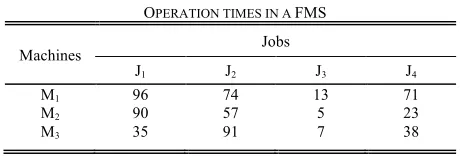
For instance, Table I shows a FMS with three machines, four jobs, and each job has three serial operations, one for each machine.
III. PETRI NETS CONCEPTS
A PN is a graphical and mathematical tool that has been used to model concurrent, asynchronous, distributed, parallel, non-deterministic, and/or stochastic systems.
The graph of a PN is directed, with weights in their arcs, and bipartite, whose nodes are of two types: places and transitions. Graphically, places are depicted as circles and transition as boxes or bars. PN arcs connect places to transitions or transition to places; it is not permissible to connect nodes of the same type. The state of the system is denoted in PN by the use of tokens, which are assigned to place nodes.
A formal definition of a PN is presented as follows [24]. A Petri net is a 5-tuple, PN = (P, T, F, W, M0) where: P = {p1, p2, …, pm} is a finite set of places,
T = {t1, t2, …, tn} is a finite set of transitions, F⊆ {P×T} ∪ {T×P} is a set of arcs,
W = F → {1, 2, 3, …} is a weight function,
M0 = P→ {0, 1, 2, 3, …} is the initial marking, P∩T = ∅ and P∪T≠∅.
The set of places that are connected to a transition is known as input places, which is denoted as •t. On the other
hand, the places connected from a transition are known as output places, and the set of output places are represented by t•.
The token movement through the PN represents the dynamical behavior of the system. In order to change the token position, the following transition firing rule is used [24]:
1. A transition t∈T is enabled if every input place p ∈ P of t has w(p,t) tokens or more. w(p,t) is the weight of the arc from p to t.
2. An enabled transition t will fire if the event represented by t takes place.
3. When an enabled transition t fires, w(p,t) tokens are removed from every input place p of t and w(t,p)
tokens are added to every output place p of t. w(t,p)
is the weight of the arc from t to p.
A Timed Place Petri Net (TPPN) is an extended PN, where a new element is added. It is a six-tuple TPPN = {P,
T, F, W, M0, D), where the first fifth elements are similar to
PN definition presented above, and D = {d1, d2, …, dm}
denotes the time-delay for each place pj ∈ P [28]. Output
transitions ti for each pj will be enabled once the time
indicated in pj is reached.
A. Analysis methods
In this paper, we are applying the matrix equation approach as the analytical method of PN theory in order to calculate the makespan of the FMS modeled.
Incidence matrix and state equation
A PN with n transitions and m places can be expressed mathematically as an n × m matrix of integers A = [aij]. The
values for each element of the matrix are given by: aij = aij+ - aij-, where aij+ is the weight of the arc from ti to pj, and aij- is
the weight of the arc from pj to ti.
The state equation is used to determine the marking of a PN after a transition firing, and it can be written as follows:
Mk = Mk-1×ATUk, k=1,2,… (1)
where uk is a n × 1 column vector of n - 1 zeros and one
nonzero entries, which represents the transition tj that will
fire. The nonzero entry is located in the position j of uk. AT is
the transpose of incidence matrix. Mk-1 is the marking before
the firing of tj. And Mk is the reached marking after the
firing of tj denoted in uk.
IV. FSSP MODELED BY A TIMED PLACE PETRI NET In this paper we are proposing a different way to obtain the makespan by using timed place PNs. The main idea is to denote every flow shop operation by a simple PN structure composed of one place denoting the operation time, one input transition to place pi, and one output transition from
place pi. (Figure 1).
TABLEI
OPERATION TIMES IN A FMS
Machines Jobs
J1 J2 J3 J4
M1 96 74 13 71
M2 90 57 5 23
M3 35 91 7 38
Every value is denoted in a time unit.
τ! t1
t2
p1
[image:2.595.47.277.296.374.2]Thus, the processing time τ is stored in the place between the transitions, and it corresponds to the operation time defined in the FSSP. For each operation of job Ji
performed in machine Mi there is a processing time τij.
(Table II).
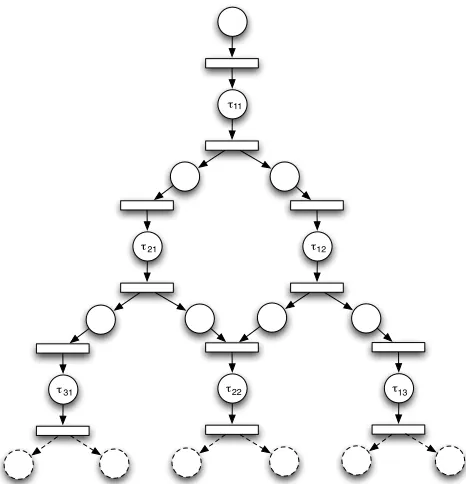
The first operation of the first job has no dependencies from another operations, and it starts immediately; however, remaining operations depend on the previous operation in the same machine, the previous operation of the same job, or both (Figure 2). Indeed, PN modeling allows setting dependencies among operations and it is taken into advantage in order to define the operations sequence of the FSSP.
As we mentioned above, the first job is processed instantly in every machine as soon as the previous machine finishes. Similarly, the first machine processes all the operations as soon as the previous operation job is processed. In these cases, the operations have only one dependency and the accumulative time is the sum of the processing time for all the operations of the first job, or the sum for the operations processed in the first machine. However, the other operations take into account the maximum time from two previous operations, the previous operation in the same machine and the previous operation of the same job.
Once the job operations have been denoted as PN structures, it is important to link them in order to create a unique PN model representing the whole flexible manufacturing system.
Linking lines in figure 2 are represented as places connecting PN transitions for each job operation. Hence, any FMS with a number of shared machines and a number of jobs can be modeled by PNs as shown in figure 3.
For instance, Table I shows the processing times needed for three machines that will process four jobs. All jobs are processed in the same order in all machines. Every value represents the processing time τ needed by an operation Oij.
which belongs to a job Jj and it is carried out in a machine
Mi.
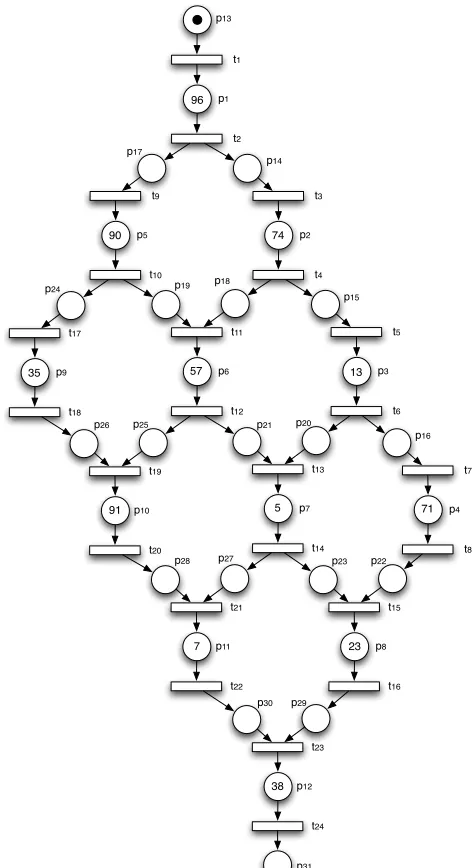
The PN model for this example is shown in figure 4. It contains twelve PN structures representing every job operation, an input place, an output place, and seventeen connecting places. Thus, the initial marking M0 is a vector
with 31 elements, 30 of them are zero and the 13th element is equal to 1.
The sequence order for the four jobs is [1 2 3 4]. For a different sequence order the PN structure is the same; however, the processing time values are assigned to different places, according to the desired order.
V. ALGORITHMS
A. Algorithm utilized to create the PN model
In this algorithm the PN model is created from the processing time data. The output is the PN model that represents the FMS.
Algorithm create_TPPN Input: τij,OS
Output: PN
1. Initialize variables place = 1
trans = 1
2. For i = 1 to NumberOfMachines For j = 1 to NumberOfJobs Aout(trans,place) = 1 trans = trans+1 Ain(trans,place) = 1 trans = trans+1 place = place+1
End For End For
3. For i = 1 to NumberOfMachines For j = 1 to NumberOfJobs if(i==1 && j==1) Ain(1,place) = 1 pos = place; place = place+1
TABLEII
MATRIX FOR OPERATION TIMES IN A FMS
Machines Jobs
J1 J2 J3 J4 …
M1 τ11 τ12 τ13 τ14 …
M2 τ21 τ22 τ23 τ24 …
M3 τ31 τ32 τ33 τ34 …
… … … … … …
τ!11
τ!12
τ!13
τ!21
τ!22
τ!31
J1
J2
J3
M1
M2
M3
Fig. 2. Job operations dependency from previous operations of the same job, and/or previous operations performed in the same machine.
τ!
τ! τ!
τ! τ! τ!
11
12
13 21
22 31
[image:3.595.312.545.52.294.2] [image:3.595.49.288.136.212.2]elseif i==1
Aout(2*(j-1),place) = 1 Ain(2*j-1,place) = 1 place = place+1 elseif j==1
Aout(2*(i-2)*nj+2*j,place) = 1 Ain(2*(i-1)*nj+1,place) = 1 place = place+1
else
Aout(2*(i-2)*nj + 2*j,place) = 1 Ain(2*(i-1)*nj+2*j-1,place) = 1 place = place+1
Aout(2*nj*(i-1)+2*(j-1),place) = 1 Ain(2*nj*(i-1)+2*j-1,place) = 1 place = place+1
End If End For End For
4. Aout(nt,place) = 1 5. PN = Aout - Ain
In Step 1 the variables place and trans are initialized to 1. In Step 2, the PN structure for every operation Oij is
created, it contains one place and two transitions. Next, in Step 3 the places to link the PN structures obtained in Step 2 are added to the PN model. In Step 4 the last place is connected to the PN. Finally, in Step 5, the PN is obtained from the subtraction of output arcs (Aout) minus input arcs (Ain).
B. Algorithm applied to calculate the makespan
Once the PN model is obtained, we are able to compute the makespan of the FMS according to a job operation sequence. The algorithm to perform this calculus is the following.
Algorithm getMakespan Input: PN, S, M0, D
Output: Makespan
1. Initialize variables Dacum = [0 0 0 … 0]
2. For i = 1 to NumberOfTransitions // input places to ti
ip = •ti
// output places from ti
op = ti•
max = -∞; For j=1 to |ip|
If Dacum(ip(j)) > max max = Dacum(ip(j)); End If
End For
For k=1 to |op|
Dacum(op(k)) = max + D(op(k)); End For
End For
3. Makespan = Dacum(NumberOfPlaces)
In Step 1, the variable Dacum is initialized to a vector with zero values. This variable is utilized to accumulate the total time needed to perform all the operations. In Step 2, every enabled transition is fired, and the maximum accumulated time from its input places is taken and placed in the output place plus the corresponding time τ. In Step 3 the accumulated time is assigned to the variable
Makespan.
C. Example
At the beginning, Dacum has only zero values, and this
vector has 31 elements. Starting the PN simulation by firing the enabled transition t1, the value 96 is assigned to Dacum
in the position of place p1. Next, the enabled transition t2 is
fired and its firing assigns the value 96 to Dacum in the position of its output places p14 and p17. After that, enabled
transition t3 is fired, and the accumulative value in its input
place p14 (96) plus the processing time in D in the position
of its output place p2 (τ=74) is assigned to Dacum in the
position of p2 (96+74=170).
All the transitions are fired in the same way, but in the case of two input places, the maximum accumulative time from both input places is considered for the sum.
VI. CONCLUSION
The nature of flexible manufacturing systems allows the use of shared resources; however, this versatility produces complications when the manufacturers think about the best sequence to process all the jobs. One of these is know as Flow Shop Scheduling Problem, which is a NP-hard problem that have been analyzed applying different kinds of techniques, such as exact models and heuristics strategies.
96 t1
t2 p1
t9
t10 p5
t3
t4 p2
t17
t18 p9
t11
t12 p6
t5
t6 p3
t19
t20 p10
t13
t14 p7
t21
t22 p11 p13
p14
p15 p17
p18 p19
p20 p21 p24
p25 p26
p27 p28
74
13
t7
t8 p4 p16
71
t15
t16 p8 90
57
t23
t24 p12
p31 5
23 35
91
7
38
p22 p23
[image:4.595.310.546.46.480.2]p29 p30
Fig. 4. PN model representing a FMS (figure 2), where processing time τ is
One important calculus in the FSSP is the makespan value, which depends on the sequence of operations for each job and the order of machine utilization.
In this paper we propose a timed place PN model to represent the processing times in a FMS with a number of jobs ready to be processed, and a number of machines utilized to process the jobs. Moreover, two algorithms are described. The first one is used to create the PN model from the time processing needed for each job operation. And the second algorithm obtains the total time required to finish all the jobs in a defined job sequence.
As further work, we are applying this PN representation in a heuristic method in order to find an acceptable job sequence to find a minimum makespan.
REFERENCES
[1] M.C. Zhou, and K. Venkatesh, Modeling, Simulation, and Control of
Flexible Manufacturing Systems. New York: World Scientific, 1999.
[2] M.L. Pinedo, Scheduling: Theory, Algorithms, and Systems, Fourth Edition, New York:Springer, 2012.
[3] J.K. Lenstra, A.H.G. Kan, P. Brucker, “Complexity of machine scheduling problem,” Annals of Discrete Mathematics, vol. 1, pp. 343 – 362.
[4] A.H.G. Rinnooy Kan, Machine Scheduling Problems: Classification,
Complexity and Computations, Nojhoff, The Hague, 1976.
[5] D.S. Palmer, “Sequencing jobs through a multistage process in the minimum total time: A quick method of obtaining a near-optimum,”
Operational Research Quarterly, vol. 16, pp. 101-107, 1965.
[6] H.G. Campbell, R.A. Dudek, M.L. Smith, “A heuristic algorithm for the n job, m machine sequencing problem,” Management Science,
vol. 16, no. 10, pp. B630-B637, 1970.
[7] D.G. Dannenbring, “An evaluation of flow shop sequencing heuristics,” Management Science, vol. 23, no. 11, pp. 1174-1182, 1977.
[8] M. Nawaz, E.E. Enscore Jr., I. Ham, “A heuristic algorithm for the m-machine, n-job flow shop sequencing problem,” OMEGA, vol. 11, no. 1, pp. 91-95, 1983.
[9] E. Taillard, “Some efficient heuristic methods for the flowshop sequencing problems,” European Journal of Operational Research, vol. 47, pp. 65-74, 1990.
[10] J .M. Framinan, R. Leisten, “An efficient constructive heuristic for flowtime minimisation in permutation flow shops,” OMEGA, vol. 31, pp. 311-317, 2003.
[11] J.M. Framinan, R. Leisten, R. Ruiz-Usano, “Efficient heuristics for flowshop sequencing with the objectives of makespan and flowtime minimisation,” European Journal of Operational Research, vol. 141, pp. 559-569, 2002.
[12] 1. Osman, C. Potts, “Simulated annealing for permutation flow shop scheduling,” OMEGA , vol. 17, no. 6, pp. 551-557, 1989.
[13] F. Ogbu, D. Smith, “The application of the simulated annealing algorithm to the solution of the n/m/Cmax flowshop problem,”
Computers and Operations Research, vol. 17, no. 3, pp. 243-253,
1990.
[14] J .Grabowski, M. Wodecki, “A very fast tabu search algorithm for the permutation flowshop problem with makespan criterion,” Computers
and Operations Research, vol. 31, no. 11, pp. 1891-1909, 2004.
[15] E. Nowicki, C. Smutnicki, “A fast tabu search algorithm for the permutation flowshop problem”, European Journal of Operational
Research, vol. 91, pp. 160-175, 1996.
[16] T. Aldowaisan, A. Allahverdi, “New heuristics for no-wait f1owshops to minimize makespan,” Computers and Operations Research, vol. 30, no. 8, pp. 1219-1231, 2003.
[17] T. Murata, H. Ishibuchi, H. Tallaka, “Genetic algorithms for f1owshop scheduling problems,” Computers and Industrial
Engineering, vol. 30, no. 4, pp. 1601-1071, 1996.
[18] R. Ruiz, C. Maroto, J. Alcaraz, “Two new robust genetic algorithms for the flowshop scheduling problems,” OMEGA, vol. 34, pp. 461-476, 2006.
[19] C. Rajendran, H. Ziegler, “Ant-colony algorithms for permutation f1owshop scheduling to minimize makespan/total flowtime of jobs,”
European Journal of Operational Research, vol. 155, no. 2, pp.
426-438, 2004.
[20] T. Stutzle, “An ant approach to the f1owshop problem,” In:
Proceedings of the 6th European Congress on Intelligent Techniques
and Soft Cmputing (EUFIT'98), Verlag Mainz, Aachen, Germany, pp.
1560-1564, 1998.
[21] T. Stutzle, “Applying iterated local search to the permutation f1owshop problem,” Technical Report, AIDA-98-04, Darmstad University of Technology, Computer Science Department, Intellctics Group, Darmstad, Germany, 1998.
[22] M.F. Tasgetiren, M. Sevkli, Y.C. Liang, and G. Gencyilmaz, “Particle swarm optimization algorithm for permutation flowshop sequencing problem,” In: Proceedings of the 4th International Workshop on Ant
Colony Optimization and Swarm Intelligence (ANTS2004), LNCS
3172, Brussels, Belgium, pp. 382-390, 2004.
[23] M.F.Tasgetiren, Y.C. Liang, M. Sevkli, G. Gencyilmaz, “Particle swarm optimization algorithm for makespan and total f1owtime minimization in the permutation f1owshop sequencing problem,”
European Journal of Operational Research, 2006.
[24] T. Murata, “Petri Nets: Properties, Analysis and Applications,”
Proceedings of the IEEE, vol. 77, no. 4, pp. 541 – 580, 1989.
[25] M.A. Gonzalez-Hernandez, “Metaheuristics solutions for Job-Shop Scheduling Problem with sequence-dependent setup times,” PhD
Thesis. Universtiy of Oviedo, 2011.
[26] R. Qing-dao-er-ji, Wang, Y. “A new hybrid genetic algorithm for job shop scheduling problem.” Computers and Operations Research, vol. 39, pp. 2291-2299, 2012.
[27] Q.K. Pan, M.F. Tasgetiren, Y.C. Liang, “A Discrete Particle Swarm Optimization Algorithm for the Permutation Flowshop Sequencing Problem with Makespan Criterion,” Research and Development in
Intelligent Systems XXIII, Springer London, pp. 19-31, 2007.
[28] Z. Zhao, G. Zhang, Z. Bing, “Scheduling Optimization for FMS Based on Petri Net Modeling and GA”, Proceedings of the IEEE
International Conference on Automation and Logistics, pp. 422-427.
August 2011, Chongqing, China.
[29] D. Gradišar, G. Mušic, “Production-process modeling based on production-management data: a Petri-net approach,” International
Journal of Computer Integrated Manufacturing, vol. 20, Issue 8,
pp,794-810, 2007.
1) Date of modification: September 4, 2016. 2) Brief Description of the changes:
a) In the abstract, the sentence “in order to satisfy the predefined objective (e.g., makespan)” was added.
b) Also in the abstract, the last sentence was rewritten, the sentence “In this work, we propose an timed place PN to calculate the makespan of FSSP.” was replaced with “In this work, we propose a new way to calculate the makespan of FSSP based on timed place PNs.”
c) Reference [29] was added, and it is cited in the last paragraph of the first page “In [29], a timed Petri net is applied to model and simulate a production system, which is generated algorithmically.”
d) Table I was placed before Section III.
e) In the first paragraph of Section III.A, “de” was replaced with “the” f) In the same section, fourth paragraph, “Mk” was replaced with “Mk”
g) Page 3, first paragraph, “Job” was replaced with “job”.