
for Contextual Nets
Roberto Bruni1 and Vladimiro Sassone2 1 Dipartimento di Informatica, Universit`a di Pisa, Italia
2 Dipartimento di Matematica e Informatica, Universit`a di Catania, Italia [email protected]
Abstract We show that the so-called ‘Petri nets are monoids’ approach initiated by Meseguer and Montanari can be extended from ordinary place/transition Petri nets tocontextualnets by considering suitable non-free monoids of places. The algebraic characterizations of net concurrent computations we provide cover both the collective and the individual
token philosophy,uniformly along the two interpretations, and coincide with the classical proposals for place/transition Petri nets in the absence of read-arcs.
Introduction
The basic features common to any ‘flavour’ of Petri net [28] essentially are that states are (multi)sets of distributed, abstract resources, and that actions only involve the coordination of local parts of the state, as they can consume some of the resources available and release fresh resources. Accordingly, a computation can be described abstractly as a partial order of events in which any two events are either causally dependent – when one could not have been executed without a resource provided by the other – or concurrent – when they could have hap-pened in any order, because they affect independent subsystems. These features make net models suitable for representing in a satisfactory wayconcurrent and distributed systems in many interdisciplinary applications.
Meseguer and Montanari in [23,24] (and successively in [12,13,31,32,6,14] sev-eral authors) have recasted these facts in algebraic terms to unveil properties of net computations and, especially, of the intrinsic concurrency of the net model. The underlying idea of the so-called ‘Petri nets are monoids’ approach is to lift the algebraic structure of states to the level of computations, so that the dis-tribution of the resources is reflected on the performed actions, analogously to what happens inrewriting logic[21,22], instructured transition systems[11] and in tile logic[17,4]. In the case of ordinary place/transition Petri nets (ptnets), Research supported by CNR Integrated ProjectMetodi e Strumenti per la Proget-tazione e la Verifica di Sistemi Eterogenei Connessi mediante Reti di Comunicazione; by Esprit Working Groups CONFER2 and COORDINA; and by MURST project
TOSCa: Tipi, Ordine Superiore e Concorrenza.
H. Ehrig et al. (Eds.): Unifying Petri Nets, LNCS 2128, pp. 427–456, 2001. c
states are multisets of places, or equivalently, elements of the free commutative monoid over the set of places. Moreover, a computation can be obviously com-posed with any computation that originates from the same state in which the first ends, yielding a computation that is the concatenation of the two. Hence, computations possess by nature an intrinsic (partial) operation of ‘sequential’ composition that gives rise to a category – arrows are computations, identities representing unused tokens. Lifting the monoidal structure of states to the cate-gory of computations results in amonoidal category of computations, where the functoriality law of the monoidal tensor product expresses a basic fact about the true concurrency of the model. Namely, that in any computation the relative or-der in which two concurrent actions are executed is always immaterial. In fact, if α1 and α2 are computations such that αi, for i = 1,2, originates in ui and leads tovi (writtenαi:ui→vi), then
(α1⊕idu2); (idv1⊕α2) =α1⊕α2= (idu1⊕α2); (α1⊕idv2),
where ⊕ is the tensor product (modeling concurrent composition of computa-tions) originated from multiset union on states, ; is the operation of sequential composition, and theidui,idvi are idle components of computations, with e.g., idu1;α1=α1=α1;idv1.
The extensive use ofptnets has given rise to different schools of thought con-cerning their semantic interpretation. In particular, the main distinction is drawn betweencollective andindividual token philosophies(see e.g. [18]). According to the collective token philosophy (CTph), one is not interested in distinguishing among different tokens in the same place (i.e., among instances of the same re-source), because all such tokens are operationally equivalent. However, tokens may have different origins and histories, carrying differentcausality information and hence consuming one instance rather than another, can make the difference from being causally dependent or not on some previous event. The point of view of the individual token philosophy (ITph) is that these causal dependencies may well form an essential information that should not be discarded when, e.g., flow analysis is concerned. Of course, causal dependencies may influence the degree of concurrency in abstract computations, and thereforeCTph andITph lead to quite different concurrent semantics.
For ordinary pt nets the algebraic approach has been pursued under both philosophies, characterizing different kinds of net processes, ranging from Best and Devillers commutative processes [3] (that support the CTph) to concaten-able processes [13,31] and strongly concatenconcaten-able processes [32] (that support the
• a
• c
• b
t0 t1
• a
•b
t0 t1
• a
•b
t0 t1
N1 N2 N3
Fig. 1.
completely general and can be applied to more general net models where, e.g., tokens are some kind of more complex data [33,15].
Several extensions of the basicptnet paradigm have been considered in the literature that either increase the expressive power or give a better represen-tation of existing phenomena. This paper focuses on extending the ‘Petri nets are monoids’ approach tocontextual nets, also known as nets withread-arcs, or condition-arcs, ortest-arcs [10,27,20,35]. The motivating idea behind ‘read-arcs’ is that of reading resources without consuming them, thus providing a way of modeling multiple concurrent accesses to the same resource. Using ordinary pt nets such readings must be rendered asself-loops, and this imposes an unwanted sequentialization of concurrent readings. On the contrary, with contextual nets, besides pre and post-sets, transitions also have ‘contexts’, that is resources that are necessary for the enabling but are not affected by the firing. Contextual nets have found applications e.g., to transaction serializability in databases [30], concurrent constraint programming [26], and asynchronous systems [34].
starts first). On the contrary, inN3 if eithert0ort1starts, then the context for the other transition is consumed and the concurrent step is forbidden. We follow the interpretation of [27] that fits better our understanding of contexts.
Contextual Nets and Collective Token Philosophy. The algebraic theory forptnets developed under theCTphis well consolidated, and the relationships between itscomputational,algebraicandlogical interpretations are by now very clear [5]. Starting with the classical ‘token-game’ semantics, many computational models for Petri nets have been proposed that follow theCTph. In particular, the commutative processes of Best and Devillers [3] reconcile the ‘diamond’ equiva-lence (cf.§1.1) on firing and step sequences, and express very nicely the concur-rency of the model. They also admit an exact algebraic representation by means of the universal constructionT( ) that yieldsstrictly symmetric strict monoidal categories from the category of ptnets. More precisely, given a pt netN, the objects of T(N) are markings and its arrows correspond to the commutative processes ofN [24,13].
Surprisingly,CTphsemantics for contextual nets have received poor attention in the literature, not only for what concerns the algebraic treatment. Whether because the problem has been underestimated, or simply because the ITph is more fascinating, we cannot tell. In any case, we think that it is useful to address this discrepancy with the semantics of ordinaryptnets. Moreover, although one can easily extend the diamond equivalence to firing sequences on contextual nets, the formalization of a goodalgebraicmodel is not at all straightforward. Inspired by a suggestion made by Meseguer in [22], we give here a satisfactory treatment of this issue. The idea is to consider monoidal categories with a commutative tensor product taken – differently from the case of pt nets – over a non-free monoid of places. In particular, we regard each tokenaas anatom (for lack of a better analogy) that can emit ‘negative’ particles a- (electrons) while keeping track of their number, i.e., as in [22], we assume that for allk∈N,a=ak⊕k·a-, whereak represents an atom that has released exactly kparticles to the environment.
Replacing context arcs onawith self-loop arcs ona-, we are able to give an axiomatic construction of a monoidal category whose arrows between standard markings (i.e., containing no negative particles) are (isomorphic to) the concur-rent computations of the net according to the CTph. A key ingredient for this result to hold is the so-called maximum sharing hypothesis, an axiom express-ing that concurrent readexpress-ings can always be seen as sharing the same token, a fundamental idea inCTph.
Contextual Nets and Individual Token Philosophy. Building on the no-tion of process introduced by Goltz and Reisig in [19], several authors have shown that the semantics of nets in theITphcan still be understood in terms of symmetric monoidal categories, where the tensor product, this time denoted by
concatenable processes is introduced in [13] (see also [31]), which admits sequen-tial composition and yields a symmetric monoidal category P(N) for each net N. Note that ⊗ is commutative on the objects of P(N). A refined version of concatenable processes is given by strongly concatenable processes [32] where origins and destinations are totally ordered (as opposed to the orderings of ori-gins and destinations of concatenable processes that are indexed by the places). Also several unfolding semantics (see e.g. [36,25]) have been proposed that give a denotational interpretation of the interplay between concurrency, causality and nondeterminism.
For contextual nets both the process and the unfolding approaches have been studied [27,8,9,2,1], giving a satisfactory understanding of the computa-tional model via the introduction ofasymmetric event structures. The algebraic approach, however, has been pursued only in a recent paper by Gadducci and Montanari [16] usingmatch-share categories. Their basic idea is that, together with symmetries, two additional auxiliary constructors must be present: one for duplicating tokens and one for matching them. Formally, for each place a the auxiliary arrows ∇a:a → a⊗a and ∆a:a⊗a → a are added to the compu-tational model (and suitably axiomatized, by letting e.g., ∇a;∆a = ida and
∇a;γa,a = ∇a with ida the identity arrow on a and γa,a the symmetry that swaps two tokens in a). Read-arcs can then be replaced by self-loops (i.e., if the transitiont consumesu, readsv and produces w, then one considers a de-rived transitiontv:u⊗v→w⊗v), and reading without consuming modeled by duplicating the context, firing the transition concurrently with an idle copy of the context, and then matching the idle copy with the corresponding produced tokens (i.e., by considering the arrowtv= (idu⊗∇v); (tv⊗idv); (idw⊗∆v) illus-trated in Figure 2(a)). Multiple concurrent access is achieved by producing via duplication – and then absorbing via matching – enough copies of the context. In [16], a suitable axiomatization of duplicators and matchers is introduced and proved to represent faithfully the basic fact about concurrent access: steps shar-ing the same context, but otherwise disjointly enabled, can execute concurrently or in any interleaved order withnonoticeable difference (e.g., using the notation above, the term (idu⊗tv); (γu,w⊗idv); (idw⊗tv); (γw,w⊗idv), illustrated in Figure 2(b), fort that consumesu, readsv and producesw, is equivalent to (γu,u⊗idv); (idu⊗tv); (γu,w ⊗idu); (idw ⊗tv) in Figure 2(c), and both ad-mit a normal form where the subtermstv and tv are executed concurrently, as illustrated in Figure 2(d)).
express-u v
tv
w v
u u v
tv
u w v
w u v
tv
w w v
w w v
u u v
u u v
tv
u w v
w u v
tv
w w v
u u v
u v u v v
tv tv
w v w v v
w w v
(a) (b) (c) (d)
Fig. 2.
ing concurrent readings, does not add any further information and may intro-duce inconsistent behaviors. For example, given two tokens in the place a, one can first duplicate both and then match each copy of the first token with a copy of the second token: it should be evident that the resulting arrow (written (∇a⊗ ∇a); (ida⊗γa,a⊗ida); (∆a⊗∆a)) is meaningless from the computational viewpoint, unless the two tokens represent the same context. We overcome this problem by extending to the ITph the approach proposed for the CTph in the first part of the paper.
ITph, we need to distinguish betweena- released by different atoms, but on the other hand, similarly to theCTph, we want to identify those particles generated by the same a. This is the precise content of our exact sharing hypothesis, as formalized by a new axiom that we call (∆).
Origin and structure of the paper. This paper builds on the work reported in [7]. Besides extendingloc. cit.by detailed examples and proofs of the main results, we improve its treatment of theITph in many respects. In particular, in [7] we relied on a distinction between forward and backward contexts, realized through a second kind of electron,a-, in addition toa-. Moreover, differently from here, our representation result was phrased in terms ofstrongly concatenable contex-tual processes. Axiom (∆) is instrumental in these improvements, and is first introduced here.
In Section 1 we recall some basics about contextual nets and the algebraic semantics ofptnets. In Sections 2 and 3 we define algebraic semantics for contex-tual nets under both theCTphand theITph, providing original characterization results for commutative and concatenable contextual processes. We remark that in the absence of read-arcs, our semantics coincide with the classical ones.
Acknowledgements. We would like to thank Jos´e Meseguer and Paolo Baldan for some interesting discussion on the topic and also Matteo Coccia for his reading of a preliminary version of our work. We are also grateful to the anonymous referees for their careful reading of the manuscript (they spot several well-hidden typos) and their helpful comments.
1
Preliminaries
1.1 Contextual Nets
Contextual nets were introduced for extending pt nets with the ‘read with-out consume’ operation [10,27,20,35]. The states of contextual nets are called markings and represent distributions of resources (tokens) in typed repositories (places). Given the set of places S, markings can be seen as finite multisets u:S → N, where u(a) denotes the number of tokens that place acarries in u. The set of finite multiset onS is the free commutative monoid onS. We denote it byS⊕, and indicate multiset inclusion, union and difference by ⊆,⊕and, respectively, with uv defined only for v ⊆ u. For k a natural number and u a multiset, k·uis the multiset such that (k·u)(a) = k·u(a) for all a. We denote byu the underlying set ofu, that can be seen as the multiset such that
u (a) = 1 ifu(a)>0 andu (a) = 0 otherwise. Ifu=u andv=v we use the standard set notationu∪v andu∩v to denote, respectively, the union and intersection ofuandv. Since we consider finite multisets only, the reader should not get confused if in the following the adjective ‘finite’ is sometimes omitted.
functions, and ς:T →S⊕ is the context function. Besides the usual assumption thatς(t)and∂0(t)⊕∂1(t)are disjoint for each transitiont, we assume thatς(t) is a set.
Informally,∂0(t)⊕ς(t) is the minimum amount of resources thattrequires to be enabled. Of these resources, those in∂0(t) are retrieved and consumed, while those inς(t) are just read and left on their repositories. Whenthas accomplished its task, it returns∂1(t) fresh tokens and releases the context. Only at this point other transitions will be able to consume the tokens in ς(t), whereas they can use the same context concurrently witht.
Definition 2. Let uandv be markings, and X a finite multiset of transitions of a contextual net N = (S, T, ∂0, ∂1, ς). We say that u evolves to v under the stepX, in symbols u[Xv, if the transitions in X are concurrently enabled at u, i.e.,t∈Tς(t)⊕t∈TX(t)·∂0(t)⊆u, and
v=u
t∈T
X(t)·∂0(t)
⊕
t∈T
X(t)·∂1(t).
A step sequencefromu0 toun is a sequence u0[X1u1. . . un−1[Xnun. Thus the execution of the step X requires that the marking u contains at leastall the tokens in the preconditions∂0(t) of transitionst∈X plus at least one token for each place that is used as context by some transition inX. This matches the intuition that a token can be used as context by many transitions at the same time. From the point of view of concurrency, the fact that transitions in X are executed in a step means that they can be equivalently executed in any order. Thus, likewise ordinary pt nets, step sequences for contextual nets can be considered up to the equivalence induced by thediamond transformation relation defined byu[X⊕Yv u[Xu1[Yv for any stepu[X⊕Yv (and suitableu1). Thediamond equivalenceis the reflexive, symmetric, transitive and sequences concatenation closure of the relation .
Definition 3. Given a contextual netN, the strictly symmetric strict monoidal category (cf. §1.2) of contextual commutative processes CT(N)has the mark-ings ofN as objects, its step sequences, taken modulo the diamond equivalence, as arrows, and composition is given by sequence concatenation.
t
t
t
t
t
t
[image:9.595.132.303.58.190.2](a) (b) (c)
Fig. 3.Three situations in whicht(immediately) precedest.
Definition 4. A (deterministic)contextual process netis a finite, acyclic w.r.t.
, contextual netΘ such that
1. for allt∈TΘ,∂0(t)and∂1(t)are sets (as opposed to multisets), and 2. for all pairs t0=t1∈TΘ,∂i(t0)∩∂i(t1) =∅, for i= 0,1.
Remark 1. One could argue that in the contextual process net illustrated in Figure 3(c) the transition t might also fire before t, inhibiting it. In fact, this cannot be the case. Since the net is a process, i.e., the description of a deter-ministic run, bothtandt must be fired, and the only possible interpretation is that t must execute before t. There is however no causal dependence between the two events, but only a temporal one. Thereforett means thattprecedes t, either causally or just temporally.
Two transitionstandt in a deterministic occurrence net are called concur-rent if they are not related by (i.e., if there is none of the two transitions that causally or temporally dependends on the other). We remark that the same definition does not apply to nondeterministic processes, where the concurrency relation must be defined on arbitrary sets of transitions and not just on pairs.
Definition 5. A contextual process π of a contextual net N is a contextual process netΘ together with a pair of functionsπT, πS, whereπT:TΘ →TN and πS:SΘ→SN, that respect source, target and context, i.e., such that∂N i◦πT = πS ◦∂Θi, for i = 0,1, and ςN ◦ πT = πS ◦ςΘ, where the symbol ◦ denotes the ordinary composition of functions. Contextual processes are considered up to isomorphism.
If no confusion can arise, we denote the componentsπT andπS just byπ.
1.2 Petri Nets Are Monoids
was to lift the structure of states to the level of transitions, providing an al-gebraic representation of concurrent firing. In turn, these ‘alal-gebraic’ steps can be sequentially concatenated in order to express more complex computations. While sequential composition endows computations with a categorical structure – markings are objects, computations are arrows, and idle tokens are identities – the parallel composition yields a tensor product. The interplay of parallel and sequential composition, regulated by functoriality of tensor products, models a basic fact about concurrency, namely that concurrent transitions can occur in any relative order. Under theCTphthe tensor product can simply be commuta-tive. Then, eachptnetN freely generates astrictly symmetric strict monoidal categoryT(N) whose arrows are in bijection with thecommutative processes of N [3].
Under theITph the situation is more complex. To be able to model causal dependencies, multisets of transitions are not enough. Degano, Meseguer and Montanari proposed to keep simple markings as objects, but to consider a tensor product non commutative on the arrows, together with a collection of arrows that may be used to explicitly change the order in which transitions fetch and produce tokens [13]. Such arrows, collected together as the components of a natural isomorphism, turn out to be the classical notion ofsymmetryin category theory, thus leading to the construction of a (non strictly) symmetric strict monoidal category P(N) for each net N, whose arrows define the concatenable processes ofN. A more concrete construction,Q(N), was introduced in [32] in order to remove some deficiencies of the previous approach. The main feature of
Q(N), which captures the so-called strongly concatenable processes, is that its objects are strings rather than multisets of tokens.
For the reader’s convenience, we briefly recall the definition of monoidal cat-egories and related concepts. As usual, forC a category, we denote the identity arrow on the objectubyidu:u→uand the composition of two arrowsf:u→v and g:v → w byf;g:u→w (i.e., the operation ; composes in the diagram-matic order). In what follows we letOC andAC denote respectively the objects and the arrows ofCand let×denote the ordinary cartesian product of categories.
Definition 6. A strict monoidal category is a triple C,⊗, e, where C is the underlying category, the functor ⊗:C × C → C is called tensor product and the object e ∈OC is called the unit. Moreover, the tensor product satisfies the associativity lawf⊗(g⊗h) = (f⊗g)⊗hfor allf, g, h∈AC and has the constant functor associated to e as neutral element, i.e., ide⊗f = f =f ⊗ide, for all f ∈AC.
For non-strict monoidal categories, the associativity and unit laws are sat-isfied only up to suitable natural isomorphisms. Since we shall always consider strict monoidal categories, the adjective ‘strict’ can be omitted to simplify the terminology. When the tensor product is commutative up to a suitable natural isomorphism, the monoidal category is called ‘symmetric’.
Definition 7. A symmetric monoidal category is a 4-tuple C,⊗, e, γ, where
isomor-phism satisfying the Kelly-MacLane coherence axioms expressed by the following equations:
γu,v;γv,u=idu⊗idv
γu,v⊗w= (γu,v⊗idw); (idv⊗γu,w)
for all objects u, v, w∈OC.
Note that the equalityγu,e =idu follows from the fact thatu⊗e =u to-gether with axioms above. Whenγ is the identity natural transformation, then the tensor product is commutative and the category is called ‘strictly symmet-ric’. Commutative products are often denoted by the additive symbol⊕instead of ⊗. The arrows of a symmetric monoidal category that can be obtained as the sequential and parallel composition of identities and symmetries are called permutations and ranged byσ,σ,σ1, and so on.
Definition 8. Let C,⊗, e and C,⊗, e be monoidal categories. A functor F:C → C is called strict monoidalif F(e) =e andF(f⊗g) =F(f)⊗F(g) for allf, g∈AC.
Again, we shall omit the term ‘strict’, since all monoidal functors that we consider are so. The category of monoidal categories and monoidal functors is commonly indicated by MonCat. Moreover, we denote by CMonCat the full subcategory of strictly symmetric monoidal categories, and useCMonCat⊕for the full subcategory ofCMonCatconsisting of categories whose sets of objects are freely generated commutative monoids. In particular, we have that both
T(N) andCT(N) belong toCMonCat⊕.
Definition 9. Let C,⊗, e, γ and C,⊗, e, γ be symmetric monoidal cate-gories. A monoidal functor F:C,⊗, e → C,⊗, e is called symmetric if F(γu,v) =γF(u),F(v).
We denote bySSMC the subcategory ofMonCatwhose objects are sym-metric monoidal categories and whose arrows are symsym-metric monoidal func-tors. Let SSMC⊗ (resp.SSMC⊕) be the full subcategory of SSMC consist-ing of monoidal categories whose sets of objects are freely generated monoids (resp. commutative monoids). Note that the tensor products of categories in SSMC⊕ are not necessarily commutative: the superscript ⊕refers to commu-tative monoidal composition of objects only, not of arrows. We have P(N) ∈ SSMC⊕ andQ(N)∈SSMC⊗.
2
Collective Contexts
(1) (r)+⊕(r)-=r (5) ((r)-)-=∅ (2) ((r)-)+=(r)- (6) ((r)+)-=(r )-(3) (r ⊕s)+=(r)+⊕(s)+ (7) (r ⊕s)-=(r)-⊕(s
)-(4) (∅)+=∅ (8) (∅)-=∅
(unit) r⊕∅=∅ (ass) r⊕(s⊕r)=(r⊕s)⊕r (comm) r⊕s=s⊕r
Fig. 4.
as contexts. On the contrary, when rewriting a term, one has to retrieve the counter and as many copies as indicated by the counter. That is, all the copies ever released. Formally, in the case of contextual nets, the data type of places is modified as follows:
a=a,0
a, n=a, n+ 1 ⊕[a].
The terms having the forma, n(foraa place andna natural number) are counters, and the [a] are copies, witha=a, n ⊕n·[a]. Then, a transition with precondition a, contextband postconditionc becomes a rewrite rule a⊕[b]⇒ c⊕[b] with a self-loop on a copy of b. However, this fits well with the CTph approach only.
We tried to characterize the algebraic structure that gives the basis for Meseguer’s encoding and have come out successfully with a representation that can be extended to deal with theITphas well. As explained in the Introduction, we build the algebraic theory over a non-free monoid of places. In particular, apart from the commutative monoidal operation ⊕ with unit∅, we consider other two operations ( )+ and ( )- that are axiomatized as in Figure 4, where we also included the ordinary unit, associativity and commutativity axioms for
⊕ . Quite simply, these mean that ( )+ and ( )- are monoid homomorphisms – laws (3), (4), (7) and (8) – such that ( )+⊕( )- = id, ( )+◦( )- = ( )-, and ( )-◦( )- =∅. Observe that (6) actually follows from (1), (7) and (5). We call the elements of this algebra molecules, ranged over byr,s, . . . . Given a set S, we letµ(S) denote the set of molecules generated byS, i.e.,µ(S) is the quotient term algebra generated bySover the signature with∅,⊕, ( )+and ( )- (modulo the axioms in Figure 4).
By these laws we can always eliminate consecutive applications of ( )+ and ( )-, except for sequences of ( )+. We shall write rk as a shorthand for ( )+ applied k times to r and omit the parentheses. We assume r0 = r, but we remark that in generalr+=r1=r.
Lemma 1. For each moleculer ∈µ(S)and each k∈N, we have(rk)-=r-.
r ∈µ(S)
idr:r →r
t∈T
t:ς(t)-⊕∂0(t)→ς(t)-⊕∂1(t)
α:r →s, β:s→s
α;β:r →s
α:r →s, β:r→s
[image:13.595.53.384.70.341.2]α⊕β:r ⊕r→s⊕s
Fig. 5.
α; (β;δ)=(α;β);δ α;ids=idr;α=α
α⊕(β⊕δ)=(α⊕β)⊕δ α⊕β=β⊕α α⊕id∅=α (α;β)⊕(δ;η)=(α⊕δ); (β⊕η) idr⊕s=idr ⊕ids
Fig. 6.
Proposition 1. For each molecule r ∈ µ(S) and each k ∈ N, we have rk = rk+1⊕r-.
Proof. By law (1), we haverk = (rk)+⊕(rk)-, and (rk)- =r- by Lemma 1.
Corollary 1. For each molecule r ∈µ(S)and each k∈N, we have r =rk⊕ k·r-.
Of course we are interested in molecules generated from places, which can be of two forms: either ak or a-. From the computational point of view, thea -are the basic contexts and carry very little information, since the nucleusakcan produce as many of them as needed. To appreciate the point, we can think of the tokens as ticket rolls with unbounded number of tickets available. Readers just take a ticket and return it after use for recycle, whereas consumers must retrieve the entire roll, including all used tickets.
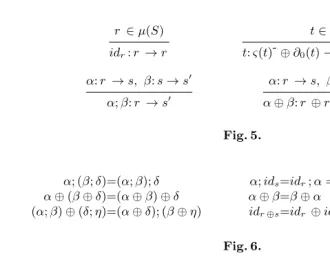
Definition 10. For N = (S, T, ∂0, ∂1, ς) a contextual net, define M(N) as the category in CMonCat with objects the molecules on S, and arrows gen-erated from the rules in Figure 5, modulo the axioms of strictly symmetric strict monoidal categories in Figure 6.
We can now characterize contextual commutative processes algebraically. Theorem 1. The category CT(N) is isomorphic (via a monoidal functor) to the full subcategory ofM(N)whose objects areS⊕N.
Proposition 2. For each moleculer ∈µ(S) andk, n∈N, we have rn⊕rk= rn+k⊕r.
Proof. By Corollary 1, we havern+k⊕r =rn+k⊕rk⊕k·r-. By commutativity (and associativity) of ⊕ we get rn+k⊕r =rn+k⊕k·r-⊕rk. By applying
ktimes Proposition 1 we have the result.
Before proving Theorem 1 we need some other technical lemmata.
Lemma 2. Each moleculer ∈µ(S)factorizes uniquely as u⊕re⊕rn where1 u∈S⊕;
re =k1·a-1⊕. . .⊕kn·a-n with n≥0 andki >0, for i= 1, . . . , n; rn=bh11⊕. . .⊕bmhm with m≥0 andhj >0, for j= 1, . . . , m; where all the ai andbj are distinct places.
Proof. The normal form representation follows by observing that ( )+ and ( )-are monoid homomorphisms and, therefore, distribute over ⊕. Then, by laws (2), (5) and (6), we can reduce the molecule to the ‘sum’ of placesa, electrons a- and nuclei ah. Then, by Proposition 2, we can simplify the expression to a form where at most one nucleus ah withh >0 is present for each a. Finally, if both ah andk·a- are present in the expression, we can simplify the expression according to the following three possibilities, until all the nuclei and electrons refer to different places.
(h > k): thenah= (ah−k)k and, by Lemma 1,k·a- =k·(ah−k)-, henceah⊕ k·a- = (ah−k)k⊕k·(ah−k)- =ah−k by Corollary 1;
(h=k): thenak⊕k·a- =aby Corollary 1;
(h < k): thenah⊕k·a- =ah⊕h·a-⊕(k−h)·a- =a⊕(k−h)·a- by applying
Corollary 1 toah⊕h·a-.
Lemma 3. If the source of an arrow α ∈ M(N) factorizes according to Lemma 2 asu⊕re⊕rn, thenα:u⊕re⊕rn→v⊕re⊕rnfor some v∈S⊕. Proof. It is straightforward to observe thatre andrn are invariants of the
gen-eration rules in Figure 5.
Lemma 4. Each arrowδ:r →sinM(N)can be decomposed as (t1⊕idr1); (t2⊕idr2);. . .; (tk⊕idrk), for somek≥0, where all theti are transitions.
Proof. By structural induction on the expression denotingδ. The complex case is when δ =α⊕β. We can then apply the functoriality of ⊕to get δ = (α⊕ idr); (β⊕ids) wherer is the source ofβ ands is the target of α. Then we
apply the inductive hypothesis toαandβ.
We are now ready to prove the main theorem.
Proof. (of Theorem 1). We start by defining the functor F:CT(N) → M(N). Given a generic step sequenceu0[X1u1. . . un−1[Xnun with lengthn (repre-senting a generic arrow inCT(N)), we let
F(u0[X1u1. . . un−1[Xnun) =F(u0[X1u1);. . .;F(un−1[Xnun), withF(u[Xv) as defined below. Let
uX =t∈XX(t)·∂0(t); vX=t∈XX(t)·∂1(t); wX =t∈XX(t)·ς(t).
We can assume that
wX=k1·a1⊕k2·a2⊕. . .⊕km·am
with m ≥0,ki >0, for i = 1, . . . , m and all the ai different places. Since the step X is enabled at u, then u = u⊕uX ⊕ wX for some u ∈ S⊕. Hence v=u⊕vX⊕ wX . With this notation fixed, let
F(u[Xv) =idu⊕X⊕idak1
1 ⊕idak22 ⊕. . .⊕idakmm .
Note that with this definition, thekitokens needed as context relatively to place ai yield an idle nucleus aki
i , for i= 1, . . . , m. Also notice that whenX =∅the result is just the identity onu.
To show that the mapping Fis well-defined we must show that it respects the diamond equivalence, i.e., that whenu[X⊕Yvis defined, then
F(u[X⊕Yv) =F(u[Xu1);F(u1[Yv)
withu1 uniquely determined byuandX. This follows easily by definition ofF and by the functoriality of the tensor product.
To show that F is faithful it suffices to observe that the only axiom that potentially may break this property (i.e., that could induce too many equali-ties on terms) is the functoriality of tensor product which, on the other hand, corresponds precisely to the diamond equivalence.
Finally, to show thatFis full (on the full subcategory ofM(N) whose objects are markings), we take a generic arrow α:u→v ∈ M(N) with u, v ∈S⊕ and show that there exists a step sequence in CT(N) that is mapped toαbyF. In fact, by Lemma 4 we take a ‘linearization’ ofα(i.e., a sequential composition of transitions in parallel with identities) and show that the obvious firing sequence associated to it can be executed in N. In doing this we employ Lemma 3 and the fact thatu∈S⊕. Observe that this construction defines the inverse toF.
N
a c b
t0 t2 t1
Fig. 7.
t0:a⊕c-→c-, t1:b⊕c-→c- and t2:c→∅,
but neithert0, nort1can represent a commutative contextual process, since their sources and targets are not elements ofS⊕. To remedy this, we must putt0and t1 in an environment where the c- become instances of a ‘complete’ token, as idc+⊕t0:a⊕c→candidc+⊕t1:b⊕c→c. The concurrent execution oft0and t1with shared context is instead written as idc2⊕t0⊕t1:a⊕b⊕c→c: since two electrons are needed the idle nucleus has ‘degree’ 2. By the functoriality of
⊕ , we have that
idc2⊕t0⊕t1= (idc+⊕t0⊕idb); (idc+⊕t1) = (idc+⊕t1⊕ida); (idc+⊕t0), (recall that idc2⊕idc- = idc+), i.e., t0 and t1 can execute in any order. Also interesting is to observe that
(idc+⊕t0)⊕((idc+⊕t1);t2) = ((idc+⊕t0);t2)⊕(idc+⊕t1),
i.e., we have no causal information about the token consumed by t2: is it the one read byt0, or the one read byt1? In fact byidc+⊕t0= (idc+⊕t0);idc and applying the functoriality of⊕we have:
(idc+⊕t0)⊕((idc+⊕t1);t2) = (idc+⊕t0⊕idc+⊕t1); (idc⊕t2). Then,idc⊕t2=t2⊕idcby commutativity of⊕and by applying the functoriality (in the opposite direction than before) we get the equality. Furthermore,
idc+⊕t0⊕idc+⊕t1=idc2⊕t0⊕t1⊕idc (by Proposition 2 and the commutativity of⊕), and thus
(idc+⊕t0)⊕((idc+⊕t1);t2) = (idc2⊕t0⊕t1⊕idc); (idc⊕t2) =idc2⊕t0⊕t1⊕t2 i.e.,t0,t1, andt2can be executed in a concurrent fashion without the possibility of distinguishing this case from those in whicht2causally depends ont0 ort1.
Corollary 2. If N is apt net, thenT(N) is a full subcategory ofM(N). We remark that the constructions we have shown can be easily extended to deal with multiplicities on read-arcs (i.e., to the case in whichς(t) is a multiset rather than a set).
3
Individual Contexts
The maximum sharing hypothesis creates obvious problems when dealing with theITph, whose entire point is to be able to recognize which electrons are emitted from each token. For ordinaryptnets, the information about causality is recov-ered in the algebraic setting by using (non strictly) symmetric strict monoidal categories, i.e., by introducingsymmetries to control rearrangements of tokens in process sequential composition. While at the level of states one can still view standard markings as indexed collections of ordered tokens (rather than resort-ing to take as states the elements of the free monoid on places, i.e., strresort-ings of places), at the level of computations (arrows), however, the tensor product is not commutative anymore, so that one is able to interpret in a canonical way the correct flow of causality through token histories. Thus, the first attempt to a uniform extension of the CTph treatment of the previous section to theITph view is to introduce symmetries on molecules.
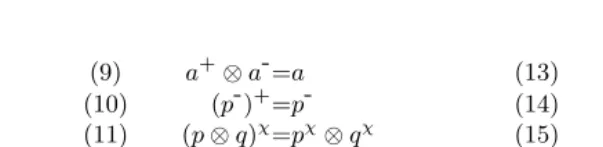
(9) a+⊗a-=a (13) (p-)-=∅ (10) (p-)+=p- (14) (p+)-=p -(11) (p⊗q)χ=pχ⊗qχ (15) ∅χ=∅ (12) aδ⊗b=b⊗aδ (16) a⊗a-=a-⊗a (l.unit) ∅⊗p=p (ass) p⊗(q⊗p)=(p⊗q)⊗p (r.unit) p⊗∅=p
Fig. 8.Axioms for bimolecules (witha=b∈S,δ, ∈N∪ {-}andχ∈ {+,-}).
places – appear in an expression is not relevant. Hence, the monoidal operation
⊗better be commutative in such situations. In other words, we have:
a+⊗b+⊗a-⊗b- =a+⊗b+⊗b-⊗a- =a+⊗b⊗a- =a+⊗a-⊗b=a⊗b, but we definitely want thata+⊗a+⊗a-=a+⊗a-⊗a+, because the particlea -in the two terms is associated to different nuclei and, therefore, the two states may give rise to different causal histories when a transition reads that particle.
We callbimolecules, ranged over byp, q, . . ., the (generalized) markings of the algebra illustrated above. It includes a set of axioms almost identical to those in Figure 4, plus some extra axioms to deal with restricted commutativity. Given a setS, we writeν(S) for the set of bimolecules onS. The complete axiomatization of bimolecules is shown in Figure 8. Note that law (9) – the analogous to (1) for molecules – on bimolecules applies only when a nucleus is immediately on the left of an electron, i.e., a-⊗a+ =a. Furthermore, while law (1) applies to generic molecules, law (9) deals with a single atom (place)a.
The final and key ingredient in our construction is toabandon the symme-try of the monoidal categories involved. With a step similar to the one that led from strictly symmetric to symmetric categories, we choose (non symmet-ric) monoidal categories to which we adjoin exactly and only the symmetries we need. In this way, we are able to omit those symmetries that would cause migration of electrons from atom to atom. In the following we shall build on a construction somehow intermediate betweenP(N) andQ(N) forptnets [12,32] and, therefore, take a non commutative monoid of objects: it is commutative only on some objects, in particular on the markings. We use the symbol ⊗for the monoidal operation and denote the free monoid on the setS byS⊗.
Definition 11. ForN = (S, T, ∂0, ∂1, ς)a contextual net,B(N)is the monoidal category with objects the bimolecules on S, and arrows generated from the rules in Figure 9, together with the symmetries
γaδ,b:aδ⊗b→b⊗aδ, fora=b∈S andδ, ∈N∪ {-},
p∈ν(S)
idp:p→p
t∈T
t:ς(t)-⊗∂0(t)→ς(t)-⊗∂1(t)
u, v∈S⊗
γu,v:u⊗v→v⊗u
α:p→q, β:q→r
α;β:p→r
α:p→q, β:p→q
α⊗β:p⊗p→q⊗q
Fig. 9.
α; (β;σ)=(α;β);σ α;idq=idp;α=α (α;β)⊗(α;β)=(α⊗α); (β⊗β)
α⊗(β⊗σ)=(α⊗β)⊗σ α⊗id∅=id∅⊗α=α idp⊗q=idp⊗idq
(α⊗β);γq,q=γp,p; (β⊗α) γp,q;γq,p=idp⊗idq γp,q⊗r=(γp,q⊗idr); (idq⊗γp,r)
Fig. 10.
The arrows are taken modulo the axioms of strict monoidal categories in Fig-ure 10 (whenever the γ’s are defined) and the laws:
σ;t;σ=t (17)
γaδ,b=idaδ⊗b, fora=b∈S andδ, ∈N∪ {-} (18)
γa,a- =ida⊗a- (19) idak⊗t=idak+1⊗t⊗ida- (∆) for all transitions t:p→q, permutationsσ:p→p,σ:q→q, andk >0.
Sinceγa-,a is inverse to γa,a- =ida⊗a- , it follows thatγa-,a =ida⊗a- . Note that we do not introduce symmetries such as γa-,a- , γak,a- , and γak,an, for
k, n ≥ 1, that would allow the particles to flow from a nucleus to a different one. For example, starting from a⊗a+=a+⊗a-⊗a+ and applying an hypo-thetical arrowida+⊗γa-,a+, we would reacha+⊗a+⊗a- =a+⊗a, allowing the nuclei to exchange electrons, which is problematic. Anothernon-example would be applying the arrowida+⊗a+⊗γa-,a- toa⊗a=a+⊗a⊗a- =a+⊗a+⊗a-⊗a -because, after the exchange, the token of the first and second nucleus get con-fused. By forcingγa-,a- to be the identity we would confuse the electrons of two different nuclei, because of the naturality axiom, and by leaving it free we would allow again for electrons migration. In fact, ourrepresentation invariant is that the electrons associated to a certain nucleusak in a bimoleculeqare determined by following the discipline of proper nesting of open and closed parentheses. The absence of those symmetries maintains this invariant for us.
distinguish between electrons of the same nucleus (the first released, the second, . . . ), as otherwise we would obtain a notion of computation very concrete and far from our target, that is to capture algebraically the notion of contextual process. Axiom (∆) takes care of identifying such particles, as the Example 2 below illustrates.
Example 2. LetN be the contextual net in Figure 7. Then we have three basic arrows inB(N) associated to the transitions ofN:
t0:c-⊗a→c-; t1:c-⊗b→c-; t2:c→∅.
Then, new arrows can be built by composing (sequentially and in parallel) these three arrows with identities and symmetries. For example, the arrowidc2⊗t0⊗t1 goes from c2⊗c-⊗a⊗c-⊗b =c⊗a⊗b to c2⊗c-⊗c- =c. Analogously we have the arrowidc2⊗t1⊗t0:c⊗b⊗a→c. Then, it is possible to prove that these two arrows are identified inB(N). In fact, we have:
idc2⊗t0⊗t1= (idc2⊗t0⊗idc-⊗b); (idc2⊗idc-⊗t1) (by functoriality) = (idc+⊗t0⊗idb); (idc+⊗t1) (by law∆).
Then, by naturality, we have t0⊗idb =γc-⊗a,b; (idb⊗t0);γb,c- , but these sym-metries are just identities and thereforet0⊗idb can be replaced byidb⊗t0 in the expression above.
idc2⊗t0⊗t1= (idc+⊗idb⊗t0); (idc+⊗t1)
= (idc2⊗c-⊗idb⊗t0); (idc2⊗t1⊗idc- ) (by law∆) =idc2⊗t1⊗t0 (by functoriality)
Notice that, as formalised by the following Definition 12, there is only one con-catenable contextual process that starts froma⊗b⊗cand involves exactly one firing oft0 and one firing of t1. By repeatedly applying law (∆) we then have, e.g.,
idc2⊗t0⊗t1=idcn+m+2⊗t1⊗idn·c-⊗t0⊗idm·c
-for alln, m ∈N. This means that the order in which the electrons are read is not important provided that they originated from the same nucleus.
As usual, concatenable processes are taken up to isomorphism. The two con-ditions imposed in the definition above ensure that we order only places of Θ that are instances of the same place ofN, and that on such places the ordering is total.
Likewise concatenable processes ofptnets, a partial operation ofsequential composition can be defined. Provided the target of processπcoincides with the source of processπ, it merges themaximal places ofπwith theminimal places ofπ according to the orders ≺1 and≺0.
Definition 13. Let (π, Θ,≺0,≺1) and (π, Θ,≺0,≺1) be two concatenable contextual processes of a contextual netN, whereTΘ∩TΘ =∅andSΘ∩SΘ is both the set of maximal places for Θ and the set of minimal places for Θ, with π(x) = π(x) for any x ∈ SΘ ∩SΘ, and x ≺1 y iff x ≺0 y for all x, y ∈SΘ∩SΘ. Then, their concatenation(π, Θ∪Θ,≺0,≺1) = (π, Θ,≺0 ,≺1); (π, Θ,≺0,≺1)is well defined, whereπis the componentwise union ofπ andπ (i.e., π(x) =π(x)ifx∈Θ andπ(x) =π(x)ifx∈Θ).
The composition is well defined because by hypothesis we haveπ(x) =π(x) for allx∈Θ∩Θ=SΘ∩SΘ, i.e., merged places have the same names.
The parallel composition of two processes consists of taking their disjoint union and extending the orders on minimal and maximal places by x ≺i y wheneverxbelongs to the first process,y to the second, andπ(x) =π(y).
Definition 14. Let (π, Θ,≺0,≺1) and (π, Θ,≺0,≺1) be two concatenable contextual processes of a contextual netN, whereTΘ∩TΘ=∅andSΘ∩SΘ=
∅. LetS0 andS0 be the set of minimal places of Θ andΘ, respectively. Like-wise, letS1 andS1be the set of maximal places ofΘandΘ, respectively. Then, the parallel composition(π, Θ∪Θ,≺0,≺1) = (π, Θ,≺0,≺1)⊗(π, Θ,≺0,≺1) is well defined, where
π is the componentwise union of π andπ; and
x ≺i y iff (x, y ∈ Si ∧x ≺i y)∨(x, y ∈ Si∧x ≺i y)∨(x ∈ Si ∧y ∈ Si∧π(x) =π(y)).
It can be shown that with these two operations the concatenable contextual processes ofN form the arrows of astrict monoidal categoryCP(N).Symmetries can be defined by taking a process that contains just places (no transitions) with suitable orderings≺0 and≺1. Each place is both minimal and maximal. These symmetries makeCP(N) a symmetric monoidal category inSSMC⊕.
Definition 15. A concatenable contextual process is called elementaryif it con-tains at most one transition.
Definition 16. Given a contextual netN and a transitiont∈TN, the elemen-tary concatenable contextual process [t] = (π, Θ,≺0,≺1) associated tot is given by
SΘ={a,0, n |a∈ ∂0(t) , 1≤n≤∂0(t)(a)}∪
TΘ ={t};
∂0(t) ={a,0, n |a∈ ∂0(t) , 1≤n≤∂0(t)(a)}; ∂1(t) ={a,1, n |a∈ ∂1(t) , 1≤n≤∂1(t)(a)}; ς(t) ={a,2,1 |a∈ ς(t) };
π(a, j, n) =a and π(t) =t;
a, i, k ≺0b, j, h iff a=b∧i=j= 0∧k < h.
a, i, k ≺1b, j, h iff a=b∧i=j= 1∧k < h.
Note that the places in{a,2,1 |a∈ ς(t) }are both minimal and maximal. Only the trivial (empty) order is needed on them, because we rely on the basic assumptions thatς(t) is a set and thatς(t)∩ ∂0(t)∪∂1(t) =∅, for anyt∈TN.
Proposition 3. Each elementary concatenable contextual process(π, Θ,≺0,≺1) that contains exactly one transition, sayx, can be obtained asσ1; ([π(x)]⊗σ2);σ3 for suitable elementary concatenable contextual processes σ1, σ2 and σ3 that contains no transition.
Proposition 4. The concatenable contextual processes of a contextual net N can be obtained as the sequential composition of elementary concatenable con-textual processes.
Proof. Likewise the analogous statement for ordinary pt nets, the proof is by induction on the number of transitions in the process net (exploiting
Proposi-tion 3).
Theorem 2. The category CP(N) is isomorphic (via a symmetric monoidal functor) to the full subcategory of B(N) whose objects are the elements of S⊗ (which is symmetric).
Before proving the main representation theorem above, we need some tech-nical lemmata that state useful properties of the arrows in B(N). We start by extending some of the properties of molecules to the framework of bimolecules.
Lemma 5. For each bimolecule pand each k∈N, we have (pk)- =p-.
Proposition 5. For each placeaand each k∈N, we have ak=ak+1⊗a-. Proof. The proof proceeds by induction onk. For the base case (k= 0) we get a=a+⊗a- directly by law (9). For the inductive case, we assume the property to be valid fork=nand prove it fork=n+ 1. Then,
an+1= (an)+ (by definition)
= (an+1⊗a-)+ (by inductive hypothesis) = (an+1)+⊗(a-)+ (by law 11)
=an+2⊗a- (by law 10).
Corollary 3. For each placea and eachk∈N, we havea=ak⊗k·a-. Lemma 6. Each bimoleculepcan be decomposed asp=p1⊗p2⊗. . .⊗pn, where each pi has the form ki,0·a-i⊗akii,1⊗aiki,2⊗. . .⊗akii,ni with ai=aj, fori=j.
Lemma 7. If p⊗q∈S⊗, then for each u∈S⊗ we havep⊗u⊗q∈S⊗. Proof. It suffices to prove the property foru∈S, which can be done via a simple case analysis, exploiting the representation ofpandqprovided by Lemma 6 and
applying law (16).
Note that in the previous lemma,p and q are generic bimolecules and not necessarily markings, in factp⊗q∈S⊗ does not imply that p∈S⊗∧q∈S⊗. We can now state some invariant and decomposition properties for the arrows in B(N).
Lemma 8. Ifα=idp⊗γx,y⊗idq withp⊗x⊗y⊗q∈S⊗, thenp⊗y⊗x⊗q∈S⊗ Proof. By a simple case analysis: all symmetries are collapsed to identities,
ex-cept when x=y=afor somea∈S.
Lemma 9. Ifα=idp⊗t⊗idq andp⊗ς(t)-⊗∂0(t)⊗q∈S⊗, thenp⊗ς(t)-⊗ ∂1(t)⊗q∈S⊗.
Proof. Follows from Lemma 7.
Proposition 6. Each α∈ B(N)can be decomposed as
α=σ0; (idp1⊗t1⊗idq1);σ1; (idp2⊗t2⊗idq2);σ2;. . .; (idpn⊗tn⊗idqn);σn, where theσiare permutations (i.e., sequential and parallel compositions of sym-metries and identities) and theti are transitions.
Proof. By structural induction. The complex case is for α=α1⊗α2 for some α1:r1 → r1 and α2:r2 → r2. But then, by functoriality we have α = (α1⊗ idr2); (idr
1⊗α2) and by inductive hypothesis
α1=σ0; (idp1⊗t1 ⊗idq1);σ1; (idp2⊗t2⊗idq2);σ2;. . .; (idp
n ⊗tn⊗idqn);σn,
α2=σ0; (idp1 ⊗t1⊗idq1);σ1; (idp2 ⊗t2⊗idq2);σ2;. . .; (idp
n⊗t
n⊗idq
n);σ
n, Then, by functoriality:
α1⊗idr2 = (σ0 ⊗idr2); (idp1⊗t
1⊗idq1⊗r2); (σ1 ⊗idr2); (idp2⊗t
2⊗idq2⊗r2);
(σ2 ⊗idr2);. . .; (idp
n⊗tn⊗idqn⊗r2); (σn⊗idr2),
idr
1⊗α2= (idr1⊗σ
0); (idr1⊗p1 ⊗t1⊗idq1); (idr1⊗σ1); (idr1⊗p2⊗t2⊗idq2); (idr
1⊗σ
2);. . .; (idr1⊗pn⊗tn⊗idqn); (idr1⊗σn),
The main law (∆) can then be extended to generic arrows whenever we know that the rightmost electron belongs to the nucleus that precedes the arrow.
Corollary 4. For eachα:p→q∈ B(N),a∈S andk >0such thatak+1⊗p⊗ a-=ak⊗pwe have idak+1⊗α⊗ida- =idak⊗α.
Corollary 5. If α:u→q∈ B(N) withu∈S⊗, thenq∈S⊗.
Proof. Consequence of Proposition 6 and Lemmata 8 and 9. Lemma 10. If α =idp⊗t⊗idq ∈ B(N) with t a transition and p⊗ς(t)-⊗ ∂0(t)⊗q∈S⊗, then α=σ; (idς(t)+ ⊗t⊗idu);σ for some permutations σand σ and some markingu∈S⊗.
Proof. By the decomposition of Lemma 6, and by the fact that the source ofαis a marking, it follows thatp=a∈Saka,1⊗. . .⊗aka,na andq=a∈Sha·a-⊗ha·a. It follows that each electron a- inς(t)- belongs to the closest ion on the left of the electron (namely, the iath nucleus of typea inpwithia the greatest index in 1≤ia ≤na such thatka,ia >0). Moreover, thehaelectrons of typeainqcan be attached to their corresponding nuclei inp, by applying law (∆). Therefore we haveα=idp⊗t⊗idvwhere p=a∈S(ia−1)·a⊗a+⊗(n
a−ia)·a(ifa is not read bytthen the corresponding argument in the sum is justna·a), and v=a∈Sha·a. Then, by naturality of symmetries, we have:
α= (idp⊗γv,ς(t)-⊗∂0(t)⊗idv); (idp⊗t⊗idv⊗v); (idp⊗γς(t)-⊗∂1(t),v⊗idv), where p = a∈S(ia −1)·a⊗a+ and v =
a∈S(na −ia)·a. In fact the symmetries that we have used in the expression are defined since they involve the swappings of ‘complete’ tokens with either ‘complete’ tokens, or electrons. By naturality we have also:
idp⊗t⊗idv⊗v= (γv,ς(t)⊗∂0(t)⊗idv⊗v); (idς(t)+⊗t⊗idv⊗v⊗v); (γς(t)⊗∂1(t),v⊗idv⊗v)
wherev=a∈S(ia−1)·a. By taking
σ= (idp⊗γv,ς(t)-⊗∂0(t)⊗idv); (γv,ς(t)⊗∂0(t)⊗idv⊗v) σ= (γς(t)⊗∂1(t),v⊗idv⊗v); (idp⊗γς(t)-⊗∂1(t),v⊗idv)
u=v⊗v⊗v
we have the thesis.
Proposition 7. Each α:u→q∈ B(N)withu∈S⊗ can be decomposed as α=σ0; (idς(t1)+⊗t1⊗idu1);σ1; (idς(t2)+⊗t2⊗idu2);σ2;. . .;
(idς(t
n)+⊗tn⊗idun);σn,
![Fig. 11. The proof of G(([t1] ⊗ σ1); σ; ([t2] ⊗ σ2)) = G(σ′; ([t2] ⊗ σ2′); σ′′; ([t1] ⊗ σ1′)).](https://thumb-us.123doks.com/thumbv2/123dok_us/1030443.618426/27.595.60.389.75.424/fig-the-proof-g-s-s-s-s.webp)
