Evolving Sounds
Brian Keegan
Department of Music
Trinity College Dublin
Declaration
I declare that this thesis has not been submitted as an exercise for a degree at this or any other university and it is entirely my own work.
I agree to deposit this thesis in the University’s open access institutional repository or allow the library to do so on my behalf, subject to Irish Copyright Legislation and Trinity College Library conditions of use and acknowledgement.
_____________________
Abstract
This work concerns the role of musical time and space in relation to the body of compositions that form part of this research. Although these two areas are immense, they are nonetheless unavoidable in music composition.
The physics of the last one hundred years confirms, the movement of time is relative. This is no less the case in music. There is clock time which marks the passage of our existence but there is also another time that is both complex and liberating. The latter time can seem to be stretched or compressed or completely static. These are the parameters that can be
experimented upon in music composition.
The contents of successive slices of time are also fruitful areas for experimentation. Space can be filled so that it seems dense and massive. Alternatively, it may be filled very delicately so that it is almost transparent. When sounds become thin enough, they give way to silence.
The compositions that make up this research explore various aspects of time and space as outlined above. For example, in “Suspiramus”, the silences, marked by fermatas of varying length, have the same status as the audible sound. Just as with breathing, in this composition, the silent rested part is as important as the noisy in-out movement.
The research presented here explores the connection between the static work of art, visible in an instant and music which unfolds over time. It looks at the influence a number of art works have had on the composition of these pieces. For example, the role of dynamism in painting and its influence on the buzzing snare drum rolls on which Mjöllnir is built.
Acknowledgements
Thanks to the following musicians and collaborators:
Elaine Clark, Rhona Clarke, Dermot Dunne, David James, Martin Johnson, Garth Knox, Victoria Massey, Gillian Maitland, Caroline Moreau, Kevin O’Connell, Richard O’Donnell, Maeve O’Hara, Ruth O’Reilly, Roberto Oliveira, Paul Roe, Ulrike Schrettenbrunner, Salvatore Sciarrino, Madeleine Staunton, Tine Verbeke and Gabriele Walter. Thanks too to the staff of Trinity College Library.
Special thanks to Sarah Lane and Anne Murnaghan.
Table of Contents
Introduction ... 1
1 Time ... 5
1.1 Introduction ... 5
1.2 Duration ... 10
1.3 Stasis ... 19
1.4 Echoes & Drones ... 24
1.5 Fragments & Voices ... 30
1.6 Conclusion ... 33
2 Space ... 35
2.1 Introduction ... 35
2.2 Waves ... 37
2.3 Form ... 42
2.4 Transparency & Density ... 44
2.5 Silence, Noise, Colour ... 48
2.6 Conclusion ... 54
3 Translation ... 56
3.1 Introduction ... 56
3.2 Crossings ... 59
3.3 Simultaneity ... 63
3.4 Mood ... 69
3.5 Conclusion ... 75
4 Notation ... 77
4.1 Introduction ... 77
4.2 Notating Time and Space ... 79
4.3 Conclusion ... 84
5 Conclusion ... 86
Bibliography ... 90
List of Figures
Figure 1 Compositions that make up this research ... 2
Figure 2 “Hier Wohnte” - cells ... 15
Figure 3 “After the Rain” - durations ... 16
Figure 4 Suspiramus - 'cells' of varying duration ... 18
Figure 5 Salve Regina extract with first nine voices ... 21
Figure 6 “After the Rain” ... 23
Figure 7 Development of an echo over time ... 24
Figure 8 “Hier Wohnte” Time being 'reset' ... 27
Figure 9 Typical form of ADSR ... 28
Figure 10 Abbandonati extract ... 29
Figure 11 Poltergeist extract ... 32
Figure 12 L'Infini Vivant extract ... 34
Figure 13 Constructive Interference ... 39
Figure 14 Cancellation ... 39
Figure 15 Waves evolving over time ... 40
Figure 16 Mjöllnir extract ... 41
Figure 17 L'Infini Vivant 'existance' ... 43
Figure 18 L'Infini Vivant 'Je l’aime' ... 43
Figure 19 Suspiramus Wave of breathing in the end ... 44
Figure 20 Maeve O'Hara playing Ymir ... 46
Figure 21 Water drops shatter on impact with a cymbal. ... 47
Figure 22 Ymir ... 47
Figure 23 Henry Moore, RecliningConnectedForm (1969). ... 49
Figure 24 Luigi Nono Fragmente ... 52
Figure 25 Ymir extract ... 53
Figure 26 “Suspiramus” 'noise chord' ... 54
Figure 27 Viktor Hartmann Paris Catacombs ... 56
Figure 28 Michelangelo Rondanini Pietà ... 58
Figure 29 Xenakis Metastasis. ... 63
Figure 30 Giacomo Balla Dynamism of a Dog on a Leash (1912) ... 64
Figure 31 Mjöllnir buzz rolls... 65
Figure 32 Hydrodynamics of ship propellers ... 66
Figure 33 Visual Analysis of Propellers (1942) ... 67
Figure 34 Propellers extract ... 68
Figure 35 Luigi Nono Abbandonati (1903) ... 70
Figure 36 Gunter Demnig stolperstein. ... 71
Figure 37 Visual Analysis of Rondanini Pietà ... 73
Figure 38 Eusebio Sempere Paisaje Iluvioso (1965) ... 74
Figure 39 “After the Rain” - tremolo ... 75
Figure 40 Philip Corner Mississippi River South of Memphis. ... 78
Figure 41 Mjöllnir 'cut score' ... 80
Figure 42 L'Infini Vivant 'cut score' ... 80
Figure 45 Lachenmann Pression. ... 81
Figure 46 Growl direction from Poltergeist. ... 82
Figure 47 Mjöllnir tablature ... 83
1
Introduction
There is no such thing as an empty space or an empty time.1
The title Evolving Sounds is used as a description of the compositions and theoretical approach taken in this research. It points towards two fundamental and, for the composer, unavoidable aspects of music. These are the basic facts that musical time progresses and that something is happening during that time. Cage’s quote above leaves us with very broad possibilities as to what will happen and exactly when it will happen during the progress of musical time.
Underlying this progression of musical time, providing a theoretical backdrop, the research looks at two parameters, time and space. Clearly, these are immense and complex concepts but in the context of music composition they are unavoidable. The pieces presented here are not intended to be realizations of some space-time effects. Therefore, with these pieces, no particular psychoacoustic effect on the listener is sought. They are, rather, experiments into the possibility of using spatial or temporal phenomena or visual art as strong guiding principles in their creation and the process of composition itself is built on aspects of space and time.
Evolving Sounds draws attention to the body of compositions that lies at the centre of this work as essentially ‘sounds’ that are realized as music. Across the ten compositions that are the focus of this work, various aspects of evolving sounds are explored. As sounds occupying space, this music is made of a range of densities and textures. These range from relatively dense (Mjöllnir, Ymir and Salve Regina) to great sparseness (Suspiramus, “Hier Wohnte” and Poltergeist). In some compositions, the texture is relatively uniform throughout (“After the Rain” and Abbandonati), while in others there is a mix of the two extremes (Propellers and L’Infini Vivant).
The aims of this research have been tackled through the use of small ensembles. While the size and makeup of these ensembles is, to some extent a matter of practicality, composing for these ensembles also puts an emphasis on the writing for and the notation of very specific instruments and techniques.
2
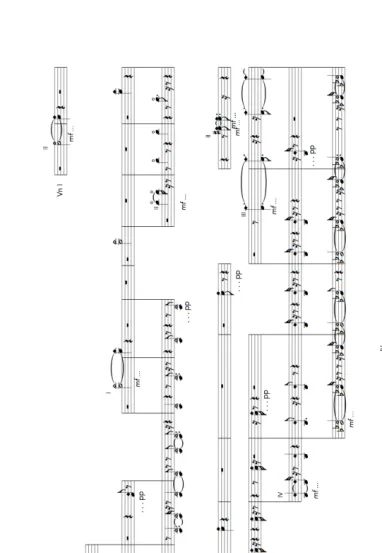
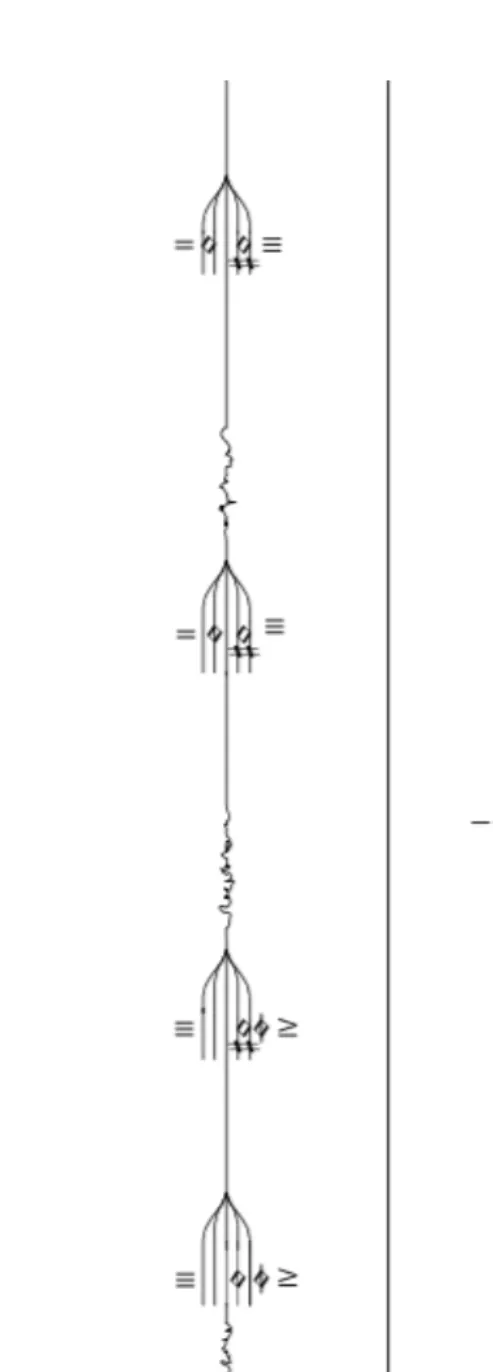
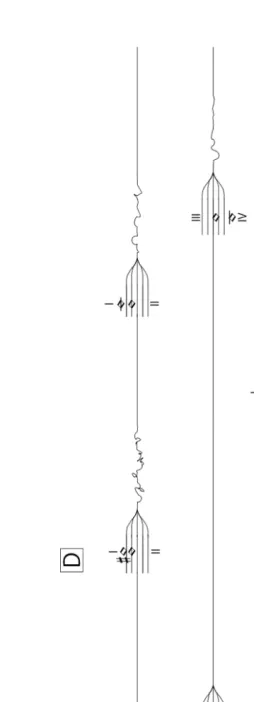
The compositions that make up this research, along with their instrumentation, is shown in Figure 1 below.2
Abbandonati - Solo marimba Mjöllnir - Snare Drum Duet Poltergeist 3- Cello, Soprano
L’Infini Vivant 4- Soprano, Timpani, Strings
Salve Regina - Female Choir
Propellers - Flute, Bass Clarinet, Accordion, Violin, Cello
Ymir5 - Bowed metal percussion, recorded water drops on metal
String Quartet 16
I – “After the Rain” II – “Suspiramus” III – “Hier Wohnte”
Figure 1 Compositions that make up this research
In broad terms, in this research, the ensemble types are utilized to explore the following areas:
Vocal music – fragments and collage Percussion – densities and dynamism String Quartet – the progress of time
With the focus on sound, notions of key, pitch centre or even pitch at all, become less important. In this context, the density of a chord or a cluster is of much greater importance than its pitch material. One of the characteristics of the densities achieved in these
compositions is the non-primacy of pitched material or any resultant established harmony. Free from this conventional parameter, the music can reside somewhere along a spectrum. At one extreme there is silence, effectively the thinnest of textures. Silence, therefore, is an
2 The website www.evolvingsounds.com has audio examples of the compositions presented here. 3 Winner of the DAAD/Embassy of Germany in Ireland Creative Arts Prize, 2014.
4 Winner of the Francois de Roubaix Composition Award, Marseilles, 2014.
5 Commissioned by TCD/Discover Research Dublin, 2014.
6 The pieces that make up String Quartet 1 could not be considered as ‘movements’ in any conventional
important feature of a number of the compositions presented here and also an important aspect of the discussion of how musical space is filled. At the other extreme is the
accumulation of texture to the point of creating noise. This is an important aspect of the composition Ymir.7
The research presented here then, follows in a tradition of late twentieth composition.8 In his
1958 essay, The Composer as Specialist, Milton Babbitt outlines developments in new music that differentiate it from what went before. Among these, he mentions the characteristics of the basic building blocks of music:
Along with this increase of meaningful pitch materials, the number of functions associated with each component of the musical event also has been multiplied. In the simplest possible terms, each such “atomic” event is located in a five-dimensional musical space determined by pitch class, register, dynamic, duration, and timbre. These five components not only together define the single event, but, in the course of a work, the successive values of each component create an individually coherent structure, frequently in parallel with the corresponding structures created by each of the other components.9
With regard to his own compositional development, Ligeti refers to the repurposing of conventional material, ‘Pitches and intervals now had a purely global function as aspects of compass and note density’.10 In the compositions presented here, an emphasis is placed on
such alternative uses of this material in, for example, the creation of stasis, echoes, pulsing, cycling, blurring and densities.
These aspects of music are explored in the chapters below. The following is an overview of the chapters in this research:
Chapter One looks at musical time. It examines the importance of duration as a means of musical measurement. It also looks at stasis, when time appears unmoving or inactive and also
7 Musical density is explored in Chapter Two with reference to Xenakis, Cage and Stockhausen. 8 Throughout this research there is a particular emphasis on the writings of twentieth-century
composers in particular. Though some of these date from the 1950s, 1960s and 1970s, times when genuinely new sounds worlds were being created, these works are insightful and important in the context of the research presented here.
looks at dynamism, where time is packed with activity. The role of drones and echoes are explored as sound events that play with the notion of duration. Finally, sounds fragmented across time, especially those produced by the voice are explored.
Chapter Two looks at space, how space is occupied in general and in music. A feature of this chapter is the idea that space is filled with waves and that these act as carriers for musical information such as timbre and pulse. This chapter also looks at how musical space is occupied with, for example, noise, silence and timbres.
Chapter Three is concerned with the influences that lie behind these compositions. As the subject matter of this research is time and space, a strong connection is drawn between the temporality of music and the spatiality of visual art. The effect of particular examples of visual art on the structure of some of the compositions presented here is examined. Similarly, the relationship between the mood or tone of an artwork and a composition is explored.11
Chapter Four deals with how the various aspects of the compositions are realized through notation. As the pieces present novel approaches to time and space, there is a requirement for unconventional and original methods of notation.
As mentioned above, the pieces that make up this research are concerned with the use of space and time in music composition. This is however just the starting point of writing and the compositions are, ultimately products of the imagination. The ideas presented here about evolving sound help at the pre-compositional phase and in the realization of scores. The concept of evolving sound continues through the playing events (workshop – rehearsal - performance) and on to the revisions of scores. These stages, rather than being endings in themselves are part of the process, enabling the sounds and whole compositions to evolve into the completed works that make up this research. This iterative process, the shaping of material by the composer is expressed by Xenakis. Regarding the process of beginning his compositions with statistical material and then shaping material derived from a computer program, Xenakis reminds us that the composer will, ‘instill his own personality in the sonic results’.12
1
Time
Real musical time is only a place of exchange and coincidence between an infinite number of different times.13
1.1
Introduction
Gerard Grisey concludes his 1987 essay, Tempus ex Machina, with the line given above. In doing so he accepts that time has become something altogether different from what it had traditionally been for centuries in Western music. Time acts in units and groups, it can exist somewhere between ordered and disordered and most importantly, the perception of time in music is a function of the sounds from which that music is made.
The definition of time has always been a thorny subject as the view of St. Augustine attests: ‘if no one asks me I know; but if someone asks me and I want to explain it, I do not know.’14
Much later Schopenhauer concludes, ‘Time in itself is empty and without properties’.15 Later
still, Einstein discovers that the most essential quality of time is that it is not absolute. How time passes depends on other factors. Fundamental to this is Einstein’s conception of special relativity which tells us that, in absolute terms, the passage of time is relative to the perceiver of time. His classic example of this makes reference to the different perceptions of temporal events by a person on a moving train and another standing on a station platform watching the train pass by.
Einstein’s conclusion, that time has a looseness to it, is the starting point for the current research. It gives a license for the exploration of musical time through the creation of compositions.
The notion that musical time is not an absolute or that it can, at least, have two fundamental characteristics, has long been recognized. Two approaches to time are given by David Epstein, ‘Time has dual modes of structure. One is essentially clocklike, a measurement mode that mechanically delineates equal periods. The other mode relies upon experience for its demarcation – experience that is particular and unique’. 16 Epstein continues:
Both modes run simultaneously, in some respects serving to reinforce one another, in other situations achieving dissonant opposition by being out of phase. Chronometric time, by its periodic nature, is structured by constant factors. Integral time is structured by elements intrinsic to its unique situation(s).17
In his Poetics of Music in the Form of Six Lessons, Stravinsky presents the thinking of Pierre Souvtchinsky who, like Epstein above, notes that there are two kinds of musical time, one running parallel to ontological time, the other running counter to it. Of this second, termed ‘psychological time’, Stravinsky writes, ‘It is not self-contained in each momentary tonal unit. It dislocates the centers of attraction and gravity and sets itself up in the unstable; and this fact makes it particularly adaptable to the translation of the composer’s emotive impulses’.18
With the psychological aspect of musical time dislocated from the ‘centres of attraction’, as Stravinsky terms it, or musical time uncoupled from clock time, Mark Delaere identifies what happens to rhythm when it is detached from metre. According to Delaere:
… the most radical innovation in the composition of time in twentieth-century music is arguable the use of (non-metric) ABSOLUTE RHYTHM. To imagine rhythmic
structures independently from metre is to deviate considerably from common practice in the composition of Western art music. With absolute rhythm, durations do not result from the division of a metrical pattern or beat but are used as values per se.19
The identification of time units that exist per se or that are intrinsic to their unique situations as Epstein terms it, is extremely important. It raises this question: if units of musical time are detached from clock time, what are these units of musical time? Sethares goes some way in identifying these units. He suggests that a rhythmic passage can be interpreted as 1) a sequence of events or 2) a sequence of durations.20 The second of these, the notion of
duration as a discrete element in musical time and musical composition, was later championed by John Cage (see section 1.2 below).
The first of these interpretations, time as a sequence of events, had previously been explored
17 (Epstein 1995) 10.
by Messiaen in his “Little Theory of my Rhythmic Language” in the introduction to his score for Quartour pour la fin du temps. There, Messiaen proposes his alternative to conventional rhythmic measurement, ‘the notions of ‘bar’ and ‘time’ are replaced by the idea of a short value (the semiquaver, for example) and of free multiplications; …’.21
Messiaen’s ‘free multiplications’, without the use of bars, became a mainstream approach for many composers subsequently. Here Ligeti explains his own relationship with barred music:
…I had to get away from the idea of seeing music divided by bars altogether. Of course, I went on using bar-lines and conventional musical notation in most of my
compositions; in the actual music, however, bar-lines had no other function for me than as points of reference, to keep the four string players of a quartet for instance from drifting away from one another. My music is a continuous flow, unbroken by bars, like a Gregorian melody.22
Delaere refers to ‘multidimensional time and non-linear time.’ He describes these as, ‘the superposition of several time layers, each moving at its own speed and more or less
directionless’. He cites Ives’ The Unanswered Question as a good example of this with its layers of textures, pitch collections and novel timings. Referring to Ives, Delaere’s explains the idea of multidimensional time:
In the case of Charles Ives, the superposition of time layers is usually motivated by programmatic ideas in general and childhood memories in particular. Past and present are combined simultaneously in a ‘stream of consciousness’, which makes Ives’ music arguably the musical counterpart of Marcel Proust’s A la recherche du temps perdu.23
This quality of stream of consciousness is a feature of the three pieces in this research that make up my String Quartet 1 presented in this research. In “After the Rain”, for example, there is no demarcation of time, no rhythm, events just seem to appear. “Hier Wohnte” is made from pulses of echoes that form their own ‘rhythm’. These pieces, therefore, are built from spans of time rather than points in time. In these pieces, time is a function of the specific musical events internal to the pieces and not reliant on any external source of time.
21 (Messiaen 1941) ii. 22 (Ligeti et al. 1983) 14.
23 (Delaere 2009) 28. Presumably here Delaere is drawing a comparison based on stream of
Spans of time are of interest not in terms of what happens temporally within them, how long they are or what rhythm they have, but also in terms of how they accumulate or dissipate (see 2.4 below), what timbre develops within them (see 2.5 below) or how they interact with each other (see 2.2 below).
Kramer defines meter as the ‘patterned succession of accented timepoints’. However, in his explanation below he reveals an interesting and pertinent view of musical time:
Just as there is an infinite number of points between any two points in geometric space, so there is an infinite number of timepoints between any two successive timepoints in music, no matter how closely together they occur. Not all these intervening timepoints are important, however. Meter singles out certain timepoints from the infinite
succession and marks them for musical significance. It is because of the constant flow of timepoints of varying degrees of accentuation that we can feel meter as motion.24
So, underlying meter (the demarcation of time) is a flow of timepoints that manifests itself as motion.25 In his description of the flow of time, Kramer uses a variety of terms such as
motion, continuity, progression, pacing, proportion, duration and tempo.26
The notion of movement through time points is the essential area of study in Epstein’s book, Shaping Time. According to Epstein:
The essence of temporal experience is movement, or motion, through time. Motion may thus be the quintessential factor in music, the aspect of music to which all else is
ultimately subservient, the aspect that in turn “moves” us in our affective experience with music.27
From the comments of both Kramer and of Epstein, it seems that we do not perceive time, we perceive changes. Time, therefore, is a function of the changes between the slices that it
24 (Kramer 1988) 83.
25 Kramer’s time points are a rather ‘digital’ way of looking at time. Another, more ‘analogue’ approach
is to look on musical time as waves. This is explored in 2.2 below.
contains. If there are no changes then we perceive time as standing still, just like a movie that has been paused on a single frame.
Messiaen deals with the concept of movement and non-movement and takes movement to be fundamental to the differences between ‘Time’ and ‘Eternity’. While considering the thinking of Saint Thomas on the concepts of eternity and time, Messiaen arrives at an interesting definition of time. He looks at the absence of movement and concludes that without
movement, there is no time. Without movement, there is permanence and that is the realm of eternity.
As eternity is the proper measure of permanent being, so time is the proper measure of movement; and hence, according as any being recedes from permanence of being, and is subject to change, it recedes from eternity, and is subject to time. Therefore, the being of things corruptible, because it is changeable, is not measured by eternity, but by time; for time measures not only things actually changed, but also things changeable; hence it not only measures movement but it also measures repose, which belongs to whatever is naturally movable, but is not actually in motion. This explains what stasis is.28
In the compositions in this research, time sometimes passes rapidly (Mjöllnir). Sometimes slowly (Abbandonati, Propellers) and sometimes it is nearly static (Salve Regina, “After the Rain”). These pieces look at what happens to time when space is filled and dense (Ymir) or empty and spacious (Suspiramus, “Hier Wohnte”).
The expansion of time from something instantaneous to something lasting many minutes is explored in two pieces. Just as Propellers is the unfurling of a single image (see 3.3 below), Poltergeist is the unfurling of a single word (see 1.4 below). With Poltergeist, a linguistic event that should last a moment is time stretched so that a single word occupies the space of several minutes. In effect, the music is structuring time.
Ultimately, musical time tends to be quantized or segmented. There are few instances in music where this does not happen. This segmentation happens all the more when music has to be notated, when the composer’s intentions have to be encoded in some systematic way. The
28 The classic example of stasis is La Monte Young Composition 1960 Number 7 that consists of just two
pieces in the current research attempt to go some way along this path and this could be summed up by saying that what is encoded or notated is a sense of periodicity. There is a sensation of cycles, loose or strict. For this reason, a number of the pieces here relate to natural rhythms, cycles or pulses. These include Mjöllnir, Salve Regina and “Hier Wohnte”. To facilitate this the notation in these pieces tries to find ways to loosen the periodicity.29
The sections below deal with aspects of the research pieces presented here. These include the idea of duration as an autonomous unit of music composition, pertinent to all the
compositions in general but to Suspiramus in particular, Dynamism (Propellers and Mjöllnir), Stasis (“After the Rain”), Drones (Abbandonati), Echoes (“Hier Wohnte”), Fragments (Poltergeist, L’Infini Vivant, Salve Regina).
1.2
Duration
As shown above, durations of musical time consisting of passages of time (as opposed to collections of beats or segments of metre) became extremely important for composers and for none more than John Cage. For Cage, duration has the special property that silence, which he regarded as being on a par with other characteristics of music, could be incorporated within it.
Sound has four characteristics: pitch, timbre, loudness, and duration. The opposite and necessary coexistent of sound is silence. Of the four characteristics of sound, only duration involves both sound and silence. Therefore, a structure based on durations (rhythmic: phrase, time lengths) is correct (corresponds with the nature of the material). whereas harmonic structure is incorrect (derived from pitch, which has no being in silence).30
In the following, Cage integrates three fundamental ideas of his music (silence, duration and form) into a single unified theory, ‘The strict division of parts, the structure, was a function of the duration aspect of sound, since, of all the aspects of sound including frequency, amplitude, and timbre, duration, alone, was also a characteristic of silence’.31 So for Cage, form is
29 This would go beyond conventional aperiodicity such as rubato, accelerando or ritardando (Yeston 1975). 30 (Cage 1973) 63.
duration. That definition allows for the creation of 4’33”, for example, where the ‘content’ of the piece is that which occupies the duration of the piece.
According to Cage, ‘Schools teach the making of structures by means of classical harmony. Outside school, however (e.g., Satie and Webern), a different and correct structural means reappears: one based on lengths of time’.32 Using different terminology, Stockhausen similarly
recognizes the structural importance of duration or what he terms, phases: Music consists of order-relationships in time; this presupposes that one has a conception of such time. We hear alterations in an acoustic field: silence – sound – silence, or sound – sound; and between the alterations we can distinguish time-intervals of varying magnitude. These time-intervals may be called phases.33
The designation of musical time into durations or phases has an interesting side effect, one that concerns our perception of these quantities of time. Grisey explains as follows:
Let us imagine a sound event, A, followed by another event, B. Between A and B exists what one calls the density of the present, a density which is not a constant but which expands and contracts according to the event. In effect, if the difference between A and B is virtually nil, in other words if the sound B is entirely predictable, time seems to move at a certain speed. By contrast, if the sound B is radically different, and virtually unpredictable, time unfolds at a different speed. 34
The notion of time unfolding at different speeds is recognized as a psychoacoustic
phenomenon of use in the composition of music, but flexibility of our perception of time is also of much broader significance and is of fundamental importance in the work of Albert Einstein. In his theory of Special Relativity, time and space are flexible depending on the location and movement of the perceiver. So, for example, at higher altitudes, time runs faster. and time runs slower the closer we are to very dense matter. This phenomenon is known as Time Dilation and seems to have parallels in music. Musicians follow the regular beat of the conductor, so for them 60 beats at 60 bpm takes one minute. For a member of the audience that duration may seem shorter or longer due to any number of influences.
32 (Cage 1973) 63.
On this question of the perception of time and the perception of stasis, Zakay and Block look at how time is estimated based on what is perceived in the moment and what is remembered.
Because cognitive variables (e.g., the attentional demands of a task) greatly influence estimates of short durations, many theorists have proposed cognitive models of psychological time. Psychological time depends on complex interactions among the conditions under which a duration is experienced and the context in which the estimate is given. (Block, 1989). One important factor is the time estimation paradigm. The differences between prospective and retrospective time estimations are now becoming clear. Under prospective conditions, participants focus their attention on time during a target duration and accumulate relevant temporal cues. Under retrospective conditions, however, participants primarily construct a duration judgement from information stored in memory representing the number of contextual changes that occurred during an interval.35
Messiaen recognizes the effect of time dilation in the most mundane of situations, ‘If we address the present, it is evident that waiting and inaction create a void which slows the passage of time. On the contrary, joy, work, and all that occupies us and captivates our attention speeds the passage of time.’36 To extend this to musical time, the implication is that
what time is filled with determines how that time is perceived.
Returning to Grisey on this same point, he presents a useful analogy for how time can appear to contract or expand corresponding to the compression and rarefaction of air.
There must exist holes in time, analogous to what aeroplane passengers call "air pockets". Chronometric time is never obliterated but our perception of it can overshadow the linear aspect for a more or less brief instant.
Thus, for example, an unexpected acoustic jolt causes us to skate over a portion of time. Sounds perceived during the ensuing moment of readjustment - a moment which is necessary for us to regain a relative equilibrium - no longer have anything like the same emotional or temporal value. This jolt which disturbs the linear unfolding of time and
which leaves a violent impression in our memories, makes us less likely to grasp the shape of the musical discourse. Time has contracted.37
On the other hand, a series of extremely predictable sound events gives us ample allowance for perception. The slightest event acquires an importance. Here, time has expanded. It is moreover this sort of predictability - this expansion of time - which we need to perceive the microphonic structure of sound. Everything happens as if the effect of a zoom lens, which brings us closer to the internal structure of sounds, was only able to function by way of an opposite effect in relation to time.’ 38
Finally, in this regard, Xenakis give license to the composer to take advantage of the plasticity of time:
When a composer writes music he uses time. That means that he has the possibility of creating time in his own way. In some cases it goes very slowly, and in other cases it is very complex, and time can be full of ‘things’, multiple layers, for example. Music is something you can repeat, but time is irreversible.39
From this, we can see that time can be manipulated and that the composer can mold time’s malleability.
In the compositions presented here, String Quartet 1 offers an exploration of the use of durations, how they are used structurally during composition and how they are ultimately perceived by the listener. In each of the 3 sections of the piece, a different aspect of duration is explored. The importance of durations, or phases, as structural units is most clearly
demonstrated in this research with the use of ‘cells’ in “Hier Wohnte” from String Quartet 1. In this piece, each cell is an independent entity with a duration determined by its contents (see Figure 2). The structure of the piece as a whole is, therefore, determined by the interweaving of cells.
Within each cell, the sound material remains the same; the essential content of each is an echo that persists for some duration, dissipates and ends. The score makes use of ‘cut’ notation to
37 Grisey’s punctuation. 38 (Grisey 1987) 258-59.
emphasize the distinctions between the cell material. So, clearly, on the surface perceptual level, there is progression. In this sense this piece differs from the featureless surfaces of the pieces mentioned above. However, there are two aspects which cause stasis. Firstly, the cells are echoes and these echoes suggest a sense of place, a fixed place where the echo reflections occur and where the reflections ultimately decay. Secondly, we intuitively know that an echo refers back to a single event that has already taken place in the past and that is no more. In contrast, if the initial event was recurring we would not have decaying echoes, but rather a pulse. Also, if the initial sound was not discrete but was instead continuous, we would have a drone.
F
igure
2 “Hie
r Wohnt
e” - c
[image:21.842.88.471.150.703.2]F
igure
3 “Aft
er t
he
Rain” - durat
[image:22.842.151.398.65.752.2]The remaining section from String Quartet 1 deals with musical duration, but from a different perspective – the perception of durations
“Suspiramus” plays with the idea of succession. Usually with two successive events, one moves into the past as the next moves into the present. The human breath does not simply move into the past; the past inhalation comes with the expectation of the exhalation.
Depending on the durations between these events, there can even be an expectation of ‘when’ the next event will occur. This expectation of the next event is, effectively, rhythm. In
“Suspiramus”, therefore, the focus is on when something will happen and what it is that will happen. The piece deals with the expectations of durations, how long a breath lasts and what occurs within the spaces of a breath. It is the most elemental of human rhythms.
F
igure
4
Sus
piramus
-
'c
ells
' of vary
ing durat
Suspiramus makes extensive use of the fermata. In the overall construction, fermatas add a structural unity. They punctuate the patters of in and out breaths. They also function to create expectation around the ending of the piece. There is nothing in the piece (in terms of
harmonic progression at least) to suggest when it will end. So, the duration of the piece is not anticipated. The internal durations of the piece resolve to fermatas, but the duration of the whole piece resolves to a fermata of infinite length.
1.3
Stasis
As described above, time can be compressed or stretched so that our perception of duration can be manipulated and time will appear to run faster or slower. Somewhere in between we can have the perception that time does not move at all. Just like the perceptions mentioned earlier, stasis is something of an aural illusion. A characteristic of music that does not seem to move is that at some, probably very minute, level, it has a lot of movement.40 On this effect, with regard to his Continuum, Ligeti says, ‘... it is like the wheel of a railway engine, which at high speed seems stationary’.41
In her discussion of Minimalist music, Sarah Davachi refers to what she terms the ‘spatiotemporal complex’:
This essentially ‘unreal’, yet lived temporal experience is typically created through the use of sustained or repeated sounds and patterns. These elements create a more multi-dimensional sense of phenomenal ‘space’ in music in that they extend the reduced sound or aural object over time. In so doing, the listener is, in a sense, positioned so as to approach the internal and oftentimes surreal ‘world’ of the sound.42
The names commonly given to this type of music, such as mass, block or static cluster, reinforce the sense that the music creates a tangible and concrete, albeit surreal, world.
Drawing on his own compositional practice Morton Feldman arrives at an interesting connection between sound that ‘moves’ and sound that does not:
40 For Pierre Schaeffer’s view on the role of discrete and continuous sounds see 2.4 below. 41 (Ligeti et al. 1983) 65.
But I work very much like a painter, insofar as I’m watching the phenomena and I’m thickening and I’m thinning and I’m working in that way and just watching what it needs. I mean I have the skill to hear it. I don’t know what the skill is to think it, I was never involved with the skills to think it. I’m the only one that works that way. But it’s like Rothko, just a question of keeping that tension or that stasis. You find it in Matisse, the whole idea of stasis. That’s the word. I’m involved in stasis. It’s frozen, at the same time it’s vibrating.43
The period of which Feldman writes, the late 1950s and 1960s, saw the explosion of
apparently unmoving music made from large sound masses. Notable composers in this regard are Ligeti, Penderecki and Xenakis. Ligeti talks of his ‘static’ period of composition:
I first began to think about a kind of static music you find in Atmosphères
and Apparitions in 1950; music wholly enclosed within itself, free of tunes, in which there are separate parts but they are not discernable, music that would change through gradual transformation almost as if it changed its colour from the inside.44
Speaking of these pieces, and also of Lontano and Volumina, Ligeti says they all have in common “a kind of musical aura”. He explains, ‘It is music that gives the impression that it could stream on continuously, as if it had no beginning and no end; what we hear is actually a section of something that has eternally begun and that will continue to sound forever’. This aura, sometimes referred to by Ligeti as a ‘mist’, has its origins at a minute level in what he calls ‘micropolyphony’. So, at the macro level, the surface appears to be unmoving, within the piece however, there are large quantities of small gestures, bow movements, changes in pitch, etc.
It is evident that the amassing of sound material in space has a direct effect on the perception of time; density causes stasis. This is analogous to time dilation mentioned above, where Einstein describes how time slows down in the vicinity of large masses. It is this apparently simple connection that is the backdrop to the examples of stasis in the compositions presented here, particularly in Salve Regina for choir.
The background to Salve Regina is presented in Chapter Three. The piece aims to achieve an atmosphere of unsettled, disembodied stillness.45 This is done primarily through the use of voiced whispers that result from voicing the in and out breaths. The dynamic throughout is quiet and the sound is relentless. To achieve this the text is spread across all twelve singers so that at any one moment there will be at least six voices. This results in the creation of a block made of woven clusters of noise.46 As can be seen in
Figure 5, the manner of weaving the sounds is fundamentally canonic.
Figure 5 Salve Regina extract with first nine voices
23
F
igure
6
“
Aft
er t
he
Rain
[image:29.842.152.406.63.765.2]1.4
Echoes & Drones
As sounds, audible moment by moment, recede into the past we can experience what Grisey refers to as, ‘this permanent distortion of sound in our cognitive memory’. He suggests ways
to overcome this forgetting: 47
1. Repetition of sounds
2. A jolting sound that leaves a trace
3. Sound that is so ‘flat’ and featureless that there are no features to forget. 4. The beginning and ending of a piece endure because of their locations.
The first of these is the fundamental technique of the string quartet, “Hier Wohnte”.48 The
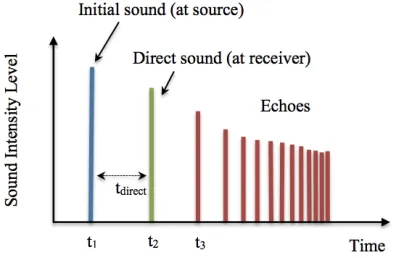
piece explores the extra-musical sound phenomena known and innate to humans that are echoes. Naturally occurring echoes give us information about our environment. They tell us about the surfaces in our vicinity, how near or far they are, their density, their texture and how many of them there are. This is one sonic phenomenon with which we interact and readily
interpret and from which we glean localization information.49 In short, we can use echoes to
[image:30.595.177.376.457.586.2]know where we are in the world.
Figure 7 Development of an echo over time50
47 (Grisey 1987) 273.
48 The paper, ‘Remembering One, Remembering All’, dealing with Hier Wohnte, was presented at the
University of Limerick “Designing Commemoration: Performance, Process and Participation” in 2015 (See Appendix A below).
49 Though echoes may carry information, the extent to which we use the information varies.
Numerous studies have been carried out which study how and to what degree room echoes are used by subjects to determine their location (see, for example, (Kellogg 1962), (Plumbley 2013) and (Wallmeier, Geßele, and Wiegrebe 2013))
According to Stockhausen, ‘When we have never heard a particular sound before, we don’t always know whether it is far or close. We have to have heard it several times before in the
context of the music, in order to know how it sounds when closer and further away.’51
When we hear an echo, we are experiencing something that disappeared some time ago. In naturally occurring echoes, the timespan is short as sound waves generally dissipate their energy and become inaudible quite quickly. The idea of capturing this fading event and the notion that the past can be encoded as string notes through the use of echoes are explored in “Hier Wohnte”.
So, echoes encode, but in a very impermanent way. They are copies of an original event, but due to the effects of time and travel across space, they become inaudible. Echoes lose energy based on a number of factors. They are in effect, real-time evidence of a phenomenon that existed at some point in the past but does not exist anymore. This is analogous to the electromagnetic radiation waves that astronomers detect today and are echoes of bodies and events that ceased to exist long ago. Although these waves move quickly, they have travelled great distances and through time, their source may no longer exist.
“Hier Wohnte” is concerned with experiencing the traces of what has gone before, as if we can tune into a sequence of echoes that continue for some period of time (see Appendix A below). It is as if the echoes have always existed and we are able to perceive short bursts of them. They appear, interact, create complex patterns and they recede.
With regard to echoes and their use in “Hier Wohnte”, the thoughts of Xenakis on repetition and persistence are of interest:
And yet, each event, like each individual on earth, is unique. But this uniqueness is the equivalent of death which lies in wait at every step, at every moment. Now, the repetition of an event, its reproduction as faithfully as possible, corresponds to this struggle against disappearance, against nothingness. As if the entire universe fought desperately to hang on to existence, to being, by its own tireless renewal at every instant,
at every death.52
Echoes have implications for what we understand as duration, how long something lasts. With echoes, cycles repeat and fade and their duration becomes unclear. It is not clear when the process will come to an end. There is indeterminacy around where an event, one of a
sequence, falls within in that sequence. Is it the last, will where be another? We do not know when the last conversation or meeting or kiss or when is the last breath will be. “Hier Wohnte” therefore has implications for the notion of ‘ending’. When or how does a musical
phrase end?53 Essentially, when does the time span of something stop or at least when do we
stop perceiving it? It is like sailing away from a shore that eventually becomes imperceptible to us.
As described above, the fundamental building block of the string quartet “Hier Wohnte”, is the echo. Every musical phrase or section is essentially based on the same model and that is the particular characteristic of the echo. This has a gradual reduction in sound level, a quickening of the rate of the reflections and a change in quality of the sound. The echo is always pointing to something that is in the past. Coveney and Highfield discuss the notion of looking backwards into the past and the possibility of reversing time:
Space surrounds us, yet time is experienced bit by bit. The distinction between right and left is trivial compared with that between past and future. We can shuffle around freely in space yet by our actions we can only affect the future, not the past. We have memory, not precognition (clairvoyants apart). Materials generally seem to decay rather than to assemble spontaneously. So it seems that although space has no preferred directional characteristics, time does. It travels like an arrow. The evocative term ‘the arrow of time’
was first coined by the astrophysicist Arthur Eddington in 1927.54
Addressing the notion of time moving backwards, Xenakis mentions, ‘Indeed, much like a god, a composer may create the reversibility of the phenomena of masses, and apparently,
invert Eddington’s “arrow of time”.55
53 Within a tonal environment of tonality and cadences, endings are clearer. 54 (Coveney and Highfield 1991) 24.
Figure 8 “Hier Wohnte” Time being 'reset'
In “Hier Wohnte” time is not reversed, but is continually being ‘reset’ to an earlier time. Figure 8 shows how a single violin harmonic has the shape of an echo ‘mapped onto’ it. Each instance of the harmonic is identical, yet transformed with the meaning encoded in the echo. So, in this example, we hear what has gone before because we learn the pattern. In “Hier
Wohnte”, this strategy is unchanging, we always learn the pattern, we always hear the past.56
The other strategy for creating a sense of ‘holding’ the past is through the use of a drone. A drone is a sustained frequency, however achieved. In the case of a string, continuous bowing produces a drone effect. Natural resonances can also create a drone. These resonances could be in the environment, as in the case of Alvin Lucier’s I Am Sitting In A Room, or in an
instrument as is the case of Abbandonati for solo marimba. By enhancing these resonances, the aspect of sustain, the typical dynamic envelope of a sound, made up of its attack, decay, sustain and release, can be disrupted and a drone is created. Writing in the context of drone vocal music, Howard and Angus give the following account of the essential characteristics.
The basic principle is that if individual harmonics are accentuated in amplitude sufficiently, that harmonic becomes a note in its own right; it “breaks away” from the
holistic spectrum of its complex tone to be a sine wave that is heard as a second note.57
56 Details of the visual artwork that points to the past and is the motivation behind Hier Wohnte are
given in section 3.4 below.
Figure 9 Typical form of ADSR
Alvin Lucier outlines the process whereby his composition creates a sustained droning effect, ‘… the space acts as a filter; it filters out all of the frequencies except the resonant ones. It has
to do with the architecture, the physical dimensions and acoustic characteristics of the space.’58
Again, with regard to Lucier’s discussion of room resonances, ‘So by playing sounds into a room over and over again, you reinforce some of them more and more each time and eliminate others. It’s a form of amplification by repetition’.
Typically, a drone is harmonically rich. This is evident from instruments such as the digeridoo or the uilleann pipes which readily produce drone sounds. Abbandonati makes use of the drone sound that is to be found in the harmonically rich lowest bars of the five-octave marimba which ranges from C2 to C7. This is achieved through the use of a tremolo or ‘mandolin’ technique. The result of this is that the normal decay of the instrument is never allowed to occur. Instead, the short-lived, natural resonances of the bars are reinforced through the repetition of the tremolo and the result is a din overlaid on the piece.
F
igure
10
Abbandonati
ex
tr
1.5
Fragments & Voices
In each of the three vocal pieces in this research, text is broken apart, stretched and
manipulated to the point where it occupies a time line very different from that of its origins.
A considerable part of Hans Werner Henze’s 1996 lecture, Language, Music and Artistic Invention, deals with his views on the meeting of poetry and music. He describes the relationship as ‘adventurous’ and that in their coming together, ‘there are no rules and no principles’. While his take on the subject is itself somewhat poetic, he expresses a sentiment that is akin to the approach taken here to the use of text in Salve Regina, Poltergeist and L’infini Vivant. Henze explains:
… it can happen, as we have seen, that the music slowly consumes the text – its words and its syntax – as the praying mantis devours her mate, until nothing remains but disjointed syllables, vowels and consonants. The poet’s words have turned into noise and resonance, the notes have seized complete control, the meaning of the verse has been transformed into pure sound.’ 59
What are the results of using very fragmentary texts? What are the implications for meaning? Although fragmentation has been in use since the 1950s, there were still composers of note who followed a different path. Christian Wolff states, ‘… I really want the words to be
understood. I don’t want the voice all over the place; I don’t want funny noises or any of that. I just want the text to be there’.60 From Wolff’s assertion that he wants words to be
understood along with the evidence from his own music, it is clear that he is concerned with the semantic function of the words. Words, of course, can have meaning other than semantic meaning.
The main area explored in the vocal pieces presented here is the temporal elongation of the text. The origins of this technique, as it is used here, lie in a lecture by Stockhausen in which he discusses what he terms, ‘Unified Time Structuring’. Stockhausen presents a scenario in which an entire Beethoven symphony is compressed in duration so that it occupies the time of
59 (Henze 1996) 15.
a single second. 61 He continues by speculating on the effects of going in the opposite
direction and of elongating sound:
… if we were to take any given sound and stretch it out in time to such an extent that it lasted twenty minutes instead of one second, then what we have is a musical piece whose large-scale form in time is the expansion of the micro-acoustic time-structure of the original sound.62
The movement between micro and macro levels that Stockhausen proposes, where the ‘sound DNA’ will remain during various time transformations is reminiscent of the quantum
mechanics of Einstein that was mentioned above. In that, energy exists in small packets or quanta. These quanta share characteristics with entities that are vastly bigger. From this we have the manifestation of the physical world as well as the energy forces that keep that world together. In these vocal pieces, there is an attempt to get to the smallest possible elements and explore what can be done with them. In the case of light, the smallest packet would be the photon, in the case of speech, the smallest element is a phoneme.63
Poltergeist, for soprano and cello, attempts to imagine what would happen if the word Poltergeist, with a spoken duration of about a second, was time stretched so that it occupied the space of more than six minutes.64 For the purposes of this composition, the word Poltergeist is taken to
mean something like, ‘noisy or clumsy ghost’. This semantic information, lost in the fragmentation of the word, is re-encoded into the piece as a whole through the particular sound world created with the solo cello and voice. The music evokes an eerie tenderness. There is at times a lost or sad quality to the voice while at other times there is an angry frustration. This is very fitting for a piece that is essentially a love song for a noisy ghost: polter - geist.
61 Stockhausen’s points are made in the context of creating electronic music. The time compression
and expansion that he proposes would be achieved electronically, by slowing down and speeding up tape recordings. This approach is realised in his Kontakte (1958-60). In contrast to this, the ‘time stretching’ in Poltergeist is achieved by breaking the text, a single word, into its most elemental phonemes and using these as the basis for time expansion.
62 (Stockhausen and Maconie 1989) 47.
63 Serious investigation by composers into the use of the smallest elements really began with the
emergence of electronic music studios in the 1950s. The work of Berio, Cage, Maderna and Nono, working at the ‘Studio di Fonologia Musicale’ in Milan, is particularly noteworthy in this regard. See also Ligeti (1983) Conversations 37.
The manner in which the text is divided up and sung is reminiscent of the Dadaist artists Raoul Hausmann and Kurt Schwitters. Schwitters’ iconic Dadaist composition Ursonate has its origins in a poem by Hausmann entitled fmsbw. The Ursonate is a particularly good example of the classic features of sound poetry composition. In Poltergeist a number of these features are present which include: the combination of the sung (pitched) and the spoken (unpitched), repetition which goes to extreme lengths, the absence of meaning in individual phonetic pieces, the colouring of sounds though the shaping of the mouth and the presence of emotion expressed through material which does not have any inherent emotional content.
However, unlike the collage of Schwitters, which is an act of assembly, Poltergeist manipulates the fragments and duplicates them. The text is reduced to phonemes and these are used as the building blocks for the piece. Figure 11 shows the opening of the composition and the
repetition of the opening /p/ sound.
Figure 11 Poltergeist extract
Poltergeist is therefore an homage to the lautpoesie of these two artists which arose from a poetry reading where Schwitters first heard fmsbw read by Hausmann in Prague and also to the collage artwork of Schwitters and others working in Germany in the middle of the twentieth century.
The technique of text reduction to phoneme level is also used in Salve Regina for twelve female voices and also in L’infini Vivant. In each, however, this approach yields different results. In
Salve Regina the semantic role of the words disappears and sound content alone is left. The text is stretched so much that the meaning is left behind and the text becomes
significant as the piece is a commemoration to those who have died without a voice or in degrading circumstances.
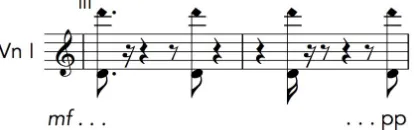
L’infini Vivant presents a wide range of textual distortion, from clear, exaggerated childlike clarity (see Figure 12 below), articulation, through to gross manipulation. Throughout the composition, the aim is to maintain the semantic integrity of the original text by Jules Verne. As the example in Fig. 12 shows, the fragmentation of the piece facilitates playful interchange with the other instruments in the ensemble.
1.6
Conclusion
The passage of time is relative. The physics of the last one hundred years confirms this. So too does the experience of composers who have grappled with temporalization of their
compositional intentions. There exists a clock time which reliably ticks through our existence. Then there is the other, stretchy time that is as liberating as it is complex. One way to navigate the latter is to regard it as being comprised of durations. How long these durations are and what they are filled with are questions that the composer can answer. The compositions that form part of this research address them from a number of perspectives. In Mjöllnir, buzzing snare drums compress packets of time as the percussionists play their rolls as fast as possible. In contrast, “Hier Wohnte”, with its lingering, decaying echoes stretches time and pulls the listener back into some distant past.
When time is neither being stretched nor compressed it may appear to be static. The surface of this music seems unmoving except, perhaps, for slow changes in timbre. Within, though, static music is made from the tiniest of materials in motion. Salve Regina is made from slithers of pitchless, noisy, breathy sounds layered on top of each other. On the outside, the piece transforms its way through a text drained of its semantic content. The droning stasis of
Abbandonati harnesses the rich harmonics of the lowest marimba bars and casts a resonantly sombre mood across the piece.
The fragmentation of time into quanta allows for the accumulation of sounds temporally. This time stretching can facilitate sounds to fill durations that would be unthinkable otherwise.
F
igure
12
L'Infini Vivant
ex
tr
ac
2
Space
2.1
Introduction
…music is made with sounds, not just musical sounds.65
This research has been exploring evolving sounds with respect to time and space. The topic could be reduced simply to the questions, what happens and when does it happen?
Throughout the research, time and space have been presented as two complementary dimensions. Years before Einstein and special relativity, this connection had been made by Leibniz who, writing in the nineteenth century, gives this assessment:
As for my own opinion, I have said more than once that I hold space to be something purely relative, as time is; that I hold it to be an order of coexistences, as time is an order of successions. For space denotes, in terms of possibility, an order of things that exist at the same time, considered as existing together, without entering into their
particular manners of existing.66
If time is a sequence of things that exist simultaneously, like slices, what occupies these slices? The quote by John Cage that opens this chapter unlocks a wide spectrum of possibilities in answer to this question. This chapter looks at how the concept of musical space occurs in the compositions presented here and also looks at the background to this concept. In a tonal environment, space consists of harmonic material in a vertical axis. In the non-tonal world of the present research, space refers to the accumulation of sounds, resulting in densities, these thicken or thin or even thin to such an extent that the result is an absence of sound and result in silence.
A number of composers have recognized and made use of the idea that musical time exists as sequences of slices. Schoenberg states:
THE TWO-OR-MORE-DIMENSIONAL SPACE IN WHICH MUSICAL IDEAS ARE PRESENTED IS A UNIT. Though the elements of these ideas appear separate and independent to the eye and the ear, they reveal their true meaning only through
65 (Kostelanetz 2003) 61.
their co-operation, even as no single word alone can express a thought without relation to other words. All that happens at any point of this musical space has more than a local effect. It functions not only in its own plane, but also in all other directions and planes,
and is not without influence even at remote points. 67
The interdependency that Schoenberg refers to is also pointed out by Ligeti. Referring to his
Lontano for orchestra he imagined, ‘… a vast space of sound in gradual transformation, not
through dense chromaticism but through a constantly changing pattern of colour like a moiré
fabric.’68
The use of ‘colour’ vocabulary in describing the contents of musical space is commonplace. Zuckerkandl proposes that sound is like light and can be mixed like two colours (red and blue) can be mixed to produce a new colour (green). According to Zuckerkandl, ‘A new tone added to one already sounding draws no boundaries in space, occupies no location that belongs to it alone, does not drive the first tone away from anywhere, is not in a different place from the
first; they are both in the same place …’.69
So, the content of time slices, that is, what they are filled with, gives rise to transformations over time. Ultimately, what fills musical space will give rise to musical form. The idea of space is important in that what occupies the space determines the form of the piece. According to Stockhausen:
As the word says, a musical “composition” means putting sounds together. You can put them together at any speed, density, or distribution in a given time and space field of the audibility range. You can produce a structure and relate it to any natural event. You
could, for instance, distribute sounds the way the leaves on a tree are distributed.70
This chapter looks at how the content of musical space is carried in the form of waves and goes on to investigate the contents of time slices.
67 (Schoenberg, Stein, and Black 1975) 220. Schoenberg’s capitalization and punctuation. 68 (Ligeti et al. 1983) 56.
2.2
Waves
Waves fill space. It turns out that our world is awash with waves. Even the force that sticks us to our planet results from the soup of gravitational waves in which the planet floats. So waves ‘carry’ so much of our elemental experience of the world; light, sound, gravity. This concept is
taken into the present compositions, where Propellers, for example is built upon pulses and
periodicity, “Hier Wohnte” is built from echoes and both “Suspiramus” and Salve Regina have
the cycle of breathing at their starting point.
Levenson outlines the classical approach to this.
The planets moving though the heavens gave off sounds, “the music of the spheres,” which exemplified the perfect organization of nature on the largest scale. The original thought, as Aristotle records it, was that the great bodies of heaven could not move without making noise, but that later traditions created a musical cosmology. The regular motions of the planets suggested ratios of number, of intervals; the suggestion was enough to produce the image of celestial bodies ringing harmony throughout the universe. Such glorious music would yet be imperceptible – continuous, unbroken, it surrounded the listener from birth to death, with never a moment of true silence to act
as its foil.71
In his essay, Rests and Repetition in Music, Christoph Peter gives an account of his subject across
musical periods. Throughout his approach there is the notion that underlying musical rests and repetitions is an elemental force. In the following, he pulls together the various strands of his thinking into a unified approach:
The whole of nature pulsates with the most diverse rhythms. Every organism has its own rhythm. It is subject to the rhythmical influences from the environment and at the same time itself affects the rhythm of other organisms. The change from day to night, from summer to winter, ebb and flow, the regular fluctuation in air pressure, the winds, terrestrial magnetism, the breath., digestion and growth processes; these and all the other natural phenomena occur in certain rhythms. In the low point of the rhythmical
curve, however, between relaxation and renewed tension, between exhaling and inhaling, between death and coming into being, a (more or less long) anti-climax, or point of rest is included, in which nature begins a new movement, developing renewed
force. The rest, which we have studied in music, has a similar significance in nature. 72
Stockhausen, referring to music from Beethoven to the 1950s, gives the following assessment:
There is a unity underlying all the different events which occur. That is why, when we listen to this music, we shouldn’t become caught up too much with their differences, but try to sense and discover the underlying proportioning principle – the genetic
principle – that gives birth to them all.73
In a similar light, Stravinsky states that, ‘All music being nothing but a succession of the impulses and repose, it is easy to see that the drawing together and separation of poles of
attraction in a way determine the respiration of music’. 74 Though here, Stravinsky refers
metaphorically to the respiration of music, Suspiramus deals directly with respiration as a
structural element in composition.
On this subject, Grisey tells us, ‘What would bring us to a better definition of sound would be the knowledge of the energy which inhabits it and of the network of correlations which
govern all its parameters.’ 75 Grisey further says:
From now on it is impossible to think of sounds as defined objects which are mutually
interchangeable. They strike me rather as force fields given direction in time. These forces
-I purposely use this word and not the word form - are infinitely mobile and fluctuating;
they are alive like cells, with a birth, life and death, and above all tend towards a continual transformation of their own energy. There exists no sound which is static,
immobile, any more than the rock strata of mountains are immobile.76
Cage presents a very holistic assessment of this relationship and makes reference to a unifying force:
72 (Peter and Stott 1992) 42.
73 (Stockhausen and Maconie 1989) 42. 74 (Stravinsky et al. 1970) 36.
The term "atonality" makes no sense. Schoenberg substitutes "pantonality," Lou Harrison (to my mind and experience the preferable term) "proto-tonality." This last term suggests what is actually the case: present even in a random multiplicity of tones (or, better, sounds [so as to include noises]), is a gravity, original and natural, "proto," to
that particular situation.77
These composers are recognizing, albeit using different language, a connection between the various phenomena of which they write. Here, that connection is taken to be wave forms. Accumulation of waves can result in varying densities (see 2.4 below) when the interference among the waves is constructive as in Figure 13 below. If the interference between the waves is destructive, sounds will be cancelled out and if cancelled completely, the result is silence as in Figure 14. The accumulation and cancellation of waves happen in nature where in one moment starlings, or fish or insects seem to form a dense cloud only to seem, in another moment, to disappear completely.
Figure 13 Constructive Interference Figure 14 Cancellation
Waves therefore, are a means to accumulate and their presence or absence indicates thinness or thickness of timbre, density and pace.
Figure 15 Waves evolving over time
Propellers for mixed ensemble has at its core the intersection of waves and has its origins in the
movement of actual propellers as depicted in the painting by Mary Swanzy (see 3.3 below). Sounds reoccur as their wave-cycles disappear then re-emerge. Some sounds appear only for a moment only to disappear and not return. To carry this proposition further, if the piece were longer, these non-repeated waves may reappear, that is, if the piece was sufficiently long that it encompassed the period of the wave.
In Suspiramus, for string quartet, breathing, a most fundamental of biological cycles is the
impetus behind the piece. During the piece, the duration of the wave phases varies. The context of the phases also changes and evolves. To this end, the piece explores the fragments of what happens between the phases.
Mjöllnir, for four snare drums, goes to the heart of periodicity and wave forms. It recognizes
that although on the surface level there may be variations of periodicity, fundamentally, everything has its own mode of oscillation. Just as in na