Abstract— Without global reserve currencies there very well could be chaos in the international trade arena. Currently, the United States holes an enviable position as the major global reserve currency with between 40 and 60%. However, the leading contender for a replacement of the US dollar is a version of the Special Drawing Rights (SDR) issued by the International Monetary Fund (IMF). The primary objective in this paper is to present the results of the stability of a proposed system to manage a new global reserve currency such as the SDR. The Information and Knowledge Architectures for Systems Management of a Global Reserve Currency (IKASM-GRC) and its ability to maintain currency stability is presented in this paper.
Index Terms— Global reserve currency, IKASM-GRC, IMF, SDR, stability.
I. INTRODUCTION
HERE is a growing movement to replace the US dollar as a major reserve currency. Today, the US dollar represents approximately 60% of all reserve currencies. Any global reserve currency must be stable, tradable, and above all reliable. It is not essential that it must be based upon a sovereign currency; a case in point has been the use of gold as a basis for settlement and liquidity in the past. The International Money Fund (IMF) and its Special Drawing Rights (SDR) is one of the candidates that may serve as the new global reserve currency. There are other contenders as a possible major new global reserve currency
The Chinese government is seeking to make its currency, yuan, one of the major reserve currencies. There are a number of difficulties since the Chinese yuan is not readily convertible and the government controls the range of its trade ability, however there seems to be movement on the part of the recently inaugurated leadership to make the currency possibly tradable.
The SDR is a form of a supplementary foreign-exchange reserve asset defined and maintained by the IMF and not a true currency. The SDR represents an unconditional claim to currency held by IMF member countries for which they may be exchanged. These can only be exchanged for euros, Japanese yen, pound sterling or the US dollar. As such the SDR represents a potential claim on IMF member
Manuscript received July 11, 2012.
M. W. Cardullo is a doctoral candidate in Information Technology, Department of Systems Engineering and Operations Research, George Mason University, Fairfax, VA, USA (703-975-4410; fax: 703-549-3789; e-mail: [email protected]).
A. P. Sage is Professor, Department of Systems Engineering and Operations Research, George Mason University, Fairfax, VA, USA; (email: [email protected]).
sovereign’s non-gold foreign-exchange reserve assets, which are usually held in the global reserve currencies. The IMF is considering expanding the SDR to include the Chinese yuan. As of 2012, the IMF has not made any decision to expand the SDR. The IMF made a large allocation of SDR in 2009; however this represents only 4% of global reserves [1]. Even if the IMF did expand the SDR, this would not mean that it is a new global reserve currency but a possible step to becoming a new global reserve currency.
There are discussions among the members of the IMF to expand the SDR’s role into a true global reserve currency. Currently, there are no plans at the IMF to implement a change of role for the SDR. In fact, the United States government would likely not give its approval to such a change. However, this can change if and when the US dollar appears weak or otherwise unsuitable to be a foreign-exchange asset as its sovereign debt escalates. Also, a global liquidity crisis similar to the 2008 Global Recession could accelerate the movement to make the SDR the basis of the international settlement, valuation of trade and liquidity for financial transactions.
1.0 Background
Cardullo and a Sage [2]-[6] have shown in prior studies the significance for developing an architecture framework that can serve to manage a new global reserve currency. Such information and knowledge architecture for system management of the global reserve currency (IKASM-GRC) currently does not exist. To develop this logical architecture a systems development process was used similar to that outlined by Levis [7], [8] and modified and shown in Fig. 1.
II. SPECIAL DRAWING RIGHTS (SDR)
The basis of the 1946 Bretton Woods Agreement was gold. Sovereign nations either held gold or US dollars (USD) as far and reserve assets. The exchange rate for dollars was set at a fixed rate for the price of gold, i.e., $35 USD per ounce. Due to the rapid rise of trade after World War II, the slow growth of gold supplies resulted in US dollars becoming a growing portion of world currency reserves. To overcome this, the IMF created the SDR in 1969. The SDR was established to supplement member countries' official reserves. The SDR claims on the IMF helped relieve the dollar claims on the US. Thus that SDRs served like demonetized gold to settle international claims [1].
Impact of Information and Knowledge
Architectures for Systems Management on
Stability of Global Reserve Currency
Mario W. Cardullo and Andrew P. Sage
MISSION REQUIREMENTS
OPERATIONAL
CONCEPT ENVIRONMENT
USE CASE ANALYSIS TASKS
STAKEHOLDERS
SERVICES
ARCHITECTURAL DESCRIPTION LOGICAL
ARCHITECTURAL DESCRIPTION
PHYSICAL ARCHITECTURAL
DESCRIPTION ORGANIZATIONAL
MODEL
SYNTHESIS EXECUTABLE
MODEL
ARCHITECTURE IMPLEMENTATION
MISSION STAGE
SERVICES STAGE
ARCHITECTURAL STAGE
IMPLEMENTATION STAGE
[image:2.595.55.285.49.315.2]DATA MODEL RULE MODEL
Fig. 1. Development Process for IKASM-GRC[3]
A. SDR Guiding Principles
The guiding principle for the SDR is that the value should be stable in terms of the major currencies, and the currencies included in the basket should be representative of those used in international transactions [9]. Accordingly the relative weights of currencies included in the basket should reflect their relative importance in global trading and financial systems and there should be continuity in the method of SDR valuations. It must be considered that these guiding principles will require modification if and when the SDR becomes a true global reserve currency.
Implementing the SDR as the main global reserve currency would be represented by an extended basket of significant currencies and commodities. The United Nations appointed Stiglitz Commission, charged with reforming the international monetary and financial system, has suggested a gradual move from the US dollar to the SDR. Moreover, following the G20 Summit in London in 2010, the IMF distributed to its members $250 billion in SDRs as a step in moving it to become a new global reserve currency [10]. If the SDR was to be able to become a true global reserve currency the IMF would possibly need to have available over $18 trillion to meet global liquidity requirements [11].
The resetting of SDRs will reflect ongoing shifts in central bank reserves positions. In particular, the IMF executive board will consider reordering the SDR to reflect a diminution in the US dollar's strength [12]. This only can be successfully accomplished if the reserve currency is:
stable;
reflects balanced trade on a global basis; can be easily monitored; and
can be easily adjusted in order to maintain stability.
A new reserve currency could limit dependence on the policies and conditions of a single, though dominant, country. Of course, it is not in the interest of the US Treasury or the US Financial Reserve to have the dollar no
longer serve as the major foreign reserve currency. This situation, in 2011-2012, allowed the US Treasury and the US Financial Reserve to borrow funds internationally at beneficial rates.
The SDR and the US dollar are highly correlated and SDRs as a substitute for dollars will not offer much risk reduction unless the basket of currencies included are more reflected of total international financial conditions. For most of the years since the last SDR reset, and during this period it was virtually stable in reference to the US dollar. The rolling 30-day correlation has averaged 98.6 percent since February 2005 [12]. This is primarily due to the high portion of US dollars (41.1%) in the SDR and the 60% that is held by sovereign central banks.
A step intended to enhance the utility of the SDR would be to make its currency composition more neutral to global cycles and more representative of the shift in economic power witnessed over the last two decades. This could be achieved by an increase in the commodity content and the inclusion of major emerging-market currencies. A variable SDR might well result in speculation and eventual financial crisis due to the uncertainties of which currencies or commodities would be added. To achieve stability requires a rapid response system such as the proposed IKASM-GRC with the ability to modify the proportions of the elements comprising the SDR.
Another approach could be to shift the basket of currencies to those currencies of the G20. The G20 is the premier forum for international economic development that promotes open and constructive discussion between industrial and emerging-market countries on key issues related to global economic stability [13].The advantages of this approach would be that the as the currencies increase included, the more closely the balance between exports and imports of the sum of these nations is in balance which may then avert the Triffin dilemma. This approach had been tried by the IMF prior to 1980 when the basket of currencies was reduced from 16 to 5 due its complexity [9].
According to Joseph Stiglitz: “The international monetary system needs fundamental reform.” [14]. It is highly unlikely that either the IMF or the G20 will rapidly move toward a new, unified global reserve currency because of this, it will likely take a major global financial collapse to force the IMF and or the G20 to take steps to rationalize the global financial system. One approach that would support this is for the SDR to gradually increase its membership.
It is unlikely that a movement to making the SDR the major global reserve currency will be done rapidly. The movement toward making the SDR the reserve currency will likely occur due to the numerous concerns of the various major economies.
B. SDR Valuation Methodology
1) Current Valuation Methodology
Currency amounts in the SDR basket used to determine the values for the next five year period are calculated on the last business day before the date the new basket becomes effective, i.e. January 1 of the next year. On that day, currency amounts are derived from the weights decided by the IMF Executive Board using the average exchange rate for each currency over the preceding three months and the currency amounts are adjusted proportionally to ensure that the value of the SDR is the same before and after the revision. The currency amounts remain fixed for the next five-year period. As a result, the actual weight of each currency in the value of the SDR changes on a daily basis as a function of changes in exchange rates [9]. However, if the SDR is to become the major global reserve currency then the proportions of the currencies would likely have to change on a more realistic basis. The proposed IKASM-GRC architecture could serve this purpose.
1) Detailed SDR Currency Weights
The current methodology for determining the weights of each currency within the SDR basket of currencies is determined solely by the exports of goods and services of the sovereign issuing the currency and the international reserves of that currency. This methodology gives equivalent weights to both the exports and the reserves. Therefore, a sovereign whose currency is held by others as a reserve currency is more favored than other economic factors. In fact, the United States a major debtor nation has an advantage due to the large amount of its currency being held as a global reserve.
This is shown in the following equations, where is the weight of the currency in the SDR basket and is the export of goods and services and is the global reserves held of sovereign “i”:
∑ ∑ (1)
As noted the foreign exchange allocation reserves have a definite impact in biasing the currency weights toward the US dollar. It must be noted that the composition would vary in yearly increments as shown in Table 1.
The staffs of the IMF have IMF have suggested a number of alternative methodologies that for future calculations of the currency weight allocations [9]. These methodologies would consider the relative weights of currencies included in the basket should reflect their relative importance in the world’s trading and financial system. The weight of the currency could be expressed as a combination of financial (FIi) and trade (TIi) indicators given by the following
equation, where α is the relative weight on trade and is approximately 67 percent [9].
( ) (2)
Table 2 illustrates the changes in the currency weights within the SDR basket for the 2005 to 2011 period. This illustrates how the SDR basket of currencies can vary.
The IMF and the G20 are considering various alternatives to the formation of the SDR basket of currencies. One element in this possible change is moving toward having the global reserves held of a sovereign’s currency only been consented a third of the value for the formation of the basket [9]. Another consideration is the inclusion of Chinese yuan as one of the currencies within the basket [9]. Furthermore,
there has been some discussion as to increasing the currencies within the basket to the major exporting nations [17].
The impact of the various IMF policies (Table 3) for choosing how the basket of currencies would have significant impacts on the value of the SDR by changing the proportion of the currencies within the basket. In almost all instances, the US dollar will become a small a portion of the value of the SDR. Realizing, this may result in variations in the value of the SDR and increase possible instabilities. The IKASM-GRC if implemented could reduce these possible instabilities as we will show in this paper.
However, some of these alternatives include a range of indicators for international financial activity including financial flows as measured by the balance of payments, turnover of foreign exchange markets, as well as stocks of international banking liabilities and outstanding international debt securities. All of these financial indicators have been shown to outpace export growth in the past two decades [9]. Therefore, the IMF has a significant number of alternatives that will impact the value of the SDR but not a systems methodology for maintaining the stability of the SDR if it becomes the major global reserve currency. The IKASM-GRC could be the means to provide this stability independent of the methodology chosen to calculate the basket of currencies.
The IMF Rule O-1uses the value of the SDR derived from the weights decided by the Executive Board using the average exchange rate for each currency over the preceding three months adjusting the currency amounts proportionally to ensure that the value of the SDR so that it is the same before and after the revision [9]. However, this only provides the starting SDR value some continuity, the actual weight of each sovereign currency in the value of the SDR changes on a daily basis as a function of changes in exchange rates.
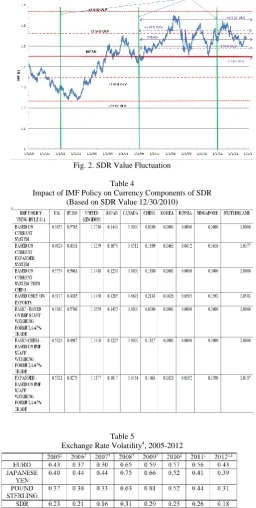
These fluctuations will vary for each of the various IMF policy decisions shown in Table 4 since the proportions forming the value of the SDR. The consequences of even a constant policy can cause variations in the value of the SDR as shown in Fig. 2. As shown, these variations can be significant in the valuation of the SDR. If these new policies are implemented, then these variations can vary with significant consequences as will be shown by the stability analysis.
III. STABILITY CONSIDERATIONS
A. Currency Rates on SDR Stability
Table 1
Currency Weight Allocations for SDR Valuation1
Volatility is one measure of a security’s risk and is normally defined by the standard deviation of the currency exchange rates over a certain time period. The IMF defines it as the mean of absolute daily percentage change in spot exchange rates. As the volatility increases for an exchange rate more uncertainty is indicated for that currency pair movement. Currency volatility is a function of the underlying variability of the economy [22]. In the case of the SDR it would be the variability of the global economy
Table 2
Impact of Varying the Proportions within the SDR Basket of Currencies2,3
Table 3
IMF Policy Alternatives in Calculating SDR Currency Ratios
IMF Policy Alternatives
Continue current system trade plus reserves
Expand current system
Current system plus China
System based only on exports
Current system based on 67% trade and 33% reserves
Current system based on 67% trade and 33% reserves plus China
Expanded system based on 67% trade and 33% reserves
The global long term economic performance will be influenced a number of factors. Table 5 shows the SDR has a much lower volatility then the members of its basket of currencies. If the SDR is to become the main global reserve currency it will be subject to market pressures exercised through this basket of currencies.
The SDR daily percentage variations in valuation are shown in Fig. 3. These variations usually spanned a range between -1% and 1% in the daily change except for a few periods during the global recession of 2008 - 2010. However, these variations must be considered in terms of the distribution between values that the IMF would likely
1
Based on data contained in [18] IMF, "World Economic Outlook Database," IMF, Ed., ed. Washington, DC: IMF, 2012, [19] IMF, "Currency Composition of Official Foreign Exchange Reserves (COFER)," IMF, Ed., ed. Washington, DC, 2012, [20] IMF. (2012, 06/3/2012).
Governance Structure. Available: http://www.imf.org/external/about/govstruct.htm
2
Based on data contained in [9] IMF, "Review of the Method of Valuation of the SDR," International Monetary Fund, Washington, DC, ReportOctober 26, 2010 2010, [18] IMF, "World Economic Outlook Database," IMF, Ed., ed. Washington, DC: IMF, 2012, [19] IMF, "Currency Composition of Official Foreign Exchange Reserves (COFER)," IMF, Ed., ed. Washington, DC, 2012, [20] IMF. (2012, 06/3/2012). Governance Structure. Available:
http://www.imf.org/external/about/govstruct.htm
3
Basic calculated on foreign reserves including those outside of basket of currencies.
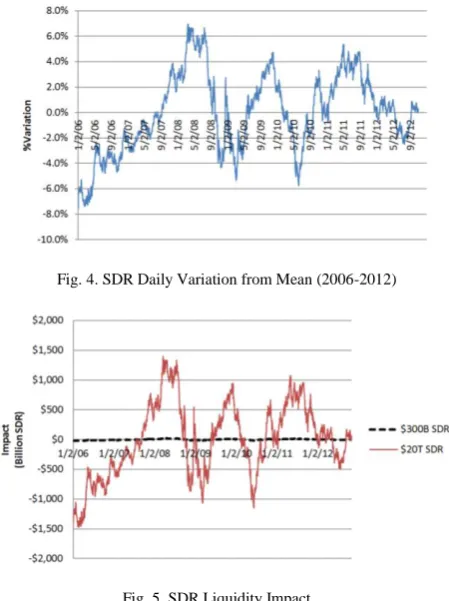
[image:4.595.304.561.153.662.2]require to maintain a stability of the SDR global liquidity. Currently, the total amounts of SDRs that have been issued are approximately $300 billion SDRs. The percentage variations from the mean in the 2006 – 2012 time-periods are shown in Fig. 4. As this figure shows, the variations have been significant when measured against the mean of the period.
Fig. 2. SDR Value Fluctuation
Table 4
Impact of IMF Policy on Currency Components of SDR (Based on SDR Value 12/30/2010)
Table 5
Exchange Rate Volatility4, 2005-2012
If and when the SDR becomes the major global reserve currency it will be required to handle global liquidity of more than $20-$30 trillion SDRs. In this case, the impact of the variations shown in Fig. 4 can be significant and could possibly lead to global financial instability. These
4
IFM volatility is measured as the mean of absolute daily percentage change in spot exchange rates against the dollar [9] IMF, "Review of the Method of Valuation of the SDR," International Monetary Fund, Washington, DC, ReportOctober 26, 2010 2010.
5
Ibid.
6 Calculated based on IMF methodology and daily spot currency rates. 7
[image:4.595.57.295.317.448.2]possibilities of global liquidity variations has been discussed in detail by the Committee on the Global Financial System of the Bank for International Settlements [23]. The possible liquidity impacts are shown in Fig. 5.
Fig. 3. SDR Daily % Variation (1999-2012)
[image:5.595.308.554.341.523.2]One of the main objectives of the IKASM-GRC is to provide a means of dampening the possible variations in the global liquidity as shown in Fig. 5. The IMF could set acceptable ranges for the variations from the value of the SDR by either the having the sovereigns whose currencies are used in the defining basket of currencies to intervene in the currency markets or the IMF could modify the basic rates set to bring the value of the SDR within their guidelines [4]. The mean for the period, 01/01/2006-10/31/2012, is a value of the SDR of $1.52741 with a standard deviation of $0.04806 or 3.145 percent. This standard deviation would imply a variation of global liquidity of $944 to $1,416 billion SDRs.
Fig. 4. SDR Daily Variation from Mean (2006-2012)
Fig. 5. SDR Liquidity Impact
Table 6 presents the necessary independent changes in the various currency pair values which will produce a 1% change in the value of the SDR. The smaller the change indicates the currency pair that will have the greatest influence on the value of the SDR depending on the IMF policy chosen. Therefore, if the IMF needs to reduce or increase the value of the SDR by an amount of 1%, then the ratio used in the calculation of the SDR would have to
change by the associated value of that particular currency. This adjustment would occur in the value of the IMF Rule O-1. Table 6 represents the changes that would be necessary to achieve a 1% change in the value of the SDR and would need to be implemented by the IKASM-GRC.
B. Impact of IKASM-GRC on SDR Stability
The IKASM-GRC can be employed to provide SDR stability by dampening the impact shown in Fig. 4 which illustrates the variation due to the amount of SDRs that serve as global liquidity. If the SDR does not become the major global reserve currency, then its stability will have little impact on global liquidity. However, if the SDR does indeed becoming the major source of global liquidity as the major global reserve currency, then variations as little as 1% can cause major fluctuations in the global reserve liquidity.
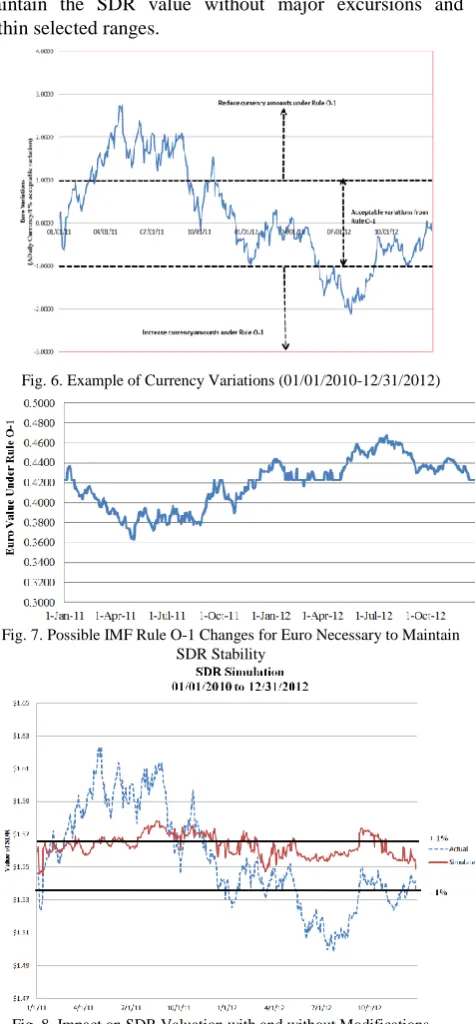
The IKASM-GRC can serve as a means to automate the SDR value without impacting individual sovereignties. This has been shown by Cardullo and Sage [4] to be the case. The various currencies currently within the SDR basket and possible future changes to this basket of currencies can have significant impacts as it will be shown. One of the current impacts to the value of the SDR is the Euro – US dollar currency pair as shown in Fig 6.
Table 6
Independent Currency Changes to Produce 1% Change in SDR Valuation
While this has been the case in the 2010 – 2012 time period, the Euro may not always the major influence on the SDR value. The value of any currency pair is a function of the individual sovereigns and cannot be changed by the IMF. The IMF, through its Executive Committee, can only impact the percentage of currencies within the SDR basket through Rule O-1. Fig. 7 is an example of how the IMF can vary the proportion of the Euro within the SDR basket to meet the fluctuations shown in Fig. 6. This approach in a modified form is used to stabilize the value of the SDR independent of the types of variations that the basket a currency and IMF policies that can occur. Such an approach does not require approval of the participating sovereigns but does require the approval of the IMF Executive Committee.
[image:5.595.60.285.390.691.2]limit of this range.
[image:6.595.58.296.163.676.2]Time series distributions for the four major currencies during the period 01/01/2010 to 12/31/2012 were developed. These time series where used to develop a simulation of the SDR value for a year. A sample of one of the distributions and the ability of the IKASM-GRC methodology to maintain the SDR value within an acceptable range is shown in Fig.9. This appears to indicate that it is possible for the proposed IKASM-GRC to develop methodologies that will maintain the SDR value without major excursions and within selected ranges.
Fig. 6. Example of Currency Variations (01/01/2010-12/31/2012)
Fig. 7. Possible IMF Rule O-1 Changes for Euro Necessary to Maintain SDR Stability
Fig. 8. Impact on SDR Valuation with and without Modifications
Fig. 8 (based on 01/01/2010 to 12/31/2012 data) shows the impact the impact of the IKASM-GRC methodology to maintain the SDR value within an acceptable range. In the proposed approach used in the IKASM-GRC methodology illustrates the potential to maintain the SDR within a stable range for various simulations (See Fig. 9 and 10).
A. Possible Implementation Mechanism
A possible implementation mechanism if the SDR is to become the major global reserve currency is through a substitution account [1],[25]. The use of a substitution account is based on sovereigns depositing their currency reserves with the IMF in return for SDR’s. It is also possible that the IMF could employ an allocation process for the SDR’s instead of through substitution. Obstfeld [1] has suggested that the IMF use the process whereby “SDR claims could be presented directly to central banks in return for their own currencies because this change would make the outside supply of reserve currencies elastic in a crisis.” Therefore, it will be important that an implementation mechanism be developed that it would not only be acceptable to the participating IMF sovereigns but would not increase potential instabilities in global liquidity.
IV. CONCLUSIONS
[image:6.595.69.279.188.337.2]The United States currency is the dominant reserve currency today and has been since the Bretton Woods Agreement of 1946 with approximately 60% of all the global reserve currencies. There is a growing concern that the United States dollar should be replaced as the major global reserve currency. One of the major candidates to replace the United States dollar is the IMF’s SDR.
Fig. 9. Time Series Simulation 1 Year Forecast
[image:6.595.318.547.370.521.2]Fig.10. Impact of Adding Currencies and IMF Policy Changes on SDR Valuation
These variations have not had a major impact on global liquidity, since the SDR represents less than 4% of all the global reserves. As the SDR becomes the only major global reserve currency, such a variation can possibly result in global financial instability to the variability in global liquidity. The proposed IKASM-GRC can provide a system and methodology which can stabilize the SDR independent of policy changes that the IMF’s Executive Committee can implement.
Using historical and simulated time series data, this paper has shown the ability to maintain a stable range for the SDR under various scenarios and policies. It is possible to develop a system such as the proposed IKASM-GRC which can manage any new global reserve currency based on a basket of currencies, such as to reduce variability and provide stability for global liquidity.
REFERENCES
[1] M. Obstfeld, "The SDR as an International Reserve Asset: What Future?," ed. Berkeley, CA: University of California, 2011. [2] M. Cardullo and A. P. Sage, "Information and Knowledge
Architectures Needs for Managing a New Global Reserve Currency," World Journal of Social Sciences vol. 2, pp. 95-114, November 2012 2012.
[3] M. Cardullo and A. P. Sage, "Development of a Mission Statement for Information and Knowledge Architectures for System Management of a Global Reserve Currency,"
Information, Knowledge, and Systems Management, vol. 11, pp. 297-319, 2012
[4] M. Cardullo and A. P. Sage, "Development of Organizational Elements, Use Cases and Rule Models for Information and Knowledge Architectures for Systems Management of a Global Reserve Currency," IEEE Systems (Under review - isj_1737-submitted October 10 , 2012), 2012.
[5] M. Cardullo and A. P. Sage, "Information, knowledge and systems management approaches for a new global reserve currency," Information Knowledge Systems Management, vol. 10, pp. 427-444, 2011.
[6] M. Cardullo and A. P. Sage, "Development of Services Model for Information and Knowledge Architectures for Systems Management of a Global Reserve Currency," IEEE Systems (Under review - isj_1539-submitted July 16, 2012), 2012. [7] A. H. Levis, "Modeling and Simulation for Architecture
Assessment," ed: US Air Force, 2004.
[8] A. H. Levis, "System Arcitectures," in Handbook of Systems Engineering and Management, A. P. Sage and W. B. Rouse, Eds., ed Hoboken, NJ: John Wiley & Sons, 2009, pp. 479-506. [9] IMF, "Review of the Method of Valuation of the SDR,"
International Monetary Fund, Washington, DC, ReportOctober 26, 2010 2010.
[10] H. Reisen. (2010, 04/11/2010). Towards a new reserve currency system? Available: http://www.oecdobserver.org/news/fullstory.php/aid/3075/Towa rds_a_new_reserve_currency_system_.html
[11] WTO, "Databases and publications," W. T. Organization, Ed., ed. Geneva, Switzerland 2012.
[12] B. Zigler. (2010, 04/11/2010). A New Reserve Currency? .
Hardassetsinvestor.com. Available:
http://www.hardassetsinvestor.com/features-and-interviews/1/2026-a-new-reserve-currency.html
[13] G20. (2011, 04/02/2011). About G20. Available: http://www.g20.org/about_what_is_g20.aspx
[14] J. Stiglitz. (2011, 04/02/2011). The best alternative to a new global currency. Available: http://www.ft.com/cms/s/0/c2215510-5bc4-11e0-b8e7-00144feab49a.html#axzz1IOmdyeO7
[15] IMF, "Review of the Method of Valuation of the SDR," International Monetary Fund, Washington, DCOctober 28, 2005 2005.
[16] I. M. Fund. (2012, 11/11/2012). SDR Valuation. Available: http://www.imf.org/external/np/fin/data/rms_sdrv.aspx [17] J. Strupczewski, "G20 "to agree on imbalance screening, future
SDR tweaks"," in Reuters, ed. BRUSSELS, Belgium: Returers, 2011.
[18] IMF, "World Economic Outlook Database," IMF, Ed., ed. Washington, DC: IMF, 2012.
[19] IMF, "Currency Composition of Official Foreign Exchange Reserves (COFER)," IMF, Ed., ed. Washington, DC, 2012. [20] IMF. (2012, 06/3/2012). Governance Structure. Available:
http://www.imf.org/external/about/govstruct.htm
[21] Wikipedia. (2013, 01/01/2013). Special drawing rights. Available: http://en.wikipedia.org/wiki/Special_drawing_rights [22] J. Simpson. (2012, 12/21/2012). Chapter 11: Currency Options
and Volatility. Available:
www.stern.nyu.edu/~msiegel/chapter11.doc
[23] A.-h. Group, "Glabal liquidity - concept measurement and policy implications," Bank for International Settlements, Basel, Switzerland 45, November 2011 2011.
[24] IMF. (2012, 12/29/2012). Exchange Rate Archives by Month. Available:
http://www.imf.org/external/np/fin/data/param_rms_mth.aspx [25] J. Williamson, "Understanding Special Drawing Rights (SDR),"
![Fig. 1. Development Process for IKASM-GRC[3]](https://thumb-us.123doks.com/thumbv2/123dok_us/474188.545697/2.595.55.285.49.315/fig-development-process-for-ikasm-grc.webp)