A Framework for Benchmarking Interactive Collision Detection
Muiris Woulfe∗ Michael Manzke†
Trinity College Dublin
[image:1.612.61.556.134.267.2](a) (b) (c) (d)
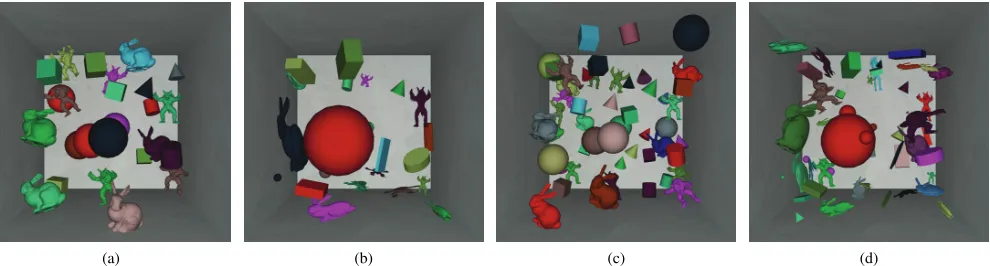
Figure 1: Screenshots of our framework executing a variety of benchmarks, each with the angular velocity of the simulated objects uniform-distributed between (–0.25, –0.25, –0.25) and (0.25, 0.25, 0.25). (a) 25 objects of size 250. (b) 25 objects with uniformly-uniform-distributed sizes between 50 and 550. (c) 50 objects of size 400. (d) 50 objects with uniformly-distributed sizes between 50 and 850.
Abstract
Collision detection is a vital component of applications spanning myriad fields, yet there exists no means for developers to anal-yse the suitability of their collision detection algorithms across the spectrum of scenarios that could be encountered. To rectify this, we propose a framework for benchmarking interactive collision de-tection, which consists of a single generic benchmark that can be adapted using a number of parameters to create a large range of practical benchmarks. This framework allows algorithm develop-ers to test the validity of their algorithms across a wide test space and allows developers of interactive applications to recreate their application scenarios and quickly determine the most amenable al-gorithm. To demonstrate the utility of our framework, we adapted it to work with three collision detection algorithms supplied with the Bullet Physics SDK. Our results demonstrate that those algo-rithms conventionally believed to offer the best performance are not always the correct choice. This demonstrates that conventional wis-dom cannot be relied on for selecting a collision detection algorithm and that our benchmarking framework fulfils a vital need in the col-lision detection community. The framework has been made open source, so that developers do not have to reprogram the framework to test their own algorithms, allowing for consistent results across different algorithms and reducing development time.
CR Categories: I.3.5 [Computer Graphics]: Computational Ge-ometry and Object Modeling—Object hierarchies; I.3.5 [Com-puter Graphics]: Computational Geometry and Object Modeling— Geometric algorithms, languages, and systems
Keywords: collision detection, benchmark, framework
∗e-mail: [email protected]
†e-mail: [email protected]
1
Introduction
Collision detection refers to the process of determining if two sim-ulated objects are intersecting. It is a vital component of computer-aided design (CAD), robotics, virtual environments and other inter-active computer graphics applications, yet it remains a fundamental problem as collision detection forms the computational bottleneck in many of these applications [Lin and Gottschalk 1998]. Inter-active applications are particularly challenging as they demand a frame rate of at least 30 Hz to maintain the illusion of visual con-tinuity, and this duration must be sufficient to execute the entire simulation potentially comprising input processing, collision de-tection, physics simulation, artificial intelligence, audio generation and graphical display. This scenario becomes even more challeng-ing when haptics are added as the collision detection must now up-date at 1 kHz [Vahora et al. 1999]. Despite numerous developments, it remains a challenge to perform accurate collision detection in this short time.
assist them in focusing on optimising those cases in which their algorithms fail to perform efficiently.
Benchmarks designed by algorithm developers also create chal-lenges for developers of applications utilising collision detection. Execution times measured using these benchmarks are often pub-lished as results in collision detection papers, making it difficult to determine the algorithm most amenable to the application’s scenar-ios. A developer could select an algorithm that appears to be supe-rior to existing algorithms, but this might not perform efficiently for the scenarios used in the application. Alternatively, they could se-lect the algorithm whose published benchmarks most closely match the application scenarios, but this removes the possibility of se-lecting a better algorithm whose developer did not publish certain benchmarks. In both cases, there is a significant risk that a devel-oper will select a non-optimal algorithm. Therefore, it would be beneficial if an application developer could quickly determine the behaviour of a wide variety of collision detection algorithms using benchmarks approximating application scenarios.
To mitigate these aforementioned issues, we propose a framework for benchmarking collision detection that currently focuses on the analysis of rigid body collision detection algorithms for interac-tive applications utilising polygonal objects. It consists of a single generic benchmark that may be modified using a number of param-eters to create a large range of practical benchmarks. Using this framework, algorithm developers can test their algorithm against a wide range of potential benchmarks to determine which are prob-lematic for their algorithms. After rectifying any issues highlighted by the framework, they can conclusively prove that their algorithm works well across a broad range of potential scenarios. Alterna-tively, application developers can use our framework to implement benchmarks approximating the scenarios found in their applica-tions, to quickly check a wide range of potential algorithms in order to determine the most appropriate one for their application. There-fore, our framework should prove invaluable to both algorithm and application developers.
Yet there exist a number of challenges in designing this framework. Firstly, the framework must be sufficiently realistic to recreate sce-narios found in interactive applications. Secondly, it must be ad-equately flexible to emulate all common scenarios, but this flexi-bility must not result in an overly complex framework. Thirdly, the framework must be extensible to allow for the integration of new collision detection algorithms and not restricted to currently available algorithms. Fourthly, it must record accurate and relevant performance data. Finally, for the framework to be useful, it must gain traction with the collision detection community. We believe that we have solved the first four challenges and that these work towards achieving the final. Details of our solutions are provided in the following sections.
2
Related Work
Researchers in many areas of computer graphics use standard-ised benchmarks. For example, there exist two such benchmarks
in the field of raytracing. The Standard Procedural Databases
(SPD) [Haines 1987] consist of simple scenes primarily containing recursively-generated objects, while A Benchmark for Animated Ray Tracing (BART) [Lext et al. 2001] consists of detailed an-imated environments. For GPUs, 3DMark Vantage [Futuremark 2009] is widely used to benchmark their performance. This appli-cation consists of two graphics tests and six feature tests designed to exercise every feature found in modern graphics cards. The stan-dardised benchmarks used in these areas allow developers to ac-curately test the performance of their designs across every likely
scenario, while facilitating comparisons between different imple-mentations.
Despite the existence of these benchmarks, there exist very few standardised benchmarks in the area of collision detection. Zach-mann [1998] outlines a benchmark in a paper proposing dynami-cally aligned discrete-orientation polytope (DOP) trees. However, the benchmark focuses on offline algorithms for unmoving objects with very large numbers of vertices. As a result, the benchmark only provides car doors, car door locks, car exteriors and sets of pipes as models and these are unsuitable for accurately benchmark-ing algorithms designed for interactive applications. Trenkel et al. [2007] outlines a development of this benchmark, which uses a castle, a helicopter, a laurel wreath, the Apollo 13 capsule, sets of pipes and a chandelier as models. Two parameters, object distance and number of vertices, are used to alter the benchmark. However, as for the previous benchmark, it is limited to unmoving objects with large numbers of vertices. Moreover, the variety of parame-ters is less wide-ranging than ours. A different approach is taken by Caselli et al. [2002], which tests a range of collision detection algorithms for their suitability in probabilistic motion planners, by attempting to plan the motion of an object through a variety of grid-like structures. However, the described benchmark is not of gen-eral utility and is restricted to a fixed set of scenarios. For haptics, Cao [2006] has created a framework for emulating a haptic device to which benchmarks can be attached. However, this is unsuitable for benchmarking non-haptic algorithm behaviour. Due to the var-ious problems with each of these benchmarks, they have failed to gain traction with the collision detection community.
Most collision detection developers design their own benchmarks. For example, I-COLLIDE [Cohen et al. 1995] was tested using a static scene comprising a single object type parameterised by the quantity of objects, their complexity, their linear velocity, their an-gular velocity and the density of objects in the scene. Van den Bergen [1997] uses three static benchmarks consisting of a single object type (either a torus, teapot or X-wing) initialised at random locations within an enclosing cube. Govindaraju et al. [2005] take a different approach as their algorithm is designed to work with de-formable bodies. Their first three benchmarks model cloth of dif-ferent complexities, the fourth models catheter in liver chemoem-bolisation and the fifth models folding curtains. Even though each of these papers has been widely cited, it appears that their bench-marks have never been used outside of these papers, as they are insufficient to test the behaviour of algorithms across a wide spec-trum of scenarios.
Despite the lack of standardised collision detection benchmarks, there has been significant research into collision detection algo-rithms. This research can be divided into two distinct phases,
re-ferred to as thebroad phaseand thenarrow phasein the taxonomy
proposed by Hubbard [1993]. The broad phase is the first collision detection phase, which uses an approximate and fast test to enu-merate appropriate pairs of objects into a potentially colliding set (PCS), while the narrow phase is the second phase, which checks the PCS using an accurate or exact algorithm.
Broad phase algorithms have been traditionally based on spatial partitioning. Examples include sweep and prune [Baraff 1992; Co-hen et al. 1995], uniform grids, hierarchical grids, spatial
hash-ing, hierarchical spatial hashing [Mirtich 1998a], octrees andk-d
trees [Bentley 1975; Friedman et al. 1977].
bound-ing box (AABB) trees [van den Bergen 1997] and k-DOP
trees [Klosowski et al. 1998]. Non-BVH based algorithms
in-clude the Lin-Canny [Lin and Canny 1991] and Voronoi-Clip (V-Clip) [Mirtich 1998b] algorithms, which both track the closest features of polyhedra, and the Gilbert-Johnson-Keerthi (GLK) al-gorithm [Gilbert et al. 1988; Gilbert and Foo 1990], which de-termines intersection between two polyhedra. All of these algo-rithms have traditionally been designed for performing collisions at discrete time intervals. However, continuous collision detec-tion methods have also been proposed [Redon et al. 2002]. De-tailed surveys of collision detection algorithms can be found in Lin and Gottschalk [1998], Jim´enez et al. [2001] and Lin and Manocha [2004].
Over the past few years, there has been significant research interest in the area of deformable bodies. The same broad phase spatial par-titioning techniques can be used as for the rigid-body case, although there exist some techniques specialised for use with deformable bodies [Luque et al. 1996]. For the narrow phase, deformations are usually solved by refitting the deformed object’s BVH. Efficient BVH refitting algorithms exist for both AABB trees [Larsson and Akenine-M¨oller 2001] and sphere trees. There also exist narrow phase spatial subdivision techniques such as Teschner et al. [2003], which presents an alternative based on spatial hashing. Deformable collision detection techniques can be adapted, as for the rigid body case, to perform continuous collision detection [Redon et al. 2005]. A detailed survey of deformable collision detection algorithms can be found in Teschner et al. [2005].
3
Design
As previously outlined, the range of applications utilising collision detection is extremely large. It would be difficult to create a tool that effectively emulates scenarios found in every potential applica-tion. For this reason, we decided to narrow our focus to scenarios encountered in interactive applications.
An analysis of modern interactive applications found that the ma-jority use some form of physics engine to control the motion of the objects within the simulated environment. To accurately recreate such application scenarios, we determined that it was vital to use a physics engine in our framework. Our analysis also indicated that the majority of objects in these applications are modelled as rigid bodies due to their simplicity and rapid execution times. For this reason, we decided to initially concentrate on rigid body collision detection, although our framework could easily be expanded to sup-port deformable bodies, particle systems and articulated rigid bod-ies in the future. Similarly, we have focused on collisions between polygonal objects and left parametric surfaces, implicit surfaces and voxel objects as future work.
We also determined that the majority of these applications contain a ground plane. However, many existing benchmarks have no ground plane and we believe that this is a significant oversight, since in simulations involving gravity, the majority of objects will tend to come to rest on the ground. If the collision detection system has been poorly designed, objects on the ground may need lengthy tests before they can be eliminated from consideration, as they will all lie in the same plane and overlap along one axis. Algorithms that are more sophisticated avoid this problem by processing axes in a specific order or by deactivating stationary objects. Therefore, it is vital to implement a ground plane so that the likely performance of a collision detection algorithm can be quantified.
Based on these identified requirements, we constructed a generic benchmark consisting of a cube containing a variable quantity of
objects. The size of the cube is determined by multiplying the num-ber of objects by 50.
3.1 Parameters
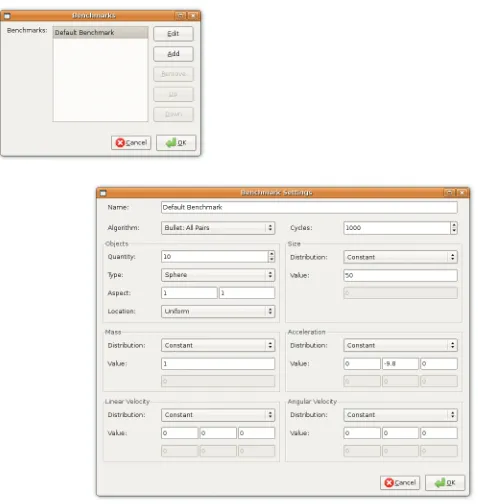
[image:3.612.320.559.227.479.2]To translate the generic benchmark into a variety of practical bench-marks, we have defined ten parameters that can be used to specify the initial state of each benchmark. These parameters mimic the standard geometric and physical properties of rigid bodies and were chosen after a preliminary analysis of a variety of interactive appli-cations. We believe these should enable developers to accurately recreate real application scenarios as benchmarks. The dialog boxes used to control the parameters are illustrated in Figure 2. Each of these parameters and their potential impact on the behaviour of the collision detection algorithm are outlined below.
Figure 2: Dialog boxes used to control the parameters.
Cycles This parameter controls the number of collision detection cycles that will be executed, with the default being 1000 cycles.
Different benchmarks require different numbers of cycles before reaching a steady state. For example, an object with a large mass falling under the influence of gravity will reach a steady state quickly, once the object comes in contact with the floor. However, if the mass were reduced substantially, the object would take longer to come into contact with the floor and it would take more cycles for the benchmark to reach a steady state. This parameter provides an opportunity to adapt the number of cycles to the behaviour of the benchmark under consideration.
Objects – Quantity This parameter modifies the quantity of simulated objects, with the default being 10 objects.
Objects – Type This parameter selects the type of the simulated objects, with an option of spheres, cuboids, cylinders, cones, Stan-ford Bunnies [Turk and Levoy 1994], StanStan-ford Armadillos [Krish-namurthy and Levoy 1996] or a combination of objects determined by the uniform probability distribution. The default is spheres. As the Stanford Bunny and Armadillo are concave objects, we con-struct them as a compound shape of convex hulls.
Object type influences algorithm execution speed, as some algo-rithms optimise for specific primitive objects while others consider every object using a generic bounding volume. Additionally, com-plex, concave objects tend to be processed differently than simpler convex primitives and can execute at very different speeds with dif-ferent algorithms.
Objects – Aspect This parameter determines the aspect ratio of the simulated objects. This ratio can be considered to be of the form
1:y:zwhereyandzare the user-modifiable options. The default is
1:1:1.
Aspect ratio influences the shape of the objects. Most collision de-tection algorithms utilise bounding volumes (BVs) and some types of BV may be difficult to fit around long, thin objects. The use of this parameter can reveal a suboptimal BV selection, as many col-lisions will occur in the PCS and the collision detection algorithm will execute slowly.
Objects – Location This parameter selects the probability dis-tribution used to populate the cube, from a choice of the uniform or normal distributions. The default is the uniform distribution. Ob-jects are placed inside the cube according to the selected distribu-tion. Once an object location is generated, it is checked to ensure it overlaps no other object or the cube walls. If it overlaps, a new location is generated according to the distribution. The distribution parameters are determined by the size of the cube. For the uniform distribution, the minimum and maximum are the coordinates of the cube walls. For the normal distribution, the mean is 0 and the vari-ance is the coordinates of the cube walls in the positive direction divided by three. This choice of variance ensures 99.7% of objects will be within the walls. The 0.3% of objects outside the walls will be detected and new normal locations within the walls will be gen-erated.
The effect of the uniform distribution is to place objects throughout the cube, while the normal distribution tends to cluster the objects in the centre of the cube. A cluster of objects is likely to result in increased collisions, as the objects within the cluster interact with one another.
Size This parameter determines the size of the simulated objects,
using a constant value or a choice of the uniform or normal prob-ability distributions. The default is a constant 50. When using the probability distributions, each side of each simulated object will be of differing size. Any sizes less than or equal to zero will be dis-carded and a new size will be generated.
Larger objects will tend to result in more collisions. The uniform distribution will tend to create objects across a full range of sizes, while the normal distribution will tend to create objects whose sizes are centred on the mean.
Mass This parameter controls the mass of the simulated objects,
using a constant value or a choice of the uniform or normal proba-bility distributions. The default is a constant 1.
The mass of the objects determines how quickly the objects will move under the influence of the acceleration. If the mass is de-termined by a distribution, the varying masses will change the rate at which objects move relative to one another. This will affect the number of collisions that occur. The mass will also determine how the objects move once they reach the ground plane. Objects with a small mass may tend to roll, while those with a larger mass will tend to come to a stop more quickly. Therefore, the mass will also determine the number of collisions that occur between objects and the ground plane.
Acceleration This parameter controls the acceleration that acts on all simulated objects, using a constant value or a choice of the uniform or normal probability distributions. The default is a con-stant (0.0, –9.8, 0.0), corresponding to acceleration due to gravity. The acceleration is applied as a single value to the entire simulated environment.
Acceleration determines the motion of the objects within the world, influencing the number of collisions. For example, the accelera-tion could be used to move all of the objects towards one wall of the cube. Alternatively, if zero acceleration were applied, objects would float, resulting in zero collisions, unless a linear or angular velocity were employed.
Linear Velocity This parameter controls the linear velocity of the simulated objects, using a constant value or a choice of the uni-form or normal probability distributions. The default is a constant (0, 0, 0).
Linear velocity determines the linear motion of objects. This pa-rameter has an effect similar to that of the acceleration, but differ-ent values can be given to differdiffer-ent objects by using a probability distribution. If objects move towards each other, this will tend to maximise the number of collisions that occur.
Angular Velocity This parameter controls the angular velocity of the simulated objects, using a constant value or a choice of the uniform or normal probability distributions. The default is a con-stant (0, 0, 0).
Angular velocity determines the rotational motion of objects. This adds a degree of complexity to the simulation due to the difficulty of fitting BVs to rotated objects. Moreover, different BVs fit rotated objects very differently, so the optimality of the collision detection algorithm’s choice of BV can be tested using this parameter.
Remarks The random number generators that power the uniform and normal probability distributions are individually seeded with a constant value of hexadecimal AAAAAAAA to make the bench-marks repeatable. Each uniform distribution takes a minimum and a maximum value as parameters, while each normal distribution takes a mean and a variance value as parameters.
3.2 Application Programming Interface (API)
To add an algorithm to the framework, the developer first inherits from a collision detection class. To initialise the appropriate algo-rithm data structures, the inherited class’ initialisation method can be overridden. Inside, a variety of method calls can be used to re-trieve object properties and geometry.
To perform the collision detection routines, the class’ collision tection method can be overridden with the appropriate collision de-tection method from the algorithm under consideration. Inside this method, the algorithm can call a selection of framework methods to retrieve object status data. This method will be called during each physics engine time step. For each collision, a point on both collid-ing objects, a contact normal and the distance between the two con-tact points is required. Using this data, the physics engine is able to perform the appropriate physics calculations before processing the next step.
4
Implementation
Our framework is implemented in C++. For the uniform and nor-mal distributions, the relevant classes defined in the Technical Re-port 1 (TR1) [JTC1/SC22/WG21 2005] additions to the C++ stan-dard library are used. The Boost 1.36.0 library [Boost 2009] pro-vides some additional data structures. Single precision is used for floating-point numbers, but this can be changed to double precision using an appropriate preprocessor directive.
For the physics engine, we selected Bullet Physics
SDK 2.74 [Coumans 2009], due to its status as a mature open source cross-platform engine featuring collision detection and physics, optional multithreaded execution and a PlayStation 3 port. All of these were deemed desirable attributes as they expand the flexibility of the framework.
To visualise the benchmark and the effect of modifying the pa-rameters, a graphical display was created using OpenGL [Khronos Group 2009]. A GUI, created using the cross-platform open source wxWidgets 2.8.7 library [wxWidgets 2009], allows the user to vi-sually modify the parameters.
To test our framework and acquire sample results, a collision de-tection system based on the one provided with Bullet is included. For comparison purposes, the user can change the broad phase al-gorithm, although the narrow phase algorithm remains constant in this initial implementation. The three broad phase algorithm op-tions are the all pairs brute force algorithm (referred to as “simple” by Bullet), the sweep and prune algorithm [Baraff 1992; Cohen et al. 1995] and the custom dynamic bounding volume tree (DBVT) algorithm, which is based on AAABs. Alternative algorithms can easily be added to our framework using its aforementioned API. Both the broad and narrow phases can be changed using this API.
Screenshots of our framework executing a variety of benchmarks are shown in Figure 1.
5
Results
Our framework was compiled with G++ 4.2.4 and optimised for speed. It was executed on an AMD Opteron 2350 2 GHz quad core CPU with 8 GB RAM running 64-bit Ubuntu Linux 8.04. For each of our experiments, we recorded the broad phase, narrow phase and complete collision detection execution times using high-resolution performance counters.
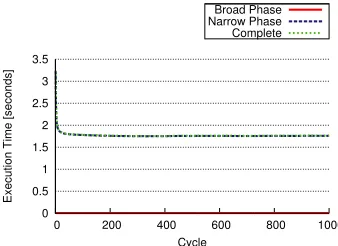
Our first experiment uses the sweep and prune algorithm to execute a benchmark consisting of 5000 objects whose types are determined by the uniform distribution. The variation in execution times across 1000 collision detection cycles is plotted in Figure 3.
0 0.5 1 1.5 2 2.5 3 3.5
0 200 400 600 800 1000
Execution Time [seconds]
Cycle
[image:5.612.357.526.109.232.2]Broad Phase Narrow Phase Complete
Figure 3: Results from the first experiment.
From our results, it is evident that the algorithm has a significant startup cost as the data structures are initialised during the first cy-cle. For the subsequent cycles, execution times remain relatively constant. We can also see that an insignificant amount of time is spent in the broad phase, with the narrow phase accounting for most of the complete execution time.
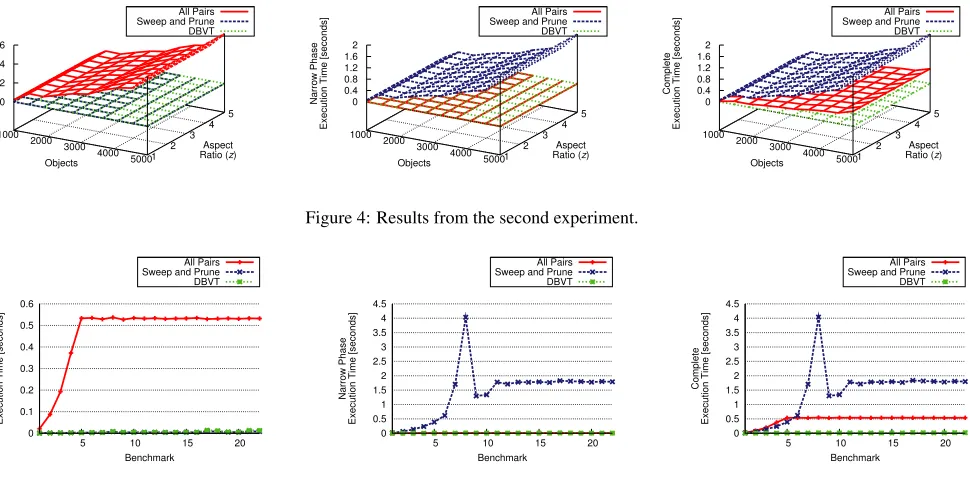
Our second experiment uses Bullet’s three collision detection al-gorithms to execute benchmarks with object types determined by the uniform distribution. The quantity of objects is varied between
1000 and 5000, and thezvalue of the aspect ratio is varied
be-tween 1 and 5, to create twenty-five variations of the benchmark. The mean execution times, averaged over 1000 collision detection cycles, are graphed in Figure 4.
From our results, we can see that for each algorithm, the aspect ratio has a negligible effect while the number of objects has a very signif-icant effect. Examining the performance of the different algorithms reveals that sweep and prune and DBVT are the most efficient in the broad phase. This is to be expected as these algorithms, un-like all pairs, exploit coherence. However, the situation changes for the narrow phase as sweep and prune takes significantly longer to execute than all pairs, suggesting that sweep and prune’s efficient broad phase comes at the expense of an inefficient narrow phase. It is likely that Bullet’s implementation of sweep and prune creates a larger PCS than all pairs. With regard to the complete execution time, DBVT performs best, followed by all pairs and then sweep and prune. This holds true for each benchmark, suggesting that the behaviour of these algorithms is not significantly affected by changes to either object count or aspect ratio.
Our third and final experiment uses Bullet’s three collision detec-tion algorithms to execute a wide range of benchmarks that demon-strate all of the framework’s parameters, except the aspect ratio as this was analysed in the second experiment. These twenty-two benchmarks are listed in Table 1 and their mean execution times, averaged over 1000 collision detection cycles, are graphed in Fig-ure 5.
Broad Phase
Execution Time [seconds]
All Pairs Sweep and Prune DBVT
1000 2000
3000 4000 5000
Objects 1
2 3
4 5
Aspect Ratio (z) 0
0.2 0.4 0.6
Narrow Phase
Execution Time [seconds]
All Pairs Sweep and Prune DBVT
1000 2000
3000 4000 5000
Objects 1
2 3
4 5
Aspect Ratio (z) 0 0.4 0.8 1.2 1.6 2 Complete
Execution Time [seconds]
All Pairs Sweep and Prune DBVT
1000 2000
3000 4000 5000
Objects 1
2 3
4 5
Aspect Ratio (z) 0 0.4 0.8 1.2 1.6 2
Figure 4: Results from the second experiment.
0 0.1 0.2 0.3 0.4 0.5 0.6
5 10 15 20
Broad Phase
Execution Time [seconds]
Benchmark All Pairs Sweep and Prune DBVT 0 0.5 1 1.5 2 2.5 3 3.5 4 4.5
5 10 15 20
Narrow Phase
Execution Time [seconds]
Benchmark All Pairs Sweep and Prune DBVT 0 0.5 1 1.5 2 2.5 3 3.5 4 4.5
5 10 15 20
Complete
Execution Time [seconds]
[image:6.612.70.555.65.307.2]Benchmark All Pairs Sweep and Prune DBVT
Figure 5: Results from the third experiment.
works well in the broad phase but poorly in the narrow phase. More significantly, from the complete execution time, it is clear that for low numbers of simple objects, sweep and prune performs better than all pairs, but for larger numbers of more complex objects, all pairs is more efficient. However, our primary finding is that DBVT works significantly better in all cases.
Our unexpected findings in these three experiments have demon-strated the need for our framework. Conventional wisdom suggests sweep and prune is the most efficient broad phase algorithm but we have discovered that, at least with Bullet’s implementation, sweep and prune’s efficiency may come at the expense of an inefficient narrow phase. Moreover, our findings recommend the use of DBVT for all scenarios similar to those found in the benchmarks used in our experiments. However, if a different scenario were to be found in an application utilising collision detection, we recommend recre-ating this scenario as a benchmark in our framework to determine whether DBVT is still the most efficient algorithm.
6
Conclusion and Future Work
We have outlined the design of a framework for benchmarking col-lision detection consisting of one generic benchmark that can be adapted by means of parameters to define a wide range of practical benchmarks. Using our framework, we tested three collision detec-tion algorithms supplied with the Bullet Physics SDK. Our results demonstrate that the three algorithms do not behave consistently across all benchmarks, highlighting the utility of the framework. We also determined that contrary to popular belief, the sweep and prune algorithm is not the optimal solution for the benchmarks we tested. Therefore, we believe that our framework should prove in-valuable to collision detection algorithm developers wishing to de-termine the performance of their algorithm across a wide spectrum of benchmarks, and to interactive application developers who wish to find the optimal algorithm for their scenarios.
To facilitate these developers, we are making our
frame-work available for download under the BSD licence from
http://gv2.cs.tcd.ie/benchmarkcd/. It compiles and
exe-cutes under both Linux and Microsoft Windows. We also provide all of the experiments in this paper, which can either be used di-rectly or as a starting point for more targeted evaluations. By pro-viding our framework for download, developers do not have to re-program the framework to test their own algorithms, allowing for consistent results across different algorithms and reducing develop-ment time.
In the future, we intend to analyse a further set of representative interactive applications, with a view to determining a minimal but complete list of parameters suitable for describing every scenario likely to be encountered by a collision detection algorithm. Adding these additional parameters will clearly make our framework more comprehensive but it will also significantly increase the possible test space. To manage this extra complexity, we intend to define a small number of benchmarks that very closely approximate the scenarios found in different types of interactive applications. Us-ing these benchmarks, developers will be able to quickly test their algorithms against the most likely scenarios, while the full set of parameters will remain for those wishing to run more comprehen-sive analyses. This will also facilitate researchers, since they will be able to publish execution times of their algorithm for standard-ised benchmarks, allowing for the easy comparison of algorithms between papers.
We also intend to integrate additional collision detection algorithms into our framework. By adding these additional algorithms, devel-opers would be provided with a greater range against which to test their new algorithms, without having to waste valuable develop-ment time. These algorithms should be relatively easy to integrate, as the framework’s API has been designed to facilitate extensibility.
1 1000 spheres
2 2000 spheres
3 3000 spheres
4 4000 spheres
5 5000 spheres
6 5000 cuboids
7 5000 cylinders
8 5000 cones
9 5000 Stanford Bunnies
10 5000 Stanford Armadillos
11 5000 uniformly-distributed object types
12 5000 uniformly-distributed object types
location normal
13 5000 uniformly-distributed object types
size uniform 50/500
14 5000 uniformly-distributed object types
size normal 275/75
15 5000 uniformly-distributed object types
mass uniform 1/500
16 5000 uniformly-distributed object types
mass normal 249.5/83.5
17 5000 uniformly-distributed object types
acceleration uniform
(–250, –250, –250)/(250, 250, 250)
18 5000 uniformly-distributed object types
acceleration normal
(0, 0, 0)/(83.333, 83.333, 83.333)
19 5000 uniformly-distributed object types
linear velocity uniform
(–250, –250, –250)/(250, 250, 250)
20 5000 uniformly-distributed object types
linear velocity normal
(0, 0, 0)/(83.333, 83.333, 83.333)
21 5000 uniformly-distributed object types
angular velocity uniform
(–250, –250, –250)/(250, 250, 250)
22 5000 uniformly-distributed object types
angular velocity normal
[image:7.612.90.261.53.452.2](0, 0, 0)/(83.333, 83.333, 83.333)
Table 1: Benchmarks used in the third experiment. All parameters other than those specified are left at their defaults.
to support these object types, through the addition of parameters such as joint types, number of particles, elasticity and plasticity, while still supporting rigid bodies and parameterisation. Moreover, the framework’s current support for detecting collisions between polygonal objects could be expanded to include parametric sur-faces, implicit surfaces and voxel objects. In this way, we could extend our framework to comprehensively benchmark collision de-tection algorithms for all aspects of modern interactive applications.
Acknowledgements
This research is supported by the Irish Research Council for Sci-ence, Engineering and Technology (IRCSET) funded by the Na-tional Development Plan (NDP).
References
BARAFF, D. 1992.Dynamic Simulation of Non-Penetrating Rigid
Bodies. PhD thesis, Cornell University, Ithaca, New York, USA. BENTLEY, J. L. 1975. Multidimensional binary search trees used
for associative searching. Communications of the ACM 18, 9
(Sept.), 509–517.
BOOST, 2009. Boost C++ libraries, 8 Feb. http://www.boost.org/.
CAO, X. R. 2006. A Framework for Benchmarking Haptic
Sys-tems. Master’s thesis, Simon Fraser University, Burnaby, British
Columbia, Canada.
CASELLI, S., REGGIANI, M.,AND MAZZOLI, M. 2002.
Ex-ploiting advanced collision detection libraries in a probabilistic
motion planner.Journal of WSCG – Proceedings of the 10th
In-ternational Conference in Central Europe on Computer Graph-ics, Visualization and Computer Vision (WSCG 2002) 10, 1–3 (4–8 Feb.), 103–109.
COHEN, J. D., LIN, M. C., MANOCHA, D., AND PONAMGI,
M. K. 1995. I-COLLIDE: An interactive and exact collision
de-tection system for large-scale environments. InProceedings of
the 1995 Symposium on Interactive 3D Graphics (SI3D 1995), M. Zyda, Ed., ACM, 189–196.
COUMANS, E., 2009. Bullet physics SDK, 22 Mar. http://www. bulletphysics.com/.
FRIEDMAN, J. H., BENTLEY, J. L., ANDFINKEL, R. A. 1977. An algorithm for finding best matches in logarithmic expected
time.ACM Transactions on Mathematical Software 3, 3 (Sept.),
209–226.
FUTUREMARK, 2009. 3DMark Vantage. http://www.futuremark.
com/benchmarks/3dmarkvantage/introduction/.
GILBERT, E. G.,ANDFOO, C.-P. 1990. Computing the distance between general convex objects in three-dimensional space.
IEEE Transactions on Robotics and Automation 6, 1 (Feb.), 53– 61.
GILBERT, E. G., JOHNSON, D. W.,ANDKEERTHI, S. S. 1988. A fast proceedure for computing the distance between complex
objects in three-dimensional space. IEEE Journal of Robotics
and Automation 4, 2 (Apr.), 193–203.
GOTTSCHALK, S., LIN, M. C.,ANDMANOCHA, D. 1996. OBB-Tree: A hierarchical structure for rapid interference detection. In
Proceedings of the 23rd International Conference on Computer Graphics and Interactive Techniques (SIGGRAPH 1996), J. Fu-jii, Ed., ACM, 171–180.
GOVINDARAJU, N. K., KNOTT, D., JAIN, N., KABUL, I., TAM -STORF, R., GAYLE, R., LIN, M. C.,ANDMANOCHA, D. 2005. Interactive collision detection between deformable models
us-ing chromatic decomposition.ACM Transactions on Graphics –
Proceedings of the 32nd International Conference on Computer Graphics and Interactive Techniques (SIGGRAPH 2005) 24, 3 (31 July–1 Aug.), 991–999.
HAINES, E. 1987. A proposal for standard graphics environments.
IEEE Computer Graphics and Applications 7, 11 (Nov.), 3–5. HUBBARD, P. M. 1993. Interactive collision detection. In
Pro-ceedings of the IEEE 1993 Symposium on Research Frontiers in Virtual Reality (VR 1993), S. Bryson and S. Feiner, Eds., IEEE Computer Society, 24–32.
JIMENEZ´ , P., THOMAS, F.,ANDTORRAS, C. 2001. 3D collision
detection: a survey. Computers & Graphics 25, 2 (Apr.), 269–
JTC1/SC22/WG21. 2005. Draft technical report on C++ library extensions. Tech. Rep. DTR 19768, ISO/IEC, 24 June.
KHRONOSGROUP, 2009. OpenGL, 20 Mar. http://www.opengl.
org/.
KLOSOWSKI, J. T., HELD, M., MITCHELL, J. S. B., SOWIZRAL,
H.,ANDZIKAN, K. 1998. Efficient collision detection using
bounding volume hierarchies ofk-DOPs.IEEE Transactions on
Visualization and Computer Graphics 4, 1 (Jan.–Mar.), 21–36.
KRISHNAMURTHY, V., AND LEVOY, M. 1996. Fitting smooth
surfaces to dense polygon meshes. InProceedings of the 23rd
International Conference on Computer Graphics and Interactive Techniques (SIGGRAPH 1996), J. Fujii, Ed., ACM, 313–324. LARSSON, T.,ANDAKENINE-M ¨OLLER, T. 2001. Collision
de-tection for continuously deforming bodies. InProceedings of the
22rd Annual Conference of the European Association for Com-puter Graphics (Eurographics 2001), J. C. Roberts, Ed., Euro-graphics Association, 313–324. Short Presentation.
LEXT, J., ASSARSSON, U.,ANDM ¨OLLER, T. 2001. A
bench-mark for animated ray tracing. IEEE Computer Graphics and
Applications 21, 2 (Mar.–Apr.), 22–31.
LIN, M. C.,ANDCANNY, J. F. 1991. A fast algorithm for
incre-mental distance computation. InProceedings of the 1991
Inter-national Conference on Robotics and Automation (ICRA 1991), T. Hsia, Ed., IEEE, 1008–1014.
LIN, M. C., ANDGOTTSCHALK, S. 1998. Collision detection
between geometric models: a survey. InProceedings of the 1998
IMA Conference on the Mathematics of Surfaces, R. Cripps, Ed., IMA, 37–56.
LIN, M. C.,ANDMANOCHA, D. 2004. Collision and proximity
queries. InHandbook of Discrete and Computational Geometry,
second ed, J. E. Goodman and J. O’Rourke, Eds. Chapman & Hall/CRC, Boca Raton, Florida, USA, 787–807.
LUQUE, R. G., COMBA, J. L. D., ANDFREITAS, C. M. D. S.
1996. Broad-phase collision detection using semi-adjusting
BSP-trees. InProceedings of the 2005 Symposium on Interactive
3D Graphics and Games (I3D 2005), D. Luebke and H. Pfister, Eds., ACM, 179–186.
MIRTICH, B. 1998. Efficient algorithms for two-phase collision
detection. InPractical Motion Planning in Robotics: Current
Approaches and Future Directions, K. Gupta and A. P. del Pobil, Eds. Wiley, Chichester, Sussex, UK, 203–223.
MIRTICH, B. 1998. V-Clip: Fast and robust polyhedral collision
detection.ACM Transactions on Graphics 17, 3 (July), 177–208.
QUINLAN, S. 1994. Efficient distance computation between
non-convex objects. In Proceedings of the 1994 IEEE
Inter-national Conference on Robotics and Automation (ICRA 1994), H. Stephanou, Ed., IEEE Computer Society, 3324–3329.
REDON, S., KHEDDARY, A., ANDCOQUILLART, S. 2002. Fast
continuous collision detection between rigid bodies. Computer
Graphics Forum – Proceedings of the 23rd Annual Conference of the European Association for Computer Graphics (Eurographics 2002) 21, 3 (2–6 Sept.), 279–287.
REDON, S., LIN, M. C., MANOCHA, D.,ANDKIM, Y. J. 2005.
Fast continuous collision detection for articulated models.
Jour-nal of Computing and Information Science in Engineering 5, 2 (June), 126137.
TESCHNER, M., HEIDELBERGER, B., M ¨ULLER, M., POMER -ANETS, D.,ANDGROSS, M. 2003. Optimized spatial hashing
for collision detection of deformable objects. InProceedings of
the 2003 International Fall Workshop on Vision, Modeling, and Visualization (VMV 2003), T. Ertl, Ed., AKA, 47–54.
TESCHNER, M., KIMMERLE, S., HEIDELBERGER, B., ZACH
-MANN, G., RAGHUPATHI, L., FUHRMANN, A., CANI,
M.-P., FAURE, F., MAGNENAT-THALMANN, N., STRASSER, W.,
ANDVOLINO, P. 2005. Collision detection for deformable
ob-jects.Computer Graphics Forum 24, 1 (Mar.), 61–81.
TRENKEL, S., WELLER, R., AND ZACHMANN, G. 2007. A
benchmarking suite for static collision detection algorithms.
Journal of WSCG – Proceedings of the 15th International Con-ference in Central Europe on Computer Graphics, Visualization and Computer Vision (WSCG 2007) 15, 1–3 (29 Jan.–1 Feb.), 105–110.
TURK, G.,ANDLEVOY, M. 1994. Zippered polygon meshes from
range images. InProceedings of the 21st International
Confer-ence on Computer Graphics and Interactive Techniques (SIG-GRAPH 1994), D. Schweitzer, A. Glassner, and M. Keeler, Eds., ACM, 311–318.
VAHORA, F., TEMKIN, B., KRUMMEL, T. M.,AND GORMAN, P. J. 1999. Development of real-time virtual reality haptic
ap-plication: Real-time issues. InProceedings of the 12th IEEE
Symposium on Computer-Based Medical Systems (CBMS 1999), IEEE Computer Society, 290–295.
VAN DENBERGEN, G. 1997. Efficient collision detection of
com-plex deformable models using AABB trees.Journal of Graphics
Tools 2, 4, 1–14.
WXWIDGETS, 2009. wxWidgets: Cross-platform GUI library, 19 Mar. http://www.wxwidgets.org/.
ZACHMANN, G. 1998. Rapid collision detection by dynamically
aligned DOP-trees. InProceedings of the IEEE Virtual Reality