Gel Dynamics
Masao DOI
Department of Applied Physics, Graduate School of Engineering, The University of Tokyo, Bunkyo, Tokyo 113-8656 (Received January 7, 2009; accepted February 19, 2009; published April 27, 2009)
Continuum mechanical model is proposed for dynamical processes in gels that involve coupling between the elastic deformation and solvent permeation. Basic equations are derived by two methods, by a physical argument, and by a variational principle. The model is then applied to discuss the swelling of gels, in which solvent permeation causes deformation, and the squeezing of gels, in which mechanical force induce solvent permeation. The model is also applied to the dynamics of the volume transition of gels. It is shown that the elasticity of gels creates various unusual features in the phase transition dynamics.
KEYWORDS: swelling, squeezing, variational principle, volume transition, elastic effect DOI: 10.1143/JPSJ.78.052001
1. Introduction
Gel is an elastic material swollen with a fluid.1,2) An example of a gel is an edible jelly. When a solution of gelatin is kept in a refrigerator, the solution loses its fluidity and becomes a gel. The gel is a soft elastic material; it can be easily deformed by hand, but it recovers its original shape when the hand is released. The gel contains a large amount of water, which can permeate through the gel. The permeation of water can be controlled by a mechanical force: the liquid in a soft jelly can be squeezed out by applying some weight to the top of the jelly.
Most gels are made of polymers. By creating bridges between polymers (either by a chemical reaction or by forming physical junctions), the fluid state of the polymer solution is transformed to an elastic state, i.e., a gel [see Fig. 1(a)]. An example of this type of gel is the small beads used in diapers. When placed in water, the beads absorb a volume of water up to thousands times larger than their own volume.
Gels can also be made from colloidal solutions. By changing the condition of the solvent (such as the PH or salt concentration), the colloidal particles aggregate to form a three-dimensional network as shown in Fig. 1(b). Examples of this type of gel are yogurt and bean curd.
This state of matter (elastic materials containing fluids) are ubiquitous in our everyday life: they are found in foods, cosmetics, and medicines. Gels are also important in industry: in printing and coating, one needs to preserve the shape of a material while the solvent is evaporating. Many processes in the fabrication of electronic devices rely on this state of matter. Gels are also important in agricultural, biological, and environmental applications. The fact that our bodies are made of gels indicates their importance.
The purpose of this article is to discuss the non-equi-librium phenomena that take place in gels. The problems we are addressing are illustrated in Fig. 2.
(1) Swelling and drying; [Fig. 2(a)]: a dry gel placed in a water absorbs water and swells. Conversely, the gel shrinks as the water evaporates from the surface. This process is not just a process of volume change: During the process, stress field is created within the gel, which causes the deformation of the gel, and in some cases, creates cracks within the gel.
(2) Squeezing; [Fig. 2(b)]: When a gel is squeezed, the stress squeeze out the solvent from the gel.
(3) Forced permeation; [Fig. 2(c)]: When a solvent on one side of the gel is pressed by a piston, it will permeate through the gel.
These phenomena are seen in our everyday life, and have been used in many industrial processes for a long time. However, the theoretical aspects of the phenomena seem to INVITED REVIEWPAPERS
Sol (fluid)
Gel (soft solid)
[image:1.595.309.540.284.440.2] [image:1.595.310.544.495.653.2](a) (b)
Fig. 1. (Color online) Process of forming gels. (a) Gelation of polymer solutions and (b) gelation of collidal solutions.
porous wall piston
gel gel
(a) (b) (c)
Fig. 2. (Color online) (a) Swelling of a gel, (b) squeezing a gel, and (c) pumping water into a gel.
have been ignored or have attracted little attention compared with their applications. Accordingly, theories for the above phenomena have not been worked out. Early works on gel dynamics focused on the analysis of dynamic light scattering and the swelling of gels.3,4)Tanaka and Filmore4)proposed an equation describing the swelling of gels, but it turned out that this equation is only valid for spherical gels. This has been corrected by Tanaka and coworkers,1,5) but equations describing the general gel dynamics have not been derived.
The purpose of this article is to provide a general framework by which one can discuss the swelling and squeezing of gels using the same basic equations. The framework can be constructed in the same way as the two-fluid model for solutions. In fact, from the viewpoint of continuum mechanics, a gel can be regarded as a homoge-neous mixture of a fluid (solvent) and a solid (a network made of polymers or colloidal particles). We call this model the fluid–solid model.
The idea of the fluid–solid model is not new. Continuum mechanical models for mixtures of solids and fluids have been studied in geophysics in which the flow of underground water is coupled with the elastic deformation of the ground. The mechanics dealing with such phenomena is called poro-mechanics (the poro-mechanics of porous materials).6–8)Although the gel dynamics discussed here has some common features with poro-mechanics, there are differences.
Firstly, a gel is a very soft material. It can be easily deformed and can change its volume enormously: the volume of a fully swollen gel can be thousands times larger than the dry gel. Therefore, the model must be able to describe large deformations and large volume changes.
Secondly, the bulk modulus of a gel is much larger than the shear modulus, and therefore gel can be regarded as an incompressible material. Hence gel can change its volume only by absorbing a solvent. This gives some unique features for the mathematical structures of gel dynamics.
Thirdly, gels can undergo a phase transition: a small change of external parameters causes a very large change in volume. In the process of phase transitions, gels show many unusual and interesting behaviors.
Gel dynamics has been constructed by several
groups,3,9–13)each studying different problems with different objectives. Accordingly, although there is a general con-sensus on the physics underlying the model, the equations proposed by these authors are not exactly the same. In this article, the discussion is restricted to slow phenomena in gels, i.e., the problems illustrated in Fig. 2. Fast phenomena such as wave propagation or density fluctuations are not discussed here.
The discussion is also restricted to the continuum mechanics of gels. The molecular aspects of gels, on which many studies have been done,1,14) are not discussed. In continuum mechanics, it does not matter whether the gel is a polymer gel or a colloidal gel. However, the present discussion is mostly suited for polymer gels since we are making two assumptions that are generally satisfied for polymer gels but not for colloidal gels.
(1) The network of gels is purely elastic: the network is not broken and does not undergo plastic deformation. This condition is usually satisfied for strong chemical gels
made of polymers but not for weak physical gels or colloidal gels.
(2) The specific density p of the network component is equal to that of the solvent s, and is a constant independent of temperature and pressure.
p¼s¼¼constant ð1Þ
The second assumption, which is commonly made for polymer solutions, can be stated as follows. Let be the volume fraction of the polymer network, then the mass density of the polymer mp, and that of the solvent ms are
given by
mp ¼; ms¼ð1Þ: ð2Þ
The total mass density of the gel mpþms is constant
independent of temperature and pressure.
Since we are focusing on polymer gels, we shall refer to the network component as the polymer network.
2. Equilibrium Theory for Soft Elastic Materials
2.1 Swelling equilibrium
Let us start the discussion with the equilibrium state of gels. A gel placed in a solvent changes its volume by absorbing or desorbing the solvent and eventually reaches thermodynamic equilibrium. The equilibrium state of a gel can also be defined when the gel is subject to an external force [as shown in Fig. 2(b)]. In this case, the swelling is not uniform but the final state is at thermodynamic equi-librium.
Equation (1) indicates that gels can change their volume only by absorbing or desorbing a solvent. Note that when we discuss the volume of gels, we are referring to the volume of the region surrounded by the material points that move with the polymer network. Also note that the deformation of gels actually means the deformation of the polymer network. The swelling of a gel can therefore be regarded as the deformation of the polymer network constituting the gel.
The mathematical framework describing the deformation of a polymer network is the same as that developed for rubber elasticity. Rubber is made of a polymer network and can be regarded as a special case of a gel in which there is no solvent (or the flow of solvent can be ignored). The continuum theory of rubber elasticity has been discussed in many literatures,15,16)and the following section is a brief summary.
2.2 Description of deformation
Let us consider the deformation of a soft elastic material (rubber or gel) that is isotropic and homogeneous when all external forces are removed. We shall use the force-free state as the reference to describe the deformation. We label each point on the material (or more precisely the points that move together with the polymer network) by its positionX
in the reference state. The deformation of the whole material is characterized by the function xx~ðXÞ which denotes the position of the material point Xafter deformation.
dx¼dX @
@Xxx~ðXÞ; ð3Þ
or in terms of components,
dxi¼FijdXj; ð4Þ
whereiandjare thex;y;zcomponents of the vector, andFij is defined by
FijðXÞ ¼
@xx~i
@Xj
: ð5Þ
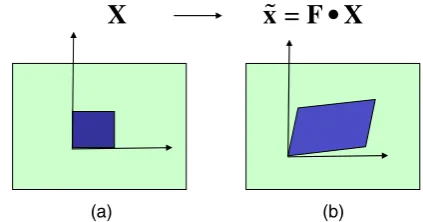
(In this article, we use the standard summation convention in which summation is taken over the repeated indices.) The quantity Fij is called the deformation gradient. Locally, the material can be regarded as undergoing a linear trans-formation from XitoFijXj.
The linear transformationXi!FijXjchanges a sphere in the reference state to an ellipsoid in the deformed state. Let
1; 2, and 3 be the lengths of the principal axes of the ellipsoid. It is easy to show that the 2
i are equal to the eigenvalues of the symmetric tensorCij¼FikFjkand are the solutions of the following equation:15)
detðCijij2Þ ¼0: ð6Þ Thus theiare functions ofFij. From this equation it is easy to show the following relations:15)
i2¼FijFij ð7Þ
123¼detðFijÞ: ð8Þ
2.3 Stress tensor
The equilibrium state of the elastic material is completely determined by the free energy functional A½xx~ which denotes the free energy of the material in the deformed state characterized by the functionxx~ðXÞ. The free energyA
is the sum of the local free energy which is entirely determined by the local deformation characterized by Fij. LetAA~ðFijÞbe the free energy density of the material subject to the deformation Fij, then the total free energy of the system can be written as
A¼
Z
dXAA~ðFijðXÞÞ: ð9Þ
Here AA~ðFijÞ is the free energy density referring to the reference state, i.e., the free energy of deformation per unit volume in thereference state.
Note that in the case of gels,AA~ðFijÞis the difference in the free energy of the two states shown in Fig. 3. Figure 3(a) is the reference state, where a gel of unit volume is immersed in a solvent. Figure 3(b) is the deformed state, where the pointXis displaced to the pointxx~¼FX. If the volume of the gel in state (b) is larger than that in state (a), the gel absorbs some of the surrounding solvent. Therefore, AA~ðFijÞ includes not only the work needed to deform the polymer network but also the work needed to mix the polymer network with the solvent.
The equilibrium state is determined by the condition
A=xx~i¼0, i.e., the variation of A with respect to xx~i is equal to zero. Since
A¼
Z dX @
~ A A
@Fij
@xx~i
@Xj
¼
Z dX @
@Xj
@AA~
@Fij
xx~iþ Z
dS Nj
@AA~
@Fij
xx~i; ð10Þ
(Ni being the unit vector normal to the boundary), the conditionA=xx~i¼0 requires that
@~ij
@Xj
¼0; ð11Þ
where
~
ij¼
@AA~ðFijÞ
@Fij
: ð12Þ
Equation (11) is the force balance equation written in the frame of the reference state:~ij is the stress in the reference frame. For a given external force applied on the surface, the solution of eqs. (11) and (12) under a suitable boundary condition determines the deformation of the material in mechanical equilibrium. The swelling equilibrium and volume transition of gels under an external force have been discussed in this manner.13)
The above formulation, which uses the coordinateXin the reference state, has a disadvantage that all physical quanti-ties such as stress and volume fraction are for the point in the reference state, not the actual point in the current state. It is convenient to use the coordinate in the current state. This can be done as follows.
LetAðFijÞbe the free energy density with reference to the
current state, i.e., the free energy of deformation per unit volume in the current state. Since the volume change of the material is given by detðFijÞ, A and AA~ are related to each other by
AðFijÞ ¼ ~ A AðFijÞ
detðFijÞ
: ð13Þ
The total free energy of the material is then written as
A¼
Z
dxAðFijðxÞÞ; ð14Þ
where the deformation gradientFijis expressed as a function of x, and the integral is evaluated over the volume of the material in the deformed state.
To obtain the equilibrium condition, let us consider a hypothetical small deformation that displaces the material pointxtoxþuðxÞ. For this deformation, the deformation gradient changes by
Fij¼
@ui
@Xj
¼@ui @xk
@xx~k
@Xj
¼@ui @xk
Fkj: ð15Þ
X
x
˜
=
F
·
X
[image:3.595.318.530.74.185.2](a) (b)
Also, let us assume that the gel is subject to some external force fext acting on the surface. The change of the free
energy is then given by
A¼
Z dx @A
@Fij
Fij Z
dS fext;iui
¼
Z dx @A
@Fij
@ui
@xk Fkj
Z
dS fext;iui:
ð16Þ
By integration by parts, we have
A¼
Z dx@ij
@xj
uiþ Z
dSðijnjfext;iÞui; ð17Þ
whereni is the unit vector normal to the surface of the gel andij is defined by
ij¼
@A
@Fik
Fjk: ð18Þ
Therefore the condition for the system to be in equilibrium is
@ij
@xj
¼0; ð19Þ
and at the boundary
ijnj¼fext;i: ð20Þ Equations (19) and (20) indicate that ij is the stress tensor in the gel. Equation (19) represents the force balance in the bulk and eq. (20) represents the force balance at the surface.
2.4 Expression for the free energy density
Before proceeding further, we briefly discuss the explicit form of the free energy densityAðFij;TÞ. (Here the temper-ature dependence of the free energy is written explicitly since we will discuss the swelling or shrinking induced by the temperature change.) Note that for isotropic materials, the free energy of deformation does not depend on which direction the material is stretched; it depends on the magnitude of the stretch. Therefore, the free energy density A depends on Fij only through 1,2, and 3, and can be
written as
A¼Að1; 2; 3;TÞ: ð21Þ
The functionAð1; 2; 3;TÞcan, in principle, be determined by experiments. In practice, this is difficult, and has only been carried out for limited systems.17) Conventionally, the functional form of the free energy density has been determined on the basis of some molecular or phenomeno-logical theories. Since this subject has been discussed extensively in textbooks of polymer physics,2,14,18)we shall discuss about it very briefly.
Let us take the dry state (the state without a solvent) as the reference state of the gel. Since the unit volume in the reference state occupies the volumedetðFijÞin the deformed state swollen with the solvent, the volume fraction of the polymeris given by
¼ 1 detðFijÞ
¼ 1
123: ð22Þ
The free energy density of a gel consists of two terms:
Að1; 2; 3;TÞ ¼Aelð1; 2; 3;TÞ þAmixð;TÞ; ð23Þ
where Ael is the free energy associated with the elastic
deformation of the polymer network andAmix is the mixing
free energy.
The elastic term Ael has been studied both theoretically
and experimentally in polymer physics. The simple Gaussian chain network model gives2,18)
Aelð1; 2; 3;TÞ ¼
1 2C1ðÞ
X
i
i23 !
; ð24Þ
whereC1ðÞis given by, according to molecular theory,
C1ðÞ ¼
kBT
2wNx
; ð25Þ
where Nx is the mean number of segments in the polymer chain connecting the neighboring junctions and w is the volume of a segment.
The mixing termAmixis a function of the polymer volume
fraction only. A simple model for Amix is to use the
expression for the mixing energy for a polymer solution:2)
Amixð;TÞ ¼
kBT
w ð1Þlnð1Þ þðTÞð1Þ
;ð26Þ
where ðTÞ is a temperature-dependent dimensionless parameter (called the chi parameter), which represents the dis-affinity between the polymer and solvent. If is increased, solvent molecules are expelled from the gel and the gel shrinks, while ifis decreased, the gel swells.
2.5 Swelling equilibrium in stress-free state
Given the expression for the free energy A, it is easy to calculate the equilibrium state for isotropic free swelling. In this case,1,2, and3are all equal to1=3 [see eq. (22)].
The free energy density is written as
Að;TÞ ¼Aelð1¼2¼3¼1=3;TÞ þAmixð;TÞ: ð27Þ
Since the total free energy of the system (per unit volume in the reference state) isAð;TÞ=, the equilibrium valueeqis determined by@ðAð;TÞ=Þ=@¼0or
@A
@A¼0: ð28Þ
For the free energy density given by eqs. (24) and (26), the equilibrium condition of eq. (28) is written as
@ @
ð1Þlnð1Þ
þðTÞð1Þ þ
3 2Nx
2=3
¼0
at¼eq: ð29Þ
This equation determines the equilibrium swelling of a force-free gel. For <0andNx1,eqhas been shown to be small; thus eq. (29) can be solved as
eq¼ 1
2
Nx
3=5
: ð30Þ
The equilibrium volume fractioneqcan be very small ifNx is large, i.e., if the gel is made of long weakly cross-linked polymers.
2.6 Free energy for small deformation
however, it can be determined generally using the symmetry argument as it is done in the linear theory of elasticity.
Let uiðxÞ be the displacement of the material point atx. We assume that uiðxÞis small and consider only the lowest order term. For an isotropic material, the free energy density is written as19)
A¼1 2K
@uk
@xk
2
þ1 4G
@ui
@xj
þ@uj @xi
2
3ij
@uk
@xk
2
; ð31Þ
where K and G are material constants called the osmotic modulus and the shear modulus respectively. G stands for the restoring force for a deformation that does not involve a volume change (such as a shear). On the other hand, K stands for the restoring force when the volume of the gel is changed. It should be noted that the osmotic modulus K is different from the bulk modulus, which we are assuming to be infinitely large: K is the restoring force for the swelling deformation (i.e., the gel volume increases by absorbing solvent).
Given the expression for free energy density, it is easy to show thatK andGare given by
K¼2 @ 2 @2
AðÞ
at¼eq; ð32Þ
G¼ @ 2
@2A 1¼eqð1þÞ; 2¼3¼eqð1=2Þ
at¼0; ð33Þ
where eq¼eq1=3. Note that the shear modulus G has a contribution fromAelonly, while the osmotic modulusKhas
contributions from bothAmix andAel.
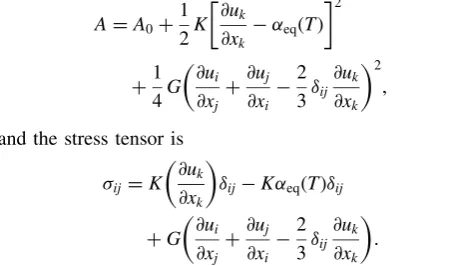
Equation (31) must be modified if the temperature of the gel is changed. Consider that the temperature is changed from T0 to T. The volume of the gel changes by eqðTÞ ¼ ½VeqðTÞ VeqðT0Þ=VeqðT0Þ, where VeqðTÞ is the
equilibrium volume of the gel at temperatureT, In this case, the free energy density is written as
A¼A0þ
1 2K
@uk
@xk
eqðTÞ
2
þ1 4G
@ui
@xj
þ@uj @xi
2
3ij
@uk
@xk
2
;
ð34Þ
and the stress tensor is
ij¼K
@uk
@xk
ijK eqðTÞij
þG @ui
@xj
þ@uj @xi
2
3ij
@uk
@xk
:
ð35Þ
The term K eqðTÞij corresponds to the thermal stress in the standard theory of elasticity. One might think that the swelling of a gel is a phenomenon similar to the thermal expansion of metals. Although this analogy is useful, there is an important difference between gels and metals.
In the case of metals, the equilibrium is attained as soon as the temperature is changed since the thermal expansion of metals is basically caused by the change of the inter atomic distance. On the other hand, in the case of gels, the volume change occurs as a result of the permeation of the solvent. (There is, of course, a change of the specific volume of the solvent due to thermal expansion, but this effect is very small and is ignored in this article.) Consequently, the
swelling equilibrium of gels is attained very slowly since the relaxation time is basically determined by the permeation speed of the solvent.
2.7 Constraint for solvent permeation
So far, the solvent in the gel has played no or a minor role. The solvent is important in calculating the free energy, but it does not appear explicitly in the governing equations: the equations governing the equilibrium shape, such as eqs. (19), (20), and (35), are the same as those in the theory of elasticity. We now show that the solvent in gels can affect the equilibrium shape.
Consider that a weight is placed on top of a gel as it is shown in Fig. 4(a). The equilibrium shape of the gel can be calculated, in the case of a small deformation, by solving eqs. (19) and (35) under the boundary condition given by eq. (20). These equations are precisely the same as those in the theory of elasticity.
Now let us consider the hypothetical situation shown in Fig. 4(b), where the whole gel is surrounded by a flexible thin film that can deform freely but blocks the permeation of the solvent. In such a situation, the volume of the gel cannot change. In this case, the equilibrium shape is determined by minimizing the free energy under the constraint that the total volume is unchanged. Therefore, in the variational calcu-lation, we need to take into account of the constraint that the volume changeVcaused by the deformationuiis equal to zero:
V ¼
Z dx@ui
@xi
¼0: ð36Þ
Therefore the variational calculation as illustrated in eq. (16) now reads
A¼
Z dx @A
@Fij
Fij Z
dS fext;iui
p
Z dx@ui
@xi
¼0;
ð37Þ
where p is a Lagrangian multiplier for the constraint given by eq. (36).
Equation (37) gives the following equations for the bulk and the boundary:
@
@xj
ðijpijÞ ¼0 in the bulk; ð38Þ
ðijpijÞnj¼ fext;i at the boundary: ð39Þ The Lagrangian multiplier pis determined by the condition that the total volume of the gel isV. Equation (39) indicates that the stress tensor is now given byijpij, and that p represents the pressure created by the constraint that the total volume of the gel cannot change.
The situation shown in Fig. 4(b) is rather artificial, but it suggests an important consequence of the constraint of the volume change. As we have discussed, the permeation of the solvent takes place very slowly. If the permeation of the solvent cannot take place, the gel must deform keeping its local volume unchanged; thus the variation must be calculated under the constraint
@ui
@xi
[image:5.595.48.274.508.641.2]which must be satisfied at all points. This gives the following condition for the variational calculation:
A¼
Z dx @A
@Fij
Fij Z
dS fext;iui Z
dxpðxÞ@ui @xi
¼0: ð41Þ
The equilibrium condition is
@
@xj
ðijpijÞ ¼0; in the bulk; ð42Þ
ðijpijÞnj¼ fext;i at the boundary: ð43Þ Note the difference between eqs. (38) and (42). In eq. (38), pis a constant independent of position, while in eq. (42)pis a function ofx. This situation is schematically illustrated in Fig. 4(c). Suppose that the gel is divided into compartments by a hypothetical flexible membrane which prevents the solvent from permeating. The pressure pin eq. (42) can be regarded as the pressure in each compartment.
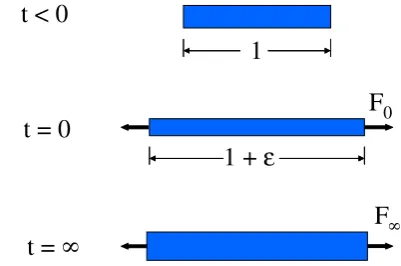
The effect of solvent permeation can be seen more quantitatively by the following example (see Fig. 5). Suppose that a rod-like specimen of a gel of length L and radius a immersed in a solvent is stretched at time t¼0 fromL toLþL. Such an experiment was first performed by Takigawa et al.,20) and they observed the following phenomena.
When the gel is stretched, it is deformed keeping its volume constant since there is no time for the surrounding solvent to permeate into the gel. Therefore, the initial change of the gel radius a0 is given by the condition ðLþ
LÞðaþa0Þ2¼La2, i.e.,
a0
a ¼
1 2
L
L : ð44Þ
As time goes on, the solvent permeates through the gel, and the equilibrium radius is given by the Poisson ratiowhich can be expressed byK andG:
a1
a ¼
L
L ; ð45Þ
whereis given by, according to the theory of elasticity,
¼ K ð2=3ÞG
2½Kþ ð1=3ÞG: ð46Þ
Thus the diameter of the gel increases by a factor of þ ð1=2Þ ¼ ðG=2Þ=½Kþ ð1=3ÞG.
As the diameter of the gel changes with time, the restoring force F also changes. Since the gel behaves as an incompressible material, the initial restoring force is given by
F0¼3G
L
L S ð47Þ
(S¼a2is the area of the cross section). On the other hand,
the equilibrium restoring force is given by
F1¼ 3G 1þ ðG=3KÞ
L
L S: ð48Þ
Thus the stress decreases by a factor of ð1þG=3KÞ1 as time goes on. Such behavior has indeed been ob-served.20)
[image:6.595.123.462.70.267.2] [image:6.595.321.522.339.472.2](a) (b) (c)
Fig. 4. (Color online) (a) When a weight is placed on a gel in a solvent, the gel is deformed and eventually reaches an equilibrium configuration. (b) The gel is now wrapped by a flexible membrane, which prevents the solvent from permeating through it. The equilibrium configuration of such a gel is different from that of the unwrapped gel since the volume of the gel is conserved. (c) Schematic picture of the gel in which the permeation of the solvent is blocked.
t < 0
t = 0
t =
F
0F
1 +
ε
1
[image:6.595.49.292.353.458.2]3. Basic Equations for Gel Dynamics
3.1 Slow dynamics in gels
Having discussed the equilibrium state of gels, we now consider the dynamics and discuss how to model the phenomena illustrated in Fig. 2.
Our objective here is to determine the velocity field of the polymer networkvpðx;tÞand that of the solvent fluidvsðx;tÞ.
The velocity field vpðx;tÞis equal to the time derivative of
the displacement field xx~ðX;tÞ, i.e.,
vpðx;tÞ ¼ @
@txx~ðX;tÞ atx¼xx~ðX;tÞ: ð49Þ
For simplicity, we assume that the temperature is constant throughout the system. Such an assumption is allowed since the thermal diffusivity is 103 to 104 times larger than the diffusion constant of the solvent.
In the following, we derive the equations forvp andvsby
two ways. One is based on a simple physical argument, and the other is based on Lagrangian mechanics.11)The second derivation is rather formal, but it is convenient for deriving equations for more general cases such as multicomponent fluids.21)
3.2 Derivation of gel dynamics equation 1
As we have discussed, the permeation of the solvent is a slow process. Let us consider the limit at which the solvent permeation is infinitesimally slow. At this limit, the local volume of the gel element cannot change with time. This is equivalent to the situation shown in Fig. 4(c), where the permeation of the solvent is prohibited by the hypothetical membrane. In such a case, the stress tensor is given byij pij and the mechanical equilibrium equation is given by
r ðpIÞ ¼0: ð50Þ
Now let us consider the effect of solvent permeation. Suppose that the hypothetical membrane is removed. Then the solvent will permeate from the high-pressure region to the low-pressure region. The permeation speed is represent-ed by the velocity of the solvent relative to that of polymer network, vsvp, and we can assume that this speed is proportional to the gradient of the pressure:
vsvp¼ 0rp: ð51Þ
Equation (51) is the empirical relation known as Darcy’s law for porous materials. In general, 0 is a tensor and can be a function of the deformation gradient of the polymer network. However, to simplify the analysis, we assume that
0 is a scalar and depends ononly.
The mass conservation law is expressed by
@
@t ¼ r ðvpÞ; ð52Þ
and the incompressible condition is written as
r ½vpþ ð1Þvs ¼0: ð53Þ
Equations (50)–(53) are the basic set of equations in gel dynamics.22)Given the free energy functionalAðF
ij;TÞand the Darcy constant0ðÞ, one can calculate, in principle, the time evolution of the gel by solving this set of equations. At this point, it may not be clear how the above set of equations
are sufficient to solve the problem. The mathematical structure of the basic equations of gel dynamics is slightly peculiar, but we will show that the above equations are the complete set of equations in later sections.
To solve the partial differential equation, we need boundary conditions. There are two sets of boundary conditions; for the mechanical condition and for the permeation condition of the solvent.22,23)
(1) Mechanical condition: This is essentially the same as the boundary condition for the theory of elasticity. Let
fextbe the force acting at the outer surface of the gel per unit area. Then the force balance at the boundary gives the following equation:
ðpIÞ n¼ fext: ð54Þ
If the boundary is constrained geometrically, other conditions are imposed. For example, if the polymer network is glued to a wall, vp must be equal to the
velocity of the wall.
(2) Permeation condition: If the solvent can permeate freely through the boundary, the pressure p in the gel must be equal to the solvent pressurepoutoutside of the
gel at the boundary. On the other hand, if the solvent cannot permeate through the boundary, the pressure gradient normal to the boundary must be zero. These conditions are expressed by the following equations:
p¼pout; permeable boundary; ð55Þ nrp¼0; no permeable boundary; ð56Þ
where pout is the pressure in the outer solvent.
3.3 Derivation of gel dynamics equation 2
We now give another derivation for the above set of equations.11) This derivation is based on the Lagrangian mechanics for dissipative systems. The derivation is more formal, and maybe less transparent, but it is more powerful for solving problems.
Consider a dynamical system with f degrees of freedom, described by the coordinates q1;q2;. . .;qf. LetKðqi;qq_iÞ be the kinetic energy of the system and UðqiÞbe the potential energy. The equation of motion of the system is given by the following Euler equation:
d
dt
@K
@qq_i
¼@K @qi
@U @qi
: ð57Þ
Equation (57) does not involve any dissipative force. Rayleigh showed that if there is a dissipative force fi that is proportional to the velocityqq_i, i.e.,
fi¼ ijqq_j; ð58Þ
the equation of motion can be written as24,25)
d dt
@K
@qq_i
¼@K @qi
@U @qi
@W @qq_i
; ð59Þ
whereWðqi;qq_iÞis given by
W ¼1
2ijqq_iqq_j; ð60Þ
If the inertia effect is negligibly small, one may set the kinetic energy term K in eq. (59) equal to zero. This gives
@U
@qi
þ@W @qq_i
¼0: ð61Þ
It is convenient to write eq. (61) in the following form:
@
@qq_i
ðUU_þWÞ ¼0; ð62Þ
whereUU_ is defined by
_ U
U¼X
i
@U
@qi _ q
qi; ð63Þ
which represents the change of the potential energy. Equation (62) can be written in a variational form.26,27)Let Rbe defined by
R¼UU_þW; ð64Þ
then the variational principle states that the actual velocity is determined by R=qq_i¼0. This variational principle is a simple rewriting of the force balance equation @U=@qiþ fi¼0. However the variational form gives us a convenient tool for deriving the equation of motion, particularly for systems with constraints.
Now let us use this principle to derive the kinetic equation for gels.11) The time evolution of a gel is entirely characterized by the two velocity fields vpðxÞ and vsðxÞ. The energy dissipation in the system is mostly caused by the relative motion between the polymer and solvent. [In a fluid– fluid mixture, the energy dissipation has two origins; one arises from the relative motion and the other arises from the viscosity of the fluid. In the fluid–solid mixture, the latter mechanism is negligibly small, and the energy dissipation function is given by eq. (65).] Thus,W can be written as
W¼1
2 Z
dxðÞðvpvsÞ2; ð65Þ
whereðÞis the friction constant per unit volume of the gel. The free energy of the system is given by eq. (14); thus, its time derivative is calculated as
AA_¼
Z dx @A
@Fij _ F
Fij: ð66Þ
Using the relation, FF_ij¼ ð@vpi=@xkÞFkj [see eqs. (15) and (18)], we have
AA_¼
Z dxij
@vpi
@xj
: ð67Þ
In performing the variational calculation forR, we need to take into account the constraint thatvpandvsmust satisfy the incompressible condition given by eq. (53). Thus, the functionalRto be minimized is
R¼
Z dx
1
2ðÞðvpvsÞ
2
þ:rvppr ½vpþ ð1Þvs
: ð68Þ
The equationsR=vp¼0andR=vs¼0give
ðÞðvpvsÞ ¼ r rp; ð69Þ ðÞðvsvpÞ ¼ ð1Þrp: ð70Þ
Adding eqs. (69) and (70), we obtain eq. (50). Equation (70) gives the Darcy law [eq. (51)], where
0ðÞ ¼1
ðÞ : ð71Þ
Thus, the set of equations in the previous subsection have been derived from the variational principle.
3.4 Gel dynamics for small deformation
The above set of equations can be written explicitly in the case that the deformation of the polymer network is small. Let uðx;tÞ be the displacement of the polymer network at pointx. The network velocityvpðx;tÞis equal to
_
u
uðx;tÞð¼@u=@tÞ. The expression for the stress tensor is given by eq. (35), and therefore the force balance equation [eq. (50)] can be written as
KþG 3
rr uþGr2u¼ rp: ð72Þ
For a small deformation, and can be regarded as constant. Therefore, the incompressible condition in eq. (53) can be written as
r uu_þ ð1Þr vs¼0: ð73Þ
Equation (73) and the Darcy law [eq. (51)] give
r uu_¼r2p; ð74Þ
where
¼ ð1Þ0¼ð1Þ 2
ðÞ : ð75Þ
Equations (72) and (74) are the linearized form of the gel dynamics.
Note that in the above set of equations, the time derivative _
u
u is not given explicitly, rather it appears in a spatial differential equation. It is possible to derive a more familiar equation. For example, if one defines the volume change
ðx;tÞby
¼ r u; ð76Þ
one can easily prove from eqs. (72) and (74) that satisfies the following diffusion equation:
@ @t ¼Dr
2 ;
ð77Þ
whereDis defined by
D¼ Kþ4 3G
: ð78Þ
Although eq. (77) is simple, it is not useful for solving problems. This is because the boundary conditions for are not given in usual problems, and we must go use eqs. (72) and (74) as we shall see in later examples.
3.5 Tanaka–Filmore equation
In the special case that the average velocity vpþ ð1 Þvs is equal to zero, the above set of equations can be
simplified. In this case, vs¼ =ð1Þvp, and eqs. (70)
(72) give
ð1Þ2vp¼ Kþ G
3
rr uþGr2u; ð79Þ
or
@u
@t ¼D rr uþr
2u
; ð80Þ
whereDis given by eq. (78) and
¼ G
Kþ ð4=3ÞG: ð81Þ
Equation (80) is called the Tanaka–Filmore (TF) equation. The TF equation4) was proposed to describe the swelling of spherical gels. In the case of the isotropic swelling of spherical gels, the average velocity is zero and the TF equation is valid. However, in the general case, such as the swelling of cylindrical or sheetlike gels, the average velocity is nonzero, and the TF equation is not valid. The TF equation cannot describe the phenomena of squeezing and filtration.
4. Examples of Analysis
In this section, we solve the linear kinetic equations given in the previous section for some typical situations, and discuss the characteristic features of gel dynamics.
4.1 Gel dynamics in one dimension
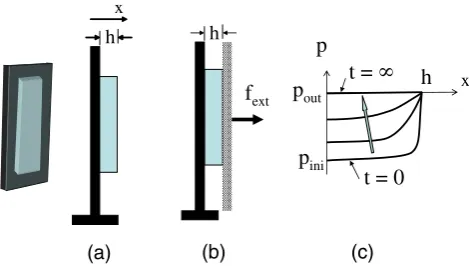
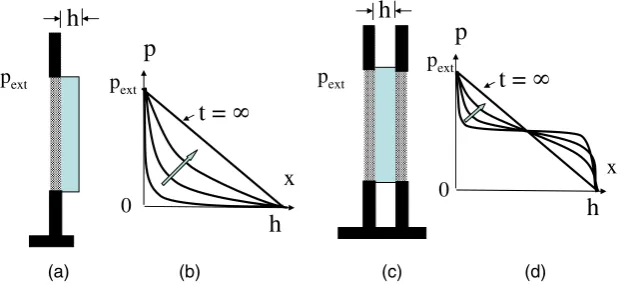
[image:9.595.49.289.137.255.2]We first consider a simple one-dimensional problem. This is realized in a thin gel glued to a rigid wall as shown in Fig. 6. In Fig. 6, the dark block indicates an impermeable wall, while the patterned block indicates a permeable wall made of a porous material. In this article, we assume that the solvent permeates through the porous wall freely (i.e., the pressure drop across the porous wall is zero).
If the gel is thin, the displacement vector u has a component normal to the wall only. We take thexcoordinate
normal to the wall, the origin of which is taken to be at the wall boundary. Then
ux¼uðx;tÞ; uy¼uz¼0: ð82Þ
Thexx-component of the stress tensor in eq. (35) is given by
xx ¼ Kþ 4 3G
@u
@xK eq: ð83Þ Therefore the basic equations (72) and (74) become
Kþ4 3G @2u
@x2 ¼ @p
@x; ð84Þ
@2u
@x@t¼
@2p
@x2 : ð85Þ
The boundary condition depends on the situation and will be discussed in the following sections.
4.1.1 Swelling of a constrained gel sheet
Consider the case that a gel in swelling equilibrium is glued to an impermeable wall as shown in Fig. 6(a). Assume that the temperature is changed at time t¼0 and the gel starts to swell fort>0. We consider the kinetic process of swelling.
Since the left wall is fixed and impermeable for the solvent, the boundary condition atx¼0is
uðx;tÞ ¼0; ð86Þ
@p
@x ¼0: ð87Þ On the other hand, the right end of the gel is free. Letpoutbe
the pressure of the solvent outside the gel. Then eqs. (54) and (55) give the following boundary conditions atx¼h.
xxp¼ pout; ð88Þ
p¼pout: ð89Þ
From eq. (84) and the boundary condition (88),pis obtained as
p¼poutþxx ¼poutþ Kþ
4 3G
@u
@xK eq: ð90Þ Eliminating@u=@xfrom eqs. (85) and (90), we find thatp satisfies the following diffusion equation
@p
@t ¼D
@2p
@x2; ð91Þ
whereD is given by eq. (78). Equation (91) can be solved for pðx;tÞ: the boundary condition is given by eqs. (87) and (89), and the initial condition ispðx;0Þ ¼poutK eq. [This
follows from the initial condition @u=@x¼0 and eq. (90).] The solution is given by
pðx;tÞ ¼poutK eq
X1
n¼0
4
ð2nþ1Þsin
ð2nþ1Þx h
exp ð2nþ1Þ 2t
; ð92Þ
where
¼ h 2
D2: ð93Þ
x
x
h h
f
extp
outt =
h
t = 0
p
inip
[image:9.595.51.286.596.729.2](a) (b) (c)
Fig. 6. (Color online) (a) Swelling of a constrained gel: a thin gel sheet of thicknesshis glued to a rigid wall and is allowed to swell. (b) Negative squeezing: the other side of the same gel is glued to a porous wall which is pulled by external force fext (c) Time evolution of the pressure
distribution. In case (a), pini¼poutK eq and in case (b), pini¼
Figure 6(c) shows a schematic diagram of the time evolution of pðx;tÞ. When the temperature is changed, the pressure inside the gel drops suddenly from pout to
poutK eq, and a large pressure gradient is created near
the free surface of the gel. This causes the solvent to diffuse into the gel and the gel to swell. Equilibrium is attained when the pressure becomes equal to pout everywhere in the
gel. Note that in the present problem the pressure pout
appears only as the reference of the pressure and does not affect the swelling behavior; the swelling behavior is unaffected even if the solvent pressure is changed during the swelling process.
The variation of the gel thicknesshðtÞis given byuðh;tÞ, which is calculated from pðx;tÞby integrating eq. (90):
hðtÞ ¼uðh;tÞ ¼
Z h
0
dx@u
@x
¼ 1
Kþ ð4=3ÞG Zh
0
dx½pðx;tÞ poutþK eq: ð94Þ
This gives the equilibrium thickness
hð1Þ ¼ K
Kþ ð4=3ÞGh eq: ð95Þ Note that the equilibrium swelling ratio hð1Þ=h is not equal to eq in this case. This is because the gel is
constrained in the x- andy-directions.
4.1.2 Squeezing of a gel sheet
Next, let us consider the case shown in Fig. 6(b), where the right side of the gel is glued to a permeable wall upon which an external force fext (per unit area) starts to be
applied at timet¼0. The boundary conditions atx¼hnow become
xxp¼fext; and p¼0; at x¼h; ð96Þ
where we have set pout equal to zero. This problem can be
solved by the same method as that described in the previous example. The analysis indicates that p satisfies the same diffusion equation, and the initial condition is pðx;0Þ ¼ fext. Thus the behavior is precisely the same as that of the
swelling: the only difference is thatK eqis now replaced by
fext. At equilibrium, the volume of the gel changes by a
factor of
hð1Þ
h ¼
fext
Kþ ð4=3ÞG: ð97Þ
4.1.3 Filtration through a gel sheet
We now consider the situation shown in Fig. 7(a). The left side of the gel is glued to a porous wall. At timet¼0, the pressure in the left compartment is increased to pext while
the pressure in the right compartment is kept at zero; the pressure pout is taken to be zero. Then the solvent will
permeate from left to right. If the right side of the gel is set free as in the case shown in Fig. 7(a), the process causes the swelling of the gel. An experimental and theoretical study of this situation was performed by Takigawa et al.28)
The boundary conditions at x¼0 are
u¼0 and p¼pext at x¼0: ð98Þ
On the other hand, the boundary conditions atx¼hare
xxp¼0 and p¼0 at x¼h; ð99Þ
where xx is now given by eq. (83) with eq¼0. Equations (84) and (99) are solved for p:
p¼ Kþ4 3G
@u
@x: ð100Þ
Hence psatisfies the same diffusion equation as before. The boundary conditions are now pð0;tÞ ¼pext and pðh;tÞ ¼0,
and the initial condition is pðx;0Þ ¼0.
The solution of the equation is shown in Fig. 7(b). In this case, the final state is not an equilibrium state, but a steady state in which the solvent flows with constant speed. In the steady state, the pressure drops linearly withxacross the gel:
pðx;1Þ ¼pext 1
x
h
; ð101Þ
and the velocity of the solvent is vs¼pext=h. The flow
exerts a constant force on the polymer network, and the gel swells accordingly.
@u
@x¼
pext
Kþ ð4=3ÞG 1 x h
fort! 1 ð102Þ
The volume change of the gel is given by
h
h ¼
1
h Zh
0
dx@u
@x¼
pext
2½Kþ ð4=3ÞG: ð103Þ
This can be compared with the volume change in the squeezing case [eq. (97)]. There is a difference of factor 1/2, which originates from the fact that in the case of squeezing, the external force acts at the surface only, while in the case of filtration, the pressure drop acts as a force on the body of the polymer network.
pext pext pext
pext
x
p
h
0
h
p
t =
h
h
0
(a) (b) (c) (d)
x
[image:10.595.48.368.76.220.2] [image:10.595.47.288.406.507.2]If the right side of the gel is constrained by a porous wall fixed in space as shown in Fig. 7(c), the pressure distribution changes as shown in Fig. 7(d). This situation has been studied experimentally by Tokita et al.,29)but a theoretical analysis has not been carried out. The pressure and solvent velocity approach the same values as those for (a) in the steady state, but their transient behaviors are different. In particular, the relaxation time in situation (c) is one-quarter of that in (a).
4.1.4 Swelling of a spherical gel
The swelling of a spherical gel is a classical problem studied by Tanaka and Filmore.4)Since the average velocity is zero, the swelling can be analyzed by the TF equation [eq. (80)], but here we derive it using the variational principle.
Letuðr;tÞbe the displacement of an element at pointr. In the swelling of a sphere, the polymer network is locally deformed uniaxially; the straink in the radial direction and the strain?normal to it are given by
k¼
@u
@r; ?¼ u
r: ð104Þ
Substituting these into eq. (34), we have
A¼
Za
0
dr4r2 1 2K
@u
@rþ2 u
r eq
2
"
þ2 3G
@u
@r u r
2#
; ð105Þ
whereais the radius of the gel. Equation (105) gives
_
A
A¼
Za
0
dr4r2 K @u
@rþ2 u
r eq
@uu_
@rþ2 _ u u
r
þ4 3G
@u
@r u r @uu_
@r _ u u r
: ð106Þ
On the other hand, the energy dissipation function can be written as
W¼1
2 Z a
0
dr4r2ðuu_vsÞ2¼
1
2 Z a
0
dr4r21
uu_
2; ð107Þ
where we have used vs¼ =ð1Þuu. The variational_
condition ðWþAA_Þ=uu_¼0 gives the following time evo-lution equation for u:
@u
@t ¼D
@2u
@r2 þ
2 r
@u
@r 2 r2u
; ð108Þ
whereDis given by eq. (78). Equation (108) can be derived directly from the TF equation [eq. (80)].
The boundary condition can also be obtained from the variational principle:
K @u
@rþ2 u r eq
þ4 3G
@u
@r u r
¼0 atr¼a:
ð109Þ
Tanaka and Filmore solved the above boundary value problem for the case ofKGand showed that the longest relaxation timeis given by
¼ a 2
2K for KG: ð110Þ
Studies of the general case were carried out,30,31)and it has been shown that at the other limit KG the longest relaxation time diverges as
¼ a 2
15K for KG: ð111Þ
The longest relaxation time is proportional to 1=K at both limits ofK=G! 1and 0. This behavior is observed for all gels as we shall see later.
4.2 Coupling effect of elastic deformation and swelling
The problems discussed so far are one-dimensional in the sense that the displacement of the polymer network takes place only in a certain fixed direction (normal to the wall or in the radial direction). We now discuss cases where it is essential to take into account the displacement in two or three dimensions. The examples shown here again demon-strate the characteristic features of gel dynamics different from simple diffusion.
4.2.1 Swelling of a free gel sheet
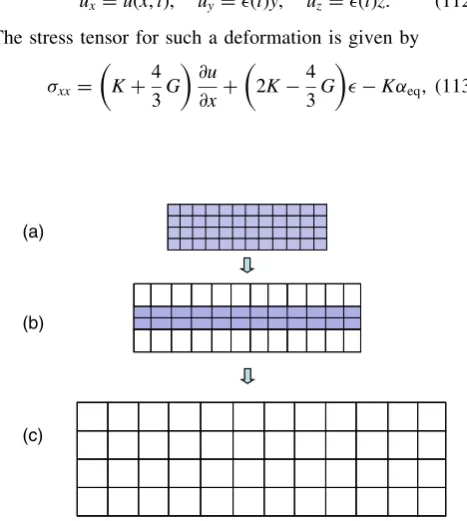
The swelling of a free gel sheet is a simple example that requires analysis in two dimensions. The reason for this is illustrated in Fig. 8. When the diffusion starts, the elements near the surface start to swell, while the inner part remains unswollen [see Fig. 8(b)]. The elements near the surface tend to extend the inner elements laterally, while the inner elements resist this. Therefore, a lateral extension is attained by their balance.
Again we take thex-direction to be normal to the sheet. If the gel is thin, the deformation in they- andz-directions may be assumed to be uniform. Therefore, if we take the origin of they- and thez-coordinates to be at the center of the sheet, the displacement of the material pointðx;y;zÞcan be written as follows:
ux¼uðx;tÞ; uy¼ðtÞy; uz¼ðtÞz: ð112Þ
The stress tensor for such a deformation is given by
xx¼ Kþ 4 3G
@u
@xþ 2K 4 3G
K eq; ð113Þ
(a)
(b)
[image:11.595.309.543.499.760.2](c)
yy¼zz¼ K 2
3G
@u
@xþ 2Kþ 2
3G
K eq:
ð114Þ
Since there is no external force acting in the x-direction,
xxpmust be zero. Therefore,
p¼ Kþ4 3G
@u
@xþ 2K 4 3G
K eq: ð115Þ
Note that the pressure p depends only on x, and does not depend on yor z.
Equation (74) is then written as
@uu_
@xþ2 _¼
@2p
@x2: ð116Þ
Eliminating@u=@xfrom eqs. (115) and (116), we have
@p
@t þ4G_¼D
@2p
@x2: ð117Þ
Note that there is an unknown term_. This is determined by the force balance condition in the y- and z-directions. The total force acting across the plane normal to y- and z-must zero, i.e.,
Z h=2
h=2
dxðyypÞ ¼0: ð118Þ
If@u=@xis expressed in terms ofpusing eq. (115), eq. (118) is written as
Zh=2
h=2
dx p¼Khð3 eqÞ: ð119Þ
Equations (117) and (119) give a coupled equation forpðx;tÞ andðtÞ. The initial condition is
pðx;0Þ ¼ K eq; ð0Þ ¼0; ð120Þ
and the boundary condition is
pðh=2;tÞ ¼ pðh=2;tÞ ¼0: ð121Þ
If eq. (115) is substituted for pin eq. (119), one gets the following equation
uðh=2;tÞ uðh=2;tÞ ¼h: ð122Þ
The right-hand side is the change of the gel thicknesshðtÞ. Equation (122) indicates that
hðtÞ
h ¼ðtÞ; ð123Þ
[image:12.595.49.293.71.298.2]i.e., during the swelling process, the aspect ratio of the gel remains unchanged: the gel swells keeping its original shape. This result is highly nontrivial since the shape of the gel is determined by a subtle balance of forces as illustrated in Fig. 8. Surprisingly, the same conclusion holds for the swelling of a cylindrical gel.
The above set of equations can be solved by the standard method of eigen function expansion. Let be the longest relaxation time. For t, the solution can be written as
pðx;tÞ ¼ fðxÞexpðt=Þ; ðtÞ ¼ eq
3 þAexpðt=Þ: ð124Þ
Substituting eq. (124) into eq. (117), we have
@2f @x2 ¼
f þ4AG
D : ð125Þ
The solution of this equation can be written as
fðxÞ ¼BcosðxÞ þB0sinðxÞ 4GA; ð126Þ
where ¼ ðDÞ1=2. From eqs. (119) and (121), it can be shown thatB0¼0andis the solution of the equation
cotðÞ ¼ 4G
3Kþ4G; ð127Þ
where
¼h
2 : ð128Þ
Letbe the smallest positive solution of eq. (127), thenis given by
¼ h 2
4D2: ð129Þ
IfK=G1, the smallest solution of eq. (127) is¼=2 and
¼ h 2
2K: ð130Þ
In this case, eq. (130) agrees with eq. (93), the relaxation time of the constrained gel. On the other hand, ifK=G1, the smallest solution of eq. (127) becomes¼ ð3=2ÞpffiffiffiffiffiffiffiffiffiffiK=G and the longest relaxation time is
¼ h 2
12K: ð131Þ
Therefore, in the limit ofK!0, the relaxation timegoes to infinity. This is different from the result for the con-strained gel. In the case of the concon-strained gel, the relaxation time is proportional to 1=½Kþ ð4=3ÞG, which does not diverge in the limit ofK!0. Note that for both constrained gel and the free gel, the swelling is governed by the permeation of the solvent normal to the sample. However, the relaxation time is different. This example demonstrates that the swelling process cannot be described by the diffusion equation [such as eq. (80)] alone.
4.2.2 Swelling of a cylindrical gel
The swelling of a long cylindrical gel can be analyzed by a method similar to that given above. This case is important since swelling experiments are usually performed for cylindrical gels. On the other hand, the development of theoretical analysis has been rather slow. In early analysis,32) the TF equation was used and the effect of stretching in the axial direction was ignored. The failure of the TF equation was corrected by Li and Tanaka,5)who proposed a method of accounting for the axial stretching. They proposed the physical mechanism, but did not express it in mathematical equations, and they solved the problem in an intuitive (and approximate) way. A more accurate calculation was per-formed by Wang et al.,33) but the analysis still involved approximation. A rigorous result has been obtained only recently.34)Leaving the detail to,34)we here summarize the main result.
length LðtÞincrease with time, but it can be shown that the gel swells keeping its aspect ratio constant.
aðtÞ að0Þ¼
LðtÞ
Lð0Þ ð132Þ
The longest relaxation time for the swelling process is given by
¼ a 2
2D; ð133Þ
whereis the smallest positive solution of the equation.
J10ðÞ þK ð4=3ÞG
Kþ ð4=3ÞGJ1ðÞ ¼0: ð134Þ HereJ1ðÞis the Bessel function of the first kind. Analysis
of the equation gives the following expression for the relaxation time
¼0:1730a
2
K forK G ð135Þ
and
¼0:125 a
2
K forK G: ð136Þ
The relaxation time is proportional to1=Kat the two limits of K=G!0 and1.
The above asymptotic behavior of the relaxation time at the limits of G=K !0 and 1 is common to gels with sheetlike or spherical shapes. In fact, this is a general result; it has been proved35) that the relaxation time of an unconstrained gel always has the following characteristic behavior:
¼ C1
L2
K for KG,
C2
L2
K for KG, 8
> > < > > :
ð137Þ
whereC1 andC2 are constants that depend on the shape of
the sample and L is the characteristic size of the sample. (The divergence of at the limit of K!0 was first proposed by Onuki31)but his derivation was based on the TF equation, which is not correct for gels with a general shape.) Analysis can be performed for a cylindrical gel stretched in the axial direction (see Fig. 5), and the time dependence of the stress and the radius of the gel can be calculated explicitly.34)
4.2.3 Gel confined by rigid plate
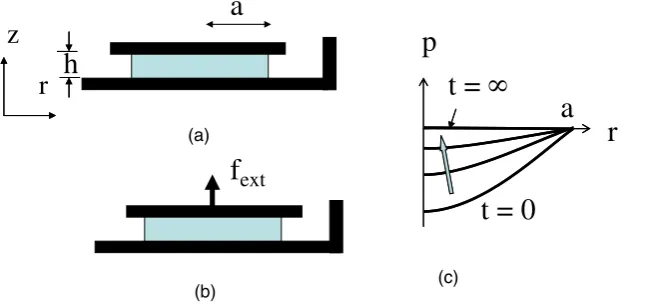
[image:13.595.48.372.79.231.2]As the final example, we analyze the situation shown in Fig. 9, the swelling of a gel slab whose top and bottom are glued to impermeable walls. For the gel to swell, the solvent must permeate sideways. Therefore, the relaxation time is determined not by the thicknesshbut by the lateral sizeaof the gel. An experiment for such a system was first performed by Suzukiet al.,36) and theoretical analysis was carried out in ref.37.
We assume that the gel is a disk of thicknesshand radius a. We take cylindrical coordinates ðr; ;zÞ, the origin of which is at the center of the bottom circle. For a thin gel (ha), we may assume that the pressure is independent of z, i.e., p¼pðr;tÞ, and that the displacement in the z direction is uniform:
uzðz;tÞ ¼ðtÞz: ð138Þ
The volume change of the polymer network is
r u¼@uz @z þ
1
r
@ðrurÞ
@r ¼þ 1
r
@ðruzÞ
@r : ð139Þ
The second term on the right-hand side of eq. (139) is much smaller than the first term and can be ignored. Therefore, eq. (74) is written as
_
¼1
r
@
@r r
@p
@r
; ð140Þ
which is solved for pusing the boundary condition p¼0at r¼a:
pðr;tÞ ¼ _ 4ðr
2a2Þ: ð141Þ
The force acting on the top plate is given by
zzp¼ Kþ 4
3G
K eqp: ð142Þ
Since there is no force acting on the top plate, the force balance equation is written as
Za
0
dr2r Kþ4 3G
K eqp
¼0: ð143Þ
Using eqs. (141) and (143) we have
_
¼1
ðeqÞ; ð144Þ
where
z
r
a
h
f
extp
t =
t = 0
a
r
(a) [image:13.595.112.224.637.688.2](b) (c)
eq¼ K
Kþ ð4=3ÞG eq; ð145Þ
and
¼ a 2
8D: ð146Þ
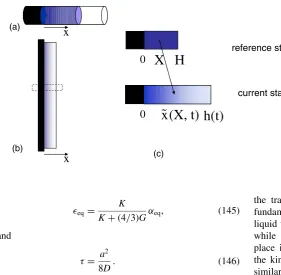
Equation (145) is the same as eq. (95); the equilibrium swelling ratio of the gel constrained at one side (Fig. 6) is equal to that constrained at both sides (Fig. 9). On the other hand, their relaxation times are different: the relaxation time of the gel constrained at both sides is much larger than that of the gel constrained at one side. This is because in the case of Fig. 9, the solvent cannot enter the gel from the top and must diffuse into the gel over the long distancea.
A similar analysis can be performed for the situation that swelling is induced by an external force acting on the rigid plate.38)In this case, eq. (143) is replaced by
Za
0
dr2r Kþ4 3G
p
¼a2fext: ð147Þ
This gives
_
þ¼ fext
Kþ ð4=3ÞG: ð148Þ
This corresponds to a mechanical model in which a spring and dashpot are connected in parallel (this model is called the Voigt model in rheology).
5. Volume Transition
5.1 Specific features of volume transition
We now consider a problem that cannot be handled by the linearized equation. Specifically, we shall discuss the phenomenon called the volume transition. The volume transition is a phenomenon that the equilibrium volume of a swollen gel changes enormously (typically by a factor of hundreds) with a small change of external parameters such as temperature or solvent composition.1,39)This phenomenon is a type of phase transition, the phase having the large volume is called the swollen phase and that having the small volume is called the shrunken phase.
The volume transition of gels has often been discussed using the analogy of the gas–liquid transition of fluids since the order parameter of the transition is the volume (or the density), and there is no symmetry change associated with
the transition. However, it must be noted that there is a fundamental difference between the two transitions: the gas– liquid transition is a phase transition taking place in a fluid, while the volume transition of gels is a transition taking place in elastic materials. In this section we shall discuss the kinetics of volume transitions of gels, focusing on the similarities and differences between the two transitions.
5.2 Analysis of one dimensional case 5.2.1 Kinetic equation
[image:14.595.50.332.67.342.2]We shall first discuss the kinetics of volume transitions taking place in one dimension, i.e., the situation that the gel can expand in only one direction.40,41)This is the situation where the analogy between the volume transition and the gas–liquid transition is justified. However, it must be noted that this is a rather idealized situation. The situation may be realized by constraining a cylindrical gel in a tube as shown in Fig. 10(a), or by gluing a thin gel sheet on a rigid wall [Fig. 10(b)]. Both setups have some technical difficulties. In the former case, one must ensure that there is sufficient lubrication between the gel and the tube wall. In the latter case, one must ensure that the displacement can take place only normal to the wall, which is not easy since the gel is subject to buckling instability as we shall discuss later.
We take thexcoordinate along the direction that the gel can move and let xx~ðX;tÞ be the x-coordinate at time t of a point on the gel located at X in the reference state. We assume that the gel is fixed to an impermeable wall atX¼0. We also assume that the the gel is free at the other end at X¼H and can absorb the solvent [see Fig. 10(c)]. The thickness of the gel at timetis given by
hðtÞ ¼xx~ðH;tÞ; ð149Þ
and the apparent (or overall) volume change is given by hðtÞ=hð0Þ. The local volume change atX is given by
ðX;tÞ ¼@xx~ðX;tÞ
@X : ð150Þ
If the reference state is taken to be the dry state, the polymer volume fractionis given by1=.
To derive the kinetic equation, it is convenient to use the Rayleighian formulation described in §3.3 LetvsðX;tÞbe the
solvent velocity at position xx~ðX;tÞ at time t. Since the polymer velocity is given byvp¼xxxx, the energy dissipation_~~
function [eq. (65)] can be written as (a)
(b)
(c)
x
x
0
0
X
(X, t) h(t)
x˜
H
reference state
current state
W¼1 2
ZH
0
dX~ðÞðxxxx~_~vsÞ2¼
1 2
ZH
0
dX ~
ð1Þ2xxxx~_~ 2
; ð151Þ
where we have used the fact that the average velocity xxxx_~~þ ð1Þvsis zero. [Note that the average velocity xxxx_~~þ ð1 Þvs is zero only when the one end of the gel is fixed to an
impermeable wall. If the right end of the wall in Fig. 10(c) is permeable, the average velocity is nonzero.]
On the other hand, the free energyAis written as
A¼
ZH
0
dXAA~ðÞ: ð152Þ
Therefore,AA_is calculated as
_
A
A¼
Z dX@
~ A A
@
_
¼
Z dX@
~ A A
@ @xxxx~_~
@X
¼
Z dX@
@Xxxxx_~~; ð153Þ
where
ðÞ ¼@ ~ A A
@ ð154Þ
and integration by parts has been used. Thus, the Rayleighian is written as
R¼
Z dX 1
2xxxx_~~
2
@
@Xxxxx_~~
; ð155Þ
where
¼ ~
ð1Þ2: ð156Þ
Minimizing eq. (155) with respect toxxxx, we have_~~
xxxx~_~¼ @ @X ¼
@
@ @
@X ð157Þ
or
@xx~
@t ¼DðÞ
@2xx~
@X2; ð158Þ
where
DðÞ ¼ 1 ðÞ
@
@: ð159Þ
At X¼H, the gel is allowed to swell freely. Therefore, the boundary condition at X¼H is ¼0. This gives the following boundary condition:
@xx~
@X¼eq atX¼H; ð160Þ whereeq is the solution ofðÞ ¼0. On the other hand, at
X¼0, the gel is fixed to a rigid wall, i.e.,
~ x
x¼0; atX¼0: ð161Þ
Equation (158) and the boundary conditions in eqs. (160) and (161) determine the free swelling in one dimension.
The kinetic equation [eq. (158)] can be rewritten in a more familiar form. By differentiating both sides of eq. (158) with respect toX, we have
@ @t ¼
@ @X DðÞ
@ @X
: ð162Þ
Thus, satisfies the usual nonlinear diffusion equation. However, eq. (162) is not very useful since the boundary condition for is not known.
5.2.2 Scaling property
An important feature of the equations given above is that the material property is entirely characterized by ðÞ and
ðÞ, and there is no material parameter with the dimension of length or time. Therefore, for a given problem, the time scale and length scale are set by the boundary conditions such as the size of the specimen. This gives the following scaling property.10)Letxx~ðX;tÞbe the solution to eq. (158) for a gel of lengthH, thenxx~ðX; 2tÞis the solution of the same equation for a gel having lengthH.
To understand the implications of the scaling property, consider the swelling of two gels having the same shape, one being larger than the other by a factor of . The scaling property indicates that the shape of the larger gel at time
2tis the same as that of the smaller gel at timet. Especially,
the relaxation times of the two gels differ by a factor of2;
i.e., the relaxation time is proportional to the square of the gel size. Such a scaling relation is known for phenomena governed by a linear diffusion equation, but the scaling relation actually holds for the nonlinear case as well. This scaling relation is a general property of gel dynamics and it holds not only for the one-dimensional case discussed here but also for the three-dimensional case.
5.2.3 Coexistence condition
[image:15.595.46.298.177.615.2]We now consider the time dependence of the volume transition. Suppose that the gel slab shown in Fig. 10(a) was initially in the shrunken state and that the temperature has been changed so that the equilibrium state of the gel is now in the swollen state. We discuss how the shrunken state transforms to the swollen state.
Figure 11 shows how the transformation takes place. Since the solvent can diffuse into the gel from the right, the swollen phase appears at the right end and expands toward the left. LetXIðtÞbe the position of the interface between the
swollen phase and shrunken phase. At XIðtÞ, changes
discontinuously.
The discontinuity in at the interface can be determined by the condition that the system is in local equilibrium.40,41) Consider a small region across the interface. LetX be the size of this region in the reference state andxbe the size in the current state. Let us assume that, within this region, the fractionwis in the shrunken state and the rest,1w. is in the swollen state. Letshandswbe the respective values of in these states. They satisfy the condition
x¼ ½wshþ ð1wÞswX: ð163Þ
The local free energy of this region is given by
~
A
Alocal¼ ½wAA~ðshÞ þ ð1wÞAA~ðswÞX: ð164Þ
@AA~local,p @sh
¼0; @
~
A Alocal,p
@sw
¼0; @
~
A Alocal,p
@w ¼0; ð165Þ
where
~
A
Alocal,p¼Alocalp½wshþ ð1wÞswX: ð166Þ
Equations (165) and (166) give
ðshÞ ¼ðswÞ ¼ ~ A
AðshÞ AA~ðswÞ
shsw ; ð167Þ
whereðÞis given by eq. (154).
Equation (167) indicates thatsh andsware obtained by constructing the common tangent in the plot ofAA~against
as shown in Fig. 12(a). The construction of the common tangent is equivalent to the Maxwell construction in the gas– liquid transition. Thus, the coexistent condition in gels is very similar to that in the gas–liquid transition.
The above argument indicates that if the solutionðX;tÞ of eq. (158) or (162) satisfies sh< ðX;tÞ< sw in a
certain region, the solution must be replaced by the discontinuous solution in the region. Alternatively, one can formulate the problem as a problem with a moving boundary condition:
@xx~
@t ¼D1ðÞ
@2xx~
@X2 forX<XIðtÞ; ð168Þ @xx~
@t ¼D2ðÞ
@2xx~
@X2 forX>XIðtÞ; ð169Þ
where D1ðÞ and D2ðÞ denote the function DðÞ in the
regions of < sh and > sw, respectively. The swelling ratio@xx~=@X is discontinuous at the interface;
@xx~
@X ¼sh atX¼XIðtÞ 0; ð170Þ
@xx~
@X ¼sw atX¼XIðtÞ þ0: ð171Þ The interface velocity XX_iðtÞ can be determined by the condition that the velocity of the polymer network at the interfaced ~xx½XIðtÞ;t=dt must be continuous atX¼XIðtÞ:
shXX_IðtÞ þ @xx~
@t X¼XIðtÞ0¼sw _ X XIðtÞ þ
@xx~
@t X¼XIðtÞþ0:ð172Þ
Using@xx~=@t¼D@=@X[see eq. (158)], we have40)
_ X
XIðtÞ ¼
DðÞ@
@X
½½ ; ð173Þ
where ½½F is the jump of F at the interface, i.e., ½½F ¼ FðXIþ0Þ FðXI0Þ.
Equation (173) allows us to estimate the velocity of the interface. The velocity @xx~=@t¼D@=@X is much larger in the swollen state than that in the shrunken state. Hence, ½½D@=@X can be approximated by D@=@X at X¼ XIþ0. Furthermore, this value can be approximated
by DðswÞðeqswÞ=ðHXIÞ [see Fig. 11(b)]. Hence,
eq. (173) gives41)
_ X
XI¼DðswÞ
eqsw
ðHXIÞðswshÞ
: ð174Þ
The equation is easily solved to give
time 0
time t
h
0X
I(t)
X
I(t)
X
H
w
(1 w)
λ
λ
(X, t)
λ
swλ
eqλ
sh [image:16.595.133.467.77.237.2](a) (b)
Fig. 11. (Color online) Intermediate state of volume transition. (a) The gel is initially in a shrunken phase, and the swollen phase appears at the right end. The boundary between the swollen phase and the shrunken phase moves to the left.XIðtÞis the coordinate (in the reference frame) of the boundary at
timet. (b) Typical behavior of the functionðX;TÞfor the state where the swollen phase and shrunken phase coexist at pointXI.
(a)
λ
sh
A(
˜
λ
)
σ
(
λ
)
λ
sh
λ
sw
λ
sw
λ
eq
λ
λ
[image:16.595.313.535.301.504.2](b)
Fig. 12. (a) Free energy density per unit volume of the reference state plotted against the swelling ratio. (b) Stress is plotted against.
eq is the solution of ðÞ ¼0, and sh and sw are determined by
![Fig. 1(a)]. An example of this type of gel is the small beads](https://thumb-us.123doks.com/thumbv2/123dok_us/8111210.236430/1.595.310.544.495.653/fig-example-type-gel-small-beads.webp)