Compositional Modelling and Verification
of Self-Adaptive Cyber Physical Systems
Aimee Borda
[email protected]under the supervision of Dr. Vasileios Koutavas
Thesis submitted to the School of Computer Science and Statistics in partial fulfilment of the requirements for the degree of
Doctor of Philosophy in Computer Science
Declaration
This thesis has not been submitted as an exercise for a degree at this or any other university. It is entirely the candidates own work. The candidate agrees that the Library may lend or copy the thesis upon request. This permission covers only single copies made for study purposes, subject to normal conditions of acknowledgments.
Aimee Borda
sense of wonder and mystery. There is always more mystery.
—Anais Nin
Abstract
Cyber-Physical Systems (CPSs) must often self-adapt to respond to changes in their operating environment. However, providing assurances of critical requirements through formal verification techniques can be computationally intractable due to the large state space of self-adaptive CPSs. In this thesis we propose a methodology to support assurances of such systems, which employs a novel modelling language, Adaptive CSP, enablingcompositional reasoning for tractable verification. The process language extends Communicating Sequential Processes (CSP) with constructs to reduce the effort required to model and compositionally verify the adaptation options and events of self-adaptive CPSs.
Our methodology allows system designers to identify (a subset of) the CPS components that can affect satisfaction of each given requirement. An adaptation procedure for these components can then be created to preserve the requirement in the face of changes to the systems operating environment. Although manual, the task of identifying components relevant to a requirement can be guided by topological relationships, such as containment and connectivity between system com-ponents. Adaptive CSP can then be used to model the system including potential self-adaptation procedures. We propose a modular structure for adaptation procedures which, together with topology-guided adaptation, allows system designers to compare alternative adaptation procedures, potentially involving different sets of CPS components.
We show that with this approach, when different requirements involve disjoint sets of com-ponents, verification of each requirement can be performed against only its relevant comcom-ponents, in isolation from the rest of the system and other adaptation procedures. When components are relevant for multiple requirements, we develop a theory of compositionality to identify cases where interference between adaptation procedures is not possible. We prove that in such cases require-ment verification can still be performed in isolation from other adaptation procedures and the rest of the system. In the other cases, the system designer must additionally verify that require-ment satisfaction is preserved when components with corresponding adaptation procedures from interdependent requirements are composed.
Our methodology has the benefit of leveraging existing formal verification tools to check re-quirement satisfaction. We illustrate this through the use of FDR—an existing refinement checker for CSP, taking advantage of its advanced model minimisation and refinement checking function-ality. The soundness of using FDR for verification relies on an adequate translation from a subset of Adaptive CSP to the language of FDR. We also alleviate the onus of modelling and verifying components in our framework further by providing a concrete syntax to Adaptive CSP, where we augment the process language with convenient idioms and macros from functional languages, together with a tool which translates Adaptive CSP code to FDR.
We demonstrate the feasibility of our methodology using a substantive motivating example of a smart art gallery. We further evaluate it with a case study of a smart stadium. Our results show that our methodology reduces the computational complexity of verifying self-adaptive CPSs and
Acknowledgements
First of all, I would like to thank my supervisor Vasileios Koutavas. I can’t be more grateful for his precious guidance throughout the PhD. His keen eye for details, everlasting patience and technical knowledge left me astounded a good number of times. This work is the product of hours of discussions and encouragement from him and so I thank Vassilis for all his help in trying to understand technical matters and the thoughts in my head. I am forever grateful to have been one of his students.
To Liliana Pasquale and Bashar Nuseibeh, the unofficial co-supervisors of this work from whom I learnt a lot. I extend my gratitude for the time spent in lengthy discussions and their knowledgeable feedback. Their insight on the domain and cheerful support kept me motivated throughout this journey. I like to acknowledge the Lero Research Centre and Trinity College Dublin as the sponsors of this work.
I like to extend a massive thank you to my family and friends back home. I love each and every one very dearly. In particular, a special thanks goes to my sister which from Day -9 months has been by side every step of the way. She has been my ultimate travelling buddy, laughing buddy, whining buddy and Crossfit buddy. There is nothing I enjoy more in life than drinking a tea and americano in some small, sunny coffee shop located in the remotest of places talking for hours all things Crossfit and life plans. I extend my love to all the people I hold close to my heart back home, which there are too many to mention by name, that remind me everyday what is really important in life.
I thank the brilliant and witty people that I shared the office with over the last four years. In the early years, Colm Bhandal has been a steady stream of interesting mathematical puzzles and Carlo Spaccasassi provided interesting discussions on religion and philosophy. These were slowly replaced by the co-owners of the coffee club: Artur Gomes and Daniel Flynn, with whom everyday at 11am I laughed and had to be explained Irish slangs, with the classic remaining ”the man with the one with the yoke” and the ever lovely Marian Reeves. I am very grateful to have met such wonderful people through this PhD.
Lastly, I thank the Dublin University Sub-Aqua Club, through which I met some of the most amazing people in Dublin and filled my thirst for adventure. The jelly-babies fuelled adventures on a small boat around the coast of Ireland will forever put a smile on my face.
Aimee Borda, Trinity College Dublin, October 22, 2019
Contents
1 Introduction 1
1.1 Motivation . . . 1
1.2 Motivating Example: An Art Gallery . . . 3
1.3 Challenges . . . 6
1.4 Research Question . . . 7
1.5 Contributions . . . 7
1.6 Limitations and Assumptions . . . 8
1.7 Organisation of the Dissertation . . . 9
2 Background 11 2.1 Process Languages . . . 11
2.1.1 Communicating Sequential Processes (CSP) . . . 12
2.1.2 Semantic Models . . . 13
2.1.3 Algebraic Laws . . . 14
2.1.4 Tools Available . . . 15
2.2 Design of Self-Adaptive Systems . . . 15
2.2.1 Decentralizing the Adaptation Procedure . . . 18
2.2.2 Topology-Aware Self-Adaptive Systems . . . 20
2.3 Verification of Self-Adaptive Systems . . . 21
2.3.1 Design-time verification . . . 21
2.3.2 Runtime verification . . . 23
2.4 Other Related Work . . . 25
3 Abstract View of Self-Adaptive Systems 27 3.1 Self-Adaptive Autonomous Vehicles . . . 28
3.2 Overview of the Modelling Framework . . . 29
3.3 Self-Adaptive Automata . . . 30
3.3.1 Adaptation Automata . . . 32
3.4 Refinement-based Verification . . . 35
3.4.1 Translation to CSP . . . 36
3.5 Expressiveness of Self-Adaptive Automata . . . 42
3.6 Summary . . . 42
4 A Methodology for Modelling and Verifying Self-Adaptive CPSs 43 4.1 The Methodology . . . 43
4.2 The Process Language ACSP . . . 47
4.3 Next Chapters . . . 52
5 Steps 2 & 3: Exploring Adaptation Procedures and ACSP Encoding 53
5.1 The Cluster . . . 53
5.1.1 Adaptation Procedures Encoding . . . 54
5.2 Modelling the Art Gallery Example . . . 56
5.3 Summary . . . 63
6 Step 4: Verification of Requirements in Isolation 65 6.1 Theory of the Verification Technique . . . 65
6.1.1 Well-formed Processes . . . 65
6.1.2 Translation into CSP . . . 68
6.1.3 Verification Results for the ACSP Process Language . . . 71
6.2 First Evaluation of the Verification Technique . . . 74
6.3 Summary . . . 77
7 Step 5 & 6: Composition and Re-verification of Overlapping Adaptation Procedures 79 7.1 Examples . . . 79
7.2 Cluster Composition . . . 82
7.2.1 Themerge Operation . . . 83
7.2.2 What needs to be re-verified? . . . 84
7.2.3 Composing multiple overlapping Scopes . . . 86
7.3 Cluster Composition in the Art Gallery . . . 87
7.3.1 The Exhibition Area . . . 87
7.3.2 The Access Point . . . 90
7.3.3 The Restoration Area . . . 91
7.3.4 The entire Art Gallery . . . 92
7.4 Revisiting the Evaluation of the Verification Technique . . . 93
7.5 Summary . . . 95
8 A Translation Tool from ACSPM to CSPM 97 8.1 The Concrete Syntax for ACSPM . . . 97
8.2 Environment Generation . . . 99
8.3 Well-formedness Checking . . . 100
8.4 Translation . . . 101
8.5 Tool Validation . . . 103
8.6 Summary . . . 104
9 Case Study: A Smart Stadium 105 9.1 Evaluation Criteria . . . 105
9.2 A Smart Stadium . . . 105
9.2.1 Challenges . . . 107
9.3 Step 1: Modelling the CPS . . . 108
9.4 Step 2-4: Encoding a Section with Adaptive CSP . . . 109
9.5 Steps 5-6: Composing and Reverification of Overlapping Adaptation Procedures . 115 9.5.1 Composition ofSAto SG . . . 122
9.6 Scalability of Verification . . . 125
10 Conclusions 129 10.1 Summary . . . 129 10.2 Future Work . . . 130
A Proofs for Self-Adaptive Automata 133
B Proofs for Verification Technique 145
C Encoding for the Art Gallery Case-Study 177
List of Figures
1.1 Two-floors plan of the Art Gallery. . . 4
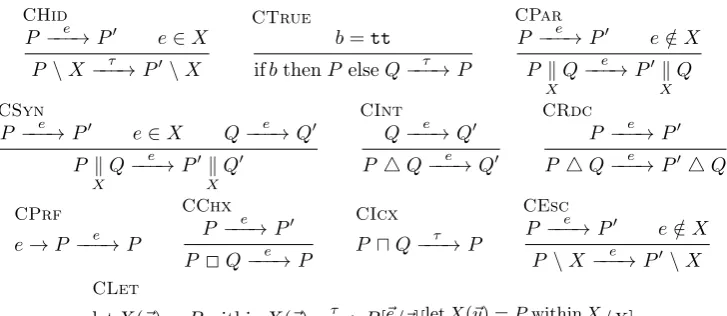
2.1 CSP Operational Semantics (omitting symmetric rules) . . . 11
2.2 Design decision for engineering a self-adaptive systems from [82] . . . 17
3.1 Self-Adaptive Autonomous Vehicles System. . . 29
3.2 The transition function forA1 (top) andA2(bottom) . . . 35
4.1 Components of the Art Gallery (partial model). . . 44
4.2 The application of the Methodology to the art gallery example. . . 46
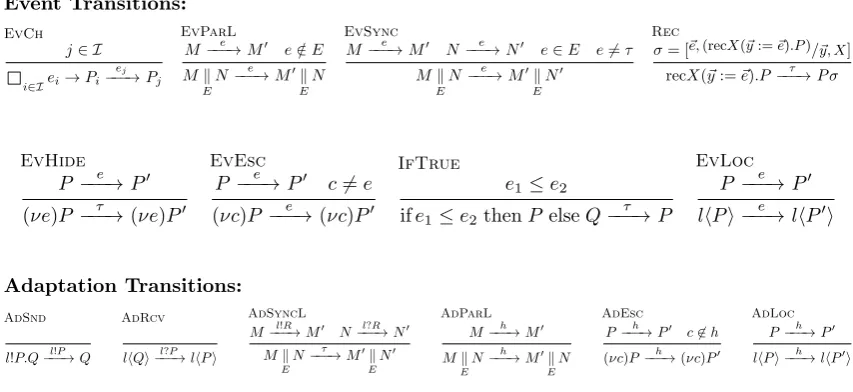
4.3 Transition Semantics of ACSP (omitting symmetric rules). . . 48
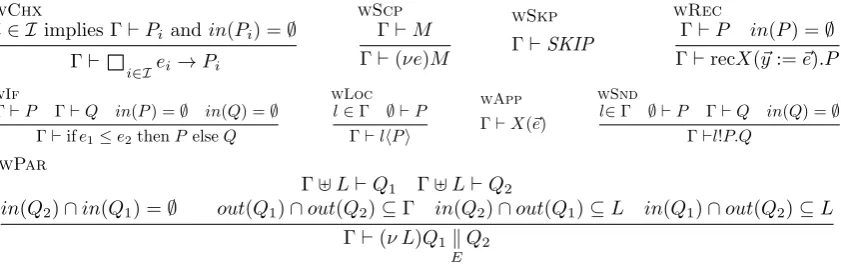
6.1 Well-Formed Processes Rules . . . 67
6.2 Translation into CSP . . . 69
6.3 Experimental results for topology-guided modelling of the exhibition area require-ments in isolation . . . 75
6.4 Experimental results for verifying topology-guided modelling of exhibition area re-quirements with FDR minimization disabled. . . 76
7.1 Experimental results for verifying exhibition area requirements when composing adaptation procedures . . . 94
7.2 Experimental results for verifying exhibition area requirements when composing adaptation procedures with FDR minimization disabled. . . 95
8.1 The translation process fromACSPM to CSPM . . . 98
9.1 The seating plan of Croke Park from [1] . . . 106
9.2 Component Model for the stadium case-study . . . 109
9.3 Violations introduced inSpecA from the Composition ofSA andSB . . . 116
9.4 Experimental results of verifying the stadium requirements against a single section, containing the composition of all adaptation procedures . . . 126
A.1 The translation of an SAA to deterministic EM . . . 137
C.1 Adaptation Procedures for enforcing Req. 2 at different levels of Granularities . . . 177
Chapter 1
Introduction
1.1
Motivation
Computational and communication capabilities are being increasingly embedded into physical en-tities and processes, resulting in a proliferation of Cyber-Physical systems (CPSs) [18]. Notable examples include smart buildings (e.g., [48, 121, 120, 52, 128]) and autonomous vehicles (e.g., [23, 16, 112, 78, 99, 128]). CPSs exhibit a sophisticated interplay of digital (cyber) processes with a physical operational environment. An aim for such systems is to be flexible and resilient by effectively responding to a wide range of changes in their context through dynamic adaptation of their behaviour [86, 87]. A change in the context of a CPS can be anything from a foreseen spike in resource usage to a catastrophic natural disaster. CPSs cannot afford to have a manual process, with a human in the loop, to counteract all changes in their context, as this would be too disruptive and error-prone. Therefore CPSs often rely on built-inself-adaptation functionality to fulfill their goals in the face of a changing operational environment.
Self-adaptation is a system’s capability to autonomously, without human input, detect when the operational environment changes and deploy counter-measures to guarantee the continued satisfaction of requirements. To engineer a SA system, a system designer needs to automate the inference of correct functionality in all possible contexts. Only then can an SA system decide autonomously, at runtime, an optimal behaviour. Moreover, as SACPSs are given autonomy over a wide range of actions that can affect the physical world, it is important that they are designed with high reliability in mind, and concrete assurances can be provided to their users. For this reason, it is crucial we understand the structure of self-adaptive systems and create techniques for building them and reasoning about their properties and runtime behaviour.
A roadmap produced by the self-adaptive community identifies two main open challengesthat need to be addressed to better understand how to build effective self-adaptive systems [42, 32].
Systematic Software-Engineering Processes: Current research aims to provide a common framework and systematic software engineering techniques to effectively model SA systems [8]. A widely accepted view of SA systems is to distinguish their functionality in two parts—theadaptation procedure and thebase system. The former encapsulates all the adaptation functionality: when, what and how to adapt; the base system contains the system functionality that may be adapted. This leads to a centralized SA system, where a single adaptation procedure has a global view of the system and determines all adaptations. In CPSs however, components may potentially be dispersed over a large area, or the CPS may need to operate in an open environment. This means that a centralized adaptation procedure that requires global and absolute knowledge of the entire
system may be impractical [127, 126, 42]. Recent research has been aiming at identifying systematic software engineering techniques for decentralized SA systems [107, 42]. In a decentralized setting, adaptation is going to emerge from the implicit composition of adaptation procedures operating on different parts of the system. A key challenge in this approach is dealing with the case where system components may need to be adapted by multiple adaptation procedures. In such a case adaptation procedures may interfere with each other leading to the violation of requirements. Effective and systematic approaches to localize adaptation to small parts of the systems may reduce the potential of interference. Yet, approaches to explicitly handle the interference between adaptation procedures are still needed [127, 126, 42].
Practical Verification Techniques: Self-adaptive CPSs increasingly support critical services. Errors can indeed be catastrophic. Thus it is important that high-level assurances are provided for these systems, guaranteeing that key requirements are satisfied in the presence of self-adaptation. The golden standard for providing such assurances is formal verification. The highly dynamic nature of SA CPSs, however, makes verification difficult due to the large state space of SA CPSs models that needs to be verified [107, 42, 32]. There are two challenges that need to be addressed to attain a tractable verification technique for such systems.
• Firstly, verifying self-adaptive CPSs using explicit state model checking of the entire system may suffer from the state explosion problem and be computationally infeasible for large-scale systems (e.g., [120]). Techniques where properties can be verified against a small part of the system, knowing that, once verified, these properties hold for the whole system are still lacking. Due to the versatility of CPSs, different groupings of concurrent cyber and physical components may need to be considered for each property.
• Secondly, verification needs to incorporate a large class of requirements that together define the overall behaviour of the system. Most existing verification techniques (e.g., [95, 28, 29, 71, 55, 54, 23, 94]) employ a utility function to quantify the satisfaction of multiple require-ments. However, during the early design phase, we may not yet know appropriate weights and probabilities to define an effective utility function. A practical qualitative verification technique for SA CPSs with multiple requirements is therefore needed [5, 126, 26].
In this thesis, we propose to tackle the complexity of modelling and verifying the satisfaction of safety properties in SA CPSs through systematic andcompositional techniques. Compositionality allows us to prove that the correctness of a verification task on a small part of the system holds for the entire system. Our approach is based on three key principles.
Topology-driven Modelling: Firstly we use a modelling methodology guided by the topological layout of CPSs and topological relations, such as containment and connectivity [102]. Consider, for example a smart building comprising rooms and sensors inside these rooms. In our model, we map the rooms and sensors to components, whereas the connectivity and containment relation between the identified components map to the interface between components.
to a group of CPS components over which an adaptation procedure aimed to ensure a requirement is defined whereas levels of granularity imply different groupings of components. Our use of the term granularity differs from the standard definition in computer science research literature [100].
Requirement-driven Adaptation: Secondly, we propose a methodology for modelling requirement-driven adaptation. The decentralization of adaptation logic in our model is guided by the topology and requirements. We utilize the topology and topological relations to systematically explore different grouping of components (levels of granularity) that affect the satisfaction of each require-ment. We then model and verify an adaptation procedure over the selected group of components that aims to ensure the satisfaction of the requirement in the face of changes to the operational environment.
Compositional Verification: Topology-driven modelling and requirement-driven adaptation can already lead to models where adaptation functionality is distributed throughout the system. A theory of compositional reasoning guarantees that some verification tasks can be localised, without considering the entire system, drastically reducing the state explosion problem. When adaptation procedures are defined over disjoint parts of the system, their composition preserves the satisfaction of requirements because of the semantic properties of the modelling language, thus requiring no additional verification at the time of composition. When adaptation procedures have overlapping scope, there is potential of interference between them. Here, we need to verify the satisfaction of requirements after composing potentially interfering adaptation procedures. As we show, however, for certain types of overlaps, interference can be theoretically ruled out (e.g., when adaptation procedures only monitor, but not adapt, common components), thus allowing us to skip certain verification tasks at the time of composition. Our definition of compositional verification differs from the traditional meaning, e.g., [12, 76, 34], where the term is often used for approaches that construct system-level correctness proofs hierarchically from proofs of component-level properties. In this thesis, we leverage compositional verification techniques to safely localize verification tasks to a small part of the system. Moreover, our approach allows us to leverage existing, well-developed verification tools. In this dissertation, we use the refinement checker FDR [59]; however, our technique is general enough to be used with other verification tools such as (bi-)simulation [89, 108], testing preorders [43, 35], and modal logics [69, 11]..
1.2
Motivating Example: An Art Gallery
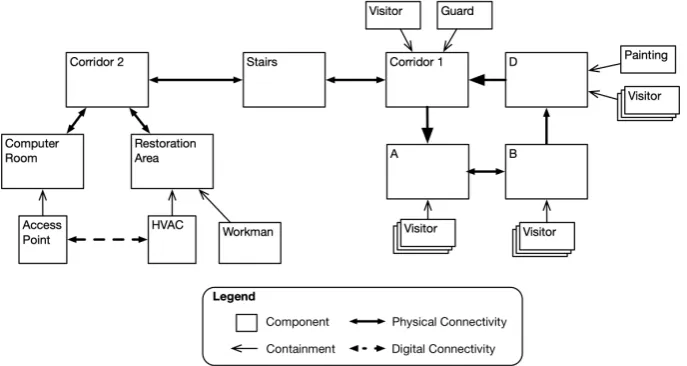
Throughout this dissertation we use a motivating example of an art gallery building. The two-floor plan of the gallery is shown in Figure 1.1. Floor 1 includes a corridor and an exhibition area (rooms A, B, and D) where paintings are displayed. Floor 2 includes aRestoration Area where maintenance and restoration of artwork is carried out. A heating, ventilation, and air conditioning system (HVAC) maintains a predefined target temperature and humidity level in theRestoration Area. A wireless access point in theComputer Room provides internet connectivity to the devices located in Floor 2. It is also connected to the HVAC allowing the latter to be monitored and controlled remotely.
The art gallery would like to promote to the public the skilled work performed in the restoration area. Nevertheless, a critical security requirement for the art gallery is:
Corridor 1
A
Restoration Area
B D
Corridor 2 Computer Room
Access point HVAC Workman
Visitor
Floor 1
Floor 2
Guard
. . .
[image:19.595.199.366.70.255.2]<= 10 Guard
Figure 1.1: Two-floors plan of the Art Gallery.
This requirement may be violated when a visitor is in the Restoration Area without a staff member present in Floor 2. However, controlling access to the Restoration Area based on the presence of restoration staff might not always be desirable. For example, when restoration work is performed, access to the restoration area should be free of controls to allow efficient movement of workers. This can lead to the situation where visitors can access theRestoration Area without the presence of a staff member and interfere with the restoration work.
To avoid violating Req. 1 a system designer can introduce adaptation procedures at different granularities. Here we examine two such procedures.
Adaptation Procedure 1.1. Adaptation is applied at the granularity of the second floor, allowing free access to theRestoration Area only in the presence of a guard.
Ad. Proc. 1.1 and all adaptation procedures defined in this section f match the definition of a self-adaptive system presented before, where the system can autonomously determine if visitors should be precluded from entering the restoration area by monitoring the movement of the guard. However, this adaptation procedure can obstruct the movement of workers by locking the restora-tion area door when a guard is not present. The following adaptarestora-tion procedure avoids this by using a coarser granularity which includes Corridor 1 and theStairs.
Adaptation Procedure 1.2. The guard fromCorridor 1 should escort visitors to Floor 2 as soon as they start climbing the stairs. This ensures that visitors always reach theRestoration Area
accompanied by a guard.
A very important painting at the core of the current exhibition is located inRoom D. Visitors can enter this room from Room B and exit toCorridor 1. To maintain integrity of the painting, the following requirement should be satisfied.
Requirement 2. No more than ten visitors should be inRoom D at the same time. ♦ To satisfy this requirement an adaptation can be used at the granularity ofRoom D.
Adaptation Procedure 2.1. Visitor entrance toRoom D is allowed only when there are fewer
than ten people in it.
Adaptation Procedure 2.2. The total number of visitors in B, and D does not exceed the maximum number of people allowed inRoom D alone; a guard is also located in Corridor 1 (to
prevent tailgating intoRoom A).
Back in Floor 2, a malicious visitor may connect a device to the wireless network and take control of the HVAC, exploiting security vulnerabilities of the wireless protocol. The following requirement is designed to prevent this.
Requirement 3. The HVAC should not be controlled remotely by unauthorised users. ♦ To satisfy this requirement an adaptation procedure can be designed at the granularity ofFloor 2, which protects the HVAC from attacks while still allowing visitors to connect to the wireless network.
Adaptation Procedure 3.1. The HVAC is disconnected from the network when an untrusted device in the second floor is connected to theAccess Point.
Additional requirements for the art gallery may involve overcrowding and emergency scenarios.
Requirement 4. No more than thirty visitors should be in the entire exhibition area at the same
time. ♦
To satisfy this requirement, an adaptation procedure can monitor the movement of people into Room Aand out ofRoom D—the entrance and exit, respectively, of the exhibition area.
Adaptation Procedure 4.1. A visitor is allowed to enter Room Afrom Corridor 1 only when the people who have enteredRoom AfromCorridor 1 minus the people who have exitedRoom D
intoCorridor 1 are no more than thirty.
This adaptation procedure allows all thirty people to be in the same room of the exhibition area. Although this is sufficient for Req. 4, the system designer may decide to refine this adaptation procedure in a way that spreads the people across the different rooms of the area.
Adaptation Procedure 4.2. Monitor visitors in roomsA,B andD and allow visitor movement between adjacent rooms only when the sum of people in adjacent rooms is less than fifteen. For example, movement fromRoom A to B is allowed when the number of visitors in rooms B and D is less than fifteen. Similarly, movement from Corridor 1 toroom A is only allowed when the
number of visitors inrooms AandB is less than fifteen.
In case of an emergency the following requirement should also be satisfied
Requirement 5. The people in the building should be able to reach the nearest emergency
exit. ♦
This requirement could be enforced at the granularity of the entire system, but this would require verification for the satisfaction of the requirement over the entire system. Instead, the following adaptation procedure is sufficient to guarantee the requirement.
Requirement 5(revised).At each room, movement in the case of an emergency is not restricted—
all doors are open. ♦
Finally, the following requirement should also be satisfied.
Adaptation Procedure 6.1. To satisfy this requirement, when a new update is available, the HVAC should connect to theAccess Point and install it. This means that visitors should be dis-connected from the access point so theHVAC can connect and install the update. This adaptation procedure controls the access point, which is also controlled in the adaptation procedure designed
to satisfy requirement 3.
1.3
Challenges
In this thesis, we aim to achieve a general tractable verification of the satisfaction of security re-quirements in SA CPSs such as the art gallery presented in the preceding section, and a stadium discussed in Chapter 9. We aim to achieve our goal throughcompositional verification, where ver-ification tasks proven over a small part of the system also hold for the whole system. For instance, the verification of Req. 1 can be localized over the restoration area and through compositionality we have the guarantee the satisfaction of the requirement holds for the whole art gallery. We thus require a modelling framework and verification approach that supports compositionality. In our art gallery, we want to verify the satisfaction each requirement by considering only a small subset of the rooms and digital components knowing that it suffices to verify the satisfaction for the art gallery.
An important aspect for successfully exploiting compositional verification is identifying which components are important to include and which to ignore. Requirements for SA CPSs include a fu-sion of computation capabilities influenced by the physical layout of the system. Thus, identifying which components to include in verification tasks is not straightforward from the requirements. For example, even though both descriptions of Requirements 3 and 6 include the HVAC, their adap-tation procedures focus solely on the access point that has the potential to connect unauthorized users to theHVAC.
Self-adaptation aims to evert as much as possible degradation in the level of service provided by an CPS, by adjusting the functionality with respect to a requirement after disruptive changes. Degradation in functionality may not always be avoidable [48] and the task of encoding effective adaptation procedures is hard and error prone. Designers of these systems must decide at which system execution points should adaptation be invoked in order for the system to operate efficiently and satisfy its requirements. We refer to the execution points where adaptation must be invoked as theadaptation pattern. These points can be as simple as timing events (e.g., everyX seconds), can be triggered by specific system events, or even have a complex logic taking account the execution history and state of the system. Existing modelling approaches for SA systems often distinguish the adaptation decision process from the base system, but encode adaptation points directly in one, or both, of these components (e.g., [10, 64, 79, 47, 132, 115, 77]). The drawback of this approach is that the pattern of adaptation events becomes a cross-cutting across the system model. Modifying this pattern in search for a correct and optimal model often requires significant changes to the description of the base system and/or the adaptation decision process, which has to be done in an ad-hoc manner. However, modularising adaptation patterns is not easy [58]. Although some systems may be able to support such events at every state, others must disallow them during critical sections of their execution. Moreover, adaptation decision processes may be able to operate only at a subset of the system states.
all adaptation procedures are composed together. We need to explicitly and effectively address potential interference between overlapping adaptation procedures. For example, consider Require-ments 2 and 4 from section 1.2 asserting the allowed number of visitors inroom D and exhibition arearespectively. The adaptation procedures overlap, yet we can verify that the composition of the adaptation procedures preserves the satisfaction of both Requirements 2 and 4. Consider now we compose an adaptation procedure that aims to ensure the satisfaction of Req. 5 requiring visitors to have a clear exit from the building in the case of an emergency. This adaptation procedure may allow any number of visitors inroom D and theexhibition area, which may potentially violate Requirements 2 and 4. Here, we need to revise the adaptation procedures and potentially the requirements to resolve the conflict. In this example, we only apply Requirements 2 and 4 in a non-emergency situation and only apply Req. 5 in an emergency. In some cases, interference is not possible, e.g., when adaptation procedures are defined over disjoint components or the adaptation procedures only monitor, without adapting, common components. In these cases, we should be able to show that the satisfaction of requirements is preserved through compositionality theorems. The challenge of attaining a compositional modelling framework for the tractable verification of SA CPSs is because of the complexity of SA CPSs.
1.4
Research Question
The main research question that we address in this thesis is
How can we tackle the complexity of modelling and verifying SA CPSs?
We propose a modelling and verification methodology that enables a system designer to tractably verify the satisfaction of security requirements in realistic SA CPSs. In particular we focus on smart buildings, where the layout is static i.e., components, like rooms or access points, are not added and removed dynamically. This is achieved by proposing a framework that support compositionality. The methodology , despite being manual, comprises software engineering techniques that guides a system designer to systematically and effectively attain a compositional model for SA CPSs. As we shall see in later chapters, the modelling process is based on topology and topological relations. We also propose a verification process that decomposes the task of verifying the satisfaction of security requirements in SA CPSs to reduce the complexity of realizing the verification. Finally, the proposed modelling methodology allow us to leverage existing verification tools and therefore avail of the years of experience in optimizing and advancing the verification technique.
1.5
Contributions
We answer our research question through two high-level contributions. To achieve the high-level contributions, we also present a number of technical sub-contributions.
A modelling methodology for SA CPSs This methodology is derived through software engineering techniques to tackle the complexity of defining a compositional model for SA CPSs. From this perspective, technical contributions include
to compose adaptation procedures to propose an iterative verification process for effectively proving the satisfaction of a number of requirements.
2. We also define a concrete representation for ACSP, which we callACSPM. The syntax for
ACSPM is inspired from CSPM [59], the machine readable dialect of CSP [70].
3. A requirement-driven adaptation approach that aims to ensures the satisfaction of safety requirements. In our framework, adaptation emerges from the implicit composition of adap-tation procedures enforcing each requirement.
4. A CPS topology-driven technique to systematically identify the smallest set of components that affect the satisfaction of a requirement, over which an adaptation procedure enforcing the requirement would operate. This work has been published in [17].
5. A modular encoding for adaptation procedures that helps a system designer experiment and compare alternative adaptation procedures. We also propose generic properties an adaptation procedure (in our encoding) should possess. This work has been published in [16].
6. An evaluation of our framework through a second case-study: a smart stadium [92].
A practical verification process One of the persistent challenges faced by the SA systems community is the lack of a practical verification techniques [107, 42, 32]. In this thesis, we present a compositional verification process to verify the satisfaction of security requirements in SA CPSs using existing verification tools. The following technical contributions have been implemented to achieve this goal,
1. A translation for a subset of ACSP to CSP, the input language to FDR. We show this translation is adequate by showing the translation is a strong bisimulation and that it models an interesting class of SA CPSs by encoding the art gallery and smart stadium case-studies.
2. A theory of compositionality that guarantees verification results proven over different subsets of an CPS which localizes adaptation are preserved for the whole system.
3. An extension of this theory to derive a technique to systematically verify the satisfaction of requirements by the composition of adaptation procedures with potentially overlapping scope. We identify cases where interference is not possible and prove that requirement satisfaction in such cases is preserved by composition, thus allowing us to avoid re-verifying the composed system.
4. The automation of the translation from ACSP to CSP with a prototype tool. This tool integrates FDR to present a complete verification process. The input language for the tool is the concrete syntax of ACSP,ACSPM. The concrete syntax augments ACSP with idioms
inspired from functional programming languages to alleviate the task of encoding realistic problems.
1.6
Limitations and Assumptions
statistics about the possibility of a hacking or burglar attempt and the probability of bypassing specific security measures like breaking a password. There are other interesting and relevant classes of requirements that would be worth exploring as a future research direction of this thesis. This include time-related requirements, e.g., requiring HVAC updates to be installed within 3 hours, and constraints on physical parameters, e.g., verifying that the temperature and energy consumption in a room is always within a pre-defined range.
We also make a number of other assumptions. Firstly, we assume that the structure of the system, i.e., the rooms and assets, is static. The verification of systems where components can be added and/or deleted autonomously at runtime is left as future work. Secondly, the mapping between requirements and specifications cannot be verified in our methodology. The requirement is the english description of the intended behaviour, whereas the specification is the formal pro-cesses encoding the intended behaviour. There is always the risk that the specification does not faithfully encode the requirement. It is the responsibility of the system designer to ensure that the specifications and requirements are close to each other as much as possible such that the mapping from the requirements to the specifications is clear. Lastly, we assume that requirements describe the intended behaviour of a small part of the system only and this enables the effective application of compositional reasoning that scales our verification approach. The effective verification of global requirements is left as future work.
1.7
Organisation of the Dissertation
The dissertation is structured as follows.
Chapter 2: In this chapter, we first overview the literature about SA systems, where we discuss related work regarding the design-time and run-time verification of SA systems. In the second part of the chapter, we present the main syntax and semantic models of the process language Communicating Sequential process (CSP) [70].
Chapter 3: We present a high-level model for centralized SA systems, which decouples adap-tation patterns from the descriptions of base systems and adapadap-tation procedure. A distinct au-tomaton pinpoints when adaptation must happen. Using this framework system designers can experiment with different adaptation patterns, without modifying the base system or adaptation procedure to discover correct and efficient patterns. We provide an adequate translation into FDR and also prove that self-adaptive systems correspond to standard models of computation. We illustrate the use of our framework through a use case of a self-adaptive system of autonomous search-and-rescue rovers.
In the remaining parts of the dissertation, we present a methodology for compositional mod-elling and verification of SA CPS.
Chapter 5: We investigate how the topological layout and relations between components of a CPS guide a system designer to systematically explore different levels of granularities (i.e., grouping of components) for satisfying a requirement. We also present a systematic technique for encoding adaptation procedures that aims to ensure the satisfaction of a requirement. We motivate this technique through the art gallery example presented in section 1.2 by providing an encoding in Adaptive CSP.
Chapter 6 We show how the satisfaction of requirements can be verified using FDR by consider-ing only a relevant subset of the components. In this chapter, we present an adequate translation where a small subset of the system encoded in Adaptive CSP is translated to CSP, the input language of FDR to verify the satisfaction of each requirement. We also present the theory of com-positionality for our verification technique that guarantees verification tasks proven over small, disjoint subsets of CPS components hold for the entire system.
Chapter 7: In this chapter we discuss the verification of requirements when adaptation pro-cedures are composed together. We extend our theory of compositionality results to investigate potential interference between different types of adaptation procedure overlaps. In some cases, in-terference is theoretically not possible—e.g., when adaptation procedures monitor, without chang-ing, overlapping components—thus allowing us to skip re-verification tasks for the composition. We present a systematic approach to compose adaptation procedures, and verify where needed the relevant system requirements.
Chapter 8: We discuss the development of a tool that implements the translation fromACSPM,
a concrete syntax for Adaptive CSP, to CSPM, the input language of FDR. The concrete syntax
extends Adaptive CSP with functional programming languages constructs to improve the usability of our framework in realistic examples.
Chapter 9: We evaluate the applicability of our modelling methodology for SA CPSs and the practicality of the verification approach through a different case study, that of a smart stadium [92].
Chapter 2
Background
2.1
Process Languages
Compositionality entails the divide-and-conquer or decomposition of complex problems into smaller more-manageable sub-problems. This techniques has been widely-utilized by the software verifi-cation community to achieve scalable verifiverifi-cation. Process algebras like CCS, CSP orπ-calculus have been proposed to compositionally model software and different verification techniques like refinement-checking [59] and behavioural equivalence [122, 44] have been proposed to compositional verify process languages. CCS [90], CSP [20] and π-calculus [108] were introduced to investigate small concurrent systems. The communication of behaviour cannot be concisely encoded in such languages. This motivated the introduction of a new class of process languages, known as higher-order process languages, e.g., CHOCS [119] and HOπ[109]. These languages are very powerful and expressive, but we lack tools to reason about higher-order processes. In this thesis, we identify a strict subclass of higher-order processes in our novel process language that can be encoded in the first-order process language CSP.
Here, we overview Communicating Sequential Processes (CSP) and refinement-based verifica-tion techniques.
CHid
P−−−→e P0 e∈X P\X −−−→τ P0\X
CTrue
b=tt
ifbthenPelseQ−−−→τ P
CPar
P −−−→e P0 e /∈X P k
X
Q−−−→e P0 k
X
Q
CSyn
P −−−→e P0 e∈X Q−−−→e Q0 Pk
X
Q−−−→e P0k
X
Q0
CInt
Q−−−→e Q0 P 4Q−−−→e Q0
CRdc
P −−−→e P0 P 4Q−−−→e P04Q
CPrf
e→P −−−→e P
CChx
P −−−→e P0 P 2Q−−−→e P
CIcx
P uQ−−−→τ P
CEsc
P −−−→e P0 e /∈X P \X −−−→e P0\X
CLet
[image:26.595.130.494.573.731.2]letX(~y) =PwithinX(~e)−−−→τ P[~e/~y][letX(~y) =PwithinX/X]
Figure 2.1: CSP Operational Semantics (omitting symmetric rules)
2.1.1
Communicating Sequential Processes (CSP)
CSP, introduced in 1978 by CAR Hoare, formally captures the notion of concurrent behaviour, where the low-level scheduling details of interleaving are abstracted over [20]. The main focus of the language is the communication between a process and its environment, which is defined in terms of events over a predefined alphabet. Here, we consider only a subset of the language. We let P, Q range over CSP Processes, x, y range over variables and e range over events. We let Σ represent the set of all events. defined as follows:
P, Q::=e→P |P 2Q|Pk
A
Q|SKIP|STOP| ifbthenP elseQ | letx(~y) =PwithinQ|P[[e2/e
1]] | P 4Q | P\A|PuQ|x(~e)
The prefix constructe→P means that the processP is guarded by evente. External (deter-ministic) choice P 2Qallows the environment to choose between synchronising withP or Q. In the case where both choices are enabled, the choice is resolved non-deterministically. The internal (non-deterministic) choice is written as P u Q. The processes letx(~y) = PwithinQ and x(~e) represent the let and application constructs respectively, e.g.,
letx(y) =ey →x(y+ 1) withinx(1)
The processes ifb then P else P, P \ A and P[[e2/e
1]] represent conditional, action hiding, and
event renaming from e1 to e2. The process and let declaration. The processesSKIP andSTOP
represent a successful termination and the deadlocked process, respectively. Interleaving Pk
A
Q
requiresP andQto synchronise on actions in the setAbut requires no synchronisation on events not in A. An interrupt process, written P 4 Q, propagates any event from P without affecting the interrupt, but if Qever performs a visible event then this removes the interrupt andP, and the entire process behaves asQ.
In fig. 2.1, we outline the operational semantic rules for CSP. The ruleCHidhides an eventefrom its environment; in rule CEscsuch an event is propagated to the environment. The condition rule CTrueand its (omitted) symmetric rule evaluates a conditional;CParand its (omitted) symmetric rule propagates an event e of P over a parallel composition Pk
E
Q, provided e /∈ E. The rule CSyn synchronizes such an event. In ruleCInt, a process P is interrupted by a processQ; in rule CRdc the interrupt is propagated forward. CPrf annotates the transition by an event e, CChx can transition to either a process in P orQ. Finally, ruleCLetunfolds a recursion by an internal transition, during which the formal parameters of the recursive process~yare replaced by the actual parameters~e, and the recursive variableX is replaced with the recursive process itself.
letx(y) =ey→x(y+ 1) withinx(1) τ
−−−→ey→x(y+ 1)[1/y][letX(y) =ey→x(y+ 1) withinx/x]
=e1→letx(y) =ey→x(y+ 1) withinx(1 + 1)
From the parallel construct Pk
A
synchronize on the set of eventsA∩B,
P AkBQ= P k Events\A
STOP
!
k
A∩B
Q k
Events\B
STOP
!
Ifev(P)⊆Aandev(Q)⊆B then the following statement holds, P AkBQ=P k
A∩B
Q
2.1.2
Semantic Models
The three main semantic models of CSP are trace (T), stable failure (F) and failure-divergence (FD) models.
Trace Semantic Model (T) Let a trace be a potentially infinite sequence of events denoted by t =he1, e2, . . .i where hi is the empty trace. We say a process P has a trace t = he1, e2, e3, . . .i
written asP −−−→t iff it can communicate all the events in the trace in order i.e.,e1 followed by
e2 and so on. Formally,P t
−−−→ is the reflexive and transitive closure ofP e1 −−−→ e2
−−−→ . . .. We define the set of tracesT for a process P as
traces(P) ={t | P −−−→ }t
The set of traces allows us to define the first semantic model for CSP. We sayQrefinesP by the trace model, written as
P vT(CSP) Q iff trace(Q)⊆traces(P)
This is useful for specifying safety properties: nothing bad ever happens, i.e., all the traces of implementationQare in the traces of the specification P.
Failure Semantic Model (F) was introduced to verify liveness properties, where the violation is the absence of a suffix leading to a desired state. Here, we also check that both the process and the specification deadlock on the same state. Consider the following two processes whereSTOP denotes a deadlock termination rather than a successful termination (i.e.,SKIP),
P = letX =a→XwithinX
Q= (letX=a→XwithinX) u STOP
The trace model doesnot distinguish the two processes as both define the language a∗. However, the failure semantic model does distinguish the processes, because Q can deadlock on STOP whereasP never reaches a deadlock state.
We define the set of refusal of a processP to be the set of events that are not enabled from process P. This allows us to define the set of failures of a processP. A failure is a pair (t, X) wheretis a trace andX is a set of first-order events refused afterP performs t.
ref usal(P) ={X ⊆Σ | P−−−→6 a anda∈X} f ailures(P) ={(t, X) | P −−−→t QandX ∈ref usal(Q)}
failures and traces of P
P vF(CSP)Q iff f ailures(Q)⊆f ailures(P) andtraces(Q)⊆traces(P)
Failure-Divergence Semantic Model (FD) is the last semantic model we consider for CSP. The failure-divergence model also distinguishes between livelock and deadlock process. A process is livelocked or divergent if the process can perform an infinite sequence of internal events τ but no observable event.
Q0⇑= for all n∈N.∃Qn+1. ;Qn τ
−−−→ Qn+1
div(P) ={t;t0 | P −−−→t QandQ⇑}
P vFD(CSP)Q=f ailures(Q)⊆f ailures(P) and div(Q)⊆div(P)
The advantages of all three semantic models presented above are that they are congruent and transitive. Congruence means that for any contextC and semantic model M∈ {T,F,FD},
P vM(CSP)Q implies C[P]vM(CSP) C[Q]
while through transitivity, we infer that
SpecvM(CSP)QandQvM(CSP)Impl implies SpecvM(CSP)Impl
This allows us to have a potentially iterative verification approach from the specification down to the implementation also known asstepwise refinement.
2.1.3
Algebraic Laws
From [105], we list some of the algebraic laws founded in CSP, that are relevant to this thesis. Equivalence between two processes means that an external observer cannot distinguish between the two processes. This is known as strong bisimulation. In CSP, the notion of divergence is important especially for the failure-divergence semantic model and thus weak bisimulation is not applicable. In this dissertation, we refer to strong bisimulation as bisimulation.
Definition 2.1.1(Bisimulation relation in CSP). The relationRon CSP processesP1 andP2 is
said to be a (strong) bisimulation iff P1RP2 and
1. IfP1 a
−−−→P10 implies there is aP20 such thatP2 a
−−−→P20 andP10RP20
2. IfP2 a
−−−→P20 implies there is aP10 such thatP1 a
−−−→P10 andP10RP20
♦
Definition 2.1.2. In later chapters, we assume the following list of equivalence laws for CSP
P = (Pk
A
P) hk −Identityi
provided ev(P)⊆A
(P XkY Q) = (QYkX P) hAkB−symmi
(P XkY Q)X∪YkZR=P XkY∪Z (QYkZ R) hAkB−associ
(P AkBQ)\Z= (P\Z∩A)AkB (Q\Z∩B) hhide−AkB−disti
provided A∩B∩Z =∅
Pk
A
Q
\Z= (P\Z) k
A
(Q\Z) hhide− k
A
−disti provided A∩Z =∅
♦
In Section 7.2 in the book [105], Roscoe shows that the relation = is a strong bisimulation
2.1.4
Tools Available
A number of tools have been developed to reason about CSP processes. Here, we provide a non-exhaustive overview of some of the tools based on CSP:
FDR [59] is an automatic refinement tool for the machine readable dialect of CSP—CSPM [110].
CSPM has been introduced to encourage the use of CSP to verify real-world systems. CSPM
extends CSP with constructs and shorthand idioms from functional programming languages, like Haskell and Miranda, to alleviate the complexity of encoding real-world processes. We can check that an implementation refines a specification according to a semantic model. We can also verify if an implementation is deterministic, deadlock free or livelock free (divergence free). We use this tool in subsequent chapters to verify our examples.
Process Analysis Toolkit (PAT) [117] is a framework for reasoning about concurrent processes in CSP, probabilistic concurrent processes (probabilistic CSP) and real-time concurrent processes (Timed-CSP). PAT implements model-checking techniques to verify deadlock-freedom, refinement-checking, divergence-freedom akin to FDR. Moreover processes are model-checked against LTL properties [117] in PAT.
CSP Prover [73] is a theorem-prover for CSP processes utilizing the theorem-prover Isabelle [97] for reasoning about infinite state-space processes.
2.2
Design of Self-Adaptive Systems
An CPS is a system where the behaviour is determined by both the digital processes and the physical aspects of the environment in which it operates. They rely on self-adaptation to satisfy requirements.
The definition of a self-adaptive systems is not precise. Cheng et al. define a self-adaptive system as a system that is able to adjust its behaviour in response to their perception of the environment and the system itself [32]. Brun et al. [21] argue that theself prefix indicates that the system decides autonomously (i.e., without or with minimal interference) how to adapt or organise to accommodate changes in its context and environment; whereas Esfahani et al. emphasise the ”uncertainty in the environment or domain in which the software is deployed as a prevalent aspect of self-adaptive systems” [51].
A widely accepted view of SA systems is that such systems comprises at least two modules: thebase system and theadaptation procedure. Thebase system represents the systems core func-tionality that is adapted autonomously at runtime, whereas the adaptation procedure localizes all adaptation functionality. The adaptation procedure is sometimes referred to as adaptation man-ager or control loop. In this dissertation, we use the term adaptation procedure to refer to the module in the system that implements the adaptation functionality. A prominent well-established architecture to model an adaptation procedure is known as the MAPE-K feedback loop. [75, 36] The MAPE-K feedback loop is a closed feedback loop comprising the following four steps: 1. Moni-tor the base system and context for changes 2.Analyzewhether a change requires an adaptation (of the base system behaviour) 3. Plan the adaptation 4.Execute the adaptation, under a knowledge base K containing the contextual information. Theenvironment or context contained inK refers to all the information we know about the system augmenting the systems state. This includes log-ging information, system topology and resources or assets status. One can view the environment as the part of the system that cannot be directly altered by the adaptation procedure but can only be monitored. A change in the environment may still require an adaptation of system’s behaviour, e.g., a breakdown in a resource would need a fail-over procedure, which is implemented through self-adaptation.
In fig. 2.2, we present a taxonomy of the characteristics of adaptation procedures presented in [82].
Adaptation Triggers As summarized in [82], adaptation can be either reactive or proactive. In reactive adaptations, the adaptation procedure reacts to events or changes after they happen, e.g., [10], whereas in a proactive approach, the SA system aims to prevent the occurrence of threats or change e.g., [93, 94, 120]. The advantage of proactive adaptations is the absence of interruption for users because adaptation is performed before it is actually needed. This also gives the system more adaptation options. On the other hand, due to its predictive nature, proactive adaptation is more complex to implement in comparison to reactive adaptation and may result in suboptimal system behaviour as a side-effect of minimizing threats. An SA system may opt for a combination of proactive and reactive adaptation. The difference between the adaptation triggers is localized in the Analyse step within the MAPE feedback loop.
Adaptation Procedure
Adaptation Trigger
Proactive
Reactive Why
Change in Context
Change in System User Preference
Change
Behavioural Structural
Context Degree of
Decentralization Centralized
Decentralized Hybrid
Decision Criteria Rules
Utility Goals
Models Where
Application Middleware
Communication
Context Coupling
External
[image:32.595.150.458.82.333.2]Internal
Figure 2.2: Design decision for engineering a self-adaptive systems from [82]
adaptation option has not been widely investigated. In this document, we focus on behavioural changes, where the adaptation procedure communicates algorithms or system behaviour to different parts of the base-system. Even though our process language can potentially encode structural changes, our verification approach cannot handle cases where components are added or removed dynamically. The modelling and verification of structural and contextual changes is left as future work.
Decision Criteria These criteria help a system designer understand adaptation—why and how a system adapt. A system designer decides the adaptation outcome, either through a utility function e.g., [95, 28, 29, 71, 55, 94], a set of rules or goal model e.g., [33]. In this document, we do not address this criteria. It is left up to a system designer to implement the adaptation decision process.
Where Here, we identify the level at which we implement the self-adaptive capabilities e.g., adaptation can be implemented at the network level or application level. These criteria does not apply in our thesis, because we do not implement the SA system.
Coupling Two approaches are identified for implementing adaptation procedures. One approach is to have the adaptation functionality intertwined with the system functionality and another approach is to modularize the adaptation functionality. The former is referred to as an internal adaptation procedure whereas the latter is known as an external adaptation procedure. One major disadvantage of the internal approach is that adaptation becomes a cross-cutting concern that may impede the scalability of the system. The lack of separation of concerns makes the potential system also hard to understand and maintain. In our approach, we encode external adaptation procedures.
Degree of decentralization Another aspect of adaptation procedures is the degree of decen-tralization. In a centralized SA system, there is one adaptation procedure that implements all the adaptation functionality. Such adaptation procedure tends to have a complete view of the system to determine the most optimal adaptation. This suffices for small-systems, however for large-systems, a centralized adaptation procedure becomes a bottleneck and a single point of failure. Therefore a decentralized approach can improve scalability and reliability, where the adaptation procedure is decomposed and deployed at the level of each component. For CPSs, adaptation may need to be implemented over a group of components, making a hybrid of the two approaches more desirable. Our encoding is flexible enough to cater for all three cases. We allow the adaptation procedure to be placed around different grouping of components.
The website [2] contains a collection of examples of SA systems and model problems that have been used extensively within the community. Here, we overview a non-exhaustive list of SA systems found in the literature. Garlan et al. in [57] introduces znn.com which simulates a self-adaptive web server of a news site. Camara et al. in [29] and Moreno et al. in [94] evaluate their frameworks using a web-server as a case-study. Another case-study widely used in the literature is the traffic routing problem introduced in [129]. Authors in [85, 88, 50, 123, 24] evaluate their frameworks through a variant of the traffic routing problem. Related to transport, SA systems implementing unmanned autonomous vehicles (UAV) introduced in [77] have been used in the evaluation of [23, 16, 112, 78, 99, 128]. Smart spaces like warehouse, healthcare centres and buildings have been studied extensively as case-studies for SA systems in [48, 121, 120, 52, 128]. Assisted living and the applicability of self-adaptive capabilities in healthcare software systems have been studied in [27, 95, 104, 116].
2.2.1
Decentralizing the Adaptation Procedure
Today systems are expected to work in an open environment. For SA systems, this means that adaptation procedures do not have a complete view of the context to plan the most optimal global adaptation. Adaptation decisions now target a small part of the system and checks are put in place to make sure that adaptations satisfy both local and global requirements. This class of SA systems motivates the drive for systematic engineering techniques for building decentralized SA systems. Even though models for SA systems supporting compositionality are the norm [85, 22, 6, 84, 78, 48]. Such literature neglects to propose techniques to attain a compositional model or address explicitly the interference caused between different adaptation procedures in a decentralized SA systems [127, 126, 42].
Uncertainty In a cyber-physical environment, the behaviour of physical components is unpre-dictable. As a result the system behaviour may become inconsistent with the environment inter-mittently. The volatility of SA systems is increased due to the lack of a centralized adaptation procedure that has a complete view of the environment.
Overhead Decentralized adaptation procedures need to co-ordinate with each other to ensure that global requirements remain satisfied. The co-ordination introduces additional overheads in terms of computational efficiency that an SA system may not be able to tolerate.
Conflicting Goals The outcome of adaptation procedures, trying to optimize the behaviour of local components of a CPS, may create interference at a global level. For instance, an adapta-tion procedure may hog resources from other adaptaadapta-tion procedures or the sub-system behaviour may conflict with other sub-systems behaviours. Approaches to reason about global goals and adaptation procedures cooperation in a decentralized systems are still in demand.
Systematic engineering Due to the inherent complexity, design patterns for modelling coor-dination between adaptation procedures are needed.
Guarantees The challenge for verifying decentralized SA system is increased merely as a by-product of the above challenges.
In our work, we tackle the last three challenges. We present a modelling process for decentralized SA CPSs that aims to minimize the coupling between adaptation procedures. We also present a verification approach to guarantee that adaptation procedures ensures the satisfaction of local requirements without interfering with the satisfaction of global requirements. We showcase that our verification approach can be applied to realistic SA CPSs through two case-studies.
Weyns et al., in [127], consolidate structural design patterns for decentralized SA systems. The authors also present guidelines for choosing a design pattern based on system priorities. For instance, for a self-optimizing system, a centralized approach may be the most appropriate as adaptation can be determined with a complete view of the system; for scalable SA systems the choice of design pattern depends on the volume of information that needs to be shared between adaptation procedures. The system designer must strive to find a balance between decentraliz-ing the adaptation procedure and minimizdecentraliz-ing the communication costs between the adaptation procedures. In a robustness-oriented SA system, a decentralized adaptation procedure removes the bottleneck created by having a single centralized control loop and checks are put in place to guarantee the continued satisfaction of requirements when one of the adaptation procedures cease to function. Efficient response tends to favour decentralized adaptation procedures, however this may result in sub-optimal responses due to the partial view adaptation procedures have of the context. Abuseta et al., in [5], present a design pattern for each step in a MAPE-K feedback loop for decentralized SA systems. The design patterns target existing systems adding self-adaptation functionality. The approach is motivated using UML – a semi-formal modelling approach that may not be suited to verify behavioural properties.
Moreover, the composition guides a system designer to building SA systems bottom-up with scal-ability and compositionality not being the main concerns. Our model aims to achieve a tractable verification using existing techniques and thus compositionality within the model is of the utmost importance.
Calinescu et al. present the DECIDE framework—a runtime quantification verification-driven approach for decentralized SA systems [26]. The authors evaluate how runtime quantitative verifi-cation can support the dynamic decentralization of adaptation functionality and provide a practical verification approach for SA systems. In our approach, we focus on design-time verification and our decentralization approach is static determined manually by the system designer.
Numerous works to decentralize the adaptation procedure have been proposed from the dis-tributed systems community e.g., based on multi-agent approaches [46, 56, 118] or service-based systems [96]. These works aim to alleviate the task of implementing the planning phase of a decen-tralized adaptation procedure. This goal is different from ours, as our aim is to verify the overall correctness of SA systems with decentralized adaptation procedures.
2.2.2
Topology-Aware Self-Adaptive Systems
Compositionality is a necessity when modelling and verifying SA CPSs. An approach for decompos-ing CPSs is systemtopology. By the topology of CPSs, we mean the structures and characteristics of both physical and digital components [102, 120]. Topology is the study of structures and spaces and how different spaces are connected [67]. A space can either be a physical entity like an agent, container or a digital entity like a connection point, the layout ofaccess domains to valuable infor-mation. The connections we consider in this document include 1. connectivity which describes how two spaces are connected e.g., rooms may be connected by a stairs or a door. This allows us to define other properties like 2. proximity, how quickly can one transition from a space to an-other space, and 3. reachability, is there a connection between the two spaces. 4. We also consider containment; for example rooms are contained in floors, and access domains may be contained in other access domains.
Example 2.2.1. Consider the art gallery from section 1.2. Here the topology consists both of physical and digital entities. The physical entities are rooms A,B,D in the exhibition area, connecting rooms like thecorridor 1 and thestairsand the upper floor consisting of therestoration area andcomputer room. The doors between the rooms represent a connectivity relation between the rooms. In the art gallery example, we can also define containment relations e.g.,rooms A,B,D are contained in theexhibition areaand in turn theexhibition areaandcorridor 1 are contained in thelower floor. Containment aids us to decompose the system, first into two floor, then the floors into different sections and sections into rooms. From the topology we infer that a visitor may go from room D toroom B in at least three steps: room D to corridor 1, then toroom Aand finally room B. : the closer an unauthorized user is to an asset, the higher the probability of a violation. ] The art gallery also has a digitalaccess pointthat theHVAC componentconnects to. We define a digital connectivity between the two components. We can also define containment relation where theHVAC is contained in therestoration area and theaccess point is contained in thecomputer room. Note how CPS blurs the boundary between the digital and physical worlds and how through topology we can define the same relations for both physical and digital components and naturally
connect digital elements with physical components. ♦
on the interplay between physical and digital components to achieve its goal. Because the same topological relations apply to both physical and digital entities, Pasquale et al. overview how topology provides a natural composition for CPSs [102]. Topological changes, like the movement of agents or assets, may introduce or eliminate a threat to the satisfaction of a requirement and an adaptation may be needed to react to the new threat. Topology can guide a system designer in identifying changes that require adaptation [83].
2.3
Verification of Self-Adaptive Systems
Verification techniques for SA systems may be classified as: design-time or run-time verification. The main challenge in the former is trying to predict the whole state space for all the changing components, while runtime verification, even though the verification process focuses on the state the system is in at that point in time, the verification process has a tight deadline to return results. In this thesis, we understand runtime verification to mean heuristics based on runtime verification techniques to infer an adaptation that ensures the satisfaction of a specification, rather than the standard definition of runtime verification where we check that the execution of our application satisfies a specificationf. Thus, both approaches aim to reduce the search space of verification to to be effective. Here, we overview the main literature regarding both design-time and run-time verification of SA systems and how the complexity of verifying SA systems is addressed.
2.3.1
Design-time verification
The objective of design-time verification is to provide guarantees before a system is deployed and as such the verification process needs to predict and verify all systems states. For an SA system, such a state space may be huge and as stated earlier, this may lead to verification being computationally infeasible. Techniques have addressed this problem through compositional frameworks.
CSP-based approaches [62, 10, 63] discuss how CSP can compositionally model SA systems. G¨othel et al. [62] overview how to model different design patterns for SA systems using CSP. Bartels et al. [10] study how SA systems can be modelled using CSP. The framework explicitly separates adaptive and non-adaptive behaviour. The authors discuss the limitation of using CSP because CSP does not support dynamic processes. The authors simulate dynamic process creation by identifying all dynamic processes and putting a guard around such processes. The activation of the process is encoded by setting the appropriate guard to true at runtime. This work is extended by G¨othel et al. [63] to include the notion of time and temporal dependencies. Our process lan-guage supports dynamic processes, whereas for our verification approach we identify a subset of the processes where the dynamic behaviour can be modelled in FDR. We guard dynamic processes by distinguished CSP events instead of boolean expressions. Our work focuses on attaining com-positional verification, which the above works do not address. Moreover, our framework enables the effective exploration of adaptation procedures, which can be a valuable tool for designing and verifying large-scale SA CPSs.
is different as it is based on a more natural encoding of self-adaptation with higher-order commu-nications, giving us more flexibility to encode systems. We also use scoped locations, instead of session types to achieve compositional reasoning, which enables us to leverage existing verification tools such as CSP. Li et al. [98] extend Schroeder et al. [115] to model SA systems compositionally using a probabilistic assume-guarantee framework. This requires special-purpose verification tool which is still to be developed [40, 72]. Our framework leverages existing verification tool – FDR. However, it would be interesting to explore possibilities of combining the two frameworks.
Automata-based Bruni et al. [23] use Maude to model each step in the MAPE-K feedback loop as an abstract state machine (ASM), which can be model-checked using PVesta – a statistical model-checker. Iftikhar et al. [85] use timed automata and timed computational tree logic (TCTL) to model decentralized SA systems and specify temporal safety and liveness properties. These properties are model-checked using Uppaal model-checker. Klarl et al. [79] present hierarchical LTS (H-LTS) which can be model checked with the SPIN model-checker and translated automat-ically into Java code. Zhao et al. [132] model SA systems using mode-automata and define mode extended LTL (mLTL); an extension of LTL with context-dependent formulas for the specification of systems. The semantics of mLTL is derived from that of LTL. Zhao et al. used the NuSMV model checker as a verification tool. Jalili et al. [3] explore a method to model and verify at runtime decentralized SA systems based on the HPobSAM framework, taking advantage of decentralisation to achieve compositionality. In these works, the ability to decompose systems into independently verifiable components is limited or non-existent. Our work provides a structured method to do this, when requirements allow it, even in systems with components that are intricately l

![Figure 2.2: Design decision for engineering a self-adaptive systems from [82]](https://thumb-us.123doks.com/thumbv2/123dok_us/966750.609854/32.595.150.458.82.333/figure-design-decision-engineering-self-adaptive-systems.webp)