LEABHARLANN CHOLAISTE NA TRIONOIDE, BAILE ATHA CLIATH TRINITY COLLEGE LIBRARY DUBLIN
OUscoil Atha Cliath The University of Dublin
Terms and Conditions of Use of Digitised Theses from Trinity College Library Dublin
Copyright statement
All material supplied by Trinity College Library is protected by copyright (under the Copyright and Related Rights Act, 2000 as amended) and other relevant Intellectual Property Rights. By accessing and using a Digitised Thesis from Trinity College Library you acknowledge that all Intellectual Property Rights in any Works supplied are the sole and exclusive property of the copyright and/or other I PR holder. Specific copyright holders may not be explicitly identified. Use of materials from other sources within a thesis should not be construed as a claim over them.
A non-exclusive, non-transferable licence is hereby granted to those using or reproducing, in whole or in part, the material for valid purposes, providing the copyright owners are acknowledged using the normal conventions. Where specific permission to use material is required, this is identified and such permission must be sought from the copyright holder or agency cited.
Liability statement
By using a Digitised Thesis, I accept that Trinity College Dublin bears no legal responsibility for the accuracy, legality or comprehensiveness of materials contained within the thesis, and that Trinity College Dublin accepts no liability for indirect, consequential, or incidental, damages or losses arising from use of the thesis for whatever reason. Information located in a thesis may be subject to specific use constraints, details of which may not be explicitly described. It is the responsibility of potential and actual users to be aware of such constraints and to abide by them. By making use of material from a digitised thesis, you accept these copyright and disclaimer provisions. Where it is brought to the attention of Trinity College Library that there may be a breach of copyright or other restraint, it is the policy to withdraw or take down access to a thesis while the issue is being resolved.
Access Agreement
By using a Digitised Thesis from Trinity College Library you are bound by the following Terms & Conditions. Please read them carefully.
Domain-Aware User Model Interoperability
A thesis submitted to the University of Dublin, Trinity College in fulfillment of the requirements for the degree of
Doctor of Philosophy
Edmond Walsh
Knowledge and Data Engineering Group, School of Computer Science and Statistics,
Trinity College Dublin, Ireland
Declaration
> ii
fl • j%‘ . . ■■
t::. y '■ *'■ A.
ir 31 * I. I SI . i v’---,i,o .••
- • ■ ' ll*’- ■■ IL * ■l ^ 'i >1 < ■ ■! ■ '. ' '■, ■ . ■■ ■ „ ■' ■ ^1-■; i -; ■ I . ■ - - f •- • I I
.■• I' •
Summary
Exchanging user information between multiple sources can potentially bring many benefits that enhance the user experience in software applications. Richer and more dynamic user models can be constructed allowing more tailoring of content and services to the specific needs of each individual user. However, providing effective interoperability is a complex challenge as there can be significant heterogeneity between user models. As u,ser model interoperability provides more expansive and detailed user models, it results in user models that contain information from multiple overlapping domains. Current generic approaches and tools offer insufficient support for the complex domain-specific nature of many user model interoperability tasks.
11* * • *■ ‘ ‘ - •; *
Acknowledgements
The author would like to acknowledge the invaluable support and guidance of his Supervisor, Prof. Vincent Wade, in undertaking this work. The author wishes to thank his Assistant Supervisor, Dr. Alexander O’Connor, for his help and advice. Finally, the author would like to express special thanks to Anne-Marie for her continued encouragement and support.
This work was funded by the Irish Research Council for Science, Engineering and Technology, and by Science Foundation Ireland.
. . / I l' I •.
f->. • -y I
'. V .
Contents
Summary v
Acknowledgements vii
List of Figures xiii
List of Tables xv
1 Introduction 1
1.1 Motivation... 1
1.2 Research Question ... 3
1.2.1 Objectives... 4
1.3 Contribution... 4
1.4 Methodology... 6
1.5 Thesis Overview ... 7
2 User Model Interoperability 11 2.1 Introduction... 1 ]
2.2 Interoperability Definitions and Methods... 12
2.2.1 Mapping Tools... 14
2.3 User Modelling... 19
2.3.1 Key Issues for User Model Interoperability... 22
2.4 User Model Interoperability Approaches... 26
2.4.1 Personis... 26
2.4.2 CUMULATE... 27
2.4.3 GUMF... 27
2.4.4 UUCM... 28
2.4.5 GUMO/UserML... 28
2.4.6 GUC ... 29
2.4.7 Dolog and Schafer... 29
2.4.8 Carmagnola and Dimitrova... 29
2.4.9 Cena ... 30
2.4.10 Berkovsky ... 31
2.4.11 Comparison of Surveyed Approaches... 31
2.5 Evaluation Metrics... 42
2.6 Summary... 45
3.2 Methodology... 48
3.3 Selection of Key Issues, Methods and Metrics... 48
3.4 Domain-Aware User Model Interoperability... 53
3.4.1 Application in Education... 56
3.5 FUSE Domain-Aware Approach... 58
3.5.1 Canonical User Model... 58
3.5.2 User Model Mapping Types... 65
3.6 FUSE Processes... 71
3.6.1 User Model Mapping... 73
3.6.2 User Model Translation ... 74
3.7 Summary... 75
Development and Evaluation of the FUSE Mapping Tool (Cycle 1) 77 4.1 Introduction... 77
4.2 Development of the FUSE Mapping Tool ... 78
4.2.1 Methodology... 78
4.2.2 Architecture... 81
4.2.3 Implementation... 83
4.3 Preliminary Analysis of Usability in User Model Mapping... 93
4.3.1 Objectives and Methodology... 93
4.3.2 Semi-Structured Interviews ... 96
4.4 Discussion... 98
4.5 Summary... 100
Development and Evaluation of the FUSE Mapping Tool (Cycle 2) 101 5.1 Introduction... 101
5.2 Development of the FUSE Mapping Tool ... 102
5.2.1 Selected Modifications... 102
5.3 Mapping Tool Walkthrough... 107
5.3.1 Basic User Model Mapping Example ... 108
5.3.2 More Complex Mapping Examples ... 113
5.4 Analysis of Accuracy and Duration in User Model Mapping ... 116
5.4.1 Objectives and Methodology... 116
5.4.2 Mapping Accuracy... 121
5.4.3 Mapping Duration ... 123
5.5 Analysis of Usability in User Model Mapping... 124
5.5.1 Objectives and Methodology... 124
5.5.2 Prior Experience Questionnaire ... 125
5.5.3 SUS Questionnaire... 127
5.5.4 Task Questionnaire... 128
5.5.5 Comparison Questionnaire... 130
5.6 Discussion... 131
5.7 Summary... 135
Development and Evaluation of the FUSE Translation Service 137 6.1 Introduction... 137
6.2 Development of the FUSE Translation Service... 138
6.2.1 Architecture... 138
6.3 Translation Service Walkthrough... 143
6.3.1 User Model Translation Example ... 143
6.4 Analysis of Performance in User Model Translation... 146
6.4.1 Objectives and Methodology... 146
6.4.2 User Model Schemas... 148
6.4.3 User Model Instances... 150
6.5 Discussion... 152
6.6 Summary... 155
7 Evaluation of the FUSE Domain-Aware Approach 157 7.1 Introduction... 157
7.2 Comparison with Surveyed Approaches... 158
7.3 Discussion... 165
7.4 Summary... 166
8 Conclusions 167 8.1 Research Question and Objectives... 167
8.2 Contribution... 171
8.3 Future Work... 174
8.4 Final Remarks... 176
Bibliography 177
Glossary 187
A User Model Examples 189
B Mapping Examples 199
r 'y
List of Figures
2.1 Stylus Studio... 15
2.2 Altova Mapforce ... 16
2.3 COMA++... 17
2-4 CogZ ... 18
3.1 Example of education-based user model with overlapping domains... 54
3.2 Direct and canonical model mapping approaches ... 59
3.3 Top-level IMS LIP elements ... 63
3.4 Canonical user model elements... 64
3.5 Generic mapping types... 66
3.6 User model mapping process... 72
3.7 User model translation process... 72
4.1 Mapping Tool development methodology ... 79
4.2 FUSE architecture... 82
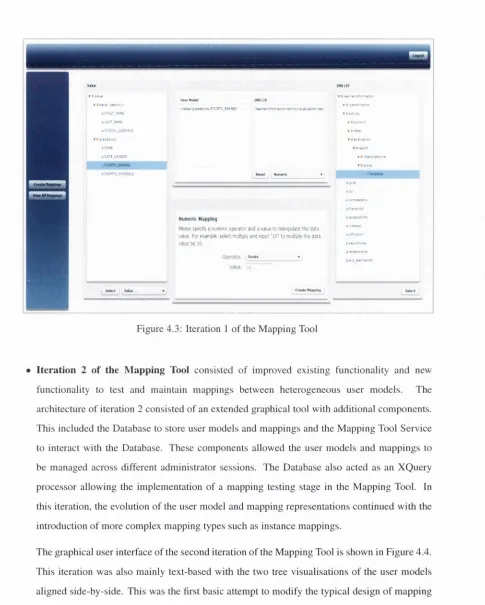
4.3 Iteration 1 of the Mapping Tool... 85
4.4 Iteration 2 of the Mapping Tool... 86
4.5 Iteration 3 of the Mapping Tool... 87
4.6 Mapping example in XML representation... 90
4.7 Mapping example in XQuery representation... 92
5.1 Version 2 of the Mapping Tool... 107
5.2 Mapping example 1... 108
5.3 Navigation of u.ser model 1 to “forename” element ... 109
5.4 Navigation of canonical user model to “firstname” element... 109
5.5 Selection of “equivalent first name” user model mapping type... 110
5.6 Selection of user model 1 “forename” element... 110
5.7 Steps 1-5 repeated to select “firstname” element from user model 4... Ill 5.8 Selection of testing area to validate created mappings... Ill 5.9 Selection of source and target for mapping testing... 112
5.10 Re.sult of mapping testing... 112
5.11 Mapping example 2... 113
5.12 Mapping example 2 in the Mapping Tool... 114
5.13 Mapping example 3... 114
5.14 Mapping example 3 in the Mapping Tool... 115
5.15 Mapping example 4... 115
5.16 Mapping example 4 in the Mapping Tool... 116
5.17 Average task accuracy results... 122
5.19 Average participant prior knowledge results... 126
5.20 SUS results... 128
5.21 Average task-based user satisfaction results ... 129
6.1 FUSE architecture... 139
6.2 APeLS-based SQL web course... 142
6.3 Test Service for the Translation Service ... 143
6.4 Translation example 1... 144
6.5 User model translation steps in the Translation Service... 145
6.6 Mapping complexity and quantity ... 148
6.7 User model quantity... 149
6.8 User model size... 150
6.9 User model in.stance quantity 1... 151
6.10 User model instance quantity 2... 151
A. 1 Example of user model 1... 189
A.2 Example of user model 2... 191
A.3 Example of user model 3... 194
A.4 Example of user model 4... 194
A. 5 Example of canonical u.ser model... 195
B. l Example of XML mappings ... 199
B.2 Example of .source to canonical XQuery mappings ... 201
List of Tables
2.1 Comparison of surveyed approaches... 32
3.1 User model interoperability key issues... 49
3.2 Preliminary and selected systems... 57
3.3 Examples of user model mapping types... 68
4.1 Trial user models... 93
4.2 Semi-structured interview results... 97
5.1 Selected modifications in the Mapping Tool... 103
5.2 Experiment user models ... 118
5.3 Gold standard mapping steps in the Mapping Tool and Altova Mapforce... 120
5.4 Prior experience questionnaire... 125
5.5 SUS questionnaire ... 127
5.6 Task questionnaire ... 128
7.1 Compari,son of FUSE with surveyed approaches... 163
C. 1 Semi-structured interview... 205
C.2 Mapping accuracy and duration for task 1... 206
C.3 Mapping accuracy and duration for task 2... 207
C.4 Mapping accuracy and duration for task 3... 208
C.5 Mapping accuracy and duration for task 4... 209
C.6 Mapping accuracy and duration for tasks 1-4... 210
C.7 Paired t-tests for accuracy and duration... 211
C.8 Prior experience questionnaire... 212
C.9 Participant responses to prior experience questionnaire... 213
C. 10 SUS questionnaire ... 214
C.l 1 Participant re.sponses to SUS questionnaire ... 215
C. 12 Task que.stionnaire ... 216
C.l3 Participant responses to questions 1-6 of task que.stionnaire... 217
C.14 Paired t-tests for questions 1-6 of task questionnaire... 218
C. 15 Participant responses to question 7 of task questionnaire ... 219
C. 16 Participant responses to question 8 of task questionnaire ... 220
C. 17 Participant respon.ses to question 9 of task questionnaire ... 221
C.l 8 Participant responses to question 10 of task que.stionnaire... 222
C.l9 Comparison questionnaire ... 223
C.20 Participant responses to question 1 of comparison questionnaire ... 223
C.21 Participant respon.ses to question 2 of comparison questionnaire ... 224
Chapter 1
Introduction
1.1 Motivation
A vast amount of information about users is now being accumulated within organisations and on the open web [Carmagnola et al., 2011], Within organisations such as those in corporate, academic, medical or governmental areas, extensive user information is a central component of many systems. For example, in recent surveys 93% of responding companies use administration systems to manage human resources [Martin, 2012] and 79% have in place or plan to use a learning management system to manage employee educational profiles [IMC (UK) Learning Ltd, 2010], Similarly, on the open web, users provide and manage their own information through the many services they use. For example, social networking websites such as Facebook and Linkedln allow users to maintain extensive personal and professional profiles. These social network profiles are increasingly becoming the focus for identity and personalisation on the web, allowing other websites to personalise content for users based on their profile.
the area of personalisation. In this case, richer user models allow for more tailoring of content and services to the specific needs of each individual user [Berkovsky et al., 2007].
Resolving the heterogeneity of the user models is the key requirement to provide effective sharing of user information. The heterogeneity of the various systems and their representations of user information can be significant. The diverse nature of the web naturally results in user data that is designed by people with different perspectives, for different purposes and can differ greatly in structure, syntax and semantics. There are afso many other challenges related to the provision of user model interoperability such as privacy and security in the exchange of user data. This research is fundamentally focused on the core technical, syntactic and semantic challenges in overcoming user model heterogeneity and, as a result, related challenges such as privacy and security are considered outside the .scope of this thesis.
There has been significant effort made in the development of standardised user models, for example IMS LIP in education, but heterogeneity remains a major challenge [Van Der Sluijs and Houben, 2006]. Mediation approaches have often been adopted when attempting to overcome user model heterogeneity [Carmagnola et al., 2011]. This can consist of a manual mapping process where a mapping administrator identifies equivalent attributes between data models. This is often accomplished using custom-made translation scripts or one of the many generic mapping tools available, such as Altova Mapforce [Altova, 2012]. The manual process can also be combined with an automatic matching process in which algorithms are used to automatically find potential matches, typically assigning them a confidence score [Shvaiko and Euzenat, 2012]. Automatic matching has been a focus for significant re.search, however, at present the complexity of many existing data interoperability tasks means that matching cannot complete the entire mediation process automatically [Falconer and Storey, 2007]. As a result, manual mapping provided by an administrator continues to be a significant requirement for user model interoperability.
This overlap of domains within user models increases the complexity of the manual mapping task: requiring mapping administrators that possess increasingly specialised domain knowledge. Current generic mapping approaches and tools offer insufficient support for the domain-specific nature of many user model interoperability tasks.
The primary motivation of this research is to investigate the impact of a domain-aware approach on key aspects of mapping and translation for user model interoperability. A domain-aware approach can be defined as:
The incorporation of exchangeable knowledge from one or more domains into generic tools and processes to support complex interoperability tasks.
Domain knowledge can be applied to support complex user model interoperability tasks in particular application areas, for example, education. However, the domain knowledge is also exchangeable and extendable to support interoperability tasks in other application areas.
This research develops a domain-aware approach to user model interoperability called FUSE (Federated USer Exchange). The approach uses knowledge from multiple domains to support both manual mapping and automatic translation for user model interoperability. The FUSE approach consists of two different domain-aware mechanisms; (i) a canonical user model and (ii) user model mapping types, which tailor the process to specific domains. All mappings are created to the canonical user model which is a consistent shared user model representation. The user model mapping types are mapping components specifically created and used for mapping between user models. The combination of the domain-aware approach in both the mapping and translation processes is novel and potentially improves key aspects of the provision of user model interoperability.
1.2 Research Question
1.2.1 Objectives
The following three objectives were derived to address the research question:
1. Conduct a review of the state of the art in user model interoperability to determine key issues and methods.
2. Design and develop the FUSE domain-aware approach to user model interoperability and implement it in the form of mapping and translation tools.
3. Evaluate the tools to determine the effect on accuracy, duration and usability of user model mapping, the performance of user model translation, and the overall provision of user model interoperability.
Education was chosen as the test application area to develop and evaluate the FUSE domain-aware approach. This area was .selected as there is a rich collection of existing educational services which contain representative u.ser models across multiple domains.
1.3 Contribution
The first minor contribution of this thesis is that the FUSE domain-aware approach and tools provide efficient performance across multiple key aspects of user model translation. This contribution of the research was supported by the development of the Translation Service which provides automatic exchange of user models between multiple heterogeneous web systems. The two domain-aware mechanisms; the canonical user model and user model mapping types, are also applied in this tool to support the execution of specialised user model mappings to a consistent, shared canonical user model. Experiment results indicate efficient translation performance across multiple key aspects relating to user models and mappings at the schema and instance levels.
The second minor contribution of this thesis is that the overall FUSE domain-aware approach and tools provide a comprehensive form of user model interoperability when compared to existing state of the art approaches. This contribution of the research was supported by a systematic functional analysis of the overall FUSE approach, consisting of the Mapping Tool and the Translation Service. Results indicate that the FUSE approach provides a comprehensive form of user model interoperability when compared with a selection of existing state of the art approaches.
Evidence of the contribution to the state of the art comes in the form of the following publications:
1. Walsh E., O’Connor A., and Wade V., “Evaluation of a Domain-Aware Approach to User Model Interoperability”, 23rd ACM Conference on Hypertext and Social Media, June 2012, Milwaukee, Wisconsin, USA. [Walsh et al., 2012]
2. Walsh E., O’Connor A., and Wade V., “Supporting Learner Model Exchange In Educational Web Systems” 7th International Conference on Web Information Systems and Technologies, May 2011, Noordwijkerhout, The Netherlands. [Walsh et al., 201 la]
3. Walsh E., and Wade V., “Lowering the Barriers to User Model Interoperability” Ubiquitous User Modeling Workshop at the Conference on User Modeling, Adaptation, Personalization, June 2009, Trento, Italy. [Walsh and Wade, 2009]
1.4 Methodology
The goal of this research was to identify how the domain-aware approach applied in FUSE affects the accuracy, duration and usability of user model mapping, the performance of user model translation, and the overall provision of user model interoperability. To achieve this, many different but related stages were required such as the development and evaluation of graphical mapping tools, translation tools and multiple user models and mapping types. As a result, a combination of different research methods were needed to achieve all the research objectives [Cohen et al., 2007].
In the initial stages of the research exploratory methods were applied [Babbie, 2010]. The field of interoperability was reviewed, including current mapping techniques and tools. The field of user modelling was reviewed and a list of key issues for user model interoperability was derived and used as criteria to compare a collection of state of the art approaches. Existing evaluation methods were also reviewed to support the subsequent evaluation of this research.
The exploratory methods led to the formulation of a new approach to user model interoperability. Firstly, appropriate key issues and methods from the state of the art review were selected. These choices were made ba.sed on the findings of the analysis of the surveyed approaches and based on the overall objectives of this research. One of the key findings of the state of art review was the requirement for support in the complex tasks inherent in user model interoperability by providing domain knowledge in the processes and tools. To address this, a novel domain-aware approach to user model interoperability was formulated and designed.
defined; a manual user model mapping process and an automatic user model translation process. These processes specify in detail how the FUSE approach is applied to provide domain-aware user model interoperability between existing systems.
For the user model mapping process, the FUSE Mapping Tool was developed using an iterative design approach based on the selected systems and user models. Once an initial prototype was designed and implemented, user feedback was collected using a number of different methods. Firstly, users were asked to complete a number of tasks using the tool. Semi-structured interview sessions were then conducted and the collected data was used to enhance the Mapping Tool as part of the iterative development process. The final experiments consisted of tasks and questionnaires completed by users to evaluate the accuracy, duration and usability of the Mapping Tool. The users also completed the same tasks and questionnaires in a widely used, commercial mapping tool allowing for a direct comparison between tools. To determine the mapping accuracy, the user mappings were compared to a set of “gold standard” benchmark mappings which were developed for both tools. The gold standard mappings were defined and categorised using a practical test-based approach. To analyse the significance of the evaluation results, commonly used statistical methods were employed.
For the user model translation process, the FUSE Translation Service was developed in stages using the selected systems and user models. A prototype tool was developed to translate user information between the heterogeneous u.ser models. The evaluation of the Translation Service consisted of a performance analysis in which the impact of user models and mappings at both the schema and instance levels was assessed. The results were analysed in relation to recommended performance guidelines for web-based systems.
A functional comparison of the overall FUSE domain-aware approach and the state of the art approaches was also conducted to examine the tools in the context of the field of user model interoperability. Overall, the applied methods allowed the research question and objectives to be addressed by providing representative and existing interoperability challenges throughout the design, implementation and evaluation of this research.
1.5 Thesis Overview
• Chapter 2 describes the field of user model interoperability. It pre.sents definitions and key methods for interoperability including mapping techniques and some existing commercial and research-based mapping tools. It details general user modelling principles and the key issues for user model interoperability. The identified key issues are then used as a basis to analyse and compare a number of key approaches in the area and and draw conclusions about the current state of the art in user model interoperability. Finally, some evaluation methods from the related research are described to support the evaluation of this research.
• Chapter 3 describes the FUSE approach to user model interoperability. To define the approach, a number of appropriate key issues, methods and metrics were selected from the state of the art review. The concept of domain-aware user model interoperability is presented and refined in the application area of education. A selection of education-hased user models and domains were identified to support in-depth development and evaluation. The FUSE domain-aware approach is presented, including its two domain-aware mechanisms; a canonical user m.odel and user model mapping types. Finally, the FUSE approach is applied in two detailed processes; a user model mapping process and a user model translation process. The combination of the domain-aware approach in both user model mapping and translation processes is novel and differentiates this work from the related state of the art approaches.
• Chapter 4 describes the design, implementation and evaluation of the first cycle of the FUSE Mapping Tool. The Mapping Tool applies the EUSE user model mapping process. The design methodology and architecture of the tool are presented followed by its implementation which includes the development of various user models and mapping types. The preliminary analysis of the usability of the tool is then described using the results of semi-structured interviews performed with early users of the prototype Mapping Tool.
aspects of the user model mapping process.
• Chapter 6 describes the design, implementation and evaluation of the FUSE Translation Service. This service applies the FUSE user model translation process. The architecture and implementation of the tool is described in detail. A walkthrough of the tool functionality is presented using the selected user models to demonstrate u.ser model translation examples. An experiment is presented which analyses many different aspects of the performance of the Translation Service and compares them with recommended performance guidelines. The results of this experiment demonstrate efficient performance across multiple key aspects of the user model translation process.
• Chapter 7 describes the functional comparison of the FUSE domain-aware approach, consisting of both the Translation Service and the Mapping Tool, with the state of the art approaches to user model interoperability. The state of the art approaches were comparatively assessed in Chapter 2 and the same categorisation of key issues is used to assess the FUSE approach. The results of this comparison demonstrate that EUSE provides a comprehensive approach to user model interoperability across a selection of key issues.
'I-.-' - liltf
. 1 - - :- v
. • I I : L*
‘ .1.'.
■ ■ .* ■■ j'', _ , ,1 ■ »
fJ=M ■•
•. .• I ii *..•.} ’ ^ I r ' " 'is-- • * -Ki '•
I ' V- ^ ' ■' • -I < .. r.s. '-■ a^a< I ,11 .
I, J Jl". . r —V.. .
li r- , - V . , ' ’ . - V. 1
.™r ‘'■j '1= - ><!..' •. ‘ T > 1 : . »'" . ' .1 1 -. I 1 B Ii * I U SW • ll* m t ^ ^ * % \ ' '* I* ( ■ . i"
'■ II I- .-v „•• ■ " ■■
F •.- ... '*■ '
-.tf-■ ■ J
, I ■" 1,' - *
I ^ I S:
Chapter 2
User Model Interoperability
2.1 Introduction
Providing interoperability between heterogeneous data models is a complex topic which encompasses elements from a number of related fields. It consists of many general interoperability issues that have been extensively examined from the perspective of relational databases [Sheth and Larson, 1990] and, more recently, the field of ontology engineering [Shvaiko and Euzenat, 2012], User model interoperability is a subset of these generic approaches and attempts to reconcile the issues at a finer-grained level based around the user.
2.2 Interoperability Definitions and Methods
The provision of interoperability is a broad and complex field that has produced various terminologies and methods. Wegner [Wegner, 1996] describes interoperability as:
“The ability of two or more software components to cooperate despite differences in language, interface, and execution platform.’’
Sheth [Sheth, 1999] describes four different levels of interoperability:
1. System interoperability refers to the ability to exchange data across different software and hardware boundaries.
2. Syntactic interoperability refers to the ability to exchange data across differences in the machine-readable aspects of data representation formats.
3. Structural interoperability refers to the ability to exchange data across data modelling constructs of different arrangement and granularity.
4. Semantic interoperability refers to the ability to exchange and interpret across differences in the meaning of information.
The.se interoperability levels have been the focus of significant research in different fields. In particular, relational databases were the .source of much of the early research into data interoperability. The emergence of the web and web-centric standards such as XML have greatly pushed the boundaries of interoperability at all levels by adding syntax and structure. More recently, the move towards the semantic web and the emergence of new data standards with a focus on semantics such as RDF [World Wide Web Consortium (W3C), 2012b] and OWL [World Wide Web Consortium (W3C), 2012a] has .seen significant focus on semantic interoperability.
Attempts to provide syntactic, structural and semantic interoperability have generally supported two high-level methods. The first is the use of shared common representation of information to which all interoperable systems adhere. For widespread use, this can often take the form of a specification or standard defined by a body such as the ISO [International Organization for Standardization (ISO), 2012]. An example in the area of user information is the IMS Learner Information Package (IMS LIP) [IMS Global Learning Consortium, 2012]. This specification supports the definition of some common user information constructs in the area of education, for example, learning competencies and preferences. However, heterogeneity at the syntactic, structural and semantic levels will still occur as not every system will fully adhere to the standard. At the semantic level, the development of ontologies is an attempt to provide shared explicit representations of domains for interoperability. However, as a single overall ontology is infeasible, multiple ontologies for the same domain concepts can also exist requiring interoperability across heterogeneous ontologies [O’Sullivan et al., 2007].
The lack of development and adoption of standards and shared representations in many areas has led to other methods being developed to provide interoperability. The second primary technique that is widely used is mediation or mapping between different data models. This method is used to provide interoperability in various fields such as database and ontology engineering and, as a result, varying terminology has emerged. Kalfoglou and Schorlemmer define many of the terms used in the context of ontology mapping [Kalfoglou and Schorlemmer, 2003]. They include:
1. Matching is the process of identifying matches between individual data model elements and often involves assigning a confidence score for each match.
2. Mapping is the process of creating the actual equivalence between the data model elements using a mapping representation format.
3. Alignment is the process of specifying all of the appropriate mappings between two data models.
in the case of XML-based data models. For RDF and OWL-based models, languages such as SWRL [World Wide Web Consortium (W3C), 2012c] and EDOAL [David et al., 2011] have been used.
However, due to the heterogeneity of real-world data models, the automatic matching process can rarely specify a full alignment [Falconer and Storey, 2007]. As a result, manual intervention is usually required in the mapping process. This often takes the form of an expert administrator manually examining the data models for matches and creating mappings. This can be done at a low-level using a translation language such as XSLT, but for large numbers of mappings this can become an extremely complex and intensive task. As a result, many tools have been developed to support users in specifying these mappings [Kalfoglou and Schorlemmer, 2003] [Haslhofer, 2008]. Manual mapping tools use graphical methods to make it easier to analyse data models and create mappings.
Different tools have been developed for different purposes such as database, XML and ontology mapping. In the following section, four mapping tools that can support XML-based data models are described, particularly from the perspective of their visualisation techniques.
2.2.1 Mapping Tools
1. Stylus Studio is a commercial development environment for working with XML. One of Stylus Studio’s main capabilities is a mapping interface as shown in Figure 2.1. Source and target XML data models can be added to start the mapping task. The visualisation used to represent the source and target data models is the common hierarchical tree-based view. In this interface, the source model is displayed on the left side and the target model is displayed on the right side of the interface.
In the central area, the mappings are created graphically by dragging line connectors between equivalent elements of the data models. Mapping type boxes which represent XQuery functions can be selected and dropped in the central area. These mapping type boxes can then be connected to represent the creation of more complex mappings. There are a wide range of different generic mapping types available in Stylus Studio to perform various manipulations of data.
The graphically created mappings can then be validated using testing. This is performed by executing the mappings to perform a translation between sample instances of the data models. Sample instances can be provided for each source and target and when the mappings are executed the resulting translation of data is displayed in an updated instance of the target data model.
2. Altova Mapforce is another example of a commercial system and has similar functionality to Stylus Studio. Again, it uses tree-based views for visualisation of the XML source and target data models as shown in Figure 2.2. However, the tree visualisations are placed on a larger main canvas area which allows them to be moved and positioned to the user’s preference. The main canvas area also allows multiple source and target data models to be visualised and mapped concurrently.
Mappings are created by connecting lines between matching elements of the tree-based source and target data models. More complex mappings can be created by selecting required mapping types from a list and dragging and dropping boxes which represent the mapping types onto the main canvas. Multiple mapping types can be added to the canvas and lines can be connected between the various inputs and outputs to the source and target data models. Mapforce contains a wide range of different generic mapping types to perform various manipulations of data.
The graphical mappings can then be validated using testing. Similarly to Stylus Studio, the mappings are executed to perform a translation between sample instances of the source and target data models. When the mappings are executed the resulting translation of data is displayed in an updated instance of the target data model.
- lUivfnyTMbl
' t** ^MnfoncM Connection (ggctien 'litm look tfnOon yelp
____
{eQtt, umIuN BOwein*' SOoentiM OlOtflWMI QOriMTM Otcurntme aOMMOOv#)! QOetfiOtKitTTyoe BOMt BOte eOwnotUmoywng >0»«ry M Ow*«y
l«-J I BOiepoct OuMf Outer 400luth OuMf nttn BOconteo* Ontmei BOcofl. S<>«otL*»»ei 0^ I <->oor8..i [ L wul
1^1'* 1, retuM .ew^ ■ Mae'Me EE la »i BOterunOjuN > BHXecnc' BOuter Outeru Ohritnam* Oi o« aOcouiM Oart Otyp* Odetciioooe 9 OortdrOoot OcourteoiMe eOtrM* Om*} OtMMttCMt Otouttcort 0«»l* lOCewofSr ’{^
L merwe 1^ petaea iS^etu. ■yael'etuU ES IjBQta* umtejTJ BO^ernei e Outer SOneanl Outer neane Otuttnemt OiMtneme Oneine Oemee ()<*<» OcounOY OeitMuMiA Ooeperimni QOieeiiHnotr(iet BOortOet eOnernt Qtutnenre Othoameme Otti.ariat OleedBtct ; eouei
t tquek«..«ieeltr | t. rf-eke
H "4
evo '■ eM tA
3. COMA++ is one of the most highly cited tools that has emerged from mapping-based interoperability research [Aumueller et al., 2005]. It can support both schema and ontology models and utilises tree-based visualisations as shown in Figure 2.3. The interface layout is similar to Stylus Studio and Mapforce, consisting of two hierarchical tree visualisations with lines connecting equivalent elements.
The tool is semi-automated and generates candidate matches using selected matching algorithms. As it is a matching-based tool, it does not have a central area to graphically create mappings. The user can review and edit the resulting matches using text-based inputs in the u.ser interface.
COMA+-(- is a matching-based tool for schema and ontologies and does not provide a testing area for instance data translation. It offers a number of functions to manipulate the mappings such as determining differences and commonalities between mappings, merging mappings, transitively composing matches and comparing mappings. The mappings are maintained in a repository and can be imported and exported for use in various interoperability tasks.
Repository Match Mapping View
% # f* * ^
f RepasItoW I Workspace X '4' w;;' I
Schemas Excel (2)
Noris (2>
Name -Mapptngl Comment jcOMA^OPT Schemas tExcel Nons Operation SCHEMA Total *45 (0 •» 45 )
■0.0 Excel (XDR) FurchaaeOrder- O' Header O' Iterj ^ Footer ? InvclceTo”* y Contact
contactliiMne : string ccBipanyNa'« : string e-ir.ail : string telephone : string 9 Address
streetl : string street* : string streetJ : string screet4 ; strin.j city : string statj^ pest cour 9 DeliverTo 9 Contact cont COSIf <
Source Node ini
Select a node to display its correspondences
Mappingl
Nons (XDR) ■fPurchaseCrder
shipmentOate : date custewerOrderRe? : string ■f^InvciceTo
9 Organization
referenceHo : string nane : string registrationNc : string ’.TiTRegtsttatienWo : string url : string
T” Address
street : string city : string state : string pcstalCcde : string country : string
Help K
Change to Advanced ’ Context (COMA default strategy)
Context Matcher COMA_OPT Nodes
Node Matcher NAMETYPE Reuse (use extstmg mapping paths)
Restore Defaults Save Save & Execute
COMA-i-i-4. PROMPT/CogZ is another highly cited research tool. PROMPT is a plug-in for the Protege ontology editor which allows the management of multiple ontologies, including the creation of matches and mappings [Noy and Musen, 2003], PROMPT uses a simple text-based visualisation and allows the user to specify two ontologies to match. It then presents a number of candidate matches in a list view that the administrator can review and add to as needed. The tool supports equivalence-based matching and mapping of ontology concepts.
Extending this work, Falconer [Falconer, 2009] has developed CogZ which adds enhanced visualisations to PROMPT as shown in Figure 2.4. It uses a combination of tree-based and graph-based views to display the two input ontologies. The graph-based display allows the ontologies to be viewed as a series of boxes connected with lines that can be expanded to navigate through the ontologies and find matches. The identified matches and the candidate matches suggested by PROMPT are combined visually using the common tree-based view. PROMPT/CogZ is an ontology matching and mapping tool and does not provide a testing area in the same way as Stylus Studio or Altova Mapforce. The main purpose of the tool is not to provide instance data translation but to align ontologies for potential use in a number of different processes such as ontology merging or transformation.
In summary, it is usually not possible to provide the interoperability of heterogeneous data models fully automatically. As a result, mapping tools are often a key component in the successful delivery of any form of data interoperability. The tools reviewed in this section represent some of the most popular commercial and research approaches currently being used.
In terms of the overall visualisation of the source and target models, tree and graph-based approaches are the most common in both research and commercial tools. Some of the tools also provide concurrent visualisation of various source and target data models which supports multi-system interoperability.
In the creation of mappings, the commercial mapping tools are more focu.sed towards data model instance translation. The research mapping tools have a greater focus on semi-automatic matching and mapping in schemas and ontologies. As a result, the commercial tools allow more complex mapping to be defined that can translate heterogeneous data model representations. They have a central area between the source and target models where mapping types are graphically defined and configured. The research tools provide equivalence-based mappings semi-automatically using matching algorithms. They are presented graphically or in a text-based form and can be edited by the user to create valid mappings.
The testing of the mappings is mainly conducted in the commercial mapping tools for the purpose of instance translation. Sample source and target data model instances are used to test the mappings and confirm that they perform the required translation. The research tools are mainly focused on aligning the schemas and ontologies for various purposes. However, providing .some form of validation for the defined mappings would be a useful addition to these tools.
Overall, the intended purpose of interoperability tasks has a significant impact on the features and functionality provided in different mapping tools. The commercial and research mapping tools have different objectives and show differences in key aspects relating to complex mapping creation and testing. However, there are also many similarities in the various tools, in particular the visualisation approaches for source and target data models and the resulting mappings.
2.3 User Modelling
different forms depending on their purpose. This section outlines some of the current approaches to user modelling and how user models have evolved over time.
User Models
The feature-based user model approach attempts to model characteristics about individual users such as their knowledge, interests, goals, background and individual traits [Brusilovsky and Millan, 2007]. A feature-based user model can contain both static and dynamic user information, for example, identification information does not change frequently while in contrast, interests, goals and knowledge can be continuously changing as the user progresses over time.
In adaptive educational systems, user knowledge is particularly important as it forms the foundation for personalisation based on the user’s understanding of concepts. The simplest way of representing the user’s knowledge in a feature-based learner model is the scalar model approach [Brusilovsky and Millan, 2007]. This presents the user’s knowledge as a single value on a scale. The scalar model is very basic as it represents the user’s understanding as a single average score across an entire subject domain.
This has led to the development of more complex structural models that allow the representation of user’s knowledge of multiple concepts in a subject domain. The structural user model is often formed using an overlay model approach [VanLehn, 1988]. This is where the concepts from the subject domain are overlaid with each user’s knowledge of those concepts. This produces a user model that consists of a collection of attribute/value pairs where the attribute is the subject domain concept and the value is the user’s knowledge of that concept. The user’s knowledge can be represented as a qualitative value, for example good/average/poor, or as a quantitative value, for example 0-100.
Users can also have misconceptions in their knowledge which can be represented in feature-based user models. For example, the constraint-based user model approach represents knowledge as a set of constraints [Ohlsson, 1994]. Constraint violations on the part of the user indicate incorrect or incomplete knowledge. User models have also been developed to deal with uncertain or imprecise information. The uncertainty-based user model approach often uses probabilistic methods based on Bayesian Networks [Horvitz et al., 1998] or Fuzzy Logic [Kavcic, 2004] to represent user knowledge.
provide personalisation based on those classifications [Brusilovsky and Millan, 2007], This was a common approach in early adaptive systems as it allowed personalisation based on simple groupings such as the user’s role. The stereotype approach is still used, often as a means to reduce the impact of the “cold start” issue. This occurs when there is insufficient user information present initially in the user models of new users thereby making it difficult to provide personalisation [Van Der Sluijs and Houben, 2006].
User models can also be represented as system user profiles. An example in education would be the learning management system (LMS). LMS are widely used systems for the centralised management of learning activities within educational institutions and as a result collect rich information about each user such as identification, preferences and assessments. LMS gather user information across a number of different tools and components, for example, assessment information in a gradebook tool. As a result, this user information is not always structured in a single profile representation and can be distributed throughout the LMS database. If this information is extracted it can be used by other educational systems and personalisation services. Similar examples of user profiles exist in administration and management systems in various other application areas.
To facilitate interoperability between systems, standardised user profiles have also been developed. An example in education is the IMS Learner Information Package (IMS LIP) [IMS Global Learning Consortium, 2012]. This specification is u.sed to create a common representation of a user’s learning history and preferences so that they can be more easily exchanged between different educational systems.
User models are also increasingly being created in the form of social-based user profiles on social networking websites such as Facebook and Linkedin. These profiles are created and maintained by users for the purposes of sharing and connecting with other users. Recently, Facebook and others have begun to offer new forms of functionality such as personalisation ba.sed on the contents of the user profile. This functionality is made available to other websites and is an attempt to make social networks such as Facebook a centralised global source of user information.
Event-Based User Data
can offer valuable information about a user’s behaviour in a system but it must be analysed and potentially extracted into a more structured user model form. LMS are one example of this, as users interact with a series of different tools for different purposes while generating usage data within the system. Another example of this approach is in recommender systems where preference-based user models are defined based on the analysis of user actions [Berkovsky et al., 2008]. In this case, recommendations can then be provided ba.sed on the similarity between different user models.
Large amounts of user event data can be generated over time. Extracting and filtering this user data is becoming a more important challenge as the number of systems and components users access continues to increase. This has led to approaches that shift the focus from user models as single entities to user model processes that act across large collections of user data [McCalla et al., 2000]. It is suggested that traditional user modelling will become impractical over time due to the rapid growth of user data and defining and exchanging the processes for user modelling is a more manageable method in the long-term.
Overall, there are many different types of user models that are created for various purposes such as personalisation, standardisation and user scrutability. Exchanging user models between the various heterogeneous representations is important to enhance knowledge of the user and personalisation across systems in increasingly distributed environments. In this research, the focus is primarily on the structural, syntactic and semantic challenges in exchanging user models. The extraction and analysis of event-based user data is outside the scope of this research but it is a topic of interest for future work. The following section describes the key issues for the provision of interoperability between different types of user models.
2.3.1 Key Issues for User Model Interoperability
will be used to eomparatively analyse a selection of state of the art approaches to user model interoperability. The eight key issues arc:
1. Interoperability task describes the intended purpose of the interoperability system and the main function that will be performed. This is one of the most fundamental aspects of any interoperability approach as the main function and purpose of the system dictates the relevant designs and methods that are used to provide interoperability. Generally, approaches have either facilitated the exchange of u.ser models or provided centrali.sed user modelling/adaptation services that store and maintain user information for individual systems.
2. Interoperability architecture specifies the overall architectural design that is used to exchange the user models. This key issue is closely related to the interoperability task. The main approaches are the centralised, decentralised and mixed architectures.
In the centralised approach, a single central system manages the user modelling functionality for multiple distributed systems. The benefit of this approach is that information from multiple systems is easily shared and analysed because it is stored in a shared location using the same user model representation. However, each system is typically developed to use this central repository and not retain user models locally. The most common form of the centrali.sed approach is the user model .server [Carmagnola et al., 2011].
In the decentralised approach, the distributed systems maintain their own individual u.ser models and attempt to exchange information directly with each other. This can lead to much greater heterogeneity between u.ser information that must be rectified in some way such as the use of a standardi.sed user model or a translation process. The decentralised approach is potentially more flexible than the centralised approach, allowing systems to maintain their own user models while avoiding the need for the architecture to use a central repository. The disadvantage to this approach is that it is significantly more complex, placing more of a burden on each system to manage the exchange of user information directly.
user models between systems. As more web-based systems that employ user models are being developed, HTTP and web service protocols such as SOAP and REST are becoming more widely used as methods for the exchange of user models.
This key issue also describes the languages for the exchange of user model data. Data interchange formats such as XML are common in existing systems and standards [IMS Global Learning Consortium, 2012]. In general, JSON is also becoming a popular alternative to XML due to its ease of use [Nurseitov et al., 2009]. The development of semantic web technologies has led to more recent research approaches using RDF and OWL to represent user models. In some cases, user model specific languages such as UserML [Heckmann and Krueger, 2003] have also been developed.
4. Representation of data exchange describes how the user models are represented during the exchange process from a syntactic and semantic perspective. The issues of syntactic and .semantic heterogeneity are well-known from related research into interoperability in relational databases, XML schemas and, more recently, ontologies. As a specific subset of these areas, user model interoperability is afso affected by the same issues. The intended purpose of the user model can vary depending on the type of system that incorporates it. This can be a fundamental difference greatly influencing the information, the way it is represented and the potential to translate that information. User models are also designed by different people who use different terminology to describe the information. This results in user models of varying complexity and expressiveness, which use inconsistent vocabularies and have different structures to the user data. Attempts to overcome these issues have commonly involved either the adoption of a common user model representation such as IMS LIP [IMS Global Learning Consortium, 2012] or GUMO [Heckmann et al., 2005] or the use of a translation approach which uses mediation components to resolve heterogeneities and translate user information between heterogeneous systems. The combination of common models and translation is also another possible approach [Berkovsky et al., 2009].
tools, environment user data which is related to a user’s context such as location and device, domain data which is the data related to the domains of the system, inferred data which is new data that has been generated by the system for a particular function such as personalisation, reasoning data which is data that describes where the inferred information was generated, for example the reasoner used, and social data which is related to a user’s social connections to other people and groups.
6. Integration of exchanged data describes the approach of incorporating the user data into the systems. In general there are two high level approaches, either the exchanged user model data is not merged into a system’s existing u,ser data but is just retrieved as needed or the exchanged user model data is merged into existing user data.
The first approach of not merging requires an on-demand exchange of user data. This method can be achieved using entire user models or individual fragments of user model data. Exchanging the entire user model is a simpler approach where an application can request and receive an entirely updated user model at any time. This approach is much more performance intensive if there are a large number of user models being exchanged at the same time. The exchange of user model fragments occurs when small sections of user models, which have been updated by an end-user, are exchanged with other systems’ user models. This approach is more complex but also more flexible and less performance intensive as updates can be provided to the user model on a continuous basis.
The second approach of merging requires the resolution of conflicts with existing data. Providing interoperability of multiple user models creates issues of overlapping and incomplete user data. When user data from several systems is combined and shared with other systems it can overlap in places. This overlap can result in repeated or conflicting user data which can cause errors in the interoperable systems. In contrast, when user data from multiple systems is combined and shared there is also a potential deficiency of user data. This occurs when there is not enough data about a particular user to fully populate the instance of a system’s user model which can result in errors in the interoperable systems.
in the exchanged user model, scrutable user models, third-party guarantors, and pseudonymous personalisation where the user data is stored using non personally identifiable keys.
8. Pre and post interoperability task encompasses some of the other key issues that exist outside of the main exchange process of user model interoperability. They are tasks performed before and after the exchange process such as the discovery of new systems for interoperation, the initial matching of user identifiers across systems, and the evaluation of any improvements in systems that retrieve and apply updated user models.
This research is fundamentally focused on the core technical, syntactic and semantic challenges in overcoming user model heterogeneity. As a result, the final two key issues, privacy and pre and post interoperability task, are considered outside the scope of this thesis. However, they are included in the review of state of art approaches in the next section in order to gain a broader and more comprehensive understanding of these approaches and their methods. Overall, to provide advanced forms of user model interoperability many of the outlined key issues must he addressed. In the following .sections, the key issues are used as the basis to describe and compare the main state of the art approaches.
2.4 User Model Interoperability Approaches
Ten approaches have been selected for review from the related state of the art research. They represent the most influential current approaches and demonstrate the diverse nature of the research in this field. In the following sections, a summary of each approach is presented and a comparison is performed using the key issues for user model interoperability.
2.4.1 Personis
information also includes additional information to control the access of applications and users. Communication between the client applieations and the server is performed using the XML-RPC protocol over SSL. More recently, Assad et al. have extended this system to provide Per.sonisAD, a framework for building context-aware, ubiquitous applications [Assad et al., 2007]. This approach allows scrutable modelling of people, sensors, devices and places and supports distributed models with active elements which can trigger when relevant events oecur.
2.4.2 CUMULATE
Brusilovsky et al. [Brusilovsky et al., 2005] have created an approach based on a number of distributed, reusable learning activities that use a centrali.sed student modelling server called CUMULATE as the common repository for all user information. CUMULATE collects learning events from each activity and stores them in a single event repository. Events can consist of any component-specific information such as the user’s progress in a specific step within a learning activity. The.se events can then be processed to generate inferenced user models which can represent information such as the user’s interests and knowledge in name-value pairs. These newly created u.ser models are accessible by external applications. The event reporting and exchange of data is performed using a HTTP-based protoeol combined with XML representations of the user models. Yudelson et al. have extended this approach to support push-based propagation of user information to improve performance with larger user models [Yudelson et al., 2007].
2.4.3 GUMF
schema conversion by an administrator using a web interface. Queries of the user model repository can be executed using SPARQL and the user information in the repository can be viewed using a web interface.
2.4.4 UUCM
Mehta et al. [Mehta et al., 2005] proposes a common format to represent user information for cross-system personalisation called the UUCM, Unified User Context Model. The UUCM is an ontology-based user context model that applications can use to represent and share their user information between systems. To support user information in multiple systems, the model is designed to be flexible and extensible and can be structured to deal with a variety of personalisation approaches and various aspects relevant for capturing user characteristics and context. The UUCM encompasses an extensible set of facets which represent various user information. Both the names and values of user facets can refer to vocabularies or ontologies. This allows the use of shared vocabularies between different interpretations of the UUCM and, as a result, potentially supports the interpretation of heterogeneous user information across multiple systems.
2.4.5 GUMO/UserML
2.4.6 GUC
Van der Sluijs and Houben [Van Der Sluijs and Houben, 2006] have proposed a system called GUC, the Generic User model Component. This approach utilises semantic web technologies to support the exchange of user model data between applications. GUC provides a centralised user model server and applications can subscribe to request and upload user data. GUC supports user models represented in OWL and to support interoperability between heterogeneous representations it allows the configuration of mappings between user models. For the most common user model information, mappings are created to a shared user model such as GUMO and additional mappings can then be created directly between different systems’ user models. The mappings are represented using SWRL and stored in a mapping repository where they can be made available to the translation service component. The mappings can be generated using tools such as COMA++. Scrutability is also provided through a user m.odel editor which allows users to access and edit their information in the central user model server.
2.4.7 Dolog and Schafer
Dolog and Schafer [Dolog and Schafer, 2005] have developed a framework which provides a common representation to exchange user models between multiple sources. The learner profde exchange model is based around a shared learner ontology which is derived from a number of standards such as IMS LIP and is represented in RDF. To participate in an exchange of learner profiles, external applications with different internal data models have to provide mappings between their internal data model and the exchange model. An API is designed and implemented to create, export and manipulate learner profiles. The API is implemented in two ways, as a Java API that can provide access between distributed applications and as a web service which acts as a user model server. Another approach which is proposed is the exchange of user information through a peer-to-peer environment consisting of a query-based infrastructure for RDF-based user models.
2.4.8 Carmagnola and Dimitrova
across applications. This approach uses semantic web technologies and evidential reasoning techniques to map heterogeneous user data between applications. An initial SeRQL [Broekstra and Kampman, 2003] query is performed by a receiver system across multiple provider systems to retrieve user models for a particular user. The provider systems submit their user models to the receiver system in the form of an RDFS user model and domain ontology. The retriever system then u.ses evidential reasoning algorithms to determine the relevancy and credibility of the various responses when compared against local ontologies or WordNet [Fellbaum, 1998]. To measure the relevancy of the u.ser model statements, the algorithms calculate semantic similarity of both the object and property of the statements. To measure the credibility of the user model statements the algorithms use descriptions of both the provider and statement to determine values of trust in the each statement. Both the relevancy and credibility measures are then used to select the best response to use in the retriever system’s user model.
2.4.9 Cena
2.4.10 Berkovsky
Berkovsky [Berkovsky et al., 2008] proposes a general framework and specific methodologies for enhancing the accuracy of user modelling in recommender systems by importing and integrating data collected by other recommender systems. This approach is defined as user model mediation and is applied in the form of a user model mediation framework. It provides a generic user data representation model for recommendation systems based on three dimensions: user, item and context. It also describes four major types of mediation: cross-user, cross-item, cross-context, and cross-representation. The framework is applied in the form of a mediator component which performs the exchange of user data between the requesting target system and the source systems. The mediator consists of two principal components. The integration mechanism is a component responsible for resolving conflicts and heterogeneities in the obtained user modelling data using various reasoning and inference mechanisms. The knowledge base is a component used by the integration mechanism. It contains semantically enhanced inter-domain and intra-domain knowledge bases representing dependencies and relationships between various user, item and context features. The data stored in the knowledge base facilitates resolving the heterogeneities in the obtained user modelling data.
2.4.11 Comparison of Surveyed Approaches
<u s: (j cs o a. Q, a a> >> > C3 CL S o U r4 <D ^2 Q C3 D. u ^ CL S O <u ' Vh f— Cu .S >> o C3 > •c Cu o c -o O D •c: w) C fee ^ -ii o 2 1-3 1) "O
■o OJ CX) § CJ X c 1) <u 60 0)
CL £ _£ X3 0 £ 5^ c
cd c/5 3 • -M Dc 3
E fc 03 cd ■0 s c/5 D > ^ C c w .p <u C/! D S ,<u 0 ^ -0 .£ »- C3 CL T3 C[3 Wh c/5 O — <L) c o 60 3 O ^ c o 3 C o c 5 ^ 3 O 0« — o
■e ^ 2 3 §■ 2 ^ CJ £ 53 CL O C3 O Ui CL CL < <J > ^ o w ^ fc c/5 -o ^ >- c/T D w (yu -C 3 <U S 5 -.W 5^, ^ e 8 S *§ r i r \ ^
<D £? (U E 3 II c o § "u s "S U S Z t Q 60 C "O o a 8 Oh “ 3 3 z ■§ c o c o E £ u £ H
"O o f—, I—J ^ s 3: X ■o 1) c a> U (D <U y > •r o ^ C) te c/5 -o x: ^ 60 g'S Z -o 4; c 60 W 3 S 3 c ^ o Vh" .^3 <L> >
e D
-c "CJ .£ <u
I t
w- O e
5 -o .£
-* -o c c c o o 3 S 13 -S c o 0 3 U S 2
Cu < O C/5 PJ Q Qi DC ■o u U 8 w 2 _• [_ l> M 5 ^ s P o J u pa >^
tu s p a c o c3 (J 'S b? S P 3 c o .2 S(^1 cu u &> I c s w -<u £f u E 3 I -3 (U c 60 Si 03 P c/5 H C o — .p '> 'o c o (L> c/5
C o E « E 3 o g U E D. Dh fc ^ H on P U o D Q
60 GO <L) D
.£ .£
lU u *>
GO 330 <D
U
’>U 0)c/5 13"O0 <uCJ ‘> t-ilU
c/5 13 TS 0 JC 0 X £ 0) <u
c/5 P £ «uc/5 P £ c/5 PJ 3
s u p p 3 "3 u 3 2 3 2 3 o CO £ -= S
o E I •§ 03 J C 60 ca P S c -g ^ o ’-pc > c^ c C <u C i_; di c o 5 <u E 3 o 2 U E p O P p S h u r“ c/! X o -o 0) c fU o (U Q 'Tt o O X PJ J 2 U- T3 5 I 0 i ^ ^ X gss ^ ^ ri
c* E c/5 05 td 55 Q C3 O'! S « D :£ ^ u
C (U <U c/5 >
(U C3 '£ o &0 c "O <U GJD 3 c/5 3 .P UC t-T ID g PE c/5 0 ^ T3 .P 60 .£ ’E o c o c/5 u. Q p X DC ■o C OJ u Q 00 § -C o X PJ ■o c r3 O c. > g 60 O &)i!l CC3
II ®
o • a-a, p Ui a. >> (j C3 > ‘C CL C -o O 1) •p! W) 2 U
5^ 1j 3 c X
ID -O
•o
£P S,
a >>
o a
X LU -o
c o
c <D w w: S § c 2 CL -o -g QC o <u
c ■o js* .2
i ^ g
^ S -a8 I
n 3 C s 8 p a. i2 u. 5D. O
§■ Si
8 iSS ^
U (U CL O C jd a o u. CL CL < C c O •^U _2 I_I (L>
O <u> O '3 c ot> f3 8 rj <D U <l> > O £ > U P C/5 o o CA uO
CA 3 G (U "P g U rt c u U *> Ui P C/5 O (J CA 3 3 "a u U CA D 3 "a £? 0) e o Z -o ■o c i -2 —H C3
CA V c o o ^
U S is
c/5 PL Q 0^ CA S i -== i y 0) , , cA UJ 3
n 3 2 d! y c3 cj:) c <r3 "O D G bX) W G G CA ^ 0-1 w > ^ c o •-P W T3
C o
i ^
c/5 PU Q - QC < PLo s
c/5 0^ “O (D 2 G 0) C X a> u S u U ^ o § BX
G Sj o J C/) o
S c 3 CT3
e>x) cjj
o ^ ^ las D s 3
2 "S
o 2c/5 £
Z -■P CS
(U 0) *0 c C G o o 3 -z: c — 3£ -p ^
o o g U £ is
X
o
•a<u X <u u ^ o I E o X UP p G 3 .PUi 3 e (U CL 02 Z
1) £? p S »
° a
Z -p
D G <u G W) <SJ 05
3 G 3 £
c o ^
G t: CA 3 C G O ^ .G ^ </j 3 0)
CA > ^ <UCA > 3) S .£ 3) g .£
•u CA ^ -P G § § -2 G P
i -g 1
U B S