The FUSE Domain-Aware Approach to User Model
Interoperability: A Comparative Study
Eddie Walsh, Alexander O’Connor and Vincent Wade
Knowledge and Data Engineering Group
School of Computer Science and Statistics
Trinity College Dublin, Ireland
{eddie.walsh,alex.oconnor,vincent.wade}@scss.tcd.ie
Abstract
Exchanging user information between multiple sources can potentially bring many benefits that enhance the user experience in software applications. Richer and more dy-namic user models can be constructed allowing more tailor-ing of content and services to the specific needs of individ-ual users. However, providing effective interoperability is a complex challenge as there can be significant heterogeneity between user models. Current generic approaches and tools offer insufficient support for the complex domain-specific nature of many user model interoperability tasks. This paper presents a comparative study of the FUSE domain-aware approach to user model interoperability. This novel approach differs from existing generic approaches by incor-porating domain knowledge in new processes and tools to support complex user model interoperability tasks in multi-ple overlapping domains. The FUSE approach is described and compared to existing state of the art approaches using a consistent set of key issues in user model interoperability.
1
Introduction
Substantial amounts of information are now being gath-ered about users [8]. Exchanging this user information be-tween multiple sources can potentially provide many bene-fits to enhance the end-user experience [3]. Richer and more dynamic user models can be constructed and shared across multiple systems. This allows each system to provide im-proved user-centric functionality while reducing duplicate user interactions [5]. One of the key benefits of user model interoperability is in the provision of personalisation. The sharing of richer user models allows for greater tailoring of content and services to each individual user’s specific needs and preferences [5].
However, there are many organisational and
technologi-cal boundaries that inhibit the sharing and reuse of this in-formation [8]. User models are designed for different pur-poses and, as a result, there can be significant heterogeneity at the structural, syntactic and semantic levels. Standard-ised user models, for example IMS LIP in education, have been developed but heterogeneity remains a major chal-lenge [19]. An alternative method to standardisation in-volves using mediation to overcome user model heterogene-ity [8]. This can consist of a manual mapping process where an administrator identifies relationships between equivalent elements in different data models. This process can be sup-ported using one of the many generic mapping tools avail-able, such as Altova Mapforce [1]. Matching tools can also be used to help find potential matches between user models automatically [18]. However, at present the complexity of many existing data interoperability tasks means that match-ing cannot complete the entire mediation process automat-ically [12]. As a result, manual mapping provided by an administrator continues to be a significant requirement for user model interoperability.
Database
Canonical User Model
(UM0)
Mappings
(m1,m2,m3,m4)
Translation Service
UM1
UM2
UM3
UM0 UM4
m1
m2
m3
m4
Mapping Tool
Mapping Tool Service
UM0 UM1
UM2
UM3
UM4 m1
m2 m3
m4
Admin
Users
System 1
User Model 1
System 2
User Model 2
System 3
User Model 3
System 4
[image:2.612.149.444.69.332.2]User Model 4
Figure 1: FUSE architecture
the domain-specific nature of many user model interoper-ability tasks.
In this paper, the FUSE domain-aware approach [20] to user model interoperability is described. A domain-aware approach can be defined as the incorporation of exchange-able knowledge from one or more domains into generic tools and processes to support complex interoperability tasks. The FUSE approach uses knowledge from multi-ple domains to support both manual mapping and automatic translation for user model interoperability. Following this, a comparative study is presented to contrast FUSE with a se-lection of existing state of the art approaches. This study is conducted across a consistent set of key issues to provide a systematic evaluation of FUSE in the context of the related research in user model interoperability.
2
FUSE: A Domain-Aware Approach to User
Model Interoperability
The FUSE (Federated USer Exchange) approach [20] consists of two processes: a manual mapping process and an automatic translation process. Both processes contain two domain-aware mechanisms: (i) a canonical user model and (ii) user model mapping transforms, which tailor the processes to specific domains. All mappings are created to the canonical user model which is a consistent shared user model representation. The user model mapping transforms are mapping components specifically created and used for
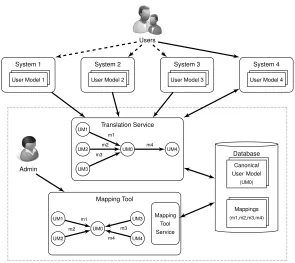
mapping between user models. An architecture which ap-plies the FUSE domain-aware approach in both the map-ping and translation processes is shown in Figure 1.
2.1
Mapping Tool
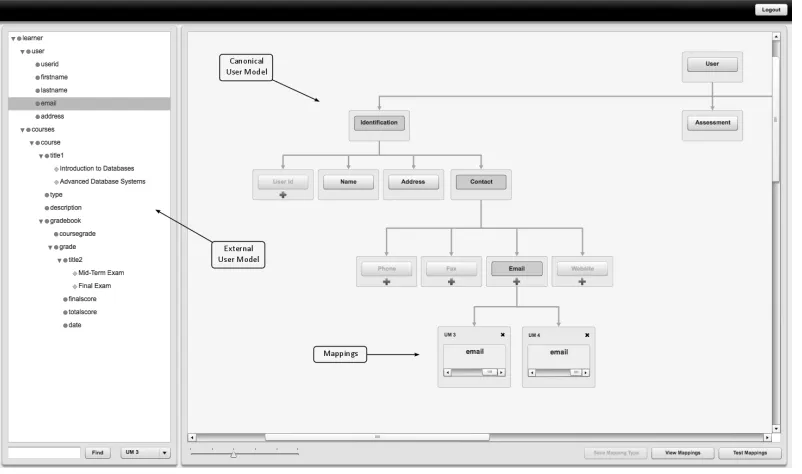
As shown in Figure 1, the Mapping Tool allows the cre-ation of relcre-ationships between different types of user mod-els. User model schemas and sample instances can be up-loaded to the Mapping Tool (UM1, UM2, UM3, UM4). Mappings from elements in the user models to their equiva-lent elements in the canonical user model (UM0) are defined manually using the graphical user interface, also shown in Figure 2. The Mapping Tool can then automatically gener-ate executable versions of the mappings (m1, m2, m3, m4). The Mapping Tool stores the various schemas, instances and mappings in the Database. The Mapping Tool com-municates with the Database using the Mapping Tool Ser-vice. This service allows various tasks to be completed such as saving and retrieving user models and executing map-pings. The Mapping Tool Service along with the Database are server-side components whereas the Mapping Tool is a client-side component. Once the mappings have been com-pleted in the Mapping Tool and deployed to the Database, they are available to the Translation Service for use during the automatic user model translation process.
mecha-Figure 2: Mapping Tool
nisms: the canonical user model and user model mapping transforms. In the Mapping Tool, the canonical model is used in the visual creation of the mappings. This is funda-mentally different to existing mapping tools as it allows a clearer and more consistent visualisation, allowing the ad-ministrator to continually map to the same user model struc-ture. The user model mapping transforms are also used in the visual creation of mappings. This approach allows the administrator to generate and reuse specialised user model mappings to support domain-specific mapping tasks.
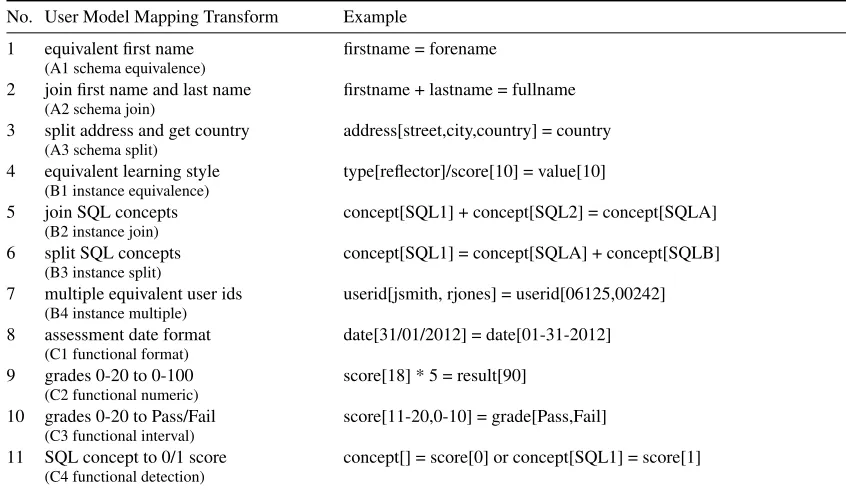
Table 1 presents a representative sample of the type of user model mapping transforms that can be created in the overlapping domains of user, education, databases and SQL. These user model mapping transforms are formed us-ing various generic schema, instance and functional map-ping transforms. The generic mapping transforms are combined with domain-specific knowledge to provide user model mapping transforms that are specifically designed for heterogeneous user models in particular application areas. These user model mapping transforms can support an ad-ministrator in typically complex user model interoperability tasks across multiple overlapping domains. The user model mapping transforms can be reused by the administrator or shared with other administrators to build a large collection of relevant mappings in an application area of interest.
2.2
Translation Service
When the administrator-led user model mapping process has been completed for a number of systems, the user model
translation process can be performed to automatically ex-change user information between those systems.
As shown in Figure 1, the Translation Service is a tool to automatically translate user model instances between ex-ternal systems (UM1, UM2, UM3, UM4). The Transla-tion Service component has access to the mappings that were created using the Mapping Tool and stored in the Database (m1, m2, m3, m4). These mappings represent ex-ecutable relationships between the external user model el-ements and their equivalent elel-ements in the canonical user model (UM0). The Translation Service automatically re-trieves instances of the various external user models and temporarily stores them in the Database. It then executes the mappings to transform user information between the heterogeneous user model representations. This updates the required target user model instance which is then returned to the requesting system. The Translation Service communi-cates with the Database directly as they are both server-side components.
[image:3.612.100.501.72.309.2]Table 1: Examples of user model mapping transforms
No. User Model Mapping Transform Example
1 equivalent first name (A1 schema equivalence)
firstname = forename
2 join first name and last name (A2 schema join)
firstname + lastname = fullname
3 split address and get country (A3 schema split)
address[street,city,country] = country
4 equivalent learning style (B1 instance equivalence)
type[reflector]/score[10] = value[10]
5 join SQL concepts (B2 instance join)
concept[SQL1] + concept[SQL2] = concept[SQLA]
6 split SQL concepts (B3 instance split)
concept[SQL1] = concept[SQLA] + concept[SQLB]
7 multiple equivalent user ids (B4 instance multiple)
userid[jsmith, rjones] = userid[06125,00242]
8 assessment date format (C1 functional format)
date[31/01/2012] = date[01-31-2012]
9 grades 0-20 to 0-100 (C2 functional numeric)
score[18] * 5 = result[90]
10 grades 0-20 to Pass/Fail (C3 functional interval)
score[11-20,0-10] = grade[Pass,Fail]
11 SQL concept to 0/1 score (C4 functional detection)
concept[] = score[0] or concept[SQL1] = score[1]
3
Comparative Study of FUSE and Related
Approaches
To evaluate the overall effectiveness of the FUSE domain-aware approach, it has been compared with a selec-tion of existing state of the art approaches. The comparison is conducted using six key issues for user model interop-erability identified by Carmagnola et al. [8]. The methods used in the FUSE approach to address the key issues are dis-cussed in the following sections in relation to the surveyed approaches. To summarise the evaluation, Table 2 presents each key issue and the methods used by each approach.
1. Interoperability taskdescribes the intended purpose of
the interoperability system and the main function that will be performed. Generally, approaches have either fa-cilitated the exchange of user models or provided a cen-tralised user modelling/adaptation service that stores and maintains user information for individual systems.
The selection of an appropriate method depends mainly on the intended purpose of the interoperability system. The interoperability task of the FUSE approach is to ex-change user models. The majority of other surveyed ap-proaches also perform this function. The apap-proaches that provide a user modelling/adaptation service are Perso-nis, CUMULATE and GUMF. These approaches are de-signed to provide centralised management of user mod-elling across various systems.
2. Interoperability architecture specifies the overall
ar-chitectural design that is used to exchange the user mod-els. This key issue is closely related to the interoperabil-ity task and the main designs are the centralised, decen-tralised and mixed architectures.
There are advantages and disadvantages associated with each architectural design. The centralised approaches such as Personis, CUMULATE and GUMF, provide common representations and locations which make it easier to manage multiple user models. However, the centralised management inhibits flexibility and wider applicability in the exchange of user models.
Decentralised approaches such as the UUCM and GUMO/UserML provide more flexible interoperability where different combinations of systems can exchange user models directly. However, they rely on the stan-dardisation of the user models to support exchange which inhibits more widespread use. Other decentralised approaches such as Carmagnola and Dimitrova’s ap-proach and Cena’s apap-proach attempt to provide auto-matic translation of user information. However, these approaches rely on the user data in different systems be-ing similar and highly structured to allow matches to be determined semi or fully automatically. These ap-proaches are not easily applicable to existing systems and user models which are likely to contain high levels of data heterogeneity.
T able 2: Comparison of FUSE with surv eyed approaches Approach Interoperability task Interoperability architecture Protocols and languages for communication Representation of data exchange Exchanged data type Inte gration of exchanged data FUSE [20] Exchange user models Mix ed REST XML Common user model and translation User , usage, en vironment, domain, inferred, social Mer ging of data Personis [16] [4] User modelling service Centralised HTTP JSON Common user model User , en vironment, inferred No mer ge of data CUMULA TE [7] [21] User modelling service Centralised HTTP XML Common user model and translation User , usage, domain, inferred No mer ge of data GUMF [2] User modelling service Centralised REST/SO AP RDF Common user model and translation User , usage, en vironment, domain, inferred No mer ge of data UUCM [17] Exchange user models Decentralised HTTP CSCP Common user model User , usage, en vironment, social No mer ge of data GUMO/UserML [14] [15] Exchange user models Decentralised HTTP UserML, O WL Common user model User , usage, en vironment, inferred No mer ge of data Carmagnola and Dimitro v a [9] Exchange user models Decentralised HTTP RDF , RDFS T ranslation User , usage, domain, inferred, reasoning Mer ging of data Cena [10] Exchange user models Decentralised SO AP RDF , RDFS Common user model and translation User , domain No mer ge of data Dolog and Schafer [11] Exchange user models Centralised or Mix ed SO AP RDF , RDFS Common user model User , usage, en vironment, domain, inferred Mer ging of data GUC [19] Exchange user models Mix ed
HTTP OWL
[image:5.612.102.508.104.716.2]and also by GUC and Berkovsky’s approach. Mixed ap-proaches provide more flexibility and applicability to ex-isting user models by providing translation between dif-ferent representations. A common centralised compo-nent reduces the complexity in the management of the user model translation. The common user model and translation approaches are discussed in more detail in the related key issue: the representation of data exchange.
3. Protocols and languages for communicationdescribes
the methods used to exchange the user models between systems.
HTTP and web services are the most commonly em-ployed methods by the surveyed approaches to exchange the user models. The most common representation for-mat for user models amongst the surveyed approaches is RDF. Some other XML-based languages have been de-veloped which provide specialised user model structure and syntax such as UserML.
In the FUSE approach, RESTful web services and HTTP are the main basis for the exchange of user models. The emergence of common web-based exchange meth-ods across the majority of approaches is a positive aspect for the wider provision of user model interoperability. The RESTful web service method is suitable for the ex-change of XML user models and is widely supported in many web-based systems.
For the user model representation, the FUSE approach uses XML. This contrasts with some of the surveyed ap-proaches which use RDF. FUSE was designed to support existing systems with heterogeneous forms of user infor-mation. RDF is currently not supported in many systems which were key targets for interoperability. For example in education, learning management systems have exten-sive support for web services and XML but little or no support for RDF. As a result, an approach based on XML was selected to provide more widespread applicability to existing systems and different types of user information.
4. Representation of data exchange describes how the
user models are represented during the exchange pro-cess from a syntactic and semantic perspective. It de-scribes the two main methods used to represent the ex-changed user data; the common user model or translation approach.
Approaches such as Personis, GUMO/UserML, UUCM, and Dolog and Schafer’s approach rely on a common representation of the user model and do not provide translations between representations. While this ap-proach promotes standardisation of user models, it does not support existing heterogeneous user models.
Approaches such as CUMULATE, GUMF, GUC, Car-magnola and Dimitrova’s approach, Cena’s approach,
and Berkovsky’s approach provide translation between different user model representations. They also typi-cally incorporate a common user model that provides a shared user model representation across systems. To specify the translations, many of the approaches require mappings between user models. These can be defined either by manual mapping or by employing one of the current generic mapping tools available such as Altova Mapforce [1]. These tools are often generic and can be difficult to use for this complex and specialised task [13].
The representation of the data exchange in the FUSE ap-proach is in the form of a canonical user model com-bined with a translation approach. A mappings-based approach was selected to provide the translation process. These methods provide a flexible approach that can be applied to different existing systems and user model rep-resentations. This key issue is also where the FUSE ap-proach provides a significant difference compared to the surveyed approaches.
The FUSE approach provides support in the complex domain-specific tasks inherent in user model interoper-ability. This is provided through the incorporation of the two domain-aware mechanisms: the canonical user model and the user model mapping transforms. These mechanisms provide domain knowledge that can support the complexity of providing user model interoperability. The FUSE Mapping Tool and Translation Service have been specifically designed and developed to incorporate these domain-aware mechanisms. This contrasts with many of the surveyed approaches which do not provide custom tools or techniques to support complex domain-specific user model interoperability tasks.
5. Exchanged data typespecifies the types of data that can
be exchanged by the interoperability system. Examples of data types include user, usage, environment, domain, inferred, reasoning and social data [8].
translation approaches, such as GUMF and GUC have the potential to support the majority of the data types be-cause new mappings can be created to support new data forms. These types of approaches can be restricted by the associated common user model representations.
In the case of the FUSE approach, a common canon-ical model and mapping-based translation method was selected. As a result, this provides flexibility in the sup-port of the majority of different types of user data. The canonical model can also be extended as needed to sup-port different forms of data. The FUSE approach has been primarily applied using forms of user and domain-specific data in the application area of education.
6. Integration of exchanged datadescribes the
incorpora-tion of the exchanged data into the systems. In general, there are two high level approaches; the exchanged user data is not merged into the systems’ existing user data but is retrieved as needed and the exchanged user data is merged into existing user data.
In the majority of the related approaches there is no merging provided into existing user data. Many of the approaches do not consider this as being relevant to the core exchange process. They view it as the responsi-bility of the interoperable system to incorporate the ex-changed data as needed [8]. Two approaches which do support the integration of exchanged data are Dolog and Schafer’s approach and Carmagnola and Dimitrova’s ap-proach which attempt to resolve conflicts and merge ex-changed user data.
The FUSE approach provides merging of exchanged user data into the interoperable systems. This function-ality is a result of the mapping-based approach and se-lected technologies. The mappings are manually spec-ified, thereby allowing an administrator to identify and resolve potential conflicts in exchanged user data. The administrator can also simulate the potential results of mappings by testing with sample use model instances. The selection of XML and XQuery for user model and mapping representations also allows update mechanisms to be used which merge exchanged user data into ex-isting user models. Providing integration of exchanged data is a key benefit when providing interoperability be-tween existing heterogeneous systems.
4
Discussion
The study was concerned with the comparison of the overall FUSE approach, consisting of both the Translation Service and Mapping Tool, with the current state of the art approaches for user model interoperability.
As shown in the comparison, the FUSE approach pro-vides a high standard method for each key issue addressed.
The rationale for the selected methods was based on the findings of an extensive state of the art review. FUSE pro-vides a mapping-based approach which uses a canonical user model as a common representation. This mixed ar-chitecture method combines the flexibility and complex in-teroperability provided by the mappings with the structure and consistency of the shared user model. The selection of a mapping-based approach allows the mapping of the ma-jority of user data types. The selection of RESTful web ser-vices and XML as the communication protocols provides interoperability between many existing systems. The selec-tion of XQuery and XML as the mapping and user model representation languages also supports the merging of data into existing XML-based user models. This results in a comprehensive overall approach which compared to the sur-veyed approaches provides high standard methods across six of the key issues of user model interoperability.
The FUSE approach provides its most significant contri-butions in key issue 4: the representation of data exchange. In this case, FUSE provides a domain-aware approach con-sisting of custom tools for both user model mapping and translation. Both tools support the two domain-aware mech-anisms: the canonical user model and user model map-ping transforms. These mechanisms provide support for the complex domain-specific nature of user model interop-erability tasks. Previous experiment results have indicated that this approach can improve accuracy and usability while maintaining duration times in specific user model map-ping tasks [20]. This comparison was performed against a generic mapping approach applied using a commercial mapping tool, Altova Mapforce. Mapforce is representative of the type of tool used to provide mappings in existing ap-proaches to user model interoperability. Experiment results have also indicated that the FUSE approach can provide ef-ficient performance in user model translation.
Overall, FUSE provides a comprehensive approach across the selected key issues for user model interoperabil-ity when compared to existing state of art approaches. It also provides indications of significant improvements in one of the key issues: the representation of data exchange.
5
Conclusions
the FUSE approach was categorised and assessed using the same criteria. The results have shown that the FUSE ap-proach provides comprehensive user model interoperabil-ity in six key issues through the combination of the Map-ping Tool and Translation Service. Previous results have also indicated that the FUSE domain-aware approach and tools provide improvements in accuracy and usability when compared with an existing approach and tool while also maintaining efficient durations and performance. This sug-gests that more specialised processes and tools can de-liver improvements and are required to support the more widespread provision of user model interoperability.
Acknowledgments.
This work was funded by Science Foundation Ireland via grant 08/IN.1/I2103: Adaptive and adaptable media and services for dynamic personalisation and contextualisation (AMAS).
References
[1] Altova Mapforce. http://www.altova.com/mapforce.html, 2012.
[2] F. Abel, D. Heckmann, E. Herder, and J. Hidders. A frame-work for flexible user profile mashups. In Workshop on Adaptation and Personalization for Web 2.0, International Conference on User Modeling, Adaptation and Personaliza-tion - UMAP 2009, 2009.
[3] L. Aroyo, P. Dolog, A. Naeve, M. Nilsson, and F. Wild. In-teroperability in Personalized Adaptive Learning. Educa-tional Technology & Society, 9(2):4–18, 2006.
[4] M. Assad, D. Carmichael, J. Kay, and B. Kummerfeld. Per-sonisAD: Distributed, active, scrutable model framework for context-aware services. InPervasive Computing: Proceed-ings of the 5th International Conference - PERVASIVE 2007, volume 4480 ofLecture Notes in Computer Science, pages 55–72. Springer, 2007.
[5] S. Berkovsky, Y. Eytani, T. Kuflik, and F. Ricci. Enhancing privacy and preserving accuracy of a distributed collabora-tive filtering. InProceedings of the 2007 ACM conference on Recommender systems - RecSys ’07. ACM, 2007. [6] S. Berkovsky, T. Kuflik, and F. Ricci. Mediation of
user models for enhanced personalization in recommender systems. User Modeling and User-Adapted Interaction, 18(3):245–286, Nov. 2008.
[7] P. Brusilovsky, S. Sosnovsky, and O. Shcherbinina. User Modeling in a Distributed E-Learning Architecture. In Pro-ceedings of the 10th International Conference on User Mod-eling - UM 2005, volume 3538 ofLecture Notes in Computer Science. Springer, 2005.
[8] F. Carmagnola, F. Cena, and C. Gena. User model interop-erability: a survey.User Modeling and User-Adapted Inter-action, 21(3):285–331, Feb. 2011.
[9] F. Carmagnola and V. Dimitrova. An Evidence-Based Ap-proach to Handle Semantic Heterogeneity in Interoperable
Distributed User Models. InProceedings of the 5th Inter-national Conference on Adaptive Hypermedia and Adap-tive Web-Based Systems - AH 2008, volume 5149 ofLecture Notes in Computer Science, pages 73–82. Springer, 2008. [10] F. Cena. Integrating web service and semantic dialogue
model for user models interoperability on the web.Journal of Intelligent Information Systems, 36(2):131–166, 2011. [11] P. Dolog and M. Schafer. A Framework for Browsing,
Ma-nipulating and Maintaining Interoperable Learner Profiles. InProceedings of the 10th International Conference on User Modeling - UM 2005, volume 3538 of Lecture Notes in Computer Science. Springer, 2005.
[12] S. Falconer and M.-A. Storey. A cognitive support frame-work for ontology mapping. InThe Semantic Web: Pro-ceedings of the 6th International Semantic Web Conference - ISWC 2007, volume 4825 ofLecture Notes in Computer Science, pages 114–127. Springer, 2007.
[13] S. M. Falconer, N. Noy, and M.-a. Storey. Ontology mapping-a user survey. InOntology Matching Workshop, International Semantic Web Conference - ISWC 2007, 2007. [14] D. Heckmann and A. Krueger. A user modeling markup lan-guage (UserML) for ubiquitous computing. InProceedings of the 9th International Conference on User Modeling - UM 2003, volume 2702 ofLecture Notes in Computer Science, pages 148–152. Springer, 2003.
[15] D. Heckmann, T. Schwartz, B. Brandherm, M. Schmitz, and M. von Wilamowitz-Moellendorff. GUMO-the general user model ontology. InProceedings of the 10th Interna-tional Conference on User Modeling - UM 2005, volume 3538 ofLecture Notes in Computer Science, pages 428–432. Springer, 2005.
[16] J. Kay, B. Kummerfeld, and P. Lauder. Personis: a server for user models. InProceedings of the 2nd International Con-ference on Adaptive Hypermedia and Adaptive Web-Based Systems - AH 2002, volume 2347 ofLecture Notes in Com-puter Science, pages 203–212. Springer, 2002.
[17] B. Mehta, C. Niederee, A. Stewart, M. Degemmis, P. Lops, and G. Semeraro. Ontologically-Enriched Unified User Modeling for Cross-System Personalization. In Proceed-ings of the 10th International Conference on User Model-ing - UM 2005, volume 3538 ofLecture Notes in Computer Science. Springer, 2005.
[18] P. Shvaiko and J. Euzenat. Ontology matching: state of the art and future challenges.IEEE Transactions on Knowledge and Data Engineering, 2012.
[19] K. Van Der Sluijs and G.-J. Houben. A generic component for exchanging user models between web-based systems. In-ternational Journal of Continuing Engineering Education and Life-Long Learning, 16(1):64–76, 2006.
[20] E. Walsh, A. O’Connor, and V. Wade. Evaluation of a Domain-Aware Approach to User Model Interoperability. In
Proceedings of the 23rd ACM Conference on Hypertext and Social Media - HT 2012, pages 197–206. ACM, 2012. [21] M. Yudelson, P. Brusilovsky, and V. Zadorozhny. A user
modeling server for contemporary adaptive hypermedia: An evaluation of the push approach to evidence propagation. In