Chemical Modification of the Bacterial Porin OmpF: Gain of Selectivity
by Volume Reduction
Maarten Vrouenraets, Jenny Wierenga, Wim Meijberg, and Henk Miedema Biomade Technology Foundation, Nijenborgh 4, 9747 AG Groningen, The Netherlands
ABSTRACT OmpF is an essentially nonselective porin isolated from the outer membrane ofEscherichia coli. Here we report on the manipulation of the ion selectivity of OmpF by chemical modification with MTS reagents (MTSET, MTSEA, and MTSES) and the (rather bulky) tripeptide glutathione, all cysteine specific. When recorded in a gradient of 0.1//1 M CaCl2or 0.1//1 M NaCl, pH 7.4 solutions, measured reversal potentials of the most cation-selective modified mutants were (virtually) identical to the Nernst potential of Ca21or Na1. Compared to this full cation selectivity, the anion-selective modified mutants performed somewhat less but nevertheless showed high anion selectivity. We conclude that a low permanent charge in combination with a narrow pore can render the same selectivity as a highly charged but wider pore. These results favor the view that both the electrostatic potential arising form the fixed charge in the pore and the space available at the selectivity filter contribute to the charge selection (i.e., cation versus anion selectivity) of a biological ion channel.
INTRODUCTION
Highly selective nanopores are believed to hold an enormous potential for future nanoscaled devices (1,2), and it is this promise that motivates the study of pores with predictable and controllable permeation characteristics. For design pur-poses two approaches prevail, typified by Bayley and Jayasinghe (1) as de novo design and redesign, respectively. Examples that follow the first approach include, among others, the synthesis of rigid-rod-b-barrels (3) or peptide ion channels (4), the fabrication of nanopores in synthetic films (5), and the deposition of protein/glutaraldehyde layers on a porous alumina template (6). The alternative approach takes a natural nanopore (or ion channel) as a starting point, keeps its scaffold more or less intact, and engineers (redesigns) its selectivity. Typical examples of this methodology are the selectivity studies on alamethicin (7,8). As fully realized by Bayley and Jayasinghe (1), the distinction is somehow artificial and may at some point become rather fuzzy. A hard to classify example in this respect is the chemical modification of the biologicala-hemolysin by dextrin-based adapters (9).
Here we followed a similar hybrid line of research. An advantage of biological over synthetic pores is that molec-ular structures found in nature already have the proper dimen-sions. This study describes the engineering of the outer membrane protein F from E. coli (OmpF) into a highly selective ion channel. The detailed electrophysiological characterization of OmpF started as early as 1978, notably by the work of Benz (10,11) and Rosenbusch (12) and co-workers. At the narrowest part of the channel lumen, OmpF is
;1-nm wide, but the diameter of most channels is even smaller. The three-dimensional structure of OmpF is known at high resolution (13), and this feature renders an additional
advantage because it allows high precision protein design and engineering at the subnanometer scale. Approximately halfway through the channel lumen of wild-type (WT) OmpF, three positively charged arginines (R42, R82, and R132) face a negatively charged aspartate (D113) and glutamate (E117). Together these amino acids make up the selectivity filter of the channel (14,15), and the permeation properties of OmpF arise to a large extent from the charge accumulated here, though other residues contribute as well (16). Substitutions of those residues that line the constriction zone change the permeation properties of OmpF and other porins (17–20).
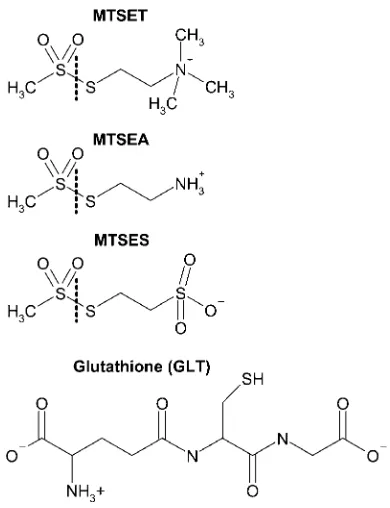
In this study we hypothesized that WT OmpF is essen-tially nonselective because of a combination of a low net permanent charge of its selectivity filter and a wide cross section. To support this view we aimed to further improve the ion selectivity of OmpF by increasing the permanent charge in the pore as well as by reducing its volume. The extent to which the filter volume can be manipulated by amino acid substitutions alone is limited by the space occupied by these amino acid residues. For this reason we combined site-directed mutagenesis with chemical modification by relatively bulky cysteine-specific reagents. After the introduction of one or two cysteines in the cysteine-free WT OmpF protein, the mutants were chemically modified by the negatively charged (1e, at pH 7.4) glutathione (GLT) or the more commonly used methanethiosulfonate-based (or MTS) reagents. To the best of our knowledge, the tripeptide GLT (g -glutamate-cysteine-glycine) has not yet been used for this purpose. Its biochemical nature and its size—it occupies more than three times the volume taken by MTSES (Fig. 1)—make GLT a suitable tool to investigate the exclusive effect of volume reduction on ion selectivity.
Submitted August 9, 2005, and accepted for publication November 2, 2005.
Address reprint requests to H. Miedema, Tel.: 31-50-3638070; Fax: 31-50-3634429; E-mail: [email protected].
MATERIALS AND METHODS
Mutagenesis of OmpF
The procedures for site-directed mutagenesis, isolation, and purification of OmpF have been described in detail previously (20). In short, (mutated) OmpF monomer was purified from inclusion bodies in large amounts. Subsequent in vitro refolding led to a mixture of mono-, di-, and trimeric protein, from which the latter was isolated with a yield of 5–10 mg per liter cell culture.
The six residues in the constriction zone of WT OmpF considered here are K16, R42, R82, R132, D113, and E117. All residues are assumed either fully ionized or fully protonated (21). Apart from the single and double R42C, R82C, R42C/R82C, D113C, E117C, and D113C/E117C mutants, the triple and quadruple mutants used in this study are listed in Table 1. Volume changes of the constriction zone after mutation and/or modification are expressed relative to the space occupied by the six formal (unmodified) residues in WT and based on the data in Table 2. In this study it has been assumed that all mutated, and for that matter chemically modified, proteins retain their global structural integrity. Experimental evidence that justifies this assumption comes from a crystallographic analysis of Lou et al. (22) that shows the local effects of not only point mutations (of R42, R82, and R132) but also of a mutant deleted of six residues (D109–114). In addition, all proteins characterized in this study formed trimers and were functional in the sense that they inserted into bilayers successfully, were able to facilitate ion transport (selectively), and retained their gating ability.
Chemical modification
The procedure followed for modification with GLT can be found in Humphries et al. (23). Cysteine mutant OmpF (5–10mg/ml) was incubated overnight with 100 mM 1,19-azobis(N,N-dimethylformamide) (diamide) and 125 mM GLT (both from Sigma, Zwijndrecht, The Netherlands), in a 200
mM NaPi buffer at pH 7.5 containing 0.3% n-octyl-poly-oxyethylene detergent (OPOE, Alexis Biochemicals, San Diego, CA).
The MTS-based labels [2-(trimethylammonium)ethyl]-methanethiosul-fonate (MTSET), 2-aminoethylmethanethiosul[2-(trimethylammonium)ethyl]-methanethiosul-fonate (MTSEA), and (2-sulfonatoethyl)methanethiosulfonate (MTSES) were purchased from Anatrace (Maumee, OH). To improve the modification efficiency by keeping the cysteine reduced, the protein was pretreated with 1 mM 1,4-dithiothreitol (DTT) for 1 h (24). Chemical modification was achieved after overnight incubation of 5–10mg/ml mutant OmpF with 50 mM MTS reagents in a 100-mM NaPibuffer, pH 7.5, containing 0.3% OPOE.
The electrophysiological characterization was performed without any further purification of the chemically modified protein.
Electrophysiology
[image:2.603.75.270.55.309.2]The entire procedure, including pulse protocol and data analysis, can be found in Miedema et al. (20). Briefly, planar lipid bilayer (PLB) experiments were performed using a chamber and Delrin cuvet (Warner Inst., Hamden, CT). By means of 3 M KCl/2% agar salt bridges, theciscompartment was connected to the headstage of the Axopatch 200B amplifier (Axon Instruments, Foster City, CA) and thetranscompartment was connected to ground. The PLB was painted across a 250-mm diameter aperture and was composed of phosphatidylethanolamine (PE) and phosphatidylcholine (PC) in an 8:2 ratio (w/w) and dissolved inn-decane. While stirring,;0.2ml of a 1–10mg/ml OmpF stock solution (in 0.1 M KCl buffer supplemented with 1% OPOE) was added to thetransside. Potential differences (V) are defined asV¼VcisVtrans. A positive (outward) current is defined as a flux of positive charge fromcistotrans. Conductance (g) is defined as the slope conductance of the fully opened trimer protein at the reversal potential (Erev). Values ofErev andgwere derived from current traces in response to a voltage ramp from100 to 100 mV in;2 s. Data were sampled at 5 kHz and filtered at 1 kHz.
[image:2.603.311.551.79.159.2]FIGURE 1 Structures of the MTS compounds and the tripeptide GLT (GLT¼g-glutamate-cysteine-glycine) used in this study. The parts on the left-hand side of the dotted lines indicate the methyl-thiosulfonate moiety of the molecules that splits off after covalently binding to the cysteine of the OmpF protein (see also Table 2).
TABLE 1 Triple and quadruple OmpF mutants used in this study
Strain Mutations
AAA R42A R82A R132A ACA R42A R82C R132A LACA K16L R42A R82C R132A EAE R42E R82A R132E LEAE K16L R42E R82A R132E LECE K16L R42E R82C R132E
TABLE 2 Occupied space by amino acids and MTS compounds in nm3
Amino acid Volume in nm3
Alanine 0.886
Cysteine 0.109
Arginine 0.173
Aspartate 0.111
Glutamate 0.138
Lysine 0.169
Leucine 0.167
Glycine 0.060
Glutathione 0.307
MTS compounds*
MTSET 0.123 (0.173) MTSES 0.090 (0.140) MTSEA 0.063 (0.113)
[image:2.603.311.550.524.682.2]Chemicals, including PE and PC, were purchased from Sigma. Recording buffers contained either 0.1 or 1 M KCl, NaCl, or CaCl2and 20 mM HEPES, adjusted to pH 7.4 withn-methyl-d-glucamine. Before use, all solutions were passed through a 0.2mm nylon filter. Gradients are representedcis/ trans; for instance, a 0.1//1 M KCl gradient indicates 0.1 M KCl in thecis
compartment and 1 M KCl in thetranscompartment. Reversal potentials measured in 1//0.1 M gradients of CaCl2, NaCl, or KCl have all been corrected for liquid junction potentials (LJP) of 19, 11, and 1 mV, respectively. LJPs were measured independently as well as calculated by using Axon’s pClamp9 software. Selectivity is expressed as the deviation of
Erevfrom the Nernst potential of the relevant ion species.
RESULTS
Chemical modification of OmpF
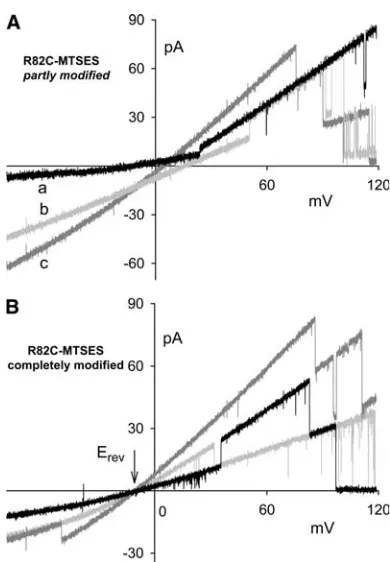
The trimeric nature of OmpF is a key characteristic in the context of chemical modification. Here, successfully chem-ically modified OmpF is defined as trimer protein with all three monomers modified. Following the protocols outlined above, the modification of cysteine-containing mutants of OmpF with either the MTS reagents or GLT was straight-forward and rendered no particular problems. The two cysteine mutants R82C and D113C/E117C were the excep-tions to the rule. With these two mutants we observed incomplete modification (i.e., not all three monomers modified), a feature that was translated in anErevthat varied with the number of open modified and open unmodified monomers. The efficiency of the modification reaction could be improved by a second or even third addition of the modification reagents, meanwhile maintaining the buffering capacity of the reaction mixture. Eventually, after optimizing the conditions, complete modification could also be achieved with these two mutant proteins, except for the reaction of R82C with GLT. In only three out of 21 attempts did we observe complete modification of R82C by GLT. Curiously, the chemical modification of the double mutant R42C/ R82C with either MTSES or GLT had far fewer problems. Examples of current traces from a partly and completely modified R82C-MTSES are shown in Fig. 2. Note that in contrast to Fig. 2 A, Fig. 2 B shows an Erev that is independent of the number of open monomers, implying that all three cysteines were modified by MTSES.
To determine the cysteine specificity of the MTS reagents, MTSET was added to the cysteine-free WT OmpF. This procedure resulted in an Erev of 21.5 6 0.5 mV and a conductance of 1476613 pS in 1//0.1 M CaCl2(see Table
3), not significantly different from the values recorded on WT in the absence of MTSET (20.961.9 mV and 15186
72 pS).
The reversibility of the chemical modification by the MTS reagents and GLT was tested on a number of mutants: R82C-MTSET, ACA-GLT, R42C/R82C-GLT, D113C-MTSEA, D113C-GLT, and LECE-MTSES. Of these, the modified D113C mutant was the only protein that proved to be sensitive to DTT and of which the modification could be completely reversed by overnight incubation in 100–200
mM DTT, pH 7.5. The modification of the other four mutants tested could not be reversed. An example obtained with D113C-GLT is shown in Fig. 3. Unmodified D113C is characterized by anErevof 25.960.6 mV and a conductance of 1443665 pS (Table 3). With GLT covalently attached,
Erevshifts almost 20 mV in the negative direction to 6.16
2.2 mV, whereas the conductance drastically drops to 1596
32 pS. Exposure of D113C-GLT to DTT results in an Erev
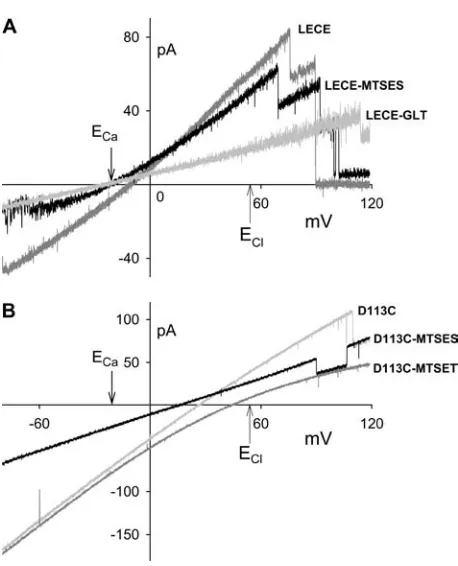
and conductance of 26.761.0 mV (10) and 1424687 pS (7), respectively, very similar to the values obtained with unmodified D113C. The fast flickering and spiky current behavior at more positive potentials was observed in all mutants that were modified with GLT (compare, e.g., with the trace of LECE-GLT in Fig. 4A).
Cation selectivity
[image:3.603.331.526.52.333.2]Table 3 lists all the (modified) mutants characterized in 1//0.1 M CaCl2, pH 7.4 solutions and the net charge introduced
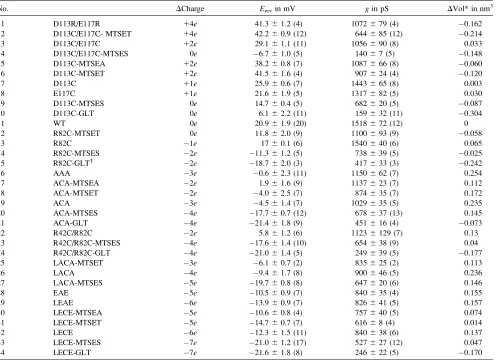
(Dcharge) in the constriction zone after the amino acid substitution(s) and subsequent modification compared to WT (i.e.,Dcharge of WT¼0). Apart fromErev, Table 3 contains the slope conductance (g) measured atErev. The conductance data are included because the changes of this parameter after treatment with the MTS reagents or GLT provide additional evidence that the cysteine mutants of the protein were actually modified. The last column of Table 3 gives the estimated change in volume (DVol) at the constriction zone, based on the data in Table 2, where a negative change indicates a smaller volume than WT. Note that in contrast to the other compounds used, modification by GLT always resulted in volume reduction, irrespective of the mutant used. Four out of the 34 (modified) proteins of Table 3 showed a complete Ca21over Clselectivity (i.e.,Erev;ECa¼ 21 mV): ACA-GLT, R42C/R82C-GLT, LECE-MTSES, and LECE-GLT. In addition, R82C-GLT and LACA-MTSES showed a slightly lower but still high Ca21 over Cl
selectivity as well, reflected in Erevs of 18.7 and 19.7 mV. The high selectivity of these six modified porins is even more remarkable when considering the high ionic strength of the recording solutions (0.1 and 1 M CaCl2), which promotes
[image:4.603.57.553.88.448.2]effective charge screening. Examples of current traces of (modified) LECE are shown in Fig. 4 A. Note the marked difference in conductance due to a filter volume that after the reaction with GLT is more than 0.2 nm3smaller than after modification with MTSES (see Table 3). Of these six OmpF variants with the highest cation over anion selectivity, only LACA-MTSES and LECE-MTSES possessed a slightly increased filter volume of 0.146 and 0.047 nm3, respectively. Apparently, the effect of a wider pore on the selectivity is counterbalanced by the large change in permanent charge in the filter of 5e and 7e, respectively. The most drastic effects of chemical modification were observed with the R82C mutant. Whereas the substitution of R82 by a cysteine shiftedErevby a mere 4 mV, reaction with MTSES or GLT
TABLE 3 Net charge introduced (DCharge, relative to WT), reversal potential (Erev), slope conductance atErev(g), and estimated volume change at the constriction zone (DVol, relative to WT) of (chemically modified)
OmpF porin in 1//0.1 M CaCl2, pH 7.4 withECa=21 mV andECl= 54 mV
No. DCharge Erevin mV gin pS DVol* in nm3
1 D113R/E117R 14e 41.361.2 (4) 1072679 (4) 0.162 2 D113C/E117C- MTSET 14e 42.260.9 (12) 644685 (12) 0.214 3 D113C/E117C 12e 29.161.1 (11) 1056690 (8) 0.033 4 D113C/E117C-MTSES 0e 6.761.0 (5) 14067 (5) 0.148 5 D113C-MTSEA 12e 38.260.8 (7) 1087666 (8) 0.060 6 D113C-MTSET 12e 41.561.6 (4) 907624 (4) 0.120 7 D113C 11e 25.960.6 (7) 1443665 (8) 0.003 8 E117C 11e 21.661.9 (5) 1317682 (5) 0.030 9 D113C-MTSES 0e 14.760.4 (5) 682620 (5) 0.087 10 D113C-GLT 0e 6.162.2 (11) 159632 (11) 0.304 11 WT 0e 20.961.9 (20) 1518672 (12) 0 12 R82C-MTSET 0e 11.862.0 (9) 1100693 (9) 0.058 13 R82C 1e 1760.1 (6) 1540640 (6) 0.065 14 R82C-MTSES 2e 11.361.2 (5) 738639 (5) 0.025 15 R82C-GLTy 2e 18.762.0 (3) 417633 (3) 0.242 16 AAA 3e 0.662.3 (11) 1150662 (7) 0.254 17 ACA-MTSEA 2e 1.961.6 (9) 1137623 (7) 0.112 18 ACA-MTSET 2e 4.062.5 (7) 874635 (7) 0.172 19 ACA 3e 4.561.4 (7) 1029635 (5) 0.235 20 ACA-MTSES 4e 17.760.7 (12) 678637 (13) 0.145 21 ACA-GLT 4e 21.461.8 (9) 451616 (4) 0.073 22 R42C/R82C 2e 5.861.2 (6) 11236129 (7) 0.13 23 R42C/R82C-MTSES 4e 17.661.4 (10) 654638 (9) 0.04 24 R42C/R82C-GLT 4e 21.061.4 (5) 249639 (5) 0.177 25 LACA-MTSET 3e 6.160.7 (2) 835625 (2) 0.113 26 LACA 4e 9.461.7 (8) 900646 (5) 0.236 27 LACA-MTSES 5e 19.760.8 (8) 647620 (6) 0.146 28 EAE 5e 10.560.9 (7) 840635 (4) 0.155 29 LEAE 6e 13.960.9 (7) 826641 (5) 0.157 30 LECE-MTSEA 5e 10.660.8 (4) 757640 (5) 0.074 31 LECE-MTSET 5e 14.760.7 (7) 61668 (4) 0.014 32 LECE 6e 12.361.5 (11) 840638 (6) 0.137 33 LECE-MTSES 7e 21.061.2 (17) 527627 (12) 0.047 34 LECE-GLT 7e 21.661.8 (8) 246622 (5) 0.170
*The volume changes (DVol) are relative to the space occupied by the six formal residues in the constriction zone of WT OmpF: K16, R42, R82, R132, D113, and E117. A volume change,0, indicates a smaller filter volume than that of WT.
y
caused Erev to shift another 28 mV (MTSES) or 36 mV (GLT) in the direction ofECa.
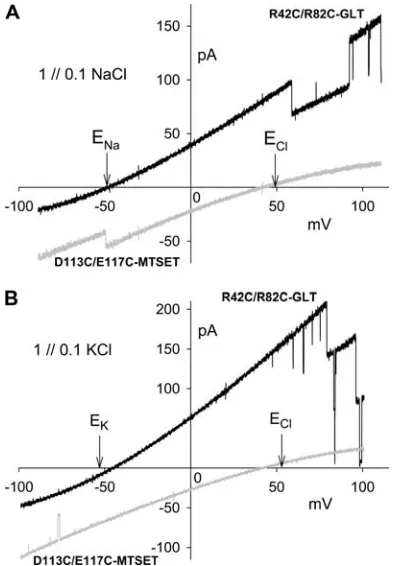
Table 4 summarizes the results of recordings in 1//0.1 M NaCl and KCl, pH 7.4 solutions of R42C/R82C-GLT and MTSES-LECE, two of the modified proteins with the highest Ca21over Clselectivity. As was the case with CaCl2, both
proteins showed nearly full cation selectivity when analyzed in NaCl solutions (note that although the average values of Erev differ from ENa of 49 mV by 1–2 mV, these differences are statistically not or hardly significant). In contrast, when measured in KCl solutions, theErevof;45 mV was still 8 mV removed fromEK(¼ 53 mV), implying that under these conditions the protein still permits measur-able quantities of Cl to permeate. These two chemically modified proteins thus show a higher cation over anion selectivity in NaCl than in KCl. Recordings of R42C/R82C-GLT in NaCl and KCl are shown in Fig. 5.
When tested for their ability to discriminate between Na1 and K1under bi-ionic conditions (with 0.1 M KCl incisand 0.1 NaCl intrans), all three proteins tested, including WT, demonstrated a very similar selectivity, reflected in a measuredErevof11.4 to9.9 mV.
Anion selectivity
Table 5 summarizes the data of two chemically modified mutants at the other end of the selectivity spectrum, i.e., those that showed the highest anion selectivity (in Table 3 those with the most positiveErevs). In contrast to the afore-mentioned extreme cation selectivity, none of the proteins tested demonstrated full anion selectivity. As for the three most selective, D113C-MTSET, D113C/E117C-MTSET, and D113R/E117R (with no fewer than five arginines in its constriction zone),Erevin 1//0.1 CaCl2of;42 mV remained
12 mV displaced fromECl of 54 mV. Examples of current traces obtained with (modified) D113C in CaCl2are shown
in Fig. 4B. Remarkably, the effect of the MTSET compound on the conductance vanishes at more negative potentials.
A similar behavior as seen in CaCl2was observed when
these two proteins were tested in 1//0.1 M NaCl and KCl solutions. When recorded in NaCl, the highest anion selectivity was achieved with D113C/E117C-MTSET, showing a 6 mV difference between Erev and ECl. As observed with the cation-selective proteins, the anion selectivity in KCl was lower than in NaCl. Fig. 5 shows traces from D113C/E117C-MTSET, recorded in either 1//0.1 M NaCl or KCl.
Chemical modification and selectivity
We also addressed the question whether the modification of mutant protein restores WT selectivity, given the final net permanent charge at the constriction zone after the reaction is the same as in WT. The answer to this question is in the negative. Table 6 compares the permeation properties in 1//0.1 CaCl2 of WT and three modified D113C porins.
[image:5.603.75.270.56.191.2]Although all four proteins are equally charged (Dcharge¼0), FIGURE 3 The modification of the D113C mutant with GLT can be
reversed by DTT. Recordings were performed on three different mutant proteins. The current axis has been enlarged to show that both the conductance and reversal potential changed upon GLT binding. Arrows indicateErevof D113C-GLT of, on average, 6.1 mV andErevof;26 mV of D113C (ingray) and D113C-GLT1DTT.
FIGURE 4 Effect of different reagents on the current profile of the LECE and D113C mutant. (A) Current traces of the unmodified, MTSES-modified, and GLT-modified LECE mutant. Note the shift ofErevin the direction of
the three modified mutants are all more cation selective than WT, reflected in anErev that is shifted towardECa of 21 mV. The measuredErevvaries by 28 mV, from 21 mV for WT to 7 mV for D113C/E117C-MTSES. These results point to the fact that charge is not the sole determinant of the ion selectivity of OmpF but that other parameters also contribute to this property. Fig. 6Aplots the measuredErevin 1//0.1 CaCl2in relation to Dcharge of WT and unmodified
OmpF mutants (solid circles), OmpF modified by MTS reagents (open circles), and GLT-modified OmpF (solid
triangles). The dotted line through the data of unmodified protein is drawn by eye and indicates the effect ofDcharge on Erev. As expected, the more negative theDcharge, the more cation-selective the protein. But this figure also shows that proteins that carry the same net permanent charge may differ significantly in their selectivity, especially those mod-ified by the bulky GLT. The effect of change of volume on selectivity is highlighted in Fig. 6B, which showsErev(in 1// 0.1 CaCl2) as a function of the change in pore volume at a
constant Dcharge of 4e, 2e, 0e, or 2e. The solid lines through the data points present linear fits and only serve to emphasize the trend observed: the larger the volume reduction, the more cation selective (forDcharge¼ 4e,2e, and 0e) or anion selective the channel (forDcharge¼2e).
DISCUSSION
Cysteine-specific modification of OmpF
[image:6.603.53.294.88.209.2]Scanning (or substituted) cysteine accessibility mutagenesis, or SCAM, has been widely used both to elucidate structural details of ion channel proteins (25–29) as well as in studies that aimed to manipulate the ion selectivity of the channel (30–32). Although OmpF has been chemically modified previously (33–35), we are aware of only two studies that report on the modification of cysteines in the constriction zone of a bacterial porin with sulfhydryl reagents. These studies were conducted on OmpC (24) and OmpF (36) but were focused on protein stability and voltage sensitivity rather than ion selectivity. Here we show the usefulness of
TABLE 4 Cation selectivity of WT, R42C/R82C-GLT, and LECE-MTSES in gradients of 1//0.1 M NaCl (ENa=49 mV) and KCl (EK=53 mV)
WT R42C/R82C-GLT LECE-MTSES
DCharge 0 4e 7e DVol (nm3)
in 1//0.1 NaCL
0 0.177 0.047
Erev 16.262.2 (9) 47.061.5 (6) 48.061.3 (7)
Erev-ENa 32.8 2.0 1.0
gatErev
in 1//0.1 KCL
1171638 (9) 730637 (5) 1073649 (4)
Erev 20.960.5 (8) 45.660.7 (6) 44.361.1 (9)
Erev-EK 32.1 7.4 8.7
[image:6.603.310.549.88.209.2]gatErev 1919622 (8) 1258682 (6) 17586136 (5)
FIGURE 5 High cation or anion selectivity of the two chemically modified double mutants R42C/R82C-GLT and D113C/E117C-MTSET. (A) Recordings of both mutants in 0.1//1 M NaCl, pH 7.4 withENa of
[image:6.603.75.272.370.653.2]49 mV andEClof 49 mV indicated. (B) Recordings of both mutants in 0.1//1 M KCl, pH 7.4 withEKof53 mV andEClof 53 mV indicated.
TABLE 5 Anion selectivity of WT, D113C-MTSET, and D113C/E117C-MTSET in 1//0.1 M NaCl (ECl= 49 mV) and KCl (ECl= 53 mV)
WT D113C-MTSET D113/E117C-MTSET
DCharge 0 2e 4e DVol (nm3)
in 1//0.1 NaCL
0 0.120 0.214
Erev 16.262.2 (9) 37.061.0 (10) 42.961.3 (8)
ECl-Erev 65.2 12 6.1
gatErev
in 1//0.1 KCL
1171638 (9) 539650 (5) 340621 (4)
Erev 20.960.5 (8) 32.061.4 (8) 41.460.9 (5)
ECl-Erev 73.9 21 11.6
gatErev 1919622 (8) 566628 (8) 425620 (7)
TABLE 6 Permeation properties of WT and modified D113C mutant protein in 1//0.1 M CaCl2withECaof21 mV
DCharge Erevin mV gin pS DVol in nm3
WT 0 20.9 1518 0
D113C-MTSES 0 14.7 682 0.087 D113C/E117C-MTSES 0 6.7 140 0.148 D113C-GLT 0 6.6 159 0.304
[image:6.603.310.551.620.681.2]these MTS reagents and GLT in manipulating the selectivity of single and double cysteine mutants of OmpF. In combi-nation with the lack of effects on WT OmpF, the reversibility of the chemical modification of the D113C mutant by DTT proves the cysteine specificity of the compounds used.
Obviously, the manipulation of ion channel selectivity by chemical modification is an option only if the particular compound can reach the constriction zone. MTS reagents are cylindrically shaped molecules with a length of ;1.0–1.2 nm (26). The widest part of the MTSEA and MTSES molecules is the sulfonyl group with a 0.48 nm diameter; for MTSET the widest part is the trimethylammonium head-group with a diameter of 0.58 nm (28). The crystal structure of WT OmpF indicates a minimum cross-sectional area of
;0.2–0.3 nm2. Molecular dynamics studies led Im and Roux (37) to conclude that the pore undergoes small fluctuations, resulting effectively in a significantly narrower pore. Although
the volume before modification of some of the cysteine mutants was substantially increased (e.g., ACA and LACA, Table 3), the volume of others remained fairly constant (e.g., D113C and D113C/E117C). Whatever the precise dimensions, our data are in support of a pore wide enough to give access to the compounds used, even in the case of the bulky GLT. In contrast to the successful chemical modification of the double mutant R42C/R82C with GLT, all efforts to modify R82C by GLT were far less effective. This observation suggests that the flanking R42 contributes somehow to the lack of reactivity of R82C.
We can only speculate on why the D113C mutant was the only protein of the variants tested for which modification could be completely reversed by DTT. Even though DTT fits into a cylinder of just 0.4 nm in diameter (28), the possibility that after modification the pore has become too narrow for DTT to enter cannot be excluded. Lack of or partial reversibility by DTT of cysteine-modified residues has been reported previously (27).
Lin and Chen (29) reported that the accessibility of the ClC-O channel to the charged MTS reagents is dependent on the electrostatic potential inside the pore. Such sensitivity was not observed with the highly negatively charged porins studied here. For instance, the modification of LECE (Dcharge¼ 6e) with the negatively charged MTSES was in no way harder to achieve than using the positively charged MTSET or MTSEA.
Ion selectivity of OmpF
Our previous work on OmpF (20) was motivated primarily by theoretical considerations regarding the mechanism by which calcium channels achieve their high Ca21 over Na1 selectivity, notably in the context of the charge space compe-tition or CSC model developed by Nonner and co-workers (38,39). Here we focused on the cation versus anion selectivity instead and therefore omitted a discussion of the results in terms of CSC theory.
This study reemphasizes the key role charge plays in the mechanism of charge selection by ion channel proteins. The results show a significant improvement of the selectivity achieved so far. For instance, whereas the LEAE mutant (Table 1) characterized previously showed full Ca21 over Cl selectivity in 0.1//0.01 M CaCl2 solutions (20), the
LECE mutant modified with MTSES shows a similar se-lectivity but at much higher ionic strength, i.e., in 1//0.1 M CaCl2. A similar gain in selectivity was achieved when studied
in gradients of 1//0.1 M NaCl, pH 7.4. For comparison, single mutations of K16, R42, R82, R132, or D113, as reported by Saint et al. (19) and Bredin et al. (40), resulted in aPNa/PClof 14 at most (for K16D). The quadruple mutant LEAE showed a strongly increased selectivity and aPNa/PClof 35 (20). Here we applied cysteine chemistry and improved the cation selectivity even further, reflected in an Erevof LECE-MTSES virtually identical toENa(implying aPNa/PClthat approachesN). FIGURE 6 Ion selectivity of OmpF in relation to the change in permanent
[image:7.603.63.282.51.390.2]With Erevs of 6–15 mV in 1//0.1 M CaCl2, the D113C
mutant modified with either MTSES or GLT is essentially nonselective. The fact that the presence of MTSES or GLT in the pore does not per se result in high selectivity argues against the view that the full cation selectivity obtained with some other mutants modified with MTSES or GLT was actually due to some kind of specific interaction between these reagents and the permeating ion species.
Despite the clear difference in cation selectivity between WT and the two modified mutants R42C/R82C-GLT and LECE-MTSES in NaCl and KCl (Table 4), any difference inErev between the three porins totally disappeared when measured under bi-ionic conditions (0.1 M KCl//0.1 M NaCl). Moreover, whereas the cation selectivity of the three porins was consistently higher in NaCl than in KCl,Erevof
;10.5 mV indicates a slightly higher selectivity for K1
than for Na1.
Like OmpF, the anion-selective Omp32 possesses three arginines at its constriction zone but lacks the acidic, negatively charged residues that face this positively charged cluster in OmpF. It has been suggested that this is one of the reasons Omp32 is anion selective (41,42). As shown in Table 3, the neutralization of D113 or both D113 and E117 does indeed shift Erev by 5 and 8 mV, respectively, into the direction ofECl. The subsequent modification of D113C and D113C/E117C by MTSET results in a further substantial improvement of the anion over cation selectivity by shifting
Erevanother 13–16 mV toward ECl. Measured in 1//0.1 M NaCl,Erevof 43 mV is however still 6 mV displaced from
ECl of 49 mV (Table 5). Compared to the observed high cation selectivity of some of the modified porins, there is room left for a further improvement of the anion selectivity of OmpF.
Roles of D113 and E117
Based on a computational study, Danelon et al. (43) hypothesized a crucial role for D113 in the cation selectivity of OmpF. Our results provide experimental evidence for the role a negatively charged residue at the 113 position plays in the cation selectivity of OmpF. Whereas the neutralization of D113 by a cysteine shiftsErev5 mV away from ECa, the reintroduction of a negative charge by the modification of D113C with either MTSES or GLT shiftsErev11 and 20 mV, respectively, back towardECa. The data on D113C/E117C and D113C/E117C-MTSES show that the selectivity further improves after the additional neutralization and modification of E117, implying that both D113 and E117 play a role in the cation selectivity of OmpF.
A different picture emerges when considering the effect of both residues on the anion selectivity.Erevof both D113C-MTSET and D113C/E117C-D113C-MTSET was 42 mV. Appar-ently, the additional modification of E117C with the positively charged MTSET does not translate into a further gain in the anion selectivity. This finding is also in agreement
with the observation that in contrast toErevof D113C,Erev
of E117C is not significantly different from Erev of WT (Table 3). Of the two residues, D113 clearly dominates the permeation properties. This point is further reinforced by the profound effects of MTSES and MTSET modification of D113C on the current profile as shown in Fig. 4B, with, in the case of MTSET, the marked asymmetry of the effect on the conductance. In addition, the drastic effect on the conductance after modifying D113C with GLT and D113C/ E117C with MTSES also points in this direction. The con-ductance left after the modification of both mutants (140– 159 pS) is only;10% of WT conductance (1518 pS). That in the case of D113C/E117C-MTSES this drop in conduc-tance is not primarily caused by steric hindrance is indicated by the significantly largergof 644 pS after the modification of D113C/E117C by the slightly more bulky MTSET.
Pore geometry and selectivity
Fig. 6Bsummarizes the key conclusion of this study: both permanent charge and pore volume contribute to the charge selectivity of the OmpF channel. When comparing equally charged porins, the chemically modified ones were generally speaking more selective, especially those modified by GLT. For example, three out of four proteins with the highest Ca21 over Clselectivity (Erev ECa ¼ 21 mV) contain the bulky GLT (Table 3). Furthermore, whereas Dcharge of LECE-GLT is7e,Dcharge of both ACA-GLT and R42C/ R82C-GLT are just 4e, yet their Erev is essentially the same. The conclusion that volume contributes to OmpF selectivity is supported by the finding that modification of the D113C mutant did not restore WT characteristics, even though WT and modified mutants are equally charged (Table 6). Partial restoration of selectivity by MTSET-like compounds has been reported previously (30,32).
Of all porins studied, Omp32 is the most (anion) selective and at the same time the porin with the smallest cross section (41). This observation already hints in the direction that structural elements play a role in ion selectivity. The fact that we did not achieve full anion selectivity yet may be due to a pore that is still too wide.
biological Na- and K-channels, effects other than the electro-static potential start to dominate the mechanism of ion selectivity, e.g., free energy differences of dehydration and solvation for the two ion species (46,47). If for OmpF a narrow pore is the key to high anion selectivity and a high Na1over K1 selectivity, it remains to be seen by how much the performance of engineered OmpF porins can be improved. Obviously, at some point volume reduction by chemical modification encounters its limit, since the larger the com-pounds, the less accessible the pore interior for these reagents.
CONCLUSIONS
At the qualitative level, the results presented here can be interpreted in terms of charge screening, the electric double layer, and the Debye length. High charge selection requires, apart from the presence of permanent charge, a relatively narrow pore with a radius that does not exceed the thickness of the EDL. Such geometry ensures that the permanent charge is not completely screened and coions are effectively repelled. Significantly wider channels are less selective because the composition of the electrolyte solution located beyond the Debye distance starts to dominate (shunting) the permeation properties of the entire pore. Applied to OmpF, the introduction of extra permanent charge and volume reduction resulted in a selectivity that covered almost the entire spectrum from fully cationic to highly anionic.
This study is part of a close collaboration with Prof. B. Eisenberg and Dr. D. Gillespie (Rush Medical College, Chicago) and Prof. W. Nonner (University of Miami). We greatly appreciate the help of Dr. H. Hektor (Biomade) in mutating OmpF.
REFERENCES
1. Bayley, H., and L. Jayasinghe. 2004. Functional engineered channels and pores.Mol. Membr. Biol.21:209–220.
2. Jeon, Y. J., H. Kim, S. Jon, N. Selvapalam, D. H. Oh, I. Seo, C. S. Park, S. R. Jung, D. S. Koh, and K. Kim. 2004. Artificial ion channel formed by cucurbit[n]uril derivatives with a carbonyl group fringed portal reminiscent of the selectivity filter of K1channels.J. Am. Chem. Soc.126:15944–15945.
3. Sakai, N., N. Sorde´, G. Das, P. Perrottet, D. Gerard, and S. Matile. 2003. Synthetic multifunctional pores: deletion and inversion of anion/ cation selectivity using pM and pH.Org. Biomol. Chem.1:1226–1231. 4. Kienker, P. K., and J. D. Lear. 1995. Charge selectivity of the designed uncharged peptide ion channel Ac-(LSSLLSL)3-CONH2.Biophys. J.
68:1347–1358.
5. Siwy, Z., I. D. Kosin´ska, A. Fulin´ski, and C. R. Martin. 2005. Asymmetric diffusion through synthetic nanopores.Phys. Rev. Lett.
94:048102.
6. Hou, S., J. Wang, and C. R. Martin. 2005. Template-synthesized protein nanotubes.Nano Lett.5:231–234.
7. Borisenko, V., M. S. P. Samsom, and G. A. Woolley. 2000. Protonation of lysine residues inverts cation/anion selectivity in a model channel.Biophys. J.78:1335–1348.
8. Lougheed, T., Z. Zhang, G. A. Woolley, and V. Borisenko. 2004. Engineering charge selectivity in model ion channels.Bioorg. Med. Chem.12:1337–1342.
9. Gu, L.-Q., M. D. Serra, J. B. Vincent, G. Vigh, S. Cheley, O. Braha, and H. Bayley. 2000. Reversal of charge selectivity in transmembrane protein pores by using noncovalent molecular adapters. Proc. Natl. Acad. Sci. USA.97:3959–3964.
10. Benz, R., K. Janko, W. Boos, and P. La¨uger. 1978. Formation of large, ion-permeable membrane channels by the matrix protein (porin) of
Escherichia coli.Biochim. Biophys. Acta.511:305–319.
11. Benz, R., K. Janko, and P. La¨uger. 1979. Ionic selectivity of pores formed by the matrix protein (porin) of Escherichia coli. Biochim. Biophys. Acta.551:238–247.
12. Schindler, H., and J. P. Rosenbusch. 1978. Matrix protein from
Escherichia coliouter membranes forms voltage-controlled channels in lipid bilayers.Proc. Natl. Acad. Sci. USA.75:3751–3755.
13. Cowan, S. W., T. Schirmer, G. Rummel, M. Steiert, R. Ghosh, R. A. Pauptit, J. N. Jansonius, and J. P. Rosenbusch. 1992. Crystal structures explain functional properties of twoE. Coliporins.Nature.358:727–733. 14. Karshikoff, A., V. Spassov, S. W. Cowan, R. Ladenstein, and T. Schirmer. 1994. Electrostatic properties of two porin channels from
Escherichia coli.J. Mol. Biol.240:372–384.
15. Nestorovich, E. M., T. K. Rostovtseva, and S. M. Bezrukov. 2003. Residue ionization and ion transport through OmpF channels.Biophys. J.85:3718–3729.
16. Alcaraz, A., E. M. Nestorovich, M. Aguilella-Arzo, V. M. Aguilella, and S. M. Bezrukov. 2004. Salting out the ionic selectivity of a wide channel: the asymmetry of OmpF.Biophys. J.87:943–957.
17. Saxena, K., V. Drosou, E. Maier, R. Benz, and B. Ludwig. 1999. Ion selectivity reversal and induction of voltage-gating by site-directed mutations in the Paracoccus denitrificans porin. Biochemistry. 38: 2206–2212.
18. Phale, P. S., A. Philippsen, C. Widmer, V. P. Phale, J. P. Rosenbusch, and T. Schirmer. 2001. Role of charged residues at the OmpF porin channel constriction probed by mutagenesis and simulation. Biochem-istry.40:6319–6325.
19. Saint, N., K.-L. Lou, C. Widmer, M. Luckey, T. Schirmer, and J. P. Rosenbusch. 1996. Structural and functional characterization of OmpF porin mutants selected for larger pore size.J. Biol. Chem.271:20676– 20680.
20. Miedema, H., A. Meter-Arkema, J. Wierenga, J. Tang, R. S. Eisenberg, W. Nonner, H. Hektor, D. Gillespie, and W. Meijberg. 2004. Per-meation properties of an engineered bacterial OmpF porin containing the EEEE-locus of Ca21channels.Biophys. J.87:3137–3147.
21. Varma, S., and E. Jakobsson. 2004. Ionization states of residues in OmpF and mutants: effects of dielectric constant and interactions be-tween residues and ionic strength.Biophys. J.86:690–704.
22. Lou, K.-L., N. Saint, A. Prilipov, G. Rummel, S. A. Benson, J. P. Rosenbusch, and T. Schirmer. 1996. Structural and functional charac-terization of OmpF porin mutants selected for larger pore size.J. Biol. Chem.271:20669–20675.
23. Humphries, K. M., C. Juliano, and S. S. Taylor. 2002. Regulation of cAMP-dependent protein kinase activity by glutathionylation.J. Biol. Chem.277:43505–43511.
24. Gocke, I., G. Bainbridge, and J. H. Lakey. 1997. Stabilising and destabilising modifications of cysteines in the E. coli outer membrane porin protein OmpC.FEBS Lett.411:201–205.
25. Pe´rez-Garc´ia, M. T., N. Chiamvimonvat, E. Marban, and G. F. Tomaselli. 1996. Structure of the sodium channel pore revealed by serial cysteine mutagenesis.Proc. Natl. Acad. Sci. USA.93:300–304. 26. Kaplan, R. S., J. A. Mayor, D. Brauer, R. Kotari, D. E. Walters, and A. M. Dean. 2000. The yeast mitochondrial citrate transport protein.
J. Biol. Chem.275:12009–12016.
27. Koch, S. E., I. Bodi, A. Schwartz, and G. Varadi. 2000. Architecture of Ca21channel pore-lining segments revealed by covalent modification of substituted cysteines.J. Biol. Chem.275:34493–34500.
29. Lin, C.-W., and T.-Y. Chen. 2003. Probing the pore of CIC-0 by substituted cysteine accessibility method using methane thiosulfonate reagents.J. Gen. Physiol.122:147–159.
30. Chiamvimonvat, N., M. T. Pere´z-Garc´ia, G. F. Tomaselli, and E. Marban. 1996. Control of ion flux and selectivity by negatively charged residues in the outer mouth of rat sodium channels.J. Physiol.
491:51–59.
31. Chen, S.-F., H. A. Hartmann, and G. E. Kirsch. 1997. Cysteine mapping in the ion selectivity and toxin binding region of the cardiac Na1channel pore.J. Membr. Biol.155:11–25.
32. Tsushima, R. G., R. A. Li, and P. H. Backx. 1997. Altered ionic selec-tivity of the sodium channel revealed by cysteine mutations within the pore.J. Gen. Physiol.109:463–475.
33. Schindler, M., and J. P. Rosenbusch. 1982. Chemical modification of matrix porin fromEscherichia coli: probing the pore topology of a transmembrane protein.J. Cell Biol.92:742–746.
34. Benz, R., H. Tokunaga, and T. Nakae. 1984. Properties of chemically modified porin from Escherichia coli in lipid bilayer membranes.
Biochim. Biophys. Acta.769:348–356.
35. Hancock, R. E., A. Schmidt, K. Bauer, and R. Benz. 1986. Role of lysines in ion selectivity of bacterial outer membrane porins.Biochim. Biophys. Acta.860:263–267.
36. Bainbridge, G., H. Mobasheri, G. A. Armstrong, E. J. A. Lea, and J. H. Lakey. 1998. Voltage-gating ofEscherichia coli porin: a cysteine-scanning mutagenesis study of loop 3.J. Mol. Biol.275:171–176. 37. Im, W., and B. Roux. 2002. Ions and counterions in a biological
channel: a molecular dynamics simulation of OmpF porin from
Escherichia coliin an explicit membrane with 1 M KCl aqueous salt solution.J. Mol. Biol.319:1177–1197.
38. Nonner, W., L. Catacuzzeno, and B. Eisenberg. 2000. Binding and selectivity in L-type calcium channels: a mean spherical approxima-tion.Biophys. J.79:1976–1992.
39. McCleskey, E. W. 2000. Ion channel selectivity using an electric stew.
Biophys. J.79:1691–1692.
40. Bredin, J., N. Saint, M. Malle´a, E. De´, G. Molle, J.-M. Page`s, and V. Simonet. 2002. Alteration of pore properties ofEscherichia coliOmpF induced by mutation of key residues in anti-loop 3 region.Biochem. J.
363:521–528.
41. Zachariae, U., A. Koumanov, H. Engelhardt, and A. Karshikoff. 2002. Electrostatic properties of the anion selective porin Omp32 from
Delftia acidovorans and of the arginine cluster of bacterial porins.
Protein Sci.11:1309–1319.
42. Zachariae, U., V. Helms, and H. Engelhardt. 2003. Multistep mecha-nism of chloride translocation in a strongly anion-selective porin channel.Biophys. J.85:954–962.
43. Danelon, C., A. Suenaga, M. Winterhalter, and I. Yamato. 2003. Molecular origin of the cation selectivity in OmpF porin: single channel conductances vs. free energy calculation.Biophys. Chem.104:591–603. 44. Daiguji, H., P. Yang, and A. Majumdar. 2004. Ion transport in
nano-fluidic channels.Nano Lett.4:137–142.
45. Siwy, Z., Y. Gu, H. A. Spohr, D. Baur, A. Wolf-Reber, R. Spohr, P. Apel, and Y. E. Korchev. 2002. Rectification and voltage gating of ion currents in a nanofabricated pore.Europhys. Lett.60:349–355. 46. Carrillo-Trip, M., H. Saint-Martin, and I. Ortega-Blake. 2004. Minimalist
molecular model for nanopore selectivity.Phys. Rev. Lett.93:168104. 47. Noskov, S. Y., S. Berne`che, and B. Roux. 2004. Control of ion