Behavior of the Two-Dimensional Viscous Flow
over Two Circular Cylinders with Different Radii
Surattana Sungnul and Ekkachai Kunnawuttipreechachan
Abstract—In this paper, we study numerical simulation of two-dimensional viscous flow over two circular cylinders with different radii. The flow structure depends on the rate of rota-tion, the gap-spacing and the Reynolds number. The algorithm used to simulate the numerical solutions is based on the concept of projection method. A mathematical model describing the flow over the two rotating cylinders is applied by the cylindrical bipolar coordinate system. The main objective is to investigate the characteristics of the fluid flow. This investigation gives a set of numerical simulations for the hydrodynamic characteristics, which can be applied to other related problems.
Index Terms—numerical simulation, cylindrical bipolar co-ordinate, projection method.
I. INTRODUCTION
T
HE interaction of the flow over two cylinders is atopic of prime scientific interest with many engineering and real life applications. Most of researches studied on two cylinders were concerned with two rotating and non-rotating cylinders of an identical diameter (see for example [1]- [4] and literature cited there). There are two different types of stationary motion of bodies in a fluid. The first type is a towed body which in the stationary motion regime external forces must affect the body. The second type is self-propelled body. Self-propelled means that a body moves because of the interaction between its boundary and the surrounding fluid and without the action of an external force. In the present work, flow structures were calculated between two circular cylinders (the left cylinder is non-rotating and the right cylinder is non-rotating in counterclockwise angular velocity) with different radii and uniform stream flow directed perpendicular to the line connecting the cylinders centers. We show some results of numerical simulations at fixed Reynolds number and moderate gap spacing and rate of cylinders rotation.
II. MATHEMATICALMODELLING
The governing equation is the Navier-Stokes equations written in cylindrical bipolar coordinate. The coordinate system is moving together with the cylinders. The cylindrical bipolar coordinate system can be defined by the following equation (1)
x= asinhη
coshη−cosξ, y=
asinξ
coshη−cosξ, (1)
Manuscript received December 28, 2017; revised January 25, 2018. This research was financially supported by the Faculty of Applied Science, King Mongkut’s University of Technology North Bangkok (Contract no. 5642110).
Surattana Sungnul is a lecturer at the Department of Mathematics, King Mongkut’s University of Technology North Bangkok, 10800, THAILAND and a researcher in Centre of Excellence in Mathematics, CHE, Bangkok, 10400, THAILAND e-mail: [email protected]
Ekkachai Kunnawuttipreechachan is a lecturer in the Department of Mathematics, King Mongkut’s University of Technology North Bangkok, 10800, THAILAND e-mail: [email protected]
where ξ ∈ [0,2π), η ∈ (−∞,∞), a is a characteristic
length in the cylindrical bipolar coordinate system which
is positive. This transformation maps the xy− plane (form
which the domain occupied by the cylinders is excluded)
into the rectangle η2≤η≤η1, 0≤ξ < 2π andη2<0,
η1>0. The surfaces of the cylinders are located atη=η2
andη =η1.The cylinder’s radii r1, r2 and the distance of
their centers from the origin d1, d2 are given by ri = a
csch|ηi|, di =acoth|ηi|, i= 1,2. The center to center
distance between the cylinders isd=d1+d2.
The Navier-Stokes equations (2)-(4) in the cylindrical bipolar
coordinate system(ξ, η)[5] are
∂vξ
∂t +
1
h
vξ
∂vξ
∂ξ +vη ∂vξ
∂η
−
−1 a
sinhη(vξvη)−sinξ(vη)
2
=−1 h
1
ρ ∂p ∂ξ +
+ν
h 1
h ∂2v
ξ
∂ξ2 + ∂2v
ξ
∂η2
−2 a
sinhη∂vη ∂ξ −sinξ
∂vη
∂η
−
coshη+ cosξ a
vξ
, (2)
∂vη
∂t +
1
h
vξ
∂vη
∂ξ +vη ∂vη
∂η
+ +1
a
sinhη(vξ)2−sinξ(vξvη)
=−1 h
1
ρ ∂p ∂η+
+ν
h 1
h ∂2v
η
∂ξ2 + ∂2v
η
∂η2
+2
a
sinhη∂vξ ∂ξ −sinξ
∂vξ
∂η
−
coshη+ cosξ a
vη
, (3)
1
h2 ∂(hv
ξ)
∂ξ +
∂(hvη)
∂η
= 0, (4)
where vξ and vη are the physical components of velocity
vectorv= (vξ, vη), pis the pressure, ρis density, ν is the
kinematic viscosity of the fluid andh= a
(coshη−cosξ).
The boundary conditions are a no-slip requirement on cylin-ders
vξ =ωiri, vη = 0, onη=ηi, ξ∈[0,2π), i= 1,2, (5)
where ωi, i = 1,2 are constant angular velocities of the
cylinders rotation. Positive values ofωi, i= 1,2correspond
to counterclockwise rotation. Upstream and downstream boundary conditions at infinity are
vx= 0, vy =U∞, as r2=x2+y2→ ∞, (6)
where vx and vy are components of velocity vector in x
stream velocity. The net force and torque exerted by fluid on
an immersed body with surface Σare
F=
Z
Σ
τdS, M=
Z
Σ
[r×τ]dS,
wherenis the unit vector normal to theΣthat points outside
the region occupied by the fluid. The force per unit area
exerted across a rigid boundary element with normalnin an
incompressible fluid is defined by
τ=−p n−µ(n×ω)
where ω is vorticity defined as ω = curl v and µ is the
coefficient of viscosity. If Fxi andFyi, i= 1,2 are the lift
and drag on the cylinders, the lift and drag coefficients are defined by
CLi= Fxi ρU∞D
, CDi = Fyi ρU∞D
, i= 1,2, (7)
where D is a diameter of right cylinder and each consists
of components due to the friction forces and the pressure. Hence
CL=CLf+CLp, CD=CDf+CDp. (8) The problem of self-motion is to find solution of the Navier-Stokes equations (2)-(4) with boundary conditions
(5)−(6)and additional constraints
F=M=0. (9)
Equation (9) determines the basic distinction between
sta-tionary flow over self-propelled and towed bodies. The numerical simulation of the flow past self-moving bodies becomes more complicated as a result of the nonlocality of
constraints like (9). For such flows, the results depend not
only on the Reynolds number, Re, but also depend on the
non-dimensional gap spacing between the two cylinders, g,
and parameters, αi representing the ratios of the rotational
velocities of the cylinder walls to the oncoming flow velocity
Re=U∞D
ν , αi = Dωi
2U∞
, i= 1,2, and g= d−r1−r2
D/2 .
III. NUMERICALALGORITHM ANDVALIDATION
The algorithm of the problem solution is based on the concept of projection methods (Chorin, 1968) [6]. The
in-termediate velocity components v˜ξ,v˜η are computed in a
first step by solving a finite difference approximation of the
momentum equations. Intermediate velocity vectorev(which
is not solenoidal) is then decomposed into divergence free and rotational free vector fields by solving Poisson equation with homogeneous Neumann boundary conditions. The final
approximation of thevandpat timetn+1 can be found and
the steady-state computed solution is defined by
kθn+1−θnk
4tkθn+1k ≤ε,
whereθ = (vξ, vη, CD, CL);4t is the time step andθn
refers to the numerical approximation at timen4t.
To validate the present numerical algorithm, the uniform
flow past rotating circular cylinders with Re = 20, 0.1 ≤
α1(= α2)≤2.0 and a large gap between cylinder surfaces
g = 14 have been calculated and the results compared
with simulation data for flow past a single cylinder. All the
TABLE I
DRAG COEFFICIENT OF FLOW OVER A ROTATING CIRCULAR CYLINDER
ATRe= 20WITH GAP SPACINGg= 14
Contribution CD
α= 0.1 α= 1.0 α= 2.0
Present 2.119 1.887 1.363
Badret al.[8] 1.990 2.000 — Ingham and Tang [7] 1.995 1.925 1.627
Chung [9] 2.043 1.888 1.361
TABLE II
LIFT COEFFICIENT OF FLOW OVER A ROTATING CIRCULAR CYLINDER AT
Re= 20WITH GAP SPACINGg= 14
Contribution CL
α= 0.1 α= 1.0 α= 2.0
Present 0.291 2.797 5.866
Badret al.[8] 0.276 2.740 — Ingham and Tang [7] 0.254 2.617 5.719
Chung [9] 0.258 2.629 5.507
TABLE III
DRAG COEFFICIENTS OF FLOW OVER TWO CIRCULAR CYLINDERS AT
FIXEDRe= 20, α2= 0.0ANDg= 1.0,2.0,3.0FOR1.0≤α1≤6.0
g α1 CD CD1 CD2
1.0
1.0 5.903 2.239 3.664 2.0 3.662 0.581 3.081 4.0 0.279 -1.603 1.882
4.25 0.009 -1.550 1.559 5.0 -0.417 -1.489 1.072
2.0
1.0 6.344 2.576 3.768 2.0 4.656 1.212 3.444 4.0 1.160 -1.111 2.271
5.0 0.002 -1.434 1.436 6.0 -1.185 -0.936 -0.249
3.0
1.0 6.217 2.678 3.539 2.0 4.552 1.354 3.198 4.0 1.343 -0.856 2.199
5.5 −0.007 -1.157 1.150 6.0 0.498 -0.473 0.971
simulations have been performed in a large domain so as to reduce the influence of the outer boundary. Tables I and II list drag and lift coefficients from our calculation and makes a comparison with (Ingham et al. 1990) [7], (Badr et al. 1989) [8] and (Chung 2006) [9]. It can be seen that the
differences are acceptable for CD and CL. The analysis of
the data collected in Tables I and II indicate an acceptable level of agreement between our computational results and the experimental and numerical data available in literature.
IV. NUMERICALRESULTS
In this work, two cylinders are placed in a stream of the
uniform speed U∞ at infinity. Numerical results have been
presented into two parts. In the first part, the left cylinder
with radius2 is non-rotating, whiles the right cylinder with
radius1 is rotating in anti-clockwise angular velocity. The
influence of the rotation rate α1 is demonstrated in Tables
III and IV. The values of drag and lift coefficients in case of
fixed Reynolds number, Re = 20 and various gap spacing,
TABLE IV
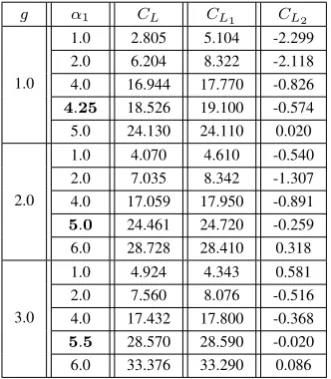
LIFT COEFFICIENT OF FLOW OVER TWO CIRCULAR CYLINDERS AT FIXED
Re= 20, α2= 0.0ANDg= 1.0,2.0,3.0FOR1.0≤α1≤6.0
g α1 CL CL1 CL2
1.0
1.0 2.805 5.104 -2.299 2.0 6.204 8.322 -2.118 4.0 16.944 17.770 -0.826
4.25 18.526 19.100 -0.574 5.0 24.130 24.110 0.020
2.0
1.0 4.070 4.610 -0.540 2.0 7.035 8.342 -1.307 4.0 17.059 17.950 -0.891
5.0 24.461 24.720 -0.259 6.0 28.728 28.410 0.318
3.0
1.0 4.924 4.343 0.581 2.0 7.560 8.076 -0.516 4.0 17.432 17.800 -0.368
5.5 28.570 28.590 -0.020 6.0 33.376 33.290 0.086
III and IV. The drag coefficients of both cylinders decrease
with increasing α1, at fixed g, (see in the third column of
Table III). The lift coefficients of both cylinders increase
with increasingα1,at fixedg,as shown in the third column
of Table IV. We found that in the case of fixed Reynolds
number, Re = 20, rate of rotation corresponding to zero
drag force ( ˜α1) increases when g increases. For example,
Table III shows that atRe= 20, α˜1 corresponding to zero
drag force are α˜1 ≈4.25, (g = 1.0), α˜1≈5.0, (g= 2.0)
and α˜1 ≈ 5.5, (g = 3.0). The streamline patterns from
the simulations are shown in Fig.1- Fig.3 . The streamline patterns and pressure contours in the case rate of rotation
corresponding to zero drag force ( ˜α1)are occurred forg=
1.0,2.0,3.0 with respectively (see in Fig. 2).
In the second part, the left cylinder is rotating α2 = 1.0
and the right cylinder is rotating in counterclockwise angular
velocity. The effect of the rotation rate α1 is demonstrated
in Tables V and VI. The values of drag and lift coefficients
in the case of fixed Reynolds number,Re= 20and various
gap spacing, g = 1.0,2.0,3.0 for 1.0 ≤α1 ≤6.0 are also
shown. The drag coefficients of both cylinders decrease with
increasingα1,at fixedg, (see in the third column of Table V).
The lift coefficients of both cylinders increase with increasing
α1, at fixed g, as shown in the third column of Table VI.
The simulations of streamline patterns are shown in Fig.4 - Fig.6. This work is a fundamental problem which can be applied to some classes of obstructed flow.
V. CONCLUSION ANDSUGGESTION
Numerical results show the flow structure over two rotating circular cylinders with different radii depend on the rate of rotation, the gap spacing and the Reynolds number. We
found that at fixed gap spacingg,the drag coefficient of both
cylinders decrease with increasingαand the lift coefficient
of both cylinders increase with increasing α. In addition
we obtain the rate of rotation corresponding to zero drag
force ( ˜α1) increases when g increases at fixed Re = 20.
However these results ( ˜α1) are not the numerical solutions
of self-motion regime because its satisfy only CD ≈ 0
but CL is not close to zero. Numerical solutions of flow
−6 −4 −2 0 2 4
−4 −2 0 2 4 6 8
0.126 −0.236 −0.598 0.126
0.488
0.85
0.126 −1.68 −0.15
−0.1
0.3 0
−0.15
−0.3
−0.05 −0.3 −0.05 0.3
1
α=0.0 α=2.0
−6 −4 −2 0 2 4 −4
−2 0 2 4 6 8
−0.317 0.0214
0.36
1.38
0.0214 −0.656
−1.33 −0.656
−1.67
−0.994
−2.35
−1.67 1.38
−1.45 −0.1
−0.03
0.1
−0.03
α=0.0 α=2.0
−6 −4 −2 0 2 4
−4 −2 0 2 4 6 8 0.242
0.555
0.869 −0.0716
−0.0716 −1.01
−0.385 −2.27
−2.58
−1.95
−2.89
−1.95
−2.27
−1.64 0.242 −1.01 1.81
−3.21
−2.7 −0.025
0 −0.025
[image:3.595.87.253.89.279.2]α=0.0 α=2.0
Fig. 1. streamline patterns of flow over two circular cylinders atRe= 20, g= 1.0,2.0,3.0andα1= 2.0, α2= 0.0.
TABLE V
DRAG COEFFICIENTS OF FLOW OVER TWO CIRCULAR CYLINDERS AT
FIXEDRe= 20, α2= 1.0ANDg= 1.0,2.0,3.0FOR1.0≤α1≤6.0
g α1 CD CD1 CD2
1.0
1.0 9.886 3.037 6.849 2.0 6.958 1.343 5.615 4.0 2.902 -0.924 3.826 6.0 1.543 -0.324 1.867
2.0
1.0 8.528 2.344 6.184 2.0 6.376 0.888 5.488 4.0 2.106 -1.270 3.376 6.0 0.994 -0.510 1.504
3.0
1.0 8.632 2.623 6.009 2.0 7.432 1.482 5.950 4.0 4.410 0.066 4.344 6.0 1.565 -0.355 1.920
[image:3.595.350.501.579.736.2]TABLE VI
LIFT COEFFICIENTS OF FLOW OVER TWO CIRCULAR CYLINDERS AT
FIXEDRe= 20, α2= 1.0ANDg= 1.0,2.0,3.0FOR1.0≤α1≤6.0
g α1 CL CL1 CL2
1.0
1.0 5.988 5.974 0.014 2.0 9.965 10.360 -0.395 4.0 21.765 22.110 -0.345 6.0 39.713 39.010 0.703
2.0
1.0 7.218 4.774 2.444 2.0 10.396 8.795 1.601 4.0 21.040 19.660 1.380 6.0 37.257 35.780 1.477
3.0
1.0 10.069 4.677 5.392 2.0 13.600 8.959 4.641 4.0 24.659 20.570 4.089 6.0 39.565 36.430 3.135
−6 −4 −2 0 2 4
−4 −2 0 2 4 6 8
1.09 0.346 −0.0265
0.346
0.718
1.46
−0.0265 −0.771
−3 −0.399
−1.89
0 −0.01
−0.2
−0.1 −0.1
0.1
α = 0.0 α=4.25
-6 -4 -2 0 2 4 -4
-2 0 2 4 6 8
-2.28
-3.04
-6.08
-8.36
-3.04
-1.52 -0.76 -2.04
-0.5 -2.08
-2.12
-1.8 -1.6
-1.6 -2.12 -2
α=4.25 α=0.0
−6 −4 −2 0 2 4
−4 −2 0 2 4 6 8
1.37 0.306 −0.0479 −0.0479
−0.401
0.306
0.659
−0.0479 −0.401
−1.46 −1.81 −1.81
−0.01
0.1 −0.25
−0.01
α=5.0
α=0.0
-6 -4 -2 0 2 4 -4
-2 0 2 4 6 8
1.34
0.458
-11.1
0.458 0.458
1.67 1.69
1.64
1.6
1.88
2 1.88 1.67 1.6
1.5
α=0.0 α=5.0
−6 −4 −2 0 2 4
−4 −2 0 2 4 6 8
0.999 0.638 −0.0835 −0.445
−0.0835
0.277
0.638
−0.0835 −0.445
−1.89 −1.53
0 −0.021
−0.021 −0.15
α=0.0 α=5.5
-6 -4 -2 0 2 4 -4
-2 0 2 4 6 8
0.205
-0.814
-4.89
-1.83 0.205
0.205
0.5
0.6 0.7
0.74 0.76
0.8
0.78
0.74
1 0.85 0.76
0.76 0.4
α=5.5 α=0.0
Fig. 2. Streamline patterns and Pressure contours of flow over two circular cylinders at Re = 20, α˜1 = 4.25 (g = 1.0), α˜1 = 5.0 (g =
2.0), α˜1= 5.5 (g= 3.0)andα2= 0.0
have to transform to another coordinate system. In addition, numerical solutions of fluid flow over two rotating circular
cylinders for self-motion regime with different radii and in cases of higher Reynolds numbers may be investigated for future works.
−6 −4 −2 0 2 4
−4 −2 0 2 4 6 8
1.43 0.679 −0.0772 −0.455 −0.833 −1.21
−0.0772
0.301
0.679
1.06
1.43
1.81
0.301
−0.0772 −0.455
−1.59 0
−0.02
0.1
0.03
α=0.0 α=5.0
−6 −4 −2 0 2 4
−4 −2 0 2 4 6 8
2.06 2.06 0.0863
0.0863 −0.309
−1.1
−2.29
−1.5
0.0863
0.482
−0.309 −0.705
−1.5
−1.1 0
−0.12
0.03
α=0.0 α=6.0
−6 −4 −2 0 2 4
−4 −2 0 2 4 6 8
1.19 0.809 0.0567 −0.32
−1.07
−1.45 0.0567
0.433
0.809
−0.32 −0.696
−1.07 −1.82 0 −0.06
−0.15
−0.06
[image:4.595.379.476.107.533.2]α=0.0 α=6.0
Fig. 3. streamline patterns of flow over two circular cylinders atRe= 20, α1= 5.0 (g= 1.0), α1= 6.0 (g= 2.0), α1 = 6.0 (g= 3.0)
andα2= 0.0
ACKNOWLEDGMENT
We would like to thanks the Faculty of Applied Science, King Mongkut’s University of Technology North Bangkok for supporting us in doing this work.
REFERENCES
[1] M. M. Zdravkovich, “Review of Flow Interference between Two Cir-cular Cylinders in Various Arrangements,”ASME J. Fluids Eng., vol. 99, pp. 618-633, 1977.
[2] S. Kang, “Characteristics of Flow over Two Circular Cylinders in a Side-by-Side Arrangement at Low Reynolds Numbers,”Phys. of Fluids, vol. 15, no. 9, pp. 486-498, 2003.
-6 -4 -2 0 2 4 -6
-4 -2 0 2 4 6 8
-1.53 -1.53
-1.76 -1.07
-1.3 -1.07
-0.837
-1.53 -1.76
-1.3 -0.146
-0.837
-0.837
-1.07 -0.607 -0.607
-2.22 -0.837
-2.45
-0.376
-1.47
-0.8 -1.47
-1.47 -0.8
α=1.0 α=2.0
-6 -4 -2 0 2 4
-6 -4 -2 0 2 4 6 8
-2.72 -2.51 -2.3
-2.09
-2.72
-2.93
-2.51 -2.51
-1.88
-2.09 -0.2
-0.831
-1.04 -0.621
-0.2 -1.25
-2.3
-2.09 -1.04
-3.14 -2.6
-2.6 -2.6 -2.6
-2.6
-1.47
α=2.0 α=1.0
-6 -4 -2 0 2 4
-6 -4 -2 0 2 4 6 8
-4.5 -4.5 -4.74 -4.97
-0.237
-1.42
-3.79 -0.71
-0.947 -0.474
-1.89
-4.03 -3.79
-4.03 -4.26
-0.71 -4.26
-4.6 -4.38
-0.8
-4.38
-0.8 -4.6
-4.38 -4.6
[image:5.595.49.539.57.352.2]α=1.0 α=2.0
Fig. 4. streamline patterns of flow over two circular cylinders atRe= 20, g= 1.0,2.0,3.0andα1= 2.0, α2= 1.0.
-6 -5 -4 -3 -2 -1 0 1 2 3 4 -6
-4 -2 0 2 4 6 8
-0.799
-1.06
-1.31
-1.06
-0.0277
-0.0277 -0.799 -2.09
-1.57
-2.6
-1.83
-1.31 -0.799 -0.542 -0.799
-0.542 -1.57
-1.19
-1.47 -0.8 -1.19
α=1.0 α=4.0
-6 -4 -2 0 2 4
-6 -4 -2 0 2 4 6 8
-2.43 -2.91
-2.19
-1.94
-1.7 -0.243 -1.7
-0.972 -1.46
-0.972 -1.46
-1.21 -0.972
-2.43 -1.7
-3.16
-5.59 -2.3
-0.8 -0.8
α=4.0 α=1.0
-6 -4 -2 0 2 4
-6 -4 -2 0 2 4 6 8
-4.2
-3.92 -3.64
-3.36
-3.08 -0.28
-0.839
-1.12
-1.68
-3.36 -2.52
-3.08
-2.8 -0.839
-5.6 -3.78
-3.22
-0.94
-3.22
-3.22 α=4.0 α=1.0
Fig. 5. streamline patterns of flow over two circular cylinders atRe= 20, g= 1.0,2.0,3.0andα1= 4.0, α2= 1.0.
[4] S. K. Panda, “Two-Dimensional Flow of Power-Law Fluids over a Pair of Cylinders in Side-by-Side Arrangement in the Laminar Regime,”
Braz. J. Chem. Eng., vol. 34, no. 2, pp. 507-530, 2017.
[5] S. Sungnul, “On the Representation of the Navier-Stokes Equations
-6 -4 -2 0 2 4
-6 -4 -2 0 2 4 6 8
-1.02 -1.35
0.618
-1.02 -0.0393
-1.68 -2.01
-3.65
-2.67 -4.31 -3.98
-0.696
-1.02 -1.35
-0.0393 -1.19
-1.19
-1.47
-0.8 -1.47
-0.8
α=1.0 α=6.0
-6 -4 -2 0 2 4
-6 -4 -2 0 2 4 6 8
-1.47 -0.111
-1.13
-1.47
-2.15
0.23 -1.13
-1.81 -3.17
-3.85 -2.83
-0.791 -2.34
-2.34 -0.8
α=6.0 α=1.0
-6 -4 -2 0 2 4
-6 -4 -2 0 2 4 6 8
-0.681
-0.341 -2.72
-2.72 -4.77
-1.02
-2.72 -1.02
-1.7 -2.38
-4.43 -4.09 -1.36
-5.11
-3.41 -2.5
-2.5 -1.2
-1.2
[image:5.595.50.284.395.688.2]-2.5 α=6.0 α=1.0
Fig. 6. streamline patterns of flow over two circular cylinders atRe= 20, g= 1.0,2.0,3.0andα1= 6.0, α2= 1.0.
in Cylindrical Bipolar Coordinate System,” in Proceedings in Annual National Symposium on Computational Science and Engineering 2005, pp. 340-348.
[6] S. J. Chorin, “Numerical Solution of the Navier-Stokes Equations,”
Math. Comp., vol. 22, pp. 745-762, 1968.
[7] D. B. Ingham and T. Tang, “A Numerical Investigation into the Steady Flow past a Rotating Circular Cylinder at Low and Intermediate Reynolds Numbers,” Journal of Computational Physics, vol. 87, pp. 91-107, 1990.
[8] D. Badr, S. C. R. Dennis and P. J. S. Young, “Steady and Unsteady Flow past a Rotating Cylinder at Low Reynolds Numbers,”Computer and Fluids, vol. 17, no. 4, pp. 579-609, 1989.