F O O D S :
T H E I R COMPOSITION A N D A N A L Y S I S , BY A. -WTNTER BLYTH, M.E.O.S., F.I.C., F.C.S., Barrister-at-Law, Public Analyst for the County of Devon, and Medical Officer of Health
for St Marylebone,
AND M. WYNTER BLYTH, B.A., B.Sc, F.C.S. " Sinrolv INDISPENSABLE in the Analyst's laboratory."—The Lancet.
-A^ew edition oiIMr Wynter Blyth's Standard work, ENRICHED WITH ALL THK HECENT DISCOVERIES AND IMPROVEMENTS, will be accepted as a l>oon."-Chemical News.
O T H E R STANDARD W O R K S . Crown 8vo, Handsome Cloth. With Diagrams. 7s. 6d. net. T O X I N E S A N D A N T I T O X I N E S .
By CARL OPPENHEIMER, PH.D., M.D., Of the Physiological Institute at Brlangen. TRANSLATED FROM THE GERMAN BY
C. AINSWOETH MITCHELL, B.A., B.Sc., F.I.C., F.C.S. With Notes, and Additions by the Author since the publication of the German Edition.
Deals icith the theory of Bacterial and other Toxines, mch as Tuberculin, Mcin, Cobra Poison, etc.
THIRD EDITION, Thoroughly Revised and Enlarged. 21s. FORENSIC MEDICINE A N D T O X I C O L O G Y .
BY J. DIXON MANN, M.D., P.E.C.P.,
Physician to the Salford Royal Infirmary ; Professor of Medical Jurisprudence and Toxicology, Owens College, Manchester; Examiner in Forensic Medicine,
London University, and Victoria University, Manchester.
"We consider this work to be one of the BEST TEXT-BOOKS ON FORENSIO MEDIOINK AND
TOXICOLOGY NOW IN PRINT, and we cordially recommend it to students who are preparing for their examinations, and also to practitioners who may bej in the course of their professional work, called upon at any time-to assist in the investigations of a medico-legal case."—The Lancet
With Illustrations. Handsome Cloth. 8s. 6d. net.
THE PHYSIOLOGY A N D PATHOLOGY O F THE U R I N E .
Br J. DIXON MANN, M.I)., F.E.C.P.
" Dr DIXON MANN is to l)e congratulated on having produced a work which cannot fail to foe of inestimable value alike to medical men and students, and whicli is in every resnect worthv of his high reputation."—Brit. Med. Journ. y
In Pocket size. Leather. "With Frontispiece. 8s. 6d. A HANDBOOK OF
MEDICAL J U R I S P R U D E N C E A N D TOXICOLOGY, FOE THE USE OF STUDENTS AND PRACTITIONERS.
BY WILLIAM A. BREND, M.A.CANTAB., M.B., B.SO.LONT>.,
Late Scholar of Sidney Sussex College, Cambridge, of the Inner Temple, Barrister-at-Iiaw. "We recommend it as a trustworthy work . . . . one specially suitable for «tmir->nfa «m,i practitioners of medicine the necessary facts only are Sate^/'-Lancet 8 t u d e n t s and
POISONS:
THEIE EFFECTS AND DETECTION.
BY
ALEXANDER WYNTER BLYTH,
M.R.C.S., F.I.C., F.C.S., &0.,
BARRI
STER-
AT-
LAW; PUBLI
A
N
D PUBLI
O
C
A
A
N
N
A
A
L
Y
L
Y
S
T
S
T
F
O
F
R THE
O
R THE
O
O
B
U
O
N
R
T
O
Y OF
U
G
H OF ST.
D
R
V
O
N ;
M
A
M
R
Y
E
L
D
E
B
C
I
O
A
N
L OFFI
K ;
ONR OF
H
K
A
L
T
H
A
N
D
MEREDITH WYNTER BLYTH,
B.A. (Cantab)., B.So. (Lond.), F.I.C., F.C.S., &C,
PUBLI
C
A
N
A
L
Y
S
T
B
O
F
O
R
R THE
O
U
G
H OF EASTBOURNE.
B
O
R
O
U
G
H OP BRI
GHTON,
A
N
D
A
L
S
O
F
O
R TIIK
F
O
T
X
K
T
H EDITION,
T
H
O
R
O
T
T
G
H
L
Y REVISED, ENLARGED,
A
N
D REWRITTEN.
illj %Mz% nnb glteutratioiw.
W t
CHARLES GRIFFIN AND
EXETER STREET, STRAND.
1906.
B Y expansion, in some directions, condensation i n others, the* present edition contains more information, without nuiteruil enlargement of the bulk of the volume, t h a n the edition which immediately preceded it.
A large portion has been rewritten, effete processes and unreliable reactions have been omitted. Newly discovered poisons and injurious substances which of recent years have come into popular use, such as sulphonal and trional, have "been added. Space has been found for a condensed account of recent ideas as to the constitution of the vegetable poisons; and we have felt that no work on toxicology would be complete without womo mention of the most powerful of all modern poisons, i.e. epincphrin. Special attention has naturally been given to arsenic, and to the delicate and reliable methods which are now available for its separation, identification, and estimation.
The authors hope t h a t their labours litivo been HO far SUCCOHN-ful t h a t the new edition will retain its place aw a recognised standard work on toxicology.
3 UPPER GLOUCESTER PLACE, W.,
PART L—INTRODUCTORY. I. THE OLD POISON-LORE. Section
1. Earliest Period—Myths as to Poison, . . . 1 2. Egyptian Knowledge of Poison, . . . 2 3. The Use of Poison by the Greeks and Romans—Nicandor,
Apollo-dorus, Dioscorides, 2-4 4. Asiatic Knowledge of Poisons, 4,5 5. Hebrew Knowledge of Poisons, . . . 5, t> 6. The part Poison lias played in History—The Death of JBritannkuiH—
A Commission of Murder—Royal Poisoners, . . . . 6-8 7. The Criminal Schools of Italy and Venice—TWaim—St. Oroix—The
Marchioness de Brinvilliers, . . . D-1JJ II. GROWTH A.NE DEVELOPMENT 01** THE MODEEN METIIGPB OF
CHEMICALLY DETECTING POISONS.
8, The growth of Pathology, 13, 14 9. The Treatise of Barthelemy d'Anglais—Porta's Work—Robert Boyle
—Richard Mead—Scheele and the Chemists of the Eighteenth
Century, 14, 15 10. Proust's Discovery of Arseniuretted Hydrogen—Marsh's Test,, . 15 11. Matthieu Joseph Bonaventura Orfila 15,16 12. The Discovery of the Alkaloids IB 13. Bibliography of the Chief Works on Toxicology (Nineteen kh
Century), , 16-1!)
PART II. I. DEFINITION OF POISON.
li. Legal Definitions of Poison, . 20, 21 15. The German and French Laws as to Poison, 2l' 22 16. Scientific Definition of a Poison, 22, 23
II. CLASSIFICATION OF POISONS.
17. General Classification of Poisons according to Symptoms, . . 23, 24 18. Eobert's Classification, 24 25 19. Classification followed in this Work, 25-20
III. STATISTICS.
^Influences causing Local Variation in the Proportion of Death from
21. EiiglTsTs'tatistics for the Ten Years ending 1903, . . . . 29~31 22. Relative Fatality of certain Poisons, 32
IV. THE CONNECTION BETWEEN TOXIC ACTION AND UHBMIUAL COMPOSITION. "3 Advance in Knowledge of the Relationsliip between Chemical and
Physiological Properties—The Influence of Iiydroxyl—Jiambergcr's
Observations, . . • • • , * , „ ' , . • • • 32-34 24. Physiological Effect of Replacing Hydrogen by Alkyls m Aromatic
Bodies—Overton's Researches—H. Meyer's Views on the Influence of the Solubility of Narcotic Substances iu the Fat of Living
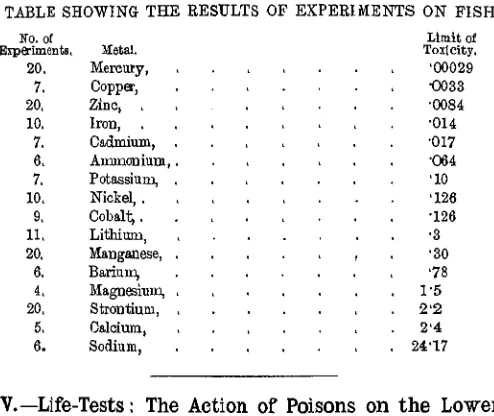
Protoplasm, 34-39 25. The Influence of CO Groups, . 39 26. Oscar Loew's Generalisations, . . . . • . . . 39-42 27. Mchet's Experiments on the Comparative Toxicity of Poisonous
Metals on Fish, 42 V. LIFE TESTS: THE ACTION OF POISONS ON THE LOWJ5II FORMS OF LIFE. 28. (1) Action of Poisons 011 the Red Blood Corpuscles ; (2) on Infusoria;
(3) on Cephalopoda; (4) on Insects, 42-45 29. The Effect of Poisons 011 the Heart of Cold-blooded Animals—
"Willliams* Apparatus—Jacobi's Apparatus, . . . . 45-48 30. The Effect of Poisons on the Iris—Toxic Myosis—Toxic Mydriasis, . 48
VI. GENEKA.L METHOD OF PEOCEDUEE IN SEARCHING FOR POISON. 31. Preliminary Examination—Distillation of Volatile Matters in a
Vacuum—Drying the Sample—Treatment by Volatile. Solvents, . 48-51 32. Methods of Destroying Organic Matter when Searching for Arsenic
Destruction by Heat—the Methods of G. Bcrfcmnd, Vurryken, Woehler and " Siebold—Basic Method—J. Ogior'n Method— A. Villiers'Method—-Process of Armand Gautior— Pagd's Process —Subsequent Treatment of Resulting Liquid by SI I., and then by
Ammonium Sulphide, "* t 51-56
VII. THE SPECTROSCOPE AS AN AID TO THE IDENTIFICATION OF CERTAIN POISONS.
33. Use of the Micro-Spectroscope—Oscar Branch's Observations on the
Absorption Bands produced in certain Tests, . . . . 56-&Q Examination of Blood or of Blood-Stains.
34. G e^1J ^e^ ~D r ag ^ d o r f T ' s Method-Solution of Blood by
35. Spectroseonic A^peknees of" Blood -Sulph^ioglobin-Carbon: ^ ^ E W Pr. ^ ^ ^ Cha™teristics of Carbon-monoxide
** M J 3 1 o o d-pf Pf ation of Hamatin Crystals—Guaiacum Test 60-65 36. Measurement of the Blood Corpuscles-Eatio of Potel toSo'da in
CONTENTS. ix PART III.-POISONOUS GASES: CARBON MONOXIDE-CHLORINE—
HYDBIC SULPHIDE. I. CARBON MONOXIDE.
Section Page 37. Properties of Carbon Monoxide, 68, 69 38. Symptoms—Acute Poisoning —Chronic Poisoning, . . . . 69, 70 39. Action of the Gas on the Blood and Nervous System, . . . 70, 71 40. Post-mortem Appearances, . . . . . . . 71,72 41. Mass Poisonings by Carbon Monoxide—The Leeds Cases—The
Dar-laston Cases, 72-74 42. Penetration of Carbon Monoxide, . • . . . 74,75 43. Detection of Carbon Monoxide—The Cuprous Chloride Reaction—
Hempel's Biological Test—The Iodine Pentoxide Method, . . 75, 76 II. CHLOHINE.
44. Preparation of Chlorine—Accidents in the Manufacture of Chlorine, 76, 77 45. Effects and Post-mortem Appearances, 77 46. Detection of Free Chlorine, 77,78
III. HYDRIC SULPHIDE.
47. General Properties, 78 48. Effects—the Hebburn-on-Tyne Cases—The Cleator Moor Cases, . 78, 79 49. Post-mortem Appearances—Chronic Poisoning, . . . . 79,80 50. Detection, 80
PART IV.—ACIDS AND ALKALIES.
SULPHURIC ACID—HYDROCHLORIC ACID—NITRIC ACID—ACETIC ACID—AMMONIA —POTASH—SODA—NEUTRAL SODIUM, POTASSIUM, AND AMMONIUM SALTS.
I. SULPHURIC ACID.
51. Commercial Forms of Sulphuric Acid—General Properties,
52. Sulphur Trioxide or Sulphuric Anhydride, . . . . . 53. Occurrence of Free Sulphuric Acid in Nature,
54. Statistics, .
55. Accidental, Suicidal, and Criminal Poisoning, . . . . 56. Fatal Dose,
57. Local Action of Sulphuric Acid, . .
58. Action of Sulphuric Acid on Vegetation, on Wood, on Paper, on Carpets, on Clothing, and on Iron—Caution in judging of Spots, 59. Symptoms—External Effects—Internal Effects, . . . . 60. Treatment of Acute Poisoning by the Mineral Acids,
61. Post-mortem Appearances—Oscar Wyss' Case—Fraenkel and Reiche's Observations on the Effects of the Acid on the Kidney,
62. Pathological Preparations illustrative of Fatal Sulphuric Acid Poisoning in the various London Museums, . • .
63. Chronic Poisoning by Sulphuric Acid,
Detection and Estimation of Free Sulphuric Acid.
64. Quinine Method—Solution of Free Acid by Alcohol—Hilger's Test, . 93, 94 65. Sulphates in the Urine — Changes in the Urine produced by
Sulphuric Acid, 94-96 66. Effects of the Acid on the Blood, 96 67. Amount of Ordinary Sulphates in Food, 96,97
II. HYDEOCHLOEIC ACID.
Section Page 68. General Properties—Uses, 97-99 69. Statistics of Poisoning "by Hydrochloric Acid, 99 70. JatalDose, 99 71. Amount of Free Acid in the Gastric Juice—Researches of Lehrnann,
Bernard, Schmidt and others, 99, 100 72. Influence of Hydrochloric Acid on Yegetation, . . . . 100,101 73. Action upon Cloth and Manufactured Articles, . . . . 101 74. Poisonous Effects of Hydrochloric Acid Gas, 101, 102 75. Effects of the Liquid Acid—A. Lesser's Experiments—Illustrative
Cases, 102,103 76. Post-mortem Appearances—Museum Preparations, . . . . 103,104
Detection and Estimation of Free JSydroc7iloric Acid. 77. (1) Detection— Giinzburg's Test—Benzo-Purpurin—The Process of
A. Villiers and Favolle ; (2) Estimation—Method of Sjokvdst—
Braun's Method, 105-107 78. Identification of Hydrochloric Acid Stains on Fabrics, . . . 108
III. NITRIC ACID.
79. General Properties and Commercial Varieties, 109 80. Use in the Arts, 109 81. Statistics of Poisoning by Nitric Acid, 109 82. Fatal Dose, 109, 110 83. Action of Mtric Acid on Vegetation; . . .' . . 110 84. Mtric Acid Yapour—Eulenberg's and Lassar's
Researches—Illustra-tive Cases, 110, 111 85. Effects of Liquid Nitric Acid, 111,112 86. Local Action, 112 87. Symptoms, 112, 113 88. Post-mortem Appearances—Museum Preparations, . . . . 113-115 89. Detection and Estimation of Nitric Acid, 115, 116
IV. ACETIC ACID.
90. Statistics—Symptoms—Detection, 116 V. AMMONIA..
91. Properties, 116, 117 92. Uses—Officinal and Commercial Preparations, 117,118 93. Statistics, • 118 94. Poisoning by Ammonia, "Vapour, . . . 118 95. Symptoms, 118, 119 96. Chronic Effects of the Gas, 119 97. Ammonia in. Solution—Action on Plants, 119 98. Action on Human Beings and Animal Life—Effects on the
Blood-Symptoms, 119-121 99. Post-mortem Appearances—Museum Preparations, . . . . 121 100. Separation of Ammonia, 121,122 101. Estimation, 122
VI. OAtrSTIC POTASH A.ND SODA.
CONTENTS. XI
Section f>^°
107. Sodae Carbonas—Carbonate of Soda, 123 108. Bicarbonate of Soda, 123,124 109. Statistics, 124 110. Effects on Animal and Vegetable Life, 124 111. Local Effects, 124, 125 112. Symptoms, 125 113. Post-mortem Appearances—Museum Preparations, . . . . 125,126 114. Chemical Analysis, 126,127 115. Estimation of the Fixed Alkalies, 127
VII. NEUTRAL SODIUM, POTASSIUM, AND AMMONIUM HALTS.
116. General Poisonous Characters of Large Doses of Salts of the Alkalies, . 127,128 117. Effects of Sodium Salts, 128 118. Effects of Potassium Salts, 128 119. Action on the Prog's Heart, 128 120. Action on Warm-blooded Animals, . . . . . . . 128 121. Elimination, 128 122. Nitrate of Potash—General Properties, 129 123. Statistics of" Nitre" Poisoning, 129 124. Uses of "Nitre "in the Arts, 129 125. Action of Nitrates of Sodium and Potassium—Poisonous Action of
Sodic Mtrite, 129 126. Post-mortem Appearances from Potassic Nitrate, . . . 130 127. Potassic Chlorate—G-eneral Properties, . . . . . . 130 128. Uses, 130 129. Poisonous Properties, 130 130. Experiments on Animals—Effects on Blood—Effects on tho Kidney, 130, 131 131. Effects on Man—Illustrative Cases, 131 132. Nephritis from Chlorate Poisoning, 131,132 133. Elimination, 132 134. Essential Action of Potassic Chlorate, 132
Detection cold Estimation of Eoktssic Qhloratc. 135. Separation from Organic Fluids—Tests—Treatment of Urine for
Chlorate, 132, 133 Toxicolocjical Detection of A Ucali 8aUs.
136. Separation of Potassium, Sodium, and Ammonium Salts from the
Contents of the Stomach, 133} i• j4
PART V.-MORE OK LESS VOLATILE POISONOUS SUBSTANCES OAP-ABLE OF BEING SEPARATED BY DISTILLATION FEOM NEUTKAL OR ACID LIQUIDS.
HYDBOCARBONS — CAMPHOR—ALCOHOL — AMYL NITJIITK — ETHBII—-OHLOHOFOIIM
AND OTHER AESTHETICS—CHLORAL—CARBON DrSULl>HIDJfi— CAIUJOLIO AOID
—NITHO-BENZENE—Pjaussio ACID—PHOSPHORUS.
I. HYDROOAKBOiNS. 1. JPetroleum.
137. Petroleum: General Properties, 135
138. Cymogene, . . . .
139. Hhigolene, . \ \ \ \ ^
i t f knzoline-Petroleum Spirit-Petrol-^rieties of Naphtha and dis- *
tinguishiiig Tests, . i6*> ;
142. Paraffin Oil, . * • 143. Effects of Petroleum, . . . • - • • • • 144. Cases of Poisoning, ., • • ' { 145. Separation and Identification of Petroleum,
•2. Coal-Tar —Naphtha—Bcnzme.
146. General Properties, . • 1 147. Case of Poisoning by the Liquid, ] 14S. Eulenberg's Experiments on the Vapour, . . . } 149. Detection and Separation of Benzene- Purification—Con version into
JTitro-Benzene—Conversion into Aniline, 138, 1 3. Terpenes—Essential Oils—Oil of Turpentine 150. Terpones—Cedrenes—Coloplienes, 1
4. Oil of Tur$mti%c—Spirit of Turpentine—•" Turps." 151. French, English, and American Turpentines—Distinguishing
Char-acters and Reactions, 139, 1-152. Effects of Turpentine, 1
II. CAMPHOR.
153. General Properties, 1< 154. Pharmaceutical Preparations, . . . . 1/ 155. Symptoms of Poisoning by Camphor, 141,14 156. Post-mortem Appearances, . . . . . . . . \t 157. Separation of Camphor from the Contents of the Stomach, . . 14
III. ALCOHOLS. 1. Ethylic Alcohol.
158. Statistics of Alcohol Poisoning, 14 159. Criminal or Accidental Alcoholic Poisoning, . . . 142-14 160. Fatal Dose 14
161. Symptoms, 144} 14
162. Postmortem Appearances, 145' 14 163. Excretion of Alcohol, 146,' \£ 164. Toxicological Detection of Alcohol—Conversion into the
Pinitro-benzoate Esters, 147 14; 2. Amylic Alcohol.
165. Physical Properties of the Amy lie Alcohols, m 166. Poisonous Effects of Amy lie Alcohol, . . . . " . ' . 141 167. Identification of Amylic Alcohol, . . . 14j 168. Amyl Nitrite—Iso-amyl Ester titrate—Physiological Elliots—
Post-mortem Appearances, 148 14 J IT. ETHEtt.
\n 5 S ? TE t¥ .i c E t l l e r' Vth?1 Oxide-Chemical Properties of, . . 14£
170. Ether as a Poison. . r ' IAQ ir/i
CONTENTS. X131 V. CHLOROFORM.
Section Pago 17*. Physical and Chemical Properties of Chloroform—Tests for Purity,. 151-153 175. Method of Manufacture, 153
1. Chloroform cos a Liquid.
176. Poisonous Effect of Liquid Chloroform—Statistics, . . . . 153 177. Local Action of Chloroform, 153,154 178. Action on Blood, Muscle, and Nervous Tissue, . . . . 154 179. General Effects of the Liquid, 154,156 180. Fatal Dose of the Liquid, USi 181. Symptoms, 155, 156 182. Post-mortem Appearances, . . 156
2. The Vapour of Chloroform,
183. Statistics of Deaths from Chloroform Vapour, 156,157 184. Suicidal and Criminal Poisoning by Chloroform, . . . . 157 185. Physiological Effects, 157,158 186. Symptoms produced by the Vapour, . . . 158,159 187. Chronic Chloroform Poisoning, 159 188. Post-mortem Appearances, . . . 159, 1 GO 189. Detection and Estimation of Chloroform, . . . 3 (JO 190. Estimation of Chloroform, 1(51
VL CHLORAL.
191. Chemical Properties of Chloral—Statistics of Chloral Poisoning, . 1(51, 102 192. Detection of Chloral Hydrate, 162 193. Assay of Chloral Hydrate, 162, 163 194. Effects of Chloral Hydrate on Animals, 103,164 195. Action of Chloral on the Blood, 164 196. Effects of Chloral Hydrate on Man, 164 197. Fatal Dose, 105, 1.65 198. Symptoms, 160 199. Treatment of Acute Chloral Poisoning, 106,167 200. Chronic Poisoning by Chloral Hydrate, 167 201. Excretion of Chloral—Separation of Uro-Chloral from the Urino, . 168 202. Separation of Chloral from Organic Matters—Tests for Chloral, . 109, 170
TIL MINOIt ANESTHETICS AND NAI10OTIO8. 203. Substitutions of the Hydrogen by Chlorine in Methane—M'otliano
Dichloride, 170 204. Pentane—Pental, . 370 205. Aldehyde (Acetaldehyde)—Metaldohydc, "170 206. Paraldehyde, 170 207. Somoform, 170, 171 208. Sulphones—Sulphonal, Trional, Tetronal—Oases of Poisoning hy
Sulphones—Separation and Identification of the Snip]]OIUJH, . 171, 17iJ 209. Veronal (Diethyl-fcarbaturic Acid), 172
VIII. BISUXPIIIDE OF CAKIJOK.
IX. THE TAB ACIDS—PHENOL—CEESOL. Section
216. CaTboUc Acid (Phenol)—Properties of . • • - • . 174, 217. Commercial Varieties—Calvert's Carbolic Acid Powder—Carbolic
Acid Soaps, 218. Uses of Carbolic Acid,
219. Statistics of Carbolic Acid Poisoning, . . . . 1 7 6 -220. Fatal Dose,
221. Effects on Animals—Infusoria—Fish—Frogs, . . . . . 1 7 8 , 222. Effects on Warm-blooded Animals—Rabbits—Cats—Mice, etc.,
223. Symptoms in Man—External Application—Illustrative Cases, . igQ_ 224. Internal Administration, . 1 8 2 225. Symptoms of Carbolic Acid Poisoning,
226. Changes in the "Urine from Carbolic Acid, . . . jg3_ 227. The Action of Carbolic Acid considered physiologically,
228. Excretion of Carbolic Acid, 135^ 229. Post-mortem Appearances—Museum Preparations, . . . . 230. Tests for Carholic Acid—the Pinewood Test—Ammonia and
Hypo-ehlorite—Ferric Chloride—Bromine,
231. Quantitative Estimation of Carbolic Acid, . . . . . 1 8 7 232. Cresol (Cresylic Acid, Methyl-Phenol)—Ortho-, Meta-, and Para- ' Cresol—Commercial Cresol, 188, ! 233. Creasote and Kreozote, ;
234. Carbolic Acid in Organic Fluids, :
235. Examination of the Urine for Phenol or Cresol, . . . . 190-i 236. Assay of Disinfectants—Carbolic Acid Powders—Bromine Method—
Colorimetric Method of Estimation, ] 237. Analysis of Carbolic Acid Powders, 192-1 238. Analysis of Carbolic Acid Soap, j
X. NITKO-BENZENE.
239. Properties and Commercial Varieties of NTitro-Benzene, . . . j 240. Effects of Poisoning by Nitro-Benzene, . . . 193 1 241. Poisoning by Nitro-Benzene Yapour, . . . ] 194'1 242. Poisoning "by Liquid N"itro-Benzene, . . " ' 195* 1 243. Fatal Dose, '.'.'. ' 1 244. Pathological Appearances, " ' j 245. Physiological Action of Nltro-Benzene, . . . . " ! j 246. Detection and Separation of Nitro-Benzene from Animal Tissues, . 197,1
XL DINITRO-BENZOL.
247. Dinitro-Benzol (Ortho-, Meta-, Para-)—Physical and Chemical
Properties, . . . . ica i<
248. Effects of Dinitro-Benzol, . 1QQ9( 249. The Blood in Nitro-Benzol Poisoning ' ' ono 9 250. Detection of Dinitro-Benzol, . . ." ." ] ; 201,2(
XII. HYDEO0YAKIC ACID.
251. General Properties of Hydrocyanic Acid or 252. Medicinal Preparations of Prussic Acid ' n,c\ 253. P o^ ^t| ^ ^ i c Acid-Use of the Acid in the Arts^Oocaixence
254. Laurocerasin, .
20 20
CONTENTS. XV Section Page 260. Symptoms in Dogs, 210, 211 261. Symptoms in Man, 211, 212 262. Poisoning by the Cyanide G-lucosides—The Rotterdam Oases, . . 212,213 263. Chronic Poisoning by Hydric Cyanide, 213, 214 264. Post-mortem Appearances, 214, 215 265. Tests for Hydrocyanic Acid and Cyanide of Potassium—Schonbein's
Test—Robert's Test, 215-217 266. Separation of Hydric Cyanide or Potassic Cyanide from Organic
Matters, 217-219 267. How long after Death can Hydric or Potassic Cyanides be Detected 1 219, 220 268. Estimation of Hydric or Potassic Cyanides, 220 269. Case of Poisoning by Bitter Almonds, 220, 221 Poisonous Cyanides other than Hydric and Potassic Cyanides. 270. Sodic and Ammonic Cyanides, 221 271. Action of Potassic Ferrocyanide—Silver Cyanide— Sulphocyanides
—Methyl Cyanide—Toxic Dose of the Nitriles, . . . . 221-224 XIII. PHOSPHORUS.
272. Chemical and Physical Properties, 224, 225 273. Phosphuretted Hydrogen—Phosphine, 225, 226 274. Medicinal Preparations of Phosphorus, . . . 226 275. Matches and Vermin Pastes, 226-228 276. Statistics of Poisoning by Phosphorus, 228, 229 277. Fatal Dose, 229 278. Effects of Phosphorus, 229 279. Varieties of Symptoms Produced, 229, 230 280. Common Form, 230, 231 281. Hsemorrhagic Form, 231 282. Nervous Form, 231, 232 283. Sequelae, 232 284. Period at which the First Symptoms commence, . . . . 232 285. Period of Death, 232 286. Poisoning by Phosphorus Vapour, 232-234 287. Chronic Phosphorus Poisoning, 234 288. Changes in the Urinary Secretion, 234, 235 289. Changes in the Blood, 235 290. Antidote—Treatment, . 235 291. Poisonous Effects of Phosphine, 235,236 292. Action of Phosphine on the Blood, . . . . 236,237 293. Post-mortem Appearances—Museum Preparations, . . . . 237, 240 294. Changes produced in the Kidneys, Heart, and Lungs, . . . 240, 241 295. Diagnostic Differences between Acute Yellow Atrophy of the Liver
and Fatty Liver produced by Phosphorus, 241 296. The Detection of Phosphorus—Mitscherlich's Process—The
Produc-tion of Phosphine—Tests dependent on the CombusProduc-tion of
PART VI.— ALKALOIDS AND POISONOUS VEGETABLE PRINCIPLES SEPARATED FOR THE MOST PART BY ALCOHOLIC SOLVENTS.
DIVISION I.—VEGETABLE ALKALOIDS.
I. GENERAL METHODS OF TESTING AND EXTBAOTING ALKALOIDS. Section Pag< 301. General Tests for Alkaloids, 248 302. Group Reagents—Iodine in Hydriodic Acid—Iodine and Potassic
Iodide—Mercuric Potassic Iodide—Bismuthic Potassic Iodide— Iodised Parethoxyphenyl Succinimide — Chloride of Gold —
Platinic Chloride, 248, 249 303. (1) Phosphomolybdic Acid as a Reagent for Alkaloids ; (2)
Silico-Tungstic Acid as a Reagent for Alkaloids ; (3) Scheibler's Method
for Alkaloids—Phospho-Tungstic Acid, 249-251 304. Schulze's Reagent, 251 305. DragendorfPs Reagent—Marine's Reagent—Potass-Zinc Iodide, . 251 306. Colour Tests—Fronde's Reagent—Mandolin's Reagent, . . . 251 307. General Processes for the Separation of Alkaloidal Substances from
Organic Matters—Kippenberger's Process, 252, 253 308. Sehni's Process, 253, 254 309. DragendorfPs Process—Kippenberger's Modification of DragendorfPs
Process, 254-256 310. Scheibler's Process, 256, 257 311. Grandval and Lajoux's Method, 257 312. Identification of the Alkaloids, " 257 313. Behrens' Method of Identification of the Alkaloids, . . . . 257, 258 314. Sublimation of the Alkaloids, . 259-262 315. Melting-point of the Alkaloids, 262,263 316. Identification by Organic Analysis—Methoxyl Groups—Nitrogen, . 264 317. Quantitative Estimation of the Alkaloids, 264-266
II. LIQUID VOLATILE ALKALOIDS.
THE ALKALOIDS OF HEMLOCK-—NICOTINE—PITFKIE—8PAHTEINE. 1. The Alkaloids of Hemlock (Conium).
318. Characters of the Hemlock Plant, 266 319. Coniine—Synthesis of Coniine—Characters of Coniine—Tests, . 266-268 320. Constitution of the Coniine
Bases—Coniceines—Conhydrin—Pseudo-conhydrine—Methylconiine, . . . 268,269 321. Pharmaceutical Preparations, 269, 270 322. Statistics of Coniine Poisoning, 270 323. Effects on Animals, 270,271 324. Effects on Man, 271 325. Physiological Action, 271 326. Post-mortem Appearances—Fatal Dose, 271,272 327. Separation of Coniine from Organic Matters or Tissues, . . . 272
2. Tobacco—Nicotine.
328. The various Species of Tobacco—Composition of the Fresh Leaves, . 273 329. Quantitative Estimation of Nicotine in Tobacco—Keller's Process—
The Polarimetric Method of Popoirci—Estimation by Cox of
CONTENTS. xvil Section Page 333. Cases of Tobacco Poisoning—Tobacco Smoke— External Application
of Tobacco Leaf, 279-281 334. Physiological Action, 281,282 335. Fatal Dose, 282 336. Post-mortem Appearances, . . . 282 337. Separation of Nicotine from Organic Matters 282,283 337A. Antidote to Nicotine, . . . 283
3. Piturie.
338. Chemical and Physical Characters of Piturie, 283, 284 4. S'parteine.
339. Chemical and Physical Characters of Sparteine, . . . . 284 5. Aniline.
340. Properties of Aniline, 284 341. Symptoms and Effects—Chronic Poisoning—Post-mortem
Appear-ances, 284, 285 342. Fatal Dose, 285 343. Detection of Aniline, 285
III. THE OPIUM GROUP OF ALKALOIDS.
344. General Composition—List of Alkaloids and other Principles—
Analysis of Samples of Opium, 286,287 345. Action of Solvents on Opium, 287 346. Assay of Opium—Process of Teschemacher and Smith—Dott's
Process—Douzard Method, 287-289 347. Medicinal and other Preparations of Opium—(1) Officinal ; (2) Patent
and other No&«Qfficinal Preparations of Opium, . . . . 290-293 348. Statistics of Opium Poisoning, 293,294 349. Poisoning of Children by Opium, . . . . . . . 294 350. Doses of Opium and Morphia, 294,295 351. General Method for the Detection of Opium, 295,296 352. Morphine: Chemical and Physical Characters of, . . . . 297 353. Morphine Salts, 297,298 354. Constitution of Morphine and Codeine, 298, 299 355. Tests for Morphine—Robert's Test—Iodic Acid Test—Vanadic Acid
Test—Tungstic Acid Test- Titanic Acid Test and other Reactions, 300-303 356. Symptoms of Opium and Morphine Poisoning—Action on Frogs,
Dogs, Goats, Cats, and Birds, 303,304 357. Physiological Action, 304,305 358. Physiological Effect of Morphine Derivatives, 305,306 359. The Forms of Opium and Morphine Poisoning—Illustrative Cases, . 306-309 360. Diagnosis of Opium Poisoning, . 309,310 361. Opium-eating—Opium-smoking, . . . 310-312 362. Treatment of Opium or Morphine Poisoning, 312 363. Post-mortem Appearances, . . 312,313 364. Separation of Morphine from Animal Tissues and Fluids, . . 313, 314 365. Extraction of Morphine, 314, 315 366. Narcotine: Chemical and Physical Properties—Behaviour of
Nar-cotine with Reagents—Constitution of NarNar-cotine, . . . 315-317 367. Effects of Narcotine, 317 368. Codeine : Chemical and Physical Properties, 317,318 369. Effects of Codeine, . . 318,319 370. Narceine: Physical and Chemical Properties of Narceine and its
Section
371. Effects of Narceine, . . • • 320,321 372. Papaverine : Chemical Properties and Tests, 321 373." Effects of Papaverine, . . • • • • • • 321, 322 374 Thebaine • Physical and Chemical Properties of, . . . . 3 2 2 37o! Effects of Thebaine, 322,323 376. Cryptopine, 323 377. Pseudomorphine, 323 378. Apomorphine, - . • • . • 323, 324 379. Laudaiiine—Laudanidine—Laudanosme, 324 3So! Tritopine, 324 S81. Meconine, m • , • 0 * • • • 324 38*2. Meconic Acid : Chemical Properties—Tests for—Separation of, . 324, 325
IV. THE STRYCHNINE OR TETANITS-PUODUOINf* GROUP OF ALKALOIDS. 1. Nux Vomica Ordnp—Strychnine—JBruclne—Ic/asurine. 383. General Characters of JSTux Vomica Seeds, 325-328 884. Chemical Constituents of Nux Yomiea Seeds 326 385. Strychnine: Chemical and Physical Characters of, . . . . 326-328 3S6. Strychnine Salts, 328, 329 387. Pharmaceutical and other Preparations of ISTux Yomiea and
Strychnine, with Suggestions for their Valuation—Separation of
the Alkaloids from Nux Yomiea—Tests—Vermin-killers, . . 329-332 388. Statistics of Death from Strychnine—the Series of Murders by
Thomas Neill Cream—The Palmer Case, 332-334 389. Fatal Dose—Falek's Researches—Illustrative Cases, . . . 334-337 390. Action on Animals^ ^ 337^ 333 391. Effects on Man—Distinction between Tetanus from Strychnine and
" Disease Tetanus," 338-340 392. Diagnosis of Strychnine Poisoning, 34O
393. Physiological Action, 34Q? 341
394. Post-mortem Appearances, .* 34l' 342 395. Treatment, " ' 342 396. Separation of Strychnine from Organic Matters, . . . . 342-345 397. Identification of the Alkaloid, * 346 347 398. The Physiological Test for Strychnine, . . . . . . 347'348
399. Hypaphorine, • • • . . . * '348
400. Quantitative Estimation of Strychnine, . . . ." * " 348 349 401. Bracine—Solubility and Chemical Properties of Briicine,' '. \ 349' 350 402. Physiological Action, * 350' 3 ^
m' Tests> ' • ' . ' . ' . ' . ' . 351,' 352
2. The Quebracho Ch-oup of Alkaloids.
404. The Alkaloids obtained from Quebracho Blancko w 405. Aspidospermine, . ' lit 406. Quebrachine, . . - . . . ' ' ?f?
3. fereirine.
m- P e r a i r i n e .353
4. Gelsemme.
408. aelsemine and Gelseminine, . o*o - , 409. Fatal Dose, . 353> 3 5 4
410. Effects on Animals oer 3^
CONTENTS.
5. Coca Alkaloids—Cocaine,.
Section Page 413. The Alkaloids in the Leaves of Eryfhroxylon coca—Cocaine, . . 356 414. Cocaine Hydrochloride, ,. 357 415. Pharmaceutical Preparations, 357 416. Separation of Cocaine and Tests, 357, 358 417. Symptoms, . 358, 359 418. Post-mortem Appearances, . . . 359 419. Fatal Dose, 359
6. Coryclalinc.
420. Alkaloids extracted from the Root of Corydalis cava—Corydaline, . 359, 360 V. THE ACONITE GROUP OF ALKALOIDS.
421. Description of the Aconitwm, napellus, 360 422. Pharmaceutical Preparations of Aconite 360,361 423. Dunstan's Researches—The Groups of Aconitine Alkaloids—The
Aconitine Group—The Pseudaconitines and the Atisine Group— The Melting-points and Specific Rotations of the Alkaloids and
the Melting-point of the Gold Salts, 361,363 424. Aconitine: Extraction and Properties, 363 425. Tests for Aconitine, 364 426. Benzoyl-Aconine, 364, 365 427. The Lethal Dose of Aconitines, 365,366 428. Effects of'Aconitine on Animal Life : Insects, Fish, Reptiles,
Frogs-Action of Aconitine on the Heart—Effects of Indaconitine—Birds
—Mammals, 366-370 429. Statistics of Aconite Poisoning, 370 430. Effects on Man, 370 431. Poisoning by the Root, 370,371 432. Poisoning by the Alkaloid Aconitine, 372-374 433. The Lamson Case, 374 434. Poisoning by Medicinal Preparations of Aconite, . . . . 375 435. Physiological Action, 375 436. Post-mortem Appearances, 375, 376 437. Separation of Aconitine from the Contents of the Stomach or the
Organs, 376, 377 VI. THE MYDRIATIC GROUP OF ALKALOIDS—ATttOPINE—HYOSOYAMINK—
80LANINE—CYTLSINE. 1. Atropine
438. Alkaloids in Plants belonging to the Solanaccm, . . . . 377, 378 439. Atropine—Alkaloidal Content of the Belladonna Plant, . . . 378,379 440. The Datura stramonium,—Distinction between Seeds of the Datura
and those of Capsicum, 379,380 441. Pharmaceutical Preparations of Belladonna, . . . 380 442. Properties of Atropine—Constitutional Formula, . . . . 380,381 443. Tests for Atropine—Distinction between Hyoscyamine and Atropine
—Strychnine and Atropine—Action of Atropine on the Iris, . . 381-384 444. Statistics of Atropine Poisoning, 384,385 445. Accidental and Criminal Poisoning by Atropino. . . . . 385, 386
446. Fatal Dose, . ' . . . . 386
2. Hyoscyamine.
Section m Pag<
454. Distribution and Properties of Hyoscyamine, . 391-39? 455. Pharmaceutical and other Preparations of Henbane, . . . 393, 39< 456. Dose and Effects; . . • * . • , . - • ' ' • • 391 457. Separation of Hyoscyamine from Organic Matters, . . . . 391
3. JScopolamine.
458. Scopolamine, 395, 391 459. Pseudo-hyoscyamine, 391 460. Atropaniine, 391 460A.Belladonnine, 391
4. Solanine.
461. Distribution of Solanine, 396, 39' 462. Properties of Solanine, . 39; 463. Solanidine, 397, 39! 464. Poisoning from Solanine, 39* 465. Separation of Solanine from the Tissues of the Body, . . . 39^
5. Cytisine.
466. The Cytisus laburnum—Cytisim, 398, 39< 467. Reactions of Cytisine, . 399, 4O( 468. Effects on Animals, 40( 469. Effects on Man, 400, 401
VII. THE ALKALOIDS OF THE VBRATIUTMS.
470. The Active Principles in Veratrum sadadiUa, V. album, and
V. viride—Chemical Properties of the Alkaloids, . . . 401-4CK 471. Yeratridine—Veratric Acid—Oevadine, 403, 40^ 472. Jervine, 404 473. Pseudo-jervine, 4CH 474. Protoveratridine, . 404, 40£ 475. Rubi-jervine, . . . 40£ 476. Yeratralbine, 40£ 477. Yeratroidine, 405, 40 ( 478. Commercial Yeratrine, 40( 479. Pharmaceutical Preparations, 406, 40/ 480. Fatal Dose, 40^ 481. Effects on Animals—Physiological Action, 40/ 482. Effects on Man, 407, 40*
483. Symptoms, . . . 40*
484. Post-mortem Appearances, ' 40£ 485. Separation from Organic Matters, 408, 40J
VIII. PHYSOSTIGMItfE.
CONTENTS.
IX. PILOOAKI'INK.
Section pag0
41)5. Thc.» Alkaloids of the Jaburandi, 414. 495. Piloearpiuo, m 414
41)7. TUHIH, * 4X4, 415
498. EflccUiuf rilcKJarpiinj—iHopiloctti'iJino —Pilocarpidiuo, . , . 415,416 X. TAXINIS.
490. Poisonous Proportion ol'Taxiuo—Oliunihwl Properties of Taxiuo, . 4l(> 500. Poisoning by Yuw, . 415 501. Kdbcls on Animals-- Physiological Action, . . . . 4i(> 417 502. KfltetHon Man, 417 503. PoHt-morlom AppuuraiiiHitf, 417
XI. OtfllMtK ALKALOIDS.
504. Tho yaritttioH of Uuniro—Imitation of the (Juraro Alkaloids, . . 418, 419 505. "PhyNiological EttaoU), . . , . . , . . , 4 1 9 , 420 506. Separation of (Jurariuo, 420
XIL C!(>W.!HI0INK.
507. OnnUml of Alkaloid in Caluhioum HCIKIH, 421 508. Oolc.hicixii?— Kxtmction—Ohmnusal Oompowtion, . . . . 421,422 501). Trsst^ 422 510- Phannaconlicfil ProparatiuiiB—Qiuwk and PuU.»nt ModiuiUCH, . . 422, 423 511. i'YUul I)<»»€, 423 512. KITMIH <ri (UArMv.im on Atnituiln, . . . . . 423 513. KiriKjtHofOfiloliiciimojiMaii, 424,425
514. iSyuiptoiTiH pr(j(lvtc.<j(l by Cole hi 01 in %—INiHirXunrtutn Appoarfiucos, . 425 515. iS(t|)arat;toti of OolchioiiK! froni Orgttiiic Matkot'H, . . . . 425, 426
XIII. Ml/HCMRINJC AND TUB AOTIVK I'ltlNiJIl'MCH OFOKRTAIM FUNGI. 510, Th«? AmmiUa irtUHcnria — Botanical ChaiucLc.i'H—EfloctH on the
Inltalut-iintrHof KiuuHchfitktt, 42G, 427 517. l'l^Hntiin^ by tlu» Amanitit., and PoHt-rnorUtni (.J1 uifjusU9rIHt#i«JH, . . 427 518. AluH«ariim: Olumiical and PliyHiolotficnl ProjicrLuiH, . , . 427,428 Mil. Aningmimtic Action of Atrojnno antl MuNctnrino, . . . . 428,429 520. J)(»t<wti«»u of MuHcnriiK! 429 5*J1. Thr JijnrictiH: pfm/faidM, 421), 430 51i2. PoHt-iitorUun Ap}i«*araii('-*'H, . . . 4J3O 5tiH. Thu AgnrJcHH lumthcriniix -TIHJ slyaricntf rHbwt . . . . 430, 431
524. Th« JtotdUH tifilwtfiit, t . . . . . . . . <\21
5U5. TIKJ (Joimnoit Mondlo, . . . . . . . 431
DlVIWON 'II.— (ililfCOHUlKH.
5iiO. ihmfu-iption nfilm Koxglovn, * 431,432 5*JH. Digitahan, 432
g g ^ ,
5:JO. Digititliii, 432, 433 531. I)igiliil«tin, . 433 532. Digitftfiu, 433 5*)*JA.Mr!|uirtttintk uf Digitoxin from Qr^iutic Muttorn, . . . . 433, 434 533* DigiUbrutin 'rartwligital«ti»? - 434
xxii
Vage 537. Fatal Dose, • • • ; ; : : . : * " 4 3° ' *|° «a iff^fouMan-Hlustetiv.> Oases, . . . . \ \ 4 3 6.4 3 9 ^Sfolo^rAotiouoftheDx^lms 439,440 541. Local Action, • * 440-449 543' Action Tf ^he ffiWii on the kuco-intestinal Tract and' other
Organs, • . ' 1: Jn the Common Blow-Fly, . . . ' 449
II OTHER POISONOUS GLUCOSIDES ACTING ON THE HEART. 1. Crystallisable Glucosidcs.
44. ^ 548. Antiann, • . * * ' ' ' 7\i 549. Effects of Antiarin,.. JJJ 55?: tt toSTof ilie Hcllebores-Hell^onn-HelleboreiB- ^ ^ 552. CaSof Poisoning by Hellebore Root, . . . 446,447 553. Euonymin, ™ 554. Thevetin, <aa/
2. Substances partly Crystallisable, hut which are not Glucosidcs. 555. Strophantin, . 447
3. Fon-GrystallisabU Ghccosides almost ImoluUe in Water. 556. Scillain, *\\ 557. Adonidin, *™
558. Oleandrin, - • , .o ;*°
559. Berlin or Oleander Digitalin, . . . . , . . 448, 449 560. Poisoning by the Neriwn oleander, 44 J 561. The Madagascar Ordeal Poison, 448
4. Substances which behave like the Digitalins.
562. Apocynin, M 9
III. SAPONIN— SAPONIN SUBSTANCES.
563. Varieties of Saponin, *5C 564. Properties of Saponin, *^> Jtt 565. Effects of Saponin, ' 4 ^ 566. Action on Man, ]^
567. Separation of Saponin, 4W> Jit
568. Identification of Saponin, • • • 4£K
DIVISION III.—VARIOUS VEGETABLE POISONOUS PRINCIPLES NOT READILY ADMITTING OF GLASSIPICATION IN THE PBEVIOUS DIVISION.
I. SANTONIN.
CONTENTS.
Section Page 571. Fatal Dose, 454 572. Effects on Animals, 454 573. Effects oa JVIan, . . . 454 455 574. Post-mortem Appearances, ' 455 575. Separation of Santonin from the Contents of the Stomach, . . 455
11. MJEZBJIEON.
576. The Daphne mtizcrc07it . . . 455
in. EJRGOT OF RYE.
577. Description of Krgoiifiecl Grain, . . . 456 578. Chemical Constituents of Ergot—Scloroiuucin—Sclerotic Acid—
—Seealm-Toxin—Comuiin—Inert Principles of Ergot, . . 457-460 579. Detention of Ergot in Flour, 460 580. Pharmaceutical Preparations of Ergot, . . . 460 581. Dose, " 460,461 582. Ergotism, 461 583. Convulsive Form of Ergotism, 461, 462 584. The Gangrenous Form of Ergotism—The Wattiaham Oases, . . 462,4.63 585. Symptoms of Acute Poisoning by Ergot, 463 586. Physiological Action as shown by Experiments 011 Animals, . . 463-465 587. Separation of the Active Principles of Ergot from Animal Tissues, . 465
II. .HCItOTOXlN, THK ACTIVE PJtOOIl'LE OF THE C0C0ULUS INDICUS (INDIAN BKltllY, LEVANT NUT).
588. Active IViucij>los oftho Moniujwrimwih (.wwilwi, . . . . 4(55,466 589. Pi<;rotoxin~~Horofcoxinin—-Picrotin, . . . 466, 467 590. Fatal Do»«, 467 591. Effects on Animals, 467. 4:68 592. Effects on Man, '468 593. Physiological Action, 468 594. Separation from Organic; Matters, 468, 469
591A. III. TUT IN"—OOKIAMYJLU'IN.
IV. THK rOlHON" OF ILUV.IUM liKUV,nmiM-—& ,/APANJBSI! PLANT. 595. The Ohouiisfcry and Pharmacology of the lUicimn rdvjwswm, . . 470
V. J'lOJIKJ AOIIJ AND J'KJRATTCH,
590. Picric, Acid, 4.70 597. Effects oF Picric, Add, 470, 471 598. Tests for Picric Add, 171
VI. ClOUTOXIN.
599. Thri Botaukial (Jharm;torn of CiatM pirosrr,, 471,472 SOO. Efleets on Animals, 472 601. Effects 011 Man, 472 602. Separation of Oicutoxin from the Body, 473
VII. JRTUVSA CYHAVIUAt (F0OL*S PARBLEY).
VIII. CENANTHE CKOCATA.
Section Page 604. The Water Hemlock: Poisonous Properties of, . . . . 473,474 605. Illustrative Cases, 474 606. Post-mortem Appearances, 474? 475
IX. OIL OF SAVIN.
607. Effects of the Oil of Savin, 475 608. Post-mortem Appearances, 475 609. Separation of the Poison and Identification, . . . 475
x. OKOTON OIL.
610. Chemical Composition of Croton Oil, . . . 476 611. Dose and Effects, 477 612. Post-mortem Appearances, 477 613. Chemical Analysis, 477
XL THE TOXALBUMINS OF CAST0K-OI1 SEEDS AND OF AJBRUS. 614. The Toxalbumins of Castor-Oil Seeds, 478 615. Toxalbumin of Abriis, . . 47s, 479
XII. ICTKOGEN.
616. Ictrogen—Poisoning by Lupin Seeds, 479 XIII. COTTON SEEDS.
617. Poisoning by Cotton Seeds, . 479, 480 XIV. LATHYRUS SATIVUS.
618. Effects of Various Species of Latliyrus, . . . . 480 XT. AKUM—BRYONY— LOCUST THEE—MALE FERN.
619. Aruon maculatiwi, 481 620. The Black Bryony, 481 621. The Locust Tree, 481 622. Male Fern, 481, 482
PART VII.—POISONS DERIVED FEOM LIVING OE DEAD ANIMAL SUBSTANCES.
DIVISION L—POISONS SECRETED BY LITING ANIMALS.
I. POISONOUS AMPHIBIA.
CONTENTS.
II. THE POISON OF THE SCOKPION.
Section Pa^e 628. Effects of Scorpion Poison, 4gg 4g^
III. POISONOUS FISH.
629. Mnrtcnob helcna—the Fugu-Poison of Japan—Tetrodonin—Tetro-donic Acid, . 437 435 630. Other Poisonous Fish—The Toad Fish, 488, 4S9
IV. POISONOUS SPIDEKS AND INSECTS.
630A. Varieties of Spiders known to be Poisonous, . . . 489-491 631. The Katipo, 491 632. Ants, 491 633. Wasps, ' 491
634. Cantharides, 491? 492
635. Cantharidin, 492 636. Pharmaceutical Preparations of Cantharides, . . . 493 637. Fatal Dose, 493 638. Effects on Animals—Effects on Man, 493-495
639. Illustrative Cases, 494? 495
640. Post-mortem Appearances, . , 495 641. Tests for Cantharidin, and its Detection in the Tissues, . . . 495-497
Y. POISONOUS SNAKES.
642. Classification of Poisonous Snakes, 498 643. The Poison of the Cobra, 498-500 644. Fatal Dose, 500 645. Effects on Animals, 500, 501 646. Effects on Man, 501, 502 647. Cobra Anti-Toxin, 502, 503 647A.Other Colubrine Snakes—The Vipcridae, 503
647B.JDM&OW& llussellii, 504
647c.The Poison of the Common Viper, . . . 504 VI. MAMMALIAN POISON.
647i>.Epinephrin, 505, 506 647E. Physiological Action of Epineplmii, • 506
DIVISION II.—PTOMAINES—ANIMAL TOXINES.
648. Definition of Ptomaine, 506,507 Isolation of Anim&l Toxines.
Diamims.
Section Page 661. Rate of Formation of Diamines, . 514 662. Ethylidenediamine, 515 663. Neuridine, 515, 516 664. Cadaverine, 516-518 665. Putrescine, 518, 519 666. Metaphenylenediarnine, 519 667. Paraphenylenediamine, 519 668. Hexamethylenediamine, 519 669. Diethylenediamine, 519, 520 670. Mydaleine, 520 671. Gnanidine, 520,521 672. Methylguanidine, 521, 522 673. Saprine, 522 674. The Oholine Group, 522, 523 675. JsTeurine—Trimethyloxyammonium, . . . 523 676. Betaine, 523, 524 677. Peptotoxine, 524 678. Pyridine Alkaloid from the Cuttle Fish, . . . 524 679. Poisons connected with Tetanus, 525 680. Tetanotoxine, 525, 526 681. Mydatoxine, 526 682. The Poison of Mussels, 526,527 683. Tyrotoxine, 527, 528 684. Toxines of Hog Cholera, 528 685. Other Animal Toxines, 528, 529
DIVISION III.—FOOD POISONING.
686. The Development of Toxic Principles in Food—Various Mass
Poison-ings—Statistics, 529-531 687. German Sausage Poisoning, . . . 532
PART VIII.—THE OXALIC ACID GROUP OF POISONS.
CONTENTS. XXVii PART IX.—IN-ORGANIC POISONS.
I- PRECIPITATED FEOM A HYDKOCHLOUIO ACID SOLUTION BY HYDKIO SULPHIDE —PRECIPITATE YELLOW OH OEANGE.
AESENIC—ANTIMONY—CADMIUM.
1. Arsenic.
Section Page 707. Metallic Arsenic, 546 708. Arsenious Anhydride—Arsenious Acid—White Arsenic, . . . 546-548 709. Arsine-Arseniuretted Hydrogen, 548, 549 710. Arsine in the Arts, 549 711. Effects on Animals and Man of Breathing Arsine, . . . . 549-551 712. The Sulphides of Arsenic, 551 713. Orpiment, or Arsenic Trisulphide, 551 714. Haloid Arsenical Compounds—The Chloride of Arsenic—the Iodide
of Arsenic, . . . 551
715. Arsenic in the Arts, 552 716. Pharmaceutical, Non-Officinal, and other Preparations of Arsenic, . 552-556 717. Statistics, 556, 557 718. The Law relative to Sale of Arsenic, 557 719. Dose, 557, 558 720. Effects of Arsenious Acid on Plants, 558 721. Effects on Animal Life, 558-560 722. Effects of Arsenious Acid on Man, 560, 561 723. Manner of Introduction of Arsenic, 561,562 724. Cases of Poisoning by the External Application of Arsenic, . . 562,563 725. Arsenic in Wall-Papers, 564 726. Forms of Arsenical Poisoning, 564, 565 727. The Subacute Form, 565-567 728. The Nervous Form, 567, 568 729. Absence of Symptoms, 568 730. Slow Poisoning, 568, 569 731. The Maybrick Case, 569-571 731A.. Poisoning by Arsenical Beer, 571,572 732. Post-mortem Appearances in Animals, . . . . 5 7 2 , 573 733. Post-mortem Appearances in Man—Museum Preparations, . . 573, 574 734. Changes in G-ullet, Stomach, Liver, and Kidneys, . . ' . 574-576 735. Physiological Action of Arsenic, 576,577 736. Elimination of Arsenic, 577 737. Antidote and Treatment, 577 738. Detection of Arsenic, 577-585 739. Arsenic in Glycerin, 585 74.0. Arsenic in Organic Matters, 585-587 741. Imbibition of Arsenic after Death, 587-590 742. Analysis of Wall-Paper for Arsenic, 590,591 743. Estimation of Arsenic, 591,592 744. Electrolytic Methods, 592-594 745. Gautier's Method, 594, 595 746. Precipitation as Tersulphidc—(«) Solution of the Precipitate in
Ammonia and Estimation by Iodine; (b) Oxidation of the Sulphide and Precipitation as Ammonio-Magnesian Arseniate ; (c) Conversion of the Trisulphide into the Arseno-Molybdate of
Ammonia ; (d) Conversion.of the Sulphide into Metallic Arsenic, 595-600 2. Antimony.
Section Page 751. Pharmaceutical, Veterinary, and Quack Preparations of Antimony
—Antimonial Preparations used in Pyrotechny, . . . . 602-604 752. Alloys containing Antimony, 604 753. Antimonial Pigments, 605 754. Dose, 605 755. Effects of Tartar Emetic and of Antimony Oxide on Animals, . . 605, 606 756. Effects of Tartar Emetic on Man, 606,607 757. Chronic Antimonial Poisoning 607, 608 758. The Chapman Case, 608, 609 759. Post-mortem Appearances, 609, 610 760. Elimination of Antimony, . . . 610 761. Antidotes for Tartar Emetic, 610 762. Effects of Chloride or Butter of Antimony, 610,611 763. Detection of Antimony in Organic Matters—Identification of
Anti-mony Sulphide : (a) Dry Method, (b) Wet Processes—Hyposulphite Method—Tartaric Acid Method—Sodium Peroxide Method. . 611-614
763A.Stibine3 614
764. Quantitative Estimation, 614, 615 3. Cadmium.
765. Properties of the Metal Cadmium, 615 766. Cadmium Oxide, 615 767. Cadmium Sulphide, 615 768. Medicinal Preparations, 615 769. Cadmium in the Arts, 615 770. Fatal Dose of Cadmium, 615,616 771. Separation and Detection of Cadmium, . . . 616
II. PRECIPITATED BY HYDRIC SULPHIDE IN HYDROCHLORIC ACID SOLUTION —PRECIPITATE BLACK.
LEAD—COPPER—BISMUTH—SILVER—MERCURY.
1. Lead.
772. Metallic Lead—Oxide of Lead—Ked Lead, . . . • . . 616,617 773. Sulphide of Lead, 617 774. Sulphate of Lead, 617 775. Acetate of Lead, 617 776. Chloride of Lead—Carbonate of Lead, 617,618 777. Preparations of Lead used in Medicine—Quack Nostrums containing
Lead—Lead Pigments—Salts used in the Arts—Alloys of Lead, . 618, 619 778. Statistics of Lead-Poisoning, 620 779. Lead as a Poison, 620-622 780. Effects of Lead Compounds on Animals, 622, 623 781. Effects of Lead Compounds on Man—Acute Poisoning, . . . 623-625 782. Chronic Poisoning by Lead, 625, 626 783. Lead Encephalopathy, 626 784. Lead-Poisoning in White-lead Factories—Distribution of Lead in the
CONTENTS. XXIX Section Page 793A.Tetra -methyl - diamino - phenyl -methane as a Test for Lead
Peroxide, 635, 636 793B.Electrolytic Method of Separating Lead as Dioxide, . . . 636 794. Estimation of Lead, 636,637
2. Copper.
795. Metallic Copper, 637 796. Cupric Oxide, 637 797. Cupric Sulphide, 637, 638 798. Solubility of Copper in Water and Various Fluids, . . . . 638-640 799. Copper in the Vegetable and Animal Kingdom and in Foods, . . 640, 641 800. The Coppering of Vegetables, 641-643 801. Preparations of Copper used in Medicine and the Arts, . . . 643, 644 802. Dose—Medicinal Dose of Copper, 644 803. Effects of Soluble Copper Salts on Animals, 644-646 804. Toxic Dose of Copper Salts, 646, 647 805. Cases of Acute Poisoning, 647, 648 806. Effects of Subacetate, Subchloride, and Carbonate of Copper, . . 648 807. Post-mortem Appearances, . . . 648 808. Chronic Poisoning by Copper, 648-650 809. Detection and Estimation of Copper—Electrolysis of Copper Salts—
Special Tests for Copper, 650, 651 810. Volumetric Processes for the Estimation of Copper, . . . . 651, 652
3. Bismuth.
811. Properties of Metallic Bismuth, 652 812. The Peroxide of Bismuth, 652 813. The Sulphide of Bismuth, 652 814. Preparations of Bismuth used in Medicine and the Arts, . . . 652, 653 815. Medicinal Doses of Bismuth, 653 816. Toxic Effects of Bismuth, 653,654 817. Extraction and Detection of Bismuth in Animal Matters, . . 654, 655 818. Estimation of Bismuth—Estimation of Bismuth by Potassic
Dichro-mate—Electrolytic Estimation, . . . 655-657 4. Silver.
819. Properties of Metallic Silver, 820. Chloride of Silver,
821. Sulphide of Silver,
822. Preparations of Silver used in Medicine and the Arts, 823. Medicinal Dose of Silver Compounds,
824. Effects of Nitrate of Silver on Animals, .
825. Toxic Effects of Silver Nitrate on Man—(1) Acute (2) Chronic Poisoning, . . . . . 826. Post-mortem Appearances,
827. Detection and Estimation of Silver,
5. Mercury.
828. Properties of the Metal—Mercurous Chloride. . . * . . . 662 829. Mercury Sulphide, 662 830. Medicinal Preparations of Mercury, 663-667 831. Mercury in the Arts, Q67,6Q8 832. The more common Patent and Quack Medicines containing Mercury, 6Q8 833. Mercury in Veterinary Medicine, 669 834. Medicinal and Fatal Dose, 669 835. Poisoning by Mercury—Statistics, 669, 670 836. Effects of Mercurial Vapour and of the Non-Corrosive Compounds of
Mercury, . 670,671
Poisoning;
657 657
657, 658 658, 659
659
659,660
660
Section PaSe 837. Effects on Man, 671,672 838. Absorption of Mercury by the Skin, 672 839. Symptoms of Poisoning by Mercury Vapour, 672, 673 840. Mercurial Tremor, 673, 674 841. Mercuric Methide, 674,675 842. Effects of the Corrosive Salts of Mercury, 675, 676 843. Poisoning by the External Application of Corrosive Sublimate, . 676 844. The Nitrates of Mercury, 676 845. Case of Poisoning by Mercury Nitrate, 676,677
846. Mercuric Cyanide, . . . * 677
847. White Precipitate, 677 848. Treatment of Acute and Chronic Poisoning, 677 849. Post-mortem Appearances—Museum Specimens, . . . . 677, 678 850. Pathological Appearances after Nitrate of Mercury, . . • 677, 678 851. Elimination of Mercury, 679, 680 852. Tests for Mercury, 680,681 853. The Detection of Mercury in Organic Substances and Fluids, . . 681-683 853A. Separation of Mercury by Hydroxylamine, 683 853B. Detection of Mercury in the Urine, 683-685 854. Estimation of Mercury, . . . - • • 685 855. Volumetric Processes for the Estimation of Mercury, . . . 685,686
III. PRECIPITATED BY HYDRIC SULPHIDE FROM A NEUTRAL SOLUTION.
ZINC—NICKEL—COBALT. 1. Zinc.
856. The Properties of Metallic Zinc, 686,687 857. The Carbonate of Zinc, 687 858. The Oxide of Zinc, 687 859. The Sulphide of Zinc—The Sulphate of Zinc, 687 860. Chloride of Zinc, 687,688 861. Zinc in the Arts—Chromate of Zinc—Contamination of Liquids by
Zinc, 688, 689 862. Effects of Zinc, as shown by Experiments on Animals, . . . 689 863. Effects of Zinc Compounds on Man—-(a) Zinc Oxide, . . . 689, 690 864. (6) Sulphate of Zinc,
865. (c) Zinc Chloride,
866. Post-mortem Appearances, . . . . 867. Detection of Zinc in Organic Liquids or Solids,
690 690, 691 691, 692 692, 693 Identification of Zinc Sulphide, 693
2. Nickel—Cobalt.
869. Poisonous Dose of Nickel Salts, 693,694 870. Symptoms in Frogs, Pigeons, Guinea-Pigs, Rats, Rabbits, . . 694, 695 871. Effects on the Circulation—Nervous System, 695 872. Action on Striped Muscle, 695 873. Separation of Nickel or Cobalt from the Organic Matters or Tissues, 695, 696 874. Estimation of Cobalt and Nickel, 696
IV. PKECIPITATED BY AMMONIUM SULPHIDE.
IRON—CHROMIUM—THALLIUM—ALUMINIUM—URANIUM. 1. Iron.
CONTENTS.
Section Page 878. Effects on Man, 697, 698 879. Elimination of Iron Chloride, 698 880. Post-mortem Appearances, 698, 699 881. Ferrous Sulphate, Copperas, or Green Vitriol, . . . . 699, 700 882. Search for Iron Salts in the Contents of the Stomach, etc. . . 700, 701
2. Chromium.
883. Poisonous Salts of Chromium—Neutral Chromate of Potash, . . 701 884. Potassic Bichromate, 701 885. Neutral Lead Chromate, 701,702 886. Use in thp Arts, 702 887. Effects of some of the Chromium Compounds on Animal Life, . . 702 888. Effects of some of the Chromium Salts on Man—Bichromate Disease, 702, 703 889. Acute Poisoning by Potassic Bichromate—Statistics—Illustrative
Cases, 703, 704 890. Poisoning by Chromate of Lead, 704,705 891. Post-mortem Appearances, 705 892. Detection of the Chromates, and Separation of the Salts of Chromium
from the Contents of the Stomach, 706 3. Thallium.
893. Thallium—General Properties, 707 894. Effects of Thallium, 707 895. Separation of Thallium from Organic Fluids or Solids, . . . 707
4. Aluminium.
896. Aluminium and its Salts, 707, 708 897. Action of Alum Salts, . 708,709 898. Post-mortem Appearances, . . . • . • 709 899. Detection of Alumina, 709,710
5. Uranium.
900. Poisonous Properties of Uranium Salts, 710 901. Detection and Estimation of Uranium, . . . • . . 710
V. ALKALINE EARTHS. Barium.
902. Poisonous Salts of Barium, 710,711 903. Chloride of Barium, 711 904. Baric Carbonate, 711 905. Sulphate of Barium, 711 906. Effects of the Soluble Salts of Barium on Animals, . . . .711,712 907. Effects of the Salts of Barium on Man—Fatal Dose, . . . 713 908. Symptoms, 713, 714 909. Distribution of Barium in the Body, 714,715 910. Post-mortem Appearances, 715 911. The Separation of Barium Salts from Organic Solids or Fluids, and
APPENDIX.
TREATMENT BY ANTIDOTES OR OTHERWISE OF CASES OF POISONING.
Section Page 912. Instruments—Emetics—Antidotes,
913. Alphabetical List of the Chief Poisons, with Antidotes and Treatment, 719, 733
DOMESTIC READY REMEDIES FOR POISONING.
914. The Multiple Antidote and Simple Remedies 733, 734
INDEX, 735-772
LIST OF ILLUSTRATIONS.
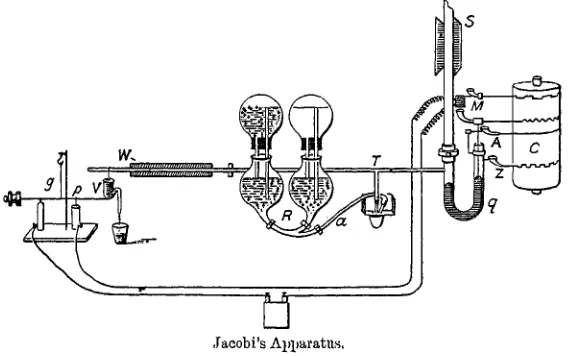
Williams' Apparatus for Investigating the Action of Poisons on the Frog's Heart, 45 Jacobi's Apparatus, 47
Mercury Pump, . . . . 50
Ether Recovery Apparatus, 51 Micro-Spectroscope, 57 Diagram showing Absorption Bands produced from Colour Reactions, . . 58 Spectroscopic Appearances of Blood, 61 Hffimatin Crystals, 64 Deaths per Million Living from Alcohol, 1875-1903, . . . . 1 4 3 Tube for Treatment of Liquids by Ethereal Solvents, 163 Diagram of Visual Field in Nitro-Benzol Poisoning, 200 Blondlot's Apparatus for Production of Phosphine, . . . 244 Subliming Cell, 260 Crystals of Methyl-Bmcine Iodide, 352 Diagram Indicating Action of Atropine on the Heart, . . . 390 Curves showing Changes in the Pulse, and Arterial Tension produced by an
Infusion of Digitalis, . 441 Bocklisch's Flask for Distillation in a Vacuum,
Berzelius' Tube for Reduction of Arsenic,
P O I S O N S :
T H E I R E F F E C T S A N D D E T E C T I O N .
PART I . - I N T R O D U C T O R Y . I.—The Old Poison-Lore.
§ 1. IT is significant that the root "tox" of the modern word toxicology can be traced back to a very ancient word meaning " how" or "arrow," or, in its broadest sense, some " tool" used for slaying: hence it is no far-fetched supposition that the first poison-knowledge was that of the septic poisons. Perchance the savage found that weapons soiled with the blood of former victims made wounds fatal; from this observation the next step naturally would be that of experiment—the arrow or spear would be steeped in all manner of offensive pastes, and smeared with the vegetable juices of those plants which were deemed noxious; and as the effects were mysterious, they would be ascribed to the supernatural powers, and covered with a veil of superstition.
The history of the poison-leh7*e, like all history, begins in the region of the myths: there was a dark saga prevailing in Greece, that in the far north existed a land ruled by sorcerers—all children of the sun— and named Aeetes, Perses, Hecate, Medea, and Circe. Later on, the enchanted land was localised at Colchis, and Aeetes and Perses were said to be brothers. Hecate was the daughter of Perses; she was married to Aeetes, and their daughters were Medea and Circe. Hecate was the discoverer of poisonous herbs, and learned in remedies both evil and good. Her knowledge passed to Medea, who narcotised the dragon, the guardian of the golden fleece, and incited Jason to great undertakings. In the expedition of the Argonauts, the poets loved to describe Hecate's garden, with its lofty walls. Thrice-folding doors of ebony barred the entrance, which was guarded by terrible forms: only the initiated few, only they who bore the leavened rod of expiation, and the concealed conciliatory offering of the Medea, could enter into the sanctuary. Towering above all was the temple of the dread Hecate, whose priestesses offered to the gods ghastly sacrifices.
§ % The oldest Egyptian king, Menes, and Attalus Phylometer, the last king of Pergamus, were both famous for their knowledge of plants. Attains Phylometer was acquainted with hyoscyamus, aconite, conium, veratrum, and others; he experimented on the preparation of poisons, and occupied himself in compounding medicines. Mithradetes Eupator stood yet higher : the receipt for the famous theriaca, prepared in later years at an enormous price, and composed of fifty-four different ingredi-ents, is ascribed to him. The wonderful skill shown by the Egyptians in embalming and technical works is sufficient to render it fairly certain that their chemical knowledge was considerable; and the frequent opera-tions of one caste upon the dead must have laid the foundaopera-tions of a pathological and anatomical culture, of which only traces remain.
The Egyptians knew prussic acid as extracted in a dilute state from certain plants, among the chief of which was certainly the peach; on a papyrus preserved at the Louvre, M. Duteil read, "Pronounce not the name of I. A. 0. under the penalty of the peach !" in which dark threat, without doubt, lurks the meaning that those who revealed the religious mysteries of the priests were put to death by waters distilled from the peach. That the priests actually distilled the peach-leaves has been doubted by those who consider the ait of distillation a modern inven-tion ; hut this process was well known to adepts of the third and fourth centuries, and there is no inherent improbability in the supposition that the Egyptians practised it."*
§ 3. From the Egyptians the knowledge of the deadly drink appears to have passed to the Romans. At the trial of Antipater,f Terns brought a potion derived from Egypt, which had been intended to destroy Herod j this was essayed on a criminal, he died at once. In the reign of Tiberius, a Roman knight, accused of high treason, swallowed a poison, and fell dead at the feet of the senators: in both cases the rapidity of action appears to point to prussic acid.
The use of poison by the G-reeks, as a means of capital punishment, without doubt favoured suicide by the same means; the easy, painless death of the state prisoner would be often preferred to the sword by one tired of life. The ancients looked indeed upon suicide, in certain in-stances, as something noble, and it was occasionally formally sanctioned. Thus, Valerius Ma,ximus tells us that he saw a woman of quality 3 in the island of Ceos, who, having lived happily for ninety years, obtained leave to take a poisonous draught, lest, by living longer, she should happen to have a change in her good fortune ; and, curiously enough, * 2osenms of Alexandria gives a drawing of a still which he states is copied from the ancient temple of Memphis in Egypt. Analyst, xxx. 295, 1905, and Hoeffer, JSistoire de Ohemie, vol. i. p. 262.
§ 3-] THE OLD POISON-LORE. 3 this sanctioning of self-destruction seems to have been copied in Europe. Mead relates that the people of Marseilles of old had a poison, kept by the public authorities, in which cicuta was an ingredient: a dose was allowed to any one who could show why he should desire death. What-ever use or abuse might be made of a few violent poisons, Greek and Eoman knowledge of poisons, their effects and methods of detection, was stationary, primitive, and incomplete.
Nicander .of Colophon (204-138 B.C.) wrote two treatises, the most ancient works on this subject extant, the one describing the effects of snake venom; the other, the properties of opium, henbane, certain fungi, colchicum, aconite, and conium. He divided poisons into those which kill quickly, and those which act slowly. As antidotes, those medicines are recommended which excite vomiting—e.g., lukewarm oil, warm water, mallow, linseed tea, etc.
Apollodorus lived at the commencement of the third century B.C. : he wrote a work on poisonous animals, and one on deleterious medicines ; these works of Apollodorus were the sources from which Pliny, Heraclitus, and several of the later writers derived most of their knowledge of poisons.
JDioscorides (40-90 A.D.) well detailed the effects of cantharides, sul-phate of copper, mercury, lead, and arsenic. By arsenic he would appear sometimes to mean the sulphides, sometimes the white oxide. Dioscorides divided poisons, according to their origin, into three classes, viz.:—
1. Animal Poisons.—Under this head were classed cantharides and allied beetles, toads, salamanders, poisonous snakes, a particular variety of honey, and the blood of the ox, probably the latter in a putrid state. He also speaks of the "sea-hare" The sea-hare was considered by the ancients very poisonous, and Domitian is said to have murdered Titus with it. It is supposed by naturalists to have been one of the genus Aplysia, among the gasteropods. Both Pliny and Dioscorides depict the animal as something very formidable: it was not to be looked at, far less touched. The aplysise exhale a very nauseous and foetid odour when they are approached : the best known of the species resembles, when in a state of repose, a mass of unformed flesh; when in motion, it is like a common slag; its colour is reddish-brown; it has four horns on its head; and the eyes, which are very small, are situated between the two hinder ones. This aplysia has an ink reservoir, like the sepia, and ejects it in orclsr to escape from its enemies; it inhabits the muddy bottom of the water, and lives on small crabs, inolhisca, etc.
of ancient Massilia), elaterin, and the juices of species of euphorbia and apocyneae. He also makes a special mention of aconite, the name of which is derived from AJcon, a small city in Heraclea. The Greeks were well aware of the deadly nature of aconite, and gave to it a mythical origin, from the foam of the dog Cerberus. Colchicum was also known to Dioscorides; its first use was ascribed to Medea. Veratrum album and nigrum were famous medicines of the Romans, and a constituent of their urat and mice powders"; they were also used as insecticides.
According to Pliny, the Gauls dipped their arrows in a preparation of veratrum.* Daphne mezereon, called by the Romans also smilax and taxusj appears to have been used by Cativolcus, the king of the Eburones, for the purpose of suicide; or possibly by " taxus" the yew-tree is meant, t
The poisonous properties of certain fungi were also known. Nicander calls the venomous mushrooms the " evil fermentation of the earth," and prescribes the identical antidotes which we would perhaps give at the present time—viz., vinegar and alkaline carbonates.
3. Mineral Poisons.—Arsenic has been already alluded to. The ancients used it as a caustic and depilatory. Copper was known as sulphate and oxide; mercury only as cinnabar: lead oxides were used, and milk and olive-oil prescribed as an antidote for their poisonous properties. The poison-lehre for many ages was considered as something forbidden. Galen, in his treatise "On Antidotes," remarks that the
only authors who dared to treat of poisons were Orpheus, Theologus Morus, Mendesius the younger, Heliodorus of Athens, Aratus, and a few others; but none of these treatises have come down to us. From the close similarity of the amount of information in the treatises of Nicander, Dioscorides, Pliny, Galen, and Paulus iEgineta, it is probable that all were derived from a common source.
§ 4. If we turn our attention to early Asiatic history, a very cursory glance at the sacred writings of the East will prove how soon the art of poisoning, especially in India, was used for the purpose of suicide, revenge,
or robbery.
The ancient practice of the Hindoo widow—self-immolation on the burning pile of her husband—is ascribed to the necessity which the Brahmins were under of putting a stop to the crime of domestic poison-ing. Every little conjugal quarrel was liable to be settled by this form of secret assassination, but such a law, as might be expected, checked the practice.
Poison was not used to remove human beings alone, for there has been from time immemorial in India much cattle-poisoning. In the Institutes of Menu, it is ordained that when cattle die the herdsman
§ 5-] T H E OLD POISON-LORE. 5 shall carry to his master their ears, their hides, their tails, the skin below their navels, their tendons, and the liquor oozing from their foreheads. Without doubt these regulations were directed against cattle-poisoners.
The poisons known to the Asiatics were arsenic, aconite, opium, and various solanaceous plants. There has been a myth floating through the ages that a poison exists which will slay a long time after its intro-duction. All modern authors have treated the matter as an exaggerated legend, but, for my own part, I see no reason why it should not, in reality, be founded on fact. There is little doubt that the Asiatic poisoners were well acquainted with the infectious qualities of certain fevers and malignant diseases. Now, these very malignant diseases answer precisely to the description of a poison which has no immediate effects. Plant smallpox in the body of a man, and for a whole fortnight he walks about, well and hearty. Clothe a person with a garment soaked in typhus, and the same thing occurs—for many days there will be no sign of failure. Again, the gipsies, speaking a tongue which is essentially a deformed prakrit, and therefore Indian in origin, have long possessed a knowledge of the properties of the curious "mucor phy corny ces." This was considered an alga by Agaron, but Berkeley
referred it to the fungi. The gipsies are said to have administered the spores of this fungi in warm water. In this way they rapidly attach themselves to the mucous membrane of the throat, all the symptoms of a phthisis follow, and death takes place in from two to three weeks. Mr. Berkeley informed me that he has seen specimens growing on broth which had been rejected from the stomach, and that it develops in enormous quantities on oil-casks and walls impregnated with grease. The filaments are long, from 12 to 18 inches, and it is capable of very rapid development.
There is also a modern poison, which, in certain doses, dooms the unfortunate individual to a terrible malady, simulating, to a considerable extent, natural disease—that is phosphorus. This poison was, however, unknown until some time in the eleventh century, when Alchid Becher, blindly experimenting on the distillation of urine and carbon, obtained his " escarboucle" and passed away without knowing the importance of his discovery, which, like so many others, had to be rediscovered at a later period.
ergot.* In the later period of their history, when they were dispersed through various nations, they would naturally acquire the knowledge of those nations, without losing their own.
§6. The part that poison has played in history is considerable. The pharmaceutical knowledge of the ancients is more graphically and terribly shown in the deaths of Socrates, Demosthenes, Hannibal, and Cleopatra, than in the pages of the older writers on poisons.
In the reign of Artaxerxes II. (Meninon), (B.O. 405-359), Phrysa poisoned the queen Statira by cutting food with a knife poisoned on one side only. Although this has been treated as an idle tale, yet two poisons, aconite and arsenic, were at least well known; either of these could have been in the way mentioned introduced in sufficient quantity into food to destroy life.
In the early part of the Christian era professional poisoners arose, and for a long time exercised their trade with impunity.! Poisoning was so much in use as a political engine that Agrippina (A.D. 26) refused to eat of: some apples offered to her at table by her father-in-law, Tiberias.
It was at this time that the infamous Locusta nourished. She is said to have supplied, with suitable directions, the poison by which Agrippina got rid of Claudius; and the same woman was the principal agent in the preparation of the poison that was administered to Britannicus, by order of his brother Nero. The details of this interesting case have been recorded with some minuteness.
It was the custom of the Romans to drink hot water, a draught nauseous enough to us, but, from fashion or habit, considered by them a luxury; and, as no two men's tastes are alike, great skill was shown by the slaves in bringing the water to exactly that degree of heat which their respective masters found agreeable.]:
The children of the Imperial house, with others of the great Roman families, sat at the banquets at a smaller side table, while their parents reclined at the larger. A slave brings hot water to Britannicus ; it is too hot; Britannicus refuses it. The slave adds cold water; and it is this cold water that is supposed to have been poisoned; in any case, Britannicus had no sooner drunk of it than he lost voice and respiration. Agrippina, his mother, was struck with terror, as well as Octavia, his sister. Nero, the author of the crime, looks coldly on, saying that such fits often happened to him in infancy without evil result ; and after a few moments' silence the banquet goes on as before. If this were not
* R. J. Wunderbar, Bibliscli-tcilmudisclie Medidti. Leipzig, 1850-60. t Tacitus, lib. xii., xiii. Mentioned also by Juvenal and Suetonius.
§ 6.] THE OLD POISON-LOKE. 7 sudden death from heart or brain disease, the poison must have been either a cyanide or prussic acid.
In those times no autopsy was possible : although the Alexandrian school, some 300 years before Christ, had dissected both the living and the dead, the work of Herophilus and Erasistratus had not been pursued, and the great Roman and Greek writers knew only the rudime