Non-projectivity and valency
Zdenka Uresova and Eva Fucikova and Jan Hajic Faculty of Mathematics and Physics, Charles University in Prague
Institute of Formal and Applied Linguistics Malostranske nam. 25
11800 Prague 1, Czech Republic
{uresova,fucikova,hajic}@ufal.mff.cuni.cz
Abstract
We describe results of investigation of a specific type of discontinuous constructions, namely non-projective constructions concern-ing verbs and their arguments. This topic is especially important for languages with a rela-tively free word order, such as Czech, which is the language we have primarily worked with. For comparison, we have included some re-sults for English. The corpora used for both languages are the Prague Czech-English De-pendency Treebank and the Prague Depen-dency Treebank, which are both annotated at a dependency syntax level as well as a deep (semantic) level, including verbs and their va-lency (arguments). We are using traditionally defined non-projectivity on trees with full lin-ear ordering, but the two levels of annotation are innovatively combined to determine if a particular (deep) verb -argument structure is non-projective. As a result, we have identi-fied several types of discontinuities, which we classify either by the verb class or structurally in terms of the verb, its arguments and their dependents. In addition, we have quantita-tively compared selected phenomena found in Czech translated texts (in the PCEDT) to the native Czech as found in the original Prague Dependency Treebank.
1 Introduction
Non-projective constructions in general have long been the subject of research in computational lin-guistics, especially within the frameworks of various
dependency-based theories (Marcus, 1965; Hudson, 1994). In Czech, which is our focus here as a repre-sentative of a (relatively) free-word order language which frequently displays this phenomenon, we can cite e.g., (Uhl´ıˇrov´a, 1972), (ˇSt´ıcha, 1996), (Oliva, 2001) or (Petkeviˇc, 1998; Petkeviˇc, 2001). How-ever, at that time, they did not have a syntactically annotated corpus at their disposal, let alone a seman-tically annotated one. Their works are thus rather theoretical treatments with little confrontation with real texts, even though these works have at least laid very good basis for the treatment of projectivity by defining (from various perspectives) what non-projectivity actually is in terms of sentence structure representation.
First treatment of non-projective constructions based on an annotated corpus, namely in the an-notation scenario of the Prague Dependency Tree-bank (PDT), was presented by Hajiˇcov´a (2004) and this issue was further elaborated by Havelka (2005) where some properties of non-projective edges rel-evant for the newly presented algorithms were dis-cussed and a hint on finding all non-projective edges using its output was given. Havelka (2007) fol-lowed and focused on a refinement of the defini-tions of non-projectivity (having found certain errors in previously published definitions, among other things) and introduced measures to further refine the notion. In addition, he also showed how em-pirical results corroborate theoretical results. All of these works have focused on the basic proper-ties of non-projectivity at the same level of
tic description (i.e., surface dependency syntax or the deep, semantically-oriented“tectogrammatical” representation as defined in the Prague Dependency Treebank), i.e., the authors limited themselves to only one syntactic layer at a time instead of try-ing to define and investigate the phenomenon from both perspectives, thus providing a more compact approach. Hajiˇcov´a et al. (2004) made an attempt at classification of non-projective constructions on these two levels separately.1 In our work, we are
trying to use both the surface and deep layer to-gether to specify and investigate a “new breed” of non-projectivity in a more holistic approach.
In Natural Language Processing, non-projectivity has long been ignored, since the first tree-banks, such as the Penn Treebank (Marcus et al., 1993), have been annotated using parse trees (or, phrase-structure-based annotation), which techni-cally do not allow for direct representation of non-projectivity, and the surrogate means (co-indexing and traces, some of which can be considered to represent non-projective constructions) have also been largely ignored by syntactic parsers developed (trained) on them. Only after the development of dependency parsers has started using natively2
anno-tated dependency treebanks (which naturally do con-tain non-projectivities), non-projectivity has been fi-nally seriously looked at from the parsing perspec-tive (McDonald et al., 2005; Nivre and Nilsson, 2005; Nivre, 2006; Kuhlmann and Nivre, 2006; Nivre, 2007; Hall and Nivre, 2008; Nivre, 2009; Bohnet and Nivre, 2012; Bj¨orkelund and Nivre, 2015). Since such parsers work with the surface-syntactic dependency trees, there was no specific at-tention paid to the relation between deep syntax or semantics and non-projectivity.
In our study, we describe the results of investigat-ing non-projectivity of verbs and their arguments, using two levels of description: for defining the constructions of interest, i.e., verbs and their argu-ments, we use the deep syntactic/semantic
annota-1The special linear ordering (which doesnotfollow the sur-face word order) of nodes at the tectogrammatical layer of anno-tation of all PDT-style treebanks will be described in Sect. 2.2.2. 2By “natively” annotated dependency treebanks we mean treebanks originally annotated manually using dependency scheme and guidelines, as opposed to phrase-based treebanks converted automatically to dependenciesex-post.
tion level of the available corpus, while for testing non-projectivity using the standard definitions, we use the ‘unquestionable’ linear ordering from the surface dependency annotation which in turn fol-lows the original word order. We believe this a novel approach not found in previous studies.
2 The corpus and its annotation
2.1 The corpora used: Prague Czech-English Dependency Treebank and the Prague Dependency Treebank
Prague Czech-English Dependency Treebank (PCEDT) is a parallel, linguistically annotated corpus (Hajiˇc et al., 2012). The texts come from the WSJ part of the Penn Treebank (Marcus et al., 1993); the Czech side is their professional trans-lation. The corpus consists of about one million tokens (on each language side) in about 50 thousand aligned sentence pairs. It is currently available from the Linguistic Data Consortium3 as well as from
the LINDAT/CLARIN repository.4 This corpus
follows the multilayer annotation scenario used in the original Prague Dependency Treebank (PDT).
The tectogrammatical annotation of these corpora includes also links to two valency lexicons, the PDT-Vallex (for Czech) and the EngPDT-Vallex (for English).
The Czech valency lexicon, called PDT-Vallex,5
is publicly available as a part of the one-million-word Prague Dependency Treebank (PDT) version 2 published by the Linguistic Data Consortium.6 It
has been developed as a resource for valency anno-tation in the PDT; it is based on the Functional Gen-erative Description valency theory framework - for details, see (Ureˇsov´a, 2011b; Ureˇsov´a, 2011a). The EngVallex7 is a lexicon of English verbs, built on
the same grounds as PDT-Vallex. It was created by a (largely manual) adaptation of an already existing resource for English with similar purpose, namely the PropBank Lexicon (Palmer et al., 2005;
Kings-3https://catalog.ldc.upenn.edu/
LDC2012T08
4http://hdl.handle.net/11858/
00-097C-0000-0015-8DAF-4
5http://hdl.handle.net/11858/
00-097C-0000-0023-4338-F
6http://www.ldc.upenn.edu/LDC2006T01
7http://hdl.handle.net/11858/
bury and Palmer, 2002), to the PDT labeling stan-dards (see also (Cinkov´a, 2006)).
2.2 PCEDT and PDT annotation
The PCEDT is annotated on both the Czech and the English side using PDT-style of annotation. Every sentence is annotated at three, explicitly interlinked layers: morphology, dependency syntax (Hajiˇc, 1998) and tectogrammatics (deep syntax/semantics).
2.2.1 Surface dependency syntax
The surface dependency syntax annotation in both the PCEDT and the PDT (Hajiˇc et al., 2004) as-signs a node to each word and punctuation sym-bol in the sentence. It is rooted in an extra node holding the ID and other bookkeeping information about the sentence. Heads are determined, when in doubt, using the morphosyntactic argument: if a node controls the morphosyntactic behavior of the word directly related to it, for example by agree-ment, morphosyntactic control constraints etc., it is considered to be the head. All relations (edges in the tree) are labeled by the type of the relation. In the PDT (and PCEDT), there are a relatively few coarse-grained types: Pred and Pnom for predicate and the nominal part of a predicate in copula construc-tions, respectively, thenSb,ObjandAdvfor verb dependents (Subject, Object, and Adverbials), and Atr for all nominal modifiers. Auxiliaries are di-vided into another set of types, such asAuxV (func-tion word-verb), AuxP for prepositions (which are heads) and AuxC for subordinate conjunctions, to name the most important. There are also ‘structural’ labels for coordination, apposition and parenthetical relation. An example is in Fig. 1.
Importantly, for the investigation of non-projectivity, all the nodes are numbered by ordinal numbers starting with 0 for the extra root node, 1 for the first word in the sentence in its surface word order, etc., forming a total linear ordering of all the nodes.
2.2.2 Deep syntax and semantics
The tectogrammatical annotation layer is based on the Functional Generative Description theory (Sgall et al., 1986). The structure of a sentence is represented as a rooted tree (as it is at the surface dependency level), with nodes bearing a number
of attributes describing their syntactic and seman-tic properties. Edges are labeled by the (mostly se-mantic) types of dependency relations, called ‘func-tor’s. As opposed to the surface syntactic annota-tion, function words and punctuation have no nodes of their own; only content words are kept. How-ever, in addition to the content words that have a sur-face counterpart, there are also nodes which have no surface counterpart (some types of restored ellipses, such as surface-elided semantically obligatory verb arguments etc.).
The set of ‘functors’ is different (and richer) than the set of dependency relations at the surface dependency level. While verb arguments are de-scribed by five core argument functors (Actor (ACT) and Patient (PAT) for the first two, and then the more semantically defined Addressee (ADDR), Ef-fect (EFF) and Origin (ORIG)), there is a set of about 30 adverbial types (LOCation, DIR1ection (from), DIR3ection (to), MANNer, ACMP for ac-companiment, TWHEN, TSINce, THL (how long) and several more for time adverbials, CAUSe, BEN-eficiary, etc.). For nominal modifiers, RSTR and DESC (restrictive and descriptive dependent) are added. Nodes serving as structure descriptors (such as coordination and aposition “heads”) are similar to the ones used at the surface dependency layer of annotation.
In addition, every verb (i.e., content verb) in the treebank is disambiguated for its sense based on an inventory of senses in the corresponding valency lexicon (PDT-Vallex for Czech and EngVallex for English, cf. Sect. 2.1). Its arguments as annotated in the treebank correspond to the argument ‘slots’ as recorded in the valency lexicons. Morphosyntactic constraints on the individual arguments as recorded in the lexicons have been checked and are consistent with the treebank annotation of the corresponding argument nodes.
2004)).8
3 Definition of non-projectivity
3.1 Dependency syntax and non-projective constructions
The definition of projectivity we are using is as fol-lows (from (Hajiˇcov´a et al., 2004) and (Havelka, 2005)):
Definition. A subtree S of a rooted dependency treeT isprojectiveif for all nodesa,bandcof the subtreeSthe condition (P) holds:
(b↓a&b < a&c↓↓b→c < a) or
(b↓a&b > a&c↓↓b→c > a) (P) where b↓a means thatbis immediately dependent on a, c↓↓b means that c is a descendant of b (i.e., transitively dependent), and<and>have the usual meaning with respect to the linear ordering of nodes.
3.2 Measure of the degree of non-projectivity
Havelka (2005) introduces the notion of a gap as a set of all nodes that ’cause’ an edge to be non-projective, i.e., the head node of such an edge be-ing a root of a non-projective tree. However, in our work, we believe that the mere set of words, or even their count, is too fine-grained to describe the ’de-gree’ of non-projectivity, at least for the purposes of this study on verb-headed constructions. There-fore, we define agapas the number ofcontinuous spans (rather than a number of all words) that ‘in-terfere’ in (are not part of) the yield of the node, of which the subtree rooted by it is being tested for non-projectivity. We also use the phrase “be in the gap” (for a word or node of a tree), if the projection of that word based on its linear surface word order is one of those that fall into that gap.
4 Finding non-projective constructions and measuring their complexity
In our analysis of non-projective constructions re-lated to verb and its arguments, we have used the definition described in Sect. 3. However, since we are interested in verbs and their arguments,
8According to the tectogrammatical annotation manual (Mikulov´a et al., 2006), the linear order of the nodes in the tec-togrammatical trees is given by the attributedord, or “deep or-der” which is defined independently of the surface word order using so-called “contextual boundness” criterion.
which are annotated on the deep (tectogrammatical) level, we have modified the definition combining the two layers. The modified definition, named CLP (Combined-Layer Projectivity), follows these three rules for determining the necessary components of the original definition:
• words (nodes for verbs, their arguments and their dependents/descendants) are taken from the tectogrammatical level;
• dependencies (i.e., the structure of the subtrees of interest) are also taken from the tectogram-matical level of annotation (used for determin-ing the↓and↓↓relations in the definition (P));
• linear ordering is taken from the surface syntac-tic level of annotation, using the surface node’s (referred to by thelex.rflink from the tec-togrammatical node) ord attribute, i.e., the surface word order is used.
While we could have possibly used the surface dependencies for determining non-projectivity, the approach outlined above gives more adequate re-sults since (a) we are focusing on verbs and their arguments, which naturally occur at the deep layer of annotation and (b) this annotation has been done fully manually in all three corpora we use, while the surface syntax has been generated automatically on both sides of the PCEDT and thus is not reliable, especially with regard to non-projectivity.9
To illustrate the gap measure as defined earlier, Fig. 1 shows a non-projective construction with one gap - the projection of the tree based on the linear ordering of nodes (i.e., word order in the case of surface dependency syntax) has two parts. In this example, the word “To” (this) is an Object of the verb “splnit” (to fulfill), and therefore, the subtree rooted in “splnit” is non-projective, since the words “je” (is) and “moˇzno” (possible) are not descendants of “splnit”, and they both constitute the one single gap present in the projection of the “splnit”-rooted subtree.
a-ln94202-3-p3s2
To je
možno splnit
Obj Pred
Pnom Sb
Cs:To.Objje.Predmoˇzno.Pnomsplnit.Sb En: (lit.)This.Objis.Predpossible.Pnomto fulfill.Sb
En:This can be fulfilled
Figure 1:Simple non-projective construction, gap=1
The number of gaps can be easily computed for every node in the surface dependency tree, by going through all the nodes from its yield (i.e., through all nodes which are descendants of the node in ques-tion) and counting the gaps. However, one has to be careful–subtrees with no gaps can still be non-projective “inside”, i.e., some of their subtrees might still be non-projective with gap count greater than zero.
For the description of non-projectivity of verbs and their arguments, we have thus computed the non-projectivity of the argument-rooted subtrees separately from the non-projectivity of the subtree rooted by the verb in question, which might have no gaps. On the other hand, if any of the argument-rooted subtrees has the gap equal to zero, it is not rel-evant to our goals whether there is a non-projectivity “hidden” inside, for some of its subtrees. In other words, we consider (verb-rooted) subtrees that have either
• non-zero gap measure at the verb root, or
• non-zero gap measure at any of its arguments.
For simplicity, we will call these constructions (and only these) non-projective, even though we are aware of the fact that we are ignoring gap=0 con-structions with embedded non-projectivity.
An important aspect of the extraction was that we have used both layers of the PDT-style
anno-tation using the modified (CLP) definition as de-scribed earlier: the identification of whether a word is a verb or not, or whether a word is an argument to a verb, has been performed at the tectogrammat-ical level (using all content, i.e., auxiliary, non-modal verbs, which had a link to the corresponding Czech or English valency lexicon). Arguments to such verbs have been identified using the valency dictionary entry, which lists all arguments by their function label (called “functor” in the tectogrammat-ical annotation scheme, cf. (Mikulov´a et al., 2006)). These labels have been matched to all immediately dependent nodes on the verb in the tectogrammati-cal annotation. However, for reasons already men-tioned, we have used the inter-layer links that the annotation scheme contains, and which connect the nodes in the surface syntax dependency tree with the tectogrammatical one(s) to retrieve the original word order and use it as described in the third bullet in (CLP).
This way, every construction of a verb and its ar-gument(s)10 could be tested against the enhanced
(CLP) definition of non-projectivity.
5 Classification of verb-argument non-projective constructions
We have extracted all examples of non-projective constructions for verbs and their arguments from the English and Czech sides of the PCEDT,11 and for
comparison also from the Prague Dependency Tree-bank (representing natively written Czech texts).
The overall number of non-projective construc-tions on the surface syntactic level of annotation us-ing the original (P) definition of projectivity and the breakdown by the number of gaps is given in Ta-ble 1. The total number of nodes at the dependency syntax layer of the PCEDT is 1,173,766 on the En-glish side and 1,151,150 on the Czech side. The to-tal number of nodes counted in the PDT is 833,193 (only sentences annotated also at the tectogrammat-ical layer have been used).
The small number of non-projective constructions
10Unless it is a NULL argument, which has no overt word in the surface sentence as a counterpart; these have been ignored.
Lang. 0 gaps 1 gap 2 gaps >2 gaps
en 479 112 1 0
cs (tr.) 61,619 44,774 3,827 449
[image:6.612.78.294.53.107.2]cs (nat.) 29,912 14,259 196 2
Table 1: Non-projective constructions in surface depndency trees, overall counts
on the English side of the PCEDT (i.e., in the WSJ texts) is caused by the fact the the parser has been trained on non-native dependency annotation, and thus almost always prefers projective constructions. The highest number of gaps on the Czech side of the PCEDT was 8, in five cases (and there was no non-projective subtree with 7 gaps). Overall, there is slightly below 10% of non-projective subtrees and less than 5% with at least one gap.
In the PDT, the overall number of nodes at the de-pendency syntax layer is 29,912, and as can be seen from the last row of Table 1, the percentages for non-projective nodes and for non-non-projective nodes with at least one gap are 5.3% and 1.7%, respectively.
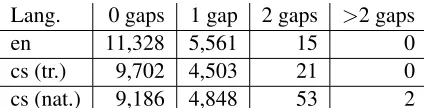
When the (CPL) definition is used, the num-bers look differently (Tab. 2). The total number of nodes at the tectogrammatical layer of the PCEDT is 757,021 on the English side and 819,206 on the Czech side. The total number of tectogrammatical nodes in the PDT is 593,473.
Lang. 0 gaps 1 gap 2 gaps >2 gaps
en 11,328 5,561 15 0
cs (tr.) 9,702 4,503 21 0
cs (nat.) 9,186 4,848 53 2
Table 2: Non-projective constructions in PCEDT and PDT, overall counts using the (CLP) definition
This table differs substantially from Tab. 1, giving much more balanced figures due to the manual anno-tation of the tectogrammatical layer. Based on these observations, we have used only the (CLP) defini-tion for our subsequent investigadefini-tion.
5.1 Constructions involving a verb and its argument
The overall number of verb tokens tested for non-projectivity in the PCEDT was 92,840. Among those, there are 2,352 cases (1,311 in English, 1,042 in Czech translations) where the non-projectivity in-volves a verb and its argument (i.e., the verb is in the
gap of the non-projective subtree of its argument) and 1,407 (932 in English, 476 in Czech) cases of two arguments (i.e., one argument is in the gap a non-projective subtree of another argument).
proč
CAUS
Proč
Dinkins ACT
Dinkins říkat PRED
říká
kritik ACT
kritik
kdy MANN
vždycky
vyčkávat EFF
vyčkává
Cs:Proˇc.CAUSDinkins.ACT,ˇr´ık´a.PREDkritik.ACT, vˇzdycky.MANNvyˇck´av´a.EFF ...
[image:6.612.319.535.119.299.2]En: (lit.)Why.CAUSDinkins.ACT,says.PRED the kicker.ACT,always.MANNwaits.EFF ... En:Why Dinkins always waits ..., says the kicker.
Figure 2:Non-projective construction, gap=1, verb in gap
An example of a Czech construction with non-projectivity of a subtree rooted in a verb argument, where the verb is in the gap, is shown in Fig. 2 (it uses the (P) definition on a surface dependency tree). Here, the root verb of the subordinate clause “vyˇck´av´a”waits, which is an argument (labeled Ef-fect) of the matrix verb “ˇr´ık´a”sayson the tectogram-matical layer, dominates a non-projective substree, since the subject has been fronted before the root verb of the whole sentence. This is one of the very typical cases of non-projective constructions, where the main verb is a communication or a re-ported speech verb (say, add, shout, remember, an-swer, argue, go on, to name a few extracted from the PCEDT).12
Another typical example of non-projective con-structions in Czech involving a verb is a construc-tion with a catenative13(and modals or quasi-modal)
verb like “podaˇrit”, “zaˇc´ıt”, “zkusit”, “nechat” (lit. “manage”, “start”, “try”, “let”), etc. The ar-gument, which is often non-projective, is the Pa-tient (PAT), typically expressed as infinitive, whose first or second argument (Actor (ACT) or Patient
12Counting on a sample of 100 examples from the English side of the PCEDT, 43 have been of this type.
[image:6.612.79.291.435.489.2](PAT)) is fronted “across” the verb. An example is “domy.PAT nezkouˇsej.PRED prod´avat.PAT bez makl´eˇre.ACMP” (lit. “houses.PATdo-not-try.PRED sell.PATwithout an-agent.ACMP).14
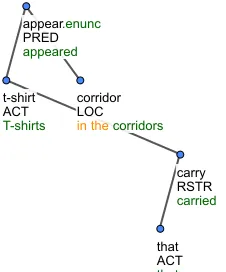
t-shirt ACT
T-shirts
appear.enunc
PRED
appeared
corridor LOC in thecorridors
that ACT
that
carry RSTR
carried
En:T-shirts.ACTappeared.PREDin the corridors.LOC that.ACTcarried.RSTR ...
[image:7.612.126.239.120.256.2]Cs (lit.):*Triˇcka.ACTse objevila.PREDna chodb´ach.LOCkter´a.ACTnesla.RSTR ... Cs:Na chodb´ach se objevila triˇcka, kter´a nesla ...
Figure 3: Non-projective construction with ACT’s dependent (RSTR) branching non-projectively to the right, verb in gap
In English, in one of the rare cases where there is no Czech non-projective counterpart, a construction which gives rise to non-projectivity is a verb argu-ment (typically Actor (ACT) expressed as Subject, i.e., in active voice) preceding the verb, which is then complemented by a time or location expression and only then an relative clause dependent on the argument is placed: “T-shirts.ACT appeared.PRED in the corridors.LOC that.ACT carried.RSTR ...” (Fig. 3). Here, in the tectogrammatical represen-tation, “T-shirt” is the Actor (ACT), and argument of “appear”, and the clause starting “that carried...” depends on it. In the tree, the subtree rooted in “T-shirt” is non-projective, since the verb “appear” (and all the words from the location adverbial, i.e., “in the corridors”) form the gap. Another English example involving a copula is “... opinion.ACT is.PRED mixed.PAT on how much of a boost the
14In such constructions, a question might arise how the shared argument between the head verb and the non-finite de-pendent verb is treated: as has been described earlier, any node elided on the surface (even if present at the tectogrammatical layer) are ignored for non-projectivity considerations due to the non-existence of its word order index, which we in no way try to re-create.
market would get.RSTR” where the root “get” of the relative clause depends on “opinion”, and there-fore “opinion” heads a non-projective subtree with the predicator“is (mixed)” falling in the gap.15
An-other example is “... the plan.PAT is.PRED impos-sible.PAT to accommodate.PAT”, where “plan” is a dependent of “accommodate”, which itself is a de-pendent of “is”, creating a non-projective subtree rooted in “accommodate”.
In Czech, there are only a few constructions which allow similar non-projectivity to the one just described for English, typically containing the verb “b´yt” as a copula: “... dividendy.ACT jsou.PRED splatn´e.PAT k 2. lednu.TWHEN z akci´ı.RSTR ...” (lit. ... dividends.ACT are.PRED payable.PAT Jan.TWHEN 2 to stock.RSTR) where “akci´ı” (lit. sharesdepends on “dividendy” (lit. dividends), and thus causes the non-projectivity of the subtree rooted in “dividendy”, with the verb “jsou” (lit. are) in the gap.
In English, but possible in Czech too16, is a
construction in which a verb argument is modi-fied by two or more modifiers, with one imme-diately following it in the surface word order but the other being far right, after additional arguments or adjuncts of the dominant verb, such as in: “A total.ACT of 139 companies.RSTR raised.PRED dividends.PAT in October.TWHEN, basically un-changed.RSTR ...”, where “unchanged” is a depen-dent of “total,” not the verb,17putting the verb (and
some of the additional dependents of the verb, such as “dividends” and “October”) in the gap of the non-projective subtree rooted in “total”.
15One could argue that the subordinate clause could be con-sidered Adverbial clause depending on the verb, in which case there will be no non-projectivity. However, the distinction be-tween “opinion on [clause] is mixed” and “opinion is mixed on [clause]” has been considered to be in the information structure rather than in syntax (Hajiˇc et al., 2004), and thus the structure in the PDT-style of annotation is the same. This argument holds, due to morphosyntactic considerations such as agreement, more firmly for Czech, but it was applied to English as well by anal-ogy.
16Even though all cases that we have found in the PCEDT have been translated using a completely different (and projec-tive) constructiton.
5.2 Constructions involving two or more arguments
These cases are less frequent than the cases involv-ing the verb beinvolv-ing in the gap of the non-projective argument-rooted tree, but they do exist.
Similar to the case of verb-argument non-projectivy of the “T-shirts.ACT appeared.PRED in the corridors.LOC that carried.RSTR ...”-type as de-scribed in the previous section, is a construction where a Patient (PAT) follows a verb, followed by an adverbial (dependent on the verb), and only then the attribute of the Patient follows: “ABC.ACT signed.PRED an agreement.PAT with DEF.ADDR under which shares will be acquired.RSTR ...”. Since “with ...” is an argument (Addressee) of “sign” at the tectogrammatical layer, and thus depends on it, the subtree rooted in the deep object (PAT) argu-ment “agreeargu-ment” is non-projective. The type of this argument-argument non-projectivity is PAT-ADDR (the ADDR-labeled argument is projected to the gap in the yield of the subtree rooted in “agreement”.
5.3 Left vs. right non-projective edges
It is well known that fronting or ’movement to the left’ tends to create non-projective constructions. In (Hajiˇcov´a et al., 2004), it was only such moves that have been investigated, due also to their relation to information structure which was one of the foci in that study.
However, in our study, we also wanted to in-vestigate whether non-projective edges leading to the right (both in Czech and English) are rare(r), or whether they differ substantially from those left-branching ones studied previously.
Lang. left (%) right (%)
en 1122 (64.93%) 606 (35.07%)
cs (tr.) 913 (68.96%) 411 (31.04%)
cs (nat.) 1,945 (79.85%) 491 (20.15%)
Table 3: Left- vs. right-branching non-projective subtrees rooted in a verb argument
The statistics alone show two things: first, the prevalence of left-branching non-projective edges is much higher in the native Czech treebank (PDT) than on Czech side of the PCEDT (which suggest influence of non-projective constructions on trans-lation), and second, that while left-branching does
prevail 2:1 or more over right-branching, the num-ber of right-branching non-projectivities rooted at verb arguments is substantial (and thus, worth fur-ther studies).
6 Conclusions
We have described the results of investigation of non-projective constructions involving verbs and their arguments, using no predefined classification scheme but an annotated material of the Prague Czech-English Dependency Treebank and the origi-nal Prague Dependency Treebank. We can summa-rize our findings in a few main points:
• as a starting point, we have divided the corpus material to those constructions that involve the verb and at least one of its arguments vs. those involving two or more arguments (and not the verb itself), under the hypothesis that these two cases will display different behavior; how-ever, this proved not to be a crucial distinction (“(a tak) transakce.PAT je.PRED pˇritom.TPAR levnˇejˇs´ı prov´adˇet...” lit. (and so) trans-action.PAT is.PRED at-the-same-time.TPAR cheaper to perform vs. “(a tak) je.PRED transakce.PAT pˇritom.TPAR levnˇejˇs´ı prov´adˇet” lit. (and so) is.PPRED transaction.PAT at-the-same-time.TPAR cheaper to perform, with “transakce” depending on “prov´adˇet”);
• the most frequent case is the construction with the communication/reporting verbs (verba di-cendiand similar verbs) when used in the mid-dle of the direct or report speech construction they introduce;
• nominals used as arguments can have their at-tribute(s) (whether expressed by a clause or as prepositinal phrase) across other arguments or adjuncts of the verb;
• as expected, certain types of non-projectivity are due to the conventions used in the annota-tion;
left-branching non-projective constructions as often as they appear in native Czech;
• we have independently confirmed that the fo-cus on fronted or left-moved constructions in (Hajiˇcov´a et al., 2004) was right, but that roughly 1/3 of non-projective constructions rooted in a verb argument are right-branching and thus not to be ignored in future research;
• certain types of verb-related non-projectivities described in (Hajiˇcov´a et al., 2004), such as a nominal group in Czech with dislo-cated RSTR (depending on a verb argu-ment) (“spoleˇcnou.RSTR m´ame.PRED ...
zod-povˇednost.PAT”, lit. “common.RSTR
we-have.PRED ... responsibility.PAT), were not at-tested in translated Czech (PCEDT), but have been found in the PDT. The same holds for nu-merals with a dislocated dependent.
In terms of future work, there are two possible di-rections. In the technological area, the results (es-pecially on English) confirm that non-projectivity is indeed going to be a problem for (deep) parsers, and that even surface dependency parsers should be looked at again to see if improvements are possi-ble based on error analysis using the classification presented. On the theoretical side, we would like to (a) continue to investigate the less frequent cases which we have not included in this study, (b) involve other features of the tectogrammatical annotation, such as the information structure (topic/focus anno-tation, and/or co-reference information) and (c) de-fine the types of non-projective verb-argument con-structions more formally, to allow for an automatic classification, e.g., on a large corpus.
Acknowledgments
This work described herein has been supported by the grant GP13-03351P of the Grant Agency of the Czech Republic and by the LINDAT/CLARIN Research Infrastructure projects, LM2010013 and LM2015071 funded by the MEYS of the Czech Re-public. It has also been using language resources developed and distributed by the LINDAT/CLARIN project (http://lindat.cz).
We would like to thank to all the three review-ers of the paper, who provided valuable comments;
specifically, we are grateful to the anonymous viewer #2, whose in-depth review helped us to re-alize and correct several important shortcomings of the original version.
References
Anders Bj¨orkelund and Joakim Nivre. 2015. Non-deterministic oracles for unrestricted non-projective transition-based dependency parsing. InProceedings of the 14th International Conference on Parsing Tech-nologies, pages 76–86.
Bernd Bohnet and Joakim Nivre. 2012. A transition-based system for joint part-of-speech tagging and la-beled non-projective dependency parsing. In Proceed-ings of the 2012 Joint Conference on Empirical Meth-ods in Natural Language Processing and Computa-tional Natural Language Learning, pages 1455–1465. Silvie Cinkov´a. 2006. From propbank to engvallex: Adapting the propbank-lexicon to the valency theory of the functional generative description. In Proceed-ings of the 5th International Conference on Language Resources and Evaluation (LREC 2006), pages 2170– 2175, Genova, Italy. ELRA, ELRA.
Jan Hajiˇc, Jarmila Panevov´a, Eva Bur´aˇnov´a, Zdeˇnka Ureˇsov´a, Alevtina B´emov´a, Jan ˇstˇep´anek, Petr Pajas, and Jiˇr´ı K´arn´ık. 2004. Anotace na analytick´e rovinˇe. N´avod pro anot´atory. Technical Report TR-2004-23,
´UFAL/CKL MFF UK, Prague.
Jan Hajiˇc, Eva Hajiˇcov´a, Jarmila Panevov´a, Petr Sgall, Ondˇrej Bojar, Silvie Cinkov´a, Eva Fuˇc´ıkov´a, Marie Mikulov´a, Petr Pajas, Jan Popelka, Jiˇr´ı Semeck´y, Jana ˇSindlerov´a, Jan ˇStˇep´anek, Josef Toman, Zdeˇnka Ureˇsov´a, and Zdenˇek ˇZabokrtsk´y. 2012. Announc-ing Prague Czech-English Dependency Treebank 2.0. In Proceedings of the 8th International Conference on Language Resources and Evaluation (LREC 2012), pages 3153–3160, Istanbul, Turkey. European Lan-guage Resources Association.
Jan Hajiˇc. 1998. Building a syntactically annotated cor-pus: The prague dependency treebank. In Issues of Valency and Meaning. Studies in Honour of Jarmila Panevov´a (ed. Eva Hajiˇcov´a). Karolinum, Charles University Press, Prague, ISBN 80-7184-601-5. Eva Hajiˇcov´a, Jiˇr´ı Havelka, Petr Sgall, Kateˇrina Vesel´a,
and Daniel Zeman. 2004. Issues of projectivity in the Prague Dependency Treebank.The Prague Bulletin of Mathematical Linguistics, (81):5–22.
Swe-den, August 25-27, 2008, Proceedings, pages 169– 180.
Jiˇr´ı Havelka. 2005. Projectivity in totally ordered rooted trees: An alternative definition of projectivity and opti-mal algorithms for detecting non-projective edges and projectivizing totally ordered rooted trees. The Prague Bulletin of Mathematical Linguistics, (84):13–30. Jiˇr´ı Havelka. 2007. Beyond projectivity:
Multilin-gual evaluation of constraints and measures on non-projective structures. In Proceedings of the 45th An-nual Meeting of the Association for Computational Linguistics, pages 608–615, Praha, Czechia. ´UFAL MFF UK, Association for Computational Linguistics. Richard Hudson. 1994. Discontinuous phrases in
depen-dency grammar. (6):89–124.
P. Kingsbury and M. Palmer. 2002. From Treebank to Propbank. In Proceedings of the 3rd International Conference on Language Resources and Evaluation (LREC-2002), pages 1989–1993. Citeseer.
Marco Kuhlmann and Joakim Nivre. 2006. Mildly non-projective dependency structures. In Proceedings of the 21st International Conference on Computational Linguistics and 44th Annual Meeting of the Associ-ation for ComputAssoci-ational Linguistics (COLING-ACL) Main Conference Poster Sessions, pages 507–514. Geoffrey N. Leech, Marianne Hundt, Christian Mair, and
Nicholas Smith. 2012. Change in Contemporary En-glish. Cambridge University Press, New York. Mitchell P. Marcus, Beatrice Santorini, and Mary Ann
Marcinkiewicz. 1993. Building a Large Annotated Corpus of English: The Penn Treebank. COMPUTA-TIONAL LINGUISTICS, 19(2):313–330.
Solomon Marcus. 1965. Sur la notion de projectivit´e. Mathematical Logic Quarterly, 11(2):181–192. Ryan McDonald, Fernando Pereira, Kiril Ribarov, and
Jan Hajiˇc. 2005. Non-projective dependency pars-ing uspars-ing spannpars-ing tree algorithms. InProceedings of Human Langauge Technology Conference and Confer-ence on Empirical Methods in Natural Language Pro-cessing, pages 523–530, Vancouver, BC, Canada. As-sociation for Computational Linguistics, AsAs-sociation for Computational Linguistics.
Marie Mikulov´a, Alevtina B´emov´a, Jan Hajiˇc, Eva Hajiˇcov´a, Jiˇr´ı Havelka, Veronika Kol´aˇrov´a, Lucie Kuˇcov´a, Mark´eta Lopatkov´a, Petr Pajas, Jarmila Panevov´a, Magda Raz´ımov´a, Petr Sgall, Jan ˇStˇep´anek, Zdeˇnka Ureˇsov´a, Kateˇrina Vesel´a, and Zdenˇek ˇZabokrtsk´y. 2006. Annotation on the tectogrammati-cal level in the Prague Dependency Treebank. Annota-tion manual. Technical Report 30, Prague, Czech Rep. Dieter Mindt. 1999. Finite vs. Non-Finite Verb Phrases in English. In Form, Function and Variation in En-glish, pages 343–352, Frankfurt am Main. Peter Lang GmbH.
Joakim Nivre and Jens Nilsson. 2005. Pseudo-projective dependency parsing. InProceedings of the 43rd An-nual Meeting of the Association for Computational Linguistics (ACL), pages 99–106.
Joakim Nivre. 2006. Constraints on non-projective de-pendency parsing. InProceedings of the 11th Confer-ence of the European Chapter of the Association for Computational Linguistics (EACL), pages 73–80. Joakim Nivre. 2007. Incremental non-projective
depen-dency parsing. In Proceedings of Human Language Technologies: The Conference of the North American Chapter of the Association for Computational Linguis-tics (NAACL HLT), pages 396–403.
Joakim Nivre. 2009. Non-projective dependency parsing in expected linear time. InProceedings of the Joint Conference of the 47th Annual Meeting of the ACL and the 4th International Joint Conference on Natural Lan-guage Processing of the AFNLP, pages 351–359. Karel Oliva. 2001. Nˇekter´e aspekty komplexity ˇcesk´eho
slovn´ıho nepoˇr´adku. 3:163–172.
Martha Palmer, Dan Gildea, and Paul Kingsbury. 2005. The proposition bank: An annotated corpus of seman-tic roles. Computational Linguistics, 31(1):71–106. F. Palmer. 1974.The English Verb. Longman, London. Vladim´ır Petkeviˇc. 1998. Special Cases of
Non-Projective Constructions in the Syntax of Czech Sen-tence. pages 61––66.
Vladim´ır Petkeviˇc. 2001. Neprojektivn´ı konstrukce v ˇceˇstinˇe z hlediska automatick´e morfologick´e disam-biguace ˇcesk´ych text˚u. In ˇCeˇstina - univerz´alia a specifika 3. Sborn´ık konference ve ˇSlapanic´ıch u Brna, 22.-24.11.2000 (eds. Zdeˇnka Hladk´a, Petr Karl´ık), pages 197–205. MU Brno.
Randolph Quirk, Sidney Greenbaum, Geoffrey Leech, and Jan Svartvik. 1985. A Comprehensive Grammar of the English Language. Longman, London.
Petr Sgall, Eva Hajiˇcov´a, and Jarmila Panevov´a. 1986. The Meaning of the Sentence in Its Semantic and Pragmatic Aspects. Dordrecht, Reidel, and Prague, Academia, Prague.
Frantiˇsek ˇSt´ıcha. 1996. Kˇr´ıˇzen´ı vˇet v ˇceˇstinˇe. Naˇse ˇreˇc, 79(1):26–31.
Ludmila Uhl´ıˇrov´a. 1972. On the non-projective con-structions in czech. The Prague Bulletin of Mathemat-ical Linguistics, (3):171–181.
Zdeˇnka Ureˇsov´a. 2011a. Valence sloves v Praˇzsk´em z´avislostn´ım korpusu. Studies in Computational and Theoretical Linguistics. ´Ustav form´aln´ı a aplikovan´e lingvistiky, Praha, Czechia.