Learning Structures of Negations from Flat Annotations
Vinodkumar Prabhakaran Department of Computer Science
Columbia University New York, NY, USA [email protected]
Branimir Boguraev IBM Watson
Thomas J. Watson Research Center Yorktown Heights, NY, USA
Abstract
We propose a novel method to learn negation expressions in a specialized (medical) domain. In our corpus, negations are annotated as ‘flat’ text spans. This allows for some infelicities in the mark-up of the ground truth, making it less than perfectly aligned with the underly-ing syntactic structure. Nonetheless, the nega-tions thus captured are correct in intent, and thus potentially valuable. We succeed in train-ing a model for detecttrain-ing the negated pred-icates corresponding to the annotated nega-tions, by re-mapping the corpus to anchor its ‘flat’ annotation spans into the predicate argu-ment structure. Our key idea—re-mapping the negation instance spans to more uniform syn-tactic nodes—makes it possible to re-frame the learning task as a simpler one, and to lever-age an imperfect resource in a way which en-ables us to learn a high performance model. We achieve high accuracy for negation detec-tion overall, 87%. Our re-mapping scheme can be constructively applied to existing flatly annotated resources for other tasks where syn-tactic context is vital.
1 Introduction
Accounting for extra-propositional aspects of mean-ing in text is a very active NLP research area in recent years, exploring different aspects of mean-ing such asfactivity(Saur´ı and Pustejovsky, 2009),
uncertainty/hedging (Farkas et al., 2010),
commit-ted belief (Prabhakaran et al., 2010), andmodalities
(Prabhakaran et al., 2012a). Among these, negation detection has generated special interest because of demonstrated needs for negation detection
capabil-ity in practical applications such as information re-trieval (Averbuch et al., 2004), information extrac-tion (Meystre et al., 2008), sentiment analysis (Wie-gand et al., 2010; Councill et al., 2010), and relation detection (Chowdhury and Lavelli, 2013).
Accurately detecting negations is especially im-portant in systems processing medical/clinical text. Consider the segment“Mild hyperinflation without
focal pneumonia”, taken from a patient’s clinical
record. It indicates the absence offocal pneumonia
in the patient. Not capturing this extra-propositional aspect of negation concerningfocal pneumoniawill lead to wrong—and harmful—inferences in down-stream processing, e.g. by a clinical decision sup-port system. The need for sophisticated negation de-tection capabilities in clinical text is even more ur-gent given the broadening spectrum of applications in this domain: clinical question answering (Lee et al., 2006), clinical decision support (Demner-Fushman et al., 2009), medical information extrac-tion (Uzuner et al., 2010), medical entity relaextrac-tion mining (Tymoshenko et al., 2012), patient history tracking (Raghavan et al., 2012), etc. Our moti-vation for detecting negations in medical texts also stems from practical concerns of an operational medical question answering (QA) system (Ferrucci et al., 2013).
Most recent approaches to negation detection adopt supervised machine learning techniques to learn the phraseology of negation-containing ex-pressions. They often follow a two step process— detection of negation cues (“no”, “without”, . . .), followed by detection of their associated scopes. Cue detection is a relatively simple task, since the set of cue words is not large. Determining the scope of
a negation cue, on the other hand, is more challeng-ing. Negation constructs do not necessarily apply to entire sentences: in the earlier example,Mild
hy-perinflationis not negated. The scope detection task
is to identify the part(s) of the sentence that come under the scope of a negation cue. Scope detection is crucial for interpreting negations, and to that end, the BioScope corpus (Vincze et al., 2008) was re-leased, with annotations of both negation cues and
their associated scopes.
The fact that these scopes are represented only as text-spans is a drawback of BioScope. Without be-ing anchored to a syntactic analysis of the sentences in which they occur, BioScope’s scope annotations suffer from a variety of inconsistencies of mark-up. They also may, and occasionally do, fail to align with the underlying syntactic structures (Vincze et al., 2011; Stenetorp et al., 2012). Such inconsisten-cies make it hard for a system to learn the actual syntactic patterns connecting negation cues and their scopes—which are, after all, the real object of nega-tion interpretanega-tion.
The insight that we develop in this paper is that a scope span can be associated with one or more nodes in the syntactic analysis of a negated expres-sion, and that these will be further connected—in a systematic way—to the negation cue node. Map-ping loosely and/or inconsistently bounded spans to unique syntactic nodes (and configurations thereof) reduces the noise inherent in BioScope. The learn-ing task for scope detection would now be the easier one of learning negation scoping patterns from syn-tactic representations.
To elaborate on this, we look at BioScope’s is-sues in some detail (Section 3.1). Our intent here, however, is not to offer a review or criticism of the corpus, nor to suggest how to correct those issues. Given that we do want to use BioScope (we moti-vate our choice of BioScope separately in Section 2), we propose a new method for learning how to de-tect negated constructs which are rooted in syntac-tic structure elements, and therefore directly usable by downstream components, many of which typi-cally assume awareness of syntax. Our method is to re-map BioScope’s scope span annotations onto the syntactic space and then to use those annota-tions’ corresponding node structure(s) to train a sys-tem to automatically detect negated syntactic nodes.
As outlined earlier, due to the re-mapping, many syntactic inconsistencies would not be seen by the learner, which now is trained on cleaner data and consequently, faces a simpler learning problem.
We verify that our re-mapping process identifies the correct negated syntactic node with high accu-racy (93%); this validates the approach we propose here. Our supervised learning system, trained us-ing re-mapped scope nodes to detect them automat-ically, obtains an overall accuracy of 87%, using automatically tagged cues. In the light of state-of-the-art performance figures, ours is a novel, con-structive and pragmatic approach which allows us to leverage effectively an important resource, despite its representational imperfections, and to utilize the essential ‘nuggets’ it captures and exposes—namely the expressions of negated predicates. This strategy can also be applied to other tasks where syntactic context is important but resources are annotated by text spans only (e.g. hedge detection (Farkas et al., 2010)).
The rest of the paper is grounded in discussion of related work, and of BioScope and its annotations (Section 2), highlighting some relevant details of the issues with these (Section 3). We then outline the syntactic framework we use in Section 4. Section 5 presents our re-mapping of BioScope, and Section 6 offers experiments and results. In Section 7, we compare our performance with previously published studies. Section 8 concludes the paper.
2 Background
Early approaches in negation detection were lim-ited in the nature of negation they were concerned with. The prime example here, NegEx (Chapman et al., 2001), took a view of negation interpretation to be “determining whether a finding or disease ... is present or absent”. From such a standpoint, the no-tion of scope is limited, since the scope is always the finding or disease that follows a negation cue. While this works well for simpler expressions of negations, it tends to fail for more complex negation constructs. More recent approaches attempt to tackle the vari-ability in scopes encountered in broader data by us-ing statistical learnus-ing methods grounded in publicly available corpora with cue and scope annotations.
al., 2008), which annotates negation cues and asso-ciated scopes in 3 genres—medical abstracts, sci-entific papers and clinical records. The BioNLP Event Extraction (EE) shared task corpus (Kim et al., 2009) also marks negation in the event annota-tions on sentences from molecular biology literature. Most recently, the *SEM 2012 shared task corpus (Morante and Blanco, 2012) marks negations, their foci, and scopes in sentences from Conan Doyle sto-ries in an attempt to extend the research on negation to the general domain. Both the BioNLP-EE and *SEM corpora capture negations within—and there-fore aligned with—syntactic analyses. Thus they de-ploy annotation schemes which assume downstream consumers of some granular negation representa-tion, learnable from the annotated resource(s). How-ever, the language in both of them differs greatly from the language encountered in clinical text, mak-ing them unsuitable for our QA system require-ments. In contrast, BioScope matches our genre of clinical text. As an additional plus, it captures nega-tion in a task-independent, linguistically motivated framework, which enables the building of systems applicable to a wider range of domains.
BioScope’s negation-scope-as-span annotation framework, however, limits th corpus utility. Vari-ous approaches have used it to train negation scope span detection systems, and many have shown the importance of deep syntactic features in that task (e.g., (Ballesteros et al., 2012; Velldal et al., 2012; Zou et al., 2013)). They share a drawback: they are optimized for predicting the spansas they are
anno-tatedin BioScope—despite its various syntactic
in-consistencies. For example, Ballesteros et al. (2012) use manual rules to detect the voice (passive or ac-tive) of a verb phrase; this is motivated by an an-notation guideline for whether to include verb sub-jects in the span or not. In reality, what matters in the end is whether a detection system can capture the underlying phenomenon of negation that the an-notations stand to represent, and not whether it can accurately replicate the representational choices the annotations follow. In light of this, our approach dif-fers from the conventional ones, in that it mitigates the effects of inconsistencies in BioScope’s original annotations by re-mapping it, as we explain in Sec-tion 5 below.
3 BioScope Corpus
The BioScope corpus (Vincze et al., 2008) is an-notated for hedges and negations in sentences from biomedical domain; in this work, we use only the negation annotations. A negation (or hedge) annota-tion comprises a cue and a corresponding scope. The scope (hereafter BioScopeScopeSpan) is marked as a contiguous text-span including the associated cue annotation (BioScopeCue). BioScope contains sen-tences from three sub-genres—abstracts, full papers, and clinical records. We use all three sub-corpora. We divide each sub-corpus into ‘Train’ (70%), ‘Dev’ (15%) and ‘Test’ (15%) sets through random sam-pling. We use sentences in the Train and Dev sets to build and select best models and report the results obtained by our best models on Dev and Test sets.
3.1 Issues Challenging the Use of BioScope BioScope is an important resource that has helped deeper understanding of various linguistic aspects of negation in a task independent manner. But, as we saw in the preceding sections, while demonstrat-ing the importance of syntactic context for negation detection, recent efforts share the frustration aris-ing from the fact that BioScopeScopeSpan annota-tions do not align with underlying syntactic struc-ture. This problem is further exacerbated by in-consistencies in the corpus annotation. From a performance-driven point of view alone, negation detection systems trained over BioScope annota-tions are optimized to match the annotated spans in the corpus (as discussed in Section 2). However, for a negation detection system followed by down-stream components implementing negation-driven inference, spans alone are not sufficient—especially spans which do not align with syntax. Negated ex-pressions need to be captured within their syntactic context, and for this, we need the uniformity of syn-tax structures.
Inconsis-tencies are largely due to ‘loose’ annotation guide-lines for BioScope, which are not rigorous enough in ensuring that annotation spans align with syntactic analyses. Given our position in this work—utilize BioScope, despite its shortcomings, in an alterna-tive framework of analysis and training (see Sec-tion 2)—we explain some of the commonly occur-ring inconsistencies in this section. For this pur-pose, we use example annotationse1-e5 from Bio-Scope. (Boldfacedenotes BioScopeCue annotations
anditalicsdenotes corresponding
BioScopeScopeS-pan annotations as present in the BioScope corpus.) One of the main source of inconsistencies within the syntactic space is with regard to the inclusion or exclusion of subjects of propositions. For exam-ple, ine1, the annotations identify the negation span to be the entire clause following the word but, in-cluding its subject and object. However, ine2, only the object of the predicate is marked as the negation scope (Figure 1). Vincze et al. (2011) state that “the treatment of subjects [in BioScope] remains prob-lematic since in BioScope it is only the complements that are usually included within the scope of a key-word (that is, subjects are not with the exception of passive constructions and raising verbs)”. Leaving aside the rationale for such a guideline, we note that such an inconsistency is harmful: proper interpreta-tion of negated proposiinterpreta-tions does require a subject, and making annotations consistent by ignoring sub-jects, if present, does not help downstream compo-nents. Additionally, it makes the learning of con-texts of negated propositions difficult.
e1: The cDNA hybridized to multiple transcripts in pre-B and B-cell lines, buttranscripts werenot detected at significant levels in plasmacytoma, T-cell, and nonlymphoid cell lines.
e2: Moreover, cAMP activators didnotactivate NF-kappa B in Jurkat cells.
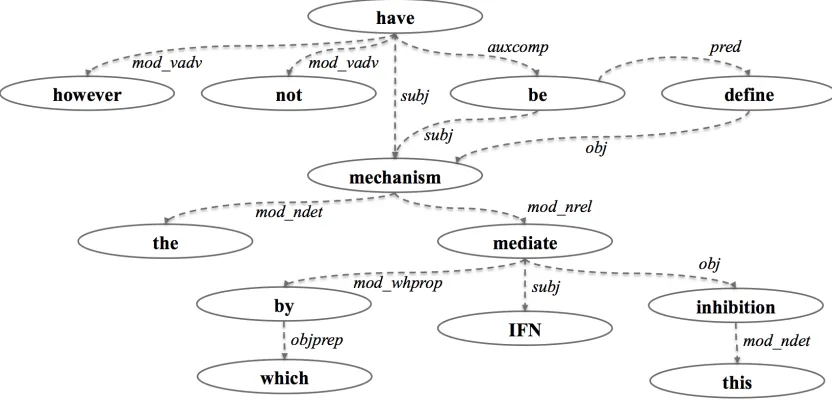
Another problem with BioScopeScopeSpan tations stems from the requirement that such anno-tations should have contiguous spans. For exam-ple, since sentencee3 is a passive construction, the corresponding BioScopeScopeSpan annotation cap-tures the subject (mechanism) as well. The conti-guity requirement then forces the propositionIFNs
mediate this inhibition—which modifies the subject
but is itself not negated (Figure 2)—to be included
within the BioScopeScopeSpan and therefore to be interpretable as negated. Clearly, there may be arbi-trary intervening text in such, and similar, construc-tions, again making the learning task difficult.
e3: However,the mechanism by which IFNs mediate this inhibition hasnotbeen defined.
Sometimes, the BioScopeScopeSpan annotation boundaries do not align with syntactic constituents. For example, in e4, the BioScopeScopeSpan anno-tation excludes the determiner the from the scope while ine5, the determinertheis part of the scope. This might be due to the guideline that the scope should include the cue as well, causing to extend the scope annotation leftward until it covers the cue word (absence). Still, we are left with a span bound-ary which crosses, partially, a noun phrase boundbound-ary.
e4: Tal-1 transcription was shown to be monoallelic in Jurkat, a T-cell line that expresses tal-1 in the
absenceof apparent genomic alteration of the locus. e5: The effects of selenium were specific for NF-kappa
B, sincethe activity of the transcription factor AP-1 wasnotsuppressed.
A system trained and optimized on how well it predicts the BioScopeScopeSpan boundaries suffers from also being forced to learn such syntactic in-consistencies along with the syntactic patterns that truly capture negation. In addition to learning the actual negation patterns, such a system is also forced to learn artifacts of annotation guidelines like: when to include or exclude subjects and when to include or exclude determiners. In order to circumvent this, we propose an approach in which we first re-map Bio-Scope annotations onto nodes in the syntactic tree, and then train a system using features derived from the nodes, and node configurations, providing the context for the negation cue and scope nodes. We next describe the syntactic framework we use and then explain our approach in detail.
4 Syntactic Framework
Figure 1: PAS fore2: “Moreover, cAMP activators did not activate NF-kappa B in Jurkat cells”
aspects of meaning ‘layered’ onto the representa-tion (precedents in prior studies can be found in e.g. (Saur´ı and Pustejovsky, 2009; Diab et al., 2009)), and their pervasive use in a state-of-the-art QA system—for question analysis, candidate genera-tion, and analysis of passage evidence (Ferrucci et al., 2010; Ferrucci, 2012)—which is at the heart of our medical adaptation (Ferrucci et al., 2013).
We use predicate-argument structure (PAS) (Mc-Cord et al., 2012) derived from dependency parses produced by the English Slot Grammar parser (Mc-Cord, 1990). In addition to normalizing across dif-ferent tree structures expressing essentially the same meaning, PAS provides a simplified view over ‘raw’ syntactic trees, gathering all arguments to a
predi-cate from local, and distant, parse tree nodes (see (McCord et al., 2012) for details). Figures 1 and 2 show the PASes for examplese2ande3. By localiz-ing the logical arguments to a proposition, predicate-based representation provides direct access toall ar-guments of e.g. a verb frame: an important require-ment for extracting context-denoting syntactic fea-tures.
PAS-based view into sentences offers unambigu-ously uniform treatment of some of the issues high-lighted in the previous section. For example, going back toe2, and the rationale for including or exclud-ing subjects in the scope of a negation, we observe that verb nodes in the PAS always have fully instan-tiated frames, with subject arguments bound to the
[image:5.612.83.499.478.680.2]predicate nodes corresponding to the deep syntac-tic subject: observe howactivator is ‘subj’ both to
do andactivate. Thus whether to include a subject
into a verb scope (e.g.not activate) becomes largely irrelevant, and a PAS-based scope rendering can al-ways include subjects. As another example, for the PAS fore3, the granular analysis of the arguments to the predicate fordefinecan be leveraged to designate the predicate node formechanismas the scope of the negationnot (defined), while excluding theIFN
me-diate inhibitionsubtree from the same scope.
5 Learning Negations from Re-mapped BioScope
Our goal is a system for automatic identification of negations and their scopes within the PAS of a sen-tence. Our resource for this is BioScope, with its text-based span annotations. We propose a novel ap-proach, realized as a two-step process:
(1) BioScope-to-PAS mapping: map BioScope’s text-span cue and scope annotations to PAS nodes (CuePredicate and NegatedPredicate) by identifying the predicate nodes in the PAS of the sentence that best capture the annotations. (2) NegatedPredicate learning: train a statistical
model to automatically identify the scope predi-cate using features from the PAS context of cue and scope predicates.
5.1 BioScopeScopeSpan-to-NegatedPredicate Mapping
Having obtained PASes for sentences in the corpus, we mark the PAS node with the minimal span that contains the entire BioScopeScopeSpan annotation as the NegatedPredicate. We define the ‘span’ of a PAS node to be the span of text covered by the sub-tree rooted at that node, which includes the spans of all of its descendants. Similarly, we mark the PAS node with the minimal span that contains the Bio-ScopeCue annotation as the CuePredicate.
For example, in Figure 1, the predicate labelednot
was marked as the CuePredicate and the predicate labeleddowas marked as the corresponding Negat-edPredicate. In order to perform a sanity check on our re-mapping, we judged whether the predi-cate nodes that we mark as NegatedPredipredi-cate in sen-tences from our Dev set are in fact the ones being
negated. Of the 470 sentences containing negations, 13 (2.8%) failed to parse, breaking the mapping. In other words, our mapping strategy has coverage of about 97.2%. Of the sentences where a Negated-Predicate was obtained, our mapping achieved an accuracy of 92.8% in finding the correct negated predicate.
5.2 NegatedPredicate Learning
We now build a supervised learning system which, given a CuePredicate in a sentence, will identify its corresponding NegatedPredicate. For every predi-cate p in a sentence PAS with a CuePredipredi-cate, we create an instance<CuePredicate, p>. The instance
<CuePredicate, p>is assigned trueif p is the cor-responding NegatedPredicate. For all other p in the PAS,<CuePredicate, p>is assignedfalse.
We extract three types of features for each in-stance<CuePredicate, p>: 1)token features(word lemma and POS tag) of CuePredicate and p, 2)
syn-tactic context features(token features of parent
pred-icates and all argument predpred-icates) of CuePredicate and p, and 3)predicate pair features (is CuePredi-cate argument of p or vice versa?; distance between CuePredicate and p; relative position of CuePredi-cate and p).
We use the ClearTk (Ogren et al., 2008) frame-work to build our system and perform experi-ments. We use quadratic kernel SVMs in all our experiments. The ClearTK wrapper for SVM-Light (Joachims, 2006) internally shifts the predic-tion threshold using sigmoid fitting to deal with the highly skewed class imbalance (around 5% of posi-tive cases) in our data. Prior studies (Prabhakaran et al., 2012b) have shown this approach to be effective in addressing the class imbalance problem.
On Dev On Test
Precision Recall F-measure Precision Recall F-measure Clinical 95.68 95.68 95.68 96.15 96.9 96.53 Abstracts 94.4 94.4 94.4 95.42 96.9 96.15 Papers 79.22 96.83 87.14 85.29 98.31 91.34 Overall 92.36 95.11 93.71 94.13 97.09 95.58 Table 1: Performance of our CuePredicate detection on Dev and Test sets
the NegatedPredicate. If <CuePredicate, c>is as-signed afalsevalue for all c, we choose the c with the least confidentfalseassignment as the Negated-Predicate.
6 Experiments and Results
The most commonly used metric to evaluate nega-tion scope span detecnega-tion is Percentage of Correct Scopes (PCS). PCS measures the percentage of ex-act matches between predicted and ex-actual scope spans. Since our task is different—negated predicate detection as opposed to negated span detection— we report the Percentage of Correct Scope Predi-cates (PCSP) obtained in our experiments. Mod-els built from the composite training corpus com-prising training corpora of all three genres (see Sec-tion 3) perform better than models built separately over each sub-corpus. We report results separately for each sub-corpus, as well as for the entire corpus, and compare them with a strong baseline.
6.1 Gold vs. Predicted CuePredicates
We report results for the NegatedPredicate detection task obtained using GOLD CuePredicates as well as predicted CuePredicates. In order to measure the performance on predicted CuePredicates, we built a CuePredicate detector using linear kernel SVM to detect whether a predicate is a negation cue or not. We use three types of features: 1) token features
(lemma and POS) of the predicate, 2) linear con-text(token features of the token after the predicate in the sentence; features of tokens before the predicate turned out to be not useful), and 3)syntactic context
(token features of parent and argument predicates). As shown in Table 1, our CuePredicate tagger ob-tained F-measures in the range of state-of-the-art re-sults on negation cue detection using the BioScope (90-96% F-measure (Velldal et al., 2012)).
6.2 Baseline NegatedPredicate Predictor
Since this formulation of the task is new, we built a strong baseline system appropriate for it. In our baseline, we predict the NegatedPredicate to be the parent predicate of the CuePredicate, if the CuePred-icate is a terminal node in the PAS (this will cover the most common cues such as noandnot). If the CuePredicate is not a terminal node (which covers the cases of verbal negation cues such as failed), we choose the CuePredicate itself as the Negated-Predicate. Columns 1 and 3 of Table 2 show PCSP obtained by the baseline algorithm on our Dev and Test sets respectively using GOLD CuePredicates. Columns 5 and 7 show corresponding results using predicted CuePredicates.
6.3 Our NegatedPredicate Predictor
Gold Cues (On Dev) Gold Cues (On Test) Predicted Cues (On Dev) Predicted Cues (On Test) Baseline System Baseline System Baseline System Baseline System
(1) (2) (3) (4) (5) (6) (7) (8)
[image:8.612.81.541.558.656.2]Clinical 83.45 97.12 88.37 100.00 82.01 93.53 87.60 96.90 Abstracts 81.34 89.18 79.07 84.50 76.49 83.96 77.52 82.56 Papers 73.02 79.37 81.36 86.44 66.67 71.43 77.97 83.05 Overall 80.85 90.21 82.06 89.23 76.81 85.11 80.49 86.77
Table 2: Percentage of Correct NegatedPredicate (PCSP) on Dev and Test sets
7 Comparison with Previous Approaches
Comparing our system with previously published approaches to negation scope detection is not straightforward, essentially because our and their tasks are different: negated predicate detection vs. negated scope span detection. The resulting differ-ence in evaluation metrics makes PCS numbers re-ported elsewhere not directly comparable with our PCSP results presented in Table 2. To make such a comparison meaningful, we transform (reverse map) the NegatedPredicates we identify back into text spans and use those to derive PCS values better aligned with previously published ones. (Note that these PCS numbers are still not directly comparable, due to differences in experiment setup, e.g. cross validation vs. held out test set.
Transforming the NegatedPredicates back to Bio-ScopeScopeSpan annotations is not trivial. As dis-cussed in Section 5.1, we choose NegatedPredicate to be the predicate node that minimally covers Bio-ScopeScopeSpan. Hence, the span of a Negated-Predicate may include text spans that were originally not part of the corresponding BioScopeScopeSpan annotation. Therefore, we built a statistically trained
system to predict whether the span of a descendant node of a NegatedPredicate should, or should not, be included in reverse mapping that NegatedPredi-cate to the corresponding BioScopeScopeSpan.
We use the same set of features and learning con-figuration as we used for NegatedPredicate learning (Section 5.2). Our transformation obtained high ac-curacy (94.9%) for the clinical records. However, it was a harder task for abstracts (66.1%) and papers (73.1%) which contain more complex sentences.
We applied this transform on the predicate nodes identified by our end-to-end system (Section 6.3) in order to derive PCS values. In Table 3, we com-pare these PCS values against four previous studies above (due to lack of space, we do not discuss their techniques here), as well as with a baseline of our own where we use the covered text of the predicate node and all of its descendants as scopes used in the comparison. Our system (with transform) obtains higher PCS values than all other reported studies on the clinical records. The PCS values obtained for the abstracts and papers sub-corpora are lower, but still in comparable range to the other studies. It is im-portant to note that the main source of error here is the NegatedPredicate-to-BioScopeScopeSpan
trans-Morante09 Ballestros12Velldal12 Ours (With Covered Text) Ours (With Transform) Zou13 On Dev On Test On Dev On Test
(1) (2) (3) (4) (5) (6) (7) (8)
Clinical 70.75 89.06 89.41 88.49 89.92 91.37 92.25 85.31 Abstracts 66.07 68.92 72.89 35.45 35.27 61.94 58.53 76.90 Papers 41.00 61.43 68.09 33.33 23.73 53.97 47.46 61.19
Overall - - - 50.85 49.55 69.57 66.82
-Table 3: PCS measures from previous BioScope span detection approaches and our end-to-end system. Col. 1-3: end-to-end systems (Morante and Daelemans, 2009), (Ballesteros et al., 2012), and (Velldal et al., 2012);
form step, with its inherent lower accuracies for these two corpora, as reported above. We emphasize that for practical applications this transformation is of little use: what matters more, certainly for a nega-tion detecnega-tion system feeding downstream compo-nents, are the PCSP values presented in Section 6.
8 Discussion and Conclusion
The results for our system, with reverse map-ping, offer indirect evidence for our observation in Section 3.1: training a system to predict Bio-ScopeScopeSpan boundaries would require it also to learn inconsistencies in BioScope annotations. This is a hard learning task, given the noise dis-cussed in Section 3.1. Indeed, our results for learn-ing the reverse-mapplearn-ing transformation show that it is harder to learn the specific annotation criteria in BioScope than to learn the structural patterns ex-pressing negations (which, as we saw in Section 6, obtained close to 90% accuracy). While we had to build a system to transform nodes back to spans for the purposes of comparative analysis, such a system has no role in our quest for practical negation detec-tion and representadetec-tion.
This substantiates our strategy of using BioScope,
as is, to learn not scope spans of negation
expres-sions, but negated predicates within the predicate-argument structure (Section 5). The re-mapping route takes us where we want to be, from the point of view of a practical application of negation-based inference: with access to negated predicate nodes. The end-to-end accuracy (overall, across three dif-ferent genres) of 87% on blind test validates the cre-ative way we propose to make use of a valuable and unique resource—despite its imperfections—by ex-tracting the real value in it, while mitigating the ef-fects of its various inconsistencies.
The results in Tables 2 and 3 show that we have achieved our primary objective: using BioScope to train a system which detects structured negation ex-pressions in clinical text. Our approach to nega-tion scope learning in the syntactic space is a two-step one—first, re-mapping the text-span annota-tions for negation scopes in BioScope to the syn-tactic space and then training a scope predicate pre-dictor. We show that our transformation introduces only a small percentage of error and also that our
predicted nodes can be transformed back to original span annotations with performance comparable to other negation scope span prediction systems trained on the same dataset. Notably, in clinical records, our system outperforms reported state-of-the-art results (column 8 of Table 3).
In a broader context, the work we report here indi-rectly argues that the method we propose to circum-vent certain limitations of a corpus like BioScope can be applied to similar tasks (such as hedging, sen-timent analysis, and variety of modalities, cf. Sec-tion 1), for which current annotaSec-tion resources offer flat, and possibly inconsistent, annotations. In addi-tion, we chose PAS as our syntactic framework for the reasons listed in Section 4, but our approach is not limited to PAS. Indeed, the claims, and methods, are presented to be applicable, and workable, in a more general syntactic framework.
Acknowledgments
This work was conducted while the first author was doing an internship at IBM Research at the TJ Watson Research Center in Yorktown Heights, NY, USA. We thank several anonymous reviewers for their constructive feedback.
References
Mordechai Averbuch, Tom Karson, Benjamin Ben-Ami, Oded Maimon, and Lior Rokach. 2004. Context-sensitive medical information retrieval. In Proc. of the 11th World Congress on Medical Informatics (MEDINFO-2004), pages 1–8. Citeseer.
Miguel Ballesteros, Virginia Francisco, Alberto D´ıaz, Jes´us Herrera, and Pablo Gerv´as. 2012. Inferring the scope of negation in biomedical documents. In13th International Conference on Intelligent Text Process-ing and Computational LProcess-inguistics (CICLING 2012), New Delhi, 2012. Springer, Springer.
Wendy W Chapman, Will Bridewell, Paul Hanbury, Gre-gory F Cooper, and Bruce G Buchanan. 2001. A sim-ple algorithm for identifying negated findings and dis-eases in discharge summaries. Journal of biomedical informatics, 34(5):301–310.
Human Language Technologies, pages 765–771, At-lanta, Georgia, June. Association for Computational Linguistics.
Isaac G Councill, Ryan McDonald, and Leonid Ve-likovich. 2010. What’s great and what’s not: learn-ing to classify the scope of negation for improved sen-timent analysis. In Proceedings of the workshop on negation and speculation in natural language process-ing, pages 51–59. Association for Computational Lin-guistics.
Dina Demner-Fushman, Wendy W Chapman, and Clement J McDonald. 2009. What can natural lan-guage processing do for clinical decision support?
Journal of biomedical informatics, 42(5):760–772. Mona Diab, Lori Levin, Teruko Mitamura, Owen
Ram-bow, Vinodkumar Prabhakaran, and Weiwei Guo. 2009. Committed belief annotation and tagging. In
Proceedings of the Third Linguistic Annotation Work-shop, pages 68–73, Suntec, Singapore, August. Asso-ciation for Computational Linguistics.
Rich´ard Farkas, Veronika Vincze, Gy¨orgy Szarvas, Gy¨orgy M´ora, and J´anos Csirik, editors. 2010. Pro-ceedings of the Fourteenth Conference on Computa-tional Natural Language Learning. Association for Computational Linguistics, Uppsala, Sweden, July. David Ferrucci, Eric Brown, Jennifer Chu-Carroll, James
Fan, David Gondek, Aditya A Kalyanpur, Adam Lally, J William Murdock, Eric Nyberg, John Prager, et al. 2010. Building watson: An overview of the deepqa project. AI magazine, 31(3):59–79.
David A Ferrucci, Anthony Levas, Sugato Bagchi, David Gondek, and Erik T Mueller. 2013. Watson: Beyond jeopardy! Artif. Intell., 199:93–105.
David A Ferrucci. 2012. Introduction to ”this is wat-son”. IBM Journal of Research and Development, 56(3.4):1:1–1:15.
Thorsten Joachims. 2006. Training Linear SVMs in Lin-ear Time. InProceedings of the 12th ACM SIGKDD international conference on knowledge discovery and data mining, pages 217–226. ACM.
Jin-Dong Kim, Tomoko Ohta, Sampo Pyysalo, Yoshi-nobu Kano, and Jun’ichi Tsujii. 2009. Overview of bionlp’09 shared task on event extraction. In Proceed-ings of the Workshop on Current Trends in Biomedical Natural Language Processing: Shared Task, BioNLP ’09, pages 1–9, Stroudsburg, PA, USA. Association for Computational Linguistics.
Minsuk Lee, James Cimino, Hai Ran Zhu, Carl Sable, Vijay Shanker, John Ely, and Hong Yu. 2006. Beyond information retrievalmedical question answering. In
AMIA Annual Symposium Proceedings, volume 2006, page 469. American Medical Informatics Association.
Michael C. McCord, J. William Murdock, and Branimir Boguraev. 2012. Deep parsing in Watson. IBM Jour-nal of Research and Development, 56(3):3.
Michael C. McCord. 1990. Slot grammar: A sys-tem for simpler construction of practical natural lan-guage grammars. In R. Studer, editor, Natural Lan-guage and Logic: Proc. of the International Scientific Symposium, Hamburg, FRG, pages 118–145. Springer, Berlin, Heidelberg.
St´ephane M Meystre, Guergana K Savova, Karin C Kipper-Schuler, and John F Hurdle. 2008. Extracting information from textual documents in the electronic health record: a review of recent research. Yearbook of medical informatics, pages 128–144.
Roser Morante and Eduardo Blanco. 2012. * SEM 2012 shared task: Resolving the scope and focus of nega-tion. InProceedings of the First Joint Conference on Lexical and Computational Semantics-Volume 1: Pro-ceedings of the main conference and the shared task, and Volume 2: Proceedings of the Sixth International Workshop on Semantic Evaluation, pages 265–274. Association for Computational Linguistics.
Roser Morante and Walter Daelemans. 2009. A met-alearning approach to processing the scope of nega-tion. In Proceedings of the Thirteenth Conference on Computational Natural Language Learning, pages 21–29. Association for Computational Linguistics. Philip V. Ogren, Philipp G. Wetzler, and Steven Bethard.
2008. ClearTK: A UIMA toolkit for statistical natural language processing. InTowards Enhanced Interoper-ability for Large HLT Systems: UIMA for NLP work-shop at Language Resources and Evaluation Confer-ence (LREC).
Vinodkumar Prabhakaran, Owen Rambow, and Mona Diab. 2010. Automatic committed belief tagging. In
COLING 2010: Posters, pages 1014–1022, Beijing, China, August. COLING 2010 Organizing Commit-tee.
Vinodkumar Prabhakaran, Michael Bloodgood, Mona Diab, Bonnie Dorr, Lori Levin, Christine D. Piatko, Owen Rambow, and Benjamin Van Durme. 2012a. Statistical Modality Tagging from Rule-based Annota-tions and Crowdsourcing. InProceedings of the Work-shop on Extra-Propositional Aspects of Meaning in Computational Linguistics, pages 57–64, Jeju, Repub-lic of Korea, July. Association for Computational Lin-guistics.
Preethi Raghavan, Albert Lai, and Eric Fosler-Lussier. 2012. Learning to temporally order medical events in clinical text. InProceedings of the 50th Annual Meet-ing of the Association for Computational LMeet-inguistics (Volume 2: Short Papers), pages 70–74, Jeju Island, Korea, July. Association for Computational Linguis-tics.
Roser Saur´ı and James Pustejovsky. 2009. Fact-bank: a corpus annotated with event factuality.
Language Resources and Evaluation, 43:227–268. 10.1007/s10579-009-9089-9.
Pontus Stenetorp, Sampo Pyysalo, Tomoko Ohta, Sophia Ananiadou, and Jun’ichi Tsujii. 2012. Bridging the gap between scope-based and event-based nega-tion/speculation annotations: a bridge not too far. In
Proceedings of the Workshop on Extra-Propositional Aspects of Meaning in Computational Linguistics, pages 47–56. Association for Computational Linguis-tics.
Kateryna Tymoshenko, Swapna Somasundaran, Vinod-kumar Prabhakaran, and Vinay Shet. 2012. Relation mining in the biomedical domain using entity-level se-mantics. InECAI, pages 780–785.
¨Ozlem Uzuner, Imre Solti, and Eithon Cadag. 2010. Extracting medication information from clinical text.
Journal of the American Medical Informatics Associa-tion, 17(5):514–518.
Erik Velldal, Lilja Øvrelid, Jonathon Read, and Stephan Oepen. 2012. Speculation and negation: Rules, rankers, and the role of syntax. Computational lin-guistics, 38(2):369–410.
Veronika Vincze, Gy¨orgy Szarvas, Rich´ard Farkas, Gy¨orgy M´ora, and J´anos Csirik. 2008. The Bio-Scope corpus: biomedical texts annotated for uncer-tainty, negation and their scopes. BMC bioinformatics, 9(Suppl 11):S9.
Veronika Vincze, Gyorgy Szarvas, Gyorgy Mora, Tomoko Ohta, Rich´ard Farkas, et al. 2011. Lin-guistic scope-based and biological event-based spec-ulation and negation annotations in the BioScope and Genia Event corpora. Journal of Biomedical Seman-tics, 2(Suppl 5):S8.
Michael Wiegand, Alexandra Balahur, Benjamin Roth, Dietrich Klakow, and Andr´es Montoyo. 2010. A sur-vey on the role of negation in sentiment analysis. In
Proceedings of the workshop on negation and specu-lation in natural language processing, pages 60–68. Association for Computational Linguistics.
Bowei Zou, Guodong Zhou, and Qiaoming Zhu. 2013. Tree kernel-based negation and speculation scope de-tection with structured syntactic parse features. In
Proceedings of the 2013 Conference on Empirical Methods in Natural Language Processing, pages 968–