1287
ZQM at SemEval-2019 Task9: A Single Layer CNN Based on Pre-trained
Model for Suggestion Mining
Qimin Zhou, Zhengxin Zhang, Hao Wu*, Linmao Wang
School of Information Science and Engineering, Yunnan University Chenggong Campus, Kunming, P.R. China
{zqmynu,zzxynu}@gmail.com, [email protected], [email protected]
Abstract
This paper describes our system that competed at SemEval 2019 Task 9 - SubTask A: ”Sug-gestion Mining from Online Reviews and Fo-rums”. Our system fuses the convolutional neural network and the latest BERT model to conduct suggestion mining. In our system, the input of convolutional neural network is the embedding vectors which are drawn from the pre-trained BERT model. And to enhance the effectiveness of the whole system, the pre-trained BERT model is fine-tuned by provid-ed datasets before the procprovid-edure of embprovid-edding vectors extraction. Empirical results show the effectiveness of our model which obtained 9th
position out of 34 teams with F1 score equals to 0.715.
1 Introduction
Suggestion mining is defined as the extraction of suggestions from unstructured text (Negi et al.,
2018). Suggestion mining is still a relatively y-oung research area as compared to other natural language processing issues like sentiment analy-sis (Negi and Buitelaar,2015). While suggestion mining is of great commercial value for organi-sations to improve the quality of their entities by considering the positive and negative opinions col-lected from platforms. The target of this task is to automatically classify the sentences collected from online reviews and forums into two classes which are suggestion and non-suggestion respec-tively (Negi et al.,2019).
BERT which stands for BidirectionalEncoder
Representation from Transformers is the latest breakthrough in the field of NLP provided by Google Research (Devlin et al., 2018). It has substantially advanced the state-of-the-art in many NLP tasks, especially in question answering ( Al-berti et al.,2019). More importantly, it provides a
widely applicable tool for representation learning which can be generalized to many NLP tasks.
For this subtask, we firstly learn the word or sentence embeddings utilizing the pre-trained BERT model. Then the embedding vectors are extracted from BERT as the input of the subse-quent model. It is worth noting that we have fine-tuned the pre-trained BERT model with provided dataset before the embedding vectors are extract-ed. In other words, this part is equivalent to the conventional embedding layer. This strategy is a little bit like ELMO (Peters et al.,2018). As for the upper layer of this system, convolutional neu-ral network (CNN) is adopted herein to process the features. Although CNN is originally invent-ed for tackling computer vision issues, while it has subsequently been shown to be effective for many NLP tasks (Kim,2014;Zhang and Wallace,2015;
Dong et al.,2015).
The remainder of the paper is organized as fol-lows. Section 2 describes the detailed architecture of our system. Section 3 reports the experimental results on the given datasets. Finally, conclusions are drawn in Section 4.
2 System Description
Figure 1 gives a high-level overview of our ap-proach. And we elaborate the details of implemen-tation which mainly consists of following steps: (1) the preprocessing of raw data, (2) the word embedding learning via BERT model, (3) feature processing via CNN and sentences classification.
2.1 Data Preprocessing
pre-Figure 1: The architecture of our proposed model.
processing steps on the raw data. At first, web links are removed through regular expression as it does not contribute to the accuracy of classifi-cation. After that, we can take more meaningful words into consideration under the condition of a finite sentence length. Andekphrasis1, a text pro-cessing tool, is utilized to conduct spelling correc-tion (Baziotis et al., 2017). Then, all character-s are converted to lowercacharacter-se. Finally, duplicated samples would be excluded from the dataset.
2.2 Embedding Learning via BERT
Embedding layer usually encodes each word in-to a fixed-length vecin-tor for subsequent study.
Word2vec,GloveandFastTextare the most simple and popular word embedding algorithms (Mikolov et al., 2013; Pennington et al., 2014; Bojanows-ki et al.,2017). While there continue to be some drawbacks, such as they cannot encode the con-textual information well. Recently, a few effec-tive algorithms have been put forward such as EL-MO and openAI GPT (Peters et al., 2018; Rad-ford et al.,2018). These two pre-trained language models can encode rich syntactic and semantic in-formation and distinguish the different meanings of a polysemy in diverse contexts, which tradi-tional word embeddings methods cannot handle well. ELMO leverages the concatenation of in-dependently trained left-to-right and right-to-left LSTM to generate features. Though LSTM can capture contextual information, the performance
1github.com/cbaziotis/ekphrasis
can be limited by the long distance of sequences to some extent. In order to deal with this problem,
openAI GPT substitute Transformer for LSTM.
Transformer rely entirely on attention mechanis-m to capture global dependencies (Vaswani et al.,
2017).
BERTis the latest language representation mod-el which also takes advantage of Transformer. Besides that, it uses the masked language mod-el (MLM) and the bidirectional Transformers to capture the contextual information which has been proved to be effective (Devlin et al.,2018). In our system, we employBERT as the embedding lay-er, in other words, we use the output of the last transformer layer from BERT as word embedding vectors. The version of pre-trained BERT model we used is BERT-BASE which has 12 layers of transformer blocks and the hidden size is equal to 768. It implies that the dimension of the output embedding vectors is equal to 768. We choose not to cover too much details of BERT as it has been elaborated on its website2.
To boost the performance of our system by mak-ing this model better fit our data, a fine-tunmak-ing step is conducted before extracting the word embed-ding vectors from pre-trained model. And the fine-tuning parameters are given in Section3.2.
2.3 Feature processing via CNN
CNN is originally invented for tackling the issues in the field of computer vision, while various
[image:2.595.78.533.84.272.2]NN models have subsequently been proven to be effective for many NLP tasks (Kalchbrenner et al.,
2014;dos Santos and Gatti, 2014). In our work, we train a single layer CNN on the word em-bedding vectors drawn from BERT model. Let
ei ∈ Rk be the k-dimensional word embedding
vector corresponding to the i-th word in the sen-tence. Then the vector representation of a sentence is denoted as Eq.1:
e1:n= [e1 ke2 ke3 k...ken], (1)
wherenrepresents the length of sentences, andk
denotes concat operation which can maintain the order of words in text. After that a filter involved in one-dimensional convolution operation is de-fined asw∈Rm×k, then the convolution process
can be defined as a function as Eq.2(Kim,2014):
pi =f(w·ei:i+m−1+b), (2)
wherepi is a scalar which stands for the new
lo-cal feature generated by a filter from a window of words ei:i+m−1, in other words, only i-th to
i+m−1-th words have been taken into consider-ation when generatei-th local feature. m is filter size which denotesmwords is taken into calcula-tion when generating a local feature.bis a bias and
fis an activation function, it istanhexactly in our system. Finally, there aren−m+ 1local features generated by a filter totally. Those local features can be concatenated as a global featureP:
P = [p1 kp2kp3 k...kpn−m+1], (3)
whereP ∈Rn−m+1represents a feature map
gen-erated by a filter. Then amax-over-time maxpool-ingoperation (Collobert et al.,2011) is applied to the feature maps which means that only the maxi-mum value ofP is reserved. If there areNf
filter-s, thenNf maximum values is generated through maxpoolingoperations. Those values can be orga-nized as a new vectorQ∈RNf as Eq.4:
Q= [max(P1)kmax(P2)k...kmax(PNf)],
(4)
2.4 Dense layers
The pooling layer is followed by two dense layers with different number of neurons. Dropout( Hin-ton et al.,2012) is utilized to alleviate overfitting problem before the first dense layer. And we have tried different dropout rates to search the best con-figuration. Firstly, the output of pooling layerQis
fed into the first dense layer with 200 hidden neu-rons. The activation function of this dense layer isrelu(Xu et al.,2015). Next is the second dense layer with two neurons and the corresponding ac-tivation function is softmax. Final output is the probability of which class the sample belongs to.
3 Experiments
3.1 Dataset
Classes Train set Trial Test set Test set 0 (non-suggestions) 6415 296 746
[image:3.595.307.531.199.236.2]1 (suggestions) 2085 296 87
Table 1: Data distribution
The available dataset released by organizer is s-plit into three parts: train set, trial test set and test set. The positive and negative sample distribution of each part is described as Table 1. Apparently, there is class imbalance that the number of neg-ative samples overwhelms the number of positive samples both in training set and test set. So for experiments, we fuse the train set and trail test set into a larger training set, and then split 10% sam-ples as validation set randomly (8183 samsam-ples for training and 909 samples for validation). We train our model on the train set, tune the model param-eters on the validation set, evaluate the model per-formance on the test set.
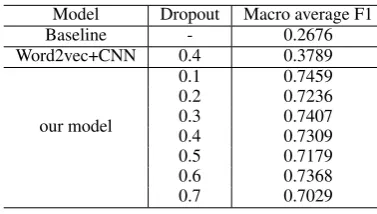
Model Dropout Macro average F1
Baseline - 0.2676
Word2vec+CNN 0.4 0.3789
our model
0.1 0.7459
0.2 0.7236
0.3 0.7407
0.4 0.7309
0.5 0.7179
0.6 0.7368
[image:3.595.319.508.462.569.2]0.7 0.7029
Table 2: The performance comparison.
Classes Precision Recall F1 score 0 (non-suggestions) 0.98 0.96 0.97
1 (suggestions) 0.70 0.79 0.75
Table 3: The classification accuracy of different class-es.
3.2 Experiment Results
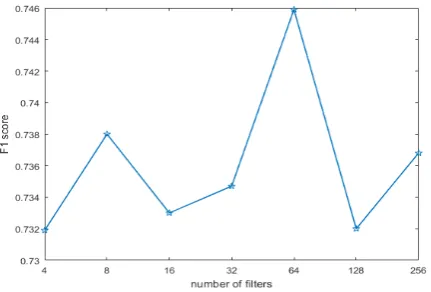
Figure 2: The impact of the number of filters.
Figure 3: The impact of filter size.
of pre-trained model, with the exception of batch size, learning rate and number of training epochs. The mini-batch size is set at 32 and learning rate is set at 5e-5, the number of training epochs is con-figured as 5. The maximal length of sentences is configured as 50 and if the length of a sentence is less than 50, it will be padded with zero; oth-erwise, it will be truncated from the tail. For the CNN component, the filter size m is configured as 5 and the number of filters Nf is 64. And the dropout rates we have tried are ranged from 0.1 to 0.7 with a step of 0.1. The experimental results are shown in Table2. In order to prove the effec-tiveness of word embeddings derived from BERT, we also employ Word2vec as comparison and the corresponding best dropout rate is 0.4. Obviously, no matter what the dropout rate is, our model con-sistently outperforms other models. And the best dropout rate of our model is around 0.1 for above-mentioned configuration. While the best dropout rate may vary with other parameter configuration like filter size and the number of filters.
Table 3 shows the Precision, Recall and F1 s-core in term of different classes. Obviously, the
system performance on negative samples is better than the performance on positive samples which is consistent with our intuition for the reason that the number of negative samples overwhelms the number of positive samples. Therefore, our sys-tem can learn more features of negative samples, which can help it recognize those negative samples accurately.
We also investigate the impact of the number of filters Nf on the classification performance with fixing the filter sizemat 5 and the dropout rate at 0.1. The experimental result is shown as Figure2. This model yields the best performance when the number of filters is equal to 64. Less filters cannot capture enough information while too many filters can result in information redundancy to some ex-tent.
The impact of filter size on classification accu-racy is shown as Figure 3. The most suitable fil-ter size which means the window size of convolu-tional operation is m = 5. It is difficult for this system to catch the global semantic information if the window size is too small. While some local semantic information would be ignored if the win-dow size of filter is too large. Hence, choosing a filter with moderate size is helpful for the perfor-mance improvement.
4 Conclusions
In this paper, we have proposed a neural model based on the pre-trained BERT model to deal with suggestion mining task. Our system can learn the representation of sentences or words effectively by leveraging BERT. Then the representations ex-tracted from BERT is fed into a simple CNN layer. Experimental results show that our system is effi-cient on the given dataset.
As for future work, it is of necessity to tackle the imbalance between positive samples and negative samples through oversampling or undersampling. And we intend to study some innovative ways to incorporate BERT model like extracting not only the output of the last transformer layer but also the output of different transformer layers and integrat-ing them with different weights.
Acknowledgments
References
Chris Alberti, Kenton Lee, and Michael Collins. 2019. A bert baseline for the natural questions. CoRR, ab-s/1901.08634.
Christos Baziotis, Nikos Pelekis, and Christos Doulk-eridis. 2017. Datastories at semeval-2017 task 4: Deep lstm with attention for message-level and topic-based sentiment analysis. In Proceedings of the 11th International Workshop on Semantic Eval-uation (SemEval-2017), pages 747–754.
Piotr Bojanowski, Edouard Grave, Armand Joulin, and Tomas Mikolov. 2017. Enriching word vectors with subword information. Transactions of the Associa-tion for ComputaAssocia-tional Linguistics, 5:135–146.
Ronan Collobert, Jason Weston, L´eon Bottou, Michael Karlen, Koray Kavukcuoglu, and Pavel Kuksa. 2011. Natural language processing (almost) from scratch. Journal of machine learning research, 12(Aug):2493–2537.
Jacob Devlin, Ming-Wei Chang, Kenton Lee, and Kristina Toutanova. 2018. Bert: Pre-training of deep bidirectional transformers for language understand-ing. arXiv preprint arXiv:1810.04805.
Li Dong, Furu Wei, Ming Zhou, and Ke Xu. 2015. Question answering over freebase with multi-column convolutional neural networks. In Proceed-ings of the 53rd Annual Meeting of the Association for Computational Linguistics and the 7th Interna-tional Joint Conference on Natural Language Pro-cessing (Volume 1: Long Papers), volume 1, pages 260–269.
Geoffrey E Hinton, Nitish Srivastava, Alex Krizhevsky, Ilya Sutskever, and Ruslan R Salakhutdinov. 2012. Improving neural networks by preventing co-adaptation of feature detectors. arXiv preprint arX-iv:1207.0580.
Nal Kalchbrenner, Edward Grefenstette, and Phil Blun-som. 2014. A convolutional neural network for modelling sentences. InACL.
Yoon Kim. 2014. Convolutional neural network-s for network-sentence clanetwork-snetwork-sification. arXiv preprint arX-iv:1408.5882.
Tomas Mikolov, Kai Chen, Greg Corrado, and Jef-frey Dean. 2013. Efficient estimation of word rep-resentations in vector space. arXiv preprint arX-iv:1301.3781.
Sapna Negi and Paul Buitelaar. 2015. Towards the ex-traction of customer-to-customer suggestions from reviews. InProceedings of the 2015 Conference on Empirical Methods in Natural Language Process-ing, pages 2159–2167.
Sapna Negi, Tobias Daudert, and Paul Buitelaar. 2019. Semeval-2019 task 9: Suggestion mining from on-line reviews and forums. In Proceedings of the
13th International Workshop on Semantic Evalua-tion (SemEval-2019).
Sapna Negi, Maarten de Rijke, and Paul Buitelaar. 2018. Open domain suggestion mining: Prob-lem definition and datasets. arXiv preprint arX-iv:1806.02179.
Jeffrey Pennington, Richard Socher, and Christopher Manning. 2014. Glove: Global vectors for word representation. InProceedings of the 2014 confer-ence on empirical methods in natural language pro-cessing (EMNLP), pages 1532–1543.
Matthew E Peters, Mark Neumann, Mohit Iyyer, Matt Gardner, Christopher Clark, Kenton Lee, and Luke Zettlemoyer. 2018. Deep contextualized word rep-resentations. arXiv preprint arXiv:1802.05365.
Alec Radford, Karthik Narasimhan, Tim Salimans, and Ilya Sutskever. 2018. Improving language under-standing by generative pre-training. URL https://s3-us-west-2. amazonaws. com/openai-assets/research-covers/languageunsupervised/language under-standing paper. pdf.
Cicero dos Santos and Maira Gatti. 2014. Deep con-volutional neural networks for sentiment analysis of short texts. In Proceedings of COLING 2014, the 25th International Conference on Computation-al Linguistics: TechnicComputation-al Papers, pages 69–78.
Ashish Vaswani, Noam Shazeer, Niki Parmar, Jakob Uszkoreit, Llion Jones, Aidan N Gomez, Łukasz Kaiser, and Illia Polosukhin. 2017. Attention is all you need. InAdvances in Neural Information Pro-cessing Systems, pages 5998–6008.
Bing Xu, Naiyan Wang, Tianqi Chen, and Mu Li. 2015. Empirical evaluation of rectified activation-s in convolutional network. arXiv preprint arX-iv:1505.00853.