UiO
2: Sequence-Labeling Negation Using Dependency Features
Emanuele Lapponi Erik Velldal Lilja Øvrelid Jonathon Read University of Oslo, Department of Informatics
{emanuel,erikve,liljao,jread}@ifi.uio.no
Abstract
This paper describes the second of two sys-tems submitted from the University of Oslo (UiO) to the 2012 *SEM Shared Task on re-solving negation. The system combines SVM cue classification with CRF sequence labeling of events and scopes. Models for scopes and events are created using lexical and syntactic features, together with a fine-grained set of la-bels that capture the scopal behavior of certain tokens. Following labeling, negated tokens are assigned to their respective cues using simple post-processing heuristics. The system was ranked first in the open track and third in the closed track, and was one of the top perform-ers in the scope resolution sub-task overall.
1 Introduction
Negation Resolution (NR) is the task of determin-ing, for a given sentence, which tokens are affected by a negation cue. The data set most prominently used for the development of systems for automatic NR is the BioScope Corpus (Vincze et al., 2008), a collection of clinical reports and papers in the bio-medical domain annotated with negation and specu-lation cues and their scopes. The data sets released in conjunction with the 2012 shared task on NR hosted by The First Joint Conference on Lexical and Computational Semantics (*SEM 2012) are com-prised of the following negation annotated stories of Conan Doyle (CD): a training set of 3644 sentences drawn fromThe Hound of the Baskervilles(CDT), a development set of 787 sentences taken from Wis-teria Lodge (CDD; we will refer to the combina-tion of CDT and CDD as CDTD), and a held-out
test set of 1089 sentences fromThe Cardboard Box andThe Red Circle (CDE). In these sets, the con-cept of negation scope extends on the one adopted in the BioScope corpus in several aspects: Nega-tion cues are not part of the scope, morphological (affixal) cues are annotated and scopes can be dis-continuous. Moreover, in-scope states or events are marked as negated if they are factual and presented as events that did not happen (Morante and Daele-mans, 2012). Examples (1) and (2) below are exam-ples of affixal negation and discontinuous scope re-spectively: The cues are bold, the tokens contained within their scopes are underlined and the negated event is italicized.
(1) Since we have been sounfortunateas to miss him [. . . ] (2) If he was in the hospital and yetnoton the staff he could
only have been a house-surgeon or a house-physician: lit-tle more than a senior student.
Example (2) has no negated events because the sen-tence is non-factual.
The *SEM shared task thus comprises three sub-tasks: cue identification, scope resolution and event detection. It is furthermore divided into two separate tracks: one closed track, where only the data sup-plied by the organizers (word form, lemma, PoS-tag and syntactic constituent for each token) may be em-ployed, and an open track, where participants may employ any additional tools or resources.
Pragmatically speaking, a token can be eitherout of scopeor assigned to one or more of the three re-maining classes:negation cue,in scopeandnegated event. Additionally, in-scope tokens and negated events are paired to the cues they are negated by.
Our system achieves this by remodeling the task as a sequence labeling task. With annotations converted to sequences of labels, we train a Conditional Ran-dom Field (CRF) classifier with a range of different feature types, including features defined over depen-dency graphs. This article presents two submissions for the *SEM shared task, differing only with re-spect to how these dependency graphs were derived. For our open track submission, the dependency rep-resentations are produced by a state-of-the-art de-pendency parser, whereas the closed track submis-sion employs dependencies derived from the con-stituent analyses supplied with the shared task data sets through a process of constituent-to-dependency conversion. In both systems, labeling of test data is performed in two stages. First, cues are detected us-ing a token classifier,1and secondly, scope and event resolution is achieved by post-processing the output of the sequence labeler.
The two systems described in this paper have been developed using CDT for training and CDD for test-ing, and differ only with regard to the source of syn-tactic information. All reported scores are generated using an evaluation script provided by the task or-ganizers. In addition to providing a full end-to-end evaluation, the script breaks down results with re-spect to identification of cues, events, scope tokens, and two variants of scope-level exact match; one re-quiring exact match also of cues and another only partial cue match. For our system these two scope-level scores are identical and so are not duplicated in our reporting. Additionally we chose not to opti-mize for the scope tokens measure, and hence this is also not reported as a development result.
Note also that the official evaluation actually in-cludes two different variants of the metrics men-tioned above; a set of primary measures with pre-cision computed as P=TP/(TP+FP) and a set of B measures where precision is rather computed as P=TP/SYS, where SYS is the total number of pre-dictions made by the system. The reason why SYS is not identical with TP+FP is that partial matches are
1
Note that the cue classifier applied in the current paper is the same as that used in the other shared task submission from the University of Oslo (Read et al., 2012), and the two system descriptions will therefore have much overlap on this particular point. For all other components the architectures of the two system are completely different, however.
only counted as FNs (and not FPs) in order to avoid double penalties. We do not report the B measures for development testing as they were introduced for the final evaluation and hence were not considered in our system optimization. We note though, that the relative-ranking of participating systems for the pri-mary and B measures is identical, and that the cor-relation between the paired lists of scores is nearly perfect (r=0.997).
The rest of the paper is structured as follows. First, the cue classifier, its features and results are described in Section 2. Section 3 presents the sys-tem for scope and event resolution and details differ-ent features, the model-internal represdiffer-entation used for sequence-labeling, as well as the post-processing component. Error analyses for the cue, scope and event components are provided in the respective sec-tions. Section 4 and 5 provide developmental and held-out results, respectively. Finally, we provide conclusions and some reflections regarding future work in Section 6.
2 Cue detection
Identification of negation cues is based on the light-weight classification scheme presented by Velldal et al. (2012). By treating the set of cue words as a closed class, Velldal et al. (2012) showed that one could greatly reduce the number of examples pre-sented to the learner, and correspondingly the num-ber of features, while at the same time improving performance. This means that the classifier only at-tempts to “disambiguate” known cue words while ignoring any words not observed as cues in the train-ing data.
or non-cue when attaching to any such token, like for instanceimage,recklessness, andbless.
2.1 Features
In the initial formulation of Velldal (2011), an SVM classifier was trained using simplen-gram features over words, both full forms and lemmas, to the left and right of the candidate cues. In addition to these token-level features, the classifier we apply here in-cludes some features specifically targeting morpho-logical or affixal cues. The first such feature records charactern-grams from both the beginning and end of the base that an affix attaches to (up to five po-sitions). For a context like impossible we would record n-grams such {possi, poss, pos, . . .} and
{sible, ible, ble, . . .}, and combine this with infor-mation about the affix itself (im) and the token part-of-speech (“JJ”).
For the second feature type targeting affix cues we try to emulate the effect of a lexicon look-up of the remaining substring that an affix attaches to, checking its status as an independent base form and its part-of-speech. In order to take advantage of such information while staying within the confines of the closed track, we automatically generate a lex-icon from the training data, counting the instances of each PoS tagged lemma in addition to n-grams of word-initial characters (again recording up to five positions). For a given match of an affix pattern, a feature will then record the counts from this lexicon for the substring it attaches to. The rationale for this feature is that the occurrence of a substring such as unin a token such as underlyingshould be consid-ered more unlikely to be a cue given that the first part of the remaining string (e.g.,derly) would be an unlikely way to begin a word.
Note that, it is also possible for a negation cue to span multiple tokens, such as the (discontinuous) pair neither / nor or fixed expressions like on the contrary. There are, however, only 16 instances of such multiword cues (MWCs) in the entire CDTD. Rather than letting the classifier be sensitive to these corner cases, we cover such MWC patterns using a small set of simple post-processing heuristics. A small stop-list is used for filtering out the relevant words from the examples presented to the classifier (on,the, etc.).
Data set Model Prec Prec F1
CDD Baseline 90.68 84.39 87.42
Classifier 93.75 95.38 94.56
CDE Baseline 87.10 92.05 89.51
[image:3.612.338.515.56.125.2]Classifier 89.17 93.56 91.31
Table 1: Cue classification results for the final classifier and the majority-usage baseline, showing test scores for the development set (training on CDT) and the final held-out set (training on CDTD).
2.2 Results
Table 1 presents results for the cue classifier. While the classifier configuration was optimized against CDD, the model used for the final held-out testing is trained on the entire CDTD, which (given our closed-class treatment of cues) provides a total of 1162 positive and 1100 negative training examples. As an informed baseline, we also tried classifying each word based on its most frequent use as cue or non-cue in the training data. (Affixal cue oc-currences are counted by looking at both the affix-pattern and the base it attaches to, basically treating the entire token as a cue. Tokens that end up be-ing classified as cues are then matched against the affix patterns observed during training in order to correctly delimit the annotation of the cue.) This simple majority-usage approach actually provides a fairly strong baseline, yielding an F1 of 87.42 on CDD (P=90.68, R=84.39). Compare this to the F1of 94.56 obtained by the classifier on the same data set (P=93.75, R=95.38). However, when applying the models to the held-out set, with models estimated over the entire CDTD, the baseline seems to able to make good use of the additional data and proves to be even more competitive: While our final cue classifier achieves F1=91.31, the baseline achieves F1=89.51, almost two percentage points higher than its score on the development data, and even outper-forms four of the ten cue detection systems submit-ted for the shared task (three of the 12 shared task submissions use the same classifier).
Of the FPs, we find five so-calledfalse negation cues (Morante et al., 2011), including three instances of none in the fixed expression none the less. The others are affixal cues, of which two are clearly wrong (underworked,universal) while others might arguably be due to annotation errors (insuperable, unhappily,endless,listlessly). Among the FNs, two are due to MWCs not covered by our heuristics (e.g., no more), while the remaining errors concern af-fixes, including one in an interesting context of dou-ble negation;not dissatisfied.
3 Scope and event resolution
In this work, we model negation scope resolution as a special instance of the classical IOB (Inside, Outside, Begin) sequence labeling problem, where negation cues are labeled to be sequence starters and scopes and events as two different kinds of chunks. CRFs allow the computation ofp(X|Y), whereXis a sequence of labels andYis a sequence of observa-tions, and have already been shown to be efficient in similar, albeit less involved, tasks of negation scope resolution (Morante and Daelemans, 2009; Councill et al., 2010). We employ the CRF implementation in the Wapiti toolkit, using default settings (Lavergne et al., 2010). A number of features were used to create the models. In addition to the information provided for each token in the CD corpus (lemma, part of speech and constituent), we extracted both left and right token distance to the closest negation cue. Features were expanded to include forward and backward bigrams and trigrams on both token and PoS level, as well as lexicalized PoS unigrams and bigrams2. Table 2 presents a complete list of tures. The more intricate, dependency-based fea-tures are presented in Section 3.1, while the labeling of both scopes and events is detailed in Section 3.2.
3.1 Dependency-based features
For the system submitted to the closed track, the syn-tactic representations were converted to dependency representations using the Stanford dependency con-verter, which comes with the Stanford parser (de Marneffe et al., 2006).3 These dependency
represen-2
Bylexicalized PoSwe mean an instance of a PoS-Tag in conjunction with the sentence token.
3
Note that the converter was applied directly to the phrase-structure trees supplied with the negation data sets, and the
General features
Token Lemma PoS unigram
Forward token bigram and trigram Backward token bigram and trigram Forward PoS trigram
Backward PoS trigram Lexicalized PoS
Forward Lexicalized PoS bigram Backward Lexicalized PoS bigram Constituent
Dependency relation First order head PoS Second order head PoS Lexicalized dependency relation PoS-disambiguated dependency relation
Cue-dependent features
Token distance
Directed dependency distance Bidirectional dependency distance Dependency path
Lexicalized dependency path
Table 2: List of features used to train the CRF models.
tations result from a conversion of Penn Treebank-style phrase structure trees, combining ‘classic’ head finding rules with rules that target specific linguistic constructions, such as passives or attributive adjec-tives. The so-calledbasicformat provides a depen-dency graph which is a directed tree, see Figure 1 for an example.
For the open track submission we used Maltparser (Nivre et al., 2006) with its pre-trained parse model for English.4 The parse model has been trained on a conversion of sections 2-21 of the Wall Street Jour-nal section of the Penn Treebank to Stanford depen-dencies, augmented with data from Question Bank. The parser was applied to the negation data, using the word tokens and supplied parts-of-speech as in-put to the parser.
The features extracted via the dependency graphs aim at modeling the syntactic relationship between each token and the closest negation cue. Token dis-tance was therefore complemented with two variants of dependency distance from each token to the
lexi-Stanford parser was not used to parse the data.
4
we have never gone out without keeping a sharp watch , and no one could have escaped our notice . "
nsubj
aux
neg
conj
cc punct
prep
part
pcomp dobj det amod
dep
nsubj aux
aux
punct punct
dobj poss root
ann. 1: ann. 2: ann. 3:
cue
cue
cue
[image:5.612.87.528.64.208.2]labels: N N CUE E E CUE N N N N S O CUE N E N N N N SO
Figure 1: A sentence from the CD corpus showing a dependency graph and the annotation-to-label conversion.
cally closest cue,Directed Distance(DD) and Bidi-rectional Distance(BD). DD is extracted by follow-ing the reversed, directed edges from tokenXto the cue. If there is no such path, the value of the feature is -1. BD uses the Dijkstra shortest path algorithm on an undirected representation of the graph. The latter feature proved to be more effective than the former when not used together; using them in con-junction seemed to confuse the model, thus the fi-nal model utilizes only BD. We furthermore use the Dependency Graph Path (DGP) as a feature. This feature was inspired by the Parse Tree Path feature presented in Gildea and Jurafsky (2002) in the con-text of Semantic Role Labeling. It represents the path traversed from each token to the cue, encod-ing both the dependency relations and the direction of the arc that is traversed: for instance, the rela-tion betweenourandnoin Figure 1 is described as poss dobj nsubj det. Like Councill et al. (2010), we also encode the PoS of the first and second order syntactic head of each token. For the tokennoin Figure 1, for instance, we record the PoS ofoneandescaped, respectively.
3.2 Model-internal representation
The token-wise annotations in the CD corpus con-tain multiple layers of information. Tokens may or may not be negation cues and they can be either in or out of scope; in-scope tokens may or may not be negated events, and are associated with each of the cues they are negated by. Moreover, scopes may be (partially) overlapping, as in Figure 1, where the
PoS # S PoS # MCUE PoS # CUE
punctuation 1492 JJ 268 RB 1026
CC 52 RB 28 DT 296
IN + TO 46 NN 16 NN 146
RB 38 NN 4 UH 118
PRP 32 IN 2 IN 64
[image:5.612.320.532.260.348.2]rest 118 rest ˜ rest 38
Table 3: Frequency distribution of parts of speech over the S, MCUE and CUE labels in CDTD.
first non-cue, out-of-scope token to the right of one labeled with N, and targets mostly punctuation.
After some experimentation with joint labeling of scopes and events, we opted for separation of the two models, hence training separate models for the two tasks of scope resolution and event detection. In the model for scopes, all E labels are switched to N; conversely, Ns become Os in the event model. Given the nature of the annotations, the predictions provided by the model for events serve a double pur-pose: finding the negated token in a sentence and deciding whether a sentence is factual or not. The outputs of the two classifiers are merged during post-processing.
3.3 Post-processing
A simple, heuristics-based algorithm was applied to the output of the labelers in order to pair each in-scope token to its negation cue(s) and determine overlaps. Our algorithm works by first determining the overlaps among negation cues. Cue A negates cue B if the following conditions are met:
• B is to the right of A.
• There are no tokens labeled with S between A and B.
• Token distance between A and B does not ex-ceed 10.
In the example in Figure 1, the overlapping condi-tion holds forneverandwithoutbut not forwithout and no, because of the punctuation between them. The token distance threshold of 10 was determined empirically on CDT. In order to assign in-scope to-kens to their respective cue, toto-kens labeled with N are treated as follows:
• Assign each token T to the closest negation cue A with no S-labeled tokens or punctuation sep-arating it from T.
• If A was found to be negated by cue B, assign T to B as well.
• If T is labeled with E by the event classifier, mark it as an event.
F1
Configuration Closed Open
(A) O, N, CUE, MCUE, E, S 64.85 66.41
Dependency Features
(B) O, N, CUE, MCUE, E, S 59.35 59.35 No Dependency Features
(C) O, N, CUE, E 62.69 63.24
Dependency Features
(D) O, N, CUE, E 56.44 56.44
[image:6.612.334.520.57.185.2]No Dependency Features
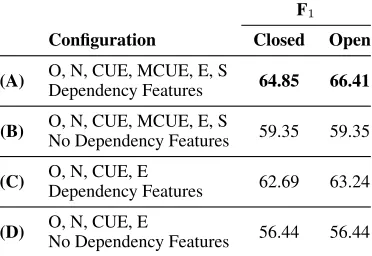
Table 4: Full negation results on CDD with gold cues.
This algorithm yields the correct annotations for the example in Figure 1; when applied to label se-quences originating from the gold scopes in CDD, the reported F1 is 95%. We note that this loss of in-formation could have been avoided by presenting the CRF with a version of a sentence for each negation cue. Then, when labeling new sentences, the model could be applied repeatedly (based on the number of cues provided by the cue detection system). How-ever, training with multiple instances of the same sentence could result in a dilution of the evidence needed for scope labeling; this remains to be inves-tigated in future work.
4 Development results
To investigate the effects of the augmented set of la-bels and that of dependency features comparatively, we present four different configurations of our sys-tem in Table 4, using F1 for the stricter score that counts perfect-match negation resolution for each negation cue. Comparing (B) and (D), we observe that explicitly encoding significant tokens with extra labels does improve the performance of the classi-fier. Comparing (A) to (B) and (C) to (B) shows the effect of the dependency features with and without the augmented set of labels. With (A) being our top performing system and (D) a kind of internal base-line, we observe that the combined effects of the la-bels and dependency features is beneficial, with a margin of about 8 and 10 percentage points for our closed and open track systems respectively.
Closed Open Prec Rec F1 Prec Rec F1
Scopes 100.00 70.24 82.52 100.00 66.67 80.00 Scope Tokens 94.69 82.16 87.98 90.64 81.36 85.75 Negated 82.47 72.07 76.92 83.65 77.68 80.55
[image:7.612.174.439.56.128.2]Full negation 100.00 47.98 64.85 100.00 49.71 66.41
Table 5: Results for scope resolution on CDD with gold cues.
trees converted to Stanford dependencies used in the closed track outperform the open system employing Maltparser on scopes, while for negated events the latter is over 5 percentage points better than the for-mer, as shown in Table 5.
4.1 Error analysis
We performed a manual error analysis of the scope resolution on the development data using gold cue information. Since our system does not deal specifi-cally with discontinuous scopes, and seeing that we are employing a sequence classifier with a fairly lo-cal window, we are not surprised to find that a sub-stantial portion of the errors are caused by discon-tinuous scopes. In fact, in our closed track system, these errors amount to 34% of the total number of errors. Discontinuous scopes, as in (3) below, ac-count for 9.3% of all scopes in CDD and the closed task system does not analyze any of these correctly, whereas the open system correctly analyzes one dis-continuous scope.
(3) I therefore spent the day at my club and did not
return to Baker Street until evening.
A similar analysis with respect to event detection on gold scope information indicated that errors are mostly due to either predictingan event for a non-factual context (false positive) or not predictingan event for afactualcontext (false negative), i.e., there are relatively few instances of predicting the wrong token for a factual context (which result in both a false negative and a false positive). This suggests that the CRF has learned what tokens should be la-beled as an event for a negation, but has not learned so well how to determine whether the negation is factual or non-factual. In this respect it may be that incorporating information from a separate and dedi-cated component for factuality detection — as in the system of Read et al. (2012) — could yield improve-ments for the CRF event model.
5 Held-out evaluation
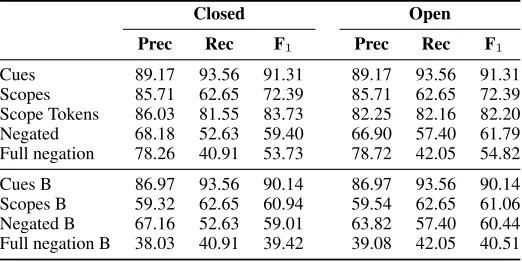
Final results on held-out data for both closed and open track submissions are reported in Table 6. For the final run, we trained our systems on CDTD. We observe a similar relative performance to our devel-opment results, with the open track system outper-forming the closed track one, albeit by a smaller margin than what we saw in development. We are also surprised to see that despite not addressing dis-continuous scopes directly, our system obtained the best score on scope resolution (according to the met-ric dubbed “Scopes (cue match)”).
6 Conclusions and future work
Closed Open Prec Rec F1 Prec Rec F1
Cues 89.17 93.56 91.31 89.17 93.56 91.31
Scopes 85.71 62.65 72.39 85.71 62.65 72.39 Scope Tokens 86.03 81.55 83.73 82.25 82.16 82.20 Negated 68.18 52.63 59.40 66.90 57.40 61.79 Full negation 78.26 40.91 53.73 78.72 42.05 54.82
[image:8.612.176.437.55.186.2]Cues B 86.97 93.56 90.14 86.97 93.56 90.14 Scopes B 59.32 62.65 60.94 59.54 62.65 61.06 Negated B 67.16 52.63 59.01 63.82 57.40 60.44 Full negation B 38.03 40.91 39.42 39.08 42.05 40.51
Table 6: End-to-end results on the held-out data.
the top-performers on the scope resolution sub-task across both tracks.
Due to time constraints we were not able to di-rectly address discontinuous scopes in our system. For future work we plan on looking for ways to tackle this problem by taking advantage of syntac-tic information, both in the classification and in the post-processing steps. We are also interested in de-veloping the CRF-internal label-set to include more informative labels. We also want to test the sys-tem design developed for this task on other corpora annotated for negation (or other related phenom-ena such as speculation), as well as perform extrin-sic evaluation of our system as a sub-component to other NLP tasks such as sentiment analysis or opin-ion mining. Lastly, we would like to try training separate classifiers for affixal and token-level cues, given that largely separate sets of features are effec-tive for the two cases.
Acknowledgements
We thank colleagues at the University of Oslo, and in particular Johan Benum Evensberget and Arne Skjærholt for fruitful discussions and suggestions. We also thank the anonymous reviewers for their helpful feedback.
References
Isaac G. Councill, Ryan McDonald, and Leonid Ve-likovich. 2010. What’s great and what’s not: Learn-ing to classify the scope of negation for improved sen-timent analysis. In Proceedings of the Workshop On Negation and Speculation in Natural Language Pro-cessing, pages 51–59.
Marie-Catherine de Marneffe, Bill MacCartney, and Christopher D. Manning. 2006. Generating typed de-pendency parses from phrase structure parses. In Pro-ceedings of the 5th International Conference on Lan-guage Resources and Evaluation.
Daniel Gildea and Daniel Jurafsky. 2002. Automatic la-beling of semantic roles. Computational Linguistic, 28(3):245–288.
Thomas Lavergne, Olivier Capp´e, and Franc¸ois Yvon. 2010. Practical very large scale CRFs. In Proceed-ings the 48th Annual Meeting of the Association for Computational Linguistics (ACL), pages 504–513. As-sociation for Computational Linguistics.
Roser Morante and Walter Daelemans. 2009. A met-alearning approach to processing the scope of nega-tion. In CoNLL ’09: Proceedings of the Thir-teenth Conference on Computational Natural Lan-guage Learning, pages 21–29. Association for Com-putational Linguistics.
Roser Morante and Walter Daelemans. 2012. ConanDoyle-neg: Annotation of negation in Conan Doyle stories. InProceedings of the Eighth Interna-tional Conference on Language Resources and Evalu-ation, Istanbul.
Roser Morante, Sarah Schrauwen, and Walter Daele-mans. 2011. Annotation of negation cues and their scope: Guidelines v1.0. Technical report, Univer-sity of Antwerp. CLIPS: Computational Linguistics & Psycholinguistics technical report series.
Joakim Nivre, Johan Hall, and Jens Nilsson. 2006. Malt-Parser: A data-driven parser-generator for dependency parsing. In Proceedings of the Fifth International Conference on Language Resources and Evaluation, pages 2216–2219.
Jonathon Read, Erik Velldal, Lilja Øvrelid, and Stephan Oepen. 2012. UiO1: Constituent-based
Erik Velldal, Lilja Øvrelid, Jonathon Read, and Stephan Oepen. 2012. Speculation and negation: Rules, rankers and the role of syntax. Computational Lin-guistics, 38(2).
Erik Velldal. 2011. Predicting speculation: A simple dis-ambiguation approach to hedge detection in biomedi-cal literature. Journal of Biomedical Semantics, 2(5). Veronika Vincze, Gy¨orgy Szarvas, Rich´ard Farkas,